Tag: Google

  • Disney+ Hotstar ropes in Google’s Sunil Rayan as president & head

    Disney+ Hotstar ropes in Google’s Sunil Rayan as president & head

    KOLKATA: The rebranded Disney+ Hotstar service gets a new head in India. As per reports, the streaming service has appointed Sunil Rayan as the new president and head. Rayan comes from Google where he was managing director for Google Cloud for Games. Former Hotstar CEO Ajit Mohan left the company in 2018.

    At Google, Rayan helped oversee product, engineering and business development strategies to help build Google Cloud for Games as managing director of the segment managing the mobile app promotion business team in 13 locations across the world. He left Google in April 2020. He also worked as associate principal at American management consulting firm McKinsey & Co.

    Rayan will be working closely with Walt Disney Company Asia Pacific president and Star and Disney India chairman Uday Shankar. As the new head, he will be leading a service which has seen major changes in content strategy, subscription model as as rebranding in last one and half year. Walt Disney's Disney+ was integrated into Hotstar in April 2020.

    “Five years ago, we set out to disrupt the way India consumed content and that mission has turned out to be totally revolutionary. Sunil is an exciting talent with global accomplishments and I am very excited to have him lead the talented Disney+ Hotstar team. At Disney+ Hotstar India, we are on a mission to create the country's largest and most advanced platform for curated content, and Sunil is just the right person to drive that ambition,” Shankar commented.

    Follow Tellychakkar for the consumer facing news & entertainment

  • Google’s new tool helps keep a tab on rising TV users

    Google’s new tool helps keep a tab on rising TV users

    MUMBAI: Google recently launched a series of tools in Display And Video 360. It comes as a sigh of relief for digital media buyers as it makes it easier for them to discover and secure ad inventory on high-quality streaming content. 

    According to data, Display and Video 360's connected TV available inventory surged by 75 per cent in April from the previous year.

    "This doesn't include YouTube and YouTube TV, which over 100 million people watch on their TV screens each month in the US. Even now, as stay-at-home restrictions are being lifted, connected TV usage remains well above pre-Covid2019 levels," Google said in a statement. 

    The platform had created a dedicated TV section in the maketplace specifically for publishers and inventory that let them reach TV audiences across devices.

    People can easily discover deals with available publisher inventory. 

    "Additional filter options let you search by geo or streaming device type to quickly find the right partner for your campaigns," informed Google.

    One can send request for proposals (RFP) to publishers directly from the dedicated space. 

    "We'll be rolling out this new interface throughout the next few weeks. In the future we will also be adding national linear TV broadcast and cable networks as well as local TV stations to this section in Marketplace," informed Google.

    The platform also mentioned that it is making YouTube Select's dedicated streaming TV lineup available to Display and Video 360 buyers in the US.

  • What next after the WFH honeymoon?

    What next after the WFH honeymoon?

    NEW DELHI: The ‘new normal’ might already have started setting in with major conglomerates of the world taking calls like allowing their employees to work from home ‘forever’. Recently, Twitter CEO Jack Dorsey announced in a company-wide email that while opening the offices will be the company’s call, to come back will be totally an employee’s choice.

    Several other tech companies, including the other two giants Facebook and Google, have told their employees to work from home till the end of this year. Closer home, e-learning platform Unacademy announced that 60 per cent of its workforce will be working from home permanently, even after the lockdown.

    This gives a clear picture of what the future of workplaces is going to be like, at least for the tech firms where most of the work can be managed over servers and clouds. Reacting to the same, brand-thinker and independent consultant Harish Bijoor noted: “WFH makes sense for every factor: economic, social, family, commute, cost, time, and common sense. Corporate society does not need to artificially divide home and work anymore. It makes great sense!”

    Brand-nomics managing director Viren Razdan said: “While Google has announced WFH beyond the lockdown, the truth is tech companies have thrived on the idea of WFH or rather WFA or Work From Anywhere. Amazon and Apple were born in home-garages, giving birth to the cult of ‘ideas behind napkins’, start-up buzz at cafes, the informality bred a new culture of play.”

    Sharing his thoughts on how the culture can be embedded in other industries, he added, “This IS perhaps the WFH honeymoon; we are all learning and encouraging, holding each other’s hand firmly through this phase. The real truths would unveil once we bring the practice into regular play.  The biggest challenge perhaps would be to disrupt our culture to allow this fluidity and freedom. Our models at work based on firm control, checks and balances in place. The buzzing office is symbolic of efficiency and business as usual. Companies would be pushed to make accountability a key factor, and shed the weight of authority. A lot of companies are moving to fast-forward to agile models of work, which are perhaps more conducive to adapt to these new systems.”

    Recently, in  a webinar hosted by the Advertising Club of Bangalore, BBH India CEO and managing partner Subhash Kamath and Wunderman Thompson South Asia group CEO and chairman Tarun Rai supported the idea of allowing flexibility to agency workforce to work from home, citing reasons like the fact that it will bring more gender-equality within the teams and liberate the talent from geography.

    However, they had also noted that to make this culture a reality, people will have to bring some behavioural changes in themselves and leave control that they like to have on subordinates, and also the firms will have to rework their appraisal policies.

    Agreeing to this, Samsika Marketing Consultants MD Jagdeep Kapoor said: “I had learnt this from grandmother and it stands relevant today that when everything closes there should be one thing that remains open, and that is your mind. I think any transition will be possible if people keep an open mind and accept changes.”

    He also vouched for the many benefits that working from home will come with. “I think working from home increases productivity, saves time, and allows teams across cities to work together for better deliverables. Personally, I have been working from a home office for more than a decade now and it has been great. I have this policy that I don’t visit client offices and meet them at my place. With remote working, now clients have eased out even more and we have those meetings over video calls now.”

  • Global video streaming market forecast to reach $184.3 billion by 2027

    Global video streaming market forecast to reach $184.3 billion by 2027

    MUMBAI: The global video streaming market size is expected to reach $184.3 billion by 2027, registering a CAGR of 20.4 per cent from 2020 to 2027. Rising technological advancements such as the implementation of block-chain technology in video streaming and the use of artificial intelligence (AI) to improve content quality are expected to boost market demand over the forecast period. Furthermore, growing adoption of cloud-based streaming solutions to increase the reach is directly influencing market growth. This trend is observed in numerous parts of North America and Asia Pacific. Factors behind the growth of these regional markets include rapid digitalization, increasing use of mobiles and tablets, and growing popularity of online viewing.

    Globally, the rising demand for on-demand video and extensive growth of online video are key drivers of the market. Moreover, increasing demand for high-speed internet connectivity acts as an advantage for the market. The growing acceptance of smartphones in combination with an extensive range of high-speed internet technologies such as 3G, 4G, and LTE has substantially led to the trend of online broadcasts. In addition, the growing demand for devices that can support digital media is helping consumers' access media content anywhere in the world.

    Key findings from the report:

    Increasing usage of videos in corporate training and in the education sector are anticipated to drive the market

    The over-the-top (OTT) segment held the largest revenue share and is also expected to grow at the fastest pace over the forecast period

    Asia Pacific is expected to witness significant growth over the forecast period, majorly due to increasing demand for high-speed internet connectivity and on-demand video streaming

    Key players in the video streaming market include Akamai Technologies, Amazon Web Services, Inc., Apple Inc., Cisco Systems, Inc., Google, Kaltura, Inc., Netflix, International Business Machine Corporation (IBM Cloud Video), Wowza Media Systems, LLC, AT&T Intellectual Property, and Hulu.

  • ViacomCBS and Google announce expanded distribution agreement

    ViacomCBS and Google announce expanded distribution agreement

    MUMBAI: ViacomCBS and Google have announced a comprehensive, multi-year distribution agreement to deliver more content from ViacomCBS’ leading portfolio of news, entertainment and sports networks for YouTube TV subscribers. In addition to featuring continued carriage of CBS broadcast stations, CBS Sports Network, Pop TV, Smithsonian Channel, and The CW, the expanded agreement introduces 14 ViacomCBS channels to the live TV and on-demand subscription service.

    BET, CMT, Comedy Central, MTV, Nickelodeon, Paramount Network, TV Land and VH1 will launch on YouTube TV this summer, providing more than two million subscribers with access to some of the most popular cable brands. BET Her, MTV2, Nick Jr., NickToons, TeenNick and MTV Classic will also launch on YouTube TV at a later date.

    The deal also includes a continued commitment to distribute ViacomCBS’ premium subscription services, including SHOWTIME, on YouTube TV, as well as an extended partnership on the broader YouTube platforms.

    “We are thrilled to have reached an expanded agreement with YouTube TV that recognizes the full power of our newly combined portfolio as ViacomCBS,” said Ray Hopkins, president, US Networks Distribution, ViacomCBS. “Google has been an excellent partner, and we look forward to bringing even more of our entertainment networks to YouTube TV subscribers for the first time.”

    "We're excited to launch ViacomCBS' portfolio on YouTube TV this summer, " said Lori Conkling, global head of partnerships at YouTube TV. "Our expanded partnership delivers on our promise to offer a premium portfolio of content to our YouTube TV subscribers, as well as across the YouTube platforms."

     YouTube TV is a subscription streaming service that lets you watch live and on-demand TV from 70+ top networks through a simple and award-winning experience. It offers live & local sports, news, shows, movies, and more, and can be watched on any screen (phone, tablet, TV, computer). Membership comes with free unlimited cloud DVR storage space to record all your favourites, personalized watch recommendations, and a family plan with 6 accounts per household so the whole family can enjoy.

    Financial terms of the agreement were not disclosed.

  • Synamedia joins Alliance for Open Media

    Synamedia joins Alliance for Open Media

    MUMBAI: The Alliance for Open Media (AOMedia) has announced that Synamedia, the world's largest independent video software provider, has joined at the promoter level.

    As a member of the Alliance, Synamedia will collaborate with AOMedia members, which include fellow leading internet and media technology companies, to advance open standards for media compression and delivery over the web. Synamedia's video network portfolio features video distribution, processing, and delivery services, and solutions to power premium quality broadcast and broadband video, create compelling live multi-screen experiences, enable software-defined video processing and unify operations.

    AOMedia members include industry leaders like Amazon, ARM, Cisco, Facebook, Google, Intel, Microsoft, Mozilla, Netflix, NVIDIA, Samsung Electronics, and Tencent.

    The availability of AOMedia Video Codec 1.0 (AV1), AOMedia's open-source, royalty-free video coding format is a significant milestone in the journey to deliver a next-generation video format. AV1 is interoperable, open, optimized for internet delivery and scalable to any modern device at any bandwidth. AV1 enables more screens to display the vivid images, deeper colours, brighter highlights, darker shadows, and other enhanced UHD imaging features that consumers and businesses have come to expect – all while using less data.

    "We're thrilled to join AOMedia. As customers make more intelligent use of virtualization and cloud, we see the adoption of AV1 as a way to further our own goals of enhancing online video streaming experiences for OTT at scale. We look forward to working alongside AOMedia members to open up new possibilities to use AV1 for royalty-free, cross-platform online video across a wide range of applications," said Julien Signes, senior vice president and general manager, video network at Synamedia.

    "We're excited to have Synamedia as our newest member, reflecting our joint commitment to increase the openness and interoperability of internet video," said Matt Frost, AOMedia vice president of communications and membership, and director at Google. "Synamedia brings to AOMedia a long history of live encoding and OTT delivery for major content distributors. We look forward to collaborating to improve the quality and availability of streaming video with AV1."

    Designed at the outset for hardware optimization, the AV1 specification, reference code, and bindings are available for toolmakers and developers to download here to begin designing AV1 into products. Specifically, the release of AV1 includes:

    Ø  Bitstream specification to enable the next generation of silicon

    Ø  Unoptimized, experimental software decoder and encoder to create and consume the bitstream

    Ø  Reference streams for product validation

    Ø  Binding specifications to allow content creation and streaming tools for user-generated and commercial video.

    Alliance for Open Media

    Launched in 2015, the Alliance for Open Media (AOMedia) was formed to define and develop media technologies to address marketplace demand for an open standard for video compression and delivery over the web. Board-level, Founding Members include Amazon, Apple, Arm, Cisco, Facebook, Google, Intel, Microsoft, Mozilla, Netflix, NVIDIA, Samsung Electronics, and Tencent. AOMedia's open-source, royalty-free, video codec AV1 is a significant milestone in the ability to deliver a next-generation video format that is interoperable, open, optimized for internet delivery and scalable to any modern device at any bandwidth.

  • Five Likee Features Every New Likeer Must Explore

    Five Likee Features Every New Likeer Must Explore

    Pioneering short video platform Likee, launched in 2017 by Singapore-based Bigo Technology Pte Ltd. is continuously marching ahead with its innovative feature offerings. A top short video platform, Likee has registered a high number of downloads in India as well as abroad amid the cut-throat competition in the sphere. A sprawling user base is proof of the increasing popularity of the platform. Easy navigation, swipe, and smooth browsing have been instrumental in Likee’s success. Likee enhances short video making experience with dramatic filters and interactive user-interface.

    While there are multiple reasons that make Likee one of the most preferred apps, here are five differentiating features that every new user must know.

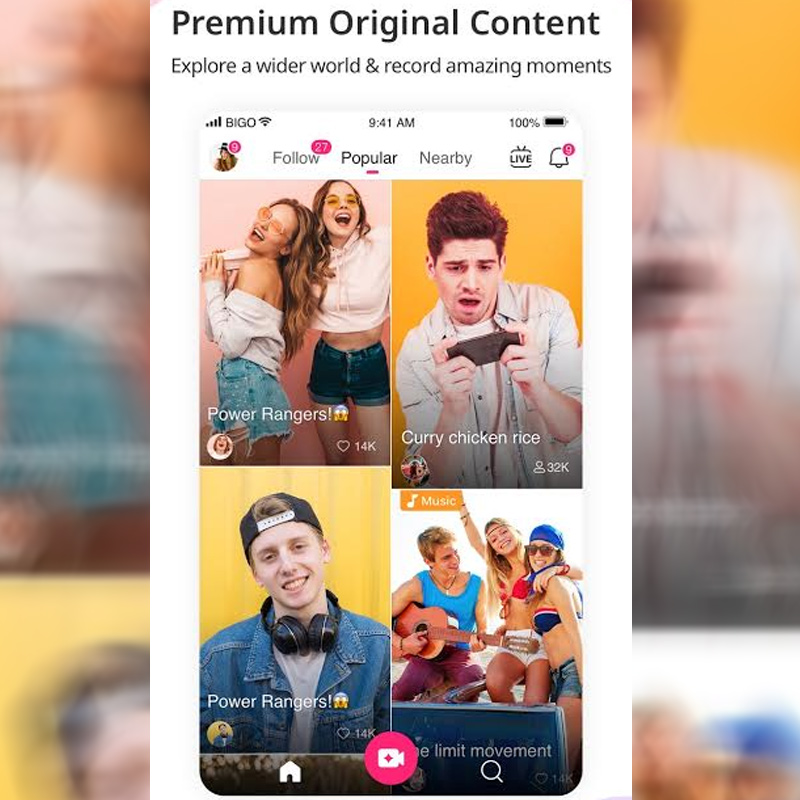
    Swipe to navigate: Anyone can easily use Likee with its helpful navigation. User can continue to swipe up for non-stop browsing of user videos. They can swipe right to directly open sections such as popular videos, Follow, nearby videos, live chat.

    Omnichannel login: One can create a Likee account by entering their existing credentials on Google, Facebook, and Instagram. The feature of Omnichannel login availability saves a lot of time and effort required to set up and manage a separate account. A Likee account can also be linked to other social media accounts easily.

    Language selection: Languages help in connecting like-minded people. A key characteristic of the Likee app is its availability in the local languages of India. Starting from 15 local Indian languages, Likee is available in international languages like Portuguese, Brazilian, Arabic, Indonesian and more.

    Nearby video: One of the unique features of the Likee app is its nearby video option. With this feature, users can view videos that are being created around their location. The nearby option lets users connect with fellow Likeers in close vicinity and get inspired by their talent.

    Hashtag searches: Hashtags have made browsing easy on every social media platform. Likee has made use of this feature to attract more and more user engagement while helping users consume niche content. The hashtag based videos get instantly popular on Likee, garnering millions of views and eventually going viral on other social media channels also.

    Millions of users are already enjoying the Likee experience, which enables them to showcase their talent and skills. Likee is also actively involved in promoting hashtags with several Bollywood inspired challenges. When the majority of online users end up falling in love with apps that make browsing easy, hassle-free and fun, Likee’s score in the category is praiseworthy. With interactive look and feel, amazing user interface design, ease of usage and productivity, Likee is effortlessly ruling the hearts of online app users. Existing features of Likee have been successfully inspiring millions to make videos, since the inception of the platform. On the other hand, the widening new user base on the platform is calling for the inclusion of more engaging features in the near future.

  • The future of AI and ML-driven platforms in the coming decade

    The future of AI and ML-driven platforms in the coming decade

    Whenever I talk about artificial intelligence (AI) and machine learning (ML), most people immediately think of Terminator or one of the many sci-fi movies that show super-intelligent machines trying to overpower the human race. But in reality, we use AI in our day-to-day lives more often than we think, because it has been adopted by the major platforms, such as Google, Facebook, Netflix, Amazon, Myntra, and Flipkart. When you scroll through Facebook and see videos and articles that pique your interest, when Netflix recommends The Witcher before you can mourn the end of Game of Thrones, or when Myntra lets you know that your outfit will be incomplete without a pair of matching shoes – all this is the work of AI and ML-driven solutions. So we can easily say that it is one of the most disruptive technologies in history that is helping companies enhance efficiencies and boost revenues. It is no wonder that as per PwC's recent report, AI's potential contribution to the global economy is slated to be $15.7 trillion by 2030!

    However, the industry is still evolving, and we are a far cry from creating systems that can contend with a creative, intelligent human brain. So, without any further ado let's take a look at a few trends that are going to shape the future of AI- and ML-driven platforms this decade.

    Smarter Search Functionality: With the rapid development of natural language processing (NLP), I am sure that search engines would gain a better understanding of our language using linguistics, semantics, and ML techniques. When you search via text or voice recognition using conversational language, technology will be able to respond to even the most complex queries. Search engines and ecommerce websites will display more relevant, contextual results, leading customers straight to the products they want, thereby increasing the chances of conversion.

    Working with Limited Data: One of the challenges AI developers and data scientists face is stringent data privacy laws. More than hundred countries have various data privacy laws in place, so it is complicated to make data both protected yet accessible. However, with time, the reasoning abilities and intelligence will improve, which means that we can work even with limited data. Unlike the data-hungry platforms of today, machines in future will learn to cope in cases of missing, unreliable or changing data.

    More Accurate Insights and Predictions: Deep learning capabilities coupled with advanced data analytics will help businesses derive more accurate insights into the minds and patterns of customers, as well as help predict and interpret behavior. Moreover, AI- and ML-led platforms will receive these actionable insights in real-time, enabling them to tweak their business strategy on the fly.

    Better Product Recommendations: Customers are expecting highly personalized shopping experiences, and AI and ML-driven platforms will evolve to fulfill the role of a live salesperson. So if you are shopping during Christmas, the platform will use past purchase history and current activity to recommend products, and it will also be able to adjust prices of high-demand items in real-time. Leading shopping search engines such as Google Shopping, Amazon DSP, and Taglr are already leveraging AI. For example, Taglr's easy-to-use digital advertising platform, ShopperAds – analyzes demographics, preferences, shopping patterns, and past purchases to recommend relevant products, thus cutting down on transaction time and customer acquisition costs. And as ML algorithms never stop learning, with every shopping experience, the recommendations will be more tailored and precise.

    Better Customer Support: Bot platforms will be able to offer 24/4 support via virtual agents and live chat and solve problems in a human-like fashion. Also, ML models will use the questions and answers generated to predict future conversations, thus facilitating interactions with customers. There will come a time when we wouldn't know whether we are chatting with a human or a bot!

    So, it is abundantly clear that in next 10 years AI and ML-led platforms will not only completely revolutionize the way businesses interact and engage with consumers, but also help businesses improve productivity, reduce costs, and save time.

    (The author is Taglr CEO. The views expressed are his own and Indiantelevision.com  may not subscribe to them.)

  • boAt ups the ante; becomes the 1st Indian brand to be showcased at both Google and Amazon booths at CES 2020

    boAt ups the ante; becomes the 1st Indian brand to be showcased at both Google and Amazon booths at CES 2020

    New Delhi: boAt Lifestyle, a brand recognized for its Audio electronic products becomes the 1st Indian brand to be showcased at both Google and Amazon booths at CES 2020. The home-grown brand unveiled its Rockerz 315 SVA smart wireless earphones with an inbuilt Google assistant at the event. In addition to this, the brand also showcased its recently launched Stone 200A, a smart speaker with inbuilt far-field Alexa capabilities like playing music, checking the news, weather forecasts, controlling smart home devices and accessing over 30,000 Alexa skills across genres.

    boAt Lifestyle is known for its intricate audio engineering, supreme comfort, exquisite designs and best in class audio quality products. It brings music to your daily routine in a seamless manner, with top-notch sound quality and a user experience like none other.

    Filled with excitement, Aman Gupta, Co-founder boAt Lifestyle says “We at boAt are proud to be the first-ever Indian electronic consumer brand to be showcased at the Google & Amazon booths at CES this year. Our partnership with Google and Amazon is a testament to our commitment to offering future-ready products. Understanding the needs of our boAtheads we have launched wireless earphones with inbuilt Google assistant and Alexa enabled speaker that will work conversationally, just how the millennial like their devices to be”.

    The brand is targeted to tech-savvy consumers, mostly millennial, looking for stylish and quality products that are affordable too. These two products show the boAt’s commitment towards offering smart products at an affordable price.

    boAt’s products on display at CES 2020 include

    CableboAt Rockerz 315 SVA at Google's booth: boAt Rockerz 315 SVA is the smart wireless neckband styled earphones with inbuilt Google assistant. Its unique 12 MM dynamic drivers, integrated controls, 9 hours of battery backup along with the ability to be operated with voice commands to set alarms, play music and make phone calls makes it designed just for the future.

    3boAt Stone 200A at Alexa's booth: Stone 200A is a smart speaker with inbuilt farfield Alexa capabilities like playing music, checking news, weather forecasts, controlling smart home devices and accessing over 30,000 Alexa skills across genres. Its unique features inclues- IPX 6 Water Resistant, making it the perfect poolside accessory. 1.96” x 1 Full Range Drivers with 5W Power Output brings the sound of a lifetime with HD Clarity that integrates into pure audio bliss. The Bluetooth V4.1 enhances wireless connectivity up to 10 meters. Stone 200A’s intricate audio engineering, supreme comfort, exquisite designs makes it portable and powerful. This speaker truly aligns with the vision to bring Alexa to customers wherever they are.

    boAt Stone 200A is the lowest priced Alexa built-in far field speaker on Amazon.in and is available at an introductory price of INR 1499. The product carry's a 1-year warranty and is available at Amazon.in

    Twitter- https://twitter.com/AmazonNews_IN
    Facebook- https://www.facebook.com/AmazonIndiaNews/
    Instagram- https://www.instagram.com/amazonnews_in/

  • India tops list in requesting TikTok for content restrictions, user info access

    India tops list in requesting TikTok for content restrictions, user info access

    MUMBAI: India has topped the list in making the highest number of legal and emergency requests to takedown specific content and to access user information, TikTok said in its first-ever Transparency Report for the first half of 2019 (1 January 2019 to 30 June 2019).

    A short-video sharing application in its report claimed that India made over 99 legal requests and eight emergency requests to TikTok, taking the total requests to 107. Followed by the United States of 79 requests, of which 68 are legal and eleven for emergency requests.

    ByteDance owned TikTok in its report said that at least 47 per cent of India’s requests have been complied with by the platform, whereas it has obliged to 86 per cent of requests made by the United States.  

    The chart of content restricts missed China’s name. “We did not receive any requests from countries other than those listed in the chart below,” the transparency report said.

    TikTok, the China-based application touts over 1.3 billion installs worldwide, has recently been banned by the United States army amid security concerns. Similarly, the platform, which has gained popularity in India, has also come under scrutiny over objectionable content.

    Meanwhile, TikTok it received over 3345 copyrighted content takedown notices from across the world, of which 85 per cent content was removed, the report said. “We honour valid take-down requests based on violations of copyright law, such as the Digital Millennium Copyright Act (DMCA).”

    Like TikTok, the social media giant Facebook, along with search-engine giant Google have also been coming out with transparency report in a timely manner that specifies takedown requests.