Tag: Goldmines Telefilms

  • Goldmines Telefilms names Joy Chakraborthy as CEO-broadcasting

    Goldmines Telefilms names Joy Chakraborthy as CEO-broadcasting

    Mumbai: Goldmines Telefilms has brought Joy Chakraborthy on board as CEO-broadcasting.

    With 27 years in the media industry, Chakraborthy is armed with experience in print, television, radio and digital businesses, with ad sales and revenue generation being core to his career.

    “We welcome Joy into the Goldmines family. He comes with vast experience across genres and media platforms in the country,” said Goldmines Telefilms director Manish Shah. “We look forward to working with him, making the most of his experience as our mega plans unfold.”

    Chakraborthy previously served as CEO of Enterr10 Media, TV Today Network, and Forbes India. Prior to that, he was Zee Group executive director, Times of India Group director, TV18 News Network president and Star TV executive vice president.

    “I am looking forward to working with Manish Shah. Having interacted with him over time, I can see his clarity, focus and drive towards the business goals. Manish’s vision and genre understanding as a promoter is a vital add-on,” said  Joy Chakraborthy. “Goldmines plans to introduce more channels and we will be talking about them as plans rollout. As I like to work on business challenges, I see my role at Goldmines as one such exciting challenge to take on.”

    Chakraborthy is an alumnus of the Harvard Business School and has graduated from National Defence Academy.

  • GUEST COLUMN: How D2C brands can level up their digital marketing game in 2022

    GUEST COLUMN: How D2C brands can level up their digital marketing game in 2022

    Mumbai: In today’s times, Direct-to-consumer is an extremely exciting space, primarily because there are so many interesting brands coming up in multiple industry verticals. Right from food to technology to health and many others, there are home-grown D2C brands making it big while raising investors’ money handsomely. And we are seeing some very interesting products and services rolled out for the end-users.

    Here are some focus areas on the top digital marketing activities that the D2C brands need to keep in mind when they want to market their products and services in 2022 –

    Advertising on Google, Facebook, and Instagram

    While this is something that most D2C brands are already doing to a very large extent, there is still a big gap in the way these campaigns are executed. Funnel wise break up of your ad campaigns on these platforms is going to be very crucial to be able to run profitable ad campaigns for your brand. In our experience of working with D2C startups, we have always advised having – remarketing campaigns right from the start, campaigns focused to maximise conversions, and using lookalikes as much as possible.

    Retention Marketing

    I primarily would like to talk about the usage of user engagement tools that help you retain. You want to focus on the lifetime value of your customers and while you do that the prime objective of your campaigns should be to use sophisticated tools like Webengage to bring the audience over and over again to your website and to have them purchase from you more than once in a year as per your product life-cycle.

    Conversion Rate Optimisation

    While D2C brands have spent quite some money in the acquisition game, the bleeding cost of sale has always been quite an important matter of discussion. In today’s time and age when the bottom line is super important from day zero, it becomes imperative that you focus on the conversion rate of the website as much as the number of conversions on your website. Reports which will help you understand where your users are dropping off and where you probably need to do a quick fix need to be generated regularly.

    Do not take an SEO any less seriously than earlier

    SEO is still one of the primary factors that will give you a long-term arbitrage on your cost per sale or cost of acquisition. This is primarily because when you are spending a lot of money in your acquisition campaigns using advertising models there is a very good chance that your organic growth will help you lower the overall cost for acquisition in your acquisition spree and help you remain sustainable in the long term. In our experience working with several D2C businesses, long-tail keywords with high intent and medium competition work best.

    Social Media Marketing

    Connecting with your customers is going to be much more important in 2022. With customers determining the persona of a brand depending on the kind of content they publish on their social media handles. If you want to be a cool brand you will have to have cool content on your social media channels for your customers to take interest and be connected to your brand in the long term. Start talking to your customers like a real person and not a suited-up brand.

    Similarly, the kind of influencers that your brand intends to associate with is going to matter a lot. The kind of content your influencers have been pushing is going to also affect the kind of personality you’re going to build for your brand in front of your customers. Personalisation, thought leadership, and focusing on building a strong brand image will separate you from the crowd.

    Being present omnichannel

    Being present omnichannel is going to be as important in 2022 as never before. This is primarily because of the kind of user behaviour that customers today have started from checking out a product online but probably going off-line and purchasing the product. You have to be in sight so that you are in the top of mind recall for your customers And hence being available at their favourite offline or local stores is going to impact your sales numbers more than ever.

    Creative Packaging

    Having great packaging for your products will be important. This is primarily because no matter how good or bad the eventual product is, the way it is packaged paints the first impression for the customer.

    (Deep Mehta is the co-founder of DigiChefs. The views expressed in this column are personal, and Indiantelevision.com may not subscribe to them.)

  • #Retrace2021: A look back at print ad campaigns that stood out in 2021

    #Retrace2021: A look back at print ad campaigns that stood out in 2021

    Mumbai: Reeling under the aftermath of the pandemic, the Indian print industry began its road to recovery in 2021. According to the latest Magna Global Forecasting Report released in December, overall, the print industry grew +12 per cent from a low base (2020: -40 per cent), despite the slowdown in business in 2021. Maximum growth came from Retail, Durables, Finance, Real Estate, and Government spending.

    After witnessing a tumultuous period of plummeting circulation, and advertising revenue, the industry also began pivoting fast to strengthen its digital presence. The projections paint a heathier picture, with 2022 growth expected to be broad-based, with most categories increasing spends and elections in a few large states helping to drive an increase of +14 per cent. However, a rise in cases of the new Covid variant could prove to be dampener.

    Nonetheless, Print remains one of the most trusted mediums to influence brand perceptions on critical factors like quality, price, and trust. This explains why 2021 saw the return of traditional, as well as newer brands, and advertisers to print to create some stand-out campaigns. As we begin 2022, we take a look back at some of these campaigns …

    TRUECALLER

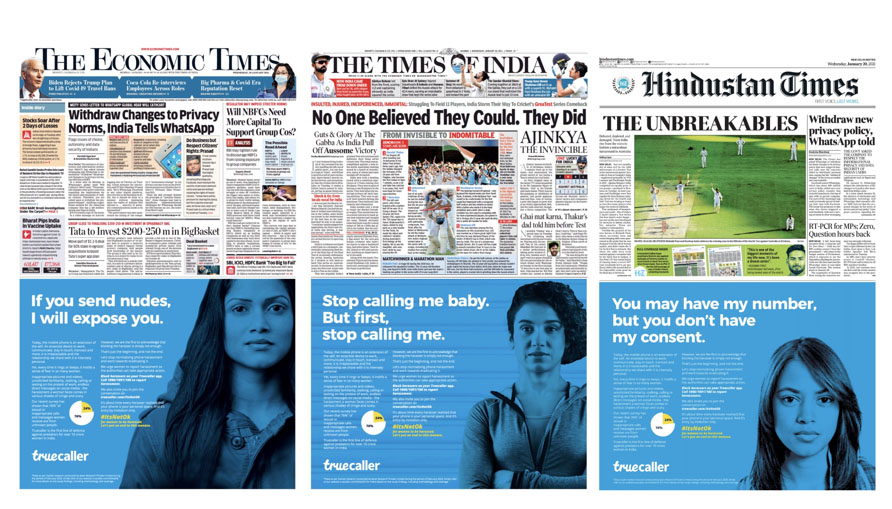
    While the businesses were beginning to reopen, the Truecaller print ad in January 2021 set the tone for the rest of the year. The in-your-face, unmissable ad carried by the app on the front pages of leading national dailies, talked about the issue of phone harassment women face. It mentioned how women could block these numbers on the app and should step forward and report these callers. The campaign #ItsNotOk has been running for four years now. But it caught everyone’s attention, courtesy of the latest print ads. Thinkstr, the Gurgaon-based independent agency for the campaign said they were “a little jittery about spending money on print” because they “knew the circulation was down”. But the print ads outdid itself “more than any other medium we’ve advertised on.” 

    NESTLE

    When in doubt, choosing ‘Print’ seems to be the mantra of marketers. Whenever there was a need to emphasise a brand’s credibility or build trust it was the go-to medium. Nestlé India’s print campaign launched in June 2021 did just that- reinforce the brand’s assurance of offering quality products, while talking about its long-standing legacy of 100 years and ‘family-like’ trust. The FMCG conglomerate switched to the damage control mode, coming out with the print ad campaign to rebuild consumers’ faith in the brand, only days after news reports questioning the ‘healthiness’ of the company’s products surfaced.

    FORTUNE

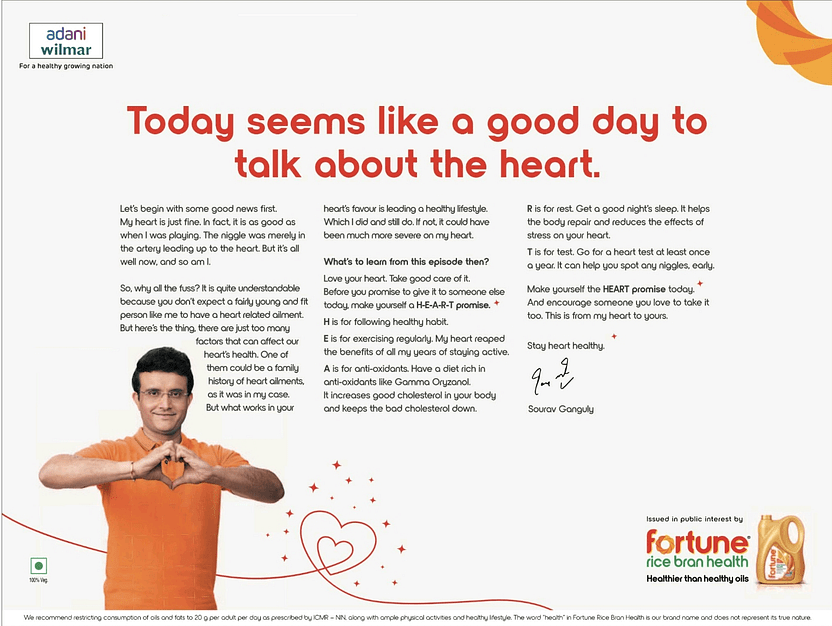
    A similar approach was followed by the Adani Wilmar Group’s Fortune oil brand. The brand’s claims of ‘a healthy oil for a healthy heart’ suffered a beating after Sourav Ganguly, the brand’s endorser, suffered a heart attack. Prior to this, he was seen in an ad for the brand’s Rice Bran oil which promotes the oil’s heart health benefits. Fortune faced severe trolling on social media as netizens chose to highlight the irony of the situation. To salvage the situation, the brand came out with front-page ads across leading publications with the caption ‘Today seems to be a good day to talk about the heart’, which had a fit-looking Ganguly dismissing the talk about his ill-health and tackling the subject of heart health head-on. The long format copy presented as a signed letter from the former cricketer himself, pushed heart health conversation to the fore, was the brand’s comeback after the stretch of online trolling.

    INDIAN OIL

    Nothing beats the traditional medium when you want to create an impactful awareness about a social cause. Indian Oil wanted to create awareness around the ill effects of excessive honking ahead of World Environment Day 2021 (5 June). It came out with a creative print campaign, conceptualised and executed by Mumbai-based agency, Grey Group that showed the life-threatening impact honking had on other living creatures. The artwork by Vaibhav Bhilare replaced the body parts of various animals with sound waves to depict the hazardous effect the loud noise had on them.

    MANFORCE

    That Print media allows a brand to tell its brand story effectively with no excessive drama is a known fact. To simply and effectively convey its message of protected sex and to educate people to use condoms as against ‘messy’ scenarios related to the consequences of indulging in unprotected sex, the Condom brand come up with a campaign, #DontMessAround. The series of tongue-in-cheek ads which appeared in leading newspapers creatively nudged people not to engage in unprotected intercourse as it can come with bigger problems such as STDs and unwanted pregnancy, even as it drove its brand message through.

    SEBAMED

    After the famed Cola ad wars, this year saw the battle of the soaps, with major soap brands taking on one another, directly targeting their rival brands in their ads. Sebamed kickstarted the creative sledge-fest at the outset of 2021, going after other popular brands like Lux, Santoor, and Dove, by comparing them to a detergent bar. The German skincare brand made quite a splash launching a series of print ads in leading dailies, with shocking claims alleging that each of these leading soaps had pH factors (ranging from 7 to 10) that rivaled that of the detergent soap Rin, to highlight the harshness of these skincare products, as against its own which it claimed stood at ‘an ideal 5.5’.

    The brand has launched another campaign ‘Conditions apply’ with print ads taking on other anti-hair loss shampoos. The campaign sought to discredit the ubiquitous disclaimer ‘Conditions apply’ used by these products while making tall claims. It has, however, refrained from naming any brand this time.

    DOVE

    The HUL brand of skincare, Dove chose to respond to Sebamed’s ‘pH’ allegations with a print campaign that reiterated its gentleness, falling back upon its familiar messaging –that the soap is mild and comprised of one fourth ‘moisturising milk’. The print ad seen in major newspapers Dove responded to the jabs that Sebamed’s ads have taken at it, coming hot on the heels of the Sebamed campaign. The ad copy in a prominent font stresses that ‘Dermatologists have put something strong in Dove’s bar – their trust’.

    The beauty soap launched another print campaign titled ‘Stop The Beauty Test’ that attempts to call out the stereotypes associated with Indian matchmaking and goes against unrealistic stereotypes of beauty in our society. Conceptualised by Ogilvy India, the campaign urges one to look at the beautiful aspects of a person’s personality and not their shortcomings. “Khoobiyan dekho, khaamiyan nahin” says the ad released across print and other media. The print ad, written in a long format, tackles in-depth how a girl is subjected to these beauty stereotypes and biases right from childhood, only getting worse as she becomes of marriageable age.

    And it is not just traditional categories that see the profit in the printed word. Newer advertiser categories like the edtech, crypto, and several digital-first brands are also opting for the mass medium, even going full-throttle with full pager, front-page displays in major dailies. For newer categories like crypto exchanges who are in their next phase of growth in India, it becomes even more crucial to target beyond the early adopters of this digital world by associating with traditional mediums like television and print, the study noted. Thus, making print a viable medium to build credibility and trust.

    COINSWITCH KUBER

    One such platform, which has been investing heavily in print is CoinSwitch Kuber. Building trust is key to the category as a lot of uncertainty and risk have been associated with cryptos in the past. The crypto brand came out with full front-page ads in leading newspapers in the last few days. “While digital media enables us to target a certain set of audiences, print has the accessibility to the most basic audience group which finds credibility in the print news,” said CoinSwitch Kuber chief business officer Sharan Nair explaining the brand’s decision to go aggressive on print advertising.

    UpGRAD

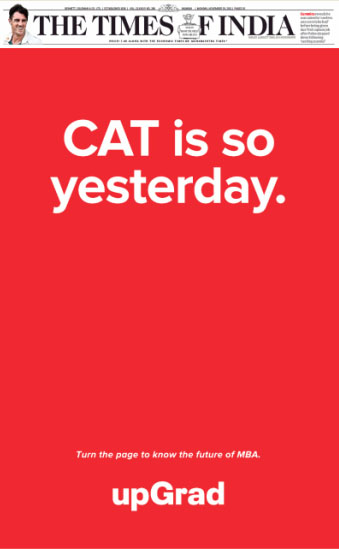
    With eye-catching full-page ads in leading dailies, edtech brand, upGrad launched the campaign for its online MBA programs to ‘fast-forward your career’ because ‘CAT is so yesterday’. The two-page managed to grab eyeballs for the brand with its effective use of empty spaces and an attention-grabbing caption.

    TINDER INDIA

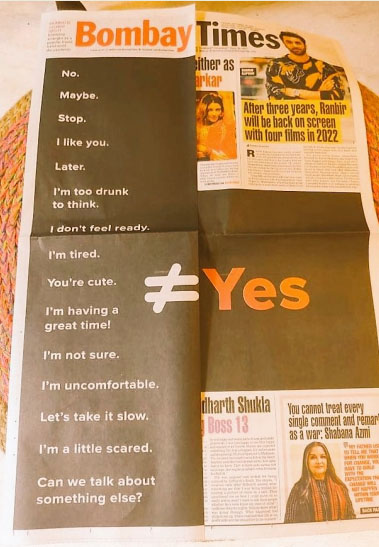
    In another resounding endorsement, a millennial and Gen Z brand like Tinder released a series of print ads, acknowledging that print still carries ‘trust and maturity’ which digital is yet to achieve. The new age dating app’s ad is indicative of how serious it is about educating its existing and potential users about consent, serving as a lesson on how many times we misinterpret our partner’s words to consider it a ‘Yes’. Tinder India’s front page Bombay Times ad is a primer on consent and what all doesn’t equate to a ‘Yes’. This ad is the latest installment from the dating app’s ongoing campaign around consent, emphasising that only a ‘Yes’ means a ‘Yes’. Nothing more, nothing less.

  • #Retrace2021: From Nykaa’s Falguni Nayar to dentsu veteran Ashish Bhasin, who all made news in 2021?

    #Retrace2021: From Nykaa’s Falguni Nayar to dentsu veteran Ashish Bhasin, who all made news in 2021?

    Mumbai: The year that began with the slowdown of pandemic cases, and phased opening of businesses across the country, is ending with another Covid variant rearing its head. The new cases of Omicron are spreading faster, even as the industry struggles to hold on to its post-pandemic revival after braving a deadly second wave in May early this year.

    Amid all these challenges, there were signs of resilience, that highlighted the advertising industry’s slow yet significant recovery this year. If 2020 was the year of ed-tech, 2021 only took the game a notch higher. E-commerce dominated headlines, and several D2C brands rose to success with their innovative advertising and marketing strategies. The year saw the largest number of startups joining the unicorn league, of which many of them are internet-based companies, including Flipkart, Nykaa, Zomato, and Paytm. The agencies too, adapted to the new normal, brainstorming newer ways to strengthen brand connect and retain audiences across media channels.

    With the curtains falling on this eventful, yet resilient year, we take a look at some of the biggest names that made headlines, and created a buzz in the world of brands, advertising, and marketing this year.

    1.      FALGUNI NAYAR, NYKAA FOUNDER

    An entrepreneur at 49 and a billionaire at 58, Nayar made waves with her company’s chartbuster initial public offering (IPO) in November. The ₹5,352-crore IPO of her FSN E-Commerce Ventures Ltd was oversubscribed nearly 82.5 times. On the same day, the company’s market capitalisation touched the ₹1 lakh crore mark, making Nayar who owns a 52.56 per cent stake in the company, India’s richest self-made woman billionaire. An investment banker, Nayar launched the beauty and fashion e-commerce platform Nykaa in March 2012 after quitting her job at Kotak Mahindra Capital. Today, Nykaa Fashion is a multi-brand platform with close to 1,500 brands—of which five are its own brands- two acquired and three it has built from scratch. Nykaa Beauty and Nykaa Fashion are separate businesses.

    Falguni Nayar: The billionaire founder of Nykaa who dared to dream at 50

    2.      BYJU RAVEENDRAN, BYJU’S FOUNDER-CEO

    Byju Raveendran-owned edtech, Byju’s has been on a dream run. The company, which saw its business grow rapidly during the pandemic, ramped up its user base and saw a swift growth in revenues. It also announced several deals around the world over, acquiring a number of its competitors, eight of which were this year. With this, Raveendran and his family have also expanded their fortunes, making them the 67th richest Indians, according to the IIFL Wealth Hurun India Rich List 2021. The home-grown edtech startup is now the 13th most valuable start-up in the world, as per CB Insights’ latest unicorn tracker. Currently valued at $21 billion, the Bengaluru-based start-up is also the world’s most valuable ed-tech start-up. It is also the only Indian name to feature in the list of the world’s elite unicorns as of December 2021. Recently, the ed-tech giant was in the news for its advanced discussions to go public through one of Churchill Capital’s special-purpose acquisition companies (SPAC). While an announcement could come as soon as January, the negotiations are not final. 

    3.      PARAG AGARWAL, TWITTER CEO

    2021 was also the year when Indians were taking over coveted leadership roles in the global forum. The first to mark his name was Indian-born Parag Agarwal, who was appointed as the CEO of the micro-blogging platform Twitter in November. An alumnus of IIT-Bombay, Agarwal had joined Twitter in 2011 and worked his way up the ladder to becoming the chief technology officer (CTO) by 2018 and was reportedly one of the ‘first choices’ of the company’s co-founder Jack Dorsey in the line of succession, after the latter announced his resignation. In a staunch endorsement of 37 years old Agrawal, Dorsey wrote: “He’s been my choice for some time, given how deeply he understands the company and its needs. Parag has been behind every critical decision that helped turn this company around… My trust in him as our CEO is bone-deep.” Before Twitter, Agrawal had briefly worked at Microsoft, AT&T, and Yahoo. He did his bachelor’s in engineering in computer science here, before moving to the US for further studies, his doctorate coming from Stanford University.   

    Jack Dorsey steps down, Parag Agarwal named as Twitter CEO

    4.      LEENA NAIR, CHANEL CEO

    In another proud moment for India, Maharashtra-born Leena Nair joined the list of Indian-origin CEOs of multinational brands in December. Her appointment as the CEO of the French luxury fashion house Chanel was unprecedented, given that Nair was a rank outsider with zilch experience in the fashion industry, not being a part of the Paris fashion scene.

    Before this, the 52-year-old had an illustrious career that spanned 30 years at Unilever, becoming the first female and youngest-ever chief human resources officer at the global company, in London- a position she resigned from to join the 111-year-old luxury group. Nair rose through the ranks of Unilever having started out as a management trainee. Under her watch Unilever achieved gender parity across global management. With the latest win, Nair is being hailed as a “serial glass-ceiling breaker”. An electronics and telecommunications engineer from Walchand College of Engineering in Sangli, Maharashtra, she did her MBA in Human Resources from XLRI Jamshedpur in 1992 before joining as a trainee at HUL.

    5.      PIYUSH PANDEY, OGILVY

    An advertising industry veteran with over three decades of experience in the industry, Pandey has donned several hats, representing Rajasthan in Ranji Trophy cricket during his younger days and being a tea taster are some of them before discovering advertising as a career choice. This year, the ad guru added one more feather to his cap when he took on the role of global creative chairman at WPP Plc. owned creative agency Ogilvy in May. He continues to serve as chairman of Ogilvy India helping brands understand their consumers.

    6.      ANITA NAYYAR, PATANJALI AYURVED COO-MEDIA & COMMUNICATIONS

    The year 2021 saw life turning 360 degrees and completing a full circle for former Havas media India boss Anita Nayyar in the advertising and media industry, as she joined Patanjali Ayurved as COO- Media & Communications in July, after a brief stint with Zee5 from May 2020 to March 2021. An industry veteran, Nayyar had an eventful two years, with transitions circumscribing the client-side from the agency side, before settling finally on the brand side, having managed many portfolios of brands across sectors in a career spanning three decades.

    #Retrace2021: Cautious optimism will drive industry growth in 2022

    The year also saw some of the country’s biggest agencies undergo senior-most level executive shuffles and the arrivals and departures of some of advertising’s top talents. In recent months, dentsu India network parted ways with many of its key leaders in an exodus that began in January. The exits were announced as part of its restructuring process to usher in the dentsu India 2.0 vision. The rejig, brings together its creative agencies under one umbrella, including Dentsu Webchutney, Taproot Dentsu, WATConsult, Perfect Relations, Isobar, Dentsu One, Dentsu India, and Dentsu Impact. The high-level exits from its India leadership team included veterans like Santosh Padhi, Shamsuddin Jasani, Vivek Bhargava, Rubeena Singh, Haresh Nayak, Gopa Menon, and the India CFO turned CEO Anand Bhadkamkar. After almost five years of being the CEO at the digital-first media agency iProspect, Rubeena Singh started new innings as the country manager at the short-video app Josh in October.

    7.      ASHISH BHASIN, DENTSU

    Ashish Bhasin -stepped down as dentsu International- CEO APAC & chairman India in November. An industry veteran with over 30 years’ experience, Bhasin had joined Aegis Media in June 2008 and was tasked with launching the business in the market. He was promoted to CEO, Dentsu Asia Pacific in September 2019. Earlier this year, Bhasin had resigned from the board of directors and Audit Committee of Broadcast Audience Research Council (BARC India) sparking the retirement rumours.

    Ashish Bhasin steps down as dentsu International CEO APAC & chairman India

    8.      SANTOSH PADHI AND AGNELLO DIAS, TAPROOT DENTSU


    The news about Padhi’s sudden exit from the agency he founded with Agnello Dias in 2009 shocked everyone in the industry. Padhi ended his historic innings with Taproot dentsu in September. An art graduate from Mumbai, Padhi began his career with DDB Mudra. He then moved on to Leo Burnett, where he was an executive creative director and later became the national head of art.

    Earlier in June, Taproot made some leadership level rejigs and announced that Agnello Dias (Aggie) will move on to a role as a consultant for key brands, but he too put in his papers around this time. Dias began his advertising career in 1989 and after working with many local and international agencies, including Dart, Interpublicity, Lowe and Leo Burnett, he joined JWT India in 2005, where he soon became the chief creative officer. It was in 2009 when the art and copy duo Padhi and Aggie, decided to together launch their independent creative boutique Taproot India — a bold independent setup. Over the last 12 years, Taproot dentsu rose to become one of India’s most prominent creative agencies, notching up several accolades along the way.

    9.      AJAY GEHLAUT, DENTSU CREATIVE

    Industry veteran Ajay Gahlaut joined dentsu Creative as group CCO in the midst of Dentsu India’s transformation journey towards dentsu India 2.0 and Ajay’s joining is a critical part of the plan, the agency said. Gahlaut, with over 27 years of experience in advertising, was with Publicis Worldwide, India, as chief creative officer and managing director till June 2020. He wrote the line ‘Do Boond Zindagi Ki’ that anchored the famous Pulse Polio Immunisation campaign with Amitabh Bachchan and the ‘Make It Large’ tagline for the whiskey brand Royal Stag. He was also the man behind the ‘Men will be men’ series of campaigns for whiskey brand Imperial Blue and the creator of the character ‘Mr. Murthy’ for Voltas air conditioners.

    10. SHAMSUDDIN JASANI, WUNDERMAN THOMPSON

    As Wunderman Thompson chairman and Group CEO South Asia Tarun Rai moved into a new role as executive director Strategic Initiatives, APAC, Jasani was roped in to take on the mantle. Before this, he was with Isobar as Group MD South Asia. Jasani is a veteran of the industry, having launched Isobar in India in 2008, growing it from a two-person team to over 300-strong across South Asia.

    Isobar’s Shamsuddin Jasani joins Wunderman Thompson South Asia as CEO

    11. PRITI MURTHY, GROUPM

    Priti joined GroupM India as president, GroupM Services India this October, which the network described as a ‘homecoming’ for her and strengthening of the GroupM India leadership team. As an industry veteran, Murthy has spent a large part of her 22+ year career with GroupM. Her last held role with GroupM was as the chief strategy officer at Maxus Global.

    Priti Murthy joins GroupM as president, GroupM services India

    12. ANISHA IYER, OMD India CEO

    Iyer was elevated to OMD India chief executive officer in December. With nearly 18 years of experience in the advertising business and a niche in digital and technology, she joined OMD, a subsidiary of the group, in 2019 as the managing director for Malaysia. Her previous stints include working in companies such as Mindshare, Madhouse, and GroupM in a career spanning two decades.

    13. ANUPRIYA ACHARYA, PUBLICIS GROUPE 

    Anupriya Acharya, a veteran in the media and advertising world, was re-elected as president of the Advertising Agencies Association of India (AAAI) for the year 2021-22 in September this year. Hailing from Dehradun, Acharya has worked with Ogilvy & Mather, McCann (then McCann Erickson), media agency Mindshare Fulcrum and The Media Edge in her 20 plus career. She has also remained the Group CEO of Zenith Optimedia (part of the Publicis Groupe), where she was elevated to lead the India business of Publicis Media in 2016 with a 900-plus strong team.

    14. SWATI BHATTACHARYA, FCB INDIA

    This year also saw the FCB Group India announce the restructuring of its creative agencies and a new three agency structure – FCB Ulka, FCB Interface and FCB India. FCB India, the newest agency in the fold, which’s led by Swati Bhattacharya as the creative chairperson, announced its newly elevated C-Suite leadership team. A noted industry professional, Bhattacharya has been the only woman CCO in India when she joined FCB Ulka in 2016. The brains behind award-winning campaigns like Sindoor Khela for the Times of India, Horlicks, Maggi sauces and noodles, Close up, Airtel, Kit Kat, 7Up, Pepsi, Pizza, UNICEF, Sunrise and Slice are some of her other note-worthy works.

    15. RAMESH NARAYAN, CANCO ADVERTISING

    Canco Advertising founder and Indian advertising doyen Ramesh Narayan was inducted into the prestigious Asian Federation of Advertising Associations (AFAA) Hall of Fame at the AdAsia conference held at Macao in December. “The AFAA Hall of Fame sets out to recognise those who’ve defined a generation of advertising, those who we look up to, who inspire us, and who have done what few others have ever done or could ever do; for those who have pioneered- the very few we can call legends,” said outgoing AFAA chairman, Raymond So about Narayan’s inclusion in the prestigious hall of fame. Earlier this year Narayan also released his book titled “A Different Route to Success”, which gives readers a ringside view of his professional life, having retired at the age of 50, after running Canco Advertising, an advertising agency he founded and ran for 24 years.

    Ramesh Narayan inducted into AFAA Hall of Fame

    16.  ARJUN MOHAN, upGrad CEO

    upGrad CEO ArjunMohan is an experienced industry professional having worked across sales, marketing, and product development domains for more than 15 years, before helming upGrad. One of the most creative edtechs in the country, when it comes to utilising marketing channels to amp up its reach, Mohan helped script a remarkable success story backed on innovative services and out-of-box marketing activities. The upGrad CEO is on a high this year with education going digital-first due to the compulsions brought about by the pandemic.

    17.  VINEETA SINGH, SUGAR COSMETICS CEO

    Singh famously gave up a crore-rupee job offer from an investment bank while she was still in her twenties because she wanted to dive into entrepreneurship. Sugar Cosmetics, a digital-first brand, is her third start-up—the first two did not take off but the second startup, Fab Bag, a subscription business that offered women an assortment of beauty products every month for a small fee- gave her enough data and insights to kickstart her third one. Unlike most digital-first brands, Sugar was early to develop an omnichannel presence and her mantra to make cosmetics for Indian skin tones and suited to the Indian environment paid off. In 2020-21, the D2C firm achieved Rs 130 crore in revenue, and raised $21 million (Rs 160 crore) in venture funding, bringing its valuation to Rs 750 crore.

    From the verge of closing shop, Sugar Cosmetics delivers 49x returns to investors

    18. GHAZAL ALAGH, MAMAEARTH CO-FOUNDER

    Baby and mother care brand Mamaearth turned unicorn after raising close to $80 million in a new round at unicorn valuation led by Sequoia. One among the few startups to turn unicorns with a woman co-founder, the five-year-old D2C brand took birth after Ghazal Alagh and her husband, Varun became parents. In 2016, the couple launched the brand under the parent company Honasa Consumer Pvt Ltd, in Gurugram using natural, plant-based or manmade ingredients, which are both certified safe as well as effective.  In just four years, Mamaearth became Asia’s first brand to get the MadeSafe certification for its toxin-free products. The company recently acquired a female-centric content platform, Momspresso, and associated influencer-engagement platform, Momspresso MyMoney to further accelerate engagement with consumers and strengthen content-to-commerce.

    19. ANIL KAPOOR, AD VETERAN

    Finally, taking a stock of all that we lost this year, there are some losses which cannot be restored ever in any manner whatsoever- and that’s the lives of people lost. This year saw the demise of many eminent names and talents of the industry, many of whom were lost to the Coronavirus.

    FCBUlka chairman emeritus Anil Kapoor passes away

    One such name is that of DraftFCB+ Ulka’s late chairman emeritus Anil Kapoor, who passed away after a prolonged battle with cancer, in April this year. His passing marked the end of an era in the advertising industry. Kapoor joined a struggling Ulka in 1988 and scripted one of the greatest turnaround stories in advertising. He was given charge of the situation to stop the exodus of clients and is credited with bringing in a fresh set of talent, including from institutions like the IIMs. Clients who had left returned and he built a leadership team that stuck together for decades. Kapoor’s career in the ad industry extended to over three decades, and under his guidance, Ulka group emerged among the top five advertising agencies of India. He was conferred with the Lifetime Achievement Award by the AAAI in 2013. His death leaves a huge void in the realm of India’s advertising industry.

    In memoriam: Anil ‘Billy’ Kapoor
  • India’s M&E industry to reach $55-70 bn by 2030: CII – BCG Big Picture 2021 Report

    India’s M&E industry to reach $55-70 bn by 2030: CII – BCG Big Picture 2021 Report

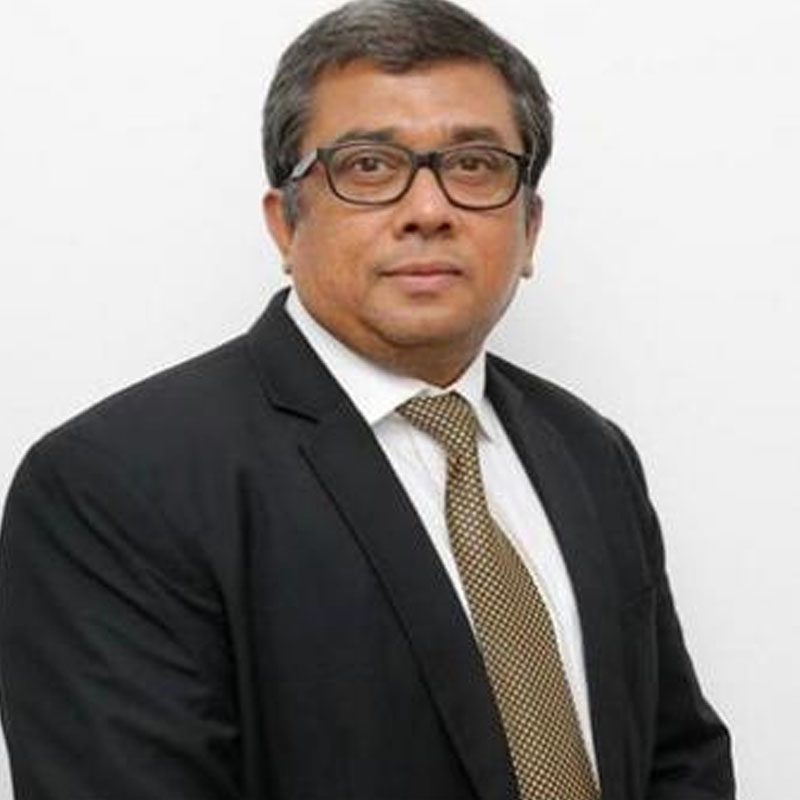
    Mumbai: Currently valued at around $27 bn, India’s media and entertainment industry is all set to grow at 10-12 per cent CAGR to become a $55-70Bn industry by 2030, the Confederation of Indian Industry (CII) and Boston Consulting Group (BCG) have projected in their new report, released on Thursday.

    Ending the year on an optimistic note, the report highlighted how the industry has already revived to pre-Covid levels and its next phase of growth will be led by OTT, gaming, VFX and animation.

    “Our industry has always been at the forefront of disruption and we will continue to innovate over the next decade. We will now need new answers and will need them fast, even on the most fundamental things like talent pool to run our companies and methodology for measuring the impact we are delivering to advertisers on our platforms. We will need to continue to embrace change going forward,” said CII National Committee on M&E – chairman and The Walt Disney Company India and Star India president K Madhavan.

    Robust growth for TV

    According to the report – ‘Blockbuster Script for the New Decade: Way Forward for Indian Media and Entertainment Industry’, TV as a medium is expected to remain robust given its function as a platform for family viewing, strong user base, and the evolution of content to meet everyone’s needs. Unlike global markets, India’s TV penetration has remained flat and ARPUs have also been steady, with both trends expected to continue in the medium term. Subscriptions will be driven by the strong performance of regional channels and cost advantage vis-à-vis OTT. Cord cutting is nascent and is expected to be limited in the medium term. TV ad volumes have bounced back to pre-Covid levels, and are expected to continue growing in the future, driven by an increase in advertising on regional channels & growth in new advertisers.

    OTT sector in the scaling stage

    The Indian OTT segment is currently in scaling stage with strong subscription growth and increased investments in premium & original content, stated the report. More affordable data has led to an increase in internet access and digital payments, thereby improving access to OTT platforms and digital videos. The industry is one of the most competitive amongst emerging markets with 40+ players representing all types of content providers. SVOD revenue has seen a remarkable surge over last few years and is expected to overtake AVOD in the coming years.

    “The share of traditional media is slowly declining with increased digital adoption but there is still high headroom for penetration with only 54 per cent of Indian households having a pay TV connection compared to more than 70 per cent in China. For many households, TV continues to be the center of the home and a significant part of family time,” said BCG India MD and partner Mandeep Kohli.

    Film industry’s road to recovery

    According to the report, the film industry has shown encouraging signs of recovery post a difficult 2020. There are a few growth factors for the future – continued growth in regional, direct to digital releases and the rise of “content films” and others. The Indian Postproduction, VFX and Animation industry accounts for <10 per cent share of the global market and has the potential to be a booming sector this decade on the back of several Central and State Government initiatives.

    “After a long period of shutdown, cinema halls are now back in business with a bang. A record number of big-ticket movies are lined up for release well into 2022. That augurs well for the sector but caps on occupancies, closures of cinemas and modified audience behaviour might impact the speed of recovery,” said CII National Committee on M&E co-chairman and founder & MD Roy Kapur Films Siddharth Roy Kapur. “On the other hand, streaming has provided new avenues for screening and broad-based the options available for producers, artistes and technicians. Along with the rise of regional cinema, this marks the start of a truly fantastic decade ahead for the Indian content business.”

    Way ahead for the industry

    According to Technicolor India country head Biren Ghose, who is also CII National Committee on Media and Entertainment vice chairman, the success of India’s media and entertainment will ultimately depend on the ability to scale world-class creative talent in order to capitalise on the global opportunity, especially in the gaming sector.

    The projections showed that the industry is at a critical juncture of transformation, offering rapid growth in some areas. “But, to realise this growth, companies must tweak their strategies to take advantage of the current market situation,” said BCG India MD and senior partner Kanchan Samtani. “In addition to investing in content and technology to improve user experience, companies should also leverage suitable distribution models to enhance reach, focus on providing integrated ad solutions and offer innovative marketing formats to enhance the value proposition to advertisers.”

    “This year’s report put together by BCG with the help of CII Media and Entertainment Committee, looks at the decade ahead, and will help businesses chart their growth path and aide the government in framing enabling measures to facilitate further expansion of the sector,” said CII director-general Chandrajit Banerjee.

  • #Retrace2021: The long road to recovery for the travel sector

    #Retrace2021: The long road to recovery for the travel sector

    Mumbai: ‘Tis the Season! To be jolly and ring in the holidays. Except that it is not.

    Just when it seemed like life was returning to normal, the spread of the omicron variant has once again put a question mark over the travel plans. The new restrictions being announced across states and countries have dashed hopes of a cheery festive season for many, including the travel sector that had just begun its road to recovery in 2021.

    “The year ushered in significant opportunities for the brand to leverage, but it remained challenging nonetheless,” summed up Thomas Cook president and group head, marketing, service quality, value-added services, and innovation Abraham Alapatt. “A big win for us is that it gave us the ability to rapidly accelerate our digital journey – to build scale and create a contactless journey through digital means for both our B2C and B2B customers.”

    The company worked on its conversation and brand messaging which underwent a major shift from price to safety-first and ease of travel.  Digital became the new normal, as companies experimented with online tools – self-service apps, AI-enabled chatbots, build-your-own holiday platforms for personalisation, and CRM connectivity across business lines to its leisure and corporate travelers. “We decided to educate customers on the most credible and updated travel restrictions and guidelines and become the first point of contact for our customers. We organised virtual events to showcase travel experiences in the new normal in Europe, Dubai, and the Maldives to encourage customers to travel,” he elaborated.

    From launching a series of campaigns to building consumer confidence, travel companies and hotels also invested in strengthening customer safety. There was continued emphasis on vaccinated hotel staff, drivers & co-travellers, offering facilities of flexible rescheduling and cancellation when required and travel insurance that covers Covid related quarantine and/or hospitalisation, with some even going the extra mile by offering 24×7 doctor-on-call and contactless Covid-negative certification services with doorstep delivery.

    Continued to pump money into advertising

    The year saw the travel-booking platforms pumping money into advertising across all media channels, and leveraging social media. There was a significant shift from print to digital/social media which was not only used to inspire travel, but more importantly to spread positive news on travel and thereby build customer confidence. Online travel brand Goibibo rolled out its campaign ‘Apna Rule Toh Full Vasool’, announcing ‘Daily Steal Deals’ for hotels and last-minute flight bookings on its platform. While, My Trip roped in the hit-duo of Ranveer Singh and Alia Bhatt for its campaign ‘JoHogaWOWHoga’ to encourage travellers to plan, book and travel once again without any worries arising out of cancellation or hassle of refund claims.

    Club Mahindra, the flagship brand of Mahindra Holidays & Resorts India also reached out to travel enthusiasts through its ‘Jaana Kahaan Hai’ campaign starring the ‘Shershah’ actor, Siddharth Malhotra. The campaign captured people’s desire to travel and explore new destinations and indulge in newer adventures in the new normal.

    “Our 2021 visibility is almost back to the pre-pandemic levels while our share of voice in print has almost doubled to that of pre-Covid levels,” said Thomas Cook president. 

    2021: The year of domestic tourism

    As most foreign destinations remained out of reach due to restrictions, 2021 emerged as the year for domestic tourism. There was a growing appetite for non-standard elements and a rising trend for deeper exploration of smaller yet undiscovered locales and a pronounced shift from micro-cations to in-depth stays. The trend also shifted from emergency travel to leisure travel, according to industry experts.

    “India’s growing appetite for outdoor and adventure is fuelled by the desire to get away from crowds,” said Alapatt sharing insights on the changing consumer behavior. “We are seeing a strong uptick for our camping, hiking, trekking, and biking trips; jungle and safari experiences too. Our biking trips are in high demand – equally from millennials as India’s C-suite, with routes across rugged yet spectacular terrain from Kashmir, Leh-Ladakh, Rajasthan, Sikkim to South India’s Madikeri, Yercaud, etc. and the option of riding your own bike or hiring a premium Ducati, Harley Davidson or equivalent.”

    According to Cleartrip chief business officer Prahlad Krishnamurti, there was at least 25 per cent improvement over 2020. “We have approximately doubled our user base from August to December which corresponds to a 30 per cent increase in conversion rates. There was a sharp recovery at almost 70-80 per cent pre covid levels in H2 2021. This recovery was stronger than what we saw post first wave in 2020,” he added.

    Apart from the metros commanding the usual high share, the leisure destinations preferred during the festive season during the second half of 2021 were Goa, Jaipur, Bhubaneswar, Chandigarh, Guwahati, and Srinagar- making up for nearly 15 per cent of the market share on the ClearTrip portal- with Goa and Rajasthan having the lion’s share in hotel bookings.

    “However, there was and still exists a lot of anxiety and uncertainty around travel due to the pandemic,” said Krishnamurti. But he remains optimistic about the prospects for next year. “ClearTrip spent 2021 ramping up and investing in building our flight and hotel products, with the goal of making travel simple for customers. We are looking to gain larger mindshare with our customers and expect this to translate into a sizable market share.”

    High hopes for 2022

    Despite the challenges, the industry remains hopeful that the pent-up demand for travel could drive rapid growth in travel ad-spend over the next few years, but it will no doubt, be a long road back to pre-pandemic spending.  According to Zenith’s latest Travel adspend forecast released in November, the fastest growth in travel advertising is expected to come from India, but it will take until 2023 for the travel ad spend to be 31 per cent above the 2019 baseline.

    Looking ahead at 2022, sustainable tourism could become a very important factor as travellers become environment-conscious.  According to industry experts, the post-pandemic travellers are going to be characterised by discerning, detail-driven, and discovery-oriented – seeing more value in depth of experience rather than whistle-stop ‘photo-op’ travel. Travellers will continue to depend on technological advancement to ensure reduced physical contact, even as safety and hygiene will remain the top most important factors in their 2022 travel decisions.

    So, here’s looking forward to a stronger and safer 2022.

  • FreshToHome kicks off Christmas celebrations with special feast

    FreshToHome kicks off Christmas celebrations with special feast

    Mumbai: Kick-starting the Christmas celebrations, FreshToHome, a fully-integrated online brand in fresh fish and meat e-commerce has launched its ‘Merry Feastmas’ campaign extending the festive warmth to consumers.

    The brand has introduced specially re-created traditional Christmas dishes from noted chefs for its discerning consumers. The resultant spread uses the freshest meat and seafood with real spices and ingredients to give authentic Christmas dishes.

    The newly launched range includes herb roast chicken – a fragrantly spiced whole chicken, prawn gambas – a Spanish styled juicy prawns in a melange of olives, sun-dried tomatoes, and roasted garlic, lamb meatballs – the traditional Swedish meatballs in a tangy gravy, smoked chicken breast – the traditional Christmas meal must have, in addition to other dishes, said the brand in a statement.

    Conceptualised and executed by the Creative Agency Action & Co, the films aim to make consumers reach out and order these sumptuous dishes online.

    The films showcase the beauty of products in action, filmed in slow motion as they leisurely get cooked. The crackle and swell of a sumptuous whole chicken getting roasted, the flip of the stuffed chicken onto the pan, the glorious curl of the prawns as they cook, the melting butter on the reef cod as it sizzles- all make for glorious visuals which wow and warm the heart and belly.

    “During the holiday season, consumers are open to try new dishes and love a great spread on their table. Since European and Continental dishes are difficult to find, we launched our special ‘Merry Featmas’ range which has popular Christmas specials from around the world and consumers can really go forth and conveniently feast to their heart’s content,” said FreshToHome co-founder Shan Kadavil. “We intend to add to the festive cheer and provide our customers with an authentic and chemical-free spread of delicacies that they wouldn’t have otherwise been able to source.”

    The campaign has multi-pronged execution which includes digital films, social activation, and contests. 

  • Sumit Vyas goes on an epic rant in Wakefit.co’s new campaign

    Sumit Vyas goes on an epic rant in Wakefit.co’s new campaign

    Mumbai: “Yeh Covid na…2020 ghar mein, aur 2021 darr mein!”

    From uncertainty about going back to work to worrying about a new variant of Covid-19 that might wreak havoc, 2021 has been a challenging year for everyone. And, this is exactly what Wakefit.co- the D2C home, and sleep solutions company is highlighting in its latest campaign- ‘The Honest Office-goer’s Rant’.

    The new campaign video features Sumeet Vyas as the protagonist, who encapsulates the emotional turbulence people have been going through in the past year, in a light-hearted manner. As several months passed and people transformed their homes into office-like environments, the relationship and the bond with homes and home furnishings have increased. ‘The Honest Office-goer’ Rant’ (which follows the viral Bartan Dho Liye video that was introduced as part of the Open Letters campaign by Wakefit.co) highlights how the new normal and WFH has fostered a close relationship between people and their homes.

    Wakefit.co head of brand Prateek Malpani said, “In the last two years, people have reoriented their way of living between the four walls of their homes. While doing so many people have naturally channelled their energies into livening up their surroundings, leading to an increasing interest in the home furniture segment. Through quirky and witty initiatives like these, we try and echo each other’s sentiments, while also addressing the importance of investing in their homes.”

    Spring Marketing Capital partner-branded content Sandeep Balan said, “The campaigns we collaborate with Wakefit.co on always have a dash of wit and humor, to go with the core brand messages. The Honest Office-goer’s rant is another out-of-the-box attempt to showcase the pulse of the average Indian citizen and build brand resonance”

    In 2020, when the first wave of Covid-19 broke out, Wakefit.co launched the Open Letters Campaign which attempted to evoke a sense of empathy and assure people that we are in this together, as a community, and will come out of it stronger, if we stand together. The videos were hosted on Wakefit.co’s branded content channel, Home Time. 

  • HUL top advertiser in week 50: Barc

    HUL top advertiser in week 50: Barc

    Mumbai: Hindustan Lever (HUL) has emerged as the top advertiser in week 50 (11 December to 17 December) in the recently released weekly Barc data. The FMCG giant delivered ad volumes of 3466.83 (‘000s), slightly less than last week’s 3975.65. Reckitt Benckiser (India) was second with 3439.56 (‘000s). At 1100.13 Ponds India finished third.

    The top three firms were followed by Cadbury’s India, Godrej Consumer Products, and Marico. Facebook Inc – the only digital brand in the FMCG-dominated list which was at the tenth position last week was at number seven in week 50. The remaining three spots were grabbed by Brooke Bond Lipton India Glaxo SmithKline and Procter & Gamble.

    Harpic Power Plus 10X Max Clean led the brands’ list with ad volumes of 593.78. Lizol and Ultratech Cement jumped to the second and third slots from their last week’s positions at number four and five respectively.

    They were followed by Dettol Antiseptic Liquid, Harpic Bathroom Cleaner, Instagram Reels (No.10 in week 49), Clinic Plus Shampoo, Veet Men Hair Removal Cream, and Dettol Disinfectant Spray. The consistent top-performer Horlicks finished last this week.

  • GUEST COLUMN: Digital marketing trends that reigned supreme in 2021

    GUEST COLUMN: Digital marketing trends that reigned supreme in 2021

    Mumbai: 2021 was coined as the year of the ‘New Normal’ and it did turn out to be one in many ways. The second wave of the Covid-19 pandemic this year not only affected every aspect of our lives but also impacted how companies further realigned their operations all over the world.

    Strengthening the migration to a digital environment in 2020 became the only viable option to stay on the map for many businesses, which in turn greatly impacted their digital marketing strategies. 

    The ‘New Normal’ kept alive the status of digital marketing as the need of the hour for businesses to stay afloat, gain new customers, retain current ones and generate revenue. Staying ahead of the digital marketing game is beyond just understanding and applying basic industry principles.

    As we bid goodbye to 2021, it’s time to analyse trends that reigned supreme. By analysing past trends and staying aware of ongoing changes, marketers in India will be better prepared for what’s next for the coming year.

    Marketing automation:

    Automation stood at the top of every marketer’s strategic pyramid this year and played a pivotal role in providing brands with more detailed insights into behavioral patterns of their users. Our research estimates that some brands even saw a 30-35 per cent increase in leads generated after implementing automation software. With each channel working together, brands were able to create a unified customer experience, thereby facilitating a seamless journey.

    AI-powered personalised marketing strategies:

    As per industry research, 70 per cent of companies observed that AI-powered personalised marketing strategies generated around 200 per cent ROI while 86 per cent of brands noticed a spike in business after integration. Thanks to AI, marketers were able to make product recommendations to users, hyper-personalisation of messages, optimisation of display and search ads, email marketing, and even content marketing by discovering what works better and what type of content is more effective. All in all, it empowered brands to have a better engagement with their customers and gave a boost to customer loyalty and retention.

    Live streaming

    The number of live streaming platforms and streamers has increased mainly since the onset of the pandemic in late 2019. With the use of live streaming this year, consumers got yet another opportunity to acquire better information about brands, products & discover the character of brands. Thanks to real-time interaction, Live streaming emerged as a strong medium for brands to create a better relationship with their consumers and expand the viewership for their marquee events and new launches.

    Continuous visibility on different live streams enabled brands to experience better engagements. The community of live streamers is just starting to get bigger and live streaming will continue to play an exceptional role in 2022 as well. 

    Vernacular content

    According to a Google KPMG report, 70 per cent of Indians find local language digital content more reliable; 88 per cent of Indian language internet users are more likely to respond to a digital advertisement in their local language as compared to English.

    We saw digital marketing moving towards vernacular in a holistic way. Brands actively began transcending into literacy agnostic content across formats – audio and video to target consumers across the spectrum. For example, if you look at the latest brand video for Baidyanath Chyawanprash, the entire communication is primarily in Hindi as North India is their target location. Even the media banners and communication on the social media handles follow the same route. In this year, there have been multiple examples of brands like Britannia Good Day (Tamil), Ola Autovin Home Delivery (Tamil), Goodknight Fabric Roll-On (in Bengali), Sunfeast YiPPee (in Malayalam) which were some of the most viewed YouTube Ads in the regional language.

    Nano influencers and creators

    Nano influencers were one of the core facets of all major ongoing campaigns and helped in providing brands with valuable awareness and recall amongst a niche audience. They often see the highest percentage of engagement, as they have a small and more closely linked community of followers. According to the INCA report, the average engagement rate of nano-influencers in India is 30 per cent, while for micro-influencers it is 14.5 per cent. For mega and macro, it stands at 18.2 per cent and 12.7 per cent, respectively. We observed major brands dedicating about 20–25 per cent of their brand promotion budget to influencer marketing and primarily focus on nano-influencers that can reach their target group.

    Voice Search

    emerged as a new market for marketers. According to research estimates, 65 per cent of smart speaker owners don’t want to go back to a life without a voice-controlled assistant. Smart speakers will continue to change the ways users interact and spend.

    Tech will continue to take the lead in the new year with robust advancements in technology, marketing tools, and forward-thinking strategies. 2022 will be the year to further seize opportunities, take charge from the front and take necessary steps to leverage customer behavioural trends to get the maximum out of digital marketing.

    (Shreyansh Bhandari is COO and co-founder at Lyxel & Flamingo, while Shikha Abrol is a media strategist at the same company. The views expressed in the column are personal, and Indiantelevision.com may not subscribe to them.)