Tag: Gogo

  • Bajaj Auto accelerates electric mobility with GoGo three-wheeler launch

    Bajaj Auto accelerates electric mobility with GoGo three-wheeler launch

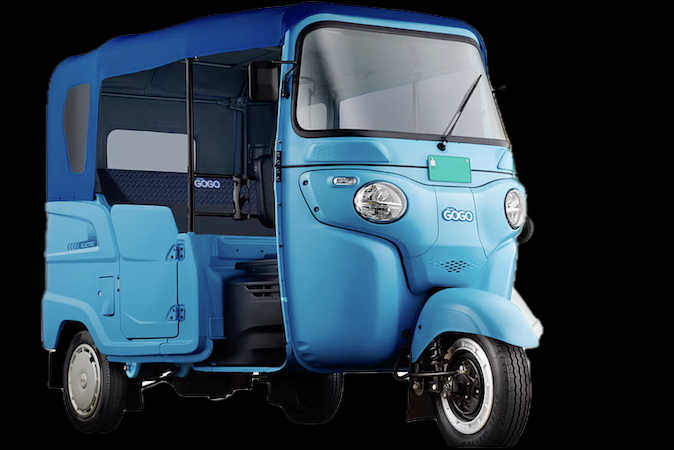
     MUMBAI: Bajaj Auto Ltd, arguably the world’s most valuable two-wheeler and three-wheeler company, has unveiled Bajaj GoGo, a comprehensive new range of electric three-wheelers set to transform urban mobility with industry-leading performance and technology.

    The new vehicles, which promise an impressive range of up to 251 kilometres on a single charge—the longest in the segment—represent Bajaj’s strategic expansion in the rapidly growing electric three-wheeler market, where the company has already established itself as one of the top two players within just one year of entry.
    “The electric three-wheeler segment in India has been growing at a staggering 30 per cent  CAGR for the past three years, and this growth is expected to continue,” said Bajaj Auto’s Intra City Business Unit president Samardeep Subandh. “With the launch of Bajaj GoGo, we’re blending our 75-year legacy of trust with cutting-edge technology tailored specifically for three-wheelers.”

    The Bajaj GoGo range features three passenger variants—P5009, P5012, and P7012—with the nomenclature indicating passenger vehicles of different sizes (50 and 70) and battery capacities (9kWh and 12kWh). The entry-level P5009 is priced at Rs 3,26,797, while the premium P7012 variant retails at Rs 3,83,004 (ex-showroom Delhi).

    What sets the GoGo range apart is its pioneering two-speed automated transmission system—an industry first that significantly improves range efficiency and gradient performance on challenging road conditions. The vehicles also feature groundbreaking safety innovations including auto hazard detection and anti-roll technology, making them the first electric three-wheelers to offer these as standard features.

    “The all-electric Bajaj GoGo range will provide a comprehensive solution to customers looking to maximise earnings and minimise the hassle of downtime and maintenance,” added Subandh. “The next time you need a ride, hail a Bajaj GoGo!”

    The GoGo brand name draws inspiration from the colloquial term used globally for three-wheelers, reflecting Bajaj Auto’s understanding of the deep cultural connection drivers share with their vehicles. With its full-metal body construction and aesthetic design, the GoGo range aims to appeal to both individual owners and fleet operators.

    Industry analysts note that the impressive 251-kilometre range addresses a critical pain point in the electric three-wheeler segment—range anxiety—which has historically been a barrier to adoption. The five-year battery warranty further reinforces Bajaj’s confidence in the product’s reliability and longevity.

    The company also offers a Premium TecPac with advanced features including remote immobilisation and reverse assist for customers seeking enhanced functionality. According to Bajaj Auto, cargo variants of the GoGo will be introduced in the coming months, expanding the brand’s footprint in the commercial delivery segment.

    Bajaj Auto’s push into the electric three-wheeler segment comes at a time when India’s urban centres are increasingly prioritising sustainable mobility solutions. The GoGo range not only promises environmental benefits but also aims to deliver compelling economics for owners, with significantly reduced operating costs compared to conventional fuel-powered alternatives.

    The company’s extensive dealership network across India will support the nationwide rollout, with bookings now open at all Bajaj Auto dealerships. This robust infrastructure is expected to provide GoGo with a competitive advantage in terms of service support and spare parts availability.

  • SES 15 launches successfully on 18 May

    MUMBAI: SES announced that the SES-15 satellite was successfully launched onboard a Soyuz rocket from the Guiana Space Center in Kourou, French Guiana at 08:54 local time. This is SES’s first satellite to launch on a Soyuz rocket for a geostationary transfer orbit mission.

    SES-15 carries a hybrid payload, comprising Ku-band wide beams and Ku-band High Throughput Satellite (HTS) capability, with connectivity to gateways in Ka-band. SES’s first hybrid satellite will be located at the orbital position of 129 degrees West and is equipped with 16 Ku-band transponders (36 MHz equivalent) as well as HTS capabilities to serve North America, Mexico, Central America and the Caribbean.

    SES-15’s high throughput payload will deliver optimised and flexible coverage for major global inflight connectivity and entertainment (IFC/IFE) service providers, such as Global Eagle Entertainment, Gogo and Panasonic Avionics. In addition, SES-15 has a dedicated wide beam that is designed to enable IFC/IFE providers to deliver live TV content on all flight routes across the US, including Hawaii and Alaska, as well as Canada, the Caribbean and Mexico. This unique combination of beams allows IFC/IFE providers to optimise HTS capacity use for internet traffic and wide beam coverage for broadcast content.

    The satellite will also enable VSAT networks and other traffic intensive data applications in the government and maritime sectors.

    SES-15 will also carry a Wide Area Augmentation System (WAAS) hosted payload, which will enable the US Federal Aviation Administration (FAA) to augment the Global Positioning Systems (GPS) with the goal of improving accuracy, integrity and availability of the system for the aviation industry.

    The satellite is equipped with an electric propulsion system for orbit-raising and in-orbit maneuvers.

    “The successful launch of SES-15 is the first of our three planned hybrid satellites, which have both wide beams and high throughput capability. SES-15, along with the soon-to-be launched SES-14 hybrid satellite, and our existing in-orbit satellites, offer the most resilient aeronautical connectivity platform in North America,” said Martin Halliwell, Chief Technology Officer at SES. “SES-15 will allow us to strengthen our ability to provide next generation services in data-intensive markets such as maritime and corporate broadband.”

    “SES is a long-standing partner, and we are delighted to be part of its important journey in serving the ever-growing aeronautical and data markets by successfully launching SES-15 on a Soyuz rocket,” said Stephane Israël, Chief Executive Officer at Arianespace.

  • Gogo signs capacity deal with SES

    Gogo signs capacity deal with SES

    MUMBAI: Gogo, a leader in in-flight connectivity, has signed major capacity deal with global satellite operator SES to deliver Gogo broadband services aboard commercial airliners.

    Coverage includes commercial aircraft flying over the North Atlantic Ocean Region, Europe and the United States.

    As part of the long-term deal covering more than six transponders of Ku-band capacity, three SES satellites will enable Gogo to expand its broadband offering in the sky to aircraft flying busy transatlantic routes.

    The SES-1 spacecraft will cover the continental US, while NSS-703 and its three powerful spot beams will reach across the North Atlantic and SES-4 will serve Europe.

    Gogo services aboard the NSS-703 satellite and will be transitioned seamlessly by mid 2014 to the new SES-6 satellite, slated for launch next year.

    Gogo has also contracted for teleport services delivered through three SES facilities in the U.S. and Europe. Two-way internet access will be delivered to Gogo customers via SES ground facilities in Woodbine, Maryland; Manassas, Virginia and Betzdorf, Luxembourg.

    “Gogo is entering the all-important international air travel market and expanding our North American offering with SES,” said Gogo President and CEO Michael Small. “A trio of SES satellites will enable Gogo to provide reliable and seamless satellite coverage for our current airline partners on their international fleets,” he added.

    Gogo is set to initiate its international internet services on Delta Air Lines in the first quarter of 2013.