Tag: Gijsbert Pols

  • Adjust launches connected TV measurement solution ‘CTV AdVision’

    Adjust launches connected TV measurement solution ‘CTV AdVision’

    Mumbai: Adjust has launched a connected TV (CTV) measurement solution called CTV AdVision.

    “As marketers increasingly leverage this growing channel as part of their overall marketing strategy, many grapple with measurement challenges, including fragmentation, complexity and expense, that are preventing them from taking advantage of CTV advertising to reach a massive engaged viewership,” said the statement.

    As per a report by Interactive Advertising Bureau, advertising spend on CTV is projected to surpass $21 billion in 2022. The IAB reports indicates that 18 per cent of total ad spend on video including CTV, social, short-form video and traditional linear TV is currently allocated to CTV.

    “Marketers have struggled to turn CTV into a performance channel because, until now, they didn’t have the data to do so,” said Adjust director of connected TV and new channels Gijsbert Pols. “What sets CTV AdVision apart is that it offers brands of all sizes the ability to analyze the assisting power of CTV on performance and reveals the extent to which CTV is helping other channels to convert and improve ROI.”

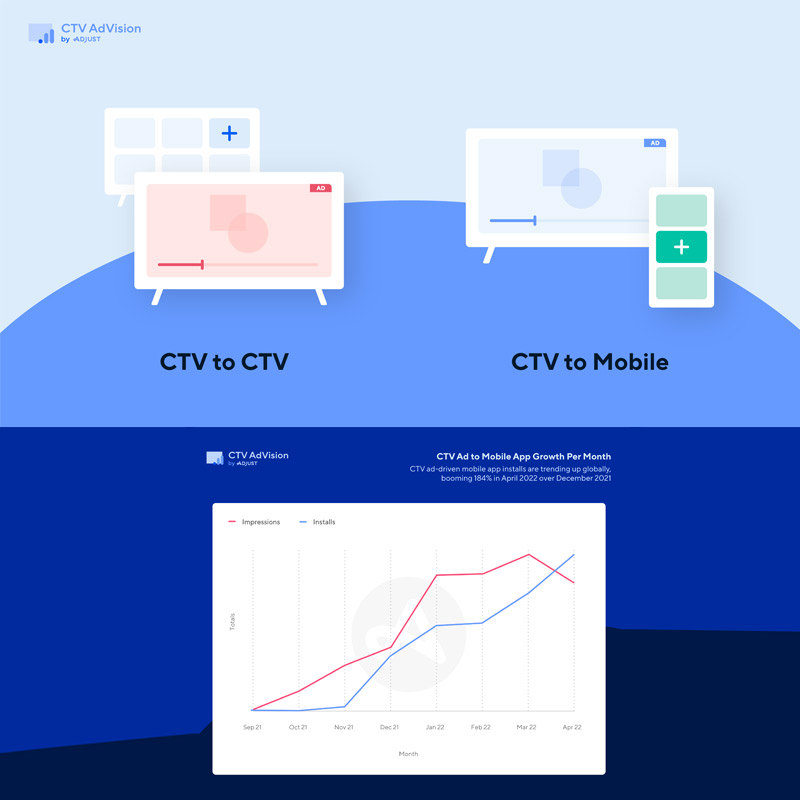
    CTV AdVision combines Adjust’s connected TV measurement offerings including CTV to Mobile and CTV to CTV with a dedicated CTV dashboard in Datascape. Marketers will be able to see how their CTV campaigns are performing overall, as well as the impact of CTV campaigns on their apps with metrics and KPIs, such as installs, revenue and RoI. Additionally, in the Datascape Overview dashboard and report building tool, marketers can gain a holistic view of their user acquisition and retention strategies to see CTV performance in context of other channels.

    The measurement solution will empower marketers to measure CTV campaign influence on mobile apps, analyse the assisting value of CTV campaigns on other campaigns, such as search and social, including the presence of CTV in customer journeys, measure the impact of advertising campaigns for apps functioning on CTV devices, create and track QR codes optimised for CTV In the dashboard and customize the attribution logic to fit the specific needs of the CTV ecosystem.

    “As CTV becomes a more prominent channel in advertising, we know marketers need to be able to prove ROI on their CTV campaigns,” said Adjust chief product officer Katie Madding. “We built CTV AdVision to empower marketers and advertisers with a unified attribution method, with reliable data and visualizations on CTV performance, that allows for consistent and independent measurement.”

    Adjust has partner integrations with leaders in the CTV ecosystem from platform providers like Samsung to intermediaries such as The Trade Desk and tvScientific.

    Clients including Plarium and PeopleFun are already using CTV AdVision to overcome the challenges of advertising on CTV.

    “With Adjust’s CTV AdVision, we’ve been able to achieve heightened visibility into the performance of our CTV efforts to optimize our campaigns,” said Plarium team lead Shlomi Laufer. “Previously, we had to make choices for our CTV marketing without the data to support or guide our decisions. With CTV AdVision, we’re able to easily and confidently purchase CTV ads.”

    “By using Adjust’s CTV AdVision, our growth team can view PeopleFun’s connected TV marketing strategy within the context of its greater digital marketing efforts,” said PeopleFun CEO Carol Miu. “We can now rely on one measurement solution, Adjust, when we promote our hit puzzle game Wordscapes on CTV. Before, we had to synthesize different measurement solutions from each CTV provider.”

  • Connected TV: A growing market in India

    Connected TV: A growing market in India

    Mumbai: Connected TV has an audience base of 45 million in India, according to Madison Advertising Report 2022.

    The segment contributes eight to ten per cent of the digital audience currently. In the last five years, it has grown nine times and is expected to grow by another four times to reach an audience base of 120 million by 2025. It is expected that connected TV audience base contribution will surge by 15 per cent in future.

    The audience base of CTV is growing mostly due to the increase in demand for smart TVs. In 2021, CTV shipments accounted for 84 per cent of overall TV shipments as compared to 64 per cent in 2020.

    These data points were presented by Madison World’s general manager Chinmay Chandratre who moderated a panel discussion at Indiantelevision Dot Com’s four-day event ‘Content-Tech, Ad-Tech, Mar-Tech and More (CAMM) Summit’ co-powered by Pubmatic and Industry Partner Adjust held on Tuesday.

    The discussion was joined by legacy and new-age brand marketers, media planners and technology providers such as Adjust lead product strategist Gijsbert Pols; Starcom chief operations officer Niti Kumar; ITC Limited chief operating officer – dairy and beverages Sanjay Singhal; HomeLane chief marketing officer Udit Mediratta and Pubmatic’s regional vice president (OTT and CTV) Vijay Anand Kunduri.

    Watch the full session.

    The discussion kicked off by understanding how a legacy brand like ITC looked at the opportunity of CTV. “Typically, the way you build huge categories like biscuits and snacks is through mass advertising,” explained ITC’s Sanjay Singhal.

    “As consumer tastes have evolved, we have found that there is a need to slice and dice consumer segments whose needs cannot be met by traditional products and communication on mass media platforms. There is a need for targeting cohorts of consumers that TV cannot do efficiently,” said Singhal.

    “There is only so much that may be communicated in a 30-seconder ad on TV,” he added.

    Singhal, “When there is a need to explain certain benefits of products to the consumer, a more engaging medium with a higher frequency build-up is required.”

    No doubt ITC is a large spender on TV but a large proportion of ad spends are moving to new age mediums for their brands that are targeting younger audiences, alluded Singhal.

    He added, “It’s not just our brands such as ‘Bingo’ and ‘Yippee’ which are youth-oriented that are moving towards digital but also our atta brand ‘Ashirvaad’. That’s the power of high frequency.”

    While legacy brands are leveraging a mix of traditional TV and CTV, new-age brands such as HomeLane are comfortable advertising only on digital and CTV platforms.

    As Udit Mediratta puts it, “As a digital-first brand, our target audience is largely millennials who are ‘cord-cutters’ and hence CTV is the new TV for us. There are inherent strengths in CTV whose visuals and formats are similar to traditional TV while at the same time it is also targeted and measurable. The only disadvantage at this point is scale because there are only 20 million CTV households. However, this base is expected to increase by four times in the next three to four years.”

    From a media planning perspective, CTV allows brands to reach incremental audiences, states Starcom’s Niti Kumar. “When you look at CTV and what it brings to the table, it is the largeness of TV in terms of screen size and format coupled with the biggest advantage of digital i.e., targeting/precision. CTV should be included in media plans based on two criteria – where’s the consumer and the brands’ business outcomes.”

    “In terms of inventory that is available and targeting, CTV in India is still in its nascent stage as compared to what a YouTube or Disney+ Hotstar can provide. There’s a lot of development that is needed in the technology but it can be layered onto media plans from an incremental reach perspective,” she adds.

    The rise of CTV also implies that publishers must be more conscious of hygiene factors while displaying an ad that negatively impacts the user experience. “What we’ve seen is a movement from the small screen to the big screen,” observed Pubmatic’s Vijay Anand Kunduri.

    “In most of the Indian market, digital penetration is largely due to mobile but in the last 24 months, we’ve seen the transition from ‘me’ to ‘we’ viewing largely in front of CTV. On the broadcaster side, the trend where the content was first being created for linear and then streamed on OTT as catch-up has reversed. Now, content is being streamed on OTT-first followed by linear telecast,” Kunduri added.

    “Parallel to CTV there’s also the emergence of free ad-supported TV (FAST) or advertising video-on-demand (AVOD) and publishers must take into account that when their ad is playing on CTV it should not face technical issues such as buffering, back-to-back ad reels and showing competitor product ads consecutively as this creates a bad user experience,” he added.

    Adjusts’ Gijsbert Pols mentioned that in terms of measurability, CTV measurement on digital platforms is just like Facebook and YouTube, however, there is an important caveat that marketers and planners must be aware of.

    He said, “Across the world, performance marketers are entering the TV space via CTV because it has become measurable. I don’t think we are far away from a fully digitalised way of measuring performance and branding as the technology and data are there. The problem is implementation which is a tough cookie to crack.”

    “While you can measure CTV in the same way you measure other digital channels, it does require you to adjust key performance indicators (KPIs). CTV is more upper-funnel as there are no clicks. For the last decade, digital marketers have been used to measure digital looking at last touch data, however, CTV requires you to adopt a multi-touch approach when it comes to measurement,” he concluded.