Tag: Germany

  • Razorfish Germany bolsters creative muscle with ECD from TBWA

    Razorfish Germany bolsters creative muscle with ECD from TBWA

    MUMBAI: Razorfish Germany has appointed Preethi Mariappan as executive creative director. Her appointment further strengthens the creative department of 50 people across two offices located in Frankfurt and Berlin. One of Preethi’s most notable pieces of work is the Red Tomato Pizza Fridge Magnet, which picked up four Cannes Lions in 2012. Additionally she has received global recognition at One Show, Sabre, Dubai Lynx and Effies.


    Preethi’s appointment is effective immediately. She brings to the role an industry wide reputation and award-winning expertise across multiple sectors. Preethi will partner with all Razorfish clients helping navigate the unknown, drive change and enabling business transformation.


    Sascha Martini, CEO Razorfish Germany commented: “To be able to attract such amazing talent demonstrates the stellar industry reputation held by Razorfish. We are thrilled to have Preethi onboard, confident that she brings a complimentary set of skills and experience to the team.”


    Preethi Mariappan said: “With a focus on driving creative solutions that go beyond campaigns and deliver real business value, Razorfish has created one of the most exciting spaces to work in digital today. I look forward to joining the team and taking this vision further.”


    Daniel Bonner, Global Chief Creative Officer, added: “Our company is in the talent business as much as we are in the advertising and marketing business and Preethi’s appointment in Germany is one more significant step forward towards our goal – a world class talent pool across the entire Razorfish network. This announcement follows a number of key hires we made of award winning Executive Creative Directors in the US, UK and Asia/Pac in the last 12 months.”


    Preethi’s last role was with Digital ECD TBWA, heading up the Digital Arts Network by bringing together storytelling, people and products. Her tenure at TBWA commenced in 2010 when she joined as Head of Digital, working on clients including GE, Nissan, Standard Chartered Bank and GSK.


    She is founder of Adwomen Middle East, an advertising community for women.

  • Indias economic confidence revives says Ipsos study

    Indias economic confidence revives says Ipsos study

    MUMBAI: India’s economic confidence revived substantially due to healthy farm output, a sharp boost in exports and narrowing of current account deficit, according to a report by global research firm Ipsos.


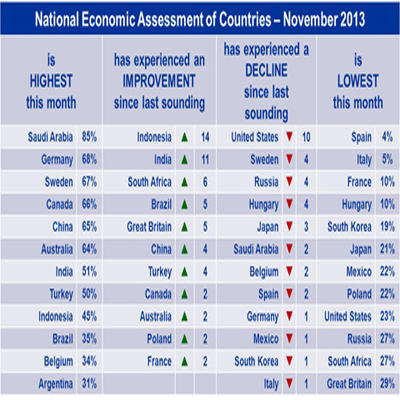
    According to the “Ipsos Economic Pulse of the World” study, India’s economic confidence jumped sharply by 11 points to 51 per cent in the month of November compared to the month of October 2013. India now stands as the seventh most economically confident country in the world after Saudi Arabia, Germany, Sweden, Canada, China, and Australia.


    Three in ten (32 per cent) Indians believe a health increase of five points. Indians are very hopeful about stability and growth in future with general election in the first half of 2014; four in ten (42 per cent) people expects that the economy in their local area will be stronger in next six months, a slender rise of one point.


    “Indian economy has bottomed out after a two-year slump and it is likely to see a positive growth trend from here on with positive indicators like narrowing CAD, revival of exports, growth of manufacturing sector and increasing investor confidence,” said Ipsos in India CEO Mick Gordon.


    “Good Monsoon resulted in bumper crop output, which in turn generated rural demand for goods such as tractors, motorcycles and consumer goods leading to growth of the manufacturing sector,” added Gordon.


    The online Ipsos Economic Pulse of the World survey was conducted in October 2013 among 18,083 people in 24 countries.


    After a significant decline last month, the average global economic assessment of national economies surveyed in 24 countries took a one-point turn for the better this month as 37 per cent of global citizens rate their national economies to be “good.”


    Saudi Arabia (85 per cent) continued to dominate the global ratings of national economies, followed in a distance by Germany (68 per cent), Sweden (67 per cent), Canada (66 per cent), China (65 per cent) and Australia (64 per cent). Once again, only a handful of those in Spain (four per cent) rate their national economies as ‘good’, followed by Italy (five per cent), Hungary (10 per cent), France (10 per cent), and South Korea (19 per cent).


    Countries with the greatest improvements in this wave were Indonesia (45 per cent, 14 points), India (51 per cent, 11 points), South Africa (27 per cent, six points), Brazil (35per cent, five points), Great Britain (29 per cent, five points) and China (65 per cent, four points).


    Those from Brazil (62 per cent), once again, hold the strongest future outlook for their local economy in the next six months. The other high-ranking countries, which followed at a distance, were: Saudi Arabia (48 per cent), India (42 per cent), China (39 per cent), Indonesia (37 per cent) and Argentina (37 per cent).

  • India fourth in phishing attacks

    India fourth in phishing attacks

    NEW DELHI: India has ranked fourth in phishing attacks in the third quarter of 2013, said RSA, a division of EMC.

    India received three per cent of the total attack volume, said  RSA  in a statement.

    Other countries targeted by phishing attacks were US (53 per cent), Germany (17 per cent), UK (eight per cent) and South Africa (three per cent). In top countries by attacked brands’ India ranked third with seven per cent of the total phishing volume worldwide. The US with 27 per cent and UK with 12 per cent topped the chart.

    RSA identified 46,119 phishing attacks in September globally with a rise in 36 per cent increase as compared to the month of August (33, 861). Phishing attacks in the month of September also mark the highest number of attacks in this quarter while July 2013 saw 45,232 numbers of attacks. Top countries to host these phishing attacks include US (42 per cent), Canada (nine per cent), Germany (five per cent) and UK (four per cent).

    The total amount of losses incurred in third Quarter of 2013 was $1.66 billion.
    Brands in the US, UK, India, and Australia were targeted by almost 50 per cent of phishing attacks in Q3 2013.

    US remained the top country on the chart, targeted with 53 per cent of the total phishing volume in Q3 2013.

    US incurred a loss of over $882 million followed by Germany with $294 million and UK with $133 million.

    Meanwhile, cyber attack is likely to cost the average home user $418 in multimedia files, but a lot of this loss could be prevented if users purchase digital content after checking that the content is secure.

    Kaspersky Lab in a statement that users can lose files in a number of different ways: losing a device, having a device stolen, or falling victim to malicious users.

    According to the B2B International survey, 27 per cent of respondents encountered a cyber attack in the last one year. At the same time, over 60 per cent of users who were victims of malware that either damaged or destroyed data admitted that they had not been able to fully restore their files. During the same period, approximately 14 per cent of users dealt with the loss, theft or crash of their device.

    Respondents in the 16-24 age group would face an average loss of $670, while those in the 25-34 group would incur an average loss of $455; users aged 45 and older would lose an average of $227.

    Residents of China and Russia were likely to incur the highest average losses at $816 and $807 per user, respectively. This figure is considerably lower in Europe ($378) and North America ($342).

    In order to protect digital assets, users not only need to back up their data on a regular basis – they also need to secure their personal devices against malicious attacks designed to steal or extort data. Smartphones and tablets should also have additional tools to help locate a lost device or to mitigate the potential damages of device theft.

  • Bing releases the top search trends of 2013

    Bing releases the top search trends of 2013

    MUMBAI: Women are on top, literally! The 2013 search trends released by Bing that includes search data from Australia, Brazil, Canada, China, France, Germany, India, Italy, Japan, Spain, the U.K. and the U.S, reveal that women ruled and were in the top searches. In eight of the 12 participating countries around the world, women were the most searched. Beyoncé reigned in the US, while Miley Cyrus’s highly publicised twerking made her the top-searched person in both Australia and Canada.

    Former flames Justin Bieber and Selena Gomez were the most-searched people in the U.K. and Germany, respectively. Actress and actors Bruna Marquezine, Wen Zhang and Salman Khan were the most-searched people in Brazil, China and India, while singers Rihanna and David Bisbal ranked at the top for France and Spain, and gorgeous TV personalities Danmitsu and Belen Rodriguez were favorites in Japan and Italy.

    It was also a year of American songs, superhero movies, Facebook love, high-end designer brands, controversial sports stars, European getaways and fierce women.

    Bing search trends, found at  www.BingTrends.com, indicate what has most captivated people around the world in 2013.

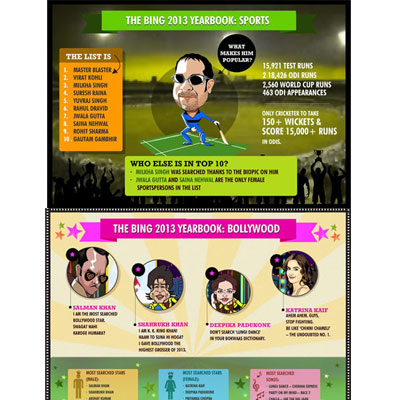
    However, when it came to the top searches in India, surprisingly, it was not the master blaster Sachin Tendulkar, who bid adieu to international cricket in 2013, who was searched the most. He was at number four, only after Salman Khan, Shah Rukh Khan and Katrina Kaif. 

    While he may have led the search among actors, Salman’s films did not feature in the top ten most searched films. The fast paced action flick Race 2 bagged top honours followed by Shahrukh starrer Chennai Express. And the surprise package among the top 10 Hindi movies was Nasha, starring Poonam Pandey. And Shah Rukh Khan may have missed top spot in the most searched actor and film, but his Lungi Dance from Chennai Express made it to the top of charts as the most searched song in India. This was followed by Party on My Mind from Race 2 and Challa from Jab Tak Hai Jaan.

    Sports stars too were popular. While Sachin Tendulkar was the most searched among sports stars, young and feisty Virat Kohli too made it to the top ten. However, the surprise entry was sprinter Milkha Singh, proving that the biopic on him did arouse curiosity about him in the country. Shuttlers Jwala Gutta and Saina Nehwal made sure that their sport was represented in the top ten dominated by cricketers.

  • Clooneys Monuments Men to open at Berlin Film Fest

    Clooneys Monuments Men to open at Berlin Film Fest

    MUMBAI: George Clooney’s The Monuments Men that is set to release in February next year will make its international debut as part of the 64th Berlin International Film Festival.


    The movie stars George Clooney, Cate Blanchett, Matt Damon, Bill Murray, John Goodman, Jean Dujardin, Bob Balaban and Hugh Bonneville.


    This is the second film announced by the fest that kicks off on 6 February. Earlier, the organisers had announced the opening film The Grand Budapest Hotel that too is shot in Germany.


    The Monuments Men German-American co-production is based on a true story focused on an unlikely World War II platoon, tasked by the Allies with going into Germany behind enemy lines to rescue artistic masterpieces from Nazi thieves and returning them to their rightful owners.


    Two-time Oscar winner Clooney has been a frequent guest of the Berlinale as a producer, actor and director. The Monuments Men will be his second directorial appearance in the official program after Confessions of a Dangerous Mind at the Berlinale 2003.

  • CareerBuilder Releases Striking Differences in Typical Workdays Around the World

    CareerBuilder Releases Striking Differences in Typical Workdays Around the World

    MUMBAI :  A new global study from CareerBuilder shows that a typical day in the office is not so typical across the globe: When you look at the average workday in the 10 largest economies around the world, you begin to see how alike workers can be—and also where they differ the most. The global survey, conducted online by Harris Interactive© from May 9 to June 5, 2013, included more than 5,000 hiring managers and human resource professionals in countries with the largest gross domestic product.

    INFOGRAPHIC:http://cb.com/1gnMhxK

    Driving vs. Public Transportation

    While the 10 countries surveyed have the largest economies on the planet, they also have some of the largest populations, but instead of taking public transportation or using other ways of getting to work, the majority of workers indicate they drive themselves to work every day,
    •    U.S. 82%
    •    Brazil: 74%
    •    China: 69%
    •    Germany: 63%
    •    France: 62%
    •    Italy: 60%
    •    Russia: 60%
    •    U.K.: 58%
    •    India: 52%
    •    Japan: 44%

    Suit and tie optional

    Of the 10 surveyed countries, India is the only place you’ll see the majority of workers in business formal attire (50 percent), such as suits. In every other surveyed country, business casual (e.g., slacks, button-down shirts, sweaters) is the standard dress code as below
    •    U.S. 64%
    •    Brazil: 57%
    •    Italy 51%
    •    UK: 51%
    •    Russia: 50%
    •    China: 49%
    •    France: 45%
    •    Germany: 45%
    •    Japan: 42%
    •    India: 36%

    Communication preference

    Although everyone might seem to be glued to their smartphones, tablets and laptops these days, face-to-face conversations still rule the workplace. In all 10 surveyed countries, in-person communication beat electronic messages such as emails, texts and instant messages by large margins, with phone conversations being the least used.

    •    U.S.: 
    o    Face-to-face: 59%
    o    Digital: 30%
    o    Phone: 10%
    •    UK:
    o    Face-to-face: 68%
    o    Digital: 20%
    o    Phone: 11%
    •    France:
    o    Face-to-face: 79%
    o    Digital: 15%
    o    Phone: 6%
    •    Germany:
    o    Face-to-face: 73%
    o    Digital: 15%
    o    Phone: 13%
    •    Italy:
    o    Face-to-face: 66%
    o    Digital: 23%
    o    Phone: 11%
    •    Russia:
    o    Face-to-face: 80%
    o    Digital: 10%
    o    Phone: 9%
    •    India:
    o    Face-to-face: 60%
    o    Digital: 23%
    o    Phone: 17%
    •    China:
    o    Face-to-face: 81%
    o    Digital: 16%
    o    Phone: 2%
    •    Japan:
    o    Face-to-face: 42%
    o    Digital: 32%
    o    Phone: 27%
    •    Brazil:
    o    Face-to-face: 45%
    o    Digital: 32%
    o    Phone: 23%

    Socializing with coworkers

    Socializing with coworkers outside of office hours can be a good way to learn about your colleagues or relax after a hard day at work. Yet, not everyone is eager to participate. Workers in China and India are more than twice as likely to attend social events than workers in Germany and the U.S.When asked do you socialize with coworkers, the following said yes,
    •    China: 98%
    •    India: 93%
    •    Brazil: 76%
    •    Russia: 68%
    •    Japan: 66%
    •    France: 64%
    •    UK: 55%
    •    Italy: 53%
    •    US: 41% 
    •    Germany: 38%

    Hours spent at work each week

    The number of hours workers spend at work is pretty consistent around the world, but while Chinese workers spend slightly less time at work each week, they report (29 percent) bringing work home with them at least once a week, higher than the other countries.
    How many hours do you work each week?
    •    31-40: U.K. (47%), China (46%)
    •    41-50: Japan (48%), U.S. (47%), India (46%), Germany (44%), Brazil (43%), Italy (42%), Russia (40%), France (37%)


    How often are youbringing work home?
    •    US: 
    o    1 Day a week: 18%
    o    Never: 26%
    •    UK:
    o    1 Day a week: 17%
    o    Never: 30%
    •    France:
    o    1 Day a week: 19%
    o    Never: 32%
    •    Germany:
    o    1 Day a week: 19%
    o    Never: 39%
    •    Italy:
    o    1 Day a week: 25%
    o    Never: 43%
    •    Russia:
    o    1 Day a week: 25%
    o    Never: 39%
    •    India:
    o    1 Day a week: 26%
    o    Never: 29%
    •    China:
    o    1 Day a week: 29%
    o    Never: 30%
    •    Japan:
    o    1 Day a week: 18%
    o    Never: 59%
    •    Brazil:
    o    1 Day a week: 22%
    o    Never: 30%

    Taking vacation

    When asked how many days they took off from vacation, workers had strikingly different answers depending on where they live. Italian workers took off the fewest days, with the nearly two-thirds majority taking 7 days or fewer (64%). Forty-six percent of Japanese workers took more than 35 days off, more than workers in any other countries.
    •    0-7 days:
    o    Italy: 64%
    o    UK: 29%
    o    Brazil: 20%
    •    8-14 days:
    o    India: 34%
    o    U.S.: 27%
    •    15-21 days:
    o    China: 28%
    •    22-28 days:
    o    Russia: 35%
    o    France: 25%
    •    29-35 days:
    o    Germany: 30%
    •    35+ days: 
    o    Japan: 46%

    Survey Methodology

    This survey was conducted online within the U.S., Brazil, China, France, Germany, India, Italy, Japan, Russia and the U.K. by Harris Interactive©on behalf of CareerBuilder among400 to 2,279 hiring managers and human resource professionals (employed full-time, not self-employed, government and non-government) in each country between May 9 and June 5, 2013 (percentages for some questions are based on a subset, based on their responses to certain questions). With pure probability samples ranging from 400 to 2,279, one could say with a 95 percent probability that the overall results have a sampling error between +/- 4.9 and +/-2.05 percentage points. Sampling error for data from sub-samples is higher and varies.

  • Creating a global footprint for Indian cinema

    Creating a global footprint for Indian cinema

    MUMBAI: At the inauguration of the Mumbai Film Mart, it looked like that the Indian film community is all set to go global. So, while it had invited delegations from other countries like Spain to partner for co-productions, the Indian film community also made an extra effort to promote films that have been made in collaboration with other countries. Like, Qissa: The tale of a Lonely Ghost that premiered on the first day of the festival is an Indo-German-Dutch-French co-production.

    NFDC GM, executive producer & head marketing Vikramjit Roy at the inauguration of the Mumbai Film Mart on 18 October, said that to take Indian cinema beyond the confines of the country, NFDC is making many efforts. “We are primarily looking at co-production with seven or eight odd countries that India has treaties with in the near future. These include the likes of Germany, France, UK, Brazil, Italy, New Zealand and I hope Spain, Canada and Australia as well very soon.”

    Roy further went onto explain how global collaboration helps a local Indian story like Qissa to team up with local funding bodies of Europe. “For example, if you do an Indo-European co-production with any of the European countries mentioned earlier, you will get to access funds from the central European funding body and the co-producer also gets an access to various regional funds,” Roy explained.

    Qissa got funding from NRW that is located in Germany; it had funding from NFF that is a Dutch film fund and also from France. “Besides, when the film goes on floor and gets a certain positioning, you get a sales agent on board. Like, we had the Match Factory join hands with Qissa. Something like this allows for a certain positioning and global footprint.”

    We have a film called ‘Arunoday’ with France and we are hoping to do one with New Zealand soon, says Vikramjit Roy

    In fact, to widen its horizon, the festival had invited the official Spanish delegation, Spanish Federation of Producers (FAPAE) for co-productions along with senior decision makers from the Spanish Ministry, Tourism and Film Commission, who are eager to partner with the Indian film community.

    Talking about it, Institute of Cinematography and Audiovisual Arts (ICAA) Spain director general Susana de la Sierra, said: “This is the first visit from the series of visits that we have planned in the time to come. This is to strengthen our relationship with India and also possibly look at making co-productions between the two countries.”

    What makes the Spain delegation more interested in partnering with India is that both the countries are similar in terms of their cultural diversity. “Spain is far smaller than India in terms of landscape and population, but there are a lot of similarities. We both have cultural diversity. We have 17 regions within the country and apart from the national film fund, we too have regional film funds,” she added.

    I feel this is not only a really good opportunity for us to work together but also help find Spanish and Indian films their audiences believes Susana De La Sierra

    Susana looks at this as a great opportunity, not only for working together but also helping Spanish and Indian films find their audiences. “Going forward, I do see more work travelling from India to Spain and vis-?-vis, as it’s a fact that after the Indian representatives visited Spain there are several projects that have been lined up to be shot in and around Spain.”

    There are also plans to import Indian films into Spain and Spanish movies into India and this practice will only intensify further as both the countries will work hand in hand to help each other. The Spanish ministry keeps aside a fixed budget to help nurture and push the film industry to take that creative freedom and showcase the Spanish culture in all its glory.

    The Indian film community has already witnessed the popularity and profit that foreign collaborations bring. In Toronto, NFDC positioned Qissa as a global film, which helped it in achieving the Best Asian Film Award by Net pack. “We are hoping that Qissa turns out to be a trendsetter as now we have a film called Arunoday – directed by Partho Sengupta – with a French collaboration and we are hoping to do one with New Zealand soon too,” Roy added.

    Looks like Indian film community is all set to make an international footprint.

  • Should sports betting be made legal?

    Should sports betting be made legal?

    NEW DELHI: This year’s Indian Premier League proved to be an expose of the kind of rot that has set into what was once touted as the gentleman’s game. With the who’s who of cricket and entertainment dragged into the murky world of betting and spot-fixing, not to mention two cricketers banned for life, the focus has shifted to the possibility of legalising and regulating sports betting.

    At the two-day ‘Conference on Regulating Sports Betting and Sports Law’ organised by FICCI recently, experts from different walks of life, through a consensus resolution, called for stringent laws to curb fraud and doping in sports.

    Inaugurating the meet, former Punjab and Haryana Chief Justice and Chairman of the Supreme Court Probe Panel into the IPL 2013 Betting and Spot Fixing Scandal, Mukul Mudgal, said the time had come to stop debating whether there was a need to regulate sports betting or not. Justice Mudgal said that besides doping, one of the biggest threats to the integrity of sports was sporting fraud, which includes match fixing, spot fixing, tanking and point shaving among others.

    His reasons for favouring regulation included: the government would earn substantial revenue from taxing sports betting, the unauthorised manner in which betting was currently taking place was a threat to the integrity of sports and sportspersons, some grass root sports programs could very well use the money generated, unauthorised betting was a source of revenue for hardened criminals, and law-abiding citizens were getting unnecessarily exposed to such anti-social elements.

    Justice Mudgal opined that the rate at which winnings from betting were to be taxed could be decided by the government and that 20 per cent would not be high, considering that in some jurisdictions like Austria and UK, the taxation rate is up to 28 per cent and 25 per cent, respectively.

    olicitor General of India N Viswanathan added: “There are pros and cons involved in legalising and regulating betting but before that, the Government should set up an Independent Regulatory Commission to study the various aspects in depth and come out with a solution, keeping in mind the elimination of book makers.”

    Alex Ward, Vice President Commonwealth Lawyers Association said: “The concern in Australia about the results of gambling and betting isn’t as much as the concern about corruption, doping and match fixing. India should legalise and regulate rather than prevent betting. By regulating like in Australia, the central and state government can get more revenue for development of sports. In India, there are some social and ethical problems unlike in Australia.”

    Carl Rohsler, Partner in Squire Sanders (UK), LLP, and International Gambling Laws Expert said that India had a choice about whether to regulate certain forms of gambling or not. “One thing that I would like to see is a survey of gambling in India – to try to gain some understanding of the numbers involved. I would also recommend the creation of some kind of committee to formally address issues related to gambling – in order to be a repository of information and knowledge not only about gambling in India but gambling all around the world. FICCI has done a great deal to start the debate – but it cannot be expected to shoulder the whole burden. The time has come for more formal support. I stress that this is not support of gambling, but support of finding out about gambling,” he said. Among the reasons he gave for regulating gambling: the first was to protect society from harm; second to facilitate movement of money from the illegitimate to legitimate sector; third, the government was responsible for operating gambling in an honest, appropriate and transparent manner; fourth, match fixers and money launderers would find it difficult to operate in a regulated market; and finally, illegitimate operators would be kept out of such a market.

    Dr A Didar Singh, Secretary General, FICCI, pointed out that with an estimated $600 million betting market in India and a possible 20 per cent tax rate on profit from betting, it would rake in revenue to the tune of $ 120-190 million for the exchequer. He said the moot question of course was whether sports betting could be regulated in India like in other countries in order to aid sports development. Singh gave the example of lottery as a regulated business in India. “While there are no authentic figures about all the states in India because of the different methods adopted for accounting of lottery receipts, it is reliably learnt that a state like Kerala is getting net revenue of Rs 682 crores (FY 2012-13) through the medium of lotteries. It has been estimated that the potential revenue for all the states from lotteries would not be less than Rs10000 to Rs12000 crore a year,” he said.

    Meanwhile, Solicitor General of India Mohan Parasaran, in his key note speech during the session on ‘Threat to Integrity of Sports: Match Fixing and Doping’ said there had been extensive discussions between the ministries of sports, and law and youth affairs, regarding drafting modern laws on sports betting with a proposal to bring in stand-alone legislation on the subject. He said ‘The Prevention of Sporting Fraud Bill 2013’ was a step in that direction and had been drafted only after studying the laws of different countries including Denmark, Finland and Germany among others.

    Senior criminal advocate K T S Tulsi, in his key note address during the session on International efforts to curb sporting fraud:  Information gathering, Regulatory structure, Criminal Law and Courts said: “After the Indian Premier League fiasco, there is a big hue and cry regarding the amendments in sports law and inclusion of issues such as criminalization of sports, invoking criminal law for match fixing and betting, and strengthening of anti-doping laws but, in an effort to clean up sports, sportsmen should not be made scapegoats. Criminal law should be invoked only where a guilty intent is proved and players should not be liable of match fixing and doping on mere presumption. There should be strong evidence to prove a player’s involvement as once an allegation is made in the media, it has a tendency to stick even in the absence of any proof and the player becomes victim to a media trial even before being declared guilty by the courts. At the same time, legalizing betting would be a step in the right direction as this will ensure transparency and lead to removal of corruption from sports, which is the need of the hour.”

    Former Attorney General of India Soli Sorabjee said during the same session: “Betting is a natural human instinct, which is inherent to human beings – it should not be denied and time demands that it should be discussed seriously to come out with the solutions to match fixing.”

    Expectedly, former Sri Lankan Cricket Team Captain Arjuna Ranatunga, spoke on behalf of players: “There is a need for creating awareness and sensitising players on the consequences of doping and other sports frauds,” he said.  

    According to him, match fixers often do not catch top players but look out for smaller fish in top teams. On the subject of doping, he said that players coming from rural areas are not aware about the ill effects of doping and are innocent. So they need to be sensitised about various drugs and their consequences.

  • IT sector granted Authorising Nation status under the CCRA

    IT sector granted Authorising Nation status under the CCRA

    NEW DELHI: India has been recognised as the ‘Authorising Nation’ under the international Common Criteria Recognition Arrangement (CCRA) to test and certify Electronics and IT products with respect to cyber security. Thus, India has become the 17th nation to earn such recognition. This international arrangement has 26 member countries. USA, UK, Germany, South Korea, France, Japan, Canada, Australia, Turkey, Malaysia etc. are the other countries who have this recognition.


    So far India was having the status of ‘Consuming Nation’ with respect to certification of electronics and IT products. The status of ‘Authorising Nation’ will enable India to test IT and electronics products and issue Certificates which will be acceptable internationally. The recognition would also remove the bottleneck which as of now had prevented international companies from submitting their products for testing and certification in India.


    The recognition would also enable investment in setting up infrastructure and labs in public and private sectors in India for testing electronics and IT products.


    Standardisation Testing and Quality Certification (STQC) Directorate of the Department of Electronics and Information Technology (DeitY) has been operating Common Criteria Certification (CC Certification) scheme in India for the last five-six years. Under it STQC undertakes certification of electronics and IT products after evaluation of the products at its lab in Kolkata. The Certificates issued by STQC Directorate shall now be acceptable internationally by all CCRA member countries.

  • IT sector granted ‘Authorising Nation’ status under the CCRA

    IT sector granted ‘Authorising Nation’ status under the CCRA

    NEW DELHI: India has been recognised as the ‘Authorising Nation’ under the international Common Criteria Recognition Arrangement (CCRA) to test and certify Electronics and IT products with respect to cyber security. Thus, India has become the 17th nation to earn such recognition. This international arrangement has 26 member countries. USA, UK, Germany, South Korea, France, Japan, Canada, Australia, Turkey, Malaysia etc. are the other countries who have this recognition. 

    So far India was having the status of ‘Consuming Nation’ with respect to certification of electronics and IT products. The status of ‘Authorising Nation’ will enable India to test IT and electronics products and issue Certificates which will be acceptable internationally. The recognition would also remove the bottleneck which as of now had prevented international companies from submitting their products for testing and certification in India. 

    The recognition would also enable investment in setting up infrastructure and labs in public and private sectors in India for testing electronics and IT products. 

    Standardisation Testing and Quality Certification (STQC) Directorate of the Department of Electronics and Information Technology (DeitY) has been operating Common Criteria Certification (CC Certification) scheme in India for the last five-six years. Under it STQC undertakes certification of electronics and IT products after evaluation of the products at its lab in Kolkata. The Certificates issued by STQC Directorate shall now be acceptable internationally by all CCRA member countries.