Tag: Germany

  • Sony Six banks on FIFA finale to reach viewership target

    Sony Six banks on FIFA finale to reach viewership target

    MUMBAI: This Sunday, 13 July, the biggest sporting event FIFA 2014 World Cup will crown its ultimate champions: Germany or Argentina. Sony Six, which bet big on FIFA to churn out viewership claims that the game has garnered them good TVTs.


    The World Cup has also been a money spinner in terms of ad rates for the games. It can be noted that for the initial matches the ad rate for a ten second slot was selling for Rs 2 lakh to Rs 2.5 lakh. But now the figure has doubled. “The ad rates for a 10 second slot for the last four matches were sold for Rs 5 lakh ,” says MSM president Rohit Gupta. But according to some media planners the sum quoted is too high and marketers would end up paying between Rs 3.5 lakh to Rs 4 lakh.


    Sony Six business head Prasana Krishnan says, “The football story in India has been pretty good for our channel. It has been a driver for growth in terms of viewership. The singular prime time slot of telecasting games at 9:30 pm has paid well.”


    For the audiences in CS male 15+ years category, Sony Six had 605 TVTs, Sony Aath had 209 TVTs, Sony Pix had 85 TVTs and combined the three channels had a combined total of 899 TVTs. For the West Bengal market, (CS male 15+ years) Six had 218 TVTs, Aath had 203 TVTs, Pix had 27 TVTs and the combined TVTs were 448. According to the channel, its TG mostly lies in the CS 15+ category.


    In terms of reach (in 000s), for CS 4+ years at an all India level, Six had a reach of 43,968; Aath 9,816; Pix 5,350 and combined reach of 50,184. Though Krishnan had expected Six’s reach to be 125 million during this FIFA World Cup, he is yet optimistic about the final. “The World Cup is not yet over, we expect the total number to increase,” he says. Giving viewers a local flavor through Bengali commentary on Aath and the resultant viewership numbers is validation of their strategy being a success, Krishnan added.


    According to TAM data sourced from the channel for week 16 to week 26 (13 April to 5 July 2014) Six has been placed number one for 11 weeks now. Krishnan adds “It is a pointer for the future. In the next five years many international titles like UEFA Euro 2016 and FIFA World Cup 2018 will help our channel immensely. The time zone for FIFA will be more favorable this time for our telecast to the Indian audiences as FIFA will be held in Russia.”

    The male and female ratio in terms of viewership for this FIFA World cup has been 67 per cent and 33 per cent respectively. Compared to the FIFA World Cup 2010, female viewership has grown.

    When questioned which has been the best performing market for Sony Six so far Krishnan says, “No prizes for guessing. It has been West Bengal followed by Kerala, Mumbai, Chennai and Assam.”

    But what is Six’s strategy once FIFA ends? “We have a few properties lined up already. The Caribbean Premier League took off on 11 July and later in the year we will be focusing on World Kabaddi League and Champions Tennis League while NBA JAM is set to hit the ground in September 2014,” Krishnan says proudly.


    It seems like the channel is all set for the year. Meanwhile, it’s time to relax and enjoy the finale of FIFA World Cup 2014.

  • Germany prevails as host nation reduced to 7-1

    Germany prevails as host nation reduced to 7-1

    MUMBAI: The most anticipated clash between Brasil and Germany turned out to be the most shocking match. Germany defeated the host nation 7-1 in the semifinal match on Tuesday to earn a berth in the finals.


    The Brasilians’ managed to score a single goal in the dying moments which was too late as Germany took the lead with a string of goals in fast succession. In just the first 30 minutes of play, Germany took the lead with five goals including a record-setting 16th from Miroslav Klose.


    Doubts prevailed that it would be a tough battle for Brasil as its star striker NeymarJr was injured and captain Thiago Silva was suspended for the semifinals.


    The fever in Brasil translated on twitter making it the most-discussed single sports game ever on Twitter. There were a total of 35.6 million tweets about the game during the match window. The most mentioned Brasilian players were Julio Cesar , midfielder Oscar who scored the lone goal and centre forward, Fred. From the German side Miroslav Klose, Toni kroos and Thomas Muller were the top three mentioned players. 


    In addition to a goal Klose scored, Toni Kroos scored twice for the Germans in two minutes, and Thomas Mueller and Sami Khedira added the others.


    Brasil has not lost an official competitive match on home soil since 1975.


    Mueller scored the first goal, one-timing a corner from Kroos past Cesar in the 11th minute. Khedira made it 5-0 in the 29th, taking a pass from Mesut Ozil and again beating Cesar.


    Brasil has spent billions of dollars preparing for the tournament, with expectations that home advantage could deliver Brasil a sixth title. The huge spends had also ignited intense anger and protests against the World Cup. With disappointment flowing in, the Brasilians seated at the stadium started to chant against their President  “Hey, Dilma, go get ****ed in the ***!” at about the 40th minute. The chants lasted for about three minutes.

  • Germany versus Brasil: most anticipated match

    Germany versus Brasil: most anticipated match

    MUMBAI: The long nights of patiently staying awake and following the players across the football field is coming close to an end. The first semi finals will kick off today and will see host Brasil face-off against Germany.


    Football fans in India will get to see the match on Sony Six at 1:20 am on 9 July. The quarter finals saw Germany defeat France and Brasil defeat Colombia to reach the semis. Both sides are crossing fingers and hoping for their teams to win.


    For Brasil it is about being the host country and winning the title for the sixth time which they will be one step closer to, if they defeat Germany. On the other hand, Germany will look forward to breaking its World Cup semi final curse. The previous two World Cups’ saw Germany lose the semi finals to Italy and Spain, just short of reaching the finals.


    Germany also has to deal with a ‘vodoo man’ who is out to curse the team and make Brasil win. The home team which will be playing without its captain Thiago Silva and striker NeymarJr is already causing concern among Brasil fans.


    Germany coach Joachim Lowe has raised concerns over Brasil’s behaviour and has asked the match officials to intervene if Brasil plays rough.


    The match will be played at 5 pm on 8 July according to Brasil standard time, 8 pm according to GMT and for countries in the east such as beyond Pakistan will see it early morning on 9 July.

  • FIFA World Cup: Sony Six & Sony Aath TVT & reach report

    FIFA World Cup: Sony Six & Sony Aath TVT & reach report

    MUMBAI: As the final  of the 2014 FIFA World Cup draws closer, fans across the world are waiting with bated breath along with the official broadcaster of the game: Sony Six as to which team will lift the much coveted trophy. Even in India, the tournament has been gathering a lot of buzz in the media and on social media.


    It seems to be doing well in terms of TV viewership as well as football fans get red-eyed late into the night watching their favourites play. In the first week of the telecast of the World Cup, Sony Six had an all India reach of 12,469,000 while Sony Aath’s reach was 3,114,000. Combined, the two channels had a total reach of 14,792,000 in the C&S 4 plus years group. In the same week, while Six recorded a reach of 3,056,000 in the West Bengal market, Sony Aath’s reach was 3,043,000.

     
    The second week proved to be even more fruitful for the channels with Sony Aath’s reach soaring to 5,589,000 in the West Bengal market. Within Kolkata, the reach of the Bengali channel was 2,561,000 for the first week while in the second week it rose to 4,427,000.
     

    What is interesting to see is, while the channels reach increased in the first two weeks of the World Cup, TVTs  have a different story to tell. So, amongst males in the C&S 15 plus age group, while Sony Aath recorded 173 TVTs in the West Bengal market in week one, it dropped to 154 TVTs in the second week. For Sony Six, the all India ratings in the same category were 613 TVTs in the first week, which saw a huge drop in the second week to  453 TVTs.


    GroupM ESP national director Vinit Karnik says the drop in TVTs as the tournament progresses is no cause for concern as it has more to do with the number of matches per week decreasing as it enters the knock out phase and the various national teams start getting eliminated.   “The drop has nothing to do with fans and their interest in the game,” he says.


    There is other  good news as well. As per week 26 of TAM TV ratings, Sony Aath has seen a rise in female viewership in the 15 plus age group for the World Cup in West Bengal. The channel recorded an average of  152 TVTs for the telecast of the matches 1-27. That is a four per cent increase over the 146 TVTs that  ESPN Star Sports (the then official broadcaster)  managed during the telecast of the 2010 World Cup.


    Karnik adds, “As compared to the male viewership, this growth among female viewers can be attributed to  young girls who are mainly herd followers of the game. They follow the game out of fan following (of players) or because of common peer interest”


    On the whole, Sony Six (all India)  and Sony Aath recorded 483 TVTs and 161 TVTs (combined  total:  644 TVTs) for matches 1-27.  
     

    Telecasting most of the matches at prime time has definitely paid off, it appears. Especially if one looks at the numbers that the Germany vs Portugal match on 16 June (telecast time 9:30 pm) racked up: 1,514 TVTs on Sony Six and 393 TVTs on Sony Aath. Combined the two channels garnered 1,907 TVTs for the match, making it the highest rated one so far.

  • Tata Sky demos 4K TV with FIFA World Cup quarter-final match

    Tata Sky demos 4K TV with FIFA World Cup quarter-final match

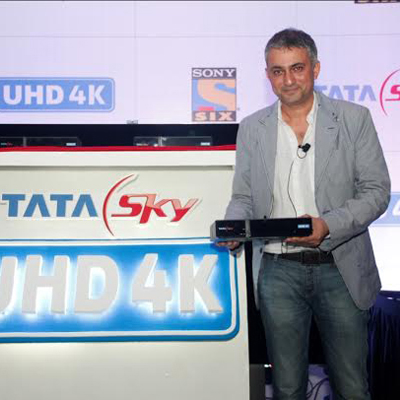
    MUMBAI: The era of India being a country that lags behind the more developed nations is gone. Indian  DTH operators in the country are waking up, ancticipating  future desires of Indian TV viewers. Which is why one of the oldest and largest DTH operators Tata Sky, is keeping itself and its subscribers up to date with the  introduction of its 4k Ultra HD service.


    The first quarter of 2015 will see Tata Sky roll out its set top boxes (STBs) for its 4k Ultra HD service. The STBs are being made by Technicolor and are based on the high efficiency video coding (HEVC) format that 4k uses the world over. However, prices of the STB are not yet known as the DTH operator wants to reveal it closer to the commercial launch date.


    At a demonstration event in Mumbai, Tata Sky along with Sony Six unveiled the 4k UHD service with a live uninterrupted broadcast of the France versus Germany FIFA World Cup 2014 quarter final. The FIFA 4k signal rights had been bought by Sony Six while the cost of acquisition and transmission was split 50:50 by the broadcaster and the operator. The telecast took place live via satellite transmission.  


    Indiantelevision.com readers will note that Videocon d2h had previewed its 4K service on 3 July 2014 too, a day before Tata Sky..


    Even though most industry professionals  claim that it is too early to launch 4k Ultra HD in India, Tata Sky chief commercial officer Vikram Mehra feels otherwise. “When we launched HD in 2010, people doubted us saying it won’t work. As you keep enhancing TV experience, the viewer will appreciate it. So, Ultra HD is our endeavour in that area. A technology becomes popular when mainline pay-TV adopts it.”


    Mehra feels that movies and sports will be the initial drivers for 4k technology and talks with broadcasters have already commenced. In three to four years, he expects it to be the way of life for most Indian TV viewers. Even though currently there is a lack of 4K content, he feels that it isn’t too far away. “We will make a product that makes sense to the customer. Customers will not buy STBs to adorn their homes. They will buy it for content,” he says.


    Sony Six business head Prasana Krishnan feels that more sporting events should be produced in 4K soon, probably in the next year or so. “4K is the future of broadcasting, specially sports. We saw technology move from SD to HD and now HD has become standard. 4K is next,” he says. Krishnan is aware that a full-fledged 4K channel can’t be expected very soon. Big sporting events will have 4K production on crucial days such as the finals, while the run up matches will be in HD and SD.


    The 4K screening of the FIFA World Cup 2014 quarter finals that took place in Mumbai yesterday, 4 July saw the Sony Six logo being superimposed on the FIFA feed on an 84 inch Sony television set that is soon to be launched in India and across the world. 4K screens give four times the clarity as compared to an HD feed.


    Mehra  was not willing to venture any guesstimates about how much uptake the Tata Sky 4K service will have when it launches next year as he feels making futuristic statements is of no use. However, the fact that the DTH operator is confident about its prospects is clear from the contract that it has signed with Technicolor, according to which deliveries of 4K set top boxes in “volume” are expected to commence in early 2015.


    Adds Mehra: “We started active service in 2007 and today we have 2.9million people paying Rs 45 each for them. Close to 65 per cent of our STBs sold today are HD. This from our total subscriber base of 13.5 million.” It is pertinent to note that Tata Sky, since late last year, has stopped buying any more SD boxes.

  • Algeria-Germany match draws record turnout at Monte Carlo Stars in Dubai Marina

    Algeria-Germany match draws record turnout at Monte Carlo Stars in Dubai Marina

    MUMBAI: Despite the late timing of the Algeria-Germany match and the event coinciding with the holy month of Ramadan, Arabs fans sat with high excitement in front of TV screens cheering wildly the only Arab team in the World Cup in Brazil.


    Monte Carlo Stars, a top destination that is offering the World Cup matches at the largest terrace overlooking Dubai Marina, has been drawing a huge number of football fans since the start of the World Cup.


    Ibrahim Al Sheikh, General Manager, Monte Carlo Stars Dubai said: “The audience waited with bated breath until the last minute of the extra time. We were thrilled with the turnout, which reflects Arab support to the only Arab team in World Cup 2014. It also reflects the diversity of cultures living in the UAE who are watching the games with great enthusiasm.”


    Al Sheikh said: “We congratulate the Algerian national team on their impressive performance despite their exit from the competition, and we expect a higher adrenaline rush as we come closer to the final matches.”


    Al Sheikh added: “Monte Carlo Stars has created a great ambience for our visitors who are coming here for Iftars and Suhoors as well as to watch the World Cup matches.”


    The Monte Carlo Stars, which has spectacular views of the Dubai Marina, is the largest marina terrace area providing the ultimate experience for each visitor through high-quality service.


    Al Sheikh concluded: “We are targeting broader segments of Dubai multicultural society in particular. The record turnout during the historic Algeria-Germany match was a proof of this.”


    It should be noted that Algeria became the third Arab team to qualify for the second round of the World Cup after Morocco in 1986 and Saudi Arabia in 1994.

  • 36% Indians Predict Brazil Will Win 2014 FIFA World Cup

    36% Indians Predict Brazil Will Win 2014 FIFA World Cup

    MUMBAI: A plurality of Indians (36%) expect host country Brazil to be victorious in the final game of the 2014 FIFA World Cup, according to a new online study by global research company Ipsos.


    While considerably fewer Indians predict football world cup winner will be Germany (10%), Argentina (8%), Spain (7%), Italy (4%), United States and Australia (both 3%), England/ Portugal/ Russia/ Belgium/ France all at 2%, and 1% who chose each of Mexico/ South Korea/ Croatia/ Switzerland/ Colombia and Japan.


    As for the runner-up, Indians choose Brazil (13%), Spain (12%), Germany (12%), Argentina (10%), France (6%), Italy (6%), England (4%), Portugal (3%), Australia (3%), United States/ Belgium/ Mexico/ Chile at 2% and Uruguay/ Netherlands/ Colombia/ Japan/ Russia and South Korea all at 1%.
    “Football fever has gripped India with 2014 FIFA World Cup soccer event underway in Brazil. Ipsos study indicates that more than 65 percent Indians have heard the buzz around the global mega sporting event,” said Biswarup Banerjee, Head Marketing Communications, Ipsos India.


    A large majority (78%) of global respondents have heard at least something about the upcoming World Cup in Brazil with 46% indicating they’ve heard something ( “a great deal” (22%), “a fair amount” (24%)) compared with 54% who have not heard much or anything (“a little bit” (32%) and “not heard anything at all” (22%)).


    Those from Brazil (69%), the host country, are most likely to say they have heard “a great deal,” followed by those from Mexico (53%), Argentina (44%), Indonesia (43%), Belgium (34%), Saudi Arabia (32%), France (30%) and India (29%). One quarter or fewer are aware of the games from these countries: South Africa (26%), South Korea (23%), China (21%), Spain (19%), Poland (17%), Turkey (17%), Italy (15%), Japan (15%), Great Britain (13%), Egypt (12%), Germany (9%), Romania (8%), the United States (7%), Hungary (7%), Australia (6%), Sweden (6%), Canada (6%) and Russia (5%).


    The Ipsos poll was conducted in May among 19,032 respondents in 26 countries, including: Argentina, Australia, Belgium, Brazil, Canada, China, Egypt, France, Germany, Great Britain, Hungary, India, Indonesia, Italy, Japan, Mexico, Poland, Romania, Russia, Saudi Arabia, South Africa, South Korea, Spain, Sweden, Turkey and the United States.


  • Who will take the glory home?

    Who will take the glory home?

    MUMBAI: The D-Day has finally arrived for football fans as the FIFA WC 2014 begins in Brazil in what is promised as a starry event. The fans across the world will be cheering for their favourite teams.

    With a few hours to begin, indiantelevision.com picks up the top five teams that hope to take home the trophy that truly matters.

    Brazil – The host country is a top favourite this season. The team being led by Paris Saint Germain defender Thiago Silva is hopeful of bringing back the trophy home for the sixth time. A key favourite in the team is 22-year-old star footballer Neymar. Tomorrow will be his 50th international when Brazil plays against Croatia in the opening match. Brazil previously won the World Cup in 1958,1962,1970,1994 and 2002.

    Argentina – Brazil’s biggest arch rival, the South American giant, won the world cup twice in 1978 and 1986.The team being led by another top contender Lionel Messi is slated to have its first match against Bosnia on 16 June.

    Spain – The team that is hopeful of retaining the world cup title after winning it the last time in 2010. The captain Iker Casillas has said in recent reports that he hopes of holding on to the title. Spain’s first match will be against Netherlands on 14 June.

    Germany – Having won the world cup three times previously in 1954, 1974 and 1990. A contingent of players who despite having injuries are led by the talented Phillip Lahm who are optimistic of lifting the world cup a fourth time around. They will meet Portugal in their first match scheduled for 16 June.

    Belgium – The underdogs this world cup, Belgium’s youthful squad is brimming with talent who are the favourites for fence sitters this time around. The team first match will be against Algeria on 17 June. The team’s best performance (they have never won the cup) so far has been at the 1986 world cup where they were placed fourth. The team is led by captain Vincent Kompany.

  • BBC World News survey reveals impact of mobile advertising on affluent consumers

    BBC World News survey reveals impact of mobile advertising on affluent consumers

    MUMBAI: BBC World News and BBC.com/news have today released the results of a global study – the first of its kind – examining the usage of mobile devices by consumers around the world.

    The study surveyed 6,000 smartphone owners in Australia, Germany, Sweden, India, Hong Kong and the US. It compared the habits of affluent consumers – the highest 20% income earners in each country – to those of the general population.

    The results reveal the increasing importance of smartphones to affluent consumers and demonstrate the extent to which mobile devices are integrated into their personal and, crucially, their business lives, as improved technology enables greater engagement with content. The study also provides clear evidence that affluent consumers, who make up a large proportion of the BBC World News and BBC.com/newsaudience, are significantly more receptive to mobile advertising than the general population.  


    Key findings include:

    •51% of affluent consumers use their mobile phone for business, compared to 40% of the general population

    •39% of affluent consumers access the internet via their mobile devices at least once an hour, which is 18% higher than the general population

    •Affluent consumers are 18% more likely to share their location to get relevant services than the general population

    •Affluent consumers are more likely to prefer mobile devices to desktop for news-related content than the general population.  The contrast is particularly notable for current affairs or breaking news, where the figure is15% higher for affluent consumers than the general population, and business/finance news, where it is28% higher

    •News apps are the most commonly used mobile phone apps for affluent consumers, whilst social network apps are favoured by the general population

    •A third of affluent consumers agree that, if a brand wants to be modern and dynamic, it needs to be on mobile – 15% higher than the general population

    •Mobile advertising is twice as effective as the already proven advertising medium desktop in driving key brand metrics such as awareness, favourability and purchase intent amongst the total population. This figure rises to four times as effective for affluent consumers

    •High income earners are as positive towards advertising on mobile (19%) as desktop (18%). The percentage who are happy to see ads on mobile websites rises to 41% for sites where the content is free.


    India

    •55% of affluent Indian consumers access the internet hourly in India on mobile devices vs. 39% of total affluent consumers

    •Affluent Indian consumers are far more likely to use their phone for business (79%) vs. 51% for total affluent consumers

    •Over half of affluent consumers in India agree that their smartphone is the primary tool for organising their personal life

    •58% of affluent consumers in India agree that an increasing amount of their work is being accomplished on their mobile device (compared to 35% all affluent consumers)

    •56% of affluent consumers in India prefer to use their mobile device to access news, rather than using a desktop (30% for all affluent consumers)

    •52% of affluent consumers in India are more likely to share stories on mobile rather than desktop (compared 31% for all affluent consumers).

    •56% of affluent Indian consumers agreed that to be seen as modern and dynamic a brand needs to be on mobile (compared to 30% all affluent consumers).

    The survey emphasises the growing trend for news consumption on mobile platforms and reflects the results of the BBC’s 2012 study of news consumption -http://www.bbc.co.uk/mediacentre/worldnews/news-consumption.html- in which 59% of affluent consumers expected to consume more news on their phones over the next five years.
     

    When asked which single device they prefer to use for news, the number of affluent consumers who name the mobile phone has risen by 15% since 2012 and tablet is up by 9%.In contrast, the amount of people who say they prefer desktop has decreased by 17%.

    Additionally, 2012’s survey found that news consumption on mobiles was mainly restricted to scanning news headlines. In comparison, 34% of new handset users* surveyed in the new study say they now dive deeper when consuming news and are likely to read additional articles connected the original piece. This is 42% higher than for those using older handsets. Owners of the latest handsets are also 10% more likely than the general population to watch news video or stream content on their mobile phones.

    Jim Egan, CEO of BBC Global News Ltd said: “The rapidly growing importance of mobile to our global audiences is one of the big themes for our industry and we are constantly working to create the best mobile browsing experience, be that with the introduction of our international BBC News and Sports apps, or on-going responsive design innovations. This new research reveals significant change in mobile consumption – people are delving deeper into stories on their mobiles, consuming more video and, significantly, growing accustomed to advertising on their mobiles. This large study provides compelling evidence that mobile advertising works with affluent mobile consumers in particular and that has big implications for publishers and advertisers alike.”

    Notes to editors

    *New/latest handsets defined as those released since September 2012. The study was conducted by Millward Brown. BBC World News and bbc.com/news are owned and operated by BBC Global News Ltd, a member of the BBC’s commercial group of companies.

    BBC World News is available in more than 200 countries and territories worldwide, and over 360 million households and 1.8 million hotel rooms. The channel’s content is also available on 175 cruise ships, 53 airlines and 22 mobile phone networks. For further information on how to receive BBC World News, download schedules or find out more about the channel, visit bbc.com/tvschedule, bbc.com is one of the most respected brands on the internet and complements BBC World News in its offering of high quality, up-to-the minute international news, business, sports, weather, lifestyle, technology content and in-depth analysis. Launched in November 2007, the site attracts 58 million unique visitors each month.

    BBC Advertising sells advertising and sponsorship solutions on behalf of BBC World News and bbc.com. For more information on BBC Advertising see http://advertising.bbcworldwide.com.


    Click here for the full release
  • MIFF 2014 concludes amid much fanfare

    MIFF 2014 concludes amid much fanfare

    NEW DELHI: Are you listening by Kamar Ahmed Simon won the Golden Conch Award for best documentary film while Nishtha Jain with her Gulabi Gang was named best director at the recently concluded 13th Mumbai International Film Festival (MIFF) for Documentary, short and animation films.


    Eminent filmmakers Adoor Gopalakrishnan and Shyam Benegal presented the awards as the curtains came down to the seven-day festival.


    Jury 1 comprised filmmaker Anand Patwardhan, film curator Angela Haardt from Germany, Director of the Yamagata Documentary Film Festival – Fujioka Asako of Japan, Slovenian film scholar Jurij Meden, and noted animator from Mumbai Shilpa Ranade.  Jury II comprised Canadian filmmaker Mark Achbar, film director and editor Amitabh Chakrabarty, film maker from Kerala M R Rajan, noted cinematographer Piyush Shah, and Netherlands based film scholar Rada Sesic.


    The 90-minute documentary by Simon won the award in the above 60-minutes category. It gets the Golden Conch trophy and Rs 500,000 cash prize (Rs 300,000 for the Director and Rs 200,000 for the producer – Sara Afreen). Set in the coastal belt of Bangladesh, the film is a powerful and beautifully photographed film that reveals the alarming effects of climate change and deftly captures the fighting spirit of a community and their will to survive. The global issue of climate change is experienced in microcosm in Simon’s film, as he observes the families of Sutarkhali.


    The Golden Conch for Best Documentary Film up to 60 minutes went to Maria Stodtmeier’s (Germany) In Between : Isang Yun in North and South Korea. This documentary explores whether music can overcome the boundaries of a divided country. It examines the worlds of North and South Korean music, taking the viewer along on an exciting journey through two political systems. It got the Golden Conch trophy and Rs 500,000 cash prize (Rs 300,000 for the Director and Rs 200,000 for the producer – Paul Smaczny).


    Black Rock directed by Vikrant Janardhan Pawar and produced by the Film and Television Institute of India was adjudged the Best Short Fiction film in International Competition. It got the Golden Conch trophy and Rs 500,000 cash prize (Rs 300,000 for the Director and Rs 200,000 for the producer – FTII).


    The Golden Conch Best Animation Film award went to True Love Story by Gitanjali Rao. This 18-minute animation set in the streets of Mumbai explores what happens when the ultimate Bollywood fantasy is applied in reality. It gives a glimpse into the influence of Bollywood on real life in Mumbai, told through puppet animation. The award carried a Golden Conch and Rs 500,000 cash prize.


    The film on Right to Information, Chakravyuh, by National Film award-winner Dhvani Desai was voted the most popular film, a new award chosen through voting by festival delegates. Chakravyuh through the struggles of four characters from different regions of India throws light on how the RTI can be used to fight corruption. The film produced by Films Division was first shown on 12 October 2013 on the occasion of the eighth anniversary of RTI in Mumbai.


    Nishtha Jain received Rs 100,000 cash award and a certificate got the Best Director Award in the International Competition section. Gulabi Gang tells the story of Sampat Pal and her group of women vigilantes and activists from Bundelkhand, who fight for women’s rights and their empowerment. Armed with a lathi (stick) the Gulabis visit abusive husbands and beat them up unless they stop abusing their wives. The film has won several other awards, and there are plans to release it in theatres on 21 February as part of PVR Director’s Rare initiative. Jain, an alumnus of FTII, is based in Mumbai.


    The Dadasaheb Phalke Chitranagari Award went to Mumbai based filmmaker Dylan Mohan Gray’s film Fire in the Blood for Best Debut Film of a Director. The 84-minute film tells the story of how Western pharmaceutical companies and governments blocked access to low-cost AIDS drugs for the countries of the global south in the years after 1996 – causing ten million or more unnecessary deaths – and the improbable group of people who decided to fight back. This award carrying a cash prize of Rs 100,000 and a Trophy has been instituted by the Maharashtra Film Development Corporation, Mumbai


    The Indian Documentary Producers Association Award for the best student film went to Sonyacha Amba (Golden Mango) directed by Govind Raju and produced by FTII, Pune. This film had participated in the Berlin and Beijing festivals as well. The Rs 100,000 cash and Trophy is given by the IDPA.


    The Pramod Pati Award for most Innovative film, carrying a cash prize of Rs 100,000 and a trophy went to Pushpa Rawat’s 57-minute documentary Nirnay (Decision). The film explores the lives of women in a lower middle class colony in Ghaziabad, who are young and educated, but feel bound and helpless when it comes to major decisions about their lives, be it career or marriage.


    The Kashmiri film Tamaash (The Puppets) got the Golden Conch for the best Short Fiction Film up to 45 minutes in the National Competition. Tamaash is the first film by directors Satyanshu and Devanshu Singh, who also wrote, edited, and produced it, along with Tulsea Pictures. The film insists on the power of goodness and the importance of preserving the innocence of children.  It had won the Golden Elephant Award at the International Children’s Film Festival held in Hyderabad during November 2013. Along with the Golden Conch, the filmmakers also get Rs 250,000 cash award.


    In the National Competition section, Seven Hundred Zero Zero Seven by Altaf Mazid got the Golden Conch for Best Documentary (upto 40 minutes), while Have You Seen the Arana by Sunanda Bhat and Invoking Justice by well-known Deepa Dhanraj shared the  Best Documentary Awards in above 40 minutes category.