Tag: Gender Equality

  • Women are smashing stereotypes-But when will the stigma croak?

    Women are smashing stereotypes-But when will the stigma croak?

    MUMBAI: Do you only appreciate God during festivals, or is the devotion an all-year affair? If faith and admiration are ingrained in us for the divine, why does it stop short when it comes to one of God’s finest creations—WOMEN? Why do we insist on sticking a ‘special’ label on just one day of the year to praise, worship, and acknowledge the achievements of women in male-dominated fields? Newsflash: women don’t magically become remarkable on 8 March and revert to invisibility the next day. Let’s retire the ceremonial fanfare and start giving credit where it’s due—every single day.

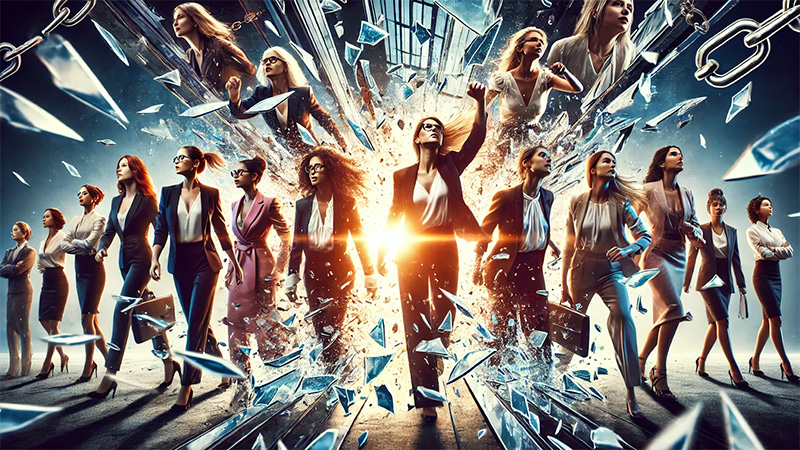
    In India, women aren’t just breaking the glass ceiling-they’re bulldosing right through it, leaving society scrambling to pick up the shards. They’re running boardrooms, leading billion-dollar empires, and rewriting the rules of success. And yet, the elephant in the room remains stubbornly unbudged: why does gender bias still loom like a ghost that refuses to be exorcised? Women in leadership are no longer the underdog story-they’re the main event. So why does recognition still feel like an annual festival rather than an everyday reality?

    Celebrating women once a year and calling it progress is like drinking one green smoothie and calling yourself a Indiqube executive director & COO Meghna Agarwalhealth guru. Indiqube executive director & COO Meghna Agarwal gets straight to the point, “Women’s economic participation is not just a social imperative but a strategic one, with the power to significantly boost India’s GDP.” And yet, despite the high-decibel conversations about equality, many women still find themselves playing a never-ending game of ‘prove yourself’ while their male counterparts get automatic upgrades.

    The numbers across industries tell an interesting story. In IT, multinational corporations (MNCs) are making strides—mentorship programs and global capability centers (GCCs) have propelled 1,100 women into global roles over five years. In marketing, women hold 60 per cent of jobs in North America and 52 per cent of CMO positions, but only 24 per cent of C-suite roles in UK SEO firms. Advertising remains stubbornly male-dominated, with men holding 71 per cent of leadership positions.

    media & entertainment

    India’s progress is a mix of wins and gaps. In media & entertainment (M&E), women hold just 12 per cent of leadership roles in top firms, down from 13 per cent last year. However, they shine on streaming platforms, occupying over 20 per cent of head-of-department roles. In advertising, women make up 40 per cent of the workforce but only 30 per cent of leadership positions-though leadership representation in India hit 36 per cent in 2025, surpassing global averages.

    Meanwhile, tech and finance continue to lag. Women hold less than a third of tech jobs and only 18-19 per cent of executive roles. In NBFCs and MFIs, women occupy just 12.5 per cent of leadership positions, proving finance still clings to its glass ceilings. Progress is real but moving at a snail’s pace.

    Aruna C. Newton

    Infosys VP, head of diversity & inclusion, ESG governance & reporting, Aruna C. Newton highlights the slow but steady march forward. “Through our flexible hybrid work model and programs like Restart with Infosys and #IamtheFuture, we continue to unleash opportunities for women to stay intentional about their careers and cement their leadership in technology,” she states. Infosys is gunning for a workforce that’s 45 per cent female by 2030, but the question remains: if businesses can adapt at the speed of light for profits, why does gender equality move at the pace of a sloth on vacation?

    The government is also throwing its hat in the ring. Supriya Shivani Wagh Lifescience Ltd. joint managing director Shivani Wagh points to the Union Budget 2025-26, which allocated Rs 4.49 lakh crore for gender-focused initiatives-a 37.5 per cent boost. “With over 14 per cent of Indian enterprises led by women, women-led entrepreneurship is on the rise,” she states. But there’s a catch. Access to the capital is still harder for women than finding a cab during peak hours. For every woman who secures funding, dozens more are stuck navigating a maze of bureaucracy and bias.

    Priya Krishnamurthy Paper policies sound great, but until the money starts flowing into real businesses, they’re just glorified wish lists.
    Tech, of course, remains one of the toughest nuts to crack. Acer India director – commercial sales, Priya Krishnamurthy gets it, “Advancing gender equality is not just a necessity but a catalyst for transformation.” 

    Translation? If the tech industry wants to stay ahead, it needs to do more than just talk a good game. Until women in STEM are as common as overpriced lattes in co-working spaces, we’re not done yet.

    The outdated belief that women lack the ‘testosterone’ to run Fortune 500 companies is about as relevant as a fax machine. Women have proven, time and again, that they can lead with both ambition and empathy-two traits that businesses desperately need. And here’s the kicker: many of the men who once doubted them now report to female bosses. And guess what? The world didn’t end. In fact, it’s thriving.

    Solitario Lab Grown Diamonds head of business & strategy Kamini Singh is all about recognising the brilliance of women. “Women are the driving force of change, shaping industries, breaking barriers, and redefining success on their own terms. This Women’s Day, we celebrate their brilliance, resilience, and unstoppable spirit. At Solitario, we believe every woman deserves to shine, not just beautifully, but powerfully, just like a diamond: strong, radiant, and timeless. Let’s Bling it!” she exclaims.

    Meanwhile, SIG Group head of market, India & Bangladesh, Vandana Tandan insists that equality needs to move beyond paper promises. “Real progress in any industry depends on recognising and valuing the unique talents of every individual. International Women’s Day provides an opportunity to reaffirm our commitment to building workplaces where equal opportunities are more than just a policy, they are a reality,” she says. In other words, let’s ditch the lip service and get down to business.

    Apollo Green Energy GM-corporate communications & digital marketing, Aanchal Sharma weighs in on the shift in leadership dynamics. “The stigma around women in leadership has not just changed. It has been challenged by women who refused to accept the notion that they did not belong. This shift has not been a single sweeping revolution but a series of quiet and persistent actions. A woman speaking up in a meeting despite being interrupted. Another negotiating her salary without apology. One balancing ambition with empathy without feeling the need to justify either. These everyday acts, multiplied across millions, have reshaped leadership.”

    She continues, “Yet, progress remains slow. Women lead only 1.6 per cent of companies listed in the Fortune India 500, despite businesses with diverse leadership teams being 25 per cent more likely to outperform their peers in profitability. The numbers tell a clear story. When women lead, companies thrive. But leadership is not just about economic success. It is about reimagining workplaces where women do not have to fight twice as hard to be heard, where ambition is not mistaken for aggression, and where success is defined by impact, not outdated expectations.”

    So, the million-dollar question: when does the stigma finally disappear? Women are already etching history-it’s society that’s dragging its feet catching up. 

    Because the future isn’t female-it’s equal. And if you’re still debating that, you’re already in the past.
     

  • Indians among most progressive on gender equality, Ipsos survey finds

    Indians among most progressive on gender equality, Ipsos survey finds

    MUMBAI — Indians rank among the world’s most progressive citizens in their views on gender equality, with 78 per cent believing in the importance of achieving gender parity, according to a new global survey released ahead of International Women’s Day 2025.

    The 30-country study by Ipsos reveals strong alignment between Indian men (77 per cent) and women (80 per cent) on gender equality issues, contrasting sharply with more polarised views in South Korea (52 per cent) and the Netherlands (54 per cent).

    Nearly half of Indians surveyed (48 per cent) perceive domestic responsibilities such as housekeeping and cooking as shared obligations rather than gender-specific tasks. Only 28 per cent attributed these responsibilities solely to women, while 18 per cent associated them with men.

     Ipsos India chief executive officer Amit Adarkar  noted the significance of these findings in light of the World Economic Forum’s projection that full gender parity remains over a century away.

    “According to the WEF, at the current rate of progress, it would take until 2158—roughly five generations from now—to reach full gender parity,” said Adarkar. “It is heartening to see that both men and women in India are aligned in their views on equal treatment and opportunity for women.”

    The survey, conducted in alignment with the International Women’s Day 2025 theme of #AccelerateAction, identified several key findings about Indian attitudes:
    * 69 per cent believe women holding positions of responsibility in business and government is crucial for accelerating gender equality
    * 66 per cent perceive increased pressure on men to support gender equality
    * 64 per cent feel that in promoting gender equality, men are sometimes discriminated against
    * 60 per cent consider men who stay home to care for children as “less of a man”—a view that has become more pronounced since 2019, when only 39 per cent held this opinion

    Regarding gender stereotypes, the survey revealed increasingly progressive attitudes in several areas. For unpaid family care, including childcare and looking after elderly relatives, 53 per cent of Indians attributed responsibility to both genders. Similar balanced views were expressed on gender-based violence (48 per cent), physical assault (48 per cent), parental leave (48 per cent), and healthcare access (52 per cent).

    Adarkar attributed these progressive shifts to changing family structures and government initiatives.
    “Urban Indians would be by far more progressive in their views on gender equality versus those residing in rural India. With urban pressures of work and home responsibilities, parents are showering their love on their child minus gender bias. Even rural India is witnessing progressive shifts with projects like Beti Bachao, Beti Padhao and Lakhpati Didis,” he said.

    The Ipsos survey interviewed 24,269 people across 30 countries between 20th December 2024 and 3rd January 2025. The India sample comprised approximately 2,200 individuals, with 1,800 interviewed face-to-face and 400 online.

  • Prime Video releases O Womaniya! Report 2024, highlights gender gaps

    Prime Video releases O Womaniya! Report 2024, highlights gender gaps

    MUMBAI: In an era where superheroes fly across screens and futuristic worlds captivate our imagination, one battle remains stubbornly grounded in reality: the gender gap. Despite women making strides into traditionally male-dominated spaces, their presence is still a drop in the ocean of overwhelming disparity.

    Nowhere is this more evident than in the entertainment sector-a realm that thrives on stories yet often silences half its storytellers.

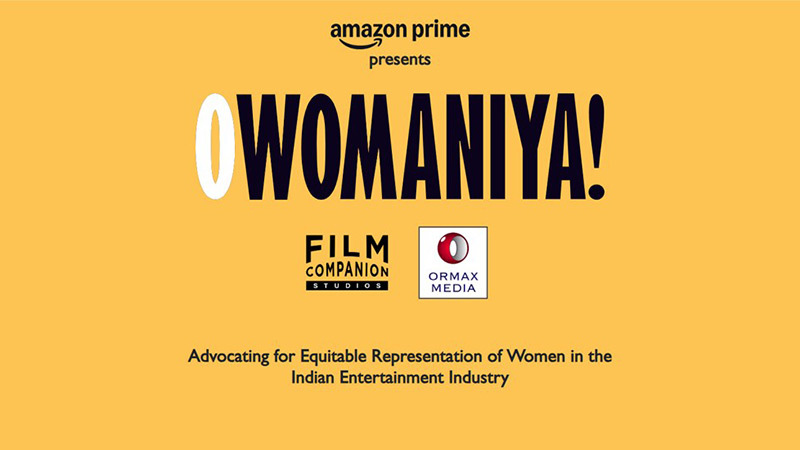
    The fourth edition of O Womaniya! 2024 report, released by Prime Video in collaboration with Ormax Media and Film Companion Studios, pulls back the curtain on gender representation across 169 Indian films and series in nine languages.

    Streaming platforms may lead the way, but the industry’s persistent imbalance reminds us that while screens evolve, some stigmas refuse to fade.

    The report introduced a unique Gender Equality Toolkit to help filmmakers evaluate female representation in their projects at the content inception stage. This toolkit analyses films and series through four critical parameters to ensure women’s agency and active participation in storytelling.

    women

    Key findings showed that only 31 per cent of the analysed titles passed the Gender Equality Toolkit test, with streaming series performing better, at 45 per cent. Additionally, the data revealed that female-led commissioning significantly improved representation, with 48 per cent of such titles passing the test. Meanwhile, traditional gender evaluation using the Bechdel Test revealed nearly half of the titles still failed to meet its benchmark.

    Among creative roles, only 15 per cent of head-of-department (HOD) positions in direction, cinematography, editing, writing, and production design were held by women. Streaming content contributed the most, with over 20 per cent female HODs. Editing emerged as the most female-represented department, particularly in streaming projects.

    In marketing, women occupied only 29 per cent of trailer talk time, reflecting incremental progress over the past two years. Streaming platforms showed higher female representation in promotional trailers. Prominent series and films such as Made in Heaven Season 2, Sweet Kaaram Coffee, and Saas Bahu Aur Flamingo featured notable female-centric narratives and voices.

    Corporate leadership saw a slight decline, with only 12 per cent of CXO or director roles at leading media and entertainment firms held by women.

    “At Prime Video, we firmly believe that Diversity, Equity, and Inclusion (DEI) is not just good to have — it is essential to driving meaningful change. We have worked intentionally and persistently to build a diverse, inclusive, and equitable ecosystem, creating more opportunities for women, both in production and within our organisation. In a collaborative industry such as ours, the true impact of DEI can only be realised when it is embraced across the board, with each of us committing to fostering an environment where women are seen, heard, and truly valued,” said Prime Video, India, director & head of production, international originals, Stuti Ramachandra. “O Womaniya! exemplifies the power of collaboration in addressing female representation in the industry. This latest edition of the report calls on all of us to accelerate these transformative efforts—not merely taking small steps, but making bold strides toward a world where opportunities and growth are defined by capability and talent, not gender.”

    Ormax Media founder & CEO, Shailesh Kapoor underscored the toolkit’s value, adding, “With every edition of O Womaniya!, we have looked at expanding the scope of the report. In this year’s edition, the introduction of the Gender Equality Toolkit offers a nuanced perspective on representation of women in entertainment. The toolkit is designed to be action-oriented, and can help creators and producers evaluate new ideas at their end, from an inclusivity perspective.”

    Film critic and producer Anupama Chopra reflected on the industry’s progress and challenges: “The entertainment industry is under greater scrutiny than ever before. With every step forward and every gap left uncovered, stakeholders are reflecting on how they can drive meaningful change. Every action and conversation around gender inclusivity matters and with the O Womaniya! Report and the newly launched Toolkit, we are moving closer to creating an equitable industry. I am deeply grateful to Prime Video and Ormax Media for their partnership in this groundbreaking initiative.”

    As the entertainment industry faces increasing scrutiny, initiatives like the O Womaniya! report continue to push for transformative change, ensuring talent and opportunities are defined by merit, not gender.

    Access the full report at www.owomaniya.org.
     

  • 75 years of Indian Independence, but where are women, asks SheThePeople’s Shaili Chopra

    75 years of Indian Independence, but where are women, asks SheThePeople’s Shaili Chopra

    Mumbai: As India turns a grand 75, have we forgotten to bring to the fore women’s issues in the media, or are we merely indulging in tokenism by scratching the surface? In an interaction with Indiantelevision.com, journalist turned entrepreneur, Shaili Chopra, reflects on the critical role that the media can play in changing perceptions of women in India and how gender equality can be achieved with the media as allies.

    As a thought leader on women’s issues and now a digital entrepreneur and observer, and as someone who has worked extensively in the media sector with 18 years of television journalism behind her, Chopra shares her insights on what’s missing in mainstream Indian media today, even 75 years after the country gained its freedom.

    Chopra is the founder of SheThePeople, a digital platform that helps shape new initiatives to support women to claim their rightful space at decision-making tables. With a focus on content, community, and skill development, it covers issues like women’s health, careers, and sexuality. She was awarded the Entrepreneur of the Year award by Entrepreneur India in 2017.

    Named one of India’s 50 most influential women in media, marketing and advertising by UK-based Impact Magazine in 2016, Chopra has authored four books. Her fifth book on women’s contribution in economic growth called ‘Sisterhood Economy’ came out last week.

    Her experiences at SheThePeople have led her to her next femtech venture, Gytree, which will launch next month and aims to provide primary and preventive healthcare to Indian women. According to Chopra, Gytree.com is a fearless and comfortable space for women to discuss their sexual and gynaecological health issues and needs. 

    Edited excerpts

    On Indian media’s portrayal of women and what more needs to be done on the front

    Shaili: We are behind the curve in how we cover women. We are slow to recognise that women’s issues are headline issues and must not be relegated to the city/inside pages of the newspaper. Things have moved for the better in the last few years. However, we are still way, way behind.

    It’s not just good enough to talk about women as women. We need to showcase female mathematicians for their math, and not just because they are women. We need to talk about the politics, health, and economics of women. We are not yet there at all. We are too busy doing tokenism and celebrating the ‘womanhood’ of these females, who in fact are way beyond that in their journey of growth and success. Let’s not just celebrate their gender, but what they do and bring to the table.

    And so, I urge all that, over the next few years, let’s prove that patriotism isn’t just about hoisting a flag in every home but also about providing equal opportunity, access, and space to half of the country’s population. If India must grow to a 4.5 trillion dollar economy by 2025, be sure it won’t just be one gender that will take us there. 

    On what has changed for women in India over the last few years

    Shaili: When I set up SheThePeople in 2015, they asked me, why do women need a separate channel? With more than 700 million women and half of the country’s population, we deserve our own space, our own voice, and a return on investment for our vote.

    As we celebrate 75 years of Indian independence, I believe things are changing and I am proud to be part of changing that narrative. There is a growing sisterhood of women in the world’s largest democracy who want to get their voices heard, their presence felt, and their economics to matter.

    On why it’s vital to talk about women’s stories and what makes the media a significant tool

    Shaili: Around the world, women are far less likely than men to be seen in the media. As subjects of stories, women only appear in a quarter of all television, radio, and print news. In a 2015 report, women made up a mere 19 per cent of experts featured in news stories and 37 per cent of reporters telling stories globally. The world is becoming more diverse, and it’s a newsroom’s responsibility to reflect this.

    Today, the media as a tool is important and necessary to move beyond traditional stereotypes of women and have diverse storytellers share their unique perspective in the media. While we are at it, it’s time that the media wakes up to include voices from marginalised communities, become caste-inclusive, and go beyond the gender binary to accurately represent the society we live in and tell relevant and impactful stories. We, at SheThePeople, have used the digital platform successfully to help amplify diverse voices and help women’s issues be heard. 

    On increased representation of women as media persons

    Shaili: If seeing is believing, then we need to have far more female representation across the board, across segments of the media (front-facing on-air as well as in business). 

    Like in many sectors, in the media too, the funnel of female leadership shrinks at higher positions. At the moment, there are many top anchors, but how many of them are driving the business or managing it? very few. I think that’s part of the problem.

    A study has also found that women continue to be given what are essentially “soft” beats like lifestyle and fashion, leaving the “hard” beats like politics, economy, and sports to the men.

    The Indian media, by marginalising women’s voices, denies the rights of nearly half the population. By having more women in leadership positions in the media, we can produce more gender-sensitive and gender-transformative content. As a participant and observer of the media industry for over a decade, I have always said that women and men need to be provided the same opportunities. This includes decision-making in all kinds of activities, so that the path to gender equality is sustainable and both women and men’s interests are accounted for..

  • IAA to host summit on ‘Gender Sensitisation In Media: Voice Of Change’

    IAA to host summit on ‘Gender Sensitisation In Media: Voice Of Change’

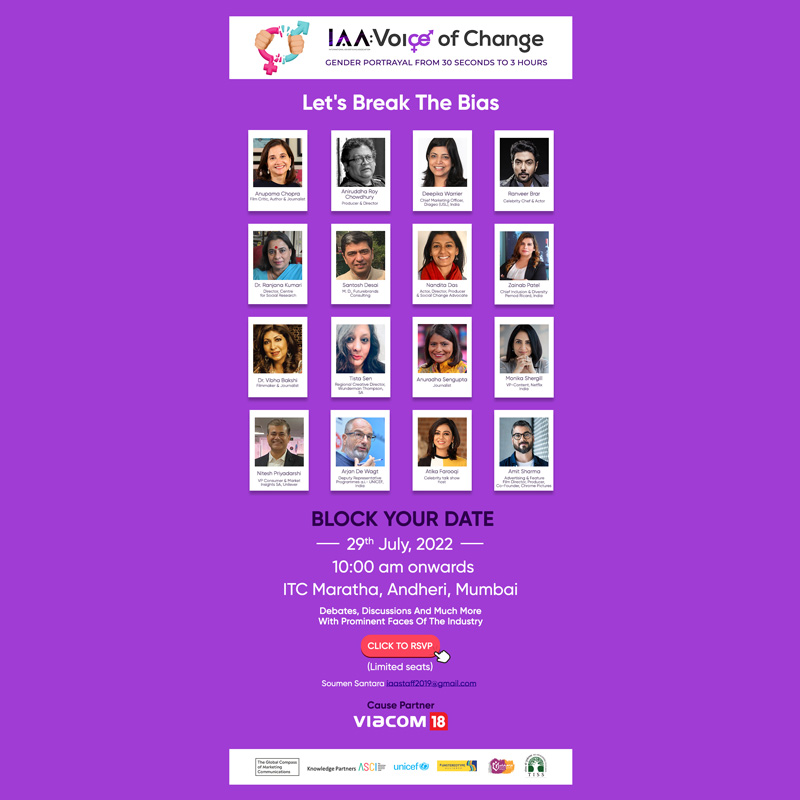
    Mumbai: International Advertising Association (IAA), India chapter is hosting a summit on Gender Sensitisation In Media on the 29 July at ITC Maratha, Andheri, Mumbai.

    The theme is Gender Portrayal across the creative spectrum from a 30 seconds TVC to a three Hour film. Prominent voices of the industry will be speaking on why it is of paramount importance to ‘break the bias’ that surrounds the industry when it comes to gender depiction.

    The summit shall witness prominent industry bodies and partners such as like ASCI, UNICEF, Tata Institute Of Social Sciences, Unstereotype Alliance and Akshara Centre along with Chief Guest Poonam Mahajan and prominent voices like Vidya Balan, Deepika Warrier, Monika Shergill, Anupama Chopra, Santosh Desai, Nandita Das, Ranveer Brar, Tista Sen, Anuradha Sengupta and many more.  

    The Voice Of Change was started as a behaviour change communication initiative which was aimed at addressing the skewed portrayal of gender in the field of advertising and communication with the launch of the ‘Geena Davis’ study with Unicef, in September 2021, the IAA – India took the first step towards effective change. The facts presented in the study, based on the evaluation of more than thousand plus ads, showed a disturbing trend of widespread gender stereotyping and prejudice. Sore truths were discovered about how women and other genders are seen, their abject objectification and pigeon holing.

    On the backdrop of such ground-breaking research being done, the IAA has stepped up to bring all this knowledge and more out in the public eye under an umbrella banner through this summit. The aim is to ensure that the discourse reaches the right people and sensitises all creative minds and industry forces to drive palpable change.

    IAA aims to sanction change through influential and evocative dialogue to enable effective change.

    Speaking about the summit, IAA India president Megha Tata said, “IAA has always brought forward initiatives that are meaningful and gender sensitive, on and off screen and has also been the one who has always taken the lead on this issue in the industry. We felt that it is time for all of us to come together and be the voice of change. We want to address the dialogue of gender discrimination across the media spectrum and hope we will collectively bring much needed change in the system.”

    “Over the last decade, women have broken stereotypes in this industry both behind the scenes and on the screen. It’s time we tell more of those stories and break biases. Through this change summit, the IAA brings prominent industry voices to communicate, converge and be the Voices Of Change that we need to empower the narrative,” said IAA Women Empowerment Committee chairperson and Viacom 18 Hindi and Kids TV Network head Nina Elavia Jaipuria.

  • ‘Stand Up’ to street harassment, says L’Oréal Paris

    ‘Stand Up’ to street harassment, says L’Oréal Paris

    NEW DELHI: On the occasion of United Nations International Day for the Elimination of Violence against Women, L’Oréal Paris has launched its international bystander intervention training programme – Stand Up – in India.  

    As per an ActionAid Survey of 2016, 79 per cent of women living in Indian cities have been subjected to harassment or violence in public. Even the national capital and the financial capital of the country are not able to provide a completely safe environment for their female residents, highlights a 2019-report by Praja Foundation, stating that 50 per cent of people in Delhi and 21 per cent in Mumbai felt that women were not safe in the respective cities. 

    These are just a few numbers but very clearly indicate how massive the issue of street harassment in India is. 

    Launching the campaign and an associated website in India via a virtual press conference, L’Oréal Paris general manager India Pau Gruart stated that the issue of women safety is very close to LÓréal’s brand ethos.

    “As a brand, we have always stood up for women empowerment but we always want to take one step further and make a concrete difference. This initiative deepens our sense of purpose and it is in total consistency with our brand essence,” he added.

    The brand has partnered with NGO Breakthrough to deliver on-ground training and sensitise the community towards the problem of harassment in public spaces and make them safer for people across genders. They are aiming to train 1 million people in India in the skill of upstanding using the 5Ds defined by NGO Hollaback!: Direct, Delegate, Document, Distract, Delay. 

    Breakthrough India president and CEO Sohini Bhattacharya noted, “Breakthrough has been working for over 20 years to make violence and discrimination against women unacceptable. We are very proud to partner with L’Oréal Paris in empowering young people to take action, for themselves, and for others, now and in the future. Bystanders are often not equipped to tackle street harassment and feel helpless during such situations. Based on the expert-approved 5D’s methodology, Stand Up makes a clarion call to citizens to take action against street harassment, by encouraging them to undertake a simple and effective training program, that not only supports victims but also enables bystanders to safely intervene. Stand Up will enable women to reclaim public spaces.” 

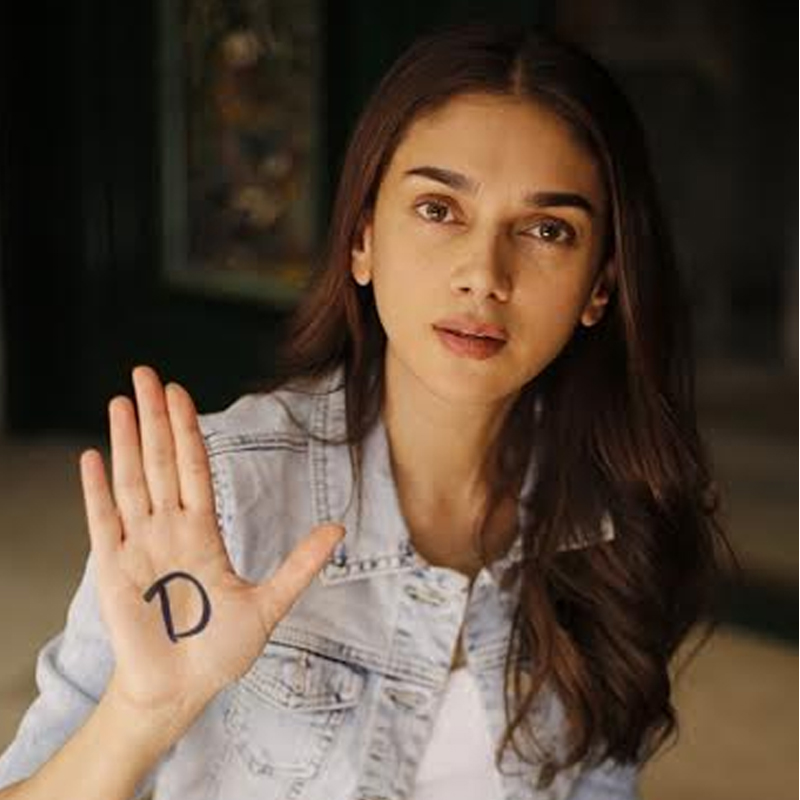
    Brand ambassador Aditi Rao Hydari added that she finds this approach more empowering than physically harming the preparator and feels that this will sensitise the community more towards cases of harassment in public spaces. 

    The brand with the support from Breakthrough is aiming to amplify the cause across the country, even to the remotest corners. It is already planning influencer activities and campus programmes to make the training more accessible. 

    Gruart shared, “At the heart of Stand Up, which is our most important global cause as a brand, is the training programme. We are going to direct all our marketing activities towards the training. For instance, we could have a classic tool of digital media; all inputs there will be one click away from the online training. We are also seeking influencer support and brand ambassador support to amplify it.”

    Bhattacharya continued, “We are willing to make the youth of the country the true crusaders for this cause. We will be enrolling people for fellowship programmes and training them in 5Ds and how they can teach further. They then will act as our ambassadors.”

    Gruart also noted they are looking for bigger partnerships across the country that might start coming into shape in 2021. 

    L’Oréal Paris has a wide portfolio of products for the Indian market including makeup, skin-care, hair colour, hair care and men's products. In 2020, the brand roped in actor Aditi Rao Hydari, former cricketer Mithali Raj and popular TV personality Shakti Mohan as its brand endorsers for the Indian market. It has launched several campaigns with these brand endorsers. L’Oréal Paris closely works with salons and hair-dressers who act as the last mile influencers for the brand.

  • Godrej Appliances’ #HumSabHomeMakers takes forward the conversation on homemakers and gender equality

    Godrej Appliances’ #HumSabHomeMakers takes forward the conversation on homemakers and gender equality

    MUMBAI: The COVID-19 lockdown has thrown a new set of challenges at our homes. With the entire family at home round the clock and no help at hand, household chores have grown manifold. Even as women continue to battle it alone in many homes, the good news is that more and more men are stepping up to their role as equal homemakers.

    Creatively narrated by WAT Consult, the film has captured this beautiful change in the form of multiple slice of life shots stitched together to depict ‘life during lockdown’ – all featuring Godrej Appliances employees at their homes, sharing the burden of every day.  

    About the film, Godrej Appliances marketing head Swati Rathi  said, “We have been having a series of conversations under the #LetsStartRight banner over the last two years. As a conscientious brand, we realise that we have a larger role to play in society. Gender equality is one of the messages we want Indian homes to embrace, and we are proud to say, we also practise what we preach. Through this campaign, we wanted to encourage people to help at home and voice proudly – #HumSabHomeMakers. Let us all take pride in our work both outside the home and inside the home. Let us be entrepreneurs, analysts, artists, bankers, marketers, engineers and managers while also being proud homemakers. We hope this film inspires a lasting change. Not just for now, but forever. #LetsStartRight! #HumSabHomeMakers.”

    WATConsult CEO Heeru Dingra said, “This video is another attempt to do away with the labels. With household chores being multiplied for our homemakers, this campaign is an urge to all of us trying our best to work from home, to extend a helping hand in managing the day to day household duties too and proudly say #HumSabHomeMakers.”

    Links :

    YouTube: https://youtu.be/TNmgtUN-xRA

    Facebook: https://m.facebook.com/story.php?story_fbid=2981892135187850&id=162668757110216

    Twitter: https://twitter.com/GodrejAppliance/status/1248835881835696130

    LinkedIn: https://www.linkedin.com/feed/update/urn:li:activity:6654594850727526400

    Instagram: https://www.instagram.com/tv/B-1EqvnB11s/?utm_source=ig_web_copy_link

  • Flipkart, Dentsu Webchutney strive for gender equality among children

    Flipkart, Dentsu Webchutney strive for gender equality among children

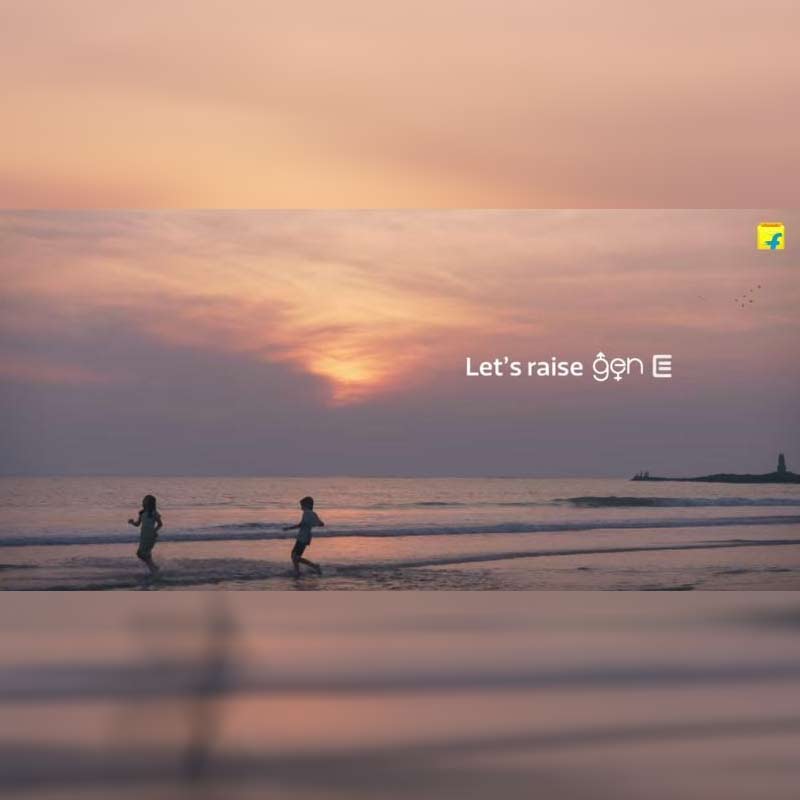
    MUMBAI: Curbing the age-old ideas of gender roles, Flipkart and Dentsu Webchutney have created an inspiring ad campaign promoting the new #GenerationEqual or “Gen-E”. The 2-minute long ad shows the new generation of kids striving for equality in all arenas—telling the parents how they would like to be raised.

    Speaking about the interesting campaign, Dentsu Webchutney senior vice-president – client services Prashant Gopalakrishnan says, “Look around you. Do you have a son, daughter, niece, nephew, or a friend’s child born a few years after the millennium? They are all part of #GenerationEqual. Real change will happen when we collectively decide to make the same rules that influence their lives. And as far as we can, let’s keep those rules the same for both boys and girls. That is the most real way to ensure our biases don’t pass on to them.”

     “As parents in 2018, we’d like to be progressive in letting our child choose for themselves in several aspects, so that they get to do what they love. Let the child experience the hobbies, passions, interests, and personality traits that come naturally to them… whether it’s a boy who wants to learn cooking, or a girl passionate about collecting superhero toys. And the other way around too,” says Flipkart director – brand marketing Apuarv Sethi.

    One of the biggest investments made by an Indian brand on the subject of gender equality among children, “Gen-E” is Flipkart’s third campaign to echo their new brand promise of ‘partnering with the progressive Indian’ via ‘Naye India ke saath’.

    In just a year of having started the new brand charter, Flipkart has campaigned on three distinctly different social subjects. With Penguin Dad, they celebrated fathers involved in child-raising; with Choose Your Age, they celebrated those defeating age with experiences; and now with Gen-E: they’re almost asking us to be what our children need us to, so that more and more of us can be celebrated. 

  • Emma Watson pushes gender equality initiative in Davos

    Emma Watson pushes gender equality initiative in Davos

    MUMBAI: Emma Watson, the Harry Potter star and goodwill ambassador for UN women, spoke about her plan to fight against deficiencies in gender equality and women’s empowerment.


    Speaking about gender equality she said, “We need all-country leadership, as well as that of hundreds of universities and corporations, to follow HeForShe’s IMPACT 10X10X10X so as to bring an end to the persisting inequalities faced by women and girls globally.”


    Watson unveiled a new element of her “HeForShe” gender equality campaign before business leaders and international politicians at the World Economic Forum in Davos, Switzerland so that the issue gets global importance.


    UN Secretary General Ban Ki-moon, who was a participant on the panel with Watson, then emphasized her appeal to encourage men to advocate alongside women for gender equality.