Tag: Gen Z

  • Pandemic Effect: 70% millennials open to trying lesser-known brands – dentsu India report

    Pandemic Effect: 70% millennials open to trying lesser-known brands – dentsu India report

    MUMBAI: The Covid-19 pandemic has overwhelmed the lives and livelihoods of people around the globe and put unprecedented pressure on the economy. Businesses and individuals are struggling to mitigate the crisis, which has not only impacted consumer sentiments, but altered their purchase habits, and demand for products and services.

    According to a new report released by the Data Sciences Division of dentsu India, over 70 per cent of millennials and Gen Z consumers in Urban India are now willing to purchase products from a lesser-known brand. It also found that close to 60 per cent of transactions of its surveyed audience claim was fulfilled via virtual wallets- 23 per cent via credit and debit cards and the remaining through cash. Google Pay continues to enjoy a lion’s share followed by Paytm.

    The latest Insights report titled ‘The Next Normal: The Rise of the Contactless Economy’ was released under the agency’s specialist consumer insights wing dentsu Marketing Cloud (DMC) Insights. It covered deep findings of the impact of a zero-touch world on consumer behavior and sentiments with a focus on millennials and Gen Z consumers in Urban India.

    The findings of the report also showed a boom in online certificates. As many as 59 per cent of people claimed to have done an online certification- a trend which is likely to continue post the pandemic, according to the agency. There was a growing preference for Ayurvedic products, as 49 per cent of the surveyed pool said they relied on Ayurveda to meet their immunity needs. 

    “There is widespread uncertainty as the world grapples with the impact of the pandemic. But, in case of ‘at home’ economy, the only assurance is that a ‘next normal’ is being created with the help of a hyper-connected world,” said dentsu Programmatic chief data officer (Asia Pacific) & CEO Gautam Mehra, highlighting that ‘at home’ consumption economy is pegged to reach a $3trillion size globally by 2025. “This will be fuelled by the need for consumers to look at digital channels to maintain normalcy in their lives whether it is to connect with friends and family virtually, purchase necessities, subscribe to content, or discover and learn new skills. Millennials and Gen Z consumers, being digital natives, have been better equipped in adapting to a virtual world by demonstrating a greater adoption of cashless payments and an openness to discover and try new brands.”

    According to dentsu International VP (Asia Pacific) and head of DMC Insights Abhinay Bhasin, Gen Z and millennials will form a cornerstone of new-age marketing and brand engagement given their growing spending power and digital literacy.  “A virtual world has given rise to human experience platforms. With the virus hitting home, there has been a hyper-awareness of health and safety amongst Millennials and Gen Z audiences. This report builds on our commitment to deliver industry leading insights on this demographic covering their impact on various aspects of consumption and growth,” said Bhasin.

  • Snap study finds Indians have amongst the largest groups of friends in the world, but Gen Z is starting to buck the trend

    Snap study finds Indians have amongst the largest groups of friends in the world, but Gen Z is starting to buck the trend

    MUMBAI: Snap Inc. today released a global study of 10,000 people across Australia, France, Germany, India, Malaysia, Saudi Arabia, the UAE, the UK and the US to explore how culture, age, and technology shape preferences and attitudes around friendship. Ten experts on friendship from around the world contributed to the report to contextualise the data.

    “Snapchat’s commitment to enabling self-expression and connecting real friends compelled us to explore the attitudes, values and perceptions that shape friendship across cultures and generations,” said Amy Moussavi, Snap Inc. head of consumer insights. “While friendship may be different across regions and age groups, it plays a universally central role in our happiness and we are committed to finding new ways to celebrate and elevate it through Snapchat."

    The Friendship Report sheds new light on the nature of friendship, including:

    ● How different cultures’ interpretation of friendship impacts friendship circles: people in India, the Middle East and SouthEast Asia report having three times the number of best friends as those in Australia, Europe and the U.S.

    ● How friendship is linked to happiness and how those without friends or with overly large friendship groups find it more difficult to talk about their problems or share when they are feeling low

    ● How we consider and form friendships is most heavily shaped by when, rather than where we are born: Gen Z in the US have more in common with Boomers in India than their own grandparents

    ● Gen Z are adjusting their approach to friendship away from the Millennial desire for widespread networks and are looking for more closeness and intimacy with a smaller group

    In India, friendship is the most celebrated human relationship with a wealth of popular culture – from songs to movies – extolling its influence on our lives. The Friendship Report also provides an insight into how Indians think of and relate to their friends compared to the rest of the world.

    Indians have more best friends

    Indians have on average six best friends. Only Saudi Arabians have more with 6.6, while the UK ranks the lowest with an average of only 2.6. Interestingly, not only do people in India have more friends overall, they also want more; with 45% of respondents indicating they would like to expand their social circle. In the report, Amit Desai, a lecturer of anthropology at the London School of Economics suggested that the approach to friendship differs from ‘the East’ to ‘the West.’ He explains that in Western Europe and North America, “friendship is about finding people who are like you and bonding over your similarities.” In many Asian countries, including India, he says friendship is more relational and focuses on seeking out an array of new and different friends who bring alternative but complementary qualities to the relationship.

    Gen Z is turning away from large friendship circles

    This approach is changing for the youngest generations however; Gen Z is starting to turn away from such large friendship circles, with the lowest average (5.2) compared to Gen X having the most (7.5). They are also slightly less likely to want as many friends as possible than Gen Y, (44% to 46%), more likely to want a small friendship group of people they can trust (23% compared to 20%) and twice as likely as Gen Y to not be interested in friendships (4%). Gen Z are also half as likely as Gen Y to consider friends having a large social group they can tap into, to be an important trait.

    Love is central to friendship in India

    Whether in person or online, interactions with friends leave Indians with overwhelmingly positive emotions; ‘loved’ (55% in person versus 43% online), ‘happy’ (48% in person versus 46% online), and ‘supported’ (43% in person versus 36% online) are the three most reported.

    Indians are most ready to fall fast for a friend, 23% became best friends at “first like.” A third of Indians also say that their best friend is the opposite sex, more than any other country outside of the US. Amit Desai has researched friendship in India extensively and believes that the shift is down to a change in romantic relationships. He suggests that while marriages in urban India have traditionally been arranged by parents, increasingly young people are seeing marriage in romantic terms that include dating, falling in love and having a spouse that is also your friend.

    Honesty is the best policy

    The report shows that regardless of generation, almost two-thirds of Indians consider honesty an important trait to have in a friend (63%). This does vary slightly by generation, however, being valued most by older generations (73%) and least by Gen Z (60%), who also value humour and lightheartedness (47%) – the highest of any generation.

    Dynamics of communicating with friends has evolved over a period of time, and unlike earlier generations, 26% of Gen Z and Gen Y see technology as a boon that enables them to have more honest and open conversation, 25% Gen Y believes chatting through apps has brought them closer to their friends.

    A picture paints a thousand words

    The report also suggests that video and photos can also be an aid in clarity; 73% of Indians say that video and photos help them to express what they want to say in a way that they can’t with words. Unsurprisingly, video and images also help people to express themselves where they don’t share a native language with their friends; 29% of those from India state that communicating through the camera is more effective.

    This could be to do with language barriers. Globally, India, Malaysia, and the UAE were the regions least likely to say they grew up speaking the same language as all of their friends, and in these countries, 24% of people state that communicating through the camera reduces language barriers. Regardless of language differences, an average of 56% of people from all countries love sending video and photos because it helps them to say what they can’t with words.

    Miriam Kirmayer, an American Therapist and Ph.D. candidate in clinical psychology specializing in interpersonal relationships says that, “Any medium that allows us to share both verbal and non-verbal behavior, like video, can help us to feel closer and more connected and to navigate relationship challenges with clarity.” She also suggests that research shows that even things like emojis can help to replace the subtlety of emotion and intent which is often lost in online conversations.

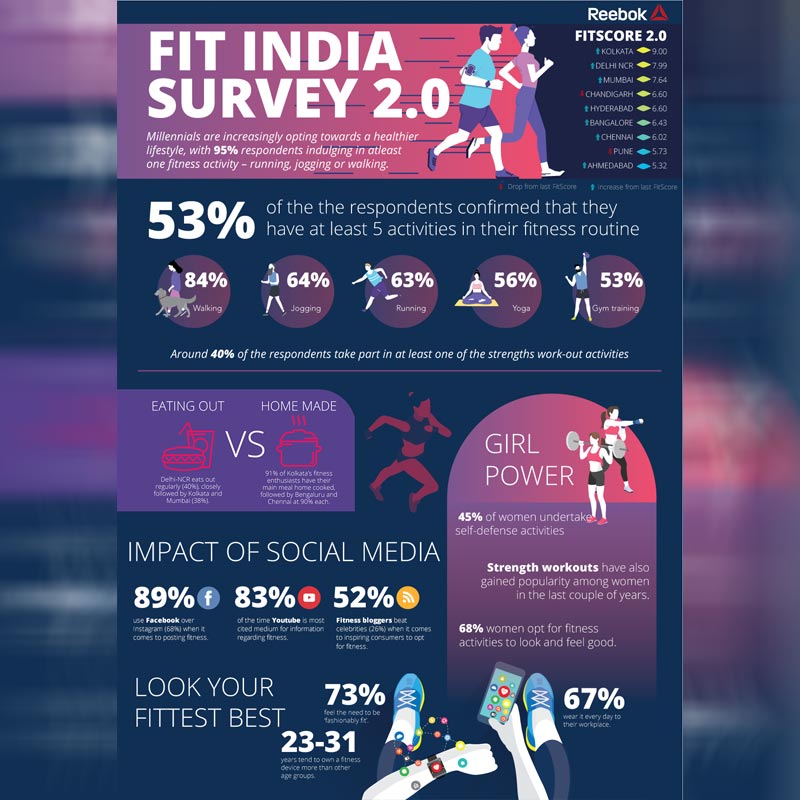
  • 95% of india commits to atleast one fitness activity –  Reveals reebok’s ‘fit india survey’

    95% of india commits to atleast one fitness activity – Reveals reebok’s ‘fit india survey’

    MUMBAI: India has witnessed a fitness revolution, with FitGenopting for healthier lifestyles by not just experimenting with their fitness regimes, but also keeping a close tab on their nutrition intake. With the objective of taking its philosophy ‘Fitness is Life’to Gen Z, Reebok India conducted the country’s first ever fitness survey– Fit India Survey in 2017 to reveal India’s fitness quotient. 

    This year, on the occasion of World Health Day, Reebok launched Fit India Survey 2.0 to trace India’s fitness journey over the past two years. And much to the disappointment of skeptics, numbers from the second edition of the survey prove that millennials are increasingly opting towards a healthier lifestyle, with 95% respondents indulging in atleastone fitness activity – running, jogging or walking. 

    Over 2200 men and women, between the age group of 18-35 years, were surveyed across the top 9 cities of India – Delhi-NCR, Mumbai, Bangalore, Kolkata, Pune, Hyderabad, Chennai, Ahmedabad and Chandigarh – as part of Fit India Survey 2.0 and among all Kolkata scores the highestFitScore(combination ofnumber of fitness activities participated in, frequency of working out & nutritional awareness) of 9.00. 

    While Kolkata is closely followed by Delhi-NCRwith a FitScore of 7.99, Puneon the other hand dropped from number one position in 2017 to the 8thon this year’s list with a lowFitScore of 5.73.

    While Kolkata was recently in news for 5% of the city’s population being overweight, the survey shows that the younger generation in the city is much more conscious about adopting a healthier lifestyle and is making better fitness choices.61% respondents from the city preferunconventional fitness activities like CrossFit, Kick-boxing, MMA and Combat training as part of their fitness regime.

    Discussing the Fit India Survey2.0 results,Mr. Sunil Gupta, Brand Director, Reebok India said, “We at Reebok know that through fitness, and through movement, people will benefit. It is exciting for us to see how India is working harder (and smarter) to increase its fitness quotient, and for us to be an integral part of that journey. We are committed to helping people become the best version of themselves, and findings from this year’s survey make us believe that we are headed in the right direction.”

    Tapping the fitness pulse of Indians, the Fit India survey decodes interesting findings ranging from fitness activitiespursued, sources of fitness knowledge, impact of social media, purchasing habits, nutritional requirements, growing athleisure trendsand more. 

  • LetsShave, a grooming statement

    LetsShave, a grooming statement

    MUMBAI: It’s groovy, it’s uber cool and it’s funny. LetsShave.com’s new promotional video, which was recently released, has all the elements of the new age men’s world. In an event held in Chandigarh, LetsShave Team and the invitees couldn’t resist shaking a leg as the goofy video played on a display screen during the launch.

    Targeting the new-age male customers – the millennial and the Gen-Z – the video is a clear statement of how our men have come of age when it comes to grooming. “While producing the video, we weren’t trying to sell LetsShave as a product but LetsShave as a grooming statement. We understand today’s men who are aware, well-read and up-to-date with the world. Men are witty by nature and we couldn’t think of a video without some humor,” said Sidharth S Oberoi while addressing the audience during the launch.

    The musical promo video with the catchy line – I got your face bro – smartly sketches pictures of when men need the shave most and how a clean-shaven look saves the day for them often. The two models – a mentor and a user – make clean shave look smashing hot while the hip-hop style makes for an interesting shaving anthem.

    Based out of Chandigarh, LetsShave is a bootstrapped Internet-only company that had reached breakeven sooner than most startups touching 1,00,000 + customers in a span of six months. It is also one of India’s 50 Most Promising Brands of 2016. LetsShave’s shaving and grooming range is a wide variety of products including world’s first 6-blade razor with a trimmer for both men and women. LetsShave enjoys partnership with industry leader Dorco which has been making high quality shaving razor blades since 1955. Dorco is also the official supplier to Dollar Shave Club – the shaving range startup which was recently acquired by Unilever. LetsShave’s unique packaging and delivery have succeeded in charming the customers or as they say – I got your face bro!

  • LetsShave, a grooming statement

    LetsShave, a grooming statement

    MUMBAI: It’s groovy, it’s uber cool and it’s funny. LetsShave.com’s new promotional video, which was recently released, has all the elements of the new age men’s world. In an event held in Chandigarh, LetsShave Team and the invitees couldn’t resist shaking a leg as the goofy video played on a display screen during the launch.

    Targeting the new-age male customers – the millennial and the Gen-Z – the video is a clear statement of how our men have come of age when it comes to grooming. “While producing the video, we weren’t trying to sell LetsShave as a product but LetsShave as a grooming statement. We understand today’s men who are aware, well-read and up-to-date with the world. Men are witty by nature and we couldn’t think of a video without some humor,” said Sidharth S Oberoi while addressing the audience during the launch.

    The musical promo video with the catchy line – I got your face bro – smartly sketches pictures of when men need the shave most and how a clean-shaven look saves the day for them often. The two models – a mentor and a user – make clean shave look smashing hot while the hip-hop style makes for an interesting shaving anthem.

    Based out of Chandigarh, LetsShave is a bootstrapped Internet-only company that had reached breakeven sooner than most startups touching 1,00,000 + customers in a span of six months. It is also one of India’s 50 Most Promising Brands of 2016. LetsShave’s shaving and grooming range is a wide variety of products including world’s first 6-blade razor with a trimmer for both men and women. LetsShave enjoys partnership with industry leader Dorco which has been making high quality shaving razor blades since 1955. Dorco is also the official supplier to Dollar Shave Club – the shaving range startup which was recently acquired by Unilever. LetsShave’s unique packaging and delivery have succeeded in charming the customers or as they say – I got your face bro!

  • Cartoon Network launches digital TV network in SE Asia

    Cartoon Network launches digital TV network in SE Asia

    MUMBAI: With Gen Z becoming more tech savvy, kids are increasingly shifting their entertainment base to tablets and mobile phones instead of television. Keeping that in mind, kid’s channel Cartoon Network has launched a TV network built exclusively for a phone or tablet. Cartoon Network Anything is an app that contains content created for portable mobile platforms, rapidly delivering entertainment in a unique and fun way – an innovation that’s never been seen before in Southeast Asia.


    The app is free and available for download now on the App Store and Google Play for smartphones and tablets. Cartoon Network Anything is an ever-growing and ever-changing stream of content consisting of games, activities, super-fast trivia quizzes and interactive video games, all approximately 15 seconds in length. After a user finishes with one item, they simply swipe the screen to move on to the next. The perpetually-updated stream is delivered randomly, providing entertainment that feels both immediate and everlasting.


    “Cartoon Network Anything is unlike anything we’ve ever designed,” said Turner Kids Networks Asia Pacific chief content officer Mark Eyers. “The app is a whole new way to engage our audience, constantly maintaining a high level of suspense of ‘what will come next?’ Basically, it hosts the best of Cartoon Network on your phone!”


    Hit franchises Adventure Time, We Bare Bears, Regular Show, The Amazing World of Gumball, Uncle Grandpa, Teen Titans Go! and Clarence all feature, but what makes the app so innovative is that everything is created exclusively for the app. Cartoon Network Anything will premiere Mighty Magiswords, an animated micro-series created specifically for this platform, along with a slew of new Asia Pacific-made short-form content such as Beat Monsters from Korea, Lamput from India, The Sketchy Show and Bill & Tony from Australia.


    Cartoon Network’s recent research – New Generations 2015 – revealed that in smartphone households in Southeast Asia with children, 86 per cent of kids use apps at least weekly. In fact, those aged 4-14 are accessing on average five apps every month. Cartoon Network Anything presents a huge opportunity for advertisers who are looking to achieve an unparalleled level of brand alignment in a digital arena.