Tag: GECs

  • Zoom’s Facebook boom

    Zoom’s Facebook boom

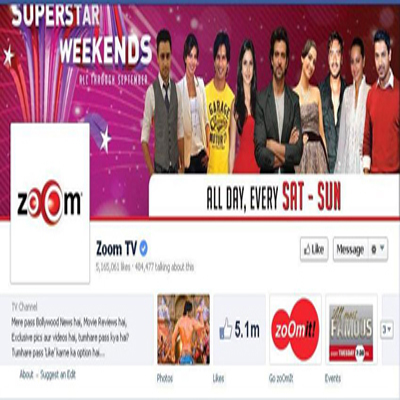
    MUMBAI: Not only does Times Television Networks’ channel Zoom enjoy the distinction of being the first Indian television channel to air all the hot gossip from tinsel town, it is now also the first to cross five million likes on Facebook.

    Indeed, at the time of filing this news piece, the number stood at 5,164,957 with 484,777 ‘talking about it’ (the channel).

    So how does Zoom pull it off? The channel claims its target audience is mainly youth, which is most interested in the happenings in the Bollywood universe.

    The Facebook page keeps audiences updated on all that they’ve missed out even if they’re not actively watching the channel. “Zoom has systems in place to ensure that even if one is not in front of the TV, one never has to lose access to the latest news,” explains Zoom CEO Avinash Kaul.

    It’s a known fact that building traffic is difficult and sustaining it even more so. In such a scenario, Zoom claims it focuses on understanding conversation patterns to come up with newer, more innovative posts in the future.

    “The choice of topic, stars, the time of the day (when an update is put out) and selection of hash tags – all comes from a close and mindful study of past trends,” elaborates Kaul, adding that the channel tries to put out breaking news to create buzz among youngsters.

    An in-house team handles social media and is responsible for selection of posts to keep audiences engaged, which includes contests, trivia and news. According to Kaul, the team micro manages the posts to draw and keep traffic. “Immediate response and relevant content through posts is our key focus that has ensured a fantastic interaction,” he says.

    Zoom’s Facebook page, which started in 2009 and reaches 95 million people weekly, also has a show called ‘Zoom It’, which plays song dedications made by its Facebook followers. The fact of the matter is Zoom has sped past GECs in terms of Facebook likes and the reason, according to Kaul, is: “As part of family TV viewing, the youth has to follow GECs even when they’re not their most preferred choice of entertainment. In the digital space however, it’s entirely up to them to choose and watch exactly what they want.”

    As things stand, only MTV just crossed the level of five million likes as well, coming a close second to Zoom with 5, 013, 539 Facebook likes, followed by Zee with 49, 349, Star Plus with 3, 184, 230 and Colors with 2, 225, 824.

    While Zoom may want to be cautious about MTV’s proximity in terms of Facebook likes, for now, it sure is leading the pack…

  • A two-sided story

    A two-sided story

    MUMBAI: The rupee going into a tailspin or prices shooting through the roof; be damned. The wheels of general entertainment channels (GECs) seem to be in continual motion, what with a new soap here or a new reality show there. Makes one wonder as to what exactly these television majors do to keep their employees happy and productive, despite taxing schedules and OTT deadlines.  

    Well, the answer lies in the kind of incentives and rewards these channels, rather – their human resources teams, are willing to heap on their staff just so as to make them want to come back every morning, ready for the grind.

    And we’re not simply talking boxes of chocolates or free tickets to movies here. Imagine an iPad being gifted for a clean and decorative desk or a five-star hotel stay in Australia or even a shopping spree in Bangkok…

    An example of the kind of moolah these companies are willing to splurge on their employees is Star India, which took its top management (nearly 35 people) on an extravagant tour down under a month or two back.

    While Viacom18 arranged separate tours to exotic destinations like Egypt or more popular ones like Bangkok early this year. In a similar vein, Sony took its employees to Dubai last year whereas Zee ferried its entire team to the beaches of Thailand. We hear Sony is currently planning an itinerary for its annual trip this year.

    While these junkets (even called off-sites) don’t come cheap for these companies, there’s a catch: they aren’t entirely about fun and booze. There are leadership and team-building exercises, presentations on progress reports, panel discussions about the future etc. built into these trips.

    But with employees not expected to shell out anything from their own pocket, they’re fun nevertheless.

    However, there’s another side to this ‘Television (GECs) shining’ story.
    Even as most of them are coughing up crores of rupees on such junkets, there are other channels like news channels that are finding it difficult to survive in the present economic situation.

    There have been widespread instances of companies handing out pink slips to their employees in the past few months.

    First, NDTV shut down its Mumbai operations, followed by Network18 relieving around 350 employees across the network in little over a month. Next in line was Bloomberg TV which terminated the services of nearly 30 employees and the latest to join the bully gang is Ananda Bazar Patrika (ABP), which is learnt to have issued notices of non-renewal of service contracts to as many as 127 employees and speculations are ripe that even Business World magazine is closing shop soon.

    According to a study by the New Delhi-based Associated Chamber of Commerce and Industry (ASSOCHAM), the weak rupee hasn’t spared even Bollywood producers, who’re shying away from shooting overseas. In the past four months, foreign film shoots have dropped 30-35 per cent owing to the volatility in currency.
    Given this not-so-bright side of the television (and film) industry, one wonders if life is truly a soap opera for GECs… 

  • Festive fervour on Life OK

    Festive fervour on Life OK

    MUMBAI: The festive season is already upon us and Life OK, Star Plus’s sister channel, is going all out to meet the celebratory mood head on. The channel, which plans to aggressively invest in content in the coming months, has a set of brand new shows up its sleeve, promising viewers a never-before-seen experience.

    As we all are aware, in this January when LC1 got added to the measurement, everybody crashed. In April, when digitisation phase II happened, the channel was down to 110GRPs. If we further break it down, from January onwards the ratings have increased in both the categories – men and women. For men, the viewership ratings witnessed a rise by 50 per cent and a similar rise of 25 per cent for women.

    The recently launched Ek Boond Ishq – BBC Worldwide’s first daily fiction series in India – offers a flavour of the kind of programming to follow on the channel.

    This tale of a girl who realises she is about to tie the knot in a prison cell, is telecast every week, Monday to Friday, at 8:30pm. One wonders however if airing such a show at a time slot when most other GECs boast strong programming, poses a risk more than an opportunity for the channel?

    “Definitely not!” shoots Life OK general manager Ajit Thakur, confident their modest attempt at providing quality entertainment will be appreciated.

    “What sells more is content. If the content is good, viewers will come anyway and watch the show,” he adds.

    Another show the channel has lined up as part of its festival bouquet is Katha Mahadev Putra Bal Ganesh Ki, a spin-off of its flagship property Mahadev, which airs on 14 September. The 16-episode series to be telecast every Saturday and Sunday at 7:00 pm, showcases the adventures of Lord Ganesh as a child, and is part of Life OK’s larger mission to replicate the success of Star Plus.

    It’s a show targeted at the entire family, particularly kids. “It’s a finite show. No other GEC has original content at this particular time slot. So we thought of taking advantage of that and occupying the slot. We not only aim to target women but also children with this show,” explains Thakur.

    Adding to the fresh batch of programming is Shakuntalam Telefilms’ edgy thriller titled Rakshak, which launches end of this month. To be aired every Saturday and Sunday at 11:00 pm, it goes without saying the limited series faces tough competition from the likes of Crime Petrol (Sony), Comedy Nights with Kapil Repeats (Colors), Star Verdict Repeats (Star Plus), Fear Files (Zee TV), Taarak Mehta ka Oolta Chashma Repeats on Saturdays and Lapataganj – Ek Baar Phir on Sundays.

    Yet another feather in the channel’s programming cap is the new reality series, SOL Productions’ The Bachelorette India featuring Bollywood actor Mallika Sherawat. As reported by this website earlier, the non-fiction show will see 30 eligible bachelors battling it out to win the sex siren’s heart… and hand.

    With the concept derived from an earlier show named Swayamvar on NDTV Imagine, comparisons between the two are inevitable. Especially since the likes of Rakhi Sawant (who ended up separating from her partner post the series) and Rahul Mahajan, who participated in Swayamvar. The Bachelorette India is not the first of the channel’s trysts with reality shows. An earlier attempt, Welcome – Baazi Mehmaan Nawazi Ki, failed badly at winning the hearts of its audience.

    While the channel has pinned high hopes on these programs, whether they will succeed is a separate story altogether. Says a highly placed media planner (name withheld on request): “I don’t think the channel is doing something new in terms of content. Viewers have already seen all this. It depends on the channel how they modify and show it to audiences. If viewers are interested, it might be a green signal for them. Talking about the upcoming shows, one will have to wait and see how they fare as it is too early to predict.”

    Many other media planners though agreed the channel has been innovating and launching new shows time and again to sustain viewership and maintain numbers.

    All said, it’s now up to the viewers to decide whether they like Life OK’s bag of goodies…

  • The seven season itch

    T he daggers are drawn and the battle field is set for what promises to be one of the most closely watched fights in recent television history.

    We’re talking about the ensuing tussle between two of the small screen’s hottest properties: Sony Entertainment’s Kaun Banega Crorepati season seven vs. Colors’ Bigg Boss season seven.   

    While there really are no guesstimates as to which among these two shows will succeed in grabbing more eyeballs (… and TVTs), both Hindi general entertainment channels (GECs) are more than ready for the kill.  

    Sony is betting big on the seventh season of KBC which comes to drawing rooms beginning 6 September, in a new and improved avatar. Not to be outdone, Colors is kick-starting Bigg Boss season seven – The ‘Wow’ and the ‘Aow’ barely nine days later i.e. 15 September.

    We identify our strengths and weaknesses, and then see how we can complement our strengths with new shows, says confident Raj Nayak

    Rechristened Saptakoti Mahadhani… Kaun Banega Mahacrorepati, KBC will be aired every Friday to Sunday at 8:30 pm. whereas Bigg Boss season seven will be telecast Monday to Sunday at 9:00 pm.

    So what is the USP of this particular season, which the GECs are banking on?

    KBC aims to create a platform of opportunities for Indians across ages, genders and socio-economic groups, and has had a makeover in terms of its format and prize money, which is now a whopping Rs 7 crore, among others.

    Bigg Boss, on the other hand, arrives with a novel theme of heaven vs hell – The ‘Wow’ associated with the former and the ‘Aow’ with the latter.

    A quick look at what’s new in both the shows:

    KBC’s money tree will now comprise 15 questions and it will boast a brand new lifeline called ‘Power Paplu’ to aid those who seek to revive an already used lifeline. ‘Flip the question’ (Alat Palat) will replace ‘Ask the expert’ while ‘50:50’ will replace ‘Double Dip’.

    In the entire game play, a hot seat contestant may now use only four of the five lifelines on offer.

    A new feature ‘Play along’ has been introduced for the Fastest Finger First contestants who do not make it to the hot seat.

    Well, competition is a reality. Within the very aggressive, competitive market, you have to differentiate the niche, says N.P Singh

    Using ‘Play along’, they can play with the hot seat contestant and the one who answers the maximum number of questions in the minimum amount of time gets to win one lakh rupees at the end of the episode.

    Additionally, the time limit for the ‘Phone a friend’ lifeline has been increased from 30 to 45 seconds. What’s more, audiences can win by playing the Ghar Baithe Jeeto Jackpot.

    In contrast, Bigg Boss promises to be a roller-coaster ride for audiences, what with the heaven vs hell theme.

    Of the 14 contestants, seven will be new names residing in a separate heaven themed house while the remaining seven will be old members, staying under one roof in another hell themed house, who’ve already been members of the Bigg Boss house during the last six seasons. The contestants from both the houses would be pitched against eachother in a series of tasks.

    Among the newbies entering the Bigg Boss house are Shekhar Suman, Vatsal Seth, Suraj Pancholi, Kushal Tandon, Pratyusha Banerjee and Sonarika Bhadoria. The seventh newcomer is still to be identified.

    Blast from the past: Hellcat Pooja Mishra is among the old members who will continue to occupy the house. Other members are still not confirmed.

    There will be some amount of competition and fragmentation between the two shows, says Deepak Netram

    Apart from programming frills, the channels themselves seem super confident about their respective properties. Moreso considering Bigg Boss has had a successful run last season with an opening of 4.0 TVR (television viewership ratings); ditto for KBC’s last season which opened with 6.1 TVR.

    Colors CEO Raj Nayak says the channel is very clear and conscious in its strategy to be a complete household entertainment channel. “Today if you do a FPC (Fixed Point Chart) check across all channels, you will see Colors has the maximum variety. While strategy is one part, everything we do involves risks. But when I say risks, we take calculated risks. We identify our strengths and weaknesses, and then see how we can complement our strengths with new shows. If we succeed, they become better. If not, we keep trying,” he exults.

    Asked if Sony has any particular strategy to beat the competition, SET chief operating officer N.P Singh says, “Well, competition is a reality. Within the very aggressive, competitive market, you have to differentiate the niche. Sony in its last 17 years has always run shows which are different from the rest and that has set us apart and we continue to follow that strategy.”

    Since it is the seventh season, both shows have a great following and it will be very hard to choose one, says Ashish Bhasin

    While Lodestar UM vice president Deepak Netram agrees there will be some amount of competition and fragmentation between the two shows, he is quick to point out that they cannot be compared. “They are unique in their own way. From the past what we have seen is KBC ratings have been there year on year. So we hope to maintain that. Bigg Boss on the other hand is looking bigger; the promotions are really huge and have happened way in advance. So it will be interesting to see how this pans out,” he observes.

    Aegis Group plc chairman India and CEO southeast Asia Ashish Bhasin echoes Netram’s sentiments saying it will be a tough call between two very established properties. “Since it is the seventh season, both shows have a great following and it will be very hard to choose one. What viewers always believe in is content. If the content is of the viewers’ interest, people will definitely opt for that. The main competition will be when something else comes at that time – say a big movie is being launched by another channel or any big news event – which show loses out in that instance is going to be more interesting to watch,” he opines.

    peaking from the point of view of advertisers, Bhasin says this particular slot is becoming increasingly attractive to them as it is also the hub of reality shows. “Advertisers will go where the eyeballs are and choose the most cost-effective way to get them. That’s how pricing will be done. And that can vary depending upon what the market rates are for that channel around that point of time. I don’t think finding advertisers for any of these shows will be an issue,” he says.

    On his part, Nayak maintains Colors’ non-fiction shows generate more traction from advertisers than its fictional shows and Bigg Boss gets some of the biggest brands. However, he adds that it works as a loss leader and the channel has been investing in it because it is a cult show. This apart, it generates a lot of buzz. Estimates are that it is in the region of Rs 15-20 crore.

    Most advertisers across categories agree that since both KBC and Bigg Boss are big properties and have local audiences across age groups, they cannot afford to ignore any one of them.

    “Who would not want to take advantage of these shows to reach out to their target group? People are waiting for the shows to start and with festivals coming up; no one would be a fool to favour one over the other. Maximum eyeballs give us maximum reach,” says an advertiser who didn’t wish to be named.

    As things stand, both the shows have gone viral on various digital platforms. Bigg Boss seven’s official Facebook page boasts around 1.8 million likes and more than 30,000 people talking about it. KBC Seven is not far behind with 1.6 million likes. Both are popular on Facebook but don’t seem to be trending that much on twitter.

    Whether Big B’s charisma will work or Salman Khan’s swagger, only time will tell…

  • ETV Marathi: Changing the rules of the game

    ETV Marathi has been one of the pioneers in regional entertainment and to our credit, we‘ve been visionaries.

    The way I see it there have been three phases of content. The first was the evolution of content. ETV Marathi, when it started out, was not on par with national TV channels but it was locally unique and culturally closer. The next phase was when Star Pravah came into being, and the quality and nature of programming took a leap. The third phase is what ETV Marathi has done since Viacom 18 came into the picture. We‘ve taken the current entertainment to its next phase.

    KHMC gets a lot more visibility and helps signify that change at multiple levels such as scale of programming, quality, production values or benchmark impacts the kind of audiences we draw.
    _____****_____

    Kon Hoyil Marathi Crorepati (KHMC) was one of the first steps to signify that. The kind of shows we were doing before and after KHMC signify the extent of change in the genre.

    KHMC gets a lot more visibility and helps signify that change at multiple levels such as scale of programming, quality, production values or benchmark impacts the kind of audiences we draw.

    The kind of programming that we have lined up is going to bring in more audiences from outside the genre. These are audiences that were not watching much of our Marathi programming but because of the quality and diversity, they would be looking at it. These are the younger audiences or more contemporary and educated in English or Hindi medium schools and therefore, are not watching regional Marathi entertainment. So it has to be the language and content that has to appeal to them. The content more than the emotional attachment to their language should pull them in.

    ETV Marathi‘s legacy is very strong but we were stuck in the past where it pulled in a certain kind of audience. We are now bringing in content that is far more vibrant, younger, contemporary and fresh in order to pull in a whole new segment of audiences to Marathi GEC.

    We had to change our FPC (Fixed Point Chart) but we didn‘t have the luxury to create content and wait because it was a running channel. We started replacing shows in a certain priority. We started by replacing some fiction shows. We brought contemporary drama on the channel. We created a completely original show called Vivah Bandhan while another was a remake of the popular show Uttaran called Asawa Sundar Swapnache Bandhan. We thought of taking something that worked nationally and serving it in a regional language with a setting that‘s closer home.

    Post that, we worked on the fiction vs. nonfiction mix. Previously, E TV Marathi had nonfiction during a late night time band post 9:30 pm or 10:00 pm, which we pulled to the 9:00 pm to 10:00 pm band. We launched three shows; one was Natya Rang, another was Comedy Expressthat we reworked on and third was another popular ETV Marathi show called Crime Diary that we brought back in a new avatar.

    E TV‘s legacy is very strong but we were stuck in the past where it pulled in a certain kind of audience.
    _____****_____

    Traditionally, ETV Marathi was not known for marketing. Now we have changed that and there is cross-channel marketing; outdoor, print, ground activities-pretty much 360 degree. We used KHMC to amplify our marketing because in a GEC space, a channel is never marketed, the show is. We did many on-ground activities for KHMC. We had vans going from city to town and organising a game play on the ‘hot seat‘. So people in a small town would gather and get an opportunity to answer five questions and get the feel of it. So we did a lot of these things that may not ultimately give an ROI on a specific show but will help to create a lot of buzz for the channel. KHMC did manage to shake people up as it came as a disrupter.

    Incidentally, KHMC is just about 20 per cent of our ratings while the rest comes from our other shows.

    We‘ve not only started doing a lot of marketing but we started just letting people know that ETV Marathi was undergoing a change.

    The consumer would take time to realise a change was happening. After carrying out some changes till March, we launched KHMC in May as our flagship program. That brought us a lot more visibility. What we have noticed is that every new show‘s launch has beaten the record of the previous show‘s launch. We brought on board better quality and differentiated nonfiction programs this year. The channel now has something for everybody.

    As a channel, for us, it is important to know what is happening in every age group. We track that by age or by SEC. Every single age group is showing growth in reach and time spent on ETV Marathi . We want to make sure that a lot of our old and loyal audiences have reason to stay on the channel as well as the younger audiences come back to the channel because our audiences don‘t sit in Mumbai and Pune. So we target the rest of Maharashtra in both ground activities and print.

  • Life’s OK digitally

    When Harvard wizkid Mark Zuckerberg launched facebook in 2004, he never imagined it would ignite a revolution in terms of the way people communicate and share information.

    Indeed, social networks have emerged as the next big thing after email and the Internet, and not just individuals and communities but even our television channels are happily jumping onto them for bettering their ‘connect‘ with the audience.

    After demystifying the digital strategies of Sony Entertainment TelevisionStar PlusColorsand Zee TVindiantelevision.com trains its lens on the endeavours of Life OK – Star India‘s sister channel – in this space.

    For starters, Life OK‘s Facebook page boasts 1,293,603 likes and more than 63,600 people talking about it simultaneously.

    We also have efficient partners that understand the nuances of social media engagement and help spread marketing ideas across digital and social platforms, says Ajit Thakur

    The page is kept up-to-speed with pictures, videos, polls and all the hot gossip, and shares links with the official pages of various shows aired on the channel.

    In a day and age when 140-character tweets more than news make headlines, the plots of Life OK‘s many soaps are also tweaked through fan tweets. The official twitter handle of the channel @LifeOKTV is abuzz with nearly 20,840 tweets from over 16,555 followers at the time of writing. With instant reactions and feedback the staple of twitter, Life OK makes the most of this platform with timely tweets and re-tweets.

    To cite an example, the channel created, #ThePerfectBachelor, for its upcoming reality show The Bachelorette India – Mere Khayalon Ki Mallika and garnered more than seven million impressions. So much so, the hash tag found its way to the numero uno spot on India trends, that too within half an hour of the beginning of the contest. It was only the second Indian show to trend for 21 hours.

    #ThePerfectBachelor hash tag garnered more than seven million impressions

    Life OK is aware that for a general entertainment channel, video uploads draw the most traffic. And so, it launched its official YouTube channel in December 2011, and has since uploaded 5,000-odd videos. Viewers can watch the latest episodes of top-rated properties like Mahadev, Shapath andSavdhaan among others.

    To top it all is Life OK‘s official website http://www.lifeok.com/. As the channel‘s mainstay, the website aims to use all its other platforms to draw more and more traffic.

    It is easily the hub of Life OK‘s online activities with web exclusive content including live streaming, picture gallery, video uploads, show trivia and a concert section. There‘s also the shows schedule for those who want to know what time their favourite show will be telecast during the day.

    Says Life OK general manager Ajit Thakur: “Social media platforms are a great place to directly engage and interact with consumers. The idea is to leverage the various platforms to drive engagement and increase affinity towards our content. We also provide additional content specific to digital platforms for users who have supported us, or in facebook terms, ‘liked‘ us.”

    The official Facebook page keeps its page up-to-date with pictures, videos, latest buzz and polls

    This is not to say Life OK‘s engagement with its audience stops at social platforms. “We are constantly trying to connect with our audiences, be it through dialogue on social media platforms or sneak previews of our content. With every show and channel marketing campaign, our digital spends supplement the print and TV mentions, thus creating a 360 degree surround across media,” provides Thakur.

    A shining example of the channel‘s 360-degree approach is the way it created the Laajo Ki Diary blog on four platforms including wordpress, blogspot, tumblr and Rediff before the launch of its show Gustakh Dil. The blog gets updated with new posts on a day-to-day basis, keeping viewers abreast of what‘s happening on it.

    The website is decked up with web exclusive content including live streaming, picture gallery, video uploads, show trivia and a concert section

    But how does the channel promote its online presence? “We have a dedicated digital content and marketing team, who focus their energies on creating interesting content for the digital audience. We also have efficient partners that understand the nuances of social media engagement and help spread marketing ideas across digital and social platforms,” replies Thakur.

    Just in case you‘re wondering which platform gets the most traction, Thakur isn‘t very helpful. “Each platform delivers a specific objective while facebook is a great place for fans to engage with us, consume rich media content and share with friends; twitter being much more time-sensitive, helps create buzz about relevant topics and shows at the right time. YouTube on the other hand is a great platform for users to sample our content (mostly short form content) and also drives digital monetisation,” he says.

    Well, talk about the channel being omnipresent in the digital space…

  • Future of Television

    Circa 2061 – Television in its new form and shape, as a personalised medium will not just continue to exist and will be 130 years old, but would actually wield a true global power.

    I truly believe that television will continue to play a critical role for India to emerge as a developed country and one of the top three economies of the world.

    Two aspects are unlikely to change – human beings will continue to bear the same thirst for entertainment and
    content will continue its reign as the real King….
    _____****_____

    It is not easy to visualise where technology will take us in the future – but two aspects are unlikely to change – human beings will continue to bear the same thirst for entertainment and content will continue its reign as the real King.

    Zee will be a leading brand for entertainment, education and a medium for prosperous growth for every Indian. Burt Manning, founder of J Walter Thomson said 40 years ago when he founded Media Lab at MIT, that the 21st century will all be about personalised segmentation of the media. We are heading towards relevant, curated content consumption. We will move from semantic web (web 2.0) to intuitive web (3.0) and finally to machine to machine talks (web 4.0).

    At Zee, our global focus is to connect to every household, and offer relevant content, to keep them engaged. Having entertained over 670 million viewers worldwide, Zee is now marching towards reaching one billion viewers. We also aim at multiplying our productivity by many folds, in order to re-conquer our achievements in the last 20 years in merely eight years. With the swift pace, at which Zee as a brand is growing worldwide, it makes me extremely confident to state that by 2061, we would be amongst the top global media conglomerate, entertaining more than half of the total television viewers across the globe.

    Zee is a pure family entertainment company. Three generations of a family can sit together and watch our programmes. We will continue in our endeavour for freedom, dignity and prosperity of our viewers and shareholders in the future. Zee as a brand, has achieved global recognition today, and has grown exponentially over the years, establishing a strong connect in the minds and hearts of its audiences globally and has gained a top of the mind recall in the media & entertainment space. Zee has been able to achieve all this through its people-centric programming and keeping its audience at the core of all its offerings.

    Our pioneering vision, has led to the formation of a seven billion dollar industry in India, and has set a foundation for not just Indian, but many international media companies. ZEE being an Indian company, has ventured into the international markets and has earned a global recognition, unlike the international media brands which have ventured in Indian markets. This strong penetration in the global markets, and the immense high brand equity earned in the last 20 years, has taken Zee to the cadre of an emerging multinational. Leveraging its core expertise of a sharp insight in the audience pulse, Zee will continue with its string of innovations and industry firsts, enhancing the media & entertainment landscape by many folds.

    Zee has been a social catalyst in TV programming and dramas, in less than 20 years. Although it surely happens at a subconscious level. When viewers watch middle class people achieve higher boundaries, they appreciate the quality of life. When they witness the rags to riches stories, they celebrate their belief in dreams and destiny.

    In another decade or so, I still expect consumers to catch up with the linear TV content. Although there would be trends of short form content in terms of news, sports, entertainment, etc., but these would never fall in high content consumption patterns. The reason being that, largely depends on the consumers’ moods, their information seeking thirst and their desire to express on social media platforms. These traits are extremely high in the mornings and also in the later part of the evening time bands. Both these activities create a leap in short consumption of content. Even today, the specially created content on new media platforms is largely following traditional media content approach.

    Introspecting the world of Television

    Television is all about content – irrespective of the advancements from a technology perspective. It has surely transformed India in the last two decades and has effectively brought about changes to hearts and minds of millions. Zee would continue with the same zeal to play a catalyst in the transformation that not just India, but the rest of the world, will witness in the coming decades.

    May be a decade later, i.e. 2020 onwards, we could expect consumers to express new moods and tastes, even when they are on the go, provided the mode of transport gets more comfortable. The content formats would also enjoy a deep paradigm shift, considering the change in consumption patterns. Just to cite some of the experimental content formats, which surely would evolve in the near future on the Non TV Screens – we could expect five to 15-minute comedy films, five-minute exposure slots (back to back new film promos), 30-minute documentaries and factual entertainment for students and business travellers, five-10 minute amateur content – short films, 60-second public service campaigns or five-10 minute highlights of sports, etc.

    TV programmes are benefiting today from the consumer habits, values and lifestyles, and at the same time they are also power feeding new lifestlyes to the consumers.

    Going forward, programming would be more inclined towards relevant issues and concerns, segmenting would
    be the way forward…
    _____****_____

    They need to evolve to a stage where they are able to predict modern India, or modern Indian lifestyles and possibly taking a position on almost all issues that affect society. Whether masses favour your position or stance, would not be that important, but a strong stance/positions will have to be taken. As of now, TV is aiming at making consumers happy with one set of generic content for all the viewers. However, going forward, when programming would be more inclined towards relevant issues and concerns, segmenting would be the way forward. So we might have a channel which only showcases modern value content, or a channel which showcases only non-fiction content, or a channel which showcases only current issues, and so on.

    As television companies adapt to the internet by deciding which shows to offer for free online, internet users accustomed to free content, and the rhetoric that promotes it, have protested that shows should be supported with advertising alone. The problem is that in a world with a hundred channels – let alone a thousand websites – there may not be enough advertising to go around. That’s why, over the course of the 1990s, cable channels that once relied mostly on advertising tried to create hit shows or buy sports rights that would let them demand higher fees from cable companies. When cable channels started to invest in original shows, they did so very differently from traditional networks. Since networks only made money on advertising, they chose shows that would reach as large of an audience as possible, whether or not individual viewers felt strongly about them. Carriage fees gave cable channels a very different incentive: to develop programmes, some viewers cared about so much that they might cancel their subscriptions without them. Not only could channels show more adventurous fare – their success depended on it.

    As we stand, we are on a brink of a revolution and convergence of television and new media platforms. We are heading towards people getting what they want, when they want, and how they want. Although it goes without saying that top quality content will be the king in the new world of TV convergence.

    In my view, TV will woo audiences to interact with the programming. And viewers will not be satisfied on the one way communication and interact with TV.

    A basic social media integration on the content distribution platform will bring in a whole new perspective to
    the viewing experience…
    _____****_____

    Unlike the pre-digitisation era, wherein there was just a monologue between the consumer and broadcaster, a more circular relationship is expected with real time communication, enabling consumers to express their feedback instantaneously. Also a basic social media integration on the content distribution platform will bring in a whole new perspective to the viewing experience.

    Reality shows shall become more and more real and would almost touch the nature of a sports event. From the current era of scripted and fictionalized content formats, there would be a huge paradigm shift to much realistic shows. The only way they can sustain the attention of viewers is by revealing real pacer content and hence as much closer to something like sports content.

    The industry is changing before our eyes and this kind of innovation creates winners and losers. No longer will consumers be forced to overpay for a one-size- fits-all bundle of channels and services.

    As rightly put forth by Robert Levine, “In the digital world, television will be revolutionised once again”. Already, more viewers than ever are using their laptops to download and to watch shows they once saw on a TV screen. The problem is that even legal online services only generate a fraction of the revenue that cable does. Like newspapers, television channels are now reaching more viewers than ever before, but in a medium where they don’t like to pay for content and aren’t worth much to advertisers. And if more viewers begin “cord-cutting”- cancelling their cable subscriptions in favour of online options – it’s hard to see how television producers could avoid the same kinds of cost reductions that are killing newspapers.

    We will be able to watch Live or On-Demand stations, either as merely stations or individual shows on home television sets, tablets, desktops or mobile phones.

    Some screens may discontinue along the way, but there will be other screens that will emerge as life continues
    to evolve…
    _____****_____

    The rise of the DVR gave access to shows on the viewer’s timetable, and the explosion of apps are putting control in consumers’ hands – who can now watch anything, anytime, anywhere. Speaking of control, a number of new TV sets- turn viewers into a remote. A remote has a touch-sensitive track pad on one side, and a Qwerty keyboard on the other. An advanced version of the same remote functions like a magic wand, allowing TV watchers to move a pointer on the screen. On the other hand, some just function based on the movements of the viewers hands. Some very advanced sets, now have an in-built voice recognition
    intelligence, enabling the viewers to literally dictate their search preference.

    To summarise, I truly believe that TV will not die. At Zee, we no longer term ourselves as merely broadcasters, but “Content Creators” and will focus on reaching out to audiences at the end of any screen that they are available on. Some screens may discontinue along the way, but there will be other screens that will emerge as life continues to evolve.

    I think there will be several technologies and platforms that are going to emerge that we have to consider and migrate. Ditto TV, which is Zee’s yet another pioneering step in the over the top television space, is something that we have foreseen and we do believe that it is going to be a big opportunity for us, in the years to come.

    The future of television is all about viewers experiencing entertainment and information content on their preferred devices, time and place.

    (Excerpted from the India 2061- A Look at the Future of India Copyright Cogito Consulting Publication) 
  • How Colors is adding ‘colours’ to its content

    We produce over 7500 hours of original content per year only amongst the top six GECs, which by itself is a tall order, and yet we produce great shows that goes on for over five years on almost a daily basis. Internationally also shows go on for years but they are in seasons and they take a break and most of them are not daily. So to that extent, in a way we can say we create great content, especially given the budgets we operate in.

    I believe that the 12 minute regulation on advertising inventory will act as the much needed catalyst for the advertising yields to go up, so I am very optimistic about the future
    _____****_____

    At this moment, the budgets we work with is very very low for fiction shows as compared to worldwide benchmarks, and it shows in the quality of the product that goes on air. It is an chicken and egg situation, you can‘t produce high quality shows if you don‘t invest…You can‘t invest if you do not generate sufficient revenue. Right now we have too much dependency on advertising revenue, where the yield has been stagnant for years and a fair share either in increased subscription revenues or a decrease in carriage fees hasn‘t really happened yet. But with digitisation progressing and the remaining phases to be implemented soon, I believe that over the next two-three year horizon this correction is bound to take place. What it means is broadcasters will then have more money in their kitty to reinvest on quality programming, thus enriching the viewing experience multifold for the consumer. I also believe that the 12 minute regulation on advertising inventory will act as the much needed catalyst for the advertising yields to go up, so I am very optimistic about the future.

    Yes we have some challenges facing the industry. There is a dearth of good script writers, most of the stories that come to us are unfortunately cut and paste jobs, either from movies or from across different shows. Original thinking is surprisingly missing. Then if you look at the comic genre, there are hardly any good comedy writers, in fact you can count them on your fingers. So either there is a genuine dearth or we haven‘t been able to scout & nurture talent as an industry. We like to work with the same people who are so overloaded with work and are unable to devote 100 per cent to one story (There ofcourse are exceptions to the rule). Production houses have become executors, the channel EP‘s take credit when a show does well but blames the production house, script writer, everyone else when the show flops. We need to move to a system where the production house takes cent per cent accountability to deliver a show and its ratings. A system where they are both incentivised and penalised for performance. The channel EP‘s must strictly supervise that all deliverables are met & quality check. The producer of the show must have a skin in the game so that they are fully involved.

    Right now we have too much dependency on advertising revenue, where the yield has been stagnant for years and a fair share either in increased subscription revenues or a decrease in carriage fees hasn‘t really happened yet
    _____****_____

    Talent is another challenge, inspite of being a country of 1.3 billion people, talent is still an issue. Again, part of the problems lies with us broadcasters, we don‘t want to experiment with new people. We want the same hosts, same judges, and are not willing to look beyond. Its a musical chair. Everyone wants to play safe. We prefer to stay in our comfort zone and we need to change this mindset.

    Last year we had a list of names floating to anchor our show Jhalak Dikhhlaa Jaa. Also for the judges. My non fiction programming head and I were insistent that we needed a face that was new…Thus we got Manish Paul & see what a success he has been! We got Karan Johar again from outside the regular judges list and he has turned out to be the best judge on any TV show! His contribution to the show, like Madhuri & Remo has been enormous.

    Television is a very potent medium. The beauty of TV is, you take anybody and put them on television a couple of times and they will become a celebrity. TV fiction stars are more popular than film stars even though they may not get the same adulation as a film star. But the truth is they invade millions of drawing rooms and bedrooms day in and day out 365 days of the year in the remotest parts of the country. I have had legends in the field of art and culture or even very eminent people from different walks of life wanting to meet some of the characters from their favourite shows. I have seen film actors‘ parents wanting a picture with their favourite TV star…The problem with TV stars is their life span is comparatively short and their fortunes are linked to the performance of, at most times, just one show. Once the show is successful some of them forget what got them there in the first place and there is no one to counsel them or professionally manage them. So that is another area, that we need to work on and develop as an industry.

    We as a channel have taken the first step in upping the ante by announcing a high production fiction show 24 with Anil Kapoor. Sony has followed by announcing a fiction show with Amitabh Bachchan. We are happy that we have set another new trend.

  • What now for broadcasters and advertisers?

    What now for broadcasters and advertisers?

    The clock is ticking down for the seven broadcast networks, (actually eight, if you include Discovery too that joined the fray over the weekend) which coerced TAM to report on them on a monthly basis unilaterally without consulting either the Indian Society of Advertisers (ISA) or the Advertising Agencies Association of India (AAAI).


    Late Friday evening, advertisers such as Levers, P&G, Loreal, ITC, Britannia, Marico and Godrej put these broadcast networks on notice that if they did not revert to weekly ratings within 72 hours, all advertising on their channels would be pulled off and release orders would stand cancelled, 48 of those hours have already gone past. These broadcasters have only 24 hours left to take a decision.


    More advertisers have been sending in their notices over the weekend and this is likely to continue over today. And their 72 hour time bomb notice will also continue to tick.


    Advertisers sent the emails over the weekend to probably show they too mean business. Senior managements and sales heads in broadcast networks normally head of for their weekend holidays or timeoffs and hence are normally loathe to convene for any major decisions. With two days out of the three day notice period gone, now broadcasters will be hard-pressed to congregate and do some brainstorming and decide on their way forward today itself.


    Above their heads is the guillotine of losing revenues. An estimate is that these broadcaster will lose Rs 22 crore a day collectively should there be a pullout.


    There’s more to worry about for the broadcasters. If there are no TVCs, what will they do with the time that has been left vacant by the absence of ads? Fill it with promos of their own shows? Film trailers? But for how long?


    They may have to incur further costs should they rely on extra content from 22-24 minutes being churned out currently to 26-27 minutes. That is going to mean writing out larger cheque amounts to TV producers as they will have to work their crew and casts for longer hours.


    Continuing being rigid is an option broadcasters have. But it could lead to advertisers being equally rigid, leading to a standoff. Somebody will have to blink.


    Even though some of the broadcast CEOs have been haw-hawing, saying that it is the advertisers who will do so, because they need the TV channels and history shows that they are prone to buckling under earlier when they are threatened with no ads, it need not hold true on this occasion.


    Advertisers have options today: there are close to 300 channels which are continuing with weekly ratings, while around 105 channels are on a monthly engine. They could put their ads on the weekly-rating- channels. Unless of course the eight “rogue” (in the eyes of the advertisers) networks convince the remainder to join the monthly ratings gang.


    At this stage, media observers feel, both sides are doing some grandstanding, watching each others’ moves closely. The squeeze will come when ads stop on TV, and if there is a stalemate. And it will be felt by both.


    The year has already seen a slowdown on the economic front, thanks to a weak rupee and a general slowdown. Financial results for most companies are not expected to be something that shareholders will take too kindly by end this year.


    Hence, it is in the interest of both to come to the negotiating table, and hammer out a face-saving solution, sooner than later, and keep the advertising cash flows going between each other. A week’s loss of advertising equates an estimated Rs 150 crore in revenue. And a possible further slow down in consumer off take of products from shop shelves for the advertisers. That’s something both cannot afford.

  • Advertisers vs Broadcasters: The battle for weekly TV ratings

    Advertisers vs Broadcasters: The battle for weekly TV ratings

    Aegis Group plc chairman India & CEO South East Asia Ashish Bhasin does not mince his words when he says. "In the next 24 to 48 hours many broadcasters are going to be getting cancellation notices from advertisers for spots booked with them. I have been getting SMSes from some of my key advertisers to move ahead with pulling off ads from TV."

    Adds Group M South Asia CEO & Advertising Agencies Association of India (AAAI) executive committee member C.V.L Srinivas: "Starting yesterday, cancellation notices have been going to broadcasters from advertising clients across the board."

    "Earlier broadcasters took the decision and now advertisers are doing so," adds IPG Media Brands CEO Shashi Sinha.

    The CEO of a channel confirmed that his network had received emails concerning 10-11 clients. "They have given us 72 hours to resolve the issue. If we fail to revert to weekly ratings all release orders for TV spots will stand cancelled," he says.

    That is the state of Indian media today. A battle royale is brewing – some call it the mother of all battles. The two warring parties – on one side of the battle line are the advertisers, and on the other are the seven broadcast TV networks.

    Group M's CVL Srinivas says advertisers will stay away from TV until they get proper weekly viewership data

    The decision Sinha is referring to relates to these broadcasters unilaterally ordering TV ratings agency TAM Media to change the frequency of reporting on their viewership from a weekly routine to a monthly routine. And to also report those details in absolute numbers, not in percentages.

    The seven broadcast networks have more than 100 channels under their umbrella, accounting for almost 50 per cent of daily TV viewing in India.

    Advertisers on the other hand have a war chest of Rs 14,000 crore which they pump into TV channels annually to promote their products and services to TV viewers who are their consumers. And almost 60-70 per cent of that goes into those seven broadcast networks.

    "I don‘t know see why there should be a need for anyone to have a confrontation at this time," expresses Bhasin.

    Aegis Group‘s Ashish Bhasin says advertisers would prefer to put money in the bank then advertise in this situation

    In fact, the broadcast industry has been increasingly flexing its muscles in recent times. While they are competing for viewership with each other daily, they have over the past four or five years increasingly bonded together, finding common cause on issues which are plaguing them. Whether it was on the cable TV carriage fee burden or self-regulation or digitisation, the broadcasters have stood united and lobbied hard to get their views heard and get decisions taken in their favour.

    One of the issues with the ad industry was the gross billing issue. This had been a practice for decades followed by ad agencies, and broadcasters for TV spots carried on them. The broadcasters – led by their association the Indian Broadcasting Foundation (IBF)- wanted the practice to be changed to net bills when the income tax department got after them to pay tax for ad agency commission (which was not being paid by them actually but was only mentioned in the bill). Ad agencies – AAAI – resisted this change even though the IBF continually urged them to do so.

    IPG Media CEO Shashi Sinha says advertisers are now taking their decision

    The IBF then put its foot down and said its broadcaster members would pull out all TV spots from TV channels. Ad agency resistance continued for a couple of days before it melted and agencies, the Indian Society of Advertisers (ISA) and the IBF hammered out a solution, which saw net billings becoming the practice, albeit with a legend of 15 per cent commission attached. To media observers, it clearly showed who had the power – broadcasters.

    "Agreed that broadcasters had their way in the net billings case because it related to a routine mechanical exercise which did not impact advertisers. It only concerned agencies and broadcasters," explains Bhasin. "But this time it is the advertisers themselves who are being impacted."

    Adds Srinivas: "And advertisers are saying, we will not advertise on those channels for which we don‘t have data. We as their agencies cannot plan on a monthly basis without data and hence are complying with our clients."

    Madison Media COO Karthik Laxminarayan cautions that aggression is not a solution

    "The key thing is that these days advertising comes in bursts of four to six weeks," points out Bhasin. "And if reporting is going to come after the period is over, how will advertisers monitor how their communication is faring with TV viewers? The world is moving to real time reporting of viewing habits. The advertiser has a right to know how the money he is spending is faring and whether it is getting him results. With the monthly reporting, it will not be efficient."

    "India and Vietnam are the only two nations which don‘t have a daily ratings system," adds Srinivas. "And now we are talking about going monthly. It is a retrograde step and it has been pushed through without any logic."

    Bhasin points out this time the broadcasters are a divided lot too. "While these seven broadcast networks are demanding monthly reporting and monitoring, the others are still going with weekly reports," he says. "How can you have two sets of practices in the same sector?"

    Vivkai Exchange CEO Mona Jain: Advertisers will blink first

    But the fact that the broadcasting industry is divided is going to work in the advertisers favour. "I don‘t know why there is this misconception that we cannot do without these 100 channels," says Srinivas. "This is a myth. We can do good media plans and reach our customers even without these channels. There are another 200 channels we can use. And they have said they are more than willing to do deals with us. DD could be a good option."

    He also believes that advertisers are going to start putting their money into other media outlets like below the line, print, and digital. "The floodgates are going to open for digital advertising. We have seen so many clients talking about using digital media over the past month ever since the TAM issue has broken out. And over the past 24 hours two clients have totally shifted from TV – one to a print plan and the other to a digital one. Agreed one of them is a niche player, but the advertising mindset is changing."

    Agrees Sinha: " What are the alternatives left for advertisers? Some might go to print, some might stay away or some might even come back to TV, no one knows what will happen until and unless both parties talk it out."

    Havas Media MD Mohit Joshi says it is a lose-lose situation for all

    Bhasin believes advertisers might also choose to totally do without advertising and straightaway add the money saved to their bottom lines "And in this tough economic times, it is better to have cash in the bank then spend it," he says.

    "It‘s true," points out Srinivas. "Advertisers would rather not advertise than advertise without any data. One or two months without advertising is not going to break any brands. There are even more efficient ways to reach customers than TV."

    What has left most media professionals confused is the hard stance taken by broadcasters. "I agree there could be genuine problems with TAM. But how is 30 days for reporting ratings better than weekly ratings when the data is not trusted by them? There is no logic to the broadcasters‘ stance. This is not a banana republic where you turn things on and off as it suits you," says Srinivas.

    ISA media committe head Hemant Bakshi will be playing a key role

    The question on the top of everyone‘s minds is: who is going to blink first and how long will the difference of opinion continue between broadcasters and advertisers? According to Bhasin, the basics of any business is "the client is always right. I think, within a week, better sense should prevail and things should get sorted out."

    Srinivas is not willing to speculate on the time period but says advertisers will stay off the TV channels until they start getting the weekly data they seek.

    "Obviously advertisers will blink first. Where will they get such a mass reaching medium," says a TV channel CEO. "They came running back to us on the third day during the net billings crisis when we blocked them out for two days."

    Vivaki Exchange CEO Mona Jain believes that "there will be some kind of a push back wherein it will be the advertisers who will have to compromise."

    Lulla says it is a private matter between broadcasters and advertisers

    Others highlight that the combative attitude should give way to finding solutions. "We, as an industry, should not think aggressively but progressively; and try to resolve it by having a healthy discussion," expresses Madison Media COO Karthik Laxminarayan.

    Havas Media India MD Mohit Joshi says that on a personal level, "I am sad that all of us together are not able to find a solution. All such issues are in a lose-lose domain. Nobody is actually going to gain. Broadcasters could end up losing revenue."

    Indiantelevision.com got in touch with ISA media committee chairman Hemant Bakshi to get the advertiser perspective and he said he would prefer not to at this stage.

    Ditto with broadcasters. Indiantelevision.com got in touch with Star India CEO Uday Shankar, Viacom18‘s Sudanshu Vats, Times Television Network CEO Sunil Lulla for their views. All of them refused to get into any discussion. "This is not a matter for public scrutiny. It is a private matter which has to be resolved between broadcasters and advertisers," says Lulla.

    For their individual sakes, hopefully they will do so soon.