Tag: GEC

  • Zee launches customised GEC in Africa for French audience

    Zee launches customised GEC in Africa for French audience

    MUMBAI: After launching its English general entertainment channel (GEC) – Zee World in Sub Saharan Africa early this year, Zee Entertainment Enterprises Limited (Zeel) is all set to launch another channel in the region called Zee Magic.


    Zee Magic is a customised GEC for French audiences in Africa, showcasing French dubbed Indian movies, series, food, reality shows and more. 


    The channel will be available on the Canal Plus Overseas platform on #51 from 1 October, 2015.


    Zee Magic will launch with three award winning series namely Remariage, La Promesse and Lien Sacre along with a host of Bollywood movies.


    Essel Group & Zeel chairman Dr. Subhash Chandra said, “Our corporate philosophy of ‘Vasudhaiva Kutumbakam’ meaning ‘The world is my family’ is at the forefront of bringing authentic and entertaining content to our fast growing audiences across the globe.”


    “Zee Magic is a dedicated French offering from Zee for Francophone Africa. All content has undergone extensive research and we are very excited to be the first to offer Bollywood in French to our viewers,” added Zee TV Africa CEO Harish Goyal.


    With a worldwide presence with over 36 international channels across 169 countries, Zeel first ventured into Africa 19 years ago as the brand’s first international territory. Its flagship channel Zee TV has been present on DSTV since 1996 and on Canal Plus since 2006.

  • TAM week 38: Colors eclipses Star Plus to capture No. 1 slot

    TAM week 38: Colors eclipses Star Plus to capture No. 1 slot

    MUMBAI: Colors has been slowly but steadily strengthening its position on the ratings chart. In week 38 of TAM Media Research data, Colors has managed to eclipse reigning Hindi general entertainment channel (GEC) Star Plus to capture the number 1 slot on an individual level.


    Leading the Hindi GEC pack, Colors garnered 237 GRPs against the 232 GRPs in week 37. On the other hand, Star Plus witnessed a downfall and grabbed the second position with 222 GRPs in week 38 as against 230 GRPs in the previous week.


    Zee TV at number three saw a fall in its ratings. The channel had registered 156 GRPs in week 37, which went down to 152 GRPs in week 38.


    In the fourth spot stood Sab, which recorded 124 GRPs, followed by Life OK with 123 GRPs in the fifth position. Sony Entertainment Television further declined in ratings and was seen at the sixth position with 87 GRPs.


    &TV came in seventh with 57 GRPs in week 38 as against 59 GRPs in week 37.


    Star Plus’ prime time show Yeh Hai Mohabbatein led the chart in top five programs on Hindi GECs with 4.05 TVR. On the other hand, Zee TV’s Kumkum Bhagya, which was perched on the top slot for the last two weeks, was down to number two with 3.6 TVR. This was followed by Colors’ Swaragini in the third position with 3.63 TVR, Meri Aashiqui Tum Se Hi in the fourth place with 3.44 TVR and Sasural Simar Ka in the fifth slot with 3.41 TVR.

  • Bhaarat Today beams test signals in India, gets formal launch in US

    Bhaarat Today beams test signals in India, gets formal launch in US

    NEW DELHI: Bhaarat Today, a channel aimed at showing the glory of Hinduism and the integrity of the country, has been launched simultaneously in the United States and India.


    A Telugu and English channel, it is the initiative of Swami Paripoornananda who has succeeded in launching the channel after two years of planning.


    Paripoornananda wants the channel, which is a news-cum-general entertainment channel (GEC), to emphasise the need to trace back the richness of the Indian philosophy that survived the onslaught of many religions and many countries. 


    The channel’s test signals have commenced on the Intelsat20 satellite at 68.5 degree east. Bhaarat Today channel will telecast programmes in test trail soon. The formal launch of the channel in the United States was on 12 September.


    Parameter Details:

    Satellite: Intelsat20@68.5E(C-BAND)

    Freq Rate: 3754

    Symbol Rate: 9300

    Polar: Vertical

    Modulation: Mpeg4/dvb s2

    Mode: Free To Air (FTA)

  • Sheena Bora murder case hogs headlines on news channels

    Sheena Bora murder case hogs headlines on news channels

    NEW DELHI: Even as the Sheena Bora murder case dominated prime time coverage on all television news channels consuming one third of the 8 to 10 pm slot, an interesting message was doing the rounds on WhatsApp.


    Addressing some prominent anchors and heads of news channels, the message agreed that no one should die the way Bora did, but stressed that such news did not add value to the nation. After highlighting other issues that faced the nation like price rise, corruption, floods or One Rank One Pension (OROP), it ended with the line, “Government is happy that the nation’s attention is diverted as the media is not talking about the real issues.”


    That said and done, the fact remains that our sensation-hungry news media, which dishes out more entertainment than some general entertainment channels (GECs) were totally taken over by this one case for over two weeks.


    According to a study by CMS Media Lab, English News channels gave more coverage to the murder case compared to Hindi News channels. Sheena Murder Case coverage dispelled the myth that Hindi News channels are more sensational compared to English News channels.


    CMS Media Lab analysed 15 days of coverage of six national TV news channels from 25 August to 8 September, 2015. The channels included in the study were Aaj Tak, ABP News, Zee News, DD News, CNN IBN and Times Now.


    The channels carried 113 stories and 61 special programs on the Sheena Bora murder case. These six TV channels broadcast 2282 minutes (38 hours) of special programs and stories during this period. Among the monitored news channels, two English News channels – Times Now and CNN IBN – between them contributed 60 per cent of the total coverage minutes.


    Times Now, which generally dwells more on political or terrorism-related stories, alone devoted 40 per cent of the total coverage time. The channel topped in the coverage by devoting 948 minutes to the case followed by CNN IBN, which allotted 424 minutes.


    Among Hindi News Channels, Aaj Tak led in the coverage by giving 341 minutes, closely followed by ABP News and Zee News. Both Zee and ABP News gave equal importance by showing 268 minutes and 263 minutes of coverage respectively.


    Expectedly, DD News gave the least time to the case by allotting only 36 minutes during the entire study period.


    The study shows the following: 


    Prime Time (8-10 PM) Coverage of Sheena Bora Murder Case

    (25 August – 8 September 2015)


    One wonders if private news channels, which dwell hours on each story with endless repetitions, and create debates on stories that do not need any discussion, will learn anything the lessons of the past when channels had to admit they had made mistakes in coverage.


    Perhaps the note doing the rounds on social media summed up the general message to the channels very aptly – “Focus on issues that concern us. Do not take us for a ride.”


  • Epic widens reach; launches on Dish TV

    Epic widens reach; launches on Dish TV

    MUMBAI: With a view to broaden its reach, segmented Hindi entertainment channel Epic has now hopped on to the Dish TV direct to home (DTH) platform.


    Epic will be available on Dish TV on channel no. 121. The channel will be available to all Dish TV subscribers on free preview till 1 July, 2015. Epic specializes across genres such as action, drama, comedy, supernatural and narrative non-fiction content, set against Indian historic and mythological eras.


    Dish TV India COO Salil Kapoor said, “Being a pioneer and market leader, Dish TV has always stood up to its promise of providing maximum entertainment to its customers. We are delighted to add Epic to our bouquet of channels. With this addition, Dish TV maintains its leadership in Hindi entertainment with maximum Hindi GEC in the industry. The Epic channel’s offering will enable our consumers to watch the very best of the segmented Hindi entertainment in the space of Indian history and mythology.”


    Epic founder and managing director Mahesh Samat added, “We are happy to announce our availability on Dish TV, which is Asia’s largest DTH brand. It will extend our reach to a wide spectrum of Dish TV users and will allow them to experience high quality stories on Indian history and mythology.”


    With this, Epic is now available across key DTH players such as Tata Sky, Airtel, Videocon, Dish TV, and Reliance Digital TV along with major cable players like Hathway and Den Networks amongst others.

  • Sri Adhikari Brothers launches Hindi GEC ‘Dillagi’ for LC1 markets

    Sri Adhikari Brothers launches Hindi GEC ‘Dillagi’ for LC1 markets

    MUMBAI: Focusing on the recently announced growth strategy of launching new channels over the next 12 months, Shri Adhikari Brothers (SAB) has launched its fifth channel ‘Dillagi’ on 23 February, 2015.


    SAB head Manav Dhanda said, “The channel will be available on Free Dish, Dish TV and will be well penetrated with other MSO’s in LC1 towns and villages across India. Seven out of every ten Indians live in towns and villages. Asli India lives these LC1 & Villages. Now be it a place Mandvi, a small town in Gujarat , or Auriya in UP to Sironj in MP, they all will have their own channel ‘DILLAGI.  A channel that truly stands by its tagline – Channel Asli India ka.”


    The USP of ‘Dillagi’ is its daily programming, which is dedicated to Asli Indians, Asli viewer’s tastes with a mix of variety of shows & movies that keeps viewers glued to their TV screen.


    “The programming which is targeted towards wholesome entertainment for the entire family will touch a cord with the audience in LC1 markets. We can say that – Full on entertainment is on when ‘Dillagi’ is on. A channel which the entire family can enjoy together,” he added.

  • FIPB defers INX Music’s proposal

    FIPB defers INX Music’s proposal

    NEW DELHI: The proposal by INX Music to undertake the additional activity of broadcasting of a non-news and current affairs channel as proposed scheme of arrangement has been deferred by the Foreign Investments Promotion Board of the Finance Ministry (FIPB).

    INX Music aggregates and distributes music content for TV channels, having 70.85 per cent indirect foreign investment.

    The FIPB has also deferred a proposal by Insight Media City for allotting shares to a non-resident Indian.

    IMC was incorporated on 21 March 2013. FIPB was informed that IMC has received inward remittance of Rs 2,40,00,052.05 from the NRI Alungal Mohammad and shares would be allotted to the NRI investor after FIPB approval. The existing shareholding in IMC is entirely held by resident Indians.

    After the FIPB approval, 17.379 per cent of the total share capital in Insight Media City will be held by Mohammad and the rest 82.621 per cent by resident Indians.


  • 2014: The year of bold steps

    2014: The year of bold steps

    The year 2014 will go down in history as the year of bold steps.  Whether it was the postponement of digitisation, the introduction of many a forward-thinking and hard-hitting paper and regulation by government regulator Telecom Regulatory Authority of India (TRAI), the industry’s punts at experimenting with big ticket shows, the completion of the acquisition of the Network18 group by Reliance Industries and the departures that followed thereafter, the push by YouTube into creating  a platform that could disrupt audiovisual content viewing, followed by the drive by broadcast networks to build their own independent digital platforms, the increasing importance of social media for television, the introduction of Reference Interconnect Offer (RIO) deals by Star India in a bid to force the industry to speed up digitisation,  big 4K announcements by Videocon and Tata Sky, the rise and rise of Life OK and SabTV, or the slow descent of Sony (once amongst the top two Hindi general entertainment channels -GECs ) to the number sixth spot, the continuing stranglehold of Star Plus over the Hindi GEC viewer,  the industry’s total disillusionment with existing TV rating provider TAM India, and the swing towards the new industry-backed BARC, the news and niche TV channels’ battle with the the government imposed advertising cap of 10+2 in the courts, the launch of three specialised Hindi general entertainment TV channels, a gradual increase in carriage fee payouts to the cable TV sector by smaller channel owners – all these and many were formed the highlights of the television business in 2014.

    To start with, the government took a firm decision to push ahead the analogue cable TV sunset date to 2016, seeing the state of progress by India’s 60,000 cable TV operators and seven-odd so called national multi system operators (MSOs). Of course, digitisation delay led to a lot of carping by many in the trade, but then it was back to business as usual very quickly. For some, no change was more comfortable than having to reinvent thinking, processes, and also business models – which was proving painful. Those who had pressed their foot on digitisation’s accelerator eased off a bit as they had been given some breathing space.

    The new government

    public://Narendra_D_Modi.jpg2014 was the year of the big change, with the Narendra Modi led Bharatiya Janata Party (BJP) sweeping the ‘election of the century’ and coming to power.  In the new government, the mantle of Information and Broadcasting Ministry was given to Prakash Javadekar, who in his five months tenure made numerous public appearances, making major announcements. Before, the portfolio was passed on to Arun Jaitely in November, Javadekar had made some crucial changes, that of pushing the deadline for digitisation of phase III to December 2015 and of phase IV to December 2016. The move was  done in order to help the indigenous set top box (STB) manufacturers’ boost their businesses as well as allow the MSOs and cable TV operators’ enough time to do it right.

    The year saw the tech savvy Prime Minister announcing his dream of seeing a ‘Digital India’, which was followed by numerous campaigns. It was also the year, when the Media and Entertainment sector envisaged of becoming a $100 billion industry by 2020.


    Cable, DTH and Distribution

    public://222222.jpgIn the cable TV sector, while the tiff between the last mile owners (LMOs) and MSOs over ownership of consumers, billing and revenue share continued like in 2013, some unity could be seen amongst the MSOs with regards to voluntary digitisation after the I&B decided to push digitisation to a later date. The LMOs on the other hand united in several parts of the country to form cooperatives in a bid to get some financial muscle to be able to digitise apart from strengthening their customer base. The year saw not only Hinduja’s headend in the sky (HITS) project taking strides, a new model of distribution: Cable Virtual Network Operator (CVNO) too came up in a few cities like Mumbai and Kolkata.

    Another major development towards the end of the year was the decision of Star India to apply the RIO deal approach with the MSOs. The move while aimed at bringing in addressability and packaging in the DAS markets, saw a number of MSOs coming up with either different packages or putting the network’s channels on a-la-carte.

    With the Average Revenue Per User (ARPU) not showing much signs of improvement, a number of MSOs have started shoring up their broadband offering to customers.  The year also saw Den Networks launching its broadband service in Delhi, with plans of expansion in the coming year.  

    The direct to home (DTH) operators too were seen taking some bold steps with Dish TV launching a sub-brand Zing for the regional markets and Tata Sky and Videocon d2h announcing that they would be introducing 4K set top boxes in India. Not only this, DD Freedish too decided to seed MPEG4 STBs along with MPEG2 boxes in interior areas.

    The icing on the cake was TRAI’s regulation on unbundling, which saw distribution giants, MediaPro and TheOneAlliance parting ways. A lot of other broadcasters too were seen setting up distribution initiatives of their own. 

    Advertising

    public://bjp.JPGThe 16th Lok Sabha elections were not only fought on the ground, but political parties laid siege to the airwaves as well. This general election was the first among many, where media was so extensively (and blatantly) used by political parties.  Far from fighting shy of marketing themselves, the main players – Congress and BJP –spent nearly Rs 400 to Rs 500 crore each on publicity campaigns. An additional Rs 500 to Rs 1,000 crore was spent on related activities such as banners, hoardings, organisation of public meetings and transportation of key campaigners, among others. Not surprisingly, media agencies had estimated around 2 to 2.5 per cent of overall advertisement spends this year to come from elections.

    The year also saw the growth of the e-commerce sector as they intensified their battle. As investments rolled in, the market spends increased to woo customers. And with Finance Minister Arun Jaitley in his maiden budget announcing that manufacturing units will be allowed to sell their products through retail including e-commerce platforms without any additional approval, paving a path for the foreign direct investment (FDI) in the manufacturing sector, the upsurge is expected to continue.

                                                                                                                                                                      News Broadcasters

    public://Mukesh-Ambani-1.jpgThe first half of the year went in covering what seems the country’s biggest election. From exit polls to election result day, one thing was clear that it was a battle of individuals and not parties. And one man leading it all was none other than, BJP’s Narendra Modi.

    The news channels went all out to outdo each other as far as presentation was concerned vis-a-vis live graphics and coverage.  As per industry sources, the channels had earmarked Rs 1 crore to Rs 1.5 crore for the day, but spent a lot more. And with youth stepping out to vote, the channels went all out to social media to gather the pulse of the nation. Channels tied up with Microsoft and Google as well.

    The second big thing, which shook the industry, was when India’s largest company Reliance Industries announced its takeover of India’s largest media companies–Network 18.

    In May, RIL said it would invest about Rs 4,000 crore through Independent Media Trust, of which RIL is the sole beneficiary, to acquire 78 per cent stake in NW18 and about 9 per cent stake in TV18. Founder Raghav Bahl continues to be on the board as a non-executive director.

    The announcement saw senior level exits from the network. The CEO, CFO, COO quit in the days after it. The network’s news channels too saw famous faces like Rajdeep Sardesai moving on.

    The move did make many ask: Is this the death of media independence? But Reliance managers took quick initiative to assuage any such doubts, essentially keeping a hands-off approach from the news network.

    Programming

    public://star.jpgThe television industry saw two major appointments – Uday Shankar taking over as president of Indian Broadcasting Federation (IBF) and NP Singh being elevated as Multi Screen Media (MSM) CEO. Then his predecessor Man Jit Singh was given a US posting and global responsibility in Sony’s home entertainment division.

    As for the programming, the number one channel as per TAM TV ratings, Star Plus intensified its youth turn by launching shows like India’s Raw Star, Airlines and Everest. 

    Zee experimented with content through its new channel, Zindagi, with a slate of programming from across the border – Pakistan . A relief from daily melodramatic soaps got another boost as the country’s first genre-specific Hindi entertainment channel, Epic, finally got a nod from the MIB after more than a year-long wait. MSM too launched two new channels – Max2 and Sony Pal – to add a little more flavour to its pack.

    As industry awaits Broadcast Audience Research Council (BARC) to give out ratings, the body held roadshows across the country to share its updates with all constituents across the entire broadcast value chain, and, equally important, to receive feedback and suggestions.

    Sports

    public://kabbdi.jpgThe year saw India embracing a number of sports leagues apart from cricket, like football, tennis, kabaddi and basketball, that too in different formats. The Pro Kabaddi League, an initiative to revive India’s contact sports was a success and a surprise, not just on television but also at the stadiums, as Indian families cheered  the country’s lost sport. Bud sadly enough, advertisers decided to play a wait and watch game and missed the bus. It was initiated by Mashal Sports and broadcaster Star Sports.

    The Hero India Super League, an IPL styled football domestic tournament was a hit too, on television, social media and fans flocking to the stadiums. Conceptualised by Star Sports, IMG-Reliance and All India Football Federation (AIFF), it garnered a strong advertising support in its maiden year. While bigger brand like Hero, Puma and Amul came on board for the league as title and associate sponsors, individual franchises too drew support from brands.  With advertising and sponsorships stakes high in the Indian Premier league (IPL), these formats have allowed brands with smaller advertising budgets to have a play in the sports television business.

    While the industry did take some bold steps in the year, it hopes to reap the benefits in 2015.
  • The Content Hub: Segmented channels predict good future for themselves

    The Content Hub: Segmented channels predict good future for themselves

    MUMBAI: The Indian television industry is undergoing a sea change in terms of the content that is being created, both on television and online, long as well as short format. With an increasing need for dynamic creators and scriptwriters, Indiantelevision.com’s first edition of The Content Hub aims to bring together writers, creators, producers, artistes and broadcast executives to discuss with those involved in the content creation process.


    Opening the session was Indiantelevision.com founder, CEO and editor in chief Anil Wanvari, who spoke about how current Indian shows run for more than 1000 episodes while the audience and time spent on digital is shooting up. “We need to create engaging content by rethinking whether we need a time shift, seasonal shows, social programmes or younger producers,” said Wanvari.


    The first session dealt with the risk taking broadcasters of the industry in which Madison World chairman Sam Balsara spoke to Epic Television Networks CEO Mahesh Samat and Reliance Broadcast Network Tarun Katial.


    Balsara started off the session by asking the two about their attempts to disrupt content in the traditional general entertainment channel (GEC) space. Samat said that over the years, the GECs have seen a very few changes and it is only in the last two or three years, due to some impact of digitisation, there has been a little shift.  He compared the current television industry scenario to the film industry where earlier only one type of movies were produced due to single screens and now due to proliferation of multiplexes there is a variety.


    Balsara said that every GEC has the type of content that Epic is trying to segment into its channel. “I am told that people watch shows, not channels?” he questioned. To this Samat took up the example of the US where in the last 25 years all the channels that have come up are segmented. To this, Katial said that the top three GECs could afford to do general content while channels beyond that have to think differently. “Truly there are only three GECs in India- Star Plus, Zee TV and Colors while Sony is largely crime and similar to that is Life OK. Sab is segmented for comedy and so is Big Magic. A lot of our growth has come from geography segmentation,” said Katial.


    Balsara pointed out that the time where people in India will pay to watch good content is still very distant, so what will be a viable model? Katial said that he doesn’t feel there is space for niche segmented content because the investment needs to be if not more then as much as what a Hindi GEC can put with also a good amount of distribution cost. “Abroad, large GECs are terrestrial and free to air. Here to create content that needs to fill three hours daily can hamper the economics and to reach 50-60 GRPs you have to play the lowest common denominator game. When you segment and get to 15-20 GRPs, no Madison will pay you the ER,” he pointed out.


    Balsara with his years of experience said that ad revenue is limited due to limited viewership because while segmented channels ask for lakhs of rupees, GECs have a CPRP of about Rs 20000 to Rs 25000. “Why would a brand buy something at five times the cost if it is available at one fifth the price?” he questioned.


    The way forward according to Katial is actually the viewership but if original content needs to be created then high investment is needed. “Channels such as FoodFood and Discovery have content with limited cost and limited distribution (restricted to urban areas) but for original content the P&L gets to Rs 300 crore,” said Katial. Answering Balsara’s question of high a-la-carte rates of channels, Samat said that a certain amount of reach and GRPs are needed before the channel can be made affordable.


    “10 years ago people laughed at DTH and look at how things are now. So subscription isn’t far off. If you make the right content with limited episodes, syndication will get you money,” highlighted Samat. He added that current long format shows don’t allow syndication.


    Balsara highlighted the language difference between English and Hindi wherein English papers command high ad revenue while English channels are almost inconsequential. To this Katial said that English papers create influence while English channels sell products. “The English viewer is hooked to other screens but not set for standard TV viewing format,” he stated.


    With several growing mediums, Balsara asked if today content is created with only TV in mind to which Samat said, “We are developing content ‘forever’ that can make money even afterwards. More than screens, we should now look at longevity.”


    In response to Balsara’s question of adapting several international formats Katial said that there is no shame in legally doing so since it has a success track record. “When you put Rs 1 crore or Rs 2 crore behind such shows, every management wants to see it has worked before and so do advertisers,” he said. Samat said that the option of creating or adapting a format lies totally on the economics of the channel.

  • Star Vijay to strengthen primetime band

    Star Vijay to strengthen primetime band

    MUMBAI: Star India’s Tamil general entertainment channel (GEC) has decided to spruce up its fiction offering by making changes to its primetime daily shows.


    The newest addition to its primetime band is the Tamil version of the hit Star Plus’ ongoing show Ye Hai Mohabbatein, called Kalyanam Mudal Kadal Varai (KMKV). Similar to what the Hindi GEC has done, KMKV was introduced on 3 November at two slots 7 pm and 9 pm. The Hindi version is being aired at 7:30 pm and 11 pm. The remake is directed by Thai Selvam.


    The reason for introducing it at 7 pm was to fill in the slot left empty by the dubbed version of Star Plus’ Mahabharat. The 9 pm slot, on the other hand, was chosen to push the other shows, in order to extend primetime from 6 pm to 11 pm.


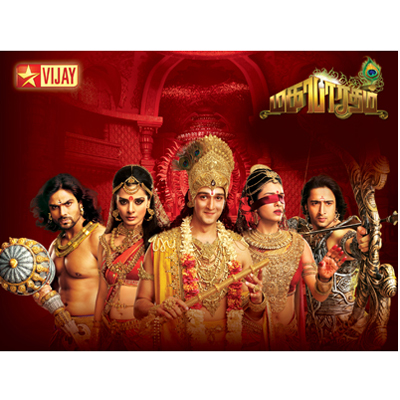
    The other big change will be the re-introduction of the dubbed version of Mahabharat which was aired from late last year, in a primetime slot which is yet undecided. “There has been a cult following of the show and we are very confident that the repeat will also give us minimum 4 TVRs,” says Star Vijay GM K Sriram. After the last airing, the channel took a feedback of people and found out that the earlier several episodes had been missed by viewers, who wanted to see it again.


    The channel plans to air Mahabharatham from second week of December. “The success of the first airing has made us take it up again. Purvika Mobile has already shown keen interest to be on board as an advertiser,” adds Sriram. This will follow a mega marketing campaign to the tune of Rs 1 crore.


    Additionally, its nonfiction show Super Singer has been shifted from 9 pm to 9:30 pm to make space for KMKV while Office has been shifted from 10 pm to 10:30 pm.


    Sriram points out that the shows at 8 pm and 8:30 pm are its blockbuster ones- Deivam Thandha Veedu and Saravanan Meenatchi and they wish to build the 9 pm band along with it. Unlike Hindi where 9pm is the supreme primetime slot, in southern GECs it is 8pm.