Tag: GDC

  • India plays its game at GDC – San Francisco developer conference

    India plays its game at GDC – San Francisco developer conference

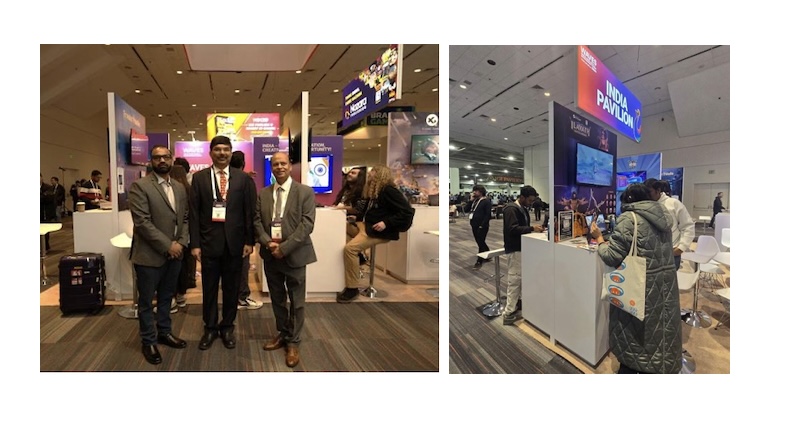
    MUMBAI: India has levelled up its presence in the global gaming industry with its  pavilion at the Game Developers Conference (GDC) in San Francisco. The showcase, inaugurated by India’s consul general in San Francisco K. Srikar Reddy, puts the spotlight on the country’s burgeoning gaming sector and its ambitions to become a worldwide content powerhouse.

    The India Pavilion features an impressive roster of exhibitors, including established players like Nazara Technologies and WinzO, alongside plucky award-winning upstarts such as Wala Interactive, Brewed Games, Xigma Games, and Singular Scheme. These companies are demonstrating that India’s gaming industry is no longer just pressing “play”—it’s pressing ahead.

    Several champions of the “Bharat Tech Triumph Season 3” challenge are also showcasing their wares, including Yudiz Solutions, Brahman Studios, and the whimsically named Over the Moon Studios. The pavilion serves as a matchmaking service of sorts, connecting Indian developers with global publishers, investors and potential collaborators.

    Beyond gaming, the pavilion is drumming up interest for the upcoming World Audio Visual and Entertainment Summit (Waves), scheduled for May in Mumbai. This flagship event, organised by the ministry of information and broadcasting through the National Film Development Corp (NFDC), aims to position India as the “Content Hub of the World”—a lofty ambition for a country already producing films and television at an industrial scale.

    The timing could hardly be better. GDC, running from 17 to 21 March, attracts the crème de la crème of the global gaming industry. By planting its flag at this influential gathering, India is signalling that its developers are ready to play in the big leagues.

    For a nation long associated with outsourced IT services, the pivot to creative digital content represents a strategic shift. India’s gaming companies are no longer content to be mere back-office operations—they’re designing the games, creating the characters, and writing the storylines that could captivate players worldwide.
    As one industry insider quipped, “India has been the world’s back office. Now it wants to be its arcade too.”

  • India’s gaming sector poised for explosive growth: Winzo report at GDC, 2025

    India’s gaming sector poised for explosive growth: Winzo report at GDC, 2025

    MUMBAI: India’s online gaming companies are gearing up for a blockbuster debut on public markets that could unlock a whopping $26bn in investor value, according to a report unveiled yesterday at the Game Developers Conference (GDC) in San Francisco.

    The India Gaming Market Report launched by WinZO Games and the Interactive Entertainment and Innovation Council (IEIC) at the India Pavilion, offers a tantalising glimpse into the sector’s meteoric rise. Currently worth $3.7bn, the industry is expected to surge at a 19.6 per cent compound annual growth rate to reach $9.1bn by 2029—and a staggering $60bn by 2034.

    “India stands at the cusp of a remarkable transformation in the global gaming ecosystem,” declared San Francisco consul general of India Srikar Reddy at the launch. The report suggests the sector’s public market potential could balloon to $63bn by 2029 if projections hold true.

    The document paints a picture of a market primed for explosive growth. With 591 million gamers—roughly 20 per cent of the global total—and approximately 11.2 billion mobile game downloads, India’s digital playground is expanding rapidly. The country now boasts around 1,900 gaming companies employing 130,000 skilled professionals.
     

    GDC

    Foreign investors are certainly not playing around, having poured $3 billion into the sector. A hefty 85 per cent of this foreign direct investment has flowed into the pay-to-play segment, which has cracked the once-vexing challenge of monetising Indian gaming assets.

    Nazara Technologies, India’s lone publicly listed gaming company, currently commands the highest premium among global gaming stocks. Apply similar multiples to the broader sector, and you get the eye-watering $26bn valuation potential cited in the report.

    “The online gaming industry in India is on an unprecedented growth path,” said WinZO  co-founder Paavan Nanda,  who launched the report alongside co-founder Saumya Singh Rathore. The duo’s company is no small player itself, boasting over 250 million registered users across India and Brazil.

    The report also highlights how Indian gamers overwhelmingly favour casual and hyper-casual games developed in regional languages, heralding what it calls “the renaissance of Indic content ‘Made in India, for the World’.”
    Despite its impressive growth, India’s gaming market currently represents just 1.1 per cent of the $300bn global market—suggesting plenty of room to level up. If projections hold, the user base could swell to 952 million by 2029, creating over two million jobs along the way.

    The report’s launch coincided with the second edition of the India Pavilion at GDC, showcasing games from major players and indie developers alike. The pavilion was a joint effort by WinZO, the Ministry of Information & Broadcasting, the Game Developer’s Association of India, and Nazara Technologies.

    In the game of global tech dominance, India’s gaming industry is clearly playing to win.

  • WPP hires former Accenture executive Prashant Mehta to lead its India GDC

    WPP hires former Accenture executive Prashant Mehta to lead its India GDC

    MUMBAI:  WPP is betting big on India. The creative transformation company early on 12 December announced that it was pumping more bucks into India by scaling up its global delivery centre  (GDC) operation in the country. It has brought on board  former Accenture executive Prashant Mehta as managing director to lead it with the responsibility of accelerating its growth globally, with the highest concentration of talent based in India.

    The specialist capability hub, which is accessible to all WPP agency teams around the world, will be headquartered in India. This further commitment to the market follows the November 2024 announcement of a new campus in Chennai,  WPP’s third after Mumbai and Gurugram.

    India’s is among its top 10 growing markets and a major source of tech innovation and creativity, and the company has been strategically scaling up its GDC team in the country.. Building on the company’s 11,000-strong workforce in the country, the GDC takes advantage of the significant resources and strong foundation of specialist expertise already in place to further accelerate WPP’s presence in the market.

    The GDC currently employs 10,000 people around the world and plays a critical role in WPP’s business transformation and simplification strategy. It unlocks WPP’s best-in-class specialist capabilities such as cloud modernisation, hyper-personalisation, composable commerce, VR and XR experiences, generative AI and product engineering to offer fully integrated and innovative solutions for clients. These services will complement existing agency expertise across media, content, customer experience (CX), commerce, technology, data and design.

    Prashant is an experienced digital transformation expert and joins WPP from Accenture, where he was global managing director of global assets at Accenture Song, responsible for its generative AI-led asset strategy, delivery and adoption. Prior to Accenture, he was the global chief product and delivery officer for Dentsu Creative & Experience, and group VP at Publicis Sapient.

    “Our GDC enables agency teams and their clients to tap into specialist expertise and new capabilities, “ said WPP CEO Mark Read. “It is underpinned by WPP Open, our AI-driven operating system for marketing transformation, fuelling growth and connecting the dots across our business. I welcome Prashant to WPP and look forward to working with him to develop our offering.”

    WPP  country manager for India CVL Srinivas, added: “As we look to drive further growth and transformation in and from India, we are excited to welcome Prashant Mehta onboard. The expertise of our team in India makes it the prime location to power our clients’ needs with a scaled world-class GDC.”

    Prashant Mehta pointed out: “It is an honour to be leading the WPP GDC, which has been built to evolve with the changing demands of our clients while delivering the highest standards of excellence. I look forward to working with our integrated teams as we harness AI and creativity to transform how we deliver growth for our clients.”

  • Inox, Fame to convert all multiplex screens to digital

    Inox, Fame to convert all multiplex screens to digital

    BANGALORE: Digital cinema solutions provider GDC Technology (GDC) has been selected as the exclusive digital cinema provider to convert all the cinema multiplexes operated by Inox Leisure (Inox) and Fame India (Fame) in India.

    It is expected that full deployment will be completed by 2012.

    GDC says that the proposed contract involves GDC Tech supplying Inox and Fame with 300 units of integrated systems comprising GDC‘s Integrated Media Block (IMB) and Barco projectors, as well as 75 units of GDC‘s Theatre Management System (TMS) with theatre automation system, and the construction of a Network Operations Center (NOC) complete with full centralised cinema chain management solution.

    “In making this important transition, we wanted to ensure the new technology would support our goal of providing the best possible movie going experience for our patrons. The GDC IMBs offer the highest reliability and picture quality of any digital cinema server out there, which is why we chose them exclusively for our patrons,” says   Alok Tandon.

    In February 2010, Inox acquired a controlling stake in multiplex operator Fame India, which created the largest theatre chain under the same management control with combined strength of 68 multiplexes and 257 screens in 34 cities nationwide, and is in the process of opening more multiplexes in the current financial year.