New Delhi: Gaming has emerged as one of the extremely promising categories of the future and is entering into the mainstream. Starting from equipment manufacturers to game creators and gamers, the industry is expanding rapidly with every passing day. Youth is now beginning to opt for gaming as a full-time career and agencies are now working very closely with brands and game developers to create a synergy.
The category has created a lot of excitement in the marketing community. Multiple brands across categories are now utilizing games as a medium to connect with their audiences as they understand that people, especially youth, are spending their time gaming. The category is slowly catching up pace in the media mix of a brand.
In the last few years, India has emerged as one of the top five gaming countries and most of the players prefer mobile over a personal computer. Interestingly, India is a mobile-first gaming market. Today, gamers include both males and females. Several experts have also suggested that the average age of a gamer in India is less than 20 years. There is a lot of younger audience and it is the freemium model that is leading to the growth in India.
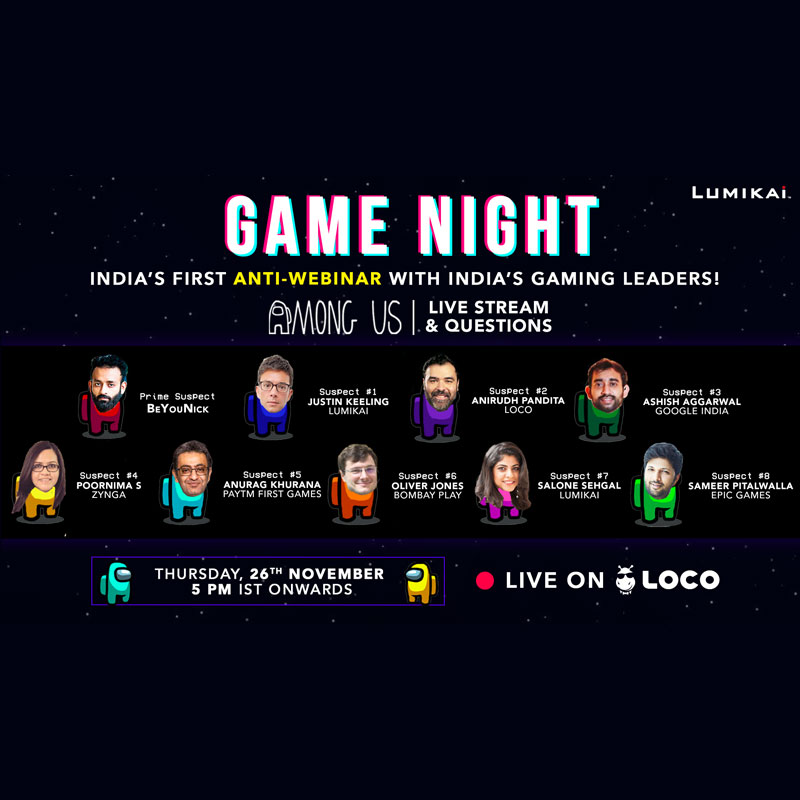
With an idea to expand the gaming ecosystem, Lumikai and Loco have organized a Game Night on 25 Nov for gamers, start-up founders, indie studios, and creators for a chat about gaming, entrepreneurship, building content and India’s growing games ecosystem
The night is hosted by BeYouNick (YouTuber) along with Justin Keeling and Salone Sehgal (Lumikai), Anirudh Pandita (Loco), Ashish Aggarwal (Google India), Sameer Pitalwala (Epic Games), Anurag Khurana (PayTm First Games), Poornima.S (Zynga), and Oliver Jones (Bombay Play).
MUMBAI: Thanks to the 4G mobile data boom, the cult of e-sports and gaming is going mainstream. The Indian online gaming industry is growing at an exponential rate year upon year, and is expected to be worth $1.1 billion by 2021. During GEMS, there was a growing consensus among experts and industry leaders that yes, gaming is indeed “Getting Into The Mainstream”.
Moderated by GroupM ESP business head Vinit Karnik, the panelists included ITC Foods business division digital strategy and media head Anushree Ghosh, Parle Products senior category head – marketing Krishnarao S.Buddha, Airtel Media VP Archana Aggarwal, MSI regional marketing manager Green Chang-Ching Lin, NVIDIA South Asia consumer marketing head Pawan Awasthi.
Karnik started the session by setting up the context for the audiences from a marketing point of view. He highlighted that India is among the top five gaming countries and most of the players prefer mobile over personal computer, making India a predominantly mobile-first market.
The experts shared their insights on how families need to understand that being a gamer and an e-sports player can be viable career options. Also, the world of gaming and e-sports is no longer taboo – more and more brands and media organizations have seized upon its potential, and have been reaching out to gamers, and through them, to their sizeable audience and followers.
Watch the session here:
Awasthi touched upon various factors that have substantiated the growth of gaming. He said: “Globally there are close to two billion gamers. When we talk to gamers, 60 percent of them game on the PC as a platform, not mobile. Worldwide, the average age is 30 plus. In India, it is less than 20 years, so it follows that our audience is of an equally young age; this is possible because of the hardware and the platform which mobile provides. It is the freemium model which is leading to the growth in India.”
For instance, game casters Dynamo and Scout, who love to play on mobile, have a following of around nine million subscribers. And there are many such players in the country.
As India has rapidly emerged as one of the most lucrative markets comprising over 300 million gamers, Taiwanese gaming laptop giant MSI is looking to move into the Indian e-sports landscape in a big way.
“We’ve been working on gaming laptops and talking to the community. India is one of the world’s fastest-growing markets. So especially for a mobile gamer, there’s a huge growth and so they’re also looking for a better device to enjoy their gameplay,” said Chang-Chin Lin, adding that India will continue to be a key focus market where MSI is looking to expand its footprints.
Talking about Indian players’ preference for mobile gaming, Chang-Chin Lin shared that during major e-sports tournaments that take place here, the majority turns up for PC gaming, but mobile gaming is certainly not to be discounted. In the gaming market, there are 160 PDM and the mobile market takes 50 per cent of it. There will be an uptick in mobile tournaments happening in India in the coming years, he predicted. Already, the success of the Mobile Premier League (the platform recently raised $90 million in financing) is testimony to this fact.
Aggarwal agreed that the e-sports landscape is booming with the influx of players and corporate investment, but there is a need for a platform where streamers or gamers can professionally play tournaments. She asserted, “Earlier, the structure was unorganized but now I am seeing a lot of media houses and companies organizing tournaments. I believe that is when the brands will start following it.”
On the marketeers side, both Buddha and Ghosh pointed out that although there is a captive audience which is playing a game, the challenge is how engaging and brand-safe it is. Hence, gaming is still two per cent of the media mix. While they see a huge scope in the gaming and e-sports space, they still need more information, proof-points, research, validation and case studies to understand how it can be a profitable investment.
“Being the household brand with a whole lot of large CPG brands, we kind of traverse in terms of the target audience that one wants to reach out to,” said Ghosh.
Elaborating on the challenges they face as marketeers, Ghosh explained: “To begin with, to advertise on gaming (and we do advertise on gaming) there are brands that talk to that 15-30 age group – whether it is a snack brand or a confectionary brand – and we are consistently reaching out to these audiences.”
Young viewers in the e-sports industry demand authentic brand interactions. As brands attempt to analyse this space, there are qualms as to whether the gaming audience will like the interruptions, given the engaged nature of the platform.
“Our question is whether interruption-based communication becomes annoying especially when audiences are engaged and suddenly there is an advertisement. We also have questions around the efficacy of media advertising. Because these are extremely engaged platforms and the consumer is actually paying to get rid of advertising. Given the nature of the platform, its effectiveness also needs to be established,” added Ghosh.
With marketeers expressing reservations on how to seamlessly integrate branded content with online gaming, there seems to be a huge question mark looming over the e-sports sector. But given the pace at which it is growing, we’re certain that in the not-so-distant future, brands would be engaging with this medium with much more enthusiasm.
MUMBAI: Live streaming technology has come a long way since its inception, and live stream viewers in India are on the rise. From conventional mainstream sports to e-sports, gaming, and online entertainment, live streaming has been used successfully in India in order to bridge the gap between new technology and traditional formats. There are about two dozen streaming services in India like Twitch, Mixer, YouTube Gaming and Hitbox, to name a few; digital subscriptions had risen by 50 per cent to Rs 3.9 billion in 2017, and are expected to hit Rs 20 billion by 2020.
Watch the session here:
During GEMS 2020, industry leaders and experts – Pocket Aces founder Anirudh Pandita, Rooter Sports Tech founder & CEO Piyush Kumar, game caster Raman Chopra and The E-sports Club co-founder Ishan Arya – discussed the future of live streaming in India.
The rise of live casting
Live streaming took off when Hotstar began streaming the IPL live in 2016. It has quickly gained ground since then, with the rise of popular game casters like Dynamo, CarryMinati, ScoutOP, and others. What started as a hobby for these YouTubers soon helped them rack up millions of followers, while also spreading the live streaming bug far and wide.
Raman Chopra started doing live streams by watching gamers on YouTube and Twitch. From being on the platform just two days a week, he started playing games every day. Initially, the gamer had a minuscule audience but it grew quickly and today, he has over 2 lakh 74 thousand followers. Just like Chopra, there are many gamers in India who have made live streaming a fully-fledged career.
With the growing popularity of live streaming, digital entertainment companies like Pocket Aces are helping streamers build their careers and make a profit. Founder Anirudh Pandita said the company has witnessed a whole new breed of content creators cropping up. For instance, there has been a marked rise in the number of game casters on YouTube in the last few years.
To cater to this segment, they’re focusing on building interactivity between gamers, streamers, and audiences through their digital streaming platform Loco. The challenges are many, but so are the rewards, and the team’s developing features and tools around it, said Pandita.
“We know talent very well; we have built some of the biggest live streams on our platform. We also know how to monetize the content, that is how we have built Pocket Aces. It was a very natural offering that we could provide to game streamers,” he further added.
Boosting viewership and scaling
In the live streaming industry, tournament organisers play a big part when it comes to promoting competitive multiplayers. E-sports platform The E-sports Club believes in building an ecosystem where gaming is conducted in a sustainable and scalable manner that is ideal for both sponsors and players.
The Esports Club co-founder Ishaan Arya highlighted that the viewership and excitement level around game casting has increased. As an e-sports organizer, Arya found out that the only way to encourage gamers to participate is by giving them real-life experiences. The company has grown from one event at a time to organising events on a daily, weekly and monthly basis.
Arya said: “The daily-weekly engagement for our content is growing massively. For instance, a campaign we did six months ago fetched us over half-a million views, and on the other hand, for another campaign that we did three weeks ago, we have already touched a million views.”
‘Live streaming next best option to real-life experience’
On similar grounds, Rooter Sports Tech is a social platform that connects sports fans and engages them during live sporting events. It launched its audio and video feature with the start of IPL and world cup matches in 2019. And for the company, the streaming business has been building up for the past 18 months.
Rooter Sports Tech founder & CEO Piyush Kumar said 2019 was a challenging year as the company was deciding to move into sports content. He focussed on building a technology that works in real-time and streaming appeared to be the best option. The reaction of fans that happens in real-time is altogether a different experience because the maximum reaction comes when the match is live.
“YouTubers and Instagrammers used to do commentary here and there to develop some audio-video content so they reached out to us. We built a set up where there are ten languages and different sets of commentators, which has now grown to 100 current commentators while the match is ongoing. It all happened with the help of UGC (User Generated Content),” he explained.
The Covid2019 pandemic led Kumar to think that the logical extension of this product would be to get into the gaming content. He pointed out that 70 to 80 per cent of content in gaming comes through streaming. He built the entire technology in the month of June, and in the last three months, it has scaled massively. The company has added 1.5 million users on its app on a monthly basis.
Monetising content: Experts debate
In Kumar’s opinion, streaming has a well-developed monetisation model. 90 per cent of the revenue made by all the key players is through monetization and the rest 10 per cent is through advertising.
“The system works by paying good publishers to create content for your platform. Firstly, we monetise through advertising which we started last year. So, we have a certain pipeline, brands and partnerships. Post this you provide them the distribution model; it could be on both apps and websites. Like Paytm and Samsung are some of your partners so we decide how to distribute them there. Eventually, take them to a level where they can monetise their content,” he said.
He went on to say that though YouTube has lots of features, it is not customized for Indian audiences.
Reports state that in the next three years, streaming will become 10 to 15 percent of revenue share of the overall gaming market. But more than monetisation, it is important to create engagement that attracts advertisers, put in Pandita.
In a similar vein, Arya said that he believes it is about giving value to sponsors who are investing money. In fact, he has increased the prize money of players by 33 per cent to motivate them.
The panellists came to a common conclusion: that e-sports and gaming is completely different from entertainment, where content could be published weekly. But when it comes to live streaming, the content needs to be created on a daily basis.
NEW DELHI: Heightened internet penetration and increasing base of smartphone users has helped generate a positive hype fore-sports and gaming in India. Amounting to 15 per cent of the global total, Indian gamers are leading the change in how gaming and tournaments are perceived in the country. The process has been further accelerated by the Covid2019 pandemic, which has drawn a significant chunk of Indian players and viewers online.
Technology is playing a key role in this process and Tata Communications has been at the forefront of enabling these technical interventions. Elaborating on how the company is leading the next generation of e-sports and gaming community into the future with its robust systems, global head media and entertainment Dhaval Ponda addressed the audience on the day one of the first Games, E-sports & More Summit (GEMS), organised by Indiantelevision.com and AnimationXpress.com.
He said, “We have the experience of working within the industry in the US, South Korea, and Europe. And we have worked with not only publishers but also technology platforms to individual gamers. We are looking at the gaming sector to evaluate the monetisation opportunities to give us a significantly better industry and significantly better experience as a community.”
Tata Communications is now striving to provide technical support to the Indian e-sports and gaming community across three key areas: digital infrastructure, streaming platforms, and production and broadcasting.
“Digital Infrastructure is something that is very close to us. The global submarine cable infrastructure is owned and operated by the Tata group. Currently, one-third of the internet infrastructure, from a consumption standpoint, is supported and managed by Tata Group and this can be the vehicle for every single aspect of viewing interaction; whether it’s streaming, or playing on mobile/iPad/PC and posting the content – the nearest CDN server will be able to do it. Also, these streams are in real-time,” he elaborated on the first aspect.
He added that their servers are running on low latency that gives a niche experience to the viewers without any lag in video quality.
Earlier this year, Tata Communication had also announced the launch of a 100G media backbone in collaboration with Swedish communication equipment maker, Net Insight, to enable broadcasters, sports organizations, OTT companies, and E-sports businesses to offer streams with up to 4K UHD resolution. Ponda promised to take it up to 8K UHD quality.
The conglomerate is already involved in remote production of some of the biggest e-sports and gaming tournaments, from completely virtualising the production to getting it on cloud servers.
“These are the points for people to consider where they can deliver a unique experience. An ultra-low-latency delivery is something that is absolutely vital for e-sports and gaming and this is something that will become a core component of the viewing experience. So by ultra-low latency, we are talking about a second or two-second delay between the event actually taking place and consuming it on a platform or video stream that we put live anywhere in the world,” he said.
Additionally, Tata Communications has set its sights on creating an exceptional pre-game and in-game experience for players. “Our comprehensively managed security service also includes DDoS attack detection and mitigation along with web application firewall and unified threat management. It is very important for the publishers too because one DDoS attack in a big event will mean people going somewhere else,” he said.
Ponda signed off by saying that things are looking pretty exciting when it comes to e-sports in India. “We’re attempting to take it mainstream, which means at par with tier-1 sports, whether it be football or rugby, or cricket.”
KOLKATA: Shagufta Iqbal aka Xyaa, a young YouTube game caster, quit her job as a computer engineer to stream full-time. Iqbal mainly focuses on Call of Duty but makes sure her streams are a mixed bag. She described herself as more of an entertainment streamer. During a panel discussion at GEMS 2020, Iqbal joked: “I don’t know what to do if streaming fails.” However, she has a back-up plan, which involves branching into vlogging and podcasts.
Another YouTuber, Ketan Patel, has amassed a following of 7 lakh plus gaming enthusiasts on his K18 gaming channel. Patel rose to prominence with the casting of PUBG tournaments before the game got banned in India. Now, the 22-year-old has ventured into vlogging too. “I am more of an entertainment gamer,” Patel said.
Clearly, instances of millennials like Iqbal giving up a traditional career to make a living out of gaming are on the rise. According to a KMPG report, the number of online gamers in India was nearing the 400 million mark as of July 2020. It’s a testament to the popularity of online gaming and streaming in the country.
Both Iqbal and Patel stated the importance of having a positive headspace in order to click with viewers. “You need to have a positive personality for your audiences. It does not to be too fancy but they should get something positive out of it,” added Patel.
While streaming, gamers can’t let their emotions run away with them either. Iqbal said she doesn’t use expletives and always maintains proper language since there are many minors who tune in to watch.
Young Indians are earning thousands by turning video games into a spectator sport. Yet, at the outset, many remain unaware of the obstacles they may encounter down the line; or after a certain point, they may flounder to stay relevant.
Now, these emerging stars are turning to talent agencies to help them work towards their goals. Loco VP operations Firasat Durrani said that the streaming platform is aiming at creating a better product for millions of new gamers. “We have had a huge inrush of casters for the last few months. We have also seen people who were not big on any other platform on social media or had never live-streamed on any other platform actually match up to the number of live streamers who are big on other platforms. We are not just offering a service but also trying to create a level playing field,” he claimed.
“At the start, no content creator knows that he/she will be a success right from the get-go; everyone starts from zero. And, the idea that you will be prepared to manage expectations is something like a dream and a vision at the beginning. This is one of the hardest parts of the job that we as managers have to do,” added Durrani.
Trinity Gaming India managing director Abhishek Aggarwal termed his job as “streaming or gaming a viable career for talents”. He went on to say how the industry has grown multi-fold in just two years. Back in 2018 when Aggarwal started his career, there were only two or three live streamers. Now, platforms like Loco alone have a database of 300-400 live streamers. Hence, it is important to keep the talents financially motivated to make them stay in the industry for a long time.
Talking about the role of talent management agencies, he said that they work as enablers. “We make them do what they want to do. We provide them with whatever facilities they need like creative support, design support, social media manager. We have an in-house business development team that goes out and pitch brands for the talents to help with connections and partnerships,” he explained.
“Currently, we have 21 partners who are streaming through Loco. We are looking after their KPIs whatever provided by Loco. We are helping them deliver a minimum number of streaming hours, social media shoutcasting, social media partnerships, etc.” Aggarwal added.
Agreeing with him, Loco’s Durrani cited an example. A streamer from Nepal wanted to get on board with Loco. Since Loco never had a streamer from abroad, the team was full of doubts and questions. The streamer lacked knowledge on how to make money in such a situation. Aggarwal’s agency mediated to help both the creator and the platform.
NEW DELHI: E-sports and virtual gaming in India is no longer limited to one-player play-to-win matches or personal entertainment without any benefits. It is now getting players recognised and driving immense monetisation across the spectrum. A fully-fledged industry now, it is supported by a larger play of schemes: from planning to development, production to play, and broadcast to post-broadcast content. And what has been at the centre of this evolution is quality content.
E-sports and gaming content production has come up as a separate genre of its own attracting technicians, creators, influencers, and publishers on board. Although the industry is still in its nascent stage, there is a wide scope for it to grow and flourish. To discuss current trends and the way ahead for the same, an elaborate panel of leading industry experts came virtually together for the Esports Production: Going Remote panel of Games, E-sports & More Summit (GEMS) presented by indiantelevision.com and AnimationXpress.com, co-powered by Tata Communications. The panel was supported by associate partner CapeTitans Games and support partner Loco by Pocket Aces.
Moderated by GoLive Games Studio founder and CEO Ravi Kiran, the panel was led by Anand Pimprikar (Tata Communications head sales BD – India, media and entertainment services), gaming/e-sports veteran Anurag Khurana, LXG director e-sports and broadcasting Kiran Noojibail, ESPL CEO Michael Broda, MPL VP-devops and reliability engineering Mukta Aphale, Playtonia Esports co-founder Sanupam Samantray, and Sky esports founder and CEO Shiva Nandy.
The speakers unanimously agreed that e-sports and gaming content is not just limited to live streams and India hosts a great pool of talent – be it technicians or players, or content creators who can take it a notch higher.
Hailing the role of content in popularising the category, Pimprikar noted: “Content drives viewership and that drives role models (for the upcoming generation of players). Therefore, it is very important to improve the quality of production, say like IPL, on both linear and essential channels.”
Multiplayer: The more, the merrier
On the sporting level, the panellists pointed out that to improve the quality of content in any e-sport or game, it is essential to make it multiplayer and interactive.
Broda said on the subject: “What I think about e-sports beside it being skill-based and competitive, it must be multiplayer. In fact, it is important for any sport to be successful. One-on-one games are good for play-to-win, real money-making challenges, but on an overall industry perspective, it is very important to go multiplayer.”
What makes multiplayer fun, added Noojbail, is that it shows glimpses of players playing the game live, making it interactive for people who are playing as well as those who are watching. “Interactivity plays a key part as unlike other games, you cannot see the player directly while playing e-sports. The entire e-sports perception eventually revolves around what the end-user gets to see and that’s where the value of e-sports content becomes even stronger,” he explained.
Noojbail also insisted that there is a dire need to curate good post-content, which goes live after the matches to keep the audience hooked. Aphale pointed out that currently, only the audience that wants to better their own game is watching the e-sports and gaming streams and broadcasts, unlike the tier-1 offline sports. This needs to be changed.
Going forward, there are two major aspects that content producers must keep in mind: how to separate the production control rooms (PCR) from the site and then how to virtualise the whole PCR, said Pimprikar.
To this end, Aphale suggested that the technology needs to focus on making the mobiles lighter so a player doesn’t have to download a lot of gaming-related programmes, and then let the cloud servers do the entire processing.
E-sports a big hit in small towns
Additionally, the panellists pressed upon the need to take e-sports to grassroots levels in India and equipping the game applications with technology and content support in regional languages.
Of the 6 crore active users on MPL, about 83 per cent of the gamers come from tier-2 and tier-3 cities, signifying that the format is already very popular there, Aphale pointed out. Therefore, they are looking for more game developers, technicians, and talents to drive the next leg of growth.
Nandy said that his aim is to further expand the presence of e-sports and gaming in every nook and corner of the country. In fact, he has already started providing streaming services in all major south-Indian languages.
Training is key to success in global arena
According to Khurana, the Indian e-sports and gaming ecosystem also requires a strong backend support system in the forms of coaches and trainers.
“I feel we have great players when it comes to the domestic circuit but we fail when we go international. It is because we are not focussing on organisation and skill development within the sector. There is a great need for psychologists, coaches, and the whole supporting sports staff within the esports ecosystem,” he explained.
Samantray seconded the thought and shared that with Playtonia, the team is already working on these lines. “We are actually working at the grassroots level and are planning to bring a certification as well as a university dedicated to e-sports.”
MUMBAI: Perhaps because people have been stuck in their homes due to the Covid2019 pandemic, the e-sports industry is bigger and bolder than ever before. For many gaming platforms, user engagement was at an all-time high during the lockdown and even now, the revenues are continuing to pour in.
Nodwin Gaming MD Akshat Rathee, an avid e-athlete himself has revolutionized the e-sports industry in India and has almost single-handedly expanded the company to the middle east and south Africa. In a virtual fireside chat with indiantelevision.com founder, CEO and editor-in-chief Anil Wanvari, Rathee spoke at length about e-sports in India and the international market and the challenges faced by the industry.
Online games have three key segments: casual games, e-sports, and real money games (RMG) that are basically skill-based online games played for stakes. However, Rathee said that there is no clear bifurcation between games in India, anything that is digital and has competition is termed as e-sports by people. This is not the case in the US or UK.
He also highlighted that outside India, the law is clearer on what constitutes gambling, skill-based games and real money gaming. He explained: “In terms of practical implications, an American or European customer is worth far more than the Indian one. But during the pandemic, physical events were cancelled and that impacted the value of sponsorship more in the western world.”
In India online viewership counts for a lot, said Rathee, citing PUBG live streams that millions tune into. “Even after the ban, the entire segment has grown… In the 45 days since the downfall of PUBG in India, a lot of other games have cropped up,” he observed.
According to Rathee, game publishers did really well during the Covid2019 pandemic. “New games were being discovered, games like The Fall Guy started becoming very popular. Apart from this, game casters benefited a lot but the algorithms did not favour the smaller players in the market,” he added.
Answering Wanvari’s question on how to clear the clutter and mess that has mucked up the e-sports and gaming ecosystem, Rathee opined that bringing in clear and well-defined regulatory measures is the only option.
“Having a differentiated definition of the word e-sports that is as per Indian regulation and doesn’t apply to the rest of the world will not work. E-sports is a speed competition. Just because a person has more money doesn’t mean he can play twice. The e-sports game needs to be fair as well so that everyone gets equal opportunity to win the competition,” he explained.
Rathee defined e-sports as something that has physicality of results. It is the physicality of moves and actions that is the differentiator between the results of the participants. For instance, chess.com clearly mentions that chess is not a sport but a game. He further added,
“E-sports are and need to be dependent on publishers. We are the world’s first sports category that is owned by someone from the very beginning. Owner of Kings belongs to Tencent, Bluehole owns PUBG, while Call of Duty is an Activision entity. So it is someone’s property – everything about the game, from the IP, data, rules, players and to the systems belongs to them,” he clarifies.
Rathee went on to say: “Another important thing is to understand the business of sports. The question arises – is e-sports a B2C business anywhere in the world without the publisher?” In his opinion, e-sports has always been a B2B business, for the simple reason that a sports organization is making money from sponsorship and media rights.
The gaming industry is at a watershed moment where the youth, information and technology, finance and IT ministry are actively making plans to regulate the sector. But there exists the roadblock of censorship and data privacy. The gaming industry is also stuck between the state and central government over GST issues. Rathee asserted that while the gaming industry is valued at less than Rs 10,000 crores, it’s like the goose with the golden egg for the government – precisely because it holds sway over the millennials and Gen Z, as well as the future of social media.
Rathee argued that it is not easy to remove one country from the ecosystem. China also has a regulatory body that makes it mandatory for companies to license the games.
“China is in a position to ban many e-sports and games because they run the ecosystem. China already has a regulatory body which could say that you have to license games through us without which we won’t let you do it. Due to the fragmentation of the internet, the Middle East is raising concern over their cultural sensibilities. So, it is a very thin line if you put a regulatory framework in place that can be exploitative,” he shared.
At the end, the question raised is whose interest you are working for. “It is important to have a proper regulatory body in place so that the industry grows,” he emphasised.
It is high time the industry developed a strident voice of its own, declared Rathee, because most of the world outside India often looks at mobile gaming and mobile e-sports as second-class citizens to the e-sports ecosystem.
NEW DELHI: Gaming and e-sports is swiftly going mainstream in India and for the industry, it’s only onward and upwards from here. PUBG ban not withstanding, the sector is giving stiff competition to major sporting events while simultaneously attracting broadcasters, aggregators, players, and viewers – all the markers of a robust ecosystem of growth and success.
However, there are still certain areas that need work in order to fully tap into the industry’s potential. At the first Gaming, E-sports, and More Summit (GEMS), presented by indiantelevision.com and AnimationXpress.com, co-powered by Tata Communications, this hot-button issue was taken up and thoroughly examined by industry experts.
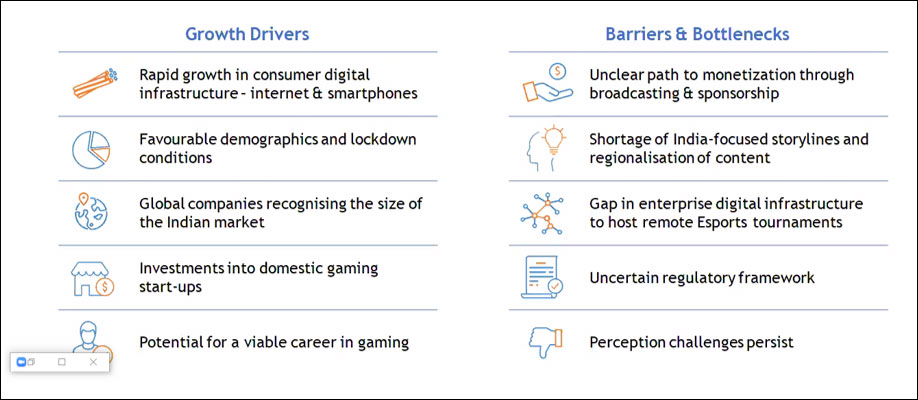
Opening the two-day-long virtual summit with his keynote address, Tata Communications global head media and entertainment Dhaval Ponda shed light on the emerging trends, growth drivers, and barriers impacting the Indian e-sports and gaming industry.
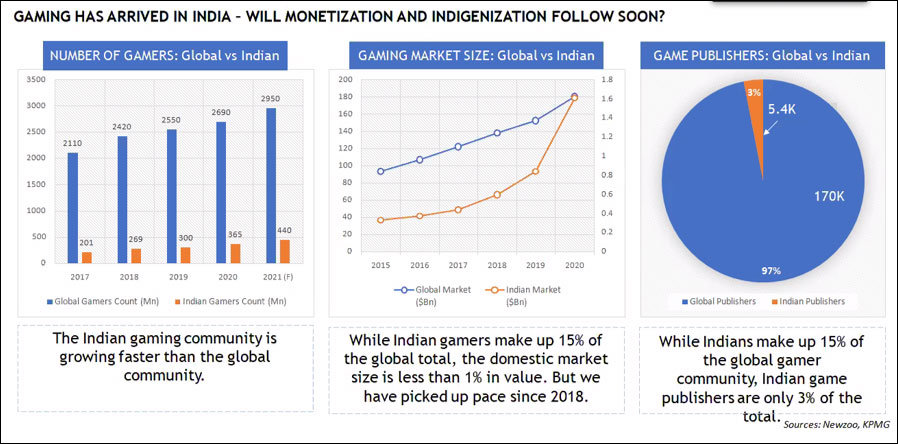
While the Indian gaming crowd is growing at a faster click than the global community, it is still not getting the right monetisation and publishing support within the country, says Ponda. Indian gamers today make for 15 per cent of the global total but the domestic market size is less than 1 per cent in value. Indian game publishers are only 3 per cent of the global value.
Though he insisted that things have started improving since 2018, there is still a lot of work that needs to be done in the sector of broadcasting and monetisation.
“We are seeing that e-sports gaming content is now being treated by these broadcasters as good as tier-1 traditional sports, and is being watched by millions of viewers. So, you (broadcasters) are also going to attract the same rights-holding fee that you would charge from tier-1 sports, like cricket and football,” stated Ponda.
Broadcasts will not only be crucial to gauge interest and get tongues wagging about e-sports,but also sustain andreinforce the community, he explained.
He added that the platforms also need to consider what else they can do beside streaming e-sports live to grab eyeballs, and make it an wholesome experience for viewers as well as the gaming community. “If you are investing, try and understand how you can be unique in your content. Ask yourself if you can have content outside of just gaming,” said Ponda. To drive his point home, he added: “For example, the way you document the NBA champions. Everyone knows where the player was born, what their history is.”
Ponda insisted that a similar culture needs to be developed for players in e-sports and gaming categories too. “People want to know who they (the players) are and where they are coming from. It is the sort of content that also sustains engagement and active viewership.”
User-experience is also going to be a crucial factor in promoting and supporting the community. “The digital infrastructure needs to grow leaps and bounds in terms of broadband and mobile internet availability. Furthermore, a sound cloud architecture, transcoding infrastructure and CDN infrastructure is required to have a good viewing experience,” he said.
Artistic and technical talent for the game development side is quite crucial too, Ponda pointed out, and suggested that the industry take inspiration from gaming studios in LA, London, and south Korea to finetune the culture within India.
NEW DELHI: The gaming and e-sports industry in India is quickly levelling up, Covid2019 possibly being the biggest booster augmenting its growing popularity amongst the masses and advertisers alike. With more and more people spending increased time on these virtual platforms promising thrill, excitement, fun, and also lucrative career opportunities, the industry is staring at a massive boom.
Albeit, there are some underlying issues related to data safety, screen timing, the nature of the games, and some peculiar nationalist sentiments to be addressed, and a growth plan to be charted that can offer the most to all stakeholders involved; from technicians to designers, to players, to aggregators, to advertisers, and to the viewers.
Indiantelevision.com and AnimationXpress.com will, therefore, be facilitating the process of direct communication amongst all the people involved in the process with its proprietary gaming, e-sports, and more summit, GEMS. The summit is co-powered by Tata Communications.
The two-day virtual conference will bring together the biggest gaming studios, game developers, broadcasters, OTT platforms, streaming giants, pro players, brands, and agencies to discuss the next level of this raging saga.
Our speakers will include the likes of Trinity Gaming founder and CEO Abhishek Aggarwal, Nodwin Gaming director Akshat Rathee, Reliance Entertainment Digital CEO Amit Khanduja, Pocket Aces founder Anirudh Pandita, ESPL CEO Michael Broda, and Parle Products Pvt Ltd sr category head marketing Krishnarao S. Buddha, among many others.
KOLKATA: The Indian government’s move to pull the plug on PUBG mobile along with other 117 Chinese apps may have come as a rude shock for game aficionado. But gamers aren’t losing sleep over it. Many are quickly reskilling themselves to train guns, strategies, and experiment on other applications. However, it has also left a question for the brands which were investing on these platforms to target younger consumers, media planners seem less worried about the void. The game is banned on mobile, however the desktop version is still available.
Tech giant Tencent has lost nearly $34 billion of its market value within two days after the news surfaced. According to a report from Sensor Tower, PUBG has more than 175 million installations from India alone which accounts for 24 per cent of the total installations worldwide. The estimates clearly indicate that India was a huge market for the multiplayer battle royale game.
“The PUBG ban in India is a great opportunity for Indian and international game developers to win some ground. This is an opportune time for the developers of Fortnite, Call Of Duty, and on local soils, Rogue Heist to ramp up their infrastructure so that they can handle the surge of new users that they will start seeing,” Zoo Media CTO and Noesis.Tech founder Siddharth Bhansali says.
Dentsu Webchutney associate creative director Zubin Jauhari also speaks about the games like Call of Duty. “For brands that are exclusively seeking gaming collaborations, there are games like Call of Duty that they could look to along with some Indian brands as well, he opines. The immediate reach in terms of audience and other engagement metrics will naturally be lower, for the near future,” he opines.
India has a huge potential for esports. As per the recent industry reports, the industry was pegged at Rs 6,200 crore in 2019 and is slated to cross Rs 25,000 crore by 2022. Experts are witnessing a four-fold growth in the coming days in this sector which clearly indicates a huge opportunity.
“I believe this move affects Tencent more than anyone else, with several reports on how Tencent’s market value dropped right after the ban was announced. PUBG had a massive following in India, but this move will affect the e-sports industry only momentarily. It opens up the doors for competitor apps to try and capture the market and is a fantastic opportunity for the Indian gaming industry to try and fill the void,” Jauhari adds.
As soon as the news of the ban on PUBG mobile was announced, Bollywood actor Akshay Kumar announced the launch of a multi-player action game called ‘Fearless And United-Guards’ or FAU-G. The game has been developed by nCore, a mobile games and interactive entertainment company, based out of Bengaluru. It is expected to by out by October end.
Supporting PM @narendramodi’s AtmaNirbhar movement, proud to present an action game,Fearless And United-Guards FAU-G. Besides entertainment, players will also learn about the sacrifices of our soldiers. 20% of the net revenue generated will be donated to @BharatKeVeer Trust #FAUGpic.twitter.com/Q1HLFB5hPt
The industry appears to be upbeat about the homegrown apps as it sees a great opportunity. Several reports suggest that the number of people playing online games is set to cross 300 million. The number has grown on the back of affordable internet and members joining from tier 2 & 3 cities.
“Currently, India is the no.1 country in terms of game downloads, but when it comes to revenue, a significant portion of this revenue is going outside the country. When we talk about digital goods, it is very easy for gaming companies which are settled abroad to add India to their market strategy, there is not much additional infrastructure that they need to invest in. However, if the gaming industry in India was to be dominated by homegrown apps, you can imagine the kind of ecosystem and the employment opportunities that it could generate,” Hitwicket VP-growth & co-founder Keerti Singh says.
While many experts are drawing similarity with TikTok’s ban as there are hardly any homegrown mobile gaming apps in India unlike short-video platforms. The names emerging as alternatives are Call of Duty(COD) Mobile, Free Fire, Fortnite, Valorant, however, none of them is developed by Indian organisations.
On the other hand, influential gamers of PUBG are probably busy developing their skills and building followers for their craft on these alternative platforms. Bhansali is of the view that brands need to act quickly to tap into gamers who are building a name for themselves on these alternative battle royale style online multiplayer games so that they can continue engaging this lucrative demographic.
“Streamers now will shift to other games. The only one that can replace PUBG mobile is Call of Duty mobile and that everyone is playing right now, all the big creators. Free Fire is also an option but the quality of gameplay is very bad for Free Fire. It’s basically a bit childish game. Conversions will definitely go to Call of Duty Mobile,” Trinity Gaming India founder COO Shivam Rao says.
TSM Entity team manager Sid Joshi also brings up an important point. According to him, banning PUBG mobile will not substantially help other games to grow other than of the same genre. It is barely going to help PC or console gaming as “a Cricket fanatic does not turn into Football enthusiast overnight.” However, Joshi adds that the gamers between the age of 19 to 25 will keep experimenting with similar games as many of them are stuck at home.
LXG e-sports and broadcasting director Kiran Noojibail also thinks on similar lines. “PC and console games are not going to have any significant impact as PUBG Mobile’s main audience were smartphone users,” opines Noojibail. However, he does not see any alternative yet in similar genre also.
Against the backdrop of a sinking economy, it is going to be very difficult as shifting to other game needs re-skilling. At the time of TikTok ban, influencers could land on another similar platform with the same set of skills.
No one can presume exact losses. “Obviously the move will impact the streamer community but as far as the people we manage are concerned, they are not complaining about it, as the decision is in the larger national interest. Everyone is in support of that. As far as brand integrations and partnerships are concerned, we are assuming that they will take a hit but it is still too early to say how big the losses would be,” Rao says.
He further adds that the major impact will be on the e-sports industry including the tournament organisers, people who are interested in lineups, boot camps and others who had tie-ups with the teams. “Those concerned groups also have to pay salaries to their players. Along with that, platforms and startups like Loco, Rio will be the worst impacted,” Rao mentions.
Noojibail also shared the same thought. He says, “A number of tournaments were also lined up which would affect the organisers’ revenue badly. Even sponsors have to re-strategise their plans. It will take at least take a couple of months before the storm calms a bit. It is a very substantial loss for the industry”.