Tag: Gajendra Singh

  • What’s exciting Gajendra Singh about his new shows on DD

    MUMBAI: There’s a lot of excitement in Gajendra Singh’s voice. Most of us know him as Gaj – the creator of the super-successful musical formats on Zee TV — Antakshri, SaReGaMa in the early part of the cable and satellite TV revolution.  Today, as the founder of production house Saaibaba Telefilms, Gaj  is quite gung-ho about his  new show that is making its debut on the national pubcaster Doordarshan.

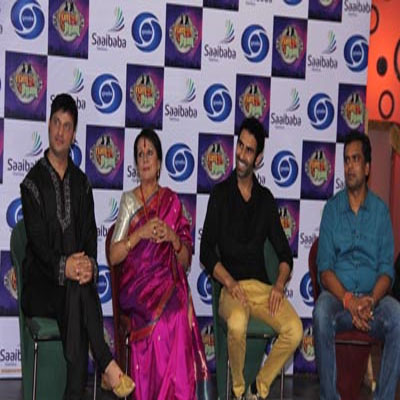
    Titled Suron Ka Eklavya – it’s intention is to find singing talent in an interesting format which seeks reversion to retro songs of three singing legends – Kishore Kumar, Lata Mangeshkar and Mohammed Rafi – with the help of well-known music directors  Bappi Lahiri, Jatin Pandit and Ismail Darbar, who will serve as mentors to the contestants.

    “Music has been my forte and  I have always endeavored to produce innovative shows. The idea is to build a bridge between the old era and the young generation,” says Gaj.  “Lata Mangeshkar, Mohd Rafi and Kishore Kumar are the pillars of film music, and therefore, even today, their songs and music are a reference point for the new generation. This show will present the songs in their signature styles but with fresh voices and innovative performances.”

    Launched on World Music Day, ‘Suron Ka Eklavya will begin  airing on Doordarshan from 29 July in the 8-9pm time slot on weekends.

    Gaj says it has taken his production house close to a year to get his show on air. “We went through the bidding process,” he says. “We were shortlisted and had to pass all the criteria that Doordarshan asked us to. And, I am happy to have got this far.”

    Suron Ka Eklavya will feature three teams which have been labeled as gharanas (houses) –  Lata Mangeshkar Gharana, Kishore Kumar Gharana and Mohammad Rafi Gharana. Contestants will sing old songs in fresh voices retaining the signature style of the respective legends with the help of their mentors and will be judged on their craft and talent. The tagline of the show is: “Andaaz Wahi Awaaz Nayi” (Retaining the style, but in a new voice).

    Going forward, Suron Ka Eklavya will also witness celebrity guests including both, actors and musicians. The production house is in talks with singers such as Sonu Nigam, Shreya Ghoshal and Sunidhi Chauhan.

    The 52-episodic talent hunt has been conceptualised by Singh and will be directed by Ashok Singh. The set has been executed by Bhavik and Munna.

    The title track of Suron Ka Eklavya  has been sung by Shaan and Anwesha, the lyrics have been penned by Swanand Kirkire and the show will be hosted by the young and dynamic Abhas Joshi.

    Filming is on at Mumbai’s Filmalaya Studio with a 15 camera set-up. “We are not maintaining a bank of 15- 20 episodes as we will be shooting live and editing on the fly and in post thereafter every week,” says Singh. “We have created a wonderful set with the best lights,  music and technicians, and have invested around Rs 2-3 million in audio, so  that we can get the best acoustics.”

    And what’s good is that Gaj is on the way to recouping his investment of around Rs 450,000 per weekly slot on DD National and production cost of Rs 2.5 million per episode. Indian Oil Corp has come on as a title sponsor whereas Vicco has come in as associate sponsor.

    “The powered by slot is yet open and we are also looking for other associates as well,” says Gaj.

    He reveals that Saaibaba Telefilms is also working on another fiction show MBA Sarpanch which is a biopic of Chhavi Rajawat who left her corporate job and city life to help develop rural India. She became the sarpanch (head of a village administration) of Soda, a village 60 kilometers from Jaipur, Rajasthan. Her grandfather Brig Raghubir Singh had been the sarpanch of the same village 20 years before Rajawat’s election.

    The  half hour show is slated to launch in August and will aired at 7:30 time from Monday – Friday on DD. It has been written by veteran Shanti Bhushan, and has been directed by Sanjeev Chadda who as done a couple of shows with Balaji Telefilms.

    ALSO READ :

    Balaji & Saaibaba bag prime time slots on DD National

    Doordarshan slots Rafi, Kishore & Lata tribute show from Sat

    Saaibaba musicals & comedy, Balaji dramas may lift DD’s fortunes from Feb

    DD non-prime time slots programmes invited; FCTs specified

  • Aircel customer wins sedan in ‘Super Challenge’

    MUMBAI: Aircel, one of India’s leading innovative telecom players, has felicitated the prize winners of “Super Challenge Contest Season 2”, an exciting general knowledge-based consumer engagement contest.Mr. Saradar Ram Dewasi, who scored the maximum points in the exciting VAS contest, was presented with a bumper prize – a brand new Hyundai Verna car. Among other prize winners, Gajendra Singh, won gold worth Rs. 1 lakh.

    Aircel Circle Business Head Karnataka Kanwarbir Singh congratulated the winners and said, “At Aircel, it is our constant endeavor to engage with our customers through innovative offerings or exciting contests and engagements.”

    Saradar Ram Dewasi, the winner of the Bumper Prize, said, “While participating in the contest I never thought that I would get a chance to win a car.”

    Aircel Super Challenge Contest, a knowledge-based contest, was conceived to engage customers in a meaningful way, wherein customers were encouraged to subscribe to the service to be eligible to play the contest via SMS with a limitation of 20 multiple-choice questions to be played per day. Currently, in its third year, the contest has successfully deepened customer engagement and created tremendous buzz among thousands of customers across the state.The contest garnered great popularity in a short span of time, as customers instantly connected with it.

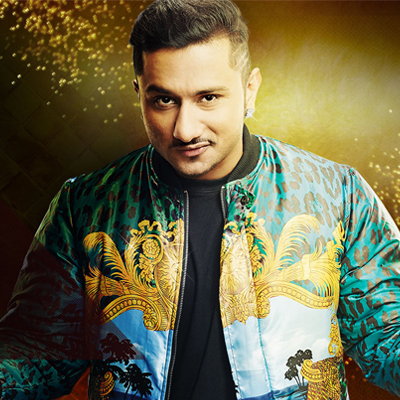
  • Star Plus gets raw with Yo Yo Honey Singh

    Star Plus gets raw with Yo Yo Honey Singh

    MUMBAI:  Indian TV viewers have been exposed to a variety of singing talent hunts over the years. You have had Sa Re Ga Ma, and Lil Champs, Antakshri, Indian Idol, Fame Gurukul, Star Voice of India – among a plethora of others. Some did well for a while; some did not even last a second season. And there is talk of the singing TV talent hunt format and genre itself suffering, courtesy audience  fatigue.


    But that has not deterred Hindi general entertainment channel (GEC) leader Star Plus from taking another stab at it  through a soon-to-be-launched show India’s Raw Star.


    The fact that it is working with arguably India’s most popular youth icon singer and music composer Yo Yo Honey Singh to unearth singing talent is probably giving it the much needed confidence. Honey Singh has more than 23.5 million likes  on Facebook, 542,000 followers on Twitter.  The India’s Raw Star audition promo on You Tube got more than 1.78 million views.


    When he posted a comment on Facebook about filming for the first episode of India’s Raw Star on 12 August, he got 46,000 likes, and around 4,500 comments from his fans. He said in the comment: “….just got packed up from Rawstar episode 1 shoot, doing Indian television ain’t no joke. Big respect to all my brothers & sisters who run this industry. Blood n sweat.”


    Over the past couple of months, Star Plus’ creative team encouraged interested participants to upload their singing videos to  the Star Plus India’s Raw Star website and to the mobile app. Hundreds of thousands of wannabe singers from all over the  world did the needful; and the entries were personally scanned by both Honey Singh and his creative team. 


    The channel is now working on a roll out plan for the  two hour Sunday show that is slated to premier on 24 August at 7 pm.  Yo Yo Honey Singh has been going on whistle stop ground promotions across the country over the past month. This will mostly increase in the run up to India’s Raw Star first episode telecast.


    What differentiates Star Plus’ India’s Raw Star from others of its ilk is the fact that there is a focus on encouraging original fare from new talent. Participants will  belt out  popular Bollywood fare when required; in addition to that they will  have to perform their own compositions and music as part of the singing competition. “The idea is to find the ultimate performing artiste who can create his own inimitable style of singing and is an all round performer irrespective of the language or the music genre,” Singh has said to creatives close to the show.


    He, on his part,  will act as a friend, mentor and guide to the 10 finalists artistes who will compete against each other  to wear the Raw Star crown .


    Production is in the able hands of singing talent show innovator and veteran Gajendra Singh and his team at Sai Baba Productions. Singh points out that the show format has been designed in a way that audiences get the feel of a live music concert while sitting in the comfort of their living rooms. 


    “We are looking at creating the first ever reality show in India sans playback singing but original voice recording,” says Star Plus general manager Gaurav Banerjee.


    Banerjee has roped in international stage director and choreographer Michael Schwandt to push choreography and dance moves up a notch. Schwandt has choreographed the high energy performances of Lady Gaga, Katy Perry, David Guetta, Kelly Rowland, and Flo Rida. Schwandt is renowned for turning mundane performances into spectacular ones.  Award winning recording engineer and music producer Ashish Manchanda has been hired to look after sound.  


    Star India VP programming Ashish Golwalkar is convinced that the show will gain traction with TV viewers. “We were looking at the kind of audiences which are active on digital. It was again a learning experience for me after having done so many reality shows in the past. Voice was what mattered here.”


    He further reveals that another difference with India’s Raw Star is that there is going to be no elimination of contestants at all for the first few weeks.


    Banerjee adds that the show is part of its strategy to get younger people to sample the Star Plus channel, and in the process attract advertisers  and sponsors targeting that audience. It has got some luck on that score: the channel has got on board Karbonn smartphones as the title sponsor and Maruti Suzuki Swift as the co-powered by sponsor.


    Ormax Media’s Shailesh Kapoor wrote in a column on a trade website recently that “given their overall dominance, Star Plus’ non-fiction record in recent years has bordered on being embarrassing. But they now have solid ammunition at their disposal: Yo Yo Honey Singh the TV star who can give a 63 per cent jump in ratings of a long-running show (Comedy Nights with Kapil saw a spike in ratings in the episode that featured Honey Singh last month) Ironically then, the Comedy Nights ratings would have probably led to more celebrations at Star than at Colors.”


    Will the Star Plus  team be celebrating 14 weeks from now when India’s Raw Star  finale will be telecast?  Punters are betting that Yo Yo Honey Singh will do the trick and break its recent non-fiction jinx.

  • ‘India’s Raw Star’ – Yo Yo Honey Singh begins the hunt for the next music sensation

    ‘India’s Raw Star’ – Yo Yo Honey Singh begins the hunt for the next music sensation

    MUMBAI: Star Plus is all set to team up with the biggest youth icon, Yo Yo Honey Singh for a first of its kind, unconventional singing reality show – India’s Raw Star.  The show that marks Yo Yo Honey Singh’s debut on television will bring in a new visual experience to music, something which has never been seen before in any singing reality show.


     Yo Yo Honey Singh will be playing the role of a friend-mentor-judge to all the budding Raw Stars.  He will be seen picking up participants from different parts who with their unique singing, style and performance, will fight it out to become the first ever India’s Raw Star.


     Gone are the days of standing in long queues for hours and travelling long distances for auditions.  Talent will now be picked up from across India and households abroad with the help of the digital platform, and success will just be a click away through the first ever exclusive digital auditions.


    India’s Raw Star kick started the audition phase of the show by opening its digital platforms for users to upload their audition video. The users have been given an option to upload an entertaining, and performance packed video of them singing on either the India’s Raw Star mobile app, WAP site or on the website. The channel has also released a special audition tutorial video with Yo Yo Honey Singh to explain to viewers the process of uploading an audition entry.


    Produced by reality show veteran Gajendra Singh’s – Sai Baba Productions,  India’s Raw Star will be on the lookout for the ultimate performing artist who can create their own inimitable style of singing, and is an all-round performer irrespective of the language of singing or the genre of music. In the show, Yo Yo Honey Singh will specifically look out for talent who are great performers and not necessarily just great playback singers.


    Nikhil Madhok, Senior Vice President Marketing & Programming Strategy at Star Plus, said, “Star Plus has always been at the forefront of creating benchmarks . With India’s Raw Star we are trying to create one such benchmark with the way we are conducting auditions for the show, which will be done exclusively on the Digital platform. Not only will this make it easier to for potential participants to audition, it will also enable others to view audition videos online, share them on social and create an online fan community even before the launch of the show. The initial response has been tremendous and we hope to see this grow in the weeks to come.”


    India’s youth sensation and icon, Yo Yo Honey Singh will be involved at each step in the journey of making the promising young talent into a Raw Star. “I am looking for talent that is authentic, original and raw! In India’s Raw Star the hunt is for someone who has his or her own style of singing, a non-tampered versatility in his or her style, someone who is as fresh as maa ke haat ka khaana. The singer has to be a performer and has to be someone who is better than me and that is no easy task!” said Yo Yo Honey Singh.


    One can log onto www.starplus.in/indiasrawstar via web or mobile phones. Alternatively one can download the India’s Raw Star mobile app. A contestant can participate by submitting his audition video along with the requested details. Below mentioned are the Terms and Conditions for the auditions and process of how to upload one’s video.

  • Why do we need sub-franchises of popular shows?

    Why do we need sub-franchises of popular shows?

    MUMBAI: Over the years, television has spawned a slew of successful non-fiction franchises which in turn have given birth to a riot of sub-franchises that are equally popular if not more.

    In our quest to find out why sub-franchises have mushroomed when there are enough and more franchises to provide entertainment and whether franchises are mightier than their off-spring, Indiantelevision.com spoke to a cross-section of industry to get to the bottom of the matter.

    Zee TV

    In 1995, Zee TV created a home-grown music-based non-fiction format titled Sa Re Ga Ma Pa that went on to capture a country’s imagination.

    What started back then under the aegis of Gajendra Singh, went on for 16 seasons till 2004 when the brand name was changed to Sa Re Ga Ma Pa Challenge and audience interaction was incorporated through a voting system. It was in 2011 that the channel infused kids’ participation to revisit the show as Sa Re Ga Ma Pa L’il Champs.

    Recalling the journey of the show, it was post 2001 that it became a brand, giving talented, albeit anonymous singers a platform and giving Bollywood much of its current talent including Shreya Ghoshal, Kunal Ganjawala and even Sonu Nigam, who was relatively unknown back then.

    In 2009, Zee created another big non-fiction property, this time in the dancing space, called Dance India Dance (DID). Till date, DID has seen four successful seasons while also giving birth to four sub-brands: DID Super Moms, DID Tashan, DID Doubles and DID Li’l Masters.

    What made Zee launch sub-franchises in the first place? “The key for any broadcaster today is to create for viewers an umbrella brand and then do a lot of exciting things under that,” says Zee TV programming head Namit Sharma. “It was a chance that Zee took and it worked. The audience at Zee is always hungry to watch new and fresh talent. Each of these shows has its own type of audience. There is a core DID audience and additionally, a different audience for each of the sub-franchises.”

    Sharma believes only successful shows make for franchises and franchises work on three things: firstly, how successful the original brand is; secondly, how innovative the creative team is; and thirdly, how receptive the audience is. Speaking of the many seasons of DID, he says the beauty of it is that with every season, the look, feel and talent can be sharpened.

    Explaining the need for sub-brands, he says, “It is fuelled by two things – one is the desire to keep doing well to want more viewership. So you know, if you are doing a DID sub-brand, it might get you more audience than a fresh show. Two – the audience enjoys it, so why not? Three – every sub-brand is actually like a new show under a mother brand. So these are all different shows. They are under one umbrella.”

    Sharma feels Zee is lucky to have two strong franchises that allow the channel to attract very good talent and showcase it in the best possible fashion.

    “There was a desire to fulfill in the singing space with Sa Re… and in the dancing space, DID took over and fulfilled that desire for talent to have a platform and the audience to watch that platform. So DID completed that wish. One of the challenges I have as a new person is to create more such franchises in different spaces,” he says.

    While Nitin Keni of Essel Vision Productions that produces DID feels that offering the same product to viewers back-to-back might erode brand value. “One is not happy about doing it back-to-back, but if audiences are seeing it as a different show altogether, then there we win. But if audiences start feeling a sense of fatigue and see that we are doing the same thing, then it loses value. So far from the ratings, it does not feel so, but yes, as a producer, we should not be repetitive,” he says. Besides, a whole lot of work goes in with every season.

    “Conceptually, every time some new twist is given to the show, we use it as a USP. There are creative people who work on it. Also in terms of finding talent, one has to scout around and find talent across the nation, which is another big task,” he adds.

    Star Plus

    In 2010, Star Plus produced MasterChef India, Colosceum Media’s cooking reality show.

    Star Plus senior vice president – programming (non-fiction) Ashish Golwalkar, who, during his earlier stint with Zee, created sub-franchises like Sa Re Ga… L’il Champs and DID L’il Masters, opines that creating a sub-brand helps a channel to leverage the popularity of the parent brand without killing it unlike adding an indiscriminate number of seasons. “Sub-franchises play a major role if you want to use the strength of the brand without overkill. For viewers also, it is easier. They are watching a bit of the same without over killing the particular kind of content,” he says. “When you go out into the market, if it is a successful sub-brand, advertisers who have earlier had a good experience with us and the brand, will be more than happy to associate with the brand again.”

    Golwalkar gives the example of MasterChef India, where Amul was the title sponsor of both the mother brand and the sub-brand, MasterChef Junior.

    So what distinguishes the sub-brand from the parent brand? “We have to understand the elements wanted in common with the original brand and those that will be brought new to the sub-brand. But there has to be a limit to it. Sometimes, channels just get carried away by doing five versions of the same brand,” says Golwalkar.

    Sony Entertainment Television

    Sony has three non-fiction franchises: Boogie Woogie, Indian Idol and Comedy Circus.

    The channel launched Boogie Woogie in 1995 with Naved Jaffrey, Javed Jaffrey and Ravi Behl. During the time it aired, the show was very well received and provided a platform for unknown talent. Only recently, Sony telecast Boogie Woogie kids’ championship, four years after the last Boogie Woogie was telecast.

    Speaking of the franchise model in general, Fremantle Media India managing director Anupama Mandloi, says: “The franchise model has worked globally and it is that success which encourages other territories including India to invest in the proven blueprint. It is like bringing in any other branded product into the country. There is a surround sound already built around the ‘product’, which enables an effective pre-sell.”

    What about the sub-franchise? “The franchise has been built very effectively over the past 10 years in India. Most television viewers would be familiar with this property today and with the need to innovate and build the brand. A sub-franchise like Idol junior opened a new gateway of contestants, music and content. In fact, we have gone as far as creating another franchise called the Idol Academy, which provides a platform for learning and building music talent,” explains Mandloi.

    The original brand, Indian Idol, launched in 2004, was a channel driver, with its opening episode garnering a TVR of 5.4. This raised expectations from the brand and it became imperative to innovate and introduce visible changes that would keep interest and loyalty alive.

    Idol has made several changes over the years, be it in terms of positioning, scheduling, changing the way the show is consumed, its approach to music, ranging from purist singing to performance and entertainment, different modes of auditioning and creating diverse touch points with the brand and the channel on-ground and various creative innovations in the journey of finding that one ‘Indian Idol’,” reveals Mandloi.

    Season after season, there was a lesson to be learnt by every content creator. “Some of those innovations were received well and some were completely dismissed by the viewer. At the end of the day, the viewer decides and with every show that you put out there for consumption, there is a lesson to be learnt by every content creator,” says she.

    After dancing and singing, it was the turn of comedy and the channel launched non-fiction property Comedy Circus in 2007. Not only did Comedy Circus see 18 successful seasons, the brand gave rise to tons of sub-brands including Comedy Circus -Kaante Ki Takkar, Comedy Circus – Chinchpokli To China, Comedy Circus 3 Ka Tadka, Comedy Circus – Maha Sangram, Jubilee Comedy Circus, Comedy Circus Ke Taansen, Comedy Circus Ke Ajoobe and Comedy Circus Ke Mahabali, among others.

    MediaSpeak

    Big Synergy director Anita Kaul Basu who has given new dimension to Indian television by producing Kaun Banega Crorepati (KBC) on Sony believes one needs to keep re-inventing to bring in the fresh perspective to the show. KBC never had a sub-franchise when it started in the Hindi space, but it brought a lot of changes within the format with each season. Whether it is in terms of format or creative, with every season it has enthralled the audiences with its content.

    Basu explains: “For long running shows like KBC, which is a knowledge-based show, you need to bring in variations so that people don’t get bored of watching the same thing which has happened 10-12 years back. Every time you bring in a new creative, while the main show remains the same in terms of structure, but these are creatives that need to come in to bring in a certain amount of dynamics into the show. In KBC, we have introduced small changes, since it started in 2000, yet its core remains the same, because its format is incredible.”

    According to media professionals, mother brands have worked better than sub-brands; some working wonders for the channel and others not. “Frankly, I don’t think any of the franchise models have worked. Indian Idol Junior didn’t do that well for the channel. Comedy Circus was variation, but more of, it was about making themes out of the show and as a viewer; it looked like a regular show. It wasn’t a separate franchise to that extent in its pure format. Dance India Dance is the only one which has done variations, but it is always the pure form that gets the maximum ratings. From a ratings perspective, I don’t think these shows have stood out like a typical franchise,” says Helios Media managing director Divya Radhakrishnan.

    According to Radhakrishnan, a sub-franchise is just a placeholder so that the channel does not have to do the same thing over and over again. The channels have to keep the interest going for any show as a product. “You cannot run it like a daily soap for years and years. The channel has to keep the brand alive and for that, they have to always keep innovating. Then it makes sense for the channels to make a sub-franchise. The main property within that umbrella will always be an original show.”

    Investment

    Advertisers in India spend around Rs 20,000 crore on TV ads and almost a third of this money goes to Hindi GECs. Reality shows can never go wrong, reveals a TV executive on the condition of anonymity. Moreover, the channels also sell spots; a 10-second one could cost anything between Rs 3.5 lakh and Rs 5 lakh and the production cost of an hour ranges anywhere between Rs 80 lakh to Rs one crore.

  • Social Media to set a red carpet for sports and entertainment

    Social Media to set a red carpet for sports and entertainment

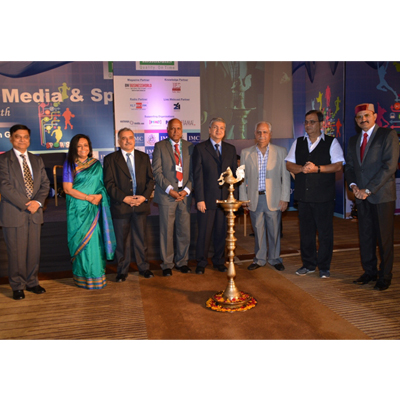
    MUMBAI:  IMC FUSION 2014, a conference presented by Indian Merchant’s Chamber (IMC), was followed up with a series of panel discussions on the major roles played by the social media in today’s three most dynamic sectors – Entertainment, Media and Sports industry.  Ramesh Sippy and Subhash Ghai were most honourable guests inaugurated this third edition of IMC Fusion 2014. This conference was divided into six sessions which focused on several trending social media topics in this generation. It also witnessed the launch of a Knowledge Paper on Multi Screen Behavior: A Study on Emerging Consumer Dynamics. 


    The IMC FUSION 2014 Conference was organized under the auspices of IMC’s Entertainment, Media & Sports Committee chaired by Mr. Manmohan Shetty and co-chaired by Ms. Bharathi Pradhan, Mr. Sanjoy Chakrabarty and Mr. Mir Ranjan Negi.  As in the first two editions, Mr. Kabir Bedi was the Host of IMC FUSION 2014. 


    The first session included an in-depth discussion on the urgency of software for today’s media content. ‘What prevents Indian media content to extend globally?’ This question received several views from the panelists. Indian media needs to bring in more variety of local and adventurous content at the same time. Gajendra Singh, Founder of Saai Baba Telefilms Pvt Ltd. said, “In order to make the Indian content globally known, the Indian media needs to pay attention toward showcasing an interesting content, helping the marketing team, co-producers to make the Broadcasters buy it and promote it eventually.” 


    The Broadcasters go forward with a long term investment into a show only if it creates TRP’S but instead it should also turn its attention to a simple and multi-lingual content at the same time. Anupam Mandoloi, Managing Director of Freemantle India, added, “The fact is that India does not have a distribution network and sufficient bandwidth to tap content across the world.” Siddharth Basu, Managing Director, Big Synergy Media Ltd, highlighted further, “Media Partnership between the Government and the Broadcasters can increase the scope of Indian content worldwide.” 


    ‘Does social media affect Traditional Journalism?’ To this, Suchitra Iyer, Editor of Society Magazine, said, “It has in a way challenged the print media, as celebrities leak out their latest happenings using social media platforms.” Harshil Karia, Co-founder Foxymoron, said, “The mobile device reaches out faster than any other media device.” It in fact helps print media to reinvent news, which proves that social media and print media are the two important wheels of mainstream media.” 


    ‘Major role of social media for sports’, the most trending topic for new generation media was also analysed. Digital platforms, especially ‘Twitter’ has proven to be a branded content mechanism in giving out a wider media coverage to sports. Vinod Bhanushali, President, Marketing, T-Series said, “Social media not only adds a spice to sports but also helps the music industry which includes Youtube and Twitter.” 


    New Delhi Television (NDTV), a pioneer leading in India’s news television, was presented with the Excellence Award in Media. Mr. Sreenivasan Jain, Managing Editor, NDTV was present to receive the award and thanked the IMC Fusion Jury. While accepting the award Mr. Sreenivasan Jain added, “Receiving a prestigious award actually creates a standard and encourages us to even improve and set new standards for the content of news overall.” 


    The different business aspects of the Indian cinema were also highlighted by Komal Nahta, Editor, Film information, Mukesh Bhatt, Producer / Director, Ramesh S Taurani, Producer, Tips Industries Limited. The availability of multi-screen theatres has led to the change in the normal mindset of Indians who prefer to experience the movie first in the theatres

  • East competes West in DDs new dance reality show

    East competes West in DDs new dance reality show

    NEW DELHI: Earlier this week, Doordarshan telecast an innovative reality show, Bharat Ki Shaan – Rum Jhum that saw classical Indian dance forms compete with Western dances.


    The programme commenced on DD National on 14 October and will be aired every Monday and Tuesday at 10.00 pm


    Conceptualised and created by the pioneer of reality shows in India, Gajendra Singh, the show has a unique concept and is being developed by the living legend of Indian classical dance Dr Sonal Mansingh.


    On the occasion, Doordarshan ADG (Publicity) V.K. Jain said: “We are very happy to produce, Bharat ki Shaan – Rum Jhum. With this show, we want to expand Bharat ki Shaan in the form of dance. The concept of doing Indian classical vs. non-Indian dance was conceptualised by DD Director General Tripurari Sharan. It was his idea to get the traditional and contemporary Indian dance vs. other forms of dance to bring out the cultural values from different parts of the world.”


    At present, Bharat ki Shaan is confined to singing.


    Mansingh will be seen for the first time on Indian television as the “Guru Shrestha”, the supreme judge. She has been honoured with Padma Bhusan and Padma Vibhusan, and is renowned world over for her expertise in Odissi and Bharatnatyam and her interpretations of the classical in modern terms. Rum Jhum is an extension of Dr Mansingh’s vision. “It is a strategy for me to bridge the gap between the popular and pure arts. I hope the show doesn’t only let the country discover new talents, but also discover dance in its diversity, richness and beauty,” she said.


    Saaibaba Telefilms CMD Gajendra Singh, who has been known as the creator of musical reality shows in India with shows like Antakshari, SaReGaMa, Voice of India, Music Ka Maha Muqqabla and the recent hit Sur Kshetra, will foray in to the world of dance with Rum Jhum. “I am looking forward to the show as much as my viewers who likewise are ardently waiting for its launch”,  Singh said.


    Besides Dr. Sonal Mansingh, the show has two other expert judges – Sandeep Soparkar, who is an expert in Ballroom dance; and Sandeep Mahavir, a Kathak dancer and expert – to groom and train and get the best from the contestants.
    Talking at the occasion, Sandip Soparrkar, said: “There is no other platform which gives prominence to non-Indian dance forms in particular. I am extremely thrilled to be a part of this show. I am glad that Gajendra Singh came up with this offer. It is a wonderful opportunity. My best wishes are with all the contestants and our entire team. I am sure we will make a great show.”


    Sandeep Mahavir, who is representing the Indian dance forms is a young Kathak dancer-choreographer who is popularising the Jaipur Gharana of Kathak the world over. “Rumjhum is a big platform for me. Youngsters who want to make a career in this field can go places because of this platform. It is not a competition but a representation of two art forms. I am excited to see the audiences’ reaction. I just hope that the upcoming talents and the contestants don’t have to struggle the way we have,” he said.


    While the two dynamic dance gurus look forward to add a dimension to the show, the fascinating blend of classical, regional folk and western music combined with Bollywood, will keep the entertainment quotient always on a high.

  • ‘Once digitalisation happens, let a thousand channels come’ – Sameer Nair

    ‘Once digitalisation happens, let a thousand channels come’ – Sameer Nair

    Concluding our three-part series of interviews looking at the year that was and on into 2008, we turn the spotlight on NDTV Imagine CEO Sameer Nair.  In a candid chat with Indiantelevision.com, the former Star Entertainment India CEO offers his take on the entertainment industry, why he feels the TV industry needs a kick up, the importance of not just ambling along, and the potential that 2008 offers.

    What were the key points of reference which defined 2007? One would be for you personally and also if you could offer a sense of where the industry is in general?
    Well, I left Star TV, in which I was working for about 13 years. But I think 2007 opened on a good note because we did KBC with Shah Rukh Khan and so I thought that was a good swansong of sorts for me. We also got Gajendra Singh from Zee to Star. He was with Zee for I think 16 years and so this was something equally dramatic.

    So those were the last good things to do at Star. On a personal level it was of course moving on and setting up a whole new company, a whole new business and preparing for the launch of a new channel.

    2007 basically marked preparation for 2008?
    Yes! As you can see, it’s been all the pre-production and production. And now we get ready for release. So it’s been a lot of that kind of hard work. It’s been about team building… It’s been about company building. It was about resource building and also financial resource building and putting it all together.
    I think by the time indiantelevision.com puts up this interview we will have over 132 people, which is I think a good collection of people across all disciplines.

    What were the positives that came out of this year?
    One positive of course is there seems to be a lot of interest in all things media, in all things entertainment. So there have obviously been so many more players entering the market, so much more money being put into the market.
    So that’s obviously a good thing, industry per se. I think a lot of people have announced or started new ventures, which shows that there is obviously place for growth and a place for new players to get into.
    There is some level of consolidation, there is some increased activity of international participation in local business. The movie business has gone through the roof.

    But was it a good year for the business?
    2007 was an interesting year because it, in my mind, remains a sort of a question mark. It will get resolved in years to come as to whether it was a good year or not. But right now everything is too close, so I mean this was the year where millions of dollars were pumped into the system. You know prices went through the roof, newer and newer players getting into it, each man with bigger and bigger claims and promises. Nobody talks the normal figures anymore.
    Everything is in a super inflated scenario. It’s like the wire where the string is really stretched. So whether it will be good or bad, it is hard to say now. Currently, everyone is into this valuation zone and everyone seems to be so rich.

    The rollout of digital cable, which was supposed to proceed in a particular manner, did not go the way it ideally should have. Your views on this?
    That is hardly a surprise. There was always this issue about how it would roll out and if it would be mandatory or voluntary. How does it all work? It didn’t really come as a surprise that it didn’t happen in A or B or C manner.

    So effectively nothing of any real note happened?
    No! There was no landmark legislation that occurred, there was no landmark regulation that occurred, there was no landmark activity. I don’t really think that there has been any major change. The world has not undergone a digital revolution, nor a mobile one. On television, some shows are doing better than others. The gap between Star and Zee narrowed, Zee came within a whisker of Star, than it again fell back. Now it is again coming back pretty much as per calculations. But there was nothing outstanding. It was straightforward.

    But for the industry in terms of sports, a lot happened.
    Sports was an interesting thing that happened. That was pretty good if you look at the high priced acquisition of the ICC rights (by ESPN Star for $ 1.1 billion).

    It is not looking so high-priced now because T-20 was not a factor in that purchase and now it’s there as a very high value part of the ICC rights.
    T-20 is the best thing that happened to Indian cricket. It completely re-energised sport and completely reignited interest in it. Now between ICL and IPL, it has really brought the sport back. But the price points, because there is no distribution revenue in this model of note, is not robust at all.

    The lament is that distribution channels are clogged and yet we have all these channels launching? Isn’t that a big contradiction?
    Well distribution and then everything that will happen as a result. Some people look at this business and they say that, ‘Oh so many new players are launching, there is no space.’ On the one hand we talk about how the market is growing, the media sector is growing. The other version is that it is growing but there is no space for new players, which is actually the exact opposite of growth. You know its like saying that the movie industry is growing but let’s any not make any more movies.
    They are completely contradictory terms. So once digitalisation happens, whichever version they choose to refer it by, I’d say let a thousand channels come. Because water finds it own level, and people decide what they want to see, when they want to see, how they want to see and what they want to pay for and it all sorts out in the end.
    But saying let not a thousand channels come, is not progress at all. It does not mark progress for consumers, or for operators. or for anyone as a matter of fact.
    What the TV business needs is one nice kick in the butt, like the telecom business got. This is what will help it really surge forward. So far it has been sort of ambling along.

    Everybody is expecting that Reliance will give that kick. Reliance is launching DTH this year, Bharti is launching.
    This is why 2008 will be a year to write home about. We hope that 2008 will be the year for the industry to really surge forward and make that big leap forward.

    Each year we talk of the big leap forward, but it’s not happened. 2004, 2005, 2006. You know few things occurred here and there, like suddenly in 2006 the cricket purchase was big. But the rest of the industry didn’t keep up. The whole $ 612 million price point (by Nimbus) was based on some assumptions, and those assumptions didn’t really come through.

    The fact is that all of business is predicated over some basic parameters, which is that people will go to movies, people will buy movie tickets. People will pay their cable bills. Advertisers do need to reach to consumers and they will buy advertising. That’s basic, and our problem is that we don’t have this in the TV part of the business. We don’t have this one little basic matter about people will pay their cable bills which will then be passed on. So it leaves a lot of things in the air when you talk about the television business.

    You are talking about pricing, subscription?
    It is already priced. Subscription is priced. But when you try and compare talk time, in the telecom context to TV, that doesn’t really work. Because the input cost on TV for example is not talk, it is real cash. If people play cricket, make movies, shows, that is like a real cost. It is not talk time. So when you say that every home will pay Rs 5 per month for a channel to see movies and serials, at some point the mathematics are not going to add up. So it is just that these things will get sorted out as it goes along. As more players get into it I think that the industry itself will sort it out.

    But there is also the theory that the government will not allow the market to determine costs of TV (and cricket) because other forms of entertainment are becoming too expensive for too many. Multiplexes for example are out of reach for many. So there is only TV. This would mean that tomorrow the IPL will be termed as being of national importance and will become free to view.
    You must note that there is no such thing as a free lunch ever, so somebody has to pay the bill. What’s been happening in the last so many years is that the advertisers have been paying the bill. The advertiser is the ultimate God who is paying for everybody’s lunch.

    Currently there is a combination of private equity money and advertisers who are footing the bill. But eventually, the bill will have to be paid by the consumers, who consume content in whatever manner or the price points will have to come down. So either all the price points return to normalcy by which the market settles and everything will sort, or you will have to pay the bill.
    Anywhere in the world in a mature TV / entertainment business, you have the twin model (advertising / subscription). That’s the way the business works. For us, it’s always been immature, fully lopsided towards the one side. Do you know any other market which boasts of 300-400 channels which are all essentially ad supported because distribution as a model is all over the place.
    You go to any other country where it is supported this way, you will find 5-10-15 channels. So that’s something which has to be sorted. It is not like players have to think that India is unique. And I think this has to happen.

    It is just a functional evaluation. This is what it needs, that leap forward. The input cost is going through the roof, return is coming down, and for the majors it is flattening their margins.
    For others what would the plan be then? So that, I think that has to happen and as they see that as the defining moment. Whether you define a moment or the moment defines you, in any case the industry will have to define the way forward. Whether it is collective or individual, something has to happen.

    That is exactly the contradiction in this. But it needs resolution. Otherwise a lot of these contradictions can co-exist for a long time. Things can go round and round and circle and circle without imploding or exploding.

    Something has to give?
    Over the last 6-8 months, and with the spate of these new announcements, there has been more addition into the TV space. This is obviously going to create an enormous amount of pressure on the current infrastructure. Obviously we are all new, we wish to make a mark for ourselves, so everyone will do things to try and make a good impression. There will be the existing players, who will obviously look to protect their turf.

    But it is at an interesting point because there is pressure on the system. Now this has never happened before, that there have suddenly been so much, forget new channels, so many new platforms that are all coming at the same time. There is this huge interest in the movie business all of a sudden. In the last year and a half all that has happened.

    Screens are opening up…
    Screens are opening up, It’s happening. So, as the pressure increases, obviously people will find newer and newer ways to do things. New minds enter into it, lots of different people, younger people, coming out with even cleverer ideas. It has to go through a change.

    So 2008 has a lot of potential?
    We hope, though these predictions have been made many times in the past and have sorely let you down. But 2008 seems to have a better chance than most years to make a real impact.

  • Adieu, eventful ’07!

    Adieu, eventful ’07!

    Man, it’s been an eventful year if you have been faithfully stuck to the couch lapping up everything offered on the tube.

    So much happened on the telly, and yet, so little was achieved. There was an average of a new soap every fortnight, an average of a talent hunt every month, and enough of cricket and cinema buzz to get those sticky eyeballs. But if cinema left a Chak De India or a Taare Zameen Par for audiences to ruminate on, TV this year left no equivalent imprint.

    Not many shows experimented, preferring the formula to being the first in
    the fray. So, Star One’s Laughter Challenge spawned a sequel and rival
    channels floated their me-too shows. Gajendra Singh carried his music
    talent format to Star Plus, and had to compete with his own Sa Re Ga Ma Pa Challenges on Zee for the ratings. Indian Idol had a tired season three,
    and Zee’s extended family of Betiyaan and Bahuraniyan, despite a
    ‘different’ beginning, dissolved into modified versions of Ekta Kapoor’s
    popular soaps elswhere. If anyone, it was Shah Rukh Khan who emerged as the surprise winner of the lot. No one expected Khan to be a patch on the Big B when it came to hosting Kaun Banega Crorepati, but Khan emerged with a style and spontaneity of his own that became endearing as the show progressed through the weeks. When the season ended, one was almost sorry to see him off.

    Well, not everyone stuck to the formula. Smriti Iraani, the actor, turned
    producer with Thodi Si Zameen Thoda Sa Aasman and later Virrudh. Interestingly, although neither show was meant to be a TRP hogger, both had a hard hitting plot, strong performances and made a subtle statement on society. Anurag Basu’s Love Story and Four, both on Sab, too were intended similarly, but somehow missed the mark. Unfortunately, all the experimentation seemed to miss the comedy genre entirely, with Star One finally relying on last year’s Sarabhai vs Sarabhai to bring on the smiles at primetime.

    All the laughter was restricted to stand-up gags offered by Raju Shrivastav (who must have been TV’s top grosser this year) and others of his ilk who appeared with alarming regularity on mainstream channels as well as news channels. Sab’s desperate effort to bring on the laughter each night failed for the umpteenth time, but it keeps trying. News channels, meanwhile, found this year that the best bet to fill up programming is to run repeats of talent hunts and behind-the-scenes goings-on at these shows. Under the garb of ‘entertainment news,’ hours of Hindi news channels continued to be chock full of idols, voices of India and the chhote ustaads all through the day.

    Even as long running soaps continued to run – Saarthi, Kumkum, Kyunki…,
    Kahaani…are examples – a milestone of sorts was reached when the ‘bahu’ of Indian TV (Smriti Iraani for the uninitiated) crossed over into enemy territory as Vrinda on Zee’s Teen Bahuraniyan. Not just that, she came armed with a tulsi plant and a similar agenda – of saving the daughters of
    the family and salvaging the family’s reputation. Ekta’s long shadow on television programming refuses to fade.

    But the year clearly belonged to the genre of the music talent hunt. If you
    had half a voice and wanted to be discovered, TV was waiting for you.
    Whether you knew the lyrics (Bol Baby Bol), were a kid that could sing (Lil
    Champs
    , Chhote Ustaad) or were an amateur singer (Indian Idol, Voice of India, Bathroom Singer…) TV was waiting with auditions in remote towns to find you. Of course, even if you were a wellknown composer or playback singer, or even a TV actor with pretensions to singing, but had never had your share of the limelight, you stood an excellent chance of turning into a mini celeb yourself. Ask Vishal – Shekhar, Abhijeet, Ismail Durbar, Alisha, Shiamak Davar and the rest who never had it so good as this year.

    But if anything marred the happiness of the couch potato, it was the unending film promotions that invaded everything on TV – the talent hunts, the soaps and the news and music channels. The marketing of Om Shanti Om and Saawariya on TV reached a screeching crescendo in November, till
    viewers’ ears ached from listening to ‘Dard e Disco’ and watching Ranbir Kapoor drop his towel for the umpteenth time.

    Also irritating was the omnipresence of judge/mentors like Javed Akhtar and Mahesh Bhatt, who judged shows, voiced their opinions on every subject and were probably present at every award show that was aired on TV.

    But couch potato’s vote of the year goes to Rakhi Sawant, who has
    established herself as the queen bee of Indian TV, by hook or by crook. With her antics, her tears and tantrums and her comments, the ‘item girl’ showed us that it was easy to get into primetime, if you knew how to tease the camera and tempt the channels. Lage raho, Rakhi!

  • Big B on Zee’s Titan Antakshri

    Big B on Zee’s Titan Antakshri

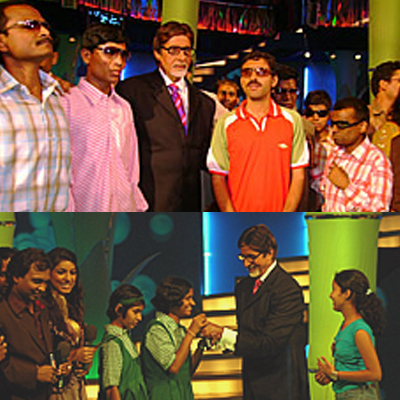
    MUMBAI: The special episode of Titan Antakshri on Zee Television was made even more memorable for the visually impaired participants with the presence of Amitabh Bacchan. Big B regaled the audience with a rendition of Khalid Hashmi’s “Main Prakash Hoon, ajar amar andhakar ek nirav gunjan”. The poem specifically reflected the fact that blindness in not a drawback.

    Zee TV Titan Antakshari has devoted a six-part mini series looking at socially relevant issues like problems faced by the visually impaired, shelter for senior citizens and rehabilitation of street children. The series called Music for a Cause. The telecast of the mini series will start from 23 March at 8:30 pm. The show featuring Amitabh Bacchan will be aired on 31 March.

    The show will also feature two visually challenged girls who presented a letter to Bacchan wishing his mother Teji Bacchan a speedy recovery.

    Bacchan had himself played the role of a teacher training a visually impaired student to understand the world and stand on her own feet in Sanjay Leela Bhansali’s Black and was touched by the gesture.

    Zee Titan Antakshari was brought back on the channel this year after the original team led by Gajendra Singh moved to Star camp.