Tag: FY18

  • Facebook India reports 27% rise in profit in FY18

    Facebook India reports 27% rise in profit in FY18

    MUMBAI: According to Registrar of Companies (RoC) filings sourced by data platform Tofler, Facebook India Online Services reported a 27 per cent increase in net profit to Rs 77 crore for the year ended March 2018.

    Facebook reported a 53 per cent rise in revenue from operations to Rs 521 crore in FY18 from Rs 341 crore in FY17. At the same time, expenses went up 55.4 per cent to Rs 443.8 crore in FY18 from Rs 285.5 crore.

    The company’s employee benefit cost also rose 18 per cent to Rs 110 crore from Rs 89.6 crore last year.

    Although, Facebook reported a 53 per cent rise in revenue in FY18 but as per filings, it reveals that there has been a slowdown in the rate of growth. Facebook had reported a 93 per cent jump in revenue to Rs 342 crore in FY17 from Rs 177 crore in FY16. And with that, the growth in net profit also looks to have been slowing down as Facebook’s net profit had jumped 31 per cent to Rs 40.7 crore in FY17 from Rs 31 crore in FY16.

    After the Cambridge Analytica data breach, Facebook had drawn a lot of criticism both from users and advertisers. Since then, Facebook has tried to take several measures to fix the issues.

    To call attention, in India, Facebook has undertaken an offline process to verify identity and locations of political advertisers in India as the country’s general elections arrive next year.

  • Broadcasters see regional adex space growing

    Broadcasters see regional adex space growing

    MUMBAI: Now that the Hindi fervour has died down, broadcasters and advertisers have latched on to the regional segment. It's no wonder that the adex in the space is expected to grow as well.

    According to the global ad growth forecast of GroupM, India’s adex is expected to grow at 14.2 per cent compared to the global growth average of 3.9 per cent in 2019 and is likely to change. Indian adex has grown by 13.2 per cent in 2018 as per estimates by the media agency network. Moreover, according to the KPMG report 2018, regional and Hindi GECs continued to be the leading genres in terms of advertisement expenditure in FY18. However, the adex on Hindi GECs declined by 9 per cent in FY18 as compared to an increase of 5.4 per cent in adex on regional channels, outlining the overall growth of the regional market in India.

    Throwing light on the Tamil and Marathi genre, they saw a marginal decline of 2 per cent and 9 per cent respectively while other major regional languages such as Telugu, Kannada, Bengali, Malayalam and Oriya, saw a growth in their contribution to the overall adex in FY18. This indicates that other regional languages are picking up quick.

    In Februrary 2018, Viacom18 entered the Tamil GEC market with the launch of Colors Tamil, with an availability across 11 million households in Tamil Nadu and 22 hours of weekly original content at launch.  

    Commenting on the same, Viacom18 head regional entertainment Ravish Kumar said that part of it could possibly be caused by the FTA channels which have come up in Hindi. The viewership has moved to them and that has led to margin dilution as opposed to margin accretion. “On the regional space, you must have seen a lot of consolidation on the top end so where the strong are getting stronger and the weak are getting weaker, more margins are analysed which normally means that the ability to command high rates are high.” He added that it is backed up with a lot of investment in formats like reality, movie premiers or events which typically tend to command higher rates.

    He further added that the growth in regional space is in double digits. Commenting on the decline in Tamil and Marathi, Kumar said that the ratings of regional channels have only increased steadily over the years and short term ups and downs are expected.

    The other factors that would aid adex growth are big ticket events such as several state elections, government advertising and cricketing events. FMCG continues to contribute 51 per cent to the total television spends followed by telecom 12 per cent and auto 8 per cent that helped reach a growth of Rs 820 crore in television adex in 2017. Hindi GECs, including FTA, contributed 28 per cent of overall television adex and Hindi is by far the largest contributor to television adex.

    As per the report, Times Network MD and CEO MK Anand said, “2018 will be a good year for adex overall. The economy has more or less come to terms with the earlier disruptions. We don’t expect any major new policy changes since it’s an election-eve year. And not to forget, the 2017 base is a depressed one. So growth will be decent.”

    Speaking about the Bengali cluster, Zee Bangla had recently refreshed its channel’s campaign by observing a wide surge in the viewership off late. Meanwhile, in an interview with Indiantelevision.com, ZEEL business head for Zee Bangla and Zee Bangla Cinema Samrat Ghosh said that in terms of ad space, it has observed a good amount of contribution to the national players as well as the local players and it sees a lot of opportunity in West Bengal in the GEC space in terms of viewership. “As I have already said that the Bengal TV viewership is growing at a CAGR of 5 per cent whereas the ad expenditure is growing at 13 per cent.”

    Adding more relevance to Ghosh’s point, ZEEL cluster head regional markets Amit Shah said that the total Bengali TV ad market is pegged at Rs 1000 crore with 90 per cent of the spends going towards Bengal GECs. “National advertisers are seeing a lot of merit in choosing Bengal for their incremental purpose where the national brand is concerned. Now, most companies divide the country into zones. According to that division, East zone in most cases is growing faster than the rest of the country which itself means that there is some good momentum in the market.”

    Whereas, in terms of Kerala market ZEEL CMO Prathyusha Agarwal said that South GECs is a larger universe with larger audience. “It actually contributes 33 per cent viewership of the network and 23 per cent of the adex share. Hence, there is scope to grow there. The total adex in the Kerala market is estimated to be Rs 650-700 crore.”

    As per the reports, with increasing focus on quality content in the regional markets, the production costs also saw an increase in FY’18. The production cost of a single original episode in the southern languages ranged between Rs 1.75-2 lakh and the acquisition price for a single ready dubbed Hindi series episode was between Rs 35,000-50,000 per episode. The proportion of local advertisers in regional channels ranges from 40-60 per cent, with the remaining being national advertisers, and this mix is skewed in favour of local advertisers for regional GECs outside the top three to four.

    Star India south business MD K Madhavan said, “The content costs saw an increase in FY18 on account of significant improvements in the quality and production value of regional content. For non-fiction properties like Big Boss Tamil, the content costs were significantly higher, an indicator of the quality that audiences are now expecting.”

    It remains to be seen what does the year 2019 have to say to the broadcasters about adex in the near future.

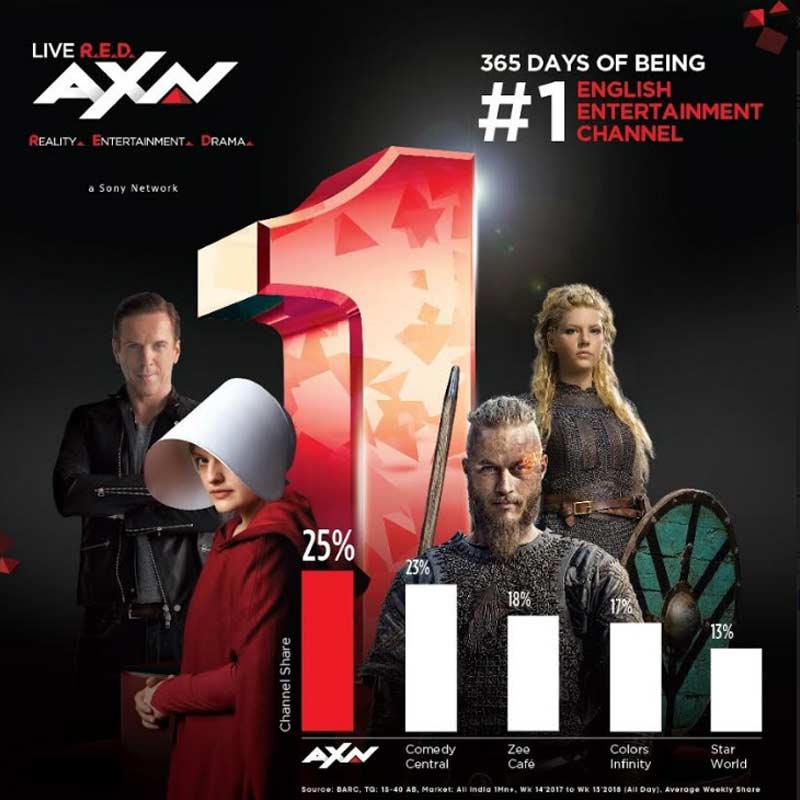
  • AXN is the Undisputed Category Leader with 365 Days at No.1!

    AXN is the Undisputed Category Leader with 365 Days at No.1!

    MUMBAI: With the financial year 2017 culminating, AXN has cemented its position as India’s No.1 English Entertainment channel for the entire year. The channel is right at the top in overall viewership with 25% market share for the fiscal year FY18 as supported by BARC data.   

    This winning feat is backed by a strong content strategy and marketing innovations. Catering to the evolving, discerning viewer, the channel introduced new properties – ‘AXN Premiere Club’ that offers hot new shows and seasons 7 days of the week e.g. The Handmaid’s Tale, Vikings etc. and ‘AXN Bestsellers’ that showcases all-time-favourite cult shows like Sex and the City, Hannibal and Breaking Bad to name a few. 

    AXN is also home to the most dashing hunks and mesmerizing women on TV like Benedict Cumberbatch, Liev Schreiber, Damian Lewis, Elizabeth Moss, Katheryn Winnick and Sarah Jessica Parker, who have made AXN the preferred choice by male and female viewers alike. 

    The channel also undertook engaging and disruptive marketing initiatives to bring the iconic shows and characters closer to the audience. The large scale, experiential activities include a ‘Sherlock Restaurant Crawl’, where audiences got a chance to be their favourite detective, ‘The Voice Karaoke Nights’ where people showcased their singing talent, ‘Vikings Workout’ for all the fitness enthusiasts and a hard-hitting, thought provoking campaign for ‘The Handmaid’s Tale’ amongst many more.

  • Magma offers scholarships to 100 under-grads

    MUMBAI: Magma Fincorp, a BFSI entity, in an effort to reach out to more meritorious students from the lower income families, has decided to to offer 100 scholarships across the country in FY18.

    Every year many meritorious students hailing from poor families are forced to discontinue their higher education due to lack of funds. Keeping alive their motto of ‘investing in the smallest dreams’, Magma offers financial assistance in the form of scholarships to such students every year under their scheme “M-Scholar”. Students will be selected on the basis of their academic performance and socio-economic background of their families who are unable to support their children to continue studies.

    Magma VP – CSR, corporate communications and admin Kaushik Sinha said, “The three year scholarship will be renewable every year on confirmation of grades in annual exams.”

    Magma believes that the scholarship will meet a part of the student’s education and related expenses while pursuing higher studies.

  • Guest Column: The ‘make or break’ budget

    Guest Column: The ‘make or break’ budget

    The recent cash ban has sucked a lot of momentum out of one the world’s fastest growing economy. Finance Minister Arun Jaitley is meticulously examining ways which can boost the slumping economy, as a result of s. No budget is effortlessly manageable, but 2017 is certainly taking challenges to a new high with several global and national factors to take note of.

    Arun Jaitley should be immaculately prepared as this is one of the most awaited budgets ever, in the history of India. The fourth budget of the NDA term, this budget demands to be the beautiful balance of crisis management and future prospectus. The government, a couple of months ago was of the notion that they will be able to reap a humongous amount of money as unreturned old currency notes. In the government’s perspective, this sum could have been later invested in infrastructural development along with other progressive measures. This plan seems to have misfired with a huge chunk of ‘unamounted’ currency finding its way back to the banks. This concern has to be dealt with caution, immediately.

    One factor that can be attributed to the demonetisation effect is the increased collection of direct taxes. This may further culminate in more of such fraudulent cases giving into the pressure and larger chunks of money being deposited in the banks as some kind of income.

    Expectations are riding high as government may benefit the salaried class by increasing the margin of the income tax slab. Taking into consideration the existing miniature base of the tax payers in the country, many experts have warned the government against taking such a move.

    The government clearly has to strike a balance between staying loyal to the fiscal deficit roadmap and borrowing large amounts to spend on improving the economy. As a nation that’s pacing towards becoming a global power, the minister will have to bring down the fiscal deficit to three per cent of GDP in FY18 to maintain the stability. Many have observed based on the current scenario that the government may announce a target of 3.5 per cent which is slightly more achievable.

    By far, the hardest challenge would be to make up for the crack caused by the private sector’s unwillingness to invest in the economy due to debt-heavy balance sheets and insufficient demand. Also, scrapping the fiscal plans would require exaltation by rating agencies will need time to be set up. The alternative would not be a cakewalk either; not loosening the grip on fiscal deficit could weaken demand in the economy more.

    For capital markets, it’s a mixed scenario. On a positive note, there might be some extra incentives for new investors in equity markets. But as a flipside, it is being assumed that the government may increase the threshold for long term capital gains to three years from the current one year. The current system favors long term investors as they do not have to pay long term capital gains when they sell. This privilege is often taken advantage of by several high net worth individuals to launder their unaccounted income, by counterfeiting long term capital gains.

    Prime Minister Narendra Modi mentioned that the financial markets must make a fair contribution to nation-building through taxes and we are looking forward to a revolutionary budget that’s inclusive of all.

    public://Untitled-3_11.jpg

    (Santosh Nair is the editor of Moneycontrol. The views expressed here are personal, and Indiantelevision.com need not necessarily subscribe to them)

  • Guest Column: The ‘make or break’ budget

    Guest Column: The ‘make or break’ budget

    The recent cash ban has sucked a lot of momentum out of one the world’s fastest growing economy. Finance Minister Arun Jaitley is meticulously examining ways which can boost the slumping economy, as a result of s. No budget is effortlessly manageable, but 2017 is certainly taking challenges to a new high with several global and national factors to take note of.

    Arun Jaitley should be immaculately prepared as this is one of the most awaited budgets ever, in the history of India. The fourth budget of the NDA term, this budget demands to be the beautiful balance of crisis management and future prospectus. The government, a couple of months ago was of the notion that they will be able to reap a humongous amount of money as unreturned old currency notes. In the government’s perspective, this sum could have been later invested in infrastructural development along with other progressive measures. This plan seems to have misfired with a huge chunk of ‘unamounted’ currency finding its way back to the banks. This concern has to be dealt with caution, immediately.

    One factor that can be attributed to the demonetisation effect is the increased collection of direct taxes. This may further culminate in more of such fraudulent cases giving into the pressure and larger chunks of money being deposited in the banks as some kind of income.

    Expectations are riding high as government may benefit the salaried class by increasing the margin of the income tax slab. Taking into consideration the existing miniature base of the tax payers in the country, many experts have warned the government against taking such a move.

    The government clearly has to strike a balance between staying loyal to the fiscal deficit roadmap and borrowing large amounts to spend on improving the economy. As a nation that’s pacing towards becoming a global power, the minister will have to bring down the fiscal deficit to three per cent of GDP in FY18 to maintain the stability. Many have observed based on the current scenario that the government may announce a target of 3.5 per cent which is slightly more achievable.

    By far, the hardest challenge would be to make up for the crack caused by the private sector’s unwillingness to invest in the economy due to debt-heavy balance sheets and insufficient demand. Also, scrapping the fiscal plans would require exaltation by rating agencies will need time to be set up. The alternative would not be a cakewalk either; not loosening the grip on fiscal deficit could weaken demand in the economy more.

    For capital markets, it’s a mixed scenario. On a positive note, there might be some extra incentives for new investors in equity markets. But as a flipside, it is being assumed that the government may increase the threshold for long term capital gains to three years from the current one year. The current system favors long term investors as they do not have to pay long term capital gains when they sell. This privilege is often taken advantage of by several high net worth individuals to launder their unaccounted income, by counterfeiting long term capital gains.

    Prime Minister Narendra Modi mentioned that the financial markets must make a fair contribution to nation-building through taxes and we are looking forward to a revolutionary budget that’s inclusive of all.

    public://Untitled-3_11.jpg

    (Santosh Nair is the editor of Moneycontrol. The views expressed here are personal, and Indiantelevision.com need not necessarily subscribe to them)

  • Balaji to invest Rs 200 cr in ALT, launch in Jan ’17

    Balaji to invest Rs 200 cr in ALT, launch in Jan ’17

    MUMBAI: Balaji Telfilms’ new venture, ALT Digital, which was earlier planned to be launched in October, has been pushed to January 2017. At present, Balaji is not actively involved with programme production. In future, it plans to launch eight shows. January–March cycle is a good time for ALT launch, the management of Ekta Kapoor’s company feels.

    Balaji Telefilms raised Rs 150 crore through preferential allotment of equity shares at Rs 140 each to select global investors such as Atyant Capital India Fund – I, Vanderbilt University, GHI LTP Ltd, GHI HSP Ltd and GHI ERP Ltd. The amount has already been capitalised. So far, Balaji spent Rs 10 crore, but the real expense would start from January when it would deliver content, Balaji Telefilms group CEO Sameer Nair said while speaking to CNBC-TV18.

    The total outlay for ALT would be about Rs 200 crore in which Balaji would invest Rs 65 crore, Nair said.

    Nair said it was looking to expanding in various regions in India. Balaji Telefilms will look to air new shows on Sony, Sun TV and Doordarshan. It had been doing shows across the channels, and it was the absolute leader in the TV business. It does not have a show on Sony, and that was an opportunity, Nair said. They were also producing shows for Colors. Balaji was also looking at the DD slot policy, he said, adding that they would be bidding for a few slots there. In main GEC business, Balaji was doing good, he said.

    After reporting a loss of Rs 28 crore as compared to profit after tax (PAT) of Rs 3.92 crore for the corresponding year-ago quarter, Balaji is planning to launch 8-10 shows by FY17-end. Both, television and film segment released a weak set of numbers at Balaji this financial year. Nair said that the new shows have a much lower margin.

    Nair said that they look at TV and films numbers separately, and if one sees the TV business year on year, it actually grew on a half-yearly basis. There were new shows that would come on board, so as one could compare it with last year when they had six shows, and they were going to do 10 shows.

    Balaji released Great Grand Masti and collections were significantly affected due to piracy of the movie ahead of its theatrical release. When it came to film business, of course there had been a disappointment and, the current quarter saw the full impact of unfortunate incidents that happened with Balaji; Grand Masti ‘leaked’ 21 days before the theatrical release. Therefore, Grand Mastii and Flying Jat didn’t do well which reflected in the current quarter, Nair said.

    About the TV business, Nair said that television business worked on a revolving quarter. There was a reduced margin in the quarter when a show was launched. So, it was ideal to analysed the TV business on annual basis.

    Balaji’s plan was to get next releases of movies in the next fiscal year, he said, adding that its film business would likely book profit in FY18. On an annual basis, because Balaji was opening at 20-25 per cent, the gross margin would go up by 35 per cent, Nair said. On an annual basis, he said, Balaji could grow by about 20 per cent year on year. From the revenue point of view, that might be little lower because of other income which would be lower this year, he added.

  • Balaji to invest Rs 200 cr in ALT, launch in Jan ’17

    Balaji to invest Rs 200 cr in ALT, launch in Jan ’17

    MUMBAI: Balaji Telfilms’ new venture, ALT Digital, which was earlier planned to be launched in October, has been pushed to January 2017. At present, Balaji is not actively involved with programme production. In future, it plans to launch eight shows. January–March cycle is a good time for ALT launch, the management of Ekta Kapoor’s company feels.

    Balaji Telefilms raised Rs 150 crore through preferential allotment of equity shares at Rs 140 each to select global investors such as Atyant Capital India Fund – I, Vanderbilt University, GHI LTP Ltd, GHI HSP Ltd and GHI ERP Ltd. The amount has already been capitalised. So far, Balaji spent Rs 10 crore, but the real expense would start from January when it would deliver content, Balaji Telefilms group CEO Sameer Nair said while speaking to CNBC-TV18.

    The total outlay for ALT would be about Rs 200 crore in which Balaji would invest Rs 65 crore, Nair said.

    Nair said it was looking to expanding in various regions in India. Balaji Telefilms will look to air new shows on Sony, Sun TV and Doordarshan. It had been doing shows across the channels, and it was the absolute leader in the TV business. It does not have a show on Sony, and that was an opportunity, Nair said. They were also producing shows for Colors. Balaji was also looking at the DD slot policy, he said, adding that they would be bidding for a few slots there. In main GEC business, Balaji was doing good, he said.

    After reporting a loss of Rs 28 crore as compared to profit after tax (PAT) of Rs 3.92 crore for the corresponding year-ago quarter, Balaji is planning to launch 8-10 shows by FY17-end. Both, television and film segment released a weak set of numbers at Balaji this financial year. Nair said that the new shows have a much lower margin.

    Nair said that they look at TV and films numbers separately, and if one sees the TV business year on year, it actually grew on a half-yearly basis. There were new shows that would come on board, so as one could compare it with last year when they had six shows, and they were going to do 10 shows.

    Balaji released Great Grand Masti and collections were significantly affected due to piracy of the movie ahead of its theatrical release. When it came to film business, of course there had been a disappointment and, the current quarter saw the full impact of unfortunate incidents that happened with Balaji; Grand Masti ‘leaked’ 21 days before the theatrical release. Therefore, Grand Mastii and Flying Jat didn’t do well which reflected in the current quarter, Nair said.

    About the TV business, Nair said that television business worked on a revolving quarter. There was a reduced margin in the quarter when a show was launched. So, it was ideal to analysed the TV business on annual basis.

    Balaji’s plan was to get next releases of movies in the next fiscal year, he said, adding that its film business would likely book profit in FY18. On an annual basis, because Balaji was opening at 20-25 per cent, the gross margin would go up by 35 per cent, Nair said. On an annual basis, he said, Balaji could grow by about 20 per cent year on year. From the revenue point of view, that might be little lower because of other income which would be lower this year, he added.