Tag: FTTH

  • Airtel-Telenor to expand home broadband to 2 mn

    Airtel-Telenor to expand home broadband to 2 mn

    MUMBAI: Airtel’s acquisition of Telenor will provide the broadband business a boost. As India is an under-served market in broadband, the company is planning to expand its home pass footprint to 2 million in FY19.

    “For us, last couple of years we have been rolling out about 500,000 to 600,000 home passes. This year, our plan is to step it up to close to 2 million. We have begun this quarter in a slightly slower wicket, it takes time to ramp up, getting clearances and permissions and all. So you will see a step-up in our broadband, home broadband investment during the course of this year,” Bharti Airtel India CEO Gopal Vittal said.

    The company will also be looking at replacing in the marquee areas wherever they are in copper right now, to convert that into fiber. So that could be another 1 million-1.5 million home passes while all of it is planned in the next three, four to five quarters.

    Though APRUs are in constant pressure in the segment, the company thinks in long run this is an extremely profitable business to be in. In the home business segments, the company’s focus generally is highrises where the cost of rollout and capex is substantially lower than a flatbed. Moreover, it goes only for marquee flatbeds. Hence, the company is highly optimistic about this segment despite Jio’s recent GigaFiber rollout.

    In May, Department of Telecom’s (DoT) final nod completed Bharti Airtel and Telenor India’s fruitful merger and the company has net added 28 million customers from the acquisition. Though the overall number was approximately 31 million, it has lost 3-3.5 million customers, purely on account of dual simming or any other reason. While Reliance Jio’s entry in the market and ongoing tariff war has made the competition tough for the company, the merger may help it to stand in a better position.

    Vittal said the merger was very well planned. On the network side addition, the company knew exactly which site it needed and did not as there was no point of having a duplicate network. “The first 30 days (after the merger got approval), we actually shut off three circles. And then the next 30 days, we shut off another couple of circles. And we are now left with just one circle, which will be shut down very soon,” he said.

    Following DoT also nodded to Vodafone-Idea merger, the telecom industry in India is heading to a three players market largely. Vittal thinks the company is reaching a point where all the players are getting larger by the day. “There is a strong possibility that at the low levels of pricing, which are clearly sustainable in terms of return on capital and all the investments that have gone into the industry, also the fact that just an incredible amount of allowances that are being given to customers, I think some of this has to correct,” he commented.

  • Netflix, Amazon woo Indians with different business models

    Netflix, Amazon woo Indians with different business models

    MUMBAI: The vast scope of Indian OTT market is undeniable. Two global streaming giants Netflix and Amazon started their endeavour in India around the same time but the latter stands at a better position. Netflix is enriching its local content library in a great momentum hooking top faces from Bollywood. While the big bosses, Jeff Bezos and Reed Hastings, both have mentioned the Indian market as an important part of their long term strategy, they are approaching the market with entirely different business models.

    From the beginning Amazon Prime Video has caught the pulse of the market that being locally relevant is the necessity. Within one year of its rollout in India, it premiered its first Indian original series Inside Edge starring Richa Chada, Tanuj Virwani, Vivek Oberoi and Angad Bedi. The story revolves around a fictional T20 cricket team, Mumbai Mavericks. It continued its march in the local library with Breathe starring R Madhavan which was even dubbed in two local languages Tamil and Telugu.

    Despite starting with fiction it has not limited its variety. From music reality show to standup comedy, it has touched various genres which appeal to Indian audiences easily. While in The Remix celebrity judges Sunidhi Chauhan and Amit Trivedi were big bets to woo audiences, for Comicstaan it could gather India’s rising stars of the comedy scene – Tanmay Bhat, Biswa Kalyan Rath, Kanan Gill, Kenny Sebastian, Kaneez Surka, Naveen Richard and Sapan Verma as judges.

    On the other hand, while Netflix is a late entrant to the Indian original content segment, it is launching and announcing back to back originals in a short span as it did in the global market too. Starting from a romantic comedy like Love Per Square Foot to Lust Stories to its critically acclaimed first Indian original web series Sacred Games it has started offering Indian audiences high quality productions in good quantity. Netflix is also trying to tap mass audience genres including horror in Ghoul and cricket and corruption in Selection Day. “With the triplet of Raw Stories, Sacred Games, and Ghoul, we are really getting some nice momentum in our India growth,” Netflix CEO Reed Hastings said. Moreover, other than India, Sacred Games has been critically acclaimed outside the country also.

    “Netflix has started taking “made in India” content to a global audience, which is a good thing to happen for India. It is time India exported its fabulous storytelling abilities, and what better platforms than these?” media and entertainment advisory services partner at Ernst & Young Ashish Pherwani said.

    India, holding a vast cultural difference, makes the play tougher for international players. Only Hindi content will not be enough for the platforms to win over the streamers across the country. From this aspect, Amazon is ahead in the race not only did because of the launch of its first Amazon Exclusive in Telugu, Gang Star this June but also the library of regional movies. Even in terms of overall library of Indian movies Amazon’s streaming service is way better than Netflix. After its Q2 result, Netflix executives themselves admitted the need to scale up its regional content. “We’ve got a long way to go to expand languages and many other aspects to be able to cover the Indian market, to be a broad Indian product,” Netflix CEO commented. Especially at this moment while the next wave of OTT content consumption growth is coming from Tier II, Tier III cities, both the platforms highly needs to focus on regional content.

    The basic difference lies between the business models of these two honchos. Netflix is targeting the affluent households as well as the audience that adores quality content and is ready to pay for its high pricing model. While still now Netflix is running with a niche approach, Amazon has a larger play in the country with its e-commerce business. Amazon lures streamers with its Amazon Prime services. Netflix is still experimenting with its pricing models in the country while Amazon has introduced a new monthly subscription at Rs 129 other than its yearly model.

    “Both of them are trying to invest a lot in Indian market by doing two things one is obviously creating original Indian content but also getting content from overseas into India. From that perspective, as both of them are doing it from a different price point, you can never tell that one is way ahead of the other,” PricewaterhouseCoopers (PwC) partner and leader, media and entertainment Frank D’Souza said.

    “Amazon has the advantage because it is offering music, prime services, the whole game. For Amazon, it is about how to keep the customer on its platform as long as possible. Whether that helps in sales of products, video consumption, audio consumption their strategy is different. Netflix is a pure video play. Hence for Netflix, the question is that is original content enough to attract customers? The answer could be yes because the economies are different,” he added.

    Even so, their pricing is higher as compared to the rates offered by local DTH and cable operators who offer a huge array of channels at a low cost. For SVOD OTT platforms, a consumer has to pay for subscription on top of data prices.

    However, as data prices are reducing, the launch of FTTH service by Jio creates more opportunities for entire OTT market in India. “Indian OTT subscriber base is growing on the back of some of the lowest data charges in the world. In addition, the launch of Jio Fiber will enable consumption of digital content on the larger screens. This will bode well for subscribers of Netflix and Amazon Prime, and help them meet their growth targets. We estimate a 6x growth in regular OTT paid subscribers by 2020,” Pherwani commented.

    While ultimately content will be the king for both Netflix and Amazon, especially in a market where local players like Hotstar, ALTBalaji, Eros Now, ZEE5 are betting big with differentiated content including sports, regional and Bollywood movies, regional originals, partnerships like Amazon-Airtel, Netflix-Tata Sky will also help both the platforms for winning more market share in the country. However, along with the localised content, the charm of The Crown, House of Cards, Goliath never fades away!
  • Reliance Jio ready to disrupt wired broadband: Matthew Oomen

    Reliance Jio ready to disrupt wired broadband: Matthew Oomen

    MUMBAI: There’s further disruption coming thanks to the Reliance Jio juggernaut. Reliance Industries chairman Mukesh Ambani has said this time and time again for the mobile space where price wars have seen call and data prices plummeting, making consumers rub their hands in glee.

    And now this was reiterated by Reliance Jio president network, global strategy and service development Matthew O Oommen, according to a report on telecoms.com of his key note address at the Big Communications Event in Texas earlier this week. Said he: “ We disrupted the mobile industry and now we are looking further. India and Jio are just getting started.”

    The “further” he is referring to is wired broadband services to the home as well as to business customers. Its aggression in the telecom space has seen it snare 186 million subscribers for its 4G services who accounted for 372 billion minutes of VOLTE calls (in Q1 of this year) and 2.4 billion hours of video each month.

    Ambani has set an even more ambitious target: that of an overall 500 million subscribers for its video-centric network.

    But it has set its sights on shaking up the broadband FTTH and enterprise solutions segment as well. Just like it is doing in the 4G space where it is driving innovation in pricing, delivery and product. Tests have been on in different cities for its FTTH service with select residential and enterprise customers.

    Oommen, during his keynote in Texas, said that the Reliance Jio philosophy is disrupt or be disrupted and that both segments are relatively under-served. There are just18 million broadband residential customers and the enterprise market is just one fifth of the size it could be, he shared in India, he stated, according to telecoms.com.

    He also proudly claimed that FTTH will also see innovation as has been evidenced in the wireless segment with its MyJio app which has had 150 million downloads, with the JioTV service signing up 100 million subs and JioChat 50 million. Among the other services figure: JioBank, JioHealthHub and JioMusic which is slated to get a pump up with the acquisition of global Indian music leading streaming music service Saavn.com.

    Are the existing wired broadband providers ready for the coming meltdown? Watch this space!

  • After telecom, Jio to bite into broadband and TV

    After telecom, Jio to bite into broadband and TV

    MUMBAI: After disrupting the telecom sector, Muskesh Ambani led Reliance Jio is now heading towards the fixed broadband and television space.

    The company will launch high speed fibre to the home (FTTH) broadband in more than 30 cities early next year, to offer TV as well as internet to subscribers, it is learnt.

    As reported by Business Standard, Jio has mapped out a plan to address over 100 million TV households across these cities, including tier II and III, by ensuring dense fibre presence for last-mile connectivity to homes. In the first phase itself, at least 50 million households will be offered the service, according to sources in the know.

    Jio has already spread out over 300,000 kilometres of optic fibre (half of which is through a long-term contract with Anil Ambani’s Reliance Communications).

    In his annual speech, Reliance Industries chairman Mukesh Ambani indicated that Jio was on track to offer high-speed broadband services. The infrastructure was in place and it would be the next big monetisation opportunity for the company, he had said.

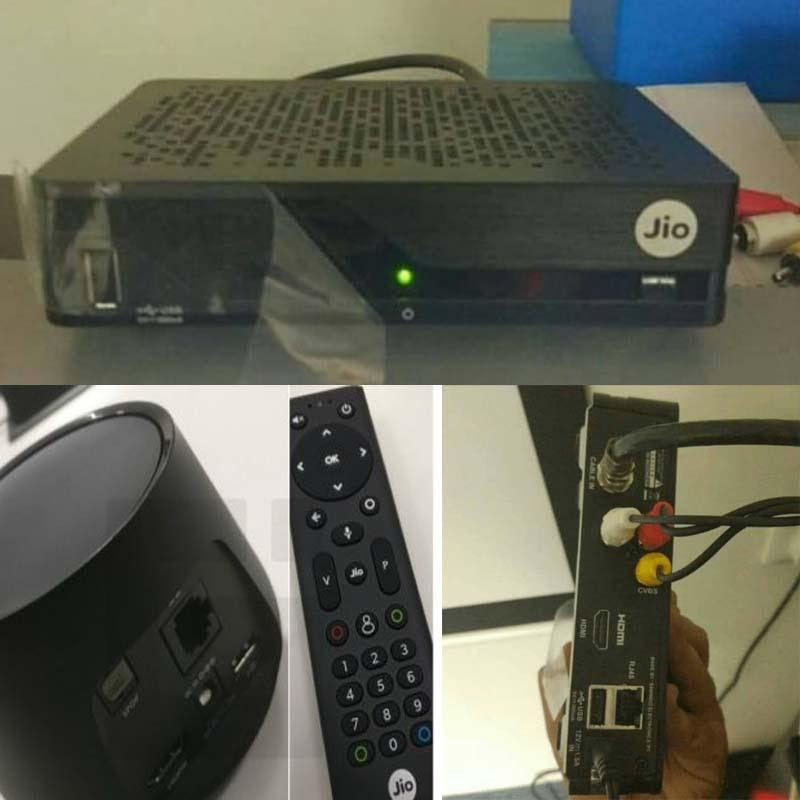
    According to the news report, Jio is expected to woo customers with premium offers such as ultra-high speed of up to 1 gigabit per second. The set-top box, as part of the package, will be a home entertainment hub – offering TV channels, high-end gaming and video on demand, among others.

    Jio is eyeing an average revenue per user of around Rs 1000 to Rs 1500 per month from subscribers (which includes internet and TV), as their usage of data goes up, a source said.

    Trials are being conducted in Mumbai and Delhi with only internet services at speeds of 100 megabits per second and 100 gigabytes of data free of cost. It is providing a special router, which connects multiple devices at a refundable deposit of Rs 4500. With a multi-service operator (MSO) licence in place, it will also offer TV services.

    Representatives of conventional TV industry cite numbers to back their claim that this is a tough game. While there are 180 million TV households in the country, subscribers fork out an average of only Rs 300- 400 a month for as many as 400 to 500 channels currently, they say.

    Competitors also say that currently, only three million subscribers cough up over Rs 1000 for high-speed broadband internet and only two million rustle up a similar amount per month for DTH or cable. So, the market that Jio is looking to address is currently niche and a small one.

    “Deploying FTTH is an expensive business and obviously Jio is making large investments. So, they have to get an adequate return on their investments. They might offer free broadband like they are doing currently and as they did earlier in the mobile space,” said a top industry executive to BS. But they will have to increase tariffs to make money and that might not translate into mass adoption.

    If the experiment succeeds, the number of households with TV and broadband, currently growing very slowly, could just explode, he said.

  • Spectranet ranked as fastest FTTH for June 2017

    Spectranet, India’s first 100% fibre broadband service provider today announced that it has been ranked as the fastest FTTH provider by Netflix. They have been ranked number 2 in the overall ISP rankings basis their primetime performance on Netflix, world’s leading internet television network with over 83 million members in over 190 countries.

    Spectranet is ranked number 2 for its superior service provided through its cutting-edge fibre network that delivers speeds of 100 Mbps and beyond and offers truly unlimited downloads & uploads without any speed capping.

    public://Untitled-3_18.jpg

    Courtesy: Netflix

    On this feat, Mr Udit Mehrotra, CEO, Spectranet said, “As we are trending upwards every month since the inception of this ranking in India, we are proud to be the fastest FFTH provider in the ranking and we are looking forward to attain the fastest ISP ranking in the near future. We have already been the fastest fibre based internet service provider basis our performance in the month of September to December 2016. This has been made possible by our sustained efforts to deliver innovative and disruptive services to our customers at amazingly affordable price. Being the only ISP with 100% fibre network we believe that we can advance the lives of people in urban India by creating and delivering the best internet services which has become a basic necessity for people in this era of Third Age of Connectivity’.

    About Netflix survey:

    Netflix ranks performances of prominent ISPs across the globe for their ‘Prime Time Netflix performance’ and the ratings for ISPs in India were introduced first in the month of May 16.  Netflix introduced ‘fast.com’ to provide quick and simple way for any internet user to test their current internet speed.

    About Spectranet

    Spectranet is an innovative and disruptive technology company dedicatedly working to deliver joy, advantage and success for people through and by, the continuous pursuit of excellence in Internet services. It is India’s only end to end pure optical fibre network enabled Internet service provider, capable of delivering speeds of 1 Gbps for home & 10 Gbps for business customers.  With headquarters in Gurgaon, its fibre network presence is currently spread across eight major cities.  For further information, please visit http://www.spectranet.in/


  • Sterlite unveils smarter optical tech & FTTH solutions at Anga Com ’17

    MUMBAI: Sterlite Tech, an end-to-end global technology leader in smarter digital networks, has unveiled new optical communication technologies and integrated capabilities in designing, building and managing smarter digital networks at Anga Com 2017.

    As partners to global telecom operators in Europe, Middle East, Latin America and Asian markets, Sterlite Tech has a focused business spanning smarter products, services and software solutions with operators in more than 100 countries. The new customised, high-quality smarter network introductions this year include:

    FTTX Smarter Network Kit: Released by Susanne Stengade, CEO, 6X International, Denmark, Sterlite Tech’s highly reliable FTTX Smarter Network Kit addresses the needs of customers by providing fastest connectivity to the last-mile revenue-generating users in hours, instead of days. The solution is based on the simple approach of plug-and-play, with highest reliability and performance.

    Indicium Lite Cable: Launched by Sean Pillans, Head of Access Engineering, Liberty Global, Indicium Lite Cable is suitable for outdoor FTTH deployments in less densely populated areas. The small inner modules in the cable are designed to be cut at one point in the network and retracted to another, where these can be fed or blown through microducts, directly to the customer premises. This solution helps in efficient deployment with zero fibre cuts.

    Atlas Lite Cable: Unveiled by Christian Aasheim, CEO, Melbye Skandinavia AS, Atlas Lite Cable features ultra-compact, light-weight cable designs, containing maximised fibre capacity. This product family is versatile and finds application across access, FTTX, Drop and/or fibre to the desk links. These cables can be blown using compressed air in pre-installed micro ducts for long distance links.

    Olympus Lite Cable: Launched by Luca Facchinetti, Director, Metallurgica Bresciana, Italy, this cable is suitable for hazardous or heavy construction zones including heavy traffic area, wind farm developments, pipelines, oil and gas fields, heavy industrial sites and a variety of additional harsh environments. Mainly used for Metro rail/Railway networks which employ products complying with major industry standards including BS EN 50200, BS 8434-2:2003. This product has safety at its core and meets the customer’s individual specification safety like data transmission security by maintaining circuit integrity under fire conditions, withstanding ultra-high temperatures and long service life.

    Highlighting the new launches at Anga Com, Sterlite Tech CTO Dr Badri Gomatam said, “Our new products and solutions have been designed and developed in close engagement with all our key customers and considering their requirements for smarter network technologies that address the growing demands for higher bandwidth and last-mile connectivity.”

    Sterlite Tech head – global sales – telecom products Ankit Agarwal said, “With our integrated knowledge and expertise in designing, building and managing smarter digital networks, we are partnering leading global telecom service providers and municipalities to realise the European Commission’s aggressive targets to create a Gigabit society through ultra-fast internet access by 2025. With our innovative and future-proof range of fibre connectivity solutions, telecom operators and ISPs can realise this vision, and enable smarter network roll-out in Europe and other geographies.”

  • Insight: Significant growth in FTTH market foreseen till ’25

    MUMBAI: Fiber to the home is a communication technology which delivers the communication signal over optical fiber directly to the home from the operator’s switching equipment. Fiber to the home is replacing traditional copper infrastructures such as coaxial cables and telephone wires. At present, Fiber to the home market is in nascent stage and offers enormous advancements in bandwidth to the consumers which enables fast access to videos, voice, data and internet services. Fiber to the home technology offers high speed of network at affordable prices. Fiber to the home provides support to applications such as tele-health, community based security, social applications, art & education applications, mobility, home automation, video conferencing, online storage, property management etc.

    Fiber To The Home Market Segmentation

    Fiber to the home market can be segmented on the basis of type into Homes Passed and Homes Connected. At present, Connected Homes segment has highest market share in global Fiber to the home market. On the basis of Deployment Provider Type, the global Fiber to the home market can be segmented into Incumbent Local Exchange Carrier (ILEC), Competitive Local Exchange Carrier (CLEC), Municipality/ Publicly Owned Systems, Developer/ Integrator, Multi-system Operator (MSO) Cable and Electric Co-ops. In 2014, Incumbent Local Exchange Carrier segment represents highest market share in global fiber to the home market. Fiber to the home has many applications such as Internet Video, VoIP, File Sharing, Online Gaming, Web/ Data, Video Conferencing etc. The end users of Fiber to the home market can be classified into urban area, sub-urban area and rural area. At present, urban area segment has highest share contribution in global fiber to the home market and sub-urban area segment is expected to reflect highest growth rate over the forecast period.

    Fiber to the home Market: Region-wise Outlook

    The global Fiber to the home market is expected to witness a healthy CAGR through 2025 owing to increasing adoption of fiber to the home among telecom carriers across the globe, an FMI report stated. Regionally, the Fiber to the home market can be segmented into North America, Latin America, Western Europe, Eastern Europe, Asia-Pacific excluding Japan (APEJ), Japan and Middle East & Africa (MEA). At present, among all the regions, North America followed by Japan is expected to account for the highest share in global smart manufacturing market. Latin America and MEA regions are reflecting slow penetration as compared to other regions.

    Fiber to the home Market: Drivers

    Increasing demand of high speed network at home for accessing online entertainment, smart systems and online books, apps and music, supplemented by technological advancement and growing penetration of cloud computing, smart grids, e-learning, e-health and e-governance service across the word are expected to drive the Fiber to the home market growth between 2015 and 2025. Furthermore, FTTH Providers are continuously supporting Greenfield activity by replacing old copper wires with fiber. In addition, more number of telecom carriers have started adapting fiber to the home to offer their customers with high bandwidth to access data. However, high capital investment, stringent regulatory risks and geographic limitations are restricting the growth of global Fiber to the home market, the FMI report stated.

    Fiber to the home Market: Key Players

    The key players operating in the global Fiber to the home market includes 3M Communication Technologies, ADTRAN Inc., Huawei Technologies Co. Ltd, DASAN Networks Inc., FiberHome Networks Co. Ltd., Enablence Technologies Inc., ZTE Corporation, Mitsubishi Electric Corp., Fujikura Ltd. and Superior Essex Inc.. Major players in the market follow the strategy of introducing innovative and cost effective solution to buy out competition. In addition, strategic partnership, collaborations and joint ventures are the other major strategies followed by the Fiber to the home solution provider to outperform competitors, the FMI report added.

  • Hathway ropes in R Madhavan as brand ambassador

    MUMBAI: Hathway broadband, India’s leading player in fixed line broadband internet service announced the appointment of actor Madhavan (popularly known as Maddy) as the national brand ambassador, adding star power to drive the internet and broadband business.

    Hathway broadband, India’s leading player in fixed-line broadband internet service announced the appointment of actor Madhavan (popularly known as Maddy) as the national brand ambassador, adding star power to drive the internet and broadband business.

    Talking about the power of high-speed broadband actor Madhavan said, “Internet is the future of the new India. The power of broadband connectivity to make services and applications available to all is fundamental in transforming India digitally. I am happy to be associated with a brand like Hathway that is committed to the vision of digital India.”

    Proudly welcoming the actor into the Hathway family, Rajan Gupta, Managing Director of Hathway Cable & Datacom Ltd said, “It is quite well known that actor Madhavan has been among the early movers in tapping into the digital phenomenon and we are extremely proud to have him as the face of the brand. Maddy’s huge popularity, pan-India acceptance, and charismatic personality as the youth icon, will help us increase our customer footprint across India.”

    Hathway will be shortly rolling out a multimedia campaign featuring the new brand ambassador that will highlight Hathway’s cutting edge GPON, Fibre to home (FTTH) technology and Ultra High-Speed broadband network.

    With the growing number of internet consumers, speed and data plan have always been the constant benchmarks for choosing a broadband connection. With the rollout of GPON Fiber to home technology, Hathway seeks to create a whole new breakthrough in the internet broadband industry with an unprecedented speed at affordable mass pricing while offering practically unlimited data. Through this Hathway aims to democratise broadband, making it accessible for internet consumers pan India.

  • Jio Fiber & Airtel gear up for broadband plans

    MUMBAI: Reliance Jio is reportedly offering a minimum of 100Mbps for the home broadband consumers, and the plans are expected to be affordable even as Airtel introduced 250 GB free broadband data plan.

    The commercial roll out of Jio’s Fiber to the Home (FTTH) broadband service may happen in June 2017, according to a previous report in Teleanalysis.

    Reliance Jio’s Fiber Preview offer has been rolled out in some areas of Delhi-NCR, Mumbai, Ahmedabad, Surat, Jamnagar, and Vadodara. The service is set for launch in other cities in a phased format.

    In September 2016, some users had discussed how the testing had begun in select residential colonies in the city of Chennai.

    Meanwhile, Airtel has introduced 250 GB free broadband data plan for postpaid customers ahead of the Jio fibre launch.

    Airtel has come up with a promotional offer that gives 5 GB of additional data every month. The company has announced its myHOME offer which is valid for each postpaid connection and digital TV service from 1 July. As per details on the site, the customer will not incur any charges for the extra data given under this offer.

    A user can bundle up to 25 postpaid connections and 25 DTH connections with the broadband service which accounts to 250 GB of additional broadband data per month.

  • Tele-components co Twinstar to bring in Rs 9k-cr FDI

    MUMBAI: Twinstar Technologies is among the 15 proposals worth Rs 12,200 crore on Monday cleared for foreign direct investments into India. Twinstar proposal will however also require the approval of the Cabinet Committee of Economic Affairs (CCEA).

    Twinstar specialises in Optical Communications Passive Components for telecommunication and focuses on providing low-cost and high quality products for the rapidly developing FTTH market.

    The inter-ministerial body Foreign Investment Promotion Board (FIPB), led by the economic affairs secretary Shaktikanta Das, cleared the 15 of the 24 proposals it discussed, while deferring six and rejecting three proposals. Proposals which got the green signal primarily included Twinstar’s Rs 9,000-crore proposal, Apollo Hospitals’ Rs 750 crore proposal, and a proposal of Vodafone India, an official from the finance ministry said.

    Proposals of Hindustan Aeronautics and Dr Reddy’s were also approved.

    Also Read:

    http://www.indiantelevision.com/regulators/ib-ministry/idea-star-den-among-rs-1200-cr-fdi-proposals-approved-latter-to-switch-to-investing-biz-170120