Tag: Free Dish

  • Cable TV lobby slams TRAI’s DTH licence fee waiver call

    Cable TV lobby slams TRAI’s DTH licence fee waiver call

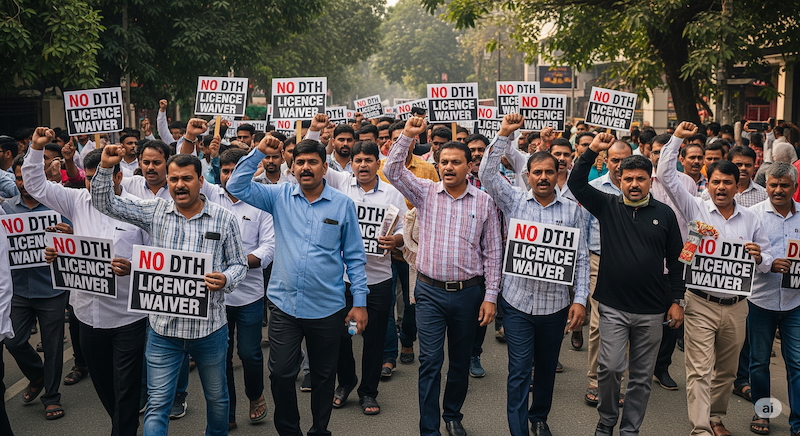
    NEW DELHI – India’s top cable lobby has sounded the alarm over TRAI’s proposal to slash and eventually scrap licence fees for Direct-to-Home (DTH) operators, warning it could wreck the delicate balance in the country’s broadcast distribution ecosystem.

    In a strongly-worded representation to the information and broadcasting ministry, the All India Digital Cable Federation (AIDCF) – which represents over 880 multi-system operators (MSOs) and 1.6 lakh local cable operators (LCOs) – said the move would “deepen regulatory inequality” and “threaten over 10 lakh livelihoods” linked to the cable TV industry.

    The AIDCF accused TRAI of tilting the scales in favour of DTH players who already enjoy “cost-free, administratively allocated spectrum” while cable operators continue to bleed under high Right of Way (RoW) charges and hefty underground infrastructure investments.

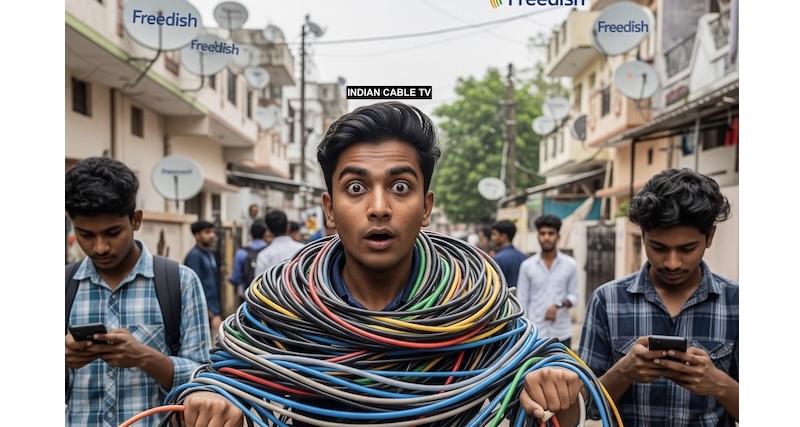
    “A DTH licence fee waiver will distort competition and violate regulatory neutrality,” an AIDCF spokesperson said, adding that any cut would hasten subscriber churn from cable to satellite platforms. The body flagged other disruptors like Free Dish, OTTs, Fast TV and digital DPOs as further stress points for the struggling cable sector.

    Rather than easing licence costs for satellite platforms, AIDCF wants the government to implement a fair cost recovery mechanism across distribution platforms, reflecting the true commercial value of spectrum. It has urged the ministry to junk TRAI’s recommendation in favour of a level playing field that safeguards the sector’s long-term viability.

  • EY-AIDCF report: Indian cable TV faces dire times unless government and regulator step in with regulatory reforms

    EY-AIDCF report: Indian cable TV faces dire times unless government and regulator step in with regulatory reforms

    NEW DELHI: India’s cable TV industry is on the ropes, reeling from a perfect storm of digital disruption, regulatory overkill, and changing viewer habits. A blistering new report by EY and the All India Digital Cable Federation (AIDCF) reveals a 40 million plunge in pay TV homes since 2018—down from 151 million to just 111 million in 2024—and warns that the bleeding isn’t over yet.

    By 2030, the figure could drop to as low as 71 million, as Indians flock to OTT, Free Dish, and smart TVs offering slicker content, better tech, and zero monthly bills. The fallout? A staggering 31 per cent collapse in employment across the Local Cable Operator (LCO) network, with up to 1.95 lakh jobs on the chopping block.
    The pay TV playbook, once defined by “kam daam, zyada samaan,” is now buckling under rising channel rates, bundling woes, and what LCOs call a “regulatory regime rigged for broadcasters.”

    A whopping 93 per cent of LCOs surveyed reported a drop in take-home income, with 79 per cent saying their earnings have nosedived by over 20 per cent since 2018.

    * Revenue for major distribution platform operators (DPOs) has shrunk by over 16 per cent since 2018, while EBITDA margins have plunged by 29 per cent.

    * Cable TV subscriptions have halved to 60 million, while smart TVs connected to the internet hit 50 million monthly active sets in 2024.
    * Pay TV now makes up just 58 per cent of the TV pie, down from 81 per cent in 2018, even as India’s TV household base touched 190 million.

    Despite being the backbone of India’s broadcast reach—physically connecting over 500 million people—LCOs remain the industry’s ignored foot soldiers, calling out a “top-heavy system” that allegedly favours deep-pocketed broadcasters and digital players.

    AIDCF proposes radical surgery: from activating over 20 million inactive set-top boxes and offering subsidies in “TV dark” zones, to limiting near-simultaneous OTT releases of pay TV content, and ensuring a level playing field between cable, OTT, Free TV and FAST channels.

    But with TRAI’s piecemeal tariff reforms (NTO 1.0 to 4.0) fuelling more legal duels than industry stability, stakeholders are demanding a full-blown reset. As OTT juggernauts steam ahead and content increasingly lives in the cloud, the cable industry’s survival may hinge not just on policy support but on reinventing itself as a digital services hub, not just a pipe.

    As the report bluntly puts it: without immediate intervention, the sun may set on the 30-year reign of India’s cable TV kings.

  • After edtech & fintech, now is time for media-tech: Anuj Gandhi at VBS 2022

    After edtech & fintech, now is time for media-tech: Anuj Gandhi at VBS 2022

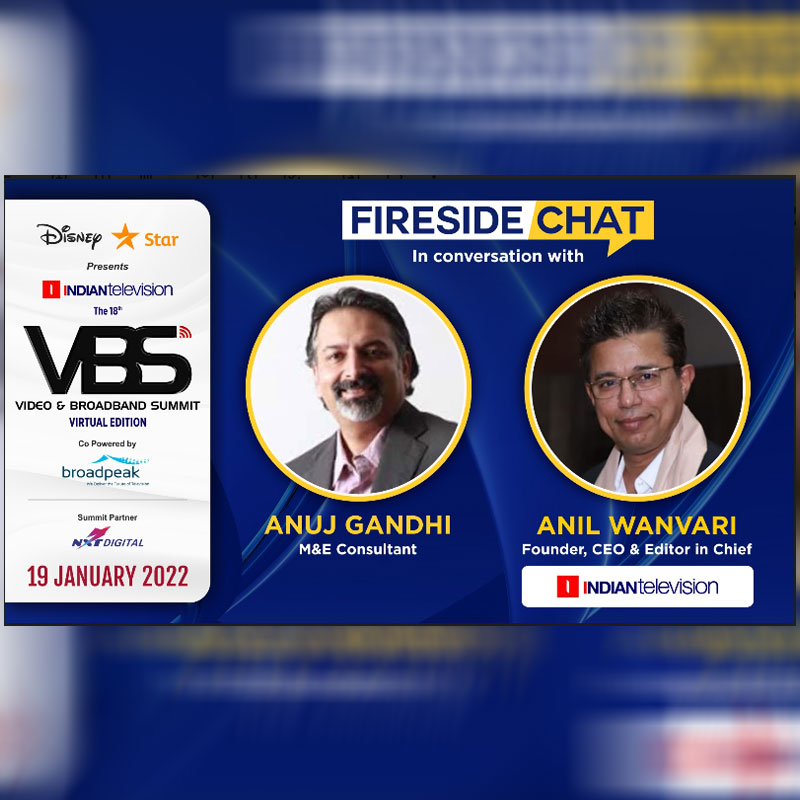
    Mumbai: After the edtech and fintech, it’s time for India to now witness the rise of media-tech, said M&E consultant and industry veteran Anuj Gandhi while decoding the post-pandemic future of the industry at the 18th edition of the Video & Broadband Summit 2022 (VBS) organised by Indiantelevision.com on Wednesday.

    The day-long virtual summit was co-powered by broadpeak, with Disney Star as the presenting partner, and NxtDigital as the summit partner.

    In a fireside chat with Indiantelevision.com founder CEO and editor-in-chief Anil Wanvari, the media distribution veteran discussed the six major trends which, according to him, will determine the course of the media and entertainment industry over the next couple of years.

    Video Trends: Unlike the days of DD and bundled offerings, the modern consumer wants more freedom to choose. With the burgeoning delivery platforms, it’s no longer that case where everyone has to be on PayTV. Moreover, in the present scenario where people are spending hours on social media, even Instagram Reels are ‘content’. Clearly, going forward, the definition of video, as well as trends in the space, will depend on the demand-supply equation. The rise of Free Dish and OTTs during the pandemic is a classic example, and even as their growth accelerates, PayTV will also continue to exist in some form or the other.

    Broadband Growth: Broadband has evolved into becoming a utility today; it is no longer limited to video. Considering the amount of consumption that’s happening over work-from-home, education, and other services, video is just a small fraction of it. The Trai’s figure for wired broadband that was stagnant at around 10-12 mn for many years, suddenly shot up to 25 mn, and this does not even include the huge undeclared market run by cable companies. The hybrid ecosystem fostered by the pandemic will continue to push this number further in the coming days.

    The fate of linear TV: It is a cause for worry and excitement at the same time. Both in India and globally there’s no denying the trend of people consuming less pay/linear TV as a result of the availability of alternatives as well as the failure of linear TV to innovate in terms of content. The Free Dish market has largely been insulated so far, but it will also experience disruption in the near future as broadband penetration in the hinterland grows.

    B2C focus and consolidation: The changes that were effected and necessitated by the growth in digital, especially in the last decade or so, have shifted the focus of the entire M&E industry from B2B to B2C. As the ecosystem opens up more and more to consumers directly, the need for consolidation will also increase, whether it is to meet the entertainment demands of viewers or to simplify content discovery for them.

    Rise of FAST: The popularity of Free Ad-Supported TV (FAST) services in the US and Europe, clearly shows that the west is moving towards AVOD. In the case of Asian markets including India, even though SVOD is picking up, the growth of Free Dish, YouTube, and OTT players like MX, is a strong indication of the potential for FAST.

    Crumbling walls: Changes in windowing norms that existed thus far will have a far-reaching impact on pricing, quality, and consumption of content as well as the actual segmentation of consumers in a multi-screen environment.

    The former group CEO of IndiaCast Media Distribution, who was also instrumental in setting up IndiaCast in March 2012 said he is hopeful about a future where all forms of video delivery – Free Dish, PayTV, VOD -will coexist. However, considering the current regulatory environment, competition, and the pace at which viewers are evolving, he recommended that the industry players must adopt an approach that gives more freedom and power to consumers rather than trying to resist the inevitable change in order to survive in the long run.

  • Right time for the LCO ecosystem to reinvent itself: Jio Platforms’ Saurabh Sancheti

    Right time for the LCO ecosystem to reinvent itself: Jio Platforms’ Saurabh Sancheti

    Mumbai: Saurabh Sancheti, the young and dynamic CFO of Jio Platfroms, and one of Fortune India’s 40 under 40 has been instrumental in scripting the success story of Reliance’s Cable business post its acquisition of two largest cable TV and broadband companies in the country – Hathway Cable & Datacom and DEN Networks for a sum of Rs 5,230 crore in October of 2018.

    At the recently concluded Apos India Summit, Sancheti discussed the transformative journey of the two acquired assets, and the challenges and opportunities for Pay TV distribution industry in the light of regulatory and technological changes.

    At the time of acquisition, and much after that as well, Reliance’s Cable business was running at an operating loss. Tasked with bringing about a disruption, Sancheti went on a brainstorming spree to figure out its strengths and problems areas. After several talks with top executives, Local Cable Operators (LCOs) as well as customers, he concluded that the one thing Cable needed was operating cash flows to be positive.

    “That is fundamental, because if you scale up a business which is losing on a unit basis, then you are only scaling up the losses,” he said. “The singular problem that I could pinpoint here was that we were not collecting whatever we billed. And if we could do that, we were home. No one disputes the bill per se; it was all about collection. That’s where I suggested moving Cable to prepaid – a rather ‘blasphemous’ idea for that time.”

    The impact was such that operating cash flows swung from a negative territory to a positive Rs 800 crore per year. Within six months most of the competition also turned to the prepaid model, bringing about a systemic change in the ecosystem.

    Since then industry players have collaborated on various initiatives and models. “The sector which was plagued with a lot of trust issues and fights has, today, come together under the umbrella of the All India Digital Cable Federation (AIDCF) which has become a de-facto platform for constructive discussions.  The AIDCF is also playing a proactive role in conveying our concerns to the government and regulatory bodies,” shared Sancheti.

    Elaborating on the regulatory challenges and their impact on the business currently as well as in the coming years, he remarked, “While a lot of changes in regulations have taken place in the past few years, the crux of it all is that the Trai is advancing in a direction which is more pro-consumer; whether it’s more consumer choice, more a-la-carte, or lesser bundling, the underlying intent is the same. This brings a lot of complexity for the business.”

    Giving a perspective in numbers, he added, “Any large e-commerce company which is handling Stock keeping units (SKUs) from multiple businesses and industries tops out a 100-150,000 SKUs. Today we are serving more than one million unique combination or SKUs to our customers at Den, Hathway, and GTPL. This is coming from an industry which until two years back (before the acquisition) was serving less than 100 SKUs. So, there has been a sea change in offerings as well as technology.”

    But even as the regulator works towards bringing the customer back in focus, there are apprehensions about the mindset and workings of the industry leadership which doesn’t seem to have been very customer-centric historically. Sancheti contended that the situation is changing, and today, not just the top leadership and MSOs, but many LCOs too have a customer friendly and progressive outlook.

    The advent of OTT and the allegedly predatory expansion of DD Free dish universe have posed major challenges to Pay TV distribution in the past couple of years. Current realities notwithstanding, Sancheti believes that there exists a huge opportunity.

    “Out of the country’s 280 million households, nearly 200 million own TV.  Of the 200 million, only about 120 million have Pay TV. So, clearly no other market has such potential as India. The problem is that this base has largely remained stagnant over the years primarily because of two factors. At the higher tier it is the advent of OTT, and at the lower, it’s DD Free Dish which has grown rapidly in last four-five years,” he added.

    There’s also a third challenge that he recognises as needing quick intervention – the dismally low earnings of Cable operators. “In the prevailing circumstances where not just competition from new technology, but even regulatory hurdles like NCF cap are working against them, an LCO takes home on an average Rs. 15000, which is just slightly above the minimum wages. Again, this is just a fraction of what they used to earn previously.”

    The good thing is that all players in the industry are now aware of these challenges, and what needs to be done. The question is ‘how’.

    Sharing his approach and vision for tackling these issues, Sancheti stated, “As an MSO we are trying to work on a low-cost rural market product and the idea is that ‘can we have a price point which can truly challenge Free Dish’. The North Star here is ‘rupee-a-day’ product. If we can have it, we can get at least 40-50 million homes into the Pay TV base.”

    One of the ways of getting to it is reinventing the entire LCO ecosystem as a ‘reseller of services’, he observed. “Our biggest strength as MSOs and LCOs is the ‘last-mile access’. As distributors we ‘own that home’ and the trust and relationship shared with it, has in many cases, been built over decades. If we can leverage it to become resellers of services like OTT and broadband, the market potential of 40-50 million can be unlocked.”

    In addition to solving the problem of LCO incomes, this ‘integrated platform play’ will help the industry to achieve the bigger objective of collectively arriving at the hypothesised challenger product to take on Free Dish.

    “Live TV on a standalone basis is not practicable anymore. So, we clearly need to act as distributors of more services. This will divide costs between businesses, thus making a lot of under-connected and unconnected homes more viable. Ultimately, all of this will tie back to our ‘rupee-a-day’ product,” elaborated Sancheti.

    Signing off on a very positive note he said, “We are standing at an inflection point where the entire LCO model is at the right stage to be reinvented. There’s no market more attractive than India. I strongly believe that it has a long-term potential of at least 170-180 million Pay TV base; it’s doable. An 80 million broadband base is also doable, all within three years.”

  • There needs to be a level playing field: Tata Sky CEO Harit Nagpal on Free Dish issue

    There needs to be a level playing field: Tata Sky CEO Harit Nagpal on Free Dish issue

    Mumbai: Harit Nagpal, the MD and CEO of India’s largest Pay TV distributor – Tata Sky is known to be a vocal man. Time and again, he has used several platforms and occasions to bring the industry’s concerns to the notice of the government and regulators. Outlining these issues once again at the APOS India Summit – the two day virtual-event that concluded recently, Nagpal stressed upon the need to iron out disparities in regulation that exist in the current ecosystem.

    With the rapid emergence of multiple distribution formats and technologies in the past few years, he strongly believes that the “time has come for everyone to step back and take a look at the regulatory inconsistencies and biases prevailing across platforms.”

    Between the three main distribution technologies of DTH, Cable and OTT, “while both DTH and cable are licensed, regulated and censored (self), DTH pays a license fee while Cable doesn’t. OTTs, on the other hand, are neither licensed, nor regulated or censored, and they don’t even pay a license fee. Just because they came in at different points in time, different rules are applied to each one of them,” said Nagpal.

    In September, Tata Sky and Airtel Digital TV had written to the Telecom Regulatory Authority of India (Trai) asking the telecom regulator to address the issue of broadcasters making their pay channels available for free on DD Free Dish.

    Also Read: https://www.indiantelevision.com/dth/dth-operator/dth-operators-write-to-trai-over-broadcasters-offering-pay-channels-on-dd-free-dish-210909

    At the summit, Nagpal reiterated that while he appreciates Free Dish as a great channel of customer acquisition, there has to be a level playing field.  “There are roughly 100 million homes in India that don’t have a TV. They will not invest in a TV set and subscription simultaneously. Hence, at any given point in time there is a large pool that owns a TV but is not paying for subscription services. A subset of this population moves into the Pay TV universe every year, opening up a huge customer acquisition opportunity for us,” he explained, adding that “the problem begins when Free Dish starts serving them at no cost, the same content that we offer for a price.”

    According to Nagpal, this is an unfair practice on the part of certain broadcasters. It goes against the current tariff regime which mandates designating of channels as either pay or FTA. “This designation should be consistent across platforms,” he insisted. “A customer in rural areas does not understand regulations, and he starts distrusting us.”

    Commenting on the overall growth this year, Nagpal said, “We are north of 17 million homes; much in the same range as what we lost to FTA and economic losses faced by rural India. We have managed to keep our heads above water.”

    Despite the many challenges, he believes that pay TV delivered via cable or satellite cannot be written off in India so quickly. “OTT requires high quality broadband getting into homes, in which case the customer has to pay for both content as well as the pipe. In the case of cable and satellite they pay for the content only. So, when we talk of the masses, Pay TV is here to stay. Out of the 100 million homes without a TV some will keep getting them every year, and those numbers are far larger than the growth of paid OTT. Pay TV and FTA will also coexist and grow.”

    Even though DTH may not be facing an existential threat from either Free Dish/FTA or OTTs, its content that has historically been ‘mass’, will have to evolve, asserted Nagpal. “The masses also want innovation which is why there are nine million HD homes today, and many with HD are now looking for something new. Innovation has, therefore, constantly been on our radar. With regard to content as well, there is a very large number of discerning viewers among those who do not have access to the pipe. They are not happy with the ‘saas-bahu’ or the content of the past. There is a niche which is likely to grow, for which content needs to be invested in by broadcasters.”

    In fact, trends show that customers are not going off Pay TV even when they can afford or avail streaming services. Sharing his observations, the Tata Sky Nagpal stated, “The premium end of our user base did not switch off their Pay TV regardless of having access to VOD services. Binge Plus was an attempt to cater to this set of audiences. Whether a consumer wants to watch OTT or Linear on phone, tablet or the TV set, my job is simply to make it convenient for them.”

    In this space again, he welcomes the advent of aggregators like Prime Channels and Google TV to grow the market and industry together.

    Concluding the discussion with his thoughts on Tata Sky and the overall broadband market, Nagpal shared, “Broadband was never intended for the mass market because we didn’t have a network of fibre in the ground across the country. Our intention is only to reach our premium customers, and hence, it will remain a niche, very high-quality broadband play for us.”

    As for satellite, he averred, “In my understanding broadband is not reaching rural areas not because it is difficult to lay a wire to that place, but the fact that it will be difficult to find enough people in a village who can pay Rs 800 per month, month-on-month. Unless it can be delivered at the rate of Rs 200-300 per month, the economics of which is unviable, it looks unlikely. But we may be surprised in the future.”

  • Pay DTH subscriber base perks up a bit

    Pay DTH subscriber base perks up a bit

    BENGALURU: The latest DTH subscriber numbers released by Telecom Regulatory Authority of India (TRAI) must bring cheer to the private television direct to home (DTH) industry. TRAI recently published quarterly subscriber data as on 30 June 2020. According to the data, the number of pay DTH subscribers using services provided by private DTH operators had declined from a peak of 72.44 million as on 31 March 2019 to a low of 68.92 million during the very next quarter end date – 30 June 2019 because of a change in the way of reckoning active DTH subscribers. Till March 2019, the subscription figure of the total active subscribers included inactive and temporarily suspended subscribers for not more than the last 120 days. However, as per new regulatory framework of Broadcasting and Cable TV Services, the total active subscribers are now counted to include only those subscribers who are inactive/ temporarily suspended for not more than the last 90 days. 

    Since 30 June 2019, the number of pay DTH subscribers using services provided by private DTH service providers has been increasing slowly until 30 June 2020. As on 30 June 2020, the number of pay DTH subscriber using services provided by private DTH service providers stood at 70.58 million. This is in addition to the subscribers of DD Free Dish (free DTH services of Doordarshan). 

    Please refer to the chart below:

    Further, as on March 2019, the number of private DTH subscribers had fallen to four from five previously. Also, TRAI commenced publication of break up of market share to an accuracy of two decimal percentage places from the quarter ended 30 September 2019 onward. Extrapolating the overall number of pay DTH subscribers using services provided by private DTH operators with the total number of pay DTH subscribers (provided in millions, to two decimal places) and the share percentage of the service providers reveals that except for Dish TV, the other three providers had seen subscriber numbers grow. Besides Dish TV’s slow but steady decline in subscriber numbers during all the four quarters for which data is available, the largest service provider in terms of number of subscribers – Tata Sky witnessed a decline in subscriber numbers in the quarter ended 30 June 2020. Please refer to the figure below:

    Cable TV operators

    TRAI reports state that the country has achieved 100 percent digitization of cable TV network. This is a stupendous achievement making India the only large country where 100 percent digital cable has been achieved through mandatory regulations.

    As on 30 June 2020, there were 1,666 MSOs registered with the ministry of information & broadcasting (MIB) as compared to 1,613 MSO registered as on 31 December 2019. Further, as per the data reported by MSOs/HITS operators, there were 12 MSOs and one HITS operator who had a subscriber base of more than one million. Details of the total active subscribers of these 12 MSOs and one HITS operator are given in the following table. Please refer to chart below:

    In the case of cable TV, the largest player Siti Networks seems to be witnessing a slow but steady loss of subscribers since the quarter ended 31 December 2019. Two other players have also witnessed a subscriber declines – Fastway Transmissions Pvt Ltd and Asianet Digital Network, while most others have gained subscribers during the four quarters in this report.

    Satellite TV Channels

    A total of 909 private satellite TV channels have been permitted by the MIB for uplinking only/ downlinking only/both uplinking and downlinking, as on 30 June 2020. The quarter-wise figures of the total number of TV channels is depicted in the chart given below.

  • Tata Sky had the largest pay DTH subscriber base in CY 2019

    Tata Sky had the largest pay DTH subscriber base in CY 2019

    BENGALURU: Telecom Regulatory Authority of India’s (TRAI) The Indian Telecom Services Performance Indicator Report October – December, 2019 says that there were 6.998 crore (69.98 million, 699.8 lakh) direct to home (DTH) subscribers in India as on 31 December 2019 that paid for their subscription. This is in addition to the subscribers of the DD Free Dish (free DTH services of Doordarshan). It is important to note that till March 2019, the subscription figure of the total active subscribers included inactive and temporarily suspended subscribers for not more than the last 120 days. However, as per new regulatory framework of Broadcasting and Cable TV Services, the total active subscribers are now counted to includeonly those subscribers who are inactive/temporarily suspended for not more than the last 90 days.

    This 6.998 crore pay DTH subscriber base was split amongst four players. The TRAI report gave the breakup of pay DTH subscribers as Tata Sky with 31.80 percent, Dish TV with 30.55 percent, Airtel Digital TV Services with 23.31 percent and Sun Direct with 14.35 percent. The numerical break up assuming that the number of subscribers was rounded off to seven crore (70 million, 700 lakh) is Tata Sky 2.23 crore (22.3 million, 223 lakh), Dish TV 2.14 crore (21.4 million, 214 lakh), Airtel Digital TV 1.63 crore (16.3 million, 163 lakh) and Sun Direct one crore (10 million 100 lakh).

    Please refer to the figure below:

    According to the TRAI report, Pay DTH subscriber base in India grew by 0.068 crore (0.6 million or 6 lakh) as on 31 December 2019 to 6.998 crore (69.88 million, 699.8 lakh) when compared to 6.930 crore (69.30 million, 693 lakh) on 30 September 2019. Please refer to the figure below for the quarter-on-quarter change in pay DTH subscriber base.

    Cable TV operators

    The TRAI report says that the country has achieved 100 percent digitisation of Cable TV network. This is a stupendous achievement making India as the only large country where 100 percent digital cable has been achieved through mandatory regulations.

    As on 31st December 2019, there were 1613 MSOs registered with the ministry of information & broadcasting (MIB). Further, as per the data reported by MSOs / HITS operators, there were13 MSOs and one HITS operator who had a subscriber base of more than one million. Details of the total active subscribers of these 13 MSOs and one HITS operator are given in the following table.

    Satellite TV Channels

    A total of 918 private satellite TV channels have been permitted by the MIB for uplinking only/ downlinking only/both uplinking and downlinking, as on 31 January, 2019. The quarter-wise figures of the total number of TV channels is depicted in the chart given below.


    Follow Tellychakkar for the consumer facing news & entertainment

  • Prasar Bharati sells MPEG-2 slot to 53 broadcasters

    Prasar Bharati sells MPEG-2 slot to 53 broadcasters

    MUMBAI: Prasar Bharati has successfully sold Free Dish’s MPEG-2 slots for the period from 01.04.2020 to 31.03.2021 through 44th online e-auction process to 53 broadcasters. The second annual e-Auction of MPEG-2 slots (44th e-auction) of DD Free Dish Platform was completed on 28 Feb 2020.

    Applications were received for e-auction under different Buckets/Genre. Subsequently, 53 channels were successfully allocated slots on various buckets on DD Free Dish slots. Subject to completion of all formalities, the channels which have successfully bid for slots will come on air on DD Free Dish Platform from 1 April 2020.

    Prasar Bharati CEO Shashi Shekhar Vempati says: “A key highlight of the e-auction was robust participation of channels across genres that saw several new channels making a debut enhancing the content diversity on DD Free Dish as a platform.”

    He further opined: “The increased competitiveness in the e-auction process is reflected in the substantial increase in bids over base prices across genres. DD Free Dish has emerged as a key enabler of competitiveness in the broadcast sector with new upstart channels challenging incumbents. Most significantly the nearly 50% growth in potential annual revenue from DD FreeDish is a key leading indicator on likely economic turnaround during FY 2020-2021.”

    Four slots were sold under bucket A+ with the reserve price of Rs 15 crore: Abzy Cool, Big Magic, Dangal, and Fun TV. The average slot price of the bucket was Rs 15.6 crore and the highest bid was Rs 15.16 crore. The A bucket was reserved for Rs 12 crore which was sold to 12 channels. The average bid price for the bucket was Rs 15.16 crore and highest bid price was Rs 15.2 crore. Under A bucket, ABZY Dhakad, ABZY Movies, B4U Kadak, B4U Movies, Blue, Cinema TV India, Enterr10, Maha Movie, Manoranjan TV, Movie Plus, Satya, and Surya Cinema reserved their place.

    Bucket B included All Music (Hindi) Channels, Sports (Hindi) Channels, GEC (Bhojpuri), Movies (Bhojpuri) and Teleshopping (Hindi) channels for the reserved price of Rs 10 crore. The pubcaster sold this slot to 16 channels- BDM GEC (Bhojpuri), Bhojpuri Cinema Movie (Bhojpuri), Big Ganga GEC (Bhojpuri), B4U Bhojpuri Movie (Bhojpuri), B4U Music Music (Hindi), Dabang Movie (Bhojpuri), Filamchi Movie (Bhojpuri), Manoranjan Grand Movie (Bhojpuri), Mastii Music (Hindi), MTV Beats Music (Hindi), Showbox Music (Hindi), Surya Bhojpuri Movie (Bhojpuri), Zee Biskope Movie (Bhojpuri), Zing Music (Hindi), 9X Jalwa Music (Hindi), and 9XM Music (Hindi). The average slot price was Rs 11.55 crore and the highest bid price was 12.25 crore.

    News & Current Affairs (Hindi) Channels, News & Current Affairs (English) and News & Current Affairs (Punjabi) Channels were included in Bucket C with the reserved price Rs 7 core. The pubcaster sold this slot to 13 channels: Aaj Tak, Aaj Tak Tez, ABP News, India News, India TV, NDTV, News Nation, News 24 Think First, News 18 India, Republic TV Bharat, TV9 Bharatvarsh, Zee Hindustan, and Zee News. The average price of Bucket C was Rs 10.85 crore and the highest bid was Rs 12.25 crore.

    All other remaining genre (language) channels and teleshopping (regional) channels were included in Bucket D with a reserved price of Rs 6 crore. Prasar Bharati sold this slot to five channels:  Fakt Marathi, Manoranjan Movies, Maha Punjabi, Shemaroo Marathibana, and Zee Punjabi. The average bid price of the bucket was Rs 6.17 crore and the highest bid price was Rs 6.25 crore.

    The Bucket R1 consisted of spiritual channels including channels promoting yoga, Ayurveda, Health & Wellness (Ayush) based on traditional methods, reserved for Rs 3 crore. The pubcaster sold this slot to three channels:  C7, Lord Budha, and Sadhana Bhakt. The average bid price for Bucket R1 was Rs 6.97 crore and the highest bid price was Rs 7.15 crore. 

  • DD Free Dish has 3.5 crore subscribers: Prakash Javadekar

    DD Free Dish has 3.5 crore subscribers: Prakash Javadekar

    MUMBAI: Union Minister for Information and Broadcasting Prakash Javadekar on Saturday stated that DD Free Dish was the biggest direct-to-home (DTH) operator in the country with 3.5 crore connections.

    "There are five to six major operators and they put together have 5.5 crore connections. The biggest DTH operator in the country is Doordarshan with 3.5 crore DTH connections where we are giving free Dish," he said.

    The minister also added that India will soon become the largest country in the world where every household has a television set.

    "There is a new dream that every household will have a TV in the coming years. There are 25 crore households in India and 18 crore have a TV set. There are still seven crore households without a TV," Javadekar was quoted as saying by news agency PTI.

    Javadekar made the comments during a program to launch distribution of Free Dish set top boxes in Kashmir. On the occasion, a signature tune for Doordarshan's satellite channel for Jammu and Kashmir DD Kashir too was unveiled.

    "Today, we are making a small beginning in which we are giving set top boxes of free Dish TV for people living in far-flung areas and to poor people. However, as soon as our economy develops people will buy a TV as soon as they are able to address the six basic needs of food, clothing, shelter, healthcare, education and livelihood," the Minister explained.

    Minister of State in Prime Minister's Office Jitendra Singh said free DTH connections will help in flow of information in regions that are not well connected.

    "People in border areas will get some relief. They will get an avenue of entertainment and the information that should reach them," Singh said.

    The Lok Sabha MP from Udhampur said the Dogri bulletin on DD Kashir satellite channel was a long pending demand of people in Jammu.

    "Steps have been taken for promotion of Kashmiri language from time to time but similar steps for Dogri were delayed. Both Kashmiri and Dogri are rich but underrated languages," he said.

    Jammu and Kashmir Governor Satya Pal Malik said the distribution of Free Dish STBs would also prevent people from falling prey to fake news and false propaganda.

  • How Doordarshan aims to fill void of GECs’ exit from Free Dish, FTA space

    How Doordarshan aims to fill void of GECs’ exit from Free Dish, FTA space

    MUMBAI: Public broadcaster Prasar Bharati, during its 154th board meeting, gave Doordarshan a major shot in the arm as it approved, in principle, significant investment in new and quality content during the year 2019-2020. The meeting was chaired by Prasar Bharati chairman A. Surya Prakash in the presence of the CEO Shashi Shekhar Vempati and member Rajeev Singh.

    According to Vempati, the plan for new content on Doordarshan will be finalized in the next few days. This infusion of fresh content by Doordarshan should fill the vacuum from the exit of several GEC channels from the free-to-air (FTA) space in general and from DD Free Dish in particular, Vempati hopes.

    While BARC India has not been making its viewership data public in recent weeks, the importance of DD Free Dish as a platform has become abundantly clear going by the measurement since 1 March. This underscores the opportunity for Doordarshan to regain its space in GEC genre, Vempati added.

    Post the implementation of TRAI tariff order, several major broadcasters like ZEE and Star India have converted their FTA channels into pay and taken off popular channels from Doordarshan's FTA DTH platform Free Dish.

    The planned investment in new content on Doordarshan will be targeted towards capturing this opportunity, Vempati stated.