Tag: France

  • India’s Qissa to compete at Vesoul Filmfest in France

    India’s Qissa to compete at Vesoul Filmfest in France

    NEW DELHI: The Indian film Qissa by Anup Singh, which has already won accolades on the international festival circuit, will one of the nine Asian films in competition at the 20th Festival International des Cinémas d’Asie.


    The Cinemas d’Asie which is a specific festival for developing film industries in Asia will be held from 11 to 18 February in Vesoul in France next month.


    There are two films from Japan, both receiving their European premiere, and one each from China, India, Iran, Philippines, South Korea, Thailand and Turkey in the Festival. Five of these nine films were also screened at last year’s Busan International Film Festival in South Korea.


    Qissa was also the opening film of the 43rd International Film Festival at Rotterdam from 22 January to 2 February and this marked the European premiere of the film. It won the Audience Award at that Festival. 


    The award comprising Euro 10,000 (INR 9 Lakh Approx) is given to the most voted film supported by the Hubert Bals Fund.

    Qissa which received the Hubert Bals Fund for Script & Project Development in 2004, was made with further support from the Netherlands Film Fund, and was co-produced by Dutch company Augustus Film.


    Set in post-colonial India, the film stars Irrfan Khan as a Sikh who has fled his village to escape ethnic cleansing at the time of partition who tries to start a new life for his family.


    The choice of opening slot for the drama is part of the 25th anniversary celebration of the festival’s Hubert Bals Fund, which had supported the Indian film’s script development ten years ago.


    The festival will also host a retrospective, Mysterious Objects: 25 Years of Hubert Bals Fund, including a screening of the fund’s first recipient, Chen Kaige’s Life on a String (1991).


    Qissa is represented internationally by Germany’s The Match Factory GmbH. The film had its North American and Asian premieres at the Toronto International Film Festivaland Busan International Film Festival respectively.


    Earlier, the film added one more feather in its cap when actor Tillotama Shome won the Best Actress award in the New Horizons competition at the Abu Dhabi Film Festival.

    In Qissa, Shome plays the youngest daughter of Umber Singh (Irrfan Khan) who decides to raise her as a boy.


    Shome made her screen debut with Mira Nair’s Monsoon Wedding in 2001 and went on to play roles in Florian Gallenberger’s Shadows of Time and Dibakar Banerjee’s Shanghai.


    Qissa earlier won the Silver Gateway Award in India Gold competition at the 15thMumbai Film Festival  and the NETPAC (Network for the Promotion of Asian Cinema) Award for Best Asian Film at the 38th Toronto International Film Festival where it had its premiere.


    Set amidst the ethnic cleansing and general chaos that accompanied India’s partition in 1947, this sweeping drama stars Irrfan Khan as a Sikh attempting to forge a new life for his family while keeping their true identities a secret from their community.


    Beautiful, timeless, and touching the deepest of human impulses, Qissa carries the spirit of a great folk tale. Although it’s set in a particular time and place — the Punjab region that straddles India and Pakistan in the years immediately after partition — it is both deeper and broader than any one moment. As this eerie family drama progresses, it cuts to the heart of eternal desires for honour, empathy, and love.


    “Qissa” is originally an Arabic word meaning folk tale. Both the word and the idea migrated from the Gulf into the Punjab, still connected by the ancient oral narratives handed down in communal settings. Working within this tradition, director Anup Singh gives his film both the grand themes and elemental emotions of classic storytelling. As Umber’s daughter is raised as a boy, the characters are propelled with greater and greater urgency towards their inevitable fates.


  • Sony Six to broadcast 2014 six nations rugby

    Sony Six to broadcast 2014 six nations rugby

    ?MUMBAI: SONY SIX, India’s premier sports and entertainment channel has won the exclusive broadcast rights to the RBS 6 Nations Rugby tournament which commences on 1stFebruary. Taking on its global viewing spectrum, the 2014 edition of the RBS 6 Nation’s Rugby tournament will be shown on aprime time slot between 8.00pm to 11.00pm on Sony Six and Sony Six HD for Indian audiences.

    The 2014 RBS 6 Nation’s Rugby tournament beginson 1stFebruary and will conclude on 15thMarch. The tournament consists of a league of 6 European nations – England, Scotland, Wales, Ireland, Italy and France. Each teamplays every other team once, with home field advantage alternating from one year to the next. Two points are awarded for a win, one for a draw and none for a loss. Defending Champions Wales take on Italy in the opening game.

    The Six Nations is the successor to the Five Nations Championship (1910–31 and 1947–99) which in turn succeeded the Home Nations Championship (1883–1909 and 1932–39). The Home Nations Championship, played between teams from England, Ireland, Scotland and Wales, was the first international rugby union tournament.

    Sony SIX has also has broadcast rights to other premier rugby tournaments such as the Super Rugby League and the Rugby Championship.


  • French football to air on UK terrestrial TV for first time

    French football to air on UK terrestrial TV for first time

    MUMBAI: The UK’s Channel 4 will air French league matches from the middle of this month in a deal with TWI, who will also produce the show.
     

    It will be the first time France’s Ligue 1 (the LFP – Ligue de Football Professionel) is shown on terrestrial television in the UK. And it will bring the French game to a new generation of football fans as C4 did previously with its coverage of Football Italia.

    The action will kick off with a series of Saturday night games shown from 13 November, followed by matches and highlights on Sunday mornings from 9 January.

     
    It will feature games by players like French international and former Manchester United star Fabien Barthez, who now plays with Ligue 1 side Marseille, or ex- Arsenal player Sylvain Wiltord, now with Lyon.

    TWI recently won a four-year deal for the international broadcasting rights to Ligue 1. It also already produces the sports magazine show Trans World Sport, which is shown on C4 on Sunday mornings, and gains a 260 million audience across 131 countries.

  • Bing releases the top search trends of 2013

    Bing releases the top search trends of 2013

    MUMBAI: Women are on top, literally! The 2013 search trends released by Bing that includes search data from Australia, Brazil, Canada, China, France, Germany, India, Italy, Japan, Spain, the U.K. and the U.S, reveal that women ruled and were in the top searches. In eight of the 12 participating countries around the world, women were the most searched. Beyoncé reigned in the US, while Miley Cyrus’s highly publicised twerking made her the top-searched person in both Australia and Canada.

    Former flames Justin Bieber and Selena Gomez were the most-searched people in the U.K. and Germany, respectively. Actress and actors Bruna Marquezine, Wen Zhang and Salman Khan were the most-searched people in Brazil, China and India, while singers Rihanna and David Bisbal ranked at the top for France and Spain, and gorgeous TV personalities Danmitsu and Belen Rodriguez were favorites in Japan and Italy.

    It was also a year of American songs, superhero movies, Facebook love, high-end designer brands, controversial sports stars, European getaways and fierce women.

    Bing search trends, found at  www.BingTrends.com, indicate what has most captivated people around the world in 2013.

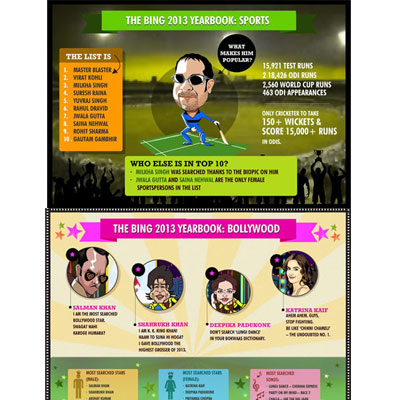
    However, when it came to the top searches in India, surprisingly, it was not the master blaster Sachin Tendulkar, who bid adieu to international cricket in 2013, who was searched the most. He was at number four, only after Salman Khan, Shah Rukh Khan and Katrina Kaif. 

    While he may have led the search among actors, Salman’s films did not feature in the top ten most searched films. The fast paced action flick Race 2 bagged top honours followed by Shahrukh starrer Chennai Express. And the surprise package among the top 10 Hindi movies was Nasha, starring Poonam Pandey. And Shah Rukh Khan may have missed top spot in the most searched actor and film, but his Lungi Dance from Chennai Express made it to the top of charts as the most searched song in India. This was followed by Party on My Mind from Race 2 and Challa from Jab Tak Hai Jaan.

    Sports stars too were popular. While Sachin Tendulkar was the most searched among sports stars, young and feisty Virat Kohli too made it to the top ten. However, the surprise entry was sprinter Milkha Singh, proving that the biopic on him did arouse curiosity about him in the country. Shuttlers Jwala Gutta and Saina Nehwal made sure that their sport was represented in the top ten dominated by cricketers.

  • Discovery channel takes viewers on a driving challenge

    Discovery channel takes viewers on a driving challenge

    MUMBAI:  Who doesn’t like to be in-charge of the steering wheel? Discovery Channel will do so by transporting viewers to the world’s most extreme environments in an all new series, World’s Toughest Driving Tests.


    On the driver’s seat will be actor, Will Mellor and comedian, Kirsten O’Brien, both of whom have swapped their safe rides and suburban streets in a bid to discover ‘who is the better driver’.


    In this action-packed thriller, Mellor and O’Brien will maneuver army tanks in Romania, amphibious rescue vehicles in Canada, gravity defying snow groomers in France and, among other tricky vehicles, they will tackle massive dump trucks in Scotland. The pair must compete in a series of tantalizing and terrifying challenges and the one who has lived and breathed the vehicle. Who has learnt from the locals and shown nerves of steel despite the odds, will be crowned the winner.


    The show starts from 2 December, and will be aired every Monday to Friday at 10:00 pm.

  • CareerBuilder Releases Striking Differences in Typical Workdays Around the World

    CareerBuilder Releases Striking Differences in Typical Workdays Around the World

    MUMBAI :  A new global study from CareerBuilder shows that a typical day in the office is not so typical across the globe: When you look at the average workday in the 10 largest economies around the world, you begin to see how alike workers can be—and also where they differ the most. The global survey, conducted online by Harris Interactive© from May 9 to June 5, 2013, included more than 5,000 hiring managers and human resource professionals in countries with the largest gross domestic product.

    INFOGRAPHIC:http://cb.com/1gnMhxK

    Driving vs. Public Transportation

    While the 10 countries surveyed have the largest economies on the planet, they also have some of the largest populations, but instead of taking public transportation or using other ways of getting to work, the majority of workers indicate they drive themselves to work every day,
    •    U.S. 82%
    •    Brazil: 74%
    •    China: 69%
    •    Germany: 63%
    •    France: 62%
    •    Italy: 60%
    •    Russia: 60%
    •    U.K.: 58%
    •    India: 52%
    •    Japan: 44%

    Suit and tie optional

    Of the 10 surveyed countries, India is the only place you’ll see the majority of workers in business formal attire (50 percent), such as suits. In every other surveyed country, business casual (e.g., slacks, button-down shirts, sweaters) is the standard dress code as below
    •    U.S. 64%
    •    Brazil: 57%
    •    Italy 51%
    •    UK: 51%
    •    Russia: 50%
    •    China: 49%
    •    France: 45%
    •    Germany: 45%
    •    Japan: 42%
    •    India: 36%

    Communication preference

    Although everyone might seem to be glued to their smartphones, tablets and laptops these days, face-to-face conversations still rule the workplace. In all 10 surveyed countries, in-person communication beat electronic messages such as emails, texts and instant messages by large margins, with phone conversations being the least used.

    •    U.S.: 
    o    Face-to-face: 59%
    o    Digital: 30%
    o    Phone: 10%
    •    UK:
    o    Face-to-face: 68%
    o    Digital: 20%
    o    Phone: 11%
    •    France:
    o    Face-to-face: 79%
    o    Digital: 15%
    o    Phone: 6%
    •    Germany:
    o    Face-to-face: 73%
    o    Digital: 15%
    o    Phone: 13%
    •    Italy:
    o    Face-to-face: 66%
    o    Digital: 23%
    o    Phone: 11%
    •    Russia:
    o    Face-to-face: 80%
    o    Digital: 10%
    o    Phone: 9%
    •    India:
    o    Face-to-face: 60%
    o    Digital: 23%
    o    Phone: 17%
    •    China:
    o    Face-to-face: 81%
    o    Digital: 16%
    o    Phone: 2%
    •    Japan:
    o    Face-to-face: 42%
    o    Digital: 32%
    o    Phone: 27%
    •    Brazil:
    o    Face-to-face: 45%
    o    Digital: 32%
    o    Phone: 23%

    Socializing with coworkers

    Socializing with coworkers outside of office hours can be a good way to learn about your colleagues or relax after a hard day at work. Yet, not everyone is eager to participate. Workers in China and India are more than twice as likely to attend social events than workers in Germany and the U.S.When asked do you socialize with coworkers, the following said yes,
    •    China: 98%
    •    India: 93%
    •    Brazil: 76%
    •    Russia: 68%
    •    Japan: 66%
    •    France: 64%
    •    UK: 55%
    •    Italy: 53%
    •    US: 41% 
    •    Germany: 38%

    Hours spent at work each week

    The number of hours workers spend at work is pretty consistent around the world, but while Chinese workers spend slightly less time at work each week, they report (29 percent) bringing work home with them at least once a week, higher than the other countries.
    How many hours do you work each week?
    •    31-40: U.K. (47%), China (46%)
    •    41-50: Japan (48%), U.S. (47%), India (46%), Germany (44%), Brazil (43%), Italy (42%), Russia (40%), France (37%)


    How often are youbringing work home?
    •    US: 
    o    1 Day a week: 18%
    o    Never: 26%
    •    UK:
    o    1 Day a week: 17%
    o    Never: 30%
    •    France:
    o    1 Day a week: 19%
    o    Never: 32%
    •    Germany:
    o    1 Day a week: 19%
    o    Never: 39%
    •    Italy:
    o    1 Day a week: 25%
    o    Never: 43%
    •    Russia:
    o    1 Day a week: 25%
    o    Never: 39%
    •    India:
    o    1 Day a week: 26%
    o    Never: 29%
    •    China:
    o    1 Day a week: 29%
    o    Never: 30%
    •    Japan:
    o    1 Day a week: 18%
    o    Never: 59%
    •    Brazil:
    o    1 Day a week: 22%
    o    Never: 30%

    Taking vacation

    When asked how many days they took off from vacation, workers had strikingly different answers depending on where they live. Italian workers took off the fewest days, with the nearly two-thirds majority taking 7 days or fewer (64%). Forty-six percent of Japanese workers took more than 35 days off, more than workers in any other countries.
    •    0-7 days:
    o    Italy: 64%
    o    UK: 29%
    o    Brazil: 20%
    •    8-14 days:
    o    India: 34%
    o    U.S.: 27%
    •    15-21 days:
    o    China: 28%
    •    22-28 days:
    o    Russia: 35%
    o    France: 25%
    •    29-35 days:
    o    Germany: 30%
    •    35+ days: 
    o    Japan: 46%

    Survey Methodology

    This survey was conducted online within the U.S., Brazil, China, France, Germany, India, Italy, Japan, Russia and the U.K. by Harris Interactive©on behalf of CareerBuilder among400 to 2,279 hiring managers and human resource professionals (employed full-time, not self-employed, government and non-government) in each country between May 9 and June 5, 2013 (percentages for some questions are based on a subset, based on their responses to certain questions). With pure probability samples ranging from 400 to 2,279, one could say with a 95 percent probability that the overall results have a sampling error between +/- 4.9 and +/-2.05 percentage points. Sampling error for data from sub-samples is higher and varies.

  • Creating a global footprint for Indian cinema

    Creating a global footprint for Indian cinema

    MUMBAI: At the inauguration of the Mumbai Film Mart, it looked like that the Indian film community is all set to go global. So, while it had invited delegations from other countries like Spain to partner for co-productions, the Indian film community also made an extra effort to promote films that have been made in collaboration with other countries. Like, Qissa: The tale of a Lonely Ghost that premiered on the first day of the festival is an Indo-German-Dutch-French co-production.

    NFDC GM, executive producer & head marketing Vikramjit Roy at the inauguration of the Mumbai Film Mart on 18 October, said that to take Indian cinema beyond the confines of the country, NFDC is making many efforts. “We are primarily looking at co-production with seven or eight odd countries that India has treaties with in the near future. These include the likes of Germany, France, UK, Brazil, Italy, New Zealand and I hope Spain, Canada and Australia as well very soon.”

    Roy further went onto explain how global collaboration helps a local Indian story like Qissa to team up with local funding bodies of Europe. “For example, if you do an Indo-European co-production with any of the European countries mentioned earlier, you will get to access funds from the central European funding body and the co-producer also gets an access to various regional funds,” Roy explained.

    Qissa got funding from NRW that is located in Germany; it had funding from NFF that is a Dutch film fund and also from France. “Besides, when the film goes on floor and gets a certain positioning, you get a sales agent on board. Like, we had the Match Factory join hands with Qissa. Something like this allows for a certain positioning and global footprint.”

    We have a film called ‘Arunoday’ with France and we are hoping to do one with New Zealand soon, says Vikramjit Roy

    In fact, to widen its horizon, the festival had invited the official Spanish delegation, Spanish Federation of Producers (FAPAE) for co-productions along with senior decision makers from the Spanish Ministry, Tourism and Film Commission, who are eager to partner with the Indian film community.

    Talking about it, Institute of Cinematography and Audiovisual Arts (ICAA) Spain director general Susana de la Sierra, said: “This is the first visit from the series of visits that we have planned in the time to come. This is to strengthen our relationship with India and also possibly look at making co-productions between the two countries.”

    What makes the Spain delegation more interested in partnering with India is that both the countries are similar in terms of their cultural diversity. “Spain is far smaller than India in terms of landscape and population, but there are a lot of similarities. We both have cultural diversity. We have 17 regions within the country and apart from the national film fund, we too have regional film funds,” she added.

    I feel this is not only a really good opportunity for us to work together but also help find Spanish and Indian films their audiences believes Susana De La Sierra

    Susana looks at this as a great opportunity, not only for working together but also helping Spanish and Indian films find their audiences. “Going forward, I do see more work travelling from India to Spain and vis-?-vis, as it’s a fact that after the Indian representatives visited Spain there are several projects that have been lined up to be shot in and around Spain.”

    There are also plans to import Indian films into Spain and Spanish movies into India and this practice will only intensify further as both the countries will work hand in hand to help each other. The Spanish ministry keeps aside a fixed budget to help nurture and push the film industry to take that creative freedom and showcase the Spanish culture in all its glory.

    The Indian film community has already witnessed the popularity and profit that foreign collaborations bring. In Toronto, NFDC positioned Qissa as a global film, which helped it in achieving the Best Asian Film Award by Net pack. “We are hoping that Qissa turns out to be a trendsetter as now we have a film called Arunoday – directed by Partho Sengupta – with a French collaboration and we are hoping to do one with New Zealand soon too,” Roy added.

    Looks like Indian film community is all set to make an international footprint.

  • ESPN drops International X Games competitions, cuts jobs

    ESPN drops International X Games competitions, cuts jobs

    MUMBAI: ESPN said on 3 October it will end the international versions of its X Games extreme sports competitions because it could not make money on the events, which feature skateboarding and other sports.


    The sports cable network owned by Walt Disney Co will be cutting an unspecified number of jobs related to the International X Games, which took place in cities including Barcelona, Munich, Foz do Iguaçu, Brazil and Tignes, France.


    ESPN owns the X Games and had announced the international expansion in 2011. It had organised the events for one year and had two years left on its contract.
    The US X Games, which take place in Austin, Texas, in the summer and Aspen, Colorado, in winter, will continue. ESPN started the competition in the summer of 1995 in Rhode Island.


    “We are proud to have run world-class competitions for both the athletes and spectators; however, the overall economics of these events do not provide a sustainable future path,” an ESPN spokeswoman said in a statement.


    “The company remains fully committed to the X Games brand and its full-scale competitions in Aspen, Colorado and Austin, Texas,” the statement continued.
    ESPN added it did not see a ‘sustainable path for economics of these events’.


    Regarding the related job cuts, ESPN said: “Changes of this nature require difficult decisions, including the elimination of some roles. Under the two-event model ESPN will require a smaller workforce to stage and support the events.”


    ESPN said a company-wide memo on the move was sent out.

  • Franchise India 2013  Asias largest Franchise & retail show

    Franchise India 2013 Asias largest Franchise & retail show

    NEW DELHI : Franchise India 2013, the 11th edition of Asia’s Biggest Franchise & Retail Opportunity Show is to be held on 19th & 20th October, Pragati Maidan New Delhi. The show will provide a platform for highly evolved prospects, top notch Education businesses and entrepreneurs from across India, neighboring countries and delegations from the other parts of the world to meet face-face with some of the most accomplished Business Ideas, attend unparalleled business summits and seminars and learn more about India and fast growing MSME industry in India. Franchise India 2013 is presented by Asia’s largest integrated franchise and retail solutions company, Franchise India, with the support of Indian Franchise Association.

    Some well prominent Education brands are participating like Sesame Street Pre-School. Planet Kids, San Fort, Kids Gurukul, and many more.

    Mr. Gaurav Marya, Chairman, Franchise India said ” The education industry is an $80billion industry growing at 13 percent. An average Indian household spends as much as 10prcent of its discretionary income on education, while american and asian households spends 2 percent and 7 percent respectively, therefore it becomes imperative that educational institutes live up to their image of providing lifelong learning. The upcoming Franchise show will bring along 100s of business opportunities of national as well as international brands.”

     
    Spanning over two days, the show will comprise of a comprehensive Exhibition covering all the industries extensively with massive domestic and international participation, informative and enlightening Conference & Workshops with prominent international and national speakers to impart knowledge and the highly prestigious Franchise Awards 2013 and Star Retailer Awards, to recognize the excellence in franchise & retail industries. Mr. Gaurav Marya, Chairman,  Franchise India said “Franchise India 2013 will bring new opportunities, new trends, new faces and new lateral thinking for the business fraternity. The exhibition will be a window into the future, presenting opportunities that radars on the direction of tomorrow’s consumer demand. The conference will be the greatest source of ideas for businesses; some that don’t even exist yet and yet have a huge built in growing demand”.

     
    The show displays Indian and global brands and is an “Opportunity Show” for liasoning with brands to offer a pool of out-of-box business ideas and practices delivering India’s biggest business exchange for Education sector.

    The exhibition also features, Franchise Talk, an open forum conceptualized by Indian Franchise Association to enhance the brand recognition. It’s a podium for a franchisor to present his business as an engrossing opportunity, to express his insight for 20 minutes & influence the prospective franchisees. The Exhibition clearly puts forth a spectrum of opportunities in franchising, retailing, licensing, real estate and retail supply from all possible industry verticals. The show not only features dedicated industry pavilions for focused business positioning but also boasts of an exclusive international pavilion showcasing enormous opportunities from countries like UAE & Middle East, USA, Cyprus, France, Russia, Singapore and UK.

    Attracting over 25000 serious business visitors, the show is highly successful for all its participants. Gleamed with top business opportunities, the show promises an insightful view of franchise options in varied investment range. This show recognizes this platform as a trusted launch pad for them to showcase their brand or opportunity to discover the serious business investors or potential partners. Franchise India 2013 Delhi Show will comprise over 500 national and International companies for doing business in India.

  • IT sector granted Authorising Nation status under the CCRA

    IT sector granted Authorising Nation status under the CCRA

    NEW DELHI: India has been recognised as the ‘Authorising Nation’ under the international Common Criteria Recognition Arrangement (CCRA) to test and certify Electronics and IT products with respect to cyber security. Thus, India has become the 17th nation to earn such recognition. This international arrangement has 26 member countries. USA, UK, Germany, South Korea, France, Japan, Canada, Australia, Turkey, Malaysia etc. are the other countries who have this recognition.


    So far India was having the status of ‘Consuming Nation’ with respect to certification of electronics and IT products. The status of ‘Authorising Nation’ will enable India to test IT and electronics products and issue Certificates which will be acceptable internationally. The recognition would also remove the bottleneck which as of now had prevented international companies from submitting their products for testing and certification in India.


    The recognition would also enable investment in setting up infrastructure and labs in public and private sectors in India for testing electronics and IT products.


    Standardisation Testing and Quality Certification (STQC) Directorate of the Department of Electronics and Information Technology (DeitY) has been operating Common Criteria Certification (CC Certification) scheme in India for the last five-six years. Under it STQC undertakes certification of electronics and IT products after evaluation of the products at its lab in Kolkata. The Certificates issued by STQC Directorate shall now be acceptable internationally by all CCRA member countries.