Tag: FMCG

  • Startup finding reality TV series The Vault makes debut

    Startup finding reality TV series The Vault makes debut

    MUMBAI: The Indian version of Dragon’s Den – on which the iconic Mark Burnett show Shark Tank is based – is being readied to hit Indian TV screens come 1 October 2016. Called The Vault, the reality TV series is looking to fund start ups and nouveau entrepreneurial ideas.

    Each wannabe entrepreneur will get a chance to pitch his idea before a six member strong investor panel and get his or her idea funded to the tune of Rs 1 lakh to Rs 1 crore.

    The 12 episodic show spanning over 30 minutes will enable startups, household businesses, aspiring entrepreneurs with an extraordinary idea, or an established venture an opportunity to expand. The idea is to finance and mentor 36 entrepreneurs by the end of the show.

    But even before The Vault has gone on the floors, it seems to have to run into some sort of controversy. Which is what its American predecessor- Shark Tank – is known for.

    Jatin Goel, the creative brains behind it, says that it will air every Saturday at 7:30 pm on ET Now and every Sunday at 11:30 pm on Times Now. But the channel spokesperson told indiantelevision.com that nothing has been finalized yet.

    However Goel says that he has a signed contract with the Times Group for The Vault.
    Says he: “We have signed a contract with Times Group to discover the next big idea for startups to expand through The Vault. This show is a first-of-its-kind initiative in India towards developing a robust environment that fosters innovation and drives growth for promising business ideas irrespective of the sector they operate in.”

    Goel added that he will be helming the show.

    And he says the procedure to get a shot at the millions on the show has been kept very simple. Entrepreneurs have to register themselves on the show’s website by filling an application form with personal, company or idea related details and the funding expected by coughing up Rs 300 as a one time non-refundable fee. Applicants have to also mention how much equity they are willing to part and for what value. The last announced date of applications is 31 August 2016.

    Accepted applications will be screened and will be shortlisted for the first round of auditions in which each entrepreneur will be grilled about his idea by experts telephonically. A total of 100 applications will be taken forward from this round.

    The shortlisted 100 applications will have to upload a two minute video for the second audition round. From this, the list will be whittled down further to the final list of just 50.

    Goel strongly believes that the Indian entrepreneurial landscape is currently at its peak. “India has the third-largest and the fastest-growing startup ecosystem in the world. The growth witnessed by SMEs and household and rural businesses also indicates that there are many more milestones yet to be achieved.”

    The jury of six will – consisting of self-made millionaires who have already proven their mettle in various backgrounds- retail, technology, real-estate, FMCG, food, health, automobile industry- will judge the entrepreneurs on their idea or startup’s uniqueness and feasibility.

    The investors will be revealed one-by-one on TV and social media through various campaigns.

    A crew of 30 will be filming the show in Film City, Noida, starting the first week of September. An eight multicamera set up is being designed – with four cameras profiling the investors and their closeups when they are talking, two will zoom in on the entrepreneurs as they are pitching and their product showcase, and two will be used for long shots showing both the investor and entrepreneurs in one frame.

    As far as marketing is concerned, Goel says the show will be promoted highly on digital and will have some brand integration involved in it. He and his team are currently in talks with seven or eight advertisers to hop on board for this show.

    “We have not fixed any deals yet. There is no specific sector that we are targeting. Any company which can relate to our concept can be on board,” voiced Goel.

    Plans are afoot to launch a YouTube channel post the show’s run. Apart from a big push on digital, the show will also be marketed on TV, radio, print with various hoardings in metros mainly Delhi, Bangalore and Mumbai. The anchors from various channels falling under Times Network will also talk about the show.

    Will it do well in India? The wagers are on. The Subhash Chandra show on Zee Business has also been running for a couple of years . Shark Tank, which aired on Viacom18 English entertainment channel Colors Infinity earlier this year , met with a muted audience response according to reports. The challenge for The Vault does not only lie in securing advertiser backing but also in gaining its audience.

  • Startup finding reality TV series The Vault makes debut

    Startup finding reality TV series The Vault makes debut

    MUMBAI: The Indian version of Dragon’s Den – on which the iconic Mark Burnett show Shark Tank is based – is being readied to hit Indian TV screens come 1 October 2016. Called The Vault, the reality TV series is looking to fund start ups and nouveau entrepreneurial ideas.

    Each wannabe entrepreneur will get a chance to pitch his idea before a six member strong investor panel and get his or her idea funded to the tune of Rs 1 lakh to Rs 1 crore.

    The 12 episodic show spanning over 30 minutes will enable startups, household businesses, aspiring entrepreneurs with an extraordinary idea, or an established venture an opportunity to expand. The idea is to finance and mentor 36 entrepreneurs by the end of the show.

    But even before The Vault has gone on the floors, it seems to have to run into some sort of controversy. Which is what its American predecessor- Shark Tank – is known for.

    Jatin Goel, the creative brains behind it, says that it will air every Saturday at 7:30 pm on ET Now and every Sunday at 11:30 pm on Times Now. But the channel spokesperson told indiantelevision.com that nothing has been finalized yet.

    However Goel says that he has a signed contract with the Times Group for The Vault.
    Says he: “We have signed a contract with Times Group to discover the next big idea for startups to expand through The Vault. This show is a first-of-its-kind initiative in India towards developing a robust environment that fosters innovation and drives growth for promising business ideas irrespective of the sector they operate in.”

    Goel added that he will be helming the show.

    And he says the procedure to get a shot at the millions on the show has been kept very simple. Entrepreneurs have to register themselves on the show’s website by filling an application form with personal, company or idea related details and the funding expected by coughing up Rs 300 as a one time non-refundable fee. Applicants have to also mention how much equity they are willing to part and for what value. The last announced date of applications is 31 August 2016.

    Accepted applications will be screened and will be shortlisted for the first round of auditions in which each entrepreneur will be grilled about his idea by experts telephonically. A total of 100 applications will be taken forward from this round.

    The shortlisted 100 applications will have to upload a two minute video for the second audition round. From this, the list will be whittled down further to the final list of just 50.

    Goel strongly believes that the Indian entrepreneurial landscape is currently at its peak. “India has the third-largest and the fastest-growing startup ecosystem in the world. The growth witnessed by SMEs and household and rural businesses also indicates that there are many more milestones yet to be achieved.”

    The jury of six will – consisting of self-made millionaires who have already proven their mettle in various backgrounds- retail, technology, real-estate, FMCG, food, health, automobile industry- will judge the entrepreneurs on their idea or startup’s uniqueness and feasibility.

    The investors will be revealed one-by-one on TV and social media through various campaigns.

    A crew of 30 will be filming the show in Film City, Noida, starting the first week of September. An eight multicamera set up is being designed – with four cameras profiling the investors and their closeups when they are talking, two will zoom in on the entrepreneurs as they are pitching and their product showcase, and two will be used for long shots showing both the investor and entrepreneurs in one frame.

    As far as marketing is concerned, Goel says the show will be promoted highly on digital and will have some brand integration involved in it. He and his team are currently in talks with seven or eight advertisers to hop on board for this show.

    “We have not fixed any deals yet. There is no specific sector that we are targeting. Any company which can relate to our concept can be on board,” voiced Goel.

    Plans are afoot to launch a YouTube channel post the show’s run. Apart from a big push on digital, the show will also be marketed on TV, radio, print with various hoardings in metros mainly Delhi, Bangalore and Mumbai. The anchors from various channels falling under Times Network will also talk about the show.

    Will it do well in India? The wagers are on. The Subhash Chandra show on Zee Business has also been running for a couple of years . Shark Tank, which aired on Viacom18 English entertainment channel Colors Infinity earlier this year , met with a muted audience response according to reports. The challenge for The Vault does not only lie in securing advertiser backing but also in gaining its audience.

  • “Story telling and production quality are going to drive the Kannada TV market”- Ashok Namboodiri

    “Story telling and production quality are going to drive the Kannada TV market”- Ashok Namboodiri

    Three months back Ashok Namboodiri replaced Star India’s Kannada entertainment channel Suvarna’s business head Anup Chandrasekharan.

    Namboodiri hails from a very strong FMCG background with more than 20 years experience with heavyweight MNCs like HUL, Coca Cola, Tata Tea, and Britannia. Prior to joining the channel, Namboodiri was the business head of J K Helene Curtis where he was responsible for building the FMCG portfolio of brands like Park Avenue and Raymond.

    In a very short span, under his guidance, Star India revamped its nine-year old brand Suvarna as Star Suvarna and its movie channel Suvarna Plus as Star Suvarna Plus. This was a part of an initiative to lift the channel’s position to numero uno in the Kannada market.  

    Indiantelevision.com’s Sonam Saini had a tete a tete with Namboodiri who spoke about his journey in the media & entertainment space, challenges and his plans for Star Suvarna. Excerpts from the conversation:

    How different is the media and entertainment space as compared to the other industry categories you have worked in before? Where do you draw your motivation from?

    I think it’s a very exciting space. The ability to understand the style of the consumer and then to address that with stories which can have an impact which goes beyond entertainment but that impacts life itself in some way.. And I particularly think this aspect of the story is very important. Compared to what I was doing earlier then this is a very fascinating and exciting space to be in.

    Motivation comes from people interaction. In some form and manner your ability to reach out to people, get insights, keeping your eyes and ears to story ideas that can come from anywhere that  makes for a very enriching experience.

    What is it like to be the business head of the channel? If you were to describe three biggest challenges what would they be?

    When it comes to running a business, the principle remains the same. You need to establish the systems and processes, put down your metrics to review periodically and also you need people to rally around a larger vision that you set for the business.

    Where I am finding this extremely challenging and exciting is in the area where I have to really convert ideas to stories that attract and engages consumer eyeballs. Here the product is something that is intangible, yet touches so deeply at the same time.

    Picking up the right story is the challenge, with the evolution of technologies, consumers are so well connected to  global trends that keeping pace and raising the bar is very important. Also, making sure in execution,  quality is not sacrificed.

    How is regional broadcasting in India different now from say what it was three years back?

    From the standpoint  of the kind of stories that need to be told, the regional market is becoming extremely competitive than what it was three years back.

    It opens the environment and gives the viewer a much more enriching experience as you have new shows, stories, characters, new technology that has come in due to the increased competitive intensity.

    Each market is different and has a different style of telling stories. In Star Suvarna we have launched Har Har Mahadev on a much higher scale when it comes to production and quality, which has completely changed the standard. That is the other thing where regional television is actually going through a change.

    How has the profile of a regional channel viewer changed say in the past three years?

    There are two things, one is the matter of trends – globalization, access to what is happening around the world, and the fact that the world is becoming younger..these trends are applicable to all including regional viewers. Secondly, the social and cultural trends are changing.

    If you were to pitch a brand to come and associate with Suvarna what would your differentiator be that your competition cannot offer?

    Star Suvarna has been here for nine years in the business and whatever research we have done one thing is evident that Star Suvarna enjoys a very unique place in the life of the Kannada consumer. Our DNA is about exclusive content and being the exclusive in content attracts potential advertisers as well.

    HD in regional channels has been the talking point over the past few months. Do you think having an HD offering in the regional market is a profitable proposition?

    With the evolution of technology, consumers are accessing content through various formats and as well as through channels in the form of HD and SD. That really doesn’t matter, at the end of day, the thing that will drive the  future is better stories and those which are executed in a superior manner. The quality will become very crucial going forward.  

    Do you think there is enough marketing of content in the region you operate? What would  Suvarna’s marketing spend per year be  and what is the media mix in terms of TV, Print, Outdoor and Digital?

    Yes, we have rolled out a 360 degree marketing campaign for our launch along with Har Har Mahadev. We are doing unique things like running a campaign reaching out the people of Karnataka. We are covering all the media channels through this campaign. We don’t comment on particular numbers. We aim to be very competitive and establishing properties that drive the marketing spends. We go for everything basically the home channel is the big one. We pick and choose the media depending on what is the objective.  

    You have just revamped the nine year old brand Suvarna and Suvarna Plus. What is the idea behind it? What new will we see in the channel?

    When we did our research and we found out that we have the capability to raise the bars altogether to a new level. We have done a lot of work on the show Har Har Mahadev – visual effects, production quality that we have has never been seen in any other show in the Kannada market. Using this as the disruption in the market, we thought it’s the right time to relaunch the channel.  We all are excited about the new line up which is there in the pipeline and of course we will leverage the Star network for technological upgradation and the entire expertise that is there to leverage from the ecosystem.  

    How has the satellite acquisition rights space for Kannada films been? Has there been a rise in acquisition price? What kind of competition is there?

    I won’t be able to comment on the price but films are an integral part of the programming line up of any GEC channel so we are also looking at the same.

    What are the programming innovations that a regional movie channel can undertake?

    Innovations can be done in two ways, one in the execution and other in the way of storytelling and content.

    What do you think will be the key driver of growth in Kannada regional market?

    Execution is the big one, talent, getting the right kind of expertise, infrastructures and digitization are going to be the key drivers. The Kannada consumer is as demanding as any other consumer, therefore fulfilling their desires will also be the important driver of growth in Kannada market. 

  • “Story telling and production quality are going to drive the Kannada TV market”- Ashok Namboodiri

    “Story telling and production quality are going to drive the Kannada TV market”- Ashok Namboodiri

    Three months back Ashok Namboodiri replaced Star India’s Kannada entertainment channel Suvarna’s business head Anup Chandrasekharan.

    Namboodiri hails from a very strong FMCG background with more than 20 years experience with heavyweight MNCs like HUL, Coca Cola, Tata Tea, and Britannia. Prior to joining the channel, Namboodiri was the business head of J K Helene Curtis where he was responsible for building the FMCG portfolio of brands like Park Avenue and Raymond.

    In a very short span, under his guidance, Star India revamped its nine-year old brand Suvarna as Star Suvarna and its movie channel Suvarna Plus as Star Suvarna Plus. This was a part of an initiative to lift the channel’s position to numero uno in the Kannada market.  

    Indiantelevision.com’s Sonam Saini had a tete a tete with Namboodiri who spoke about his journey in the media & entertainment space, challenges and his plans for Star Suvarna. Excerpts from the conversation:

    How different is the media and entertainment space as compared to the other industry categories you have worked in before? Where do you draw your motivation from?

    I think it’s a very exciting space. The ability to understand the style of the consumer and then to address that with stories which can have an impact which goes beyond entertainment but that impacts life itself in some way.. And I particularly think this aspect of the story is very important. Compared to what I was doing earlier then this is a very fascinating and exciting space to be in.

    Motivation comes from people interaction. In some form and manner your ability to reach out to people, get insights, keeping your eyes and ears to story ideas that can come from anywhere that  makes for a very enriching experience.

    What is it like to be the business head of the channel? If you were to describe three biggest challenges what would they be?

    When it comes to running a business, the principle remains the same. You need to establish the systems and processes, put down your metrics to review periodically and also you need people to rally around a larger vision that you set for the business.

    Where I am finding this extremely challenging and exciting is in the area where I have to really convert ideas to stories that attract and engages consumer eyeballs. Here the product is something that is intangible, yet touches so deeply at the same time.

    Picking up the right story is the challenge, with the evolution of technologies, consumers are so well connected to  global trends that keeping pace and raising the bar is very important. Also, making sure in execution,  quality is not sacrificed.

    How is regional broadcasting in India different now from say what it was three years back?

    From the standpoint  of the kind of stories that need to be told, the regional market is becoming extremely competitive than what it was three years back.

    It opens the environment and gives the viewer a much more enriching experience as you have new shows, stories, characters, new technology that has come in due to the increased competitive intensity.

    Each market is different and has a different style of telling stories. In Star Suvarna we have launched Har Har Mahadev on a much higher scale when it comes to production and quality, which has completely changed the standard. That is the other thing where regional television is actually going through a change.

    How has the profile of a regional channel viewer changed say in the past three years?

    There are two things, one is the matter of trends – globalization, access to what is happening around the world, and the fact that the world is becoming younger..these trends are applicable to all including regional viewers. Secondly, the social and cultural trends are changing.

    If you were to pitch a brand to come and associate with Suvarna what would your differentiator be that your competition cannot offer?

    Star Suvarna has been here for nine years in the business and whatever research we have done one thing is evident that Star Suvarna enjoys a very unique place in the life of the Kannada consumer. Our DNA is about exclusive content and being the exclusive in content attracts potential advertisers as well.

    HD in regional channels has been the talking point over the past few months. Do you think having an HD offering in the regional market is a profitable proposition?

    With the evolution of technology, consumers are accessing content through various formats and as well as through channels in the form of HD and SD. That really doesn’t matter, at the end of day, the thing that will drive the  future is better stories and those which are executed in a superior manner. The quality will become very crucial going forward.  

    Do you think there is enough marketing of content in the region you operate? What would  Suvarna’s marketing spend per year be  and what is the media mix in terms of TV, Print, Outdoor and Digital?

    Yes, we have rolled out a 360 degree marketing campaign for our launch along with Har Har Mahadev. We are doing unique things like running a campaign reaching out the people of Karnataka. We are covering all the media channels through this campaign. We don’t comment on particular numbers. We aim to be very competitive and establishing properties that drive the marketing spends. We go for everything basically the home channel is the big one. We pick and choose the media depending on what is the objective.  

    You have just revamped the nine year old brand Suvarna and Suvarna Plus. What is the idea behind it? What new will we see in the channel?

    When we did our research and we found out that we have the capability to raise the bars altogether to a new level. We have done a lot of work on the show Har Har Mahadev – visual effects, production quality that we have has never been seen in any other show in the Kannada market. Using this as the disruption in the market, we thought it’s the right time to relaunch the channel.  We all are excited about the new line up which is there in the pipeline and of course we will leverage the Star network for technological upgradation and the entire expertise that is there to leverage from the ecosystem.  

    How has the satellite acquisition rights space for Kannada films been? Has there been a rise in acquisition price? What kind of competition is there?

    I won’t be able to comment on the price but films are an integral part of the programming line up of any GEC channel so we are also looking at the same.

    What are the programming innovations that a regional movie channel can undertake?

    Innovations can be done in two ways, one in the execution and other in the way of storytelling and content.

    What do you think will be the key driver of growth in Kannada regional market?

    Execution is the big one, talent, getting the right kind of expertise, infrastructures and digitization are going to be the key drivers. The Kannada consumer is as demanding as any other consumer, therefore fulfilling their desires will also be the important driver of growth in Kannada market. 

  • Aastha, Swami Ramdev’s HD TV plans

    Aastha, Swami Ramdev’s HD TV plans

    MUMBAI: Most spiritual and devotional channels operating in India have a bagful of problems: limited revenues, low production budgets, which have led to very poor production values for their shows. Programmes and shows are shot with standard definition cameras with cheap sets as backdrops.

    This, at a time, when most of television land is moving to high definition and a select few towards 4k high dynamic range productions – both of which give better quality video – which can play out better on HD and 4K sets, making for a near realistic viewing experience.

    Swami Ramdev and Acharaya Balkrishna’s Patanjali Ayurveda has been giving FMCG multinationals in India a bit of a headache by eating away at their market shares in several product categories.

    Now the yoga guru-turned-entrepreneur is hoping to capture global audiences with his brand of yoga keeping in mind prime minister Narendra Modi’s penchant for it.

    Aastha – as is known to many – is among the leaders in the spiritual television space in India. And it is a channel that is part of Swami Ramdev’s empire.

    Over the past year or so, an HD revolution has been taking place silently in Noida where Aastha TV’s studios, playout and uplinking hub are located. Swami Ramdev has pumped in more than Rs 50 lakh into infrastructure – including 10-12 Sony PMW 200 cameras and post production facilities – which has helped facilitate production of programmes featuring him in high definition.

    Two multi-camera teams have been trailing the yoga guru filming him at gatherings, camps and seminars where he has led his disciples in asanas. Almost 700 hours of Yoga have been filmed in HD so far.

    “We wanted to upgrade and keep pace with technology,” says Aastha Broadcasting Network CEO Pramod Joshi. “We were producing and transmitting in SD which has limited demand in international markets.”

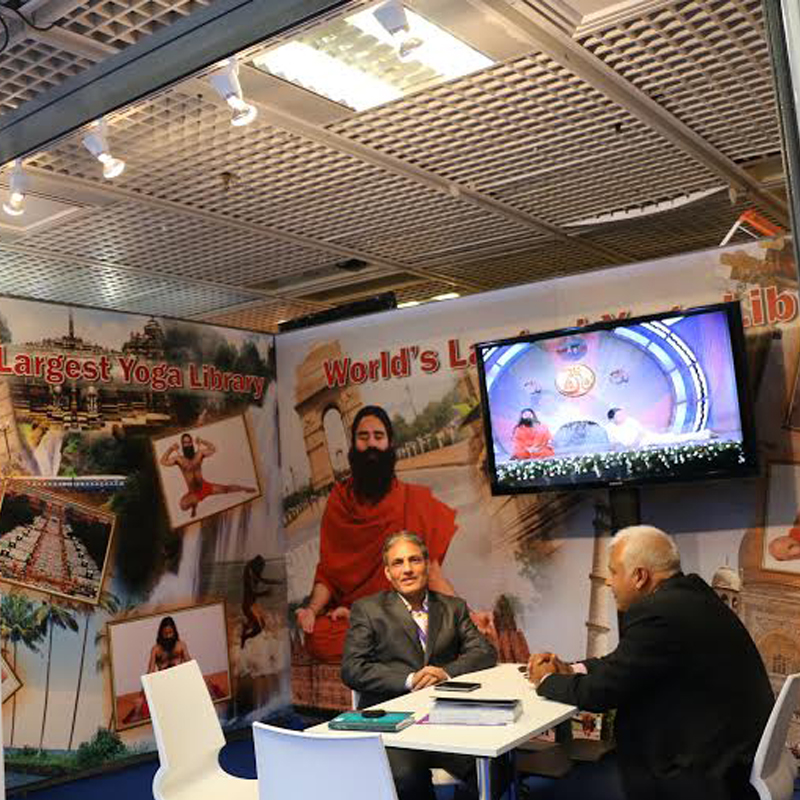
    Joshi acknowledges that the shift to HD came at the urging of Reed Midem’s India, Pakistan, Bangladesh and Sri Lanka representative Anil Wanvari (also the founder of the indiantelevision.com group) when the company exhibited at annual trade show MipCom in Cannes, France.

    He points out that there here are no plans to roll out a HD channel for now, since the focus is on building a library first with Swami Ramdev’s yoga practice. Simultaneously, the channel’s programmers have been giving a nudge to other prime gurus who have taken slots on Aastha to upgrade their productions.

    “We know there is a lot of demand for Indian spirituality and yoga worldwide,” points out Joshi. “With this step up in quality, we believe many more networks will want our programming. We are also open to dubbing the content in other local languages.”

    Currently, Zee International airs programmes featuring Swami Ramdev practising and teaching yoga at his camps. Enquiries from other overseas networks have been coming in.

    In addition to yogic exercise and spiritual TV shows, Joshi says that Aastha is also looking at filming spiritual tourism documentaries by partnering with different state tourism boards. “There is a lot of India interest and these documentaries will go a long way in helping both Indian and international visitors understand India’s diverse belief systems and places of spiritual worship better and from a regional perspective.”

    Finally, Aastha, like other Indian networks which are looking at licensing and syndication revenues, is hopeful that its HD production will find cachet with international buyers. “Swamiji is known worldwide,” he says. “That’s to our advantage. We hope in the next year or so, licensing and syndication of our content will scale up. “

    When it does, Astha’s investment in HD will start paying off.

  • Aastha, Swami Ramdev’s HD TV plans

    Aastha, Swami Ramdev’s HD TV plans

    MUMBAI: Most spiritual and devotional channels operating in India have a bagful of problems: limited revenues, low production budgets, which have led to very poor production values for their shows. Programmes and shows are shot with standard definition cameras with cheap sets as backdrops.

    This, at a time, when most of television land is moving to high definition and a select few towards 4k high dynamic range productions – both of which give better quality video – which can play out better on HD and 4K sets, making for a near realistic viewing experience.

    Swami Ramdev and Acharaya Balkrishna’s Patanjali Ayurveda has been giving FMCG multinationals in India a bit of a headache by eating away at their market shares in several product categories.

    Now the yoga guru-turned-entrepreneur is hoping to capture global audiences with his brand of yoga keeping in mind prime minister Narendra Modi’s penchant for it.

    Aastha – as is known to many – is among the leaders in the spiritual television space in India. And it is a channel that is part of Swami Ramdev’s empire.

    Over the past year or so, an HD revolution has been taking place silently in Noida where Aastha TV’s studios, playout and uplinking hub are located. Swami Ramdev has pumped in more than Rs 50 lakh into infrastructure – including 10-12 Sony PMW 200 cameras and post production facilities – which has helped facilitate production of programmes featuring him in high definition.

    Two multi-camera teams have been trailing the yoga guru filming him at gatherings, camps and seminars where he has led his disciples in asanas. Almost 700 hours of Yoga have been filmed in HD so far.

    “We wanted to upgrade and keep pace with technology,” says Aastha Broadcasting Network CEO Pramod Joshi. “We were producing and transmitting in SD which has limited demand in international markets.”

    Joshi acknowledges that the shift to HD came at the urging of Reed Midem’s India, Pakistan, Bangladesh and Sri Lanka representative Anil Wanvari (also the founder of the indiantelevision.com group) when the company exhibited at annual trade show MipCom in Cannes, France.

    He points out that there here are no plans to roll out a HD channel for now, since the focus is on building a library first with Swami Ramdev’s yoga practice. Simultaneously, the channel’s programmers have been giving a nudge to other prime gurus who have taken slots on Aastha to upgrade their productions.

    “We know there is a lot of demand for Indian spirituality and yoga worldwide,” points out Joshi. “With this step up in quality, we believe many more networks will want our programming. We are also open to dubbing the content in other local languages.”

    Currently, Zee International airs programmes featuring Swami Ramdev practising and teaching yoga at his camps. Enquiries from other overseas networks have been coming in.

    In addition to yogic exercise and spiritual TV shows, Joshi says that Aastha is also looking at filming spiritual tourism documentaries by partnering with different state tourism boards. “There is a lot of India interest and these documentaries will go a long way in helping both Indian and international visitors understand India’s diverse belief systems and places of spiritual worship better and from a regional perspective.”

    Finally, Aastha, like other Indian networks which are looking at licensing and syndication revenues, is hopeful that its HD production will find cachet with international buyers. “Swamiji is known worldwide,” he says. “That’s to our advantage. We hope in the next year or so, licensing and syndication of our content will scale up. “

    When it does, Astha’s investment in HD will start paying off.

  • Indian TV AD EX to grow at 12 .3 per cent in 2016: Carat report 2016

    Indian TV AD EX to grow at 12 .3 per cent in 2016: Carat report 2016

    MUMBAI:  Based on data  received from 59 markets across the Americas, Asia Pacific and EMEA, Carat’s latest global forecast highlights that advertising spends will reach  US$538  billion in 2016,  accounting for a +4.5 per cent year-on-year increase. The report also forecasts India growing begun on a positive note with a forecast growth rate  of +12.0 per cent in 2016. Carat’s first forecast for worldwide advertising expenditure in 2017 also predicts India’s ad spends will leapfrog to a growth of 13.9 per cent by 2017.

    Unlike growth in the other BRIC markets – Brazil, Russia and China – advertising expenditure in India would continue to accelerate in this year, supported  by the  India T20  Cricket World Cup and  the  state  elections. TV advertising revenues  are forecast  to grow by +12.3 per cent in 2016,  supported  by strong spending from e-commerce companies and FMCG brands.

    While TV is expected  to  remain  dominant for many  years  to  come,  advertisers  are increasingly  utilising online  video as  an  invaluable  complement. In spite of the much talked about digital marketing drive in the country, the overall   share of total digital advertising spends in India is still relatively low at 8.9 per cent (2016).

    Whereas the global ad spends on news paper  are declining  in markets like North America and Latin, India shows a  positive newspaper  advertising  spend    at +10.5 per cent in 2016,  primarily due  to investment  from e-commerce, automotive and a small contribution from government spending.  Retail advertisers also continue to spend on print.

    Carat’s first forecasts for 2017 predict continuing strong growth for the advertising market in India with an estimated increase  of +13.9 per cent and expected  favourable  economic  conditions in which advertisers vie for the consumers’  attention.

    The report makes it clear that while TV  will continue to dominate the lion share of advertising spends, digital is the real growth driver. Powered by the upsurge  of mobile (+37.9 per cent), online video (+34.7 per cent) and social media (+29.8 per cent) in 2016,  the strength  of digital is expected  to continue  to grow at double digit prediction levels of +15.0 per cent this year, and a further +13.6 per cent in 2017.  

    Overall, Carat predicts the upsurge  of digital to account for 27.0 per cent of advertising spends in 2016  and extend significantly to 29.3 per cent in 2017,  reaching  US$161  billion globally.

    Whilst digital is constantly closing the gap, TV continues to command the majority of market share with a steady 42 per cent. In 2015 ad spends is predicted to grow by +3.1 per cent this year as the Olympic Games and US elections are predicted to generate significant TV viewership across various markets.  In addition, Carat’s forecasts reconfirm the steady decline in Print* in 2016  and into 2017  with Newspapers declining by -5.4 per cent and Magazines  by -1.7 per cent in 2016  whilst highlighting positive year-on-year growth in 2016 for all other media, including Outdoor (+3.4 per cent),

    Radio (+2.2 per cent) and Cinema (+2.8 per cent), with the latter expected to grow further at +5.0 per cent in 2017.

  • Indian TV AD EX to grow at 12 .3 per cent in 2016: Carat report 2016

    Indian TV AD EX to grow at 12 .3 per cent in 2016: Carat report 2016

    MUMBAI:  Based on data  received from 59 markets across the Americas, Asia Pacific and EMEA, Carat’s latest global forecast highlights that advertising spends will reach  US$538  billion in 2016,  accounting for a +4.5 per cent year-on-year increase. The report also forecasts India growing begun on a positive note with a forecast growth rate  of +12.0 per cent in 2016. Carat’s first forecast for worldwide advertising expenditure in 2017 also predicts India’s ad spends will leapfrog to a growth of 13.9 per cent by 2017.

    Unlike growth in the other BRIC markets – Brazil, Russia and China – advertising expenditure in India would continue to accelerate in this year, supported  by the  India T20  Cricket World Cup and  the  state  elections. TV advertising revenues  are forecast  to grow by +12.3 per cent in 2016,  supported  by strong spending from e-commerce companies and FMCG brands.

    While TV is expected  to  remain  dominant for many  years  to  come,  advertisers  are increasingly  utilising online  video as  an  invaluable  complement. In spite of the much talked about digital marketing drive in the country, the overall   share of total digital advertising spends in India is still relatively low at 8.9 per cent (2016).

    Whereas the global ad spends on news paper  are declining  in markets like North America and Latin, India shows a  positive newspaper  advertising  spend    at +10.5 per cent in 2016,  primarily due  to investment  from e-commerce, automotive and a small contribution from government spending.  Retail advertisers also continue to spend on print.

    Carat’s first forecasts for 2017 predict continuing strong growth for the advertising market in India with an estimated increase  of +13.9 per cent and expected  favourable  economic  conditions in which advertisers vie for the consumers’  attention.

    The report makes it clear that while TV  will continue to dominate the lion share of advertising spends, digital is the real growth driver. Powered by the upsurge  of mobile (+37.9 per cent), online video (+34.7 per cent) and social media (+29.8 per cent) in 2016,  the strength  of digital is expected  to continue  to grow at double digit prediction levels of +15.0 per cent this year, and a further +13.6 per cent in 2017.  

    Overall, Carat predicts the upsurge  of digital to account for 27.0 per cent of advertising spends in 2016  and extend significantly to 29.3 per cent in 2017,  reaching  US$161  billion globally.

    Whilst digital is constantly closing the gap, TV continues to command the majority of market share with a steady 42 per cent. In 2015 ad spends is predicted to grow by +3.1 per cent this year as the Olympic Games and US elections are predicted to generate significant TV viewership across various markets.  In addition, Carat’s forecasts reconfirm the steady decline in Print* in 2016  and into 2017  with Newspapers declining by -5.4 per cent and Magazines  by -1.7 per cent in 2016  whilst highlighting positive year-on-year growth in 2016 for all other media, including Outdoor (+3.4 per cent),

    Radio (+2.2 per cent) and Cinema (+2.8 per cent), with the latter expected to grow further at +5.0 per cent in 2017.

  • Disney India launches ‘Gajju Bhai’ with Hyundai and Patanjali as sponsors

    Disney India launches ‘Gajju Bhai’ with Hyundai and Patanjali as sponsors

    MUMBAI: After thrilling the tiny tots with the action adventure series Arjun, Disney India is all set to win more hearts with its latest action comedy original animation series, Gajju Bhai that premieres on Monday 18 April.  Co produced by Disney and Toonz Animation India,  Gajju Bhai is about the coming of age story of a legendary ‘jollywood’ superstar and his transformation from a reel life to a real life hero. Add to that a mix of fantasy as he finds himself transported to a fantastical kingdom and solving young prince Iravan’s problems.

    Slated to air  on Mondays at 6 pm, with repeats throughout the day and the week, the show is targeting kids between the age of 6 to 10 years of both genders. Explaining the concept of the story, Disney India  Content and Communications, Media Networks – head and VP Vijay Subramaniam shares, “While Gajju Bhai knows he isn’t a hero in real life, after being sucked into prince Iravan’s fantastical kingdom, and finding out how the prince is a huge fan of his, he has to live up to his screen image, and by doing so he somehow manages to save the day in the end.”

    While the show will showcase long and plot heavy arcs, the format of the program is mostly episodic with each 22 minute long episode telling a story in itself. So far the network has slotted 52 episodes  in the first season along with a full length 90 minute movie that the channel plans to air two months into the show. Apart from the high quality 2D animation, the show also boasts of a 90 second song sequence in each episode. On an average each episode has cost the channel between Rs 20 to 25 lacs.

    When it comes to marketing, the channel has opted for conventional modes of communication and is hedging on its own network to create the initial buzz with music being the focus of the promotions. “We also plan to do an on ground activation around the middle of the show, to build the buzz up to the premiere of the full length feature. You can expect costumed characters and fun interactive activities surrounding the show’s characters then,” Subramaniam adds.

    On sponsorships, Subramaniam reveals that while Disney India doesn’t do title sponsors, there are a couple of lead sponsors on board the Gajju Bhai including  automobile brand Hyundai and FMCG brand Patanjali Juice. “The show will be driven by Hyundai and in association with Patanjali Juice. Each of our local animations has gotten a very welcome response from advertisers. Local animation has a lot of purchase among all our advertisers and Gajju Bhai isn’t any exception,” revealed Subramaniam further.

    The channel is strategically launching the show early into the summer, so that it airs during the full length of vacation season and builds a connection with the young audience. “Summer is the time when kids have more time to be in front of the TV. As a kids channel we plan to make the most of it and cater to the variety of demands the kids have. We understand that children do not want the same type of story to entertain them and therefore we have a different show every month for the,”

    With an aim to launch a new original programming every month during summer, the channel has two more soon to be launched shows in its kitty in the upcoming months.


  • Disney India launches ‘Gajju Bhai’ with Hyundai and Patanjali as sponsors

    Disney India launches ‘Gajju Bhai’ with Hyundai and Patanjali as sponsors

    MUMBAI: After thrilling the tiny tots with the action adventure series Arjun, Disney India is all set to win more hearts with its latest action comedy original animation series, Gajju Bhai that premieres on Monday 18 April.  Co produced by Disney and Toonz Animation India,  Gajju Bhai is about the coming of age story of a legendary ‘jollywood’ superstar and his transformation from a reel life to a real life hero. Add to that a mix of fantasy as he finds himself transported to a fantastical kingdom and solving young prince Iravan’s problems.

    Slated to air  on Mondays at 6 pm, with repeats throughout the day and the week, the show is targeting kids between the age of 6 to 10 years of both genders. Explaining the concept of the story, Disney India  Content and Communications, Media Networks – head and VP Vijay Subramaniam shares, “While Gajju Bhai knows he isn’t a hero in real life, after being sucked into prince Iravan’s fantastical kingdom, and finding out how the prince is a huge fan of his, he has to live up to his screen image, and by doing so he somehow manages to save the day in the end.”

    While the show will showcase long and plot heavy arcs, the format of the program is mostly episodic with each 22 minute long episode telling a story in itself. So far the network has slotted 52 episodes  in the first season along with a full length 90 minute movie that the channel plans to air two months into the show. Apart from the high quality 2D animation, the show also boasts of a 90 second song sequence in each episode. On an average each episode has cost the channel between Rs 20 to 25 lacs.

    When it comes to marketing, the channel has opted for conventional modes of communication and is hedging on its own network to create the initial buzz with music being the focus of the promotions. “We also plan to do an on ground activation around the middle of the show, to build the buzz up to the premiere of the full length feature. You can expect costumed characters and fun interactive activities surrounding the show’s characters then,” Subramaniam adds.

    On sponsorships, Subramaniam reveals that while Disney India doesn’t do title sponsors, there are a couple of lead sponsors on board the Gajju Bhai including  automobile brand Hyundai and FMCG brand Patanjali Juice. “The show will be driven by Hyundai and in association with Patanjali Juice. Each of our local animations has gotten a very welcome response from advertisers. Local animation has a lot of purchase among all our advertisers and Gajju Bhai isn’t any exception,” revealed Subramaniam further.

    The channel is strategically launching the show early into the summer, so that it airs during the full length of vacation season and builds a connection with the young audience. “Summer is the time when kids have more time to be in front of the TV. As a kids channel we plan to make the most of it and cater to the variety of demands the kids have. We understand that children do not want the same type of story to entertain them and therefore we have a different show every month for the,”

    With an aim to launch a new original programming every month during summer, the channel has two more soon to be launched shows in its kitty in the upcoming months.