Tag: FMCG brands

  • Adani Wilmar tops Kirana Club report for stellar customer service and order fulfillment

    Adani Wilmar tops Kirana Club report for stellar customer service and order fulfillment

    Mumbai: Adani Wilmar emerges as a frontrunner in the newly released Kirana Club Insider report findings, showcasing the performance of FMCG brands in crucial servicing aspects of customer service. The brand has secured an A+ rating for its exemplary performance in efficient order fulfillment. Outshining renowned brands, Adani Wilmar’s commitment to prompt delivery resonates strongly with kirana retailers.

    With a focus on addressing retailers’ pain points, the report highlights the significance of timely product delivery. Adani Wilmar’s absence from the list of brands associated with out-of-stock issues as well as defective products emphasises its proactive approach to inventory management, ensuring uninterrupted supply chains and mitigating potential revenue losses.

    Kirana Club insider report findings surveyed over 9,000 retailers on the Kirana Club platform and was conducted from 15 April to 5 May, with a majority of respondents from the HSM (Hindi-speaking market) region.

    https://insider.kirana.club/p/retailers-verdict-on-servicing

  • Mamaearth debuts on national TV with first ad film

    Mamaearth debuts on national TV with first ad film

    New Delhi: It was nearly four years ago when the husband-wife duo Varun and Ghazal Alagh decided to launch their own personal care and beauty brand – Mamaearth, foraying into the toxin-free products category within the overall personal care and beauty sector that is estimated at $24 billion in India and is rapidly expanding at 8.3 per cent CAGR. This category includes traditional as well as new age brands, which posed a major challenge to Mamaearth.

    Initially, it started with baby care products, but today it is a Rs 100 crore plus brand with a portfolio of over 120 plus products including skincare and hair care items that are Made Safe certified, available across retail channels in 500+ cities as well as online.

    Interestingly, the founders have always stated that the intention behind starting the company stemmed from a personal need, because a few years back there were hardly any natural products in the market. However, with awareness, there is an increasing demand for such products in different demographics. Today, the brand has competitors in the same category.

    The larger purpose of the company is to reduce parental stress, and it is continually improving and innovating to make the world a safer place for both babies and their parents.

    First step

    Unlike most personal care brands that go for full scale ATL campaigns to create buzz about their products, Mamaearth decided to take the digital route for promotions and user acquisition. It targeted premium metro consumers and tied up with influencer moms to spread the word about toxin-free products on social media.

    The strategy worked well, and sales went up through positive word-of-mouth on popular social networking sites. The brand, since then, followed a two pronged marketing strategy – one is to leverage influencer marketing to reach the target audience, and secondly, promoting product offerings via campaigns only through the digital platforms and mediums.

    As per reports, Facebook works very well from an acquisition standpoint, Google for remarketing, YouTube for awareness and stories for the brand.

    Over the years, the brand has created a sizeable fan base on social media. It has nearly half a million followers on Instagram, along with a growing community on Facebook and Twitter.

    During this time, the brand got investments from Bollywood actor Shilpa Kundra and several other investors. Earlier this year, it also raised Rs 130 crore from Sequoia.

    The brand is now targeting a run rate of Rs 300 crore by end of this financial year.

    Next big step

    After four years of digital promotions, the brand has decided to go big and scale. It announced a partnership with the current season of Bigg Boss and as an extension of that association, it debuted with an ad campaign on national television.

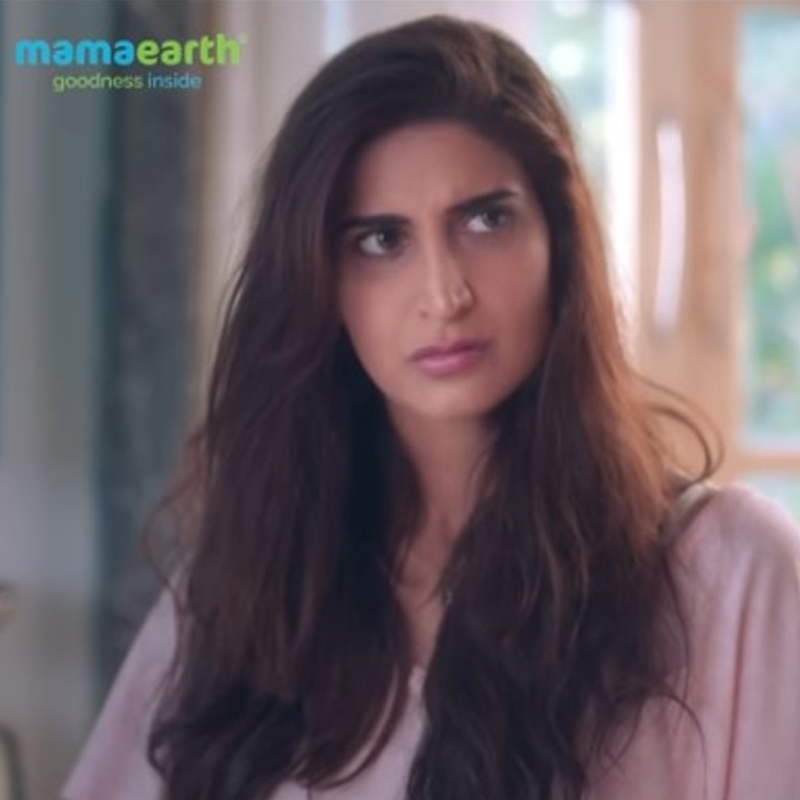
    The television commercial on onion hair oil highlights the benefits of onion oil in reducing hair fall, and pitches Mamaearth’s innovative product as a modern alternative to DIY hacks of making onion pulp for hair at home.

    Designed and conceptualised by Korra Worldwide, and featuring actors Aahana Kumra and Pavail Gulati, the film positions Mamaearth onion hair oil as an easier and modern way to give one’s hair the goodness of sulphur, enriched with 10 essential oils and herbs that helps in reducing hair fall. The TVC is a simple yet powerful representation of the brand’s philosophy and product proposition of goodness inside.

    Mamaearth co-Founder and CIO Ghazal Alagh said, “Millennials are increasingly choosing products that are free of chemicals and safe. Mamaearth, with the goodness of nature in their products, is becoming the brand of choice by millennials for the product and value proposition. While the age-old remedies are effective, it is extremely tedious and time consuming to make them. Mamaearth is bringing these traditional recipes, coupling it with science and presenting convenient yet effective solutions for skincare and haircare needs. The film reflects this exact proposition.”

    Alagh stated that the product differentiation of Mamaearth has always helped it in achieving this fast-paced growth. There is a lot of awareness and demand around toxin-free products. Traditional brands are also foraying into this category to ensure that they are able to retain their loyal audiences.

    The campaign is further supported on social media and digital platforms.

    Deepak Kumar, head of creative, Korra said: “Women are very aware of the benefits of onion oil, especially with the rising searches on YouTube and DIY hacks. But these hacks and remedies are cumbersome and very laborious. The Mamaearth TVC had to clearly remind people about the ease of using onion oil now in a bottle. The right cast, right music helped us create this beautiful piece.”

    Initially, when the brand started its journey, the objective was to spread awareness about toxin-free products, but now it is also focused on communicating the USP of its products. It is clear that the brand now wishes to scale up as it is now focusing on achieving growth and targeting a revenue of Rs 1,000 crores in the next three years. A television campaign with support on impact properties like Bigg Boss definitely helps the brand to cut across a large audience base across geographies and socio-economic categories. Alagh mentioned that the company is aiming to establish itself among the top 25 FMCG brands in the country.

    During the Covid2019 lockdown, the brand launched a few campaigns i.e. 'Spread awareness, not fear' and ‘Let your smile show.’ It also looped in ‘Goodness Ambassadors’ to distribute hand sanitisers for free to people in need.

    Mamaearth is also seeing an upward trend on Google searches, which clearly sets the time right for going for the next big move.

    The brand has claimed to be consistently upping its marketing budgets to have a strong plan in place for short, mid, as well as long term. It has always been extremely RoI fixated.

    It has focused on its products, innovations, and communication with the millennial generation. Over a period of time, the brand is breaking the traditional mould of big distribution required to enter the FMCG segment. The D2C business has helped it in reaching consumers faster and with more efficiency.

  • “We want to be in the top 25 FMCG brands in India” – Mamaearth’s Ghazal Alagh

    “We want to be in the top 25 FMCG brands in India” – Mamaearth’s Ghazal Alagh

    It is a little baby in the FMCG space, but its safe, natural, toxin-free personal care products have helped Mamaearth take rapid steps and get noticed by the biggies. Started in 2015, by the husband-wife duo of Varun and Ghazal Alagh under Honasa Consumer Pvt Ltd, Mamaearth began with six baby care products, and today has 100 plus stock taking units, including its skin and hair care range targeted at both men and women, and natural products for pregnant women.

    More than that it has notched up a revenue of Rs 100 crore in the year just ended and has its eyes set on a Rs 1,000 crore top line by 2023.  Apart from actress Shilpa Shetty who invested in the company, it has blue chip private equity firms which believe it is well on course to do that. It announced a series B investment of Rs 130 crore from Sequoia Capital, and existing investors Fireside Ventures, Stellaris Venture Partners and Sharp Ventures in January 2020.

    The paucity of good quality natural products when their baby was born, was the driving force for the Alagh couple to foray into manufacturing them, and now with demand growing – especially among millennials – even the big boys of the FMCG world are eyeing the segment.

    But Ghazal explains that Mamaearth has a substantial lead time over them because “the biggies  are still struggling to remove toxins from their products, whereas we have already ventured into the personal care segment with toxin free skin and hair products.”

    Being a digital first brand, Mamaearth- which is available in stores in New Delhi, Mumbai, Kolkata ,Chennai, Pune, Nagpur,  has been pretty focused on online marketing through influencers and digital campaigns. For instance, during the Covid2019 lockdown, it asked netizens to “Spread awareness, not fear”” and gave away 50,000 sanitisers through thousands of goodness ambassadors to health care workers, security personnel, delivery agents, domestic helps etc. Then it launched its “Let your smile show” initiative under which it gave away 20,000 smiley masks  as the lockdown was being lifted.

    Indiantelevision.com’s Dolly Mahayan got into a conversation with Ghazal Alagh on what makes the brand tick and the road ahead. Excerpts from the interview:

    Marketing always plays a very crucial role in any new brand. What was your marketing perspective when you started, and how it has evolved over the years?

    We started as a small brand with a premium proposition and wanted to reach out to only the metro consumers. That’s why we chose the digital medium to reach our target audience and communicate our brand story. We tied up with influencer moms who helped us spread the word about toxin-free products on social media. The strategy worked well, and our sales went up through positive word-of-mouth on popular social networking sites. Even today, we use influencer marketing to reach out to our core consumer group. While earlier, our objective was to spread awareness about toxin-free products, we are now focused on communicating the USP of each of our products.

    With every passing year, brands tend to increase their ad spends, ultimately leading to a surge in product pricing. How should a brand find the right balance between marketing expenses and product costs?

    The idea is to have a strong marketing plan in place for short, mid, as well as for the long term. Building a clear marketing budget from the beginning and breaking down the costs monthly helps us stay on top of the spends, without any nasty surprises at the end of the financial year. Finally, even if the ad spends increase every year, the key is to spend effectively.

    The brand is extensively prioritising influencer marketing to drive engagement. In what ways, these partnerships have helped?

    Influencer marketing has worked really well for us. Our target audience is the millennial generation who rely on information available on the internet and are influenced by word of mouth from their peers.  In today’s digital age, influencers have built a high amount of trust from their followers, and recommendations from them establish trust with the brand’s potential customers.

    For a new brand like Mamaearth, how do you find the right balance between marketing expenses and product costs?

    Being a product company, we make sure we are not cutting down costs on raw material and manufacturing. In the end, it is the product that will deliver. Marketing efforts at each stage of the brand, especially for FMCG, keep changing, and each stage requires a different approach and investment. Eventually, the right balance between marketing expense and product cost has to be made by keeping in mind a healthy bottom line.

    Your products are towards the higher end of the spectrum, what do you think gives you an edge in the Indian market?

    We’ve focused on our products, innovations, and communication with the millennial generation.  Another factor that gives us an edge over other FMCG products is our D2C business. We are breaking the traditional mold of big distribution required to enter the FMCG segment. The D2C business has helped us in reaching our consumers faster and with more efficiency.

    The company has recently started rolling out digital campaigns. Any plans to expand the reach to TV or any other medium?

    So far, we’ve been able to reach and engage with our target audience through the digital medium. Not only is it cost-effective, but digital technology also helps us in understanding our consumers better and connecting with them closely. So, for now, we’ll continue with digital campaigns only.  

    You have crossed the initial hurdle, now, what is the way forward? What are your plans when it comes to retail expansion?

    With our focus on innovation, a six-product portfolio is now a 100+ SKU portfolio within four years. Even during this pandemic, we managed to introduce 12 new products —the goal is to consistently and quickly push the envelope in the big personal care segments. Soon the goal is to enter the more niche segments (sheet masks, face cream, hand cream, etc.) as well.

    For our brand Mamaearth, the goal is to reach a Rs 1000 crore run rate in the next three years, which will put us in the top 20-25 FMCG brands in the country.

  • Modern brand marketing methods not just digital-exclusive

    Modern brand marketing methods not just digital-exclusive

    MUMBAI: The use of the internet and other digital media and technology to support 'modern marketing’ has given rise to the concept of digital marketing, and we at Tanishq believe that the focus has always been on building a 360-degree marketing plan, with seamless integration of products, services and communication. We try to not look at traditional and digital as two separate entities. Although digital ad spends have shown a considerable increase in comparison to traditional media, the base however, continues to be relatively smaller. Regardless, we have intensified the number of digital assets and we are also leveraging new-age tools at disposal like geo-targeting, virtual reality, online-to-offline attribution modelling etc., basically all tools that help us ensure maximum accessibility of the brand, for the consumers.

    Most categories and brands are focusing on a multichannel media approach and that has reflected a lot in the festive season as well. With regards to the ad spend share for FMCG brands, we have noticed a reduction in their focus from traditional mediums like TV and seen them re-direct their path to the digital front with customised campaigns across YouTube, Facebook, Instagram and other social channels.

    With the upcoming concept of omni-channel marketing, a smart digital strategy becomes all the more critical. No more can we focus only on one medium, especially if buyers themselves are branching out through new arenas. A diversification in mediums is essential when it comes to communicating our brand messaging.

    Brands today are evolving with its consumers, and are looking towards transforming mass online marketing to one-to-one interactions to engage with the consumer. As a result of this, we are already on our way to developing a big-data driven approach to create moments of delight for our consumer through an intelligent recommendation system, not to mention taking the in-store experience online through AR/VR tools. Basically we want to be present with the customer, when the “intent rich” digital discovery moment occurs.

    (The author is  associate vice president, marketing, jewellery division at Titan Company. The views expressed here are her own and Indiantelevision.com may not subscribe to them)   

  • FMCGs were top TV advertisers in week 9

    BENGALURU: 10 FMCG players were top television advertisers in week 9 of 2017 (Saturday, 25 February to Friday, March 3, 2017) Top 10 Advertisers *Across Genre : All India (U+R) : 2+ Individuals as per . Broadcast Audience Research Council (BARC) data. FMCG major Hindustan Lever Limited (Lever) was the top advertiser with 1,25,370 television ad insertions or spots during the week under consideration.

    In terms of brands, six FMCG brands, one each from politics, mobile banking, mobile apps and jewellery genres were advertised on television the most in week 9 of 2017 as per BARC data for Top 10 Brands *Across Genre : All India (U+R) : 2+ Individuals.

    This paper must be read with a caveat: It deals only with the players present in BARC’s top 10 lists of advertisers and brandsper week. The sums/percentages of other advertisers/brands other than those indicated in BARC’s top 10 lists of have not been considered/mentioned in this paper during the period under consideration and those numbers could be more/higher.

    During the first 8 weeks of 2017, 17 advertisers (a maximum possible of 80 for 8 weeks) were present in the top 10 list of advertisers and 42 brands (a maximum possible of 80 for 8 weeks) were present in the list at least once during the 8 weeks. In week 9, one new advertiser–Coca Cola India Limited was added to the top 10 advertisers list to take the count to of top TV advertisers in weeks 1 to 9 of 2017 to 18 advertisers. Also, one new brand – Pears entered the top 10 brands in terms of TV ad spots list in week 9 to take the total number of most advertised brands in the first nine weeks of 2017to 43.

    public://Untitled-2_12.jpg

    Though the Bharatiya Janata Party (BJP) dropped to the third position in week 9 in terms of television ad insertions of brands in a week in week 9 with 7,920 spots, overall, it topped the list during the first nine weeks of 2017 with 71,450 insertions.

    Mobile Banking brand Airtel Payments Bank was the most advertised brand on television in week 9 of 2017 with 10,673 insertions, followed by FMCG Oral care brand Close Up Ever Fresh with 8,430 insertions in week 9. As mentioned above, the BJP was the third most advertised brand in week 9. Please refer to the charts below for the top 10 brands in week 9 of 2017. Three brands entered top 10 brands list in week 9 as compared to week 8 – They were – GoodKnight Active Plus, Pears and Dr Ortho Oil & Capsule. The brands that exited the list from week 8 were Jio Fi, Vivo V5 Plus and Dettol Liquid Soap. Among the 43 brands in the lists over 9 weeks’ Surf Excel Easy Wash was present in 6 lists in the first nine weeks of 2017, including week 9. In terms of frequency, the BJP was next with a presence in 5 weeks of the nine during the first nine weeks of 2017.

    public://Untitled-3_15.jpg


  • 25% of Rural Maharashtra Uses Internet Services on their Phones reveals Chrome survey

    25% of Rural Maharashtra Uses Internet Services on their Phones reveals Chrome survey

    MUMBAI: Post a successful execution of the world’s largest rural survey by Chrome Data Analytics and Media, the company has revealed some game- changing numbers for FMCG brands.

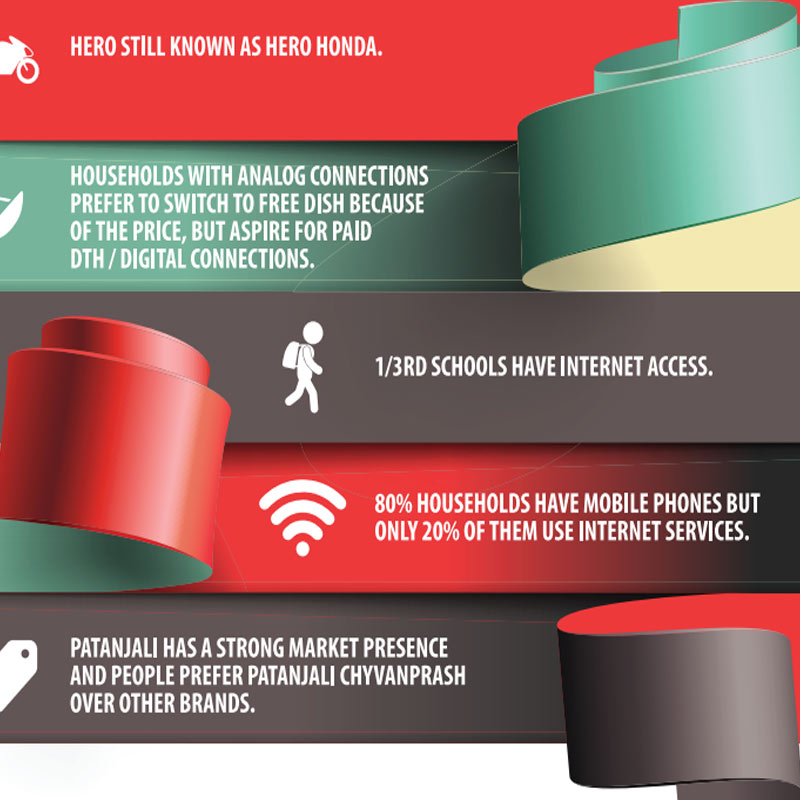
    Amongst other findings, the Rural Establishment Survey states that while 80% of rural Maharashtra uses mobile phones, only 20% are actually using internet services on them. The extensive survey that was spread across a period of 15 months, has also reported a number of other interesting insights that will change the way FMCG brands are targeting their user base.

    When it comes to educational infrastructure, the rural institutions seem to be moving in the right direction. According to the report, 1/3rd of schools in the area have access to the internet. The report also goes into marketing and branding effectiveness through the questionnaire. For example, one of the country’s largest selling two-wheeler companies is still known by its former name, years after breaking up with its Japanese collaborator.

    On speaking to Chrome DM CEO Pankaj Krishna about the impact of this study he stated that ‘The study has taken a deep dive into rural India’s consumer behavior and habits, which is a sure shot solution for FMCG brands to redirect their sales and marketing strategies.’

    Further to this, the report is aimed at assisting companies to tap the untapped market. Especially since 74% of the Indian population still resides in rural areas, there is a huge opportunity for companies to scale up their sales to the next level.

  • 25% of Rural Maharashtra Uses Internet Services on their Phones reveals Chrome survey

    25% of Rural Maharashtra Uses Internet Services on their Phones reveals Chrome survey

    MUMBAI: Post a successful execution of the world’s largest rural survey by Chrome Data Analytics and Media, the company has revealed some game- changing numbers for FMCG brands.

    Amongst other findings, the Rural Establishment Survey states that while 80% of rural Maharashtra uses mobile phones, only 20% are actually using internet services on them. The extensive survey that was spread across a period of 15 months, has also reported a number of other interesting insights that will change the way FMCG brands are targeting their user base.

    When it comes to educational infrastructure, the rural institutions seem to be moving in the right direction. According to the report, 1/3rd of schools in the area have access to the internet. The report also goes into marketing and branding effectiveness through the questionnaire. For example, one of the country’s largest selling two-wheeler companies is still known by its former name, years after breaking up with its Japanese collaborator.

    On speaking to Chrome DM CEO Pankaj Krishna about the impact of this study he stated that ‘The study has taken a deep dive into rural India’s consumer behavior and habits, which is a sure shot solution for FMCG brands to redirect their sales and marketing strategies.’

    Further to this, the report is aimed at assisting companies to tap the untapped market. Especially since 74% of the Indian population still resides in rural areas, there is a huge opportunity for companies to scale up their sales to the next level.