Tag: Flipkart

  • Alcatel’s smartphone ‘Onetouch Fire C’ launches on Flipkart’s Big Billion Day Sale

    Alcatel’s smartphone ‘Onetouch Fire C’ launches on Flipkart’s Big Billion Day Sale

    BENGALURU:  A number of companies have said that they are working on the $20-25 smartphone for India. Alcatel Onetouch (Alcatel) has come in close with a smartphone that seems to have features that just about slot it into the smartphone category, a little above the features phone at a price of Rs 1990, or a little more than $30 – the ‘Onetouch Fire C’.


    The company is targeting first time users of smartphones that want to upgrade from the basic or the features phone in a very price sensitive market like India. The Onetouch Fire C will be available exclusively through Flipkart starting 6 October, or Flipkart’s Big Billion Day (Sale Day), for which the company has initiated a huge multimedia campaign. Flipkart feels that a lot of first time internet users will access the net on the Big Billion Day and hence push up sales of Onetouch Fire C. Flipkart has not planned a special campaign for individual products which include a Lenovo launch on 6 December 2014.


    However, Alcatel plans to push the Onetouch Fire C digitally for now, and through the print media sometime around Diwali. Its creatives are done globally, while media buying is through Ad Syndicate and Zenith Optimedia.


    “Even today, 71 per cent of market in India is feature phones, while 29 per cent is smartphones. Of that 29 per cent, between 30-40 per cent of the market is for the Rs 5000 or lower smartphone, and it is this market that we are targeting primarily with the Fire C,” said Alcatel Onetouch regional director APAC BU Praveen Valecha. The Onetouch Fire C is a 2G phone and the company is likely to come up with an upgraded low cost model sometime in November or December this year, which could have 3G or even 4G capability.


    “As a launch partner for Firefox OS, we know that our customers love its simple user interface and smooth navigation. We see a great deal of opportunity to bring these benefits to more consumers on a greater variety of devices at most affordable price and we are sure of success as it’s an innovative product selling on Flipkart, India’s largest e-commerce platform,” said Valecha.


    Here’s what a press release has to say about the Onetouch Fire C:


    Offering Firefox OS features at entry-level price; the Fire C is a pocket-sized smartphone that is designed to make sharing simple. Its 3.5” HVGA screen and 1 GHZ processor offer smooth and fast Firefox OS apps experience. Complete with mobile broadband and stereo FM radio RDS, the Fire C2G offers all of the features needed to capture, share and enjoy content. Firefox is totally a web HTML based OS which gives best user experience on-the-go. It constitutes marketplace and best adaptive applications search along with rich media and social messaging apps support. A unique dynamic UI will be a big plus for the phone.


    Key features include:

    Onetouch Fire C – 2G: OS version – Firefox 1.3, Compact, pocket friendly design,  3.5” HVGA display, dual sim, 1.0 GHz, 1.3 MP camera; Colour – bluish black and dark chocolate; Multilingual support – English, Bangla, Tamil and Hindi languages.

  • Flipkart joins hands with PC Jeweller

    Flipkart joins hands with PC Jeweller

    MUMBAI: Continuing the string of announcements, Flipkart has now joined hands with jewellery retailer PC Jeweller to create a platform for online jewellery shopping, reported PTI. “With the aim to revolutionise the trend of jewellery buying in India, this partnership will provide an online go-to platform for the shoppers,” both the companies said in a statement.


    The focus will be on the replicating the comfort, convenience and brilliance that is associated with shopping at a PC Jeweller’s large format showroom online on Flipkart, it also added.


    PC Jeweller executive director and chief operating officer RK Sharma said, “We are focussed on our online jewellery brand WearYourShine by PC Jeweller and going forward, we would also like to work with Flipkart towards creating a seamless offline-online integration wherein customers get a flexibility to buy online and exchange or return offline across over 46 showrooms of PC Jeweller.”


    “We see online jewellery sales becoming a huge market in the next few years, contributing a good share to our business,” he added.


    Flipkart’s deep data analytics and online cataloguing assistance will further refine the online shopping experience.


    Flipkart retail senior VP Kalyan Krishnamurthy said, “Our access to the country’s largest customer base allows us to predict market needs and list new products on our site that we feel will cater to current customer demands. We are confident that precious jewellery, as a category, has huge potential if done right.”


    “The association of Flipkart and PC Jewellers, both names that are trusted widely by customers, is well positioned to take online jewellery shopping to the next level,” he added.

  • We obsess about customer, not competition, says Jeff Bezos

    We obsess about customer, not competition, says Jeff Bezos

    MUMBAI: With the battle brewing in the e-commerce segment, the sector is making headlines every day; the latest being of Amazom chairman Jeff Bezos’s four-day visit to India.


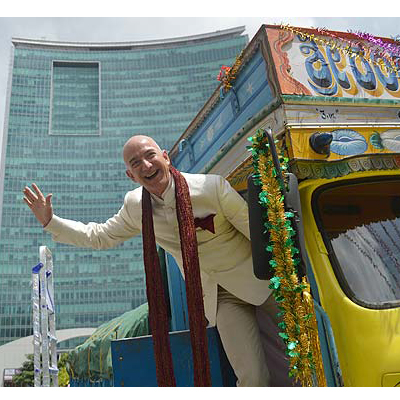
    To make his business intentions in India clear, Bezos, who is on his second visit to India, carried out a road show on a supply truck at the premises of a shopping mall in Bangalore on 28 August handing a $2 billion cheque to Amazon India VP and country manager Amit Agarwal. This is by far the biggest expansion money from overseas that has come from a multi-national.


    According to the media reports, while handing the cheque, he said, “Amazon has unveiled a $2 billion investment in the country … we’ll work to better what Indians love most in shopping — vast selection, competitive pricing and fast delivery.”


    Amazon had announced a $2billion investment in India barely a day after homegrown Flipkart raised $1 bn from private investors.

    As per the reports, Bezos added that the cash pile will be spent on building performance centers, upgrading logistics services, developing the mobile platform and new tools and techniques to help the small and medium businesses.


    Amazon’s interest in the small and medium enterprises has been echoed by several homegrown e-tailers. While Snapdeal recently announced that it was inching close to the 100,000-seller mark, Flipkart has been tying up with industry bodies like FISME and NCDPD to penetrate the SME clusters.


    In an initiative called Amazon OneonOne, Bezos also had luncheon with about 100 customers on 28 September in order to find their views and opinions about the site and if there were any recommendations.


    According to various media reports, Bezos also indicated that policy hurdles in India is not impacting the company’s investment plans for the country. India is yet to allow FDI in online retail. Another issue is lack of clarity in tax laws that are impacting the company’s functioning in various states.


    Amazon’s main rivals in India are Bangalore-based Flipkart and Snapdeal, the Delhi-based company that counts eBay, Azim Premji and Ratan Tata as investors. Together, they have sold goods worth more than $4 billion, with Flipkart alone estimated to have crossed $2 billion. Alibaba, too, is keen on India, and the Chinese company has the money, experience and ambition to succeed here.


    Talking about the competition, Bezos also reportedly said, “We have a long history of obsessing over customers rather than competition.”


    With revenue of nearly $75 billion in 2013 the giant online retail site has a market value of $150 billion. It also runs a fast growing cloud computing business called Amazon Web Services and makes Kindle tablets and Fire smartphones. Bezos, in his personal capacity, bought The Washington Post newspaper last year. In India, Amazon started its technology operation first and employs a total of about 12,000 staff at offices in Bangalore, Hyderabad, Chennai and Delhi.


  • Puma India appoints new MD Abhishek Ganguly

    Puma India appoints new MD Abhishek Ganguly

    MUMBAI: Soon after Rajiv Mehta quit the company after nine years, Puma India has announced the appointment of Abhishek Ganguly, as its new managing director.


    Talking about the new appointment Puma EEMEA region GM said, “We’re delighted to ring in Abhishek’s appointment as the managing director of Puma India as one of the founding directors of PUMA India. Abhishek brings with him a wealth of experience that will guide the brand towards its next leap in India.”


    “Puma India has delivered an outstanding performance during the last nine years and I look forward to the continued progress of this great brand of ours with Abhishek,” he added.


    Ganguly previously had been spearheading the sales and retail functions for the brand and had joined Puma right at its inception in 2005 as a founding director. His appointment comes at a time when the brand is taking bold steps in its new positioning to be the fastest brand in the world. The brand recently launched the Forever Faster campaign.


    Puma India now has around 300 stores in 100 cities and towns. The company has opted for the hybrid retail model in India which is made up of franchises as well as owned-and-operated stores. As much as 15 per cent of its stores are owned-and-operated. And 12 per cent of its annual revenue comes from online platforms such as Myntra, Jabong and Flipkart.

  • Alibaba in talks with Snapdeal to enter India

    Alibaba in talks with Snapdeal to enter India

    MUMBAI: As it is ready to embark upon a new journey by launching what may be the biggest IPO ever, Chinese e-retailer Alibaba may also be making a move to tap into the growing Indian retail market through an investment in local e-retailer Snapdeal.


    According to an Economic Times report, Alibaba, is in talks with online retailer Snapdeal to enter India. The e-commerce giant is in discussion for a possible investment in the Indian company, but no decision has been taken yet.


    The report also quoted a source saying that the deal will be announced in a month.


    The Chinese company is expected to be valued at over $165 billion at the conclusion of its initial public offer. So far, Alibaba has only been linking Indian merchants with overseas buyers and sellers.


    With its entry in the Indian online retail space by aligning with Snapdeal, the Chinese e-tailer will be competing directly against market leaders like Flipkart and Amazon. Even though the Chinese company would be a late entrant, it has the advantage of size — as per sales Alibaba is bigger than Amazon and eBay combined.


    While on the other hand, the Delhi-based company has already raised a total of $233 million in two rounds of investments this year. The last round in May valued the firm at $1 billion. It is expected to be worth Rs 50,000 crore by 2016, according to a market rating agency Crisil.


    The company, in which Ratan Tata holds a stake, is also attracting attention from Japan’s largest e-commerce company Rakuten Inc and telecommunications firm SoftBank Corp, the report added.


    On contacting Snapdeal, the spokesperson said, “As a policy, we do not comment on such speculations.”


    Alibaba’s shares are set to debut on the US market on 19 September, in what could be the world’s largest ever initial public offering. It increased the price range on its offering from $66 to $68 on 15 September, reflecting strong demand from investors for the year’s most anticipated debut.

  • Amazon to start a wholesale portal in India?

    Amazon to start a wholesale portal in India?

    MUMBAI: After launching an e-retailer Amazon India and a product-comparison site Junglee.com, the US online retail giant is all set to launch a new portal in India.


    According to a report by economic times, the Seattle-based company is preparing to launch a portal for wholesale merchants in India, the first country outside the US where such an initiative is being planned.


    The report also said that the wholesale portal could be launched as early as next year and the team has been working on this secret project for the past few months. Talks with potential suppliers and the hiring process have also begun. The initiative could be led by Samir Kumar, who is currently director of category management and the team will report to Amazon India head Amit Agarwal.


    “It will be similar to what Walmart is doing online in India and what Alibaba does in China,” sources said to economic times.


    Amazon refused to comment to the report. An Amazon India spokeswoman said, “As a policy, we do not comment on anything that we may or may not do in the future.”


    Amazon’s online retail business has grown rapidly since its debut in India. It is already the biggest competition to the home-grown e-commerce site Flipkart. Just a day after Flipkart raised $1 billion, Amazon founder Jeff Bezos announced that Amazon is going to invest $2 billion in its Indian arm.


    The India wholesale portal is said to be similar to AmazonSupply, its online site in the US focused on business consumers. The India platform will target small and medium enterprises. However, it is not clear what categories of products will the company sell under its wholesale platform. For instance, AmazonSupply does not sell apparel and other soft lines such as furnishings.


    Launched in 2012, AmazonSupply sells products ranging from office supplies to electrical equipment.


    Since June last year, Amazon in India has set up a network of seven warehouses across the country and has over 8,500 merchants selling products in over 28 categories on its platform.


    Recently, US retail giant Walmart also estimated that India’s wholesale market will grow to $700 billion by 2020 from the current $300 billion. Earlier this year, it launched a business-focused site bestpricewholesale.co.in for its wholesale club members in Lucknow and Hyderabad.


    It is estimated that the retail market in India currently at $525 billion will double in size by 2020.

  • “India is an incredibly important market for us with no dearth of stories to tell”:   Ravi Agrawal

    “India is an incredibly important market for us with no dearth of stories to tell”: Ravi Agrawal

    It has been just six months since he’s taken charge of CNN International operations from south Asia. As bureau chief from New Delhi, Ravi Agrawal has been associated with the media conglomerate since he stepped into the media fraternity eight years ago.


    First in London and then in New York, Agrawal has been producer for several shows including ‘Fareed Zakaria GPS’. Now in Delhi, he will be looking at increasing the coverage from the country with a new government at the helm. As the world’s focus shifts towards South Asia, Agrawal will lead the CNN team from India to deliver key stories for the global English audience.


    In conversation with indiantelevision.com’s Vishaka Chakrapani, he shares a few insights on the focus of CNN International in the country and what Indian stories mean to the world.


    Excerpts…


    How important is India in terms of world stories for CNN International?


    India is a great fascinating story now. It’s 1/6th of humanity. It has become an increasingly important force economically speaking and is demographically vibrant. In all our stories we emphasise that the median age of Indians is 27 which means half of all Indians are under 27 years of age which when compared to other countries shows India as a very young and vibrant country. It has immense potential to be a huge player. The spurt in growth of smartphones which will grow from 130 million users today to 250 million in the next five years will impact stories and the economy. This in turn will also impact how we as journalists cover stories. India is an incredibly important market for us and there is no dearth of stories to tell us. 


    What are the changes you’ve brought in the reporting teams?


    Historically, we have had a very strong presence in India and are looking at maintaining that with two correspondents in Mumbai and Delhi for politics and business. With producers and cameramen and now we are well positioned to attack not just breaking news but also trend stories.


    What stories from India interest your audience?


    Certainly demographics interest us as well as the growth of digital in the country. The reason why Flipkart raised $1 billion was because there was a feeling that with the growth of the smartphone industry, Indians are going to spend a lot of money online. Immediately after, Amazon announced its investment of $2 billion here. We are fascinated with this because it changes not just retail but also the media, banking and daily life of people.


    Politics is also of interest to us, especially with the arrival of a new government which has got a mandate after 30 years with absolute majority. A lot of businessmen we spoke to are optimistic about the opportunity India has in store. Our challenge is how will we cover the larger India narrative that is on the cusp of doing what China might have done 20 years ago which is high speed growth, big transformative change across country and as journalists we need to analyse whether this change will actually happen.


    We do have a commitment to doing strong people stories. For all of India’s economic advances, there are a number of social ills too. We have a show called Freedom Project where we tackle world issues but they have mostly led us back to south Asia.


    Have there been any changes in the reporting style?


    That’s a constantly evolving process. We use Live-U for reporting, which enables us to go anywhere and broadcast with just two people. In India, with widespread technology and 3G coverage, we get amazing signals and so we can be more mobile and live.


    We invest a lot of money and resources in our photographers. We shoot state of the art 16:9 HD and we broadcast in HD in the US and you can see that difference the way our shots are framed, the way we get to places that few others get to. Some examples are our coverage in Gaza, Africa for Ebola and the Ukraine crisis. We invest a lot in just reaching these places and reporting from there. It costs a lot to get there first, to ensure security and to be with experienced teams.


    Does CNN have any plan to produce shows from India anytime soon?


    We have a bureau where we have a number of places where we can go live from, but we don’t have a studio yet. However, we are committed to telling the India story. One of our shows, Connect the World has now shifted from London to Abu Dhabi that puts focus on the Middle East and South Asia. That’s a global story, watched in Latin America but it still nods to the fact that its 8:30pm in India when its telecast.


    During elections, Becky Anderson came to India and hosted her entire show from here.  We are well equipped to broadcast live from India by getting anchors here for breaking news. Indian elections were covered in both our International feed and the US feed. Americans love elections and so a number of shows did live and guest segments with Becky.


    Any plans for a regional focus in India?


    We are essentially an English channel catering to an English speaking audience that is the upper niche, outward looking, global traveller with business interests. The global viewer is English and India will soon be the biggest English speaking audience.


    How do you operate on digital? Is digital a precursor to TV for breaking news now?


    We’ve stopped distinguishing between TV and digital. We don’t think of a story as ‘this is a web story’ or ‘this is a TV story’.  The basic research needed for both is the same. CNN is truly one of those places where we think multi-platform for every story. When we take a picture we think of it in terms of the best TV imagery and also if it can be used online. The aim is to show it visually for TV and in a simple way for digital. We ensure that we aren’t just tweeting our stories but also engaging people and collecting news. When there is breaking news, we first verify and then put it out on multi platforms simultaneously.

  • Flipkart launches third private brand – Citron

    Flipkart launches third private brand – Citron

    MUMBAI: Bangalore-based e-retailer Flipkart announced its in-house home appliances and personal healthcare brand — Citron.


    The label includes a wide range of cooking utilities and grooming products. According to the press release, the product range in electronics includes electric kettles, sandwich makers, hand blenders and pop-up toasters while the range in the personal healthcare category has shavers and trimmers, hair straighteners and dryers.


    Flipkart, which has so far raised $1.75 billion from investors forayed into the private labels segment in 2012 with Digiflip, selling digital accessories, before launching tablets under the brand. Flipkart had also launched lifestyle private brand Flippd in January this year.


    Excited with the recent launch, Flipkart SVP-Retail Kalyan Krishnamurthy said, “The launch of Citron is our next step in expanding the private labels offering at Flipkart. This enables us to offer our customers quality products at a great value for yet another category after lifestyle and tablets.”


    “In the next three months we will expand into selling various other products such as irons, induction cooktops, juicers, mixers etc.,” he added.


    While the home appliances products are priced between Rs 500 and Rs 999, the personal healthcare products are available at Rs 549- 949.


    While most online fashion portals like Jabong and Myntra (which Flipkart recently acquired) have multiple private labels in clothing, Flipkart has been one of the first to introduce its own range in electronics like tablets and other gadgets.

  • “We are customer obsessed, not competition obsessed”: Amit Agarwal

    “We are customer obsessed, not competition obsessed”: Amit Agarwal

    Since its inception over 20 years ago in the United States, Amazon.com has been obsessed with a fervor to serve its consumer and being the ‘earth’s biggest bookstore’. It has grown from a ‘dot-com’ corporation into a king in the domain of internet retail. And now, its Indian arm under the leadership of Amit Agarwal, is looking at achieving the same landmark.  


    Describing his current role as ‘Bringing Earth’s Biggest Selection to India; building India’s most customer-centric company’ on Linkedin, the new role has countless firsts for Mumbai-born Agarwal, now an American citizen. He has never worked in India in a business-facing role and never headed country operations as well.


    The IIT-Kanpur and Stanford alumnus has been with Amazon since 1999. He has worked in various departments in the company including technical advisor to CEO Jeff Bezos between 2007 and 2009, before heading the operations in India.


    Born in 1974, Agarwal joined Amazon as a part of its technology team.


    Just a year old and Amazon India has already become the biggest threat to the seven-year old Flipkart in the Indian e-retail market. With an action-packed first year, the global online retail giant is gearing up to play a dominant role in the $13 billion Indian e-commerce industry.


    In an interview with Indiantelevision.com’s Pranati Deva, Amazon India VP & country manager Amit Agarwal discloses Amazon India’s journey in the Indian e-commerce space and plans for the future.


    Excerpts…


    What inspired you to finally start an arm in India? Flipkart started in 2007, why did you think 2013 was the right year to jump into the Indian e-commerce space?


    We believe that we entered the India market at the right time. Indian e-commerce space is still in a very nascent stage with significant potential for innovation to improve customer experience. We believe that the growth is at an inflection point and there is tremendous opportunity. 


    We have received a fabulous response from both customers and sellers in the last 14 plus months of our India operations. We launched in India with two departments – Books and Movies & TV Shows – and in these 14 plus months, our total selection now stands at more than 17 million products across 30 departments and hundreds of categories. We have witnessed phenomenal selection growth across several categories and are already the largest store  in 12 of the 30 departments that we have on amazon.in including Books, Music, Video Games, Toys, Home & Kitchen, Luggage and Backpacks, Fashion Jewellery, Beauty Products, Movies & TV shows, Men’s inner wear , Sports, Fitness & Outdoors and Pet Supplies.


    What is your current strategy in India? And how will your strategy change if the e-commerce sector opens up to FDI?


    Our strategy for amazon.in is the same as our global vision to be India’s most customer-centric company by giving customers more of what they want – low prices, vast selection, fast and reliable delivery, and a trusted and convenient experience – and provide sellers a world-class e-commerce platform. The execution of this strategy is local. If you look at the logistics infrastructure, Amazon has built one of the most sophisticated logistics infrastructures that has ever been built to serve sellers and customers


    We start with the customer experience and work backwards from it. Building a great customer experience drives traffic; traffic attracts sellers; more sellers drive more selection and this further improves the customer experience.


    We have always maintained that opening up this sector to FDI will be good for consumers and Indian businesses as it would allow us to partner with local manufacturers to source products not carried by other sellers in the marketplace, giving Indian consumers unique and wider choices at lower prices. Allowing FDI, also, positively impacts infrastructure development in the country.


    The announcement for the $2 billion investment in Amazon India came in just days after Flipkart announced fundraising of $1 billion. Was the announcement strategically placed?


    We are customer obsessed and not competition obsessed.  We aspire to provide Earth’s biggest selection and the most trustworthy and convenient online shopping experience to our customers in India.  And we have been investing aggressively right from the beginning.


    Our rapid growth in a short time and the significant opportunity ahead of us makes us very comfortable in making this large additional investment. We are not surprised if our rapid growth and customer experience ambitions have increased investment elsewhere as well.     


    What areas will you mainly focus on now, after the investment?            


    We don’t talk about any of our future plans but essentially it will go towards growing our business and enhancing customer and seller experience. 


    Which categories contribute the most to your revenue?


    Categories with the strongest growth are Books, Consumer Electronics, Shoes, Baby Products, and Watches.


    To increase your demand in the Indian space, which brands have you associated with recently for their products?


    We are witnessing that both brands and SMEs are willing and are excited to use the Amazon India marketplace to reach to consumers nationally. Brands and sellers see a lot of value in their association with us. We not only play a significant role in driving sales but also in building consumer awareness about products and educating them about the benefits of these offerings so that they are able to make smart purchase decisions.


    Today several sellers and brands are keenly exploring possibilities of exclusive associations with us. For example Amazon India is the exclusive retail partner for Microsoft’s entire Interactive Entertainment Business portfolio which includes Xbox One, Xbox 360, Kinect, Xbox Live, Xbox Accessories and all Microsoft-published Xbox game titles. Similarly, Philips has made available its new Philips Disney Imaginative Lighting range for kids exclusively on www.amazon.in. In mobiles we have exclusive launch deals with Samsung for the Samsung Galaxy K Zoom, Karbonn, Lava, XOLO, OPPO mobiles, etc.


    We are also the exclusive online partner for KitchenAid, a premium kitchen appliances brand from Whirlpool that launched in India in March, for Waterlily LA, a premium leather handbag brand headquartered in Los Angeles that made its India debut on Amazon.in as well as for many more. There are several such examples across the 30 departments that we, at present, have on Amazon.in. We are very excited to see this response from brands and sellers and this stands proof to the value that they see in associating with us.


    What is Amazon India doing differently to stay ahead of the competition in India?


    In terms of services – we were the first ones in India to introduce premium guaranteed delivery services including the ‘One-Day Delivery’ service for items fulfilled by Amazon. Within a short time we have been able to make available over 300,000 products for next day delivery across hundreds of pin codes in India. More than 60 per cent of our customer demand is already eligible for next-day shipping on products fulfilled by Amazon.


    We are investing in making sellers successful; continually looking for ways to do the heavy lifting for them; and enabling them to sell more and make more money. We started with over 100 sellers and today this base has grown to more than 10,000 sellers.


    We now have seven fulfilment centres in India with a total storage capacity of half million square feet. All FCs are aimed at meeting fulfilment needs of retailers and small and medium-sized businesses and to help them achieve nationwide scale.


    We are the first ones in India to introduce customised, personalised and multi-lingual Amazon.in Gift Cards that enable customers to buy over 15 million products (excludes ebooks) from our marketplace. Customers can purchase the Amazon.in Gift Cards of any value starting from Rs 10 up to Rs 10,000. Available in nine Indian languages including Hindi, Kannada, Marathi, Tamil, Gujarati, Telugu, Malayalam, Bengali and Punjabi in more than 200 designs that celebrate various special and memorable occasions in a person’s life.


    Indian Postal Services (IPS) is one of the prime carriers that Amazon India uses as a delivery channel Amazon uses the extensive IPS network to service over 19,000 pin-codes through 140,000 post-offices across all 35 states and union territories in India. Number of deliveries through India Post has increased from 800 (June 2013) to 35,000 (in July 2014)


    For us it is always ‘Day 1’ and today we believe we have the right ingredients to entice and delight our customers with a trusted online shopping experience.


    Learning points so far about the Indian consumer and the e-commerce market in India?


    Our experience of working around the world has shown one thing, that customers around the world are similar. Customers around the world always want a vast selection at low prices and a convenient, reliable and trustworthy online shopping experience. Indian customers are no different.  I am yet to come across a customer who will say that they want a smaller selection or higher prices. And we are focused on ensuring that we are able to deliver and raise the bar for online shopping in India.


    What are your views about the Indian e-commerce industry and what are your expectations from the sector in the coming future?


    Indian e-commerce space is still at a very nascent stage with significant potential for innovation to improve customer experience. The growth is at an inflection point. With increasing internet penetration, both broadband and smartphones, there is an interest and demand from mini metros and smaller towns across the country. We see as a tremendous opportunity and are very excited by it.