Tag: Flipkart

  • Livpure associates with Flipkart for their digital campaign on Livpure Smart AC #ThinksLikeYou

    Livpure associates with Flipkart for their digital campaign on Livpure Smart AC #ThinksLikeYou

    MUMBAI: Livpure for the first time associates with Flipkart, the world’s largest e-commerce platform for their digital campaign on Livpure Smart AC #ThinksLikeYou. The film targets the millennials of today that are more inclined towards the use of smart technologies. From the house of Livpure, it brings for its consumers a campaign that shows that the Livpure ACs are embedded with Artificial Intelligence and Machine Learning, equipped with Wi-Fi and IoT.

    The narrative of the campaign has a protagonist that focuses around using ‘smart’ and AI technology equipment in every situation and showcasing the importance of technology today. Through various scenarios, the protagonist when finally meets his friend, he is being introduced to Livpure Smart AC that is powered by HEKA technology. Aimed at creating awareness, the brand focuses on the features of the product that with one touch can make a difference in the lives of the users. With the tagline ‘Stay cool the smart way’ the brand’s objective is to give its consumers preferences as per their comfort and stay smart.

    Keeping in mind the preference of the users, Livpure, India’s fastest growing water purifier brand enters into a new product category by launching India’s first future ready Smart Air Conditioner powered by HEKA technology that saves up to 40% energy. With a simple and interactive mobile app, the users can convert the mobile into remote access for operating AC from anywhere. By adaptive pairing with Alexa, Livpure Smart AC allows the users to operate effortlessly thorough voice command control.

    The product is available on Flipkart in different price ranges starting from Rs 38,990 for 1 ton 3 star, Rs. 44990 for 1.5 ton 3 star and 52990 for 1.5 ton 5 star.

  • LinkedIn releases fourth edition of 2019 Top Companies list

    LinkedIn releases fourth edition of 2019 Top Companies list

    MUMBAI: LinkedIn, the world’s largest professional network, today launched the fourth edition of the 2019 Top Companies list for India. Determined by the actions of its 610+ million members globally, the annual ranking highlights the 25 most sought-after companies in the country by professionals. The list reveals where Indian professionals really want to work and stay, fuelled by proprietary LinkedIn insights including job seeker’s interest in the company, engagement with the company’s employees, job demand, and employee retention.

    With more Millennials and Gen Z professionals entering the job market, the 2019 Top Companies have actively deployed employee-first initiatives such as informal work culture and fairness of working conditions and wages. At the same time companies are focusing on blazing business growth through smart acquisitions, and the expansion of employee strength with innovative hiring practices. These emerging trends have led to the debut (and comeback) of IT giants on the list this year, and new entrants including homegrown Internet and IT companies, Swiggy, Zomato, and Freshworks.

    Internet companies dominate the top 10 spots as Flipkart (Walmart) jumps one spot up to #1, Amazon moves to #2 from #4 last year, and OYO has made headway from #10 to#3 – respectively taking the top three spots this year. While India’s IT giant Tata Consultancy Services has debuted at #7, new entrants and homegrown Internet and consumer services companies Swiggy and Zomato rank at #6 and #8 respectively, and Uber, another new entrant, takes the #5 spot. One97 Communications, a constant on the list’s Top 5, comes in #4. Breaking the monotony,India’s Oil and Energy conglomerate Reliance Industries takes a massive leap from #24 to #10, consulting firm Boston Consulting Group (BCG) is a new entrant at #13, along with banks, YES BANK and ICICI Bank that come in on the list for the first time at #14 and #20 respectively.

    “Every year, based on LinkedIn’s unique position to be the pulse of what job seekers in India are looking for, the Top Companies list highlights homegrown companies and global giants, where professionals want to land their next job. Interestingly this year, half the companies are new entrants on the list, including IT giants such as Tata Consultancy Services and IBM that showcase the changing job and hiring landscape. The presence of more blue chip Indian companies such as Larsen & Toubro and Reliance Industries, among others emphasizes the fact that these large firms are getting better at attracting Millennial employees,” said Adith Charlie, India Managing Editor, LinkedIn.

    Here are the 2019 Top 25 Companies in India:

    1.    Flipkart (Walmart)
    2.    Amazon
    3.    OYO
    4.    One97 Communications (Paytm)
    5.    Uber
    6.    Swiggy
    7.    Tata Consultancy Service
    8.    Zomato
    9.    Alphabet (Google)
    10.    Reliance Industries
    11.    EY
    12.    Adobe
    13.    Boston Consulting Group (BCG)
    14.    YES Bank
    15.    IBM
    16.    Daimler AG
    17.    Freshworks
    18.    Accenture
    19.    Ola
    20.    ICICI Bank
    21.    PwC India
    22.    KPMG India
    23.    Larsen & Toubro
    24.    Oracle
    25.    Qualcomm

    Some of the emerging workplace themes this year are:

    Betting big in a dynamic business environment: Most top companies are not shying away from spreading their wings. Of the top three, Amazon is foraying into the offline world by bagging retail chains and setting up kiosks in malls. Flush with money from its $1 billion fundraise, OYO is venturing into food-tech, event management and co-working by acquiring startups. With 450,000 exclusive rooms globally, the online hospitality company aims to overtake Marriott as the world’s largest hotel chain by 2023.

    Engineering – amongst the most hired for job functions: Technology roles were seen to dominate the jobs market but soft skills are also critical to succeed in this tech age according to the 2018 India Emerging Jobs Report  by LinkedIn. This year’s rankings corroborate this trend with majority of companies in the list making maximum new hires for engineering jobs followed by operations and business development. Tata Consultancy Services, the country’s largest IT services company made a net addition of nearly 27,000 employees last year, up four-fold from 7,000 in 2017. Ranked at #9, Alphabet (Google) resumed campus hiring at the IITs in 2018, after giving the elite engineering schools a miss for two consecutive years.

    Informal work culture drives happy employees: Holding #4 rank this year, mobile Internet company, One97 Communications (Paytm) has done away with the concept of work appointments. Employees are free to have impromptu meetings and occupy available rooms without blocking calendars. Designations such as assistant general manager, deputy general manager and general manager could soon be a thing of the past at India’s second-largest private bank ICICI (#20) which seeks to cut hierarchy and boost accountability.

    Traditional hiring takes on a new twist: New entrant on the Top Companies list, Freshworks (#17) has an eye for people with alternate career interests as it looks to employ marketers who host podcasts, engineers who are full-time musicians, and even social activists. At #21, PwC India is moving from its monopoly of chartered accountants and tax professionals by hiring employees from diverse backgrounds such as journalists, doctors, design thinkers, data scientists and environmentalists.

    Sustainable business is a profitable business: With employees putting purpose before passion in their job search, even companies are looking to give back to the society. New on the top companies list, IBM at #15 is harnessing the power of emerging technologies to solve problems specific to India, whether it’s eradicating food wastage or predicting crop prices to help farmers. Mopping up $300 million as part of its partnership with Hyundai which is focused on electric cars, Ola eventually aims to put 1 million green cars on Indian roads by 2022.  
    Read more about the 2019 Top Companies in India list here. Join the conversation on LinkedIn using the hashtag #LinkedInTopCompanies.

    Methodology

    The Top Companies list is the only ranking of its kind to be based entirely on the actions of users. We analyze billions of data points generated by LinkedIn’s 610+ million members around the world to come up with a blended score used to rank the winners in each geography.

    LinkedIn ranks companies based on four pillars:

    (I) Interest in the company: Interest in the company is measured by unique, non-employee new follows of the company’s LinkedIn page

    (II) Engagement with employees: Employee engagement looks at how many non-employees are viewing unique employees at the company

    (III) Job demand: Job demand counts the rate at which people are viewing and applying to jobs at the company, including both paid and unpaid job postings on LinkedIn

    (IV) Employee retention: Employee retention measures how many employees are still at the company at least one year after their date of hire, based on LinkedIn member profiles

    To be eligible, companies must have at least 500 employees as of February 1 and must have flat or positive employee growth over the 12 months (based on LinkedIn Talent Insights data). Only parent companies rank on the list; majority-owned subsidiaries and associated data are wrapped into its total score. All data is normalized based on company size. The methodology and insights time frame is February 1, 2018 through January 31, 2019. All data is aggregated and anonymised to protect members’ private information.

    LinkedIn excludes all staffing and recruiting firms, nonprofits, educational institutions, government agencies and government-owned entities. LinkedIn and LinkedIn’s parent company, Microsoft, are excluded from all LinkedIn Lists.

  • Flipkart to bring best of fashion to trend-conscious shoppers

    Flipkart to bring best of fashion to trend-conscious shoppers

    Mumbai: Flipkart has come together with Vogue to help fashion-conscious shoppers up their game through 10,000+ looks curated by experts. Vogue India’s handpicked choices will help customers access the trendiest looks according to the industry. Customers will be able to take advantage of Vogue India’s expertise on Flipkart starting 5 March.

    Indians have displayed an increasing propensity for shopping for fashion and lifestyle products online, with Flipkart Fashion having grown over 50 per cent since launching six years ago. Customers across the country are increasingly becoming fashion conscious and trend-aware, from metros to tier 4 cities. Their tie-up with Vogue India will allow consumers to add depth and more nuanced angles to their choices through personalised, curated looks. This initiative will help bridge the gap between the masses and the best of the fashion industry, ensuring that fashion is no longer just the domain of a select group of people.

    Flipkart group head for fashion Rishi Vasudev said, “Customers are not just looking for price and quality when they shop for fashion online. They want access to the latest styles that they may see in magazines or on TV, but they may not know how to go about this. Through our association with Vogue India, our customers will be able to benefit from this fashion behemoth’s expertise and discover new, exciting products based on their personal style. Everyone knows that Vogue is the most recognised name in fashion internationally. By partnering with them, we hope to democratise high-street fashion in the country and make it more accessible to millions of Indians.”

    Vogue India editor-in-chief Priya Tanna said, “Vogue has always been about bringing both aspirational and accessible fashion to the Indian consumer. With this new collaboration with Flipkart, we bring our readers a Vogue curated edit of the latest fashion trends and the pieces you should own.”

  • Rishi Vasudev to head Myntra-Jabong fashion and lifestyle division

    Rishi Vasudev to head Myntra-Jabong fashion and lifestyle division

    MUMBAI: Just a week after naming Amar Nagaram as the head of Myntra-Jabong, Flipkart has now promoted its fashion department head Rishi Vasudev to handle the additional responsibility of the fashion and lifestyle categories of its fashion portals Myntra and Jabong. Earlier this month, Vasudev was promoted as senior vice president.

    While Nagaram will now be heading the product, tech, and customer experience, Vasudev will be overseeing the fashion and lifestyle at Myntra and Jabong. Both of them will be reporting to Flipkart CEO Kalyan Krishnamurthy.

    Prior joining Flipkart, Vasudev was appointed with Calvin Klien in India as CEO. He is the third Flipkart executive, following Ayyappan R and Nagaram to have been given responsibilities in Myntra and Jabong since Walmart acquired the company in August last year.

  • Sachin Bansal invests $21 mn in Ola

    Sachin Bansal invests $21 mn in Ola

    MUMBAI: According to a filing with the Registrar of Companies (RoC), Flipkart co-founder Sachin Bansal has invested around $21 million in the SoftBank-backed cab-hailing platform Ola in a Series J funding round. The move comes a week after it raised $74 million from existing investor Steadview Capital. The fund raised is expected to be a part of the $1 billion, the company has been trying to raise.

    The filing reveals that 70,588 fully and compulsorily convertible, cumulative ‘Series ‘J’ preference shares with a face value of Rs 10 have been allotted at a subscription price of Rs 21,250 at a premium of Rs 21,240.

    This is Bansal’s first major move after leaving Flipkart last May.

  • Network18 Digital CEO Manish Maheshwari departs

    Network18 Digital CEO Manish Maheshwari departs

    MUMBAI: Network18 Media & Investments Ltd’s Digital CEO Manish Maheshwari is set to depart from his role at the company.

    Maheshwari is currently serving his notice period, sources confirm in the organisation.

    Allied for more than two years with Network18, he had joined the company in April 2016. As Network18 Digital’s CEO, he managed the digital estates which included Firstpost, News18, Moneycontrol, CNBC-TV18, In.com and CricketNext.

    Maheshwari had worked with Flipkart before joining Network18 where he headed the merchant business and seller ecosystem.

    Previously, he also worked with Intuit as GM and managing director of txtWeb, also has the experience with companies such as McKinsey and Procter & Gamble.

  • Product selling norms tightened for e-commerce sites

    Product selling norms tightened for e-commerce sites

    MUMBAI: The government of India, in its new set of orders, has listed out new rules for e-commerce services like Amazon, Flipkart, Grofers, and BigBasket to make consumer-experience more satisfactory and secure.

    As per the new directives released by Commerce and Industry Ministry, shopping sites are now barred them from selling products of companies in which they have a stake while FSSAI has stepping up scrutiny of food companies, stating that there can be no compromise on last-mile delivery and safety of food products.

    “An entity having equity participation by e-commerce marketplace entity or its group companies, or having control on its inventory by e-commerce marketplace entity or its group companies, will not be permitted to sell its products on the platform run by such marketplace entity,” the Ministry mandated in a statement. It has also prohibited e-commerce companies from entering into an agreement for exclusive sale of products.  

    As per the directives, the e-commerce sites cannot exercise ownership or control over the inventory and can enter into transactions with sellers only on B2B basis.

    On the other hand, FSSAI has announced that food products supplied by online portals are now liable to be sampled at any point in the supply chain. Companies will also need to provide an indicative image of the food on their platforms so that consumers can recognise the product. All mandatory information mentioned in the Food Safety and Standards (FSS) Act will also have to be provided to consumers before purchase and only fresh food should be delivered to consumers. Food should have a remaining shelf life of 30 per cent or 45 days before expiry at the time of delivery, the guidelines said.

  • Myntra, Jabong Christmas sales attract 2.5 mn online buyers

    Myntra, Jabong Christmas sales attract 2.5 mn online buyers

    MUMBAI: As revealed by a company statement, Myntra and Jabong collectively had 2.5 million shoppers shopping from their 22 to 25 December special sale. The shoppers ordered eight million products during the sale.

    The shopping carnival also saw 7.2 lakh new customers ordering through the portals. The two portals together sold 1,200 products per minute during the four-day sale.

    "The ninth edition of End of Reason Sale concluded with Myntra and Jabong recording a massive surge in sale and traffic," read the statement released by Flipkart-owned Myntra.

    As a result of the sale, the fashion portals saw a 700 per cent surge in sales and 120 per cent increase in online traffic over normal business days, it added.

    American retail giant Walmart-owned leading e-commerce player Flipkart Group includes online fashion portals Myntra and Jabong.

    "Sports goods were the highest selling category with a total of eight lakh pairs of shoes sold across the country during the sale," the statement added.

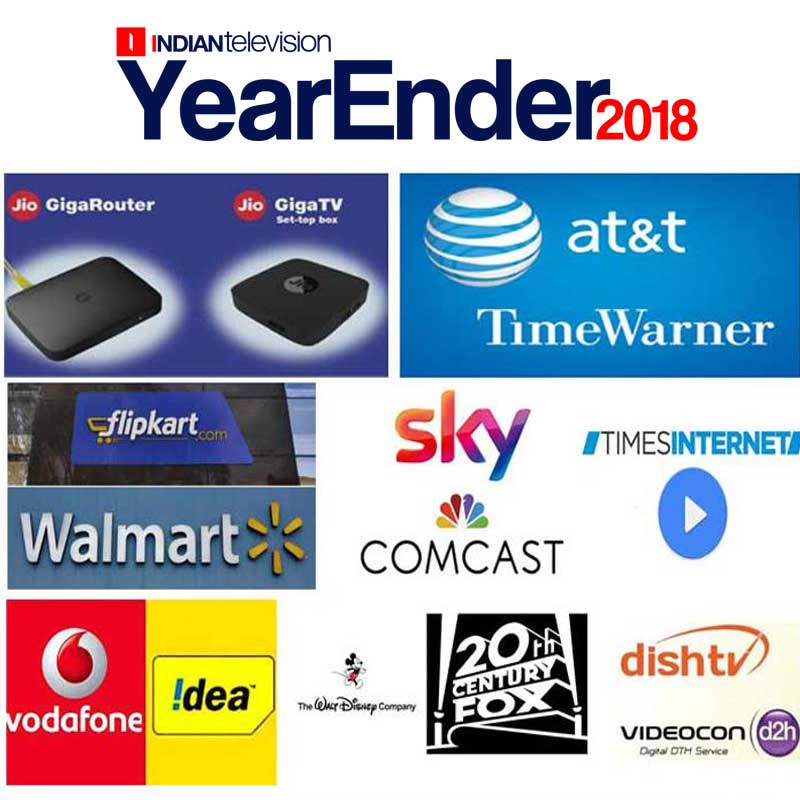
  • The year M&A changed the face of the media and entertainment industry

    The year M&A changed the face of the media and entertainment industry

    MUMBAI: The emergence of numerous streaming platforms and convergence between technology, media, and telecom companies shook the core of the media and entertainment business globally. Giant tech and telco players, on the back of their direct customer reach, started taking content creation and distribution a lot more seriously. Rapid change in content consumption pressurised traditional players to invest more in technology and focus more on the B2C model. The ongoing flux brought the industry on the brink of instability, leading to consolidation in the form of mergers and acquisitions.

    In the last couple of years, the nature of competition in the global ecosystem has witnessed a gradual swing. Organisations like Netflix, Amazon Prime and Google have brought a structural shift forcing traditional players to rethink their approach to content and distribution. Legacy brands upped the ante to attract and retain more consumers even through cross-border deals. PwC India partner Raman Kalra points that everybody in this world of media disruption is trying to be relevant in reach and scale, the two critical factors that are driving deals. To corroborate his thesis, he highlights the AT&T-Time Warner deal where the former, with a huge reach, wanted to scale up its content play with the collaboration.

    Closer to home, billionaire Mukesh Ambani’s RIL rode the TMT convergence wave better than most. India’s richest man started the year with a bang, intensifying TV18’s stake to 51 per cent by acquiring 1 per cent of Viacom18’s equity from Viacom Inc. for a cash consideration of $20 million. The RIL-owned Jio Infocomm also acquired a controlling stake in two large MSOs – DEN and Hathway – building ammunition for its FTTH’s foray. That’s not all, RIL also pocketed a small but significant five per cent stake in Eros International.

    E&Y media and entertainment advisory services partner Ashish Pherwani expects more deals to materialise in 2019.

    “Especially technology-driven deals because so many changes are happening in that space, and consolidation, led by inbound investments. There are three types of deal. One type of deal is happening in order to build efficiency and scale in the business, led by cost pressures. Another type of deal is around relevance and market share – to get a bigger slice of the market to monetise a larger base of consumers.  The third type of deal which is happening is basically technology driven – for access to technology that could drive competitive advantage in the digital future. Hence, the three reasons market share, efficiency, technology are driving the deals,” he adds.

    There were other interesting deals struck through the year that are likely to reshape the media and entertainment business going forward.

    Birth of the world’s second largest DTH company

    The Indian market wasn’t exempted from the global merger frenzy. The coming together of two large DTH operators – Dish TV India and Videocon d2h – was finally concluded this year, creating the largest DTH service provider in the country with a subscriber base of about 29 million. Apart from leveraging their individual strengths, it was expected that the combined entity would benefit from economies of scale. One of the biggest attractions for Dish TV as the acquirer was Videocon’s significantly higher average revenue per user (ARPU). Significantly, the combined entity’s ARPU was Rs 207 in the second quarter as opposed to Dish TV’s standalone ARPU of Rs 144 pre-merger. The deal also helped Dish TV position itself better when it came to negotiating with broadcasters.

    Decks cleared for FTTH warfare

    From formally launching FTTH service Jio GigaFiber to acquiring majority stakes in two large MSOs to speed up the rollout, the Mukesh Ambani-led Reliance Jio was definitely the centre of attention in 2018. Reliance Industries Ltd (RIL) made an investment of Rs 2,290 crore for 66 per cent stake in Den and Rs 2,940 crore for 51.3 per cent stake in Hathway. It will save RIL the cost of reaching out to customers as well as making the last mile connectivity easier in its ambitious bid of seizing control over India’s wired broadband business. With the launch of its telecom service, RIL gave rise to what many call ‘digital democratisation’. As the Jio juggernaut marked its entry into India’s multi-billion-dollar cable TV and DTH businesses, traditional players eyed the development with a healthy mix of scepticism and optimism.

    Rivals joined hands

    The Indian telecom sector this year saw the marriage of two giant companies, creating the country’s largest telecom company. In the month of August, Vodafone India and Idea Cellular completed the merger after getting approval from National Company Law Tribunal (NCLT). The consolidation of India’s telecom sector was a direct result of Jio’s relentless pricing war. Post the Idea-Vodafone deal, India’s telco business now comprises of just three players. Analysts expect the combined entity to yield better coverage than before as it would have access to a more robust ecosystem of cellular towers. COAI also believes that as competitive pressures drive consolidation, customers and the industry stand to benefit from the greater stability and better networks which will emerge. Surprisingly, a few years ago, the Indian telco sector had 13 operators.

    Bansals became billionaires

    Walmart gained a strong foothold in India’s this year as it completed its much-talked-about $16 billion acquisition of the country’s largest e-commerce company Flipkart. Poster boys of India’s start-up community Sachin and Binny Bansal became billionaires in a big win for Indian talent and home-grown businesses. Despite protests from traders across the country, as the deal could potentially harm their business, the Competition Commission of India (CCI)’s green signal came earlier this year. The biggest e-commerce deal globally bolstered Walmart’s repertoire in its war with Amazon internationally. With India being one of the most attractive retail markets in the world, a strong play here is bound to further boost the American behemoth in a rapidly changing environment.

    Times Group joined the streaming sweepstakes

    With almost major broadcasters and media companies trying to grab a slice of the hottest piece of the M&E business – OTT, the Times Group too jumped on the bandwagon. To get a stronger foothold in the space, Times Internet invested over Rs 1,000 crore to acquire a majority stake in video playback app MX Player. According to media reports, the company will introduce a streaming service within the app. The large cross-border deal which surprised the industry will definitely help Times Internet in the OTT race thanks to the huge base and popularity of MX Player in south Asian countries. With over 30 OTT players vying for consumers’ attention in India, the game has just begun with enough opportunities for new platforms. Earlier in the year, MX Player content head Gautam Talwar had told Indiantelevision.com that like many other OTT platforms, MX Player too wants to tap into the millennial audience. It wants to cater to users with 50,000 to 100,000 hours of premium curated licensed content along with a high focus on originals, he further added. 

    The telco takeover

    Giant wireless carrier and telco AT&T’s acquisition of content powerhouse Time Warner is just one example of how the lines between distribution companies and content creators are blurring. With the $85 billion deal, the telco gained ready access to the content pool of CNN, HBO, and Warner Bros.

    “Under the terms of the merger, Time Warner Inc shareholders received 1.437 shares of AT&T common stock, in addition to $53.75 in cash, per share of Time Warner Inc.1 As a result, AT&T issued 1,185M shares of common stock and paid $42.5B in cash,” said AT&T providing the financial details of the deal.

    Though the deal was first announced in 2016, it had to negotiate past several subsequent legal hurdles. The Donald Trump-led US Department of Justice (DOJ) even filed a lawsuit against AT&T and Time Warner to block the proposed merger. Following a six week trial, a US district court approved the deal without any conditions on 12 June and also urged the government to not seek any stay. The main argument of the US administration was that the merger would hand over too much power to AT&T, making the market less competitive.

    A once-in-a-lifetime deal

    Another blockbuster deal that came through this year was the $71 billion acquisition of 21st Century Fox assets by Disney. After a long and sustained bidding war with Comcast, the Mouse House got its hands on much of the Murdoch empire. “Combining the 21CF businesses with Disney and establishing new ‘Fox’ will unlock significant value for our shareholders,” 21st Century Fox executive chairman Rupert Murdoch said. The shareholders of both the companies approved the deal immediately, with foreign approvals and regulatory reviews now the final procedural hurdle.

    Disney is now in pole position to take on streaming giants like Amazon and Netflix with its OTT Disney+. The company has also already indicated its desire to stop licensing content to Netflix by ending the deal in favour of its own B2C service. Moreover, Disney now has majority control of Hulu, Endemol Shine Group and Star India, making it the most powerful content owner in the world. The reaction to the growth of OTT services has clearly shown that joining forces with rivals and competitors is not unacceptable anymore to survive in the market.

    Second time lucky

    After a failed attempt to buy 21st Century Fox, US cable giant Comcast won the bid for European entertainment biggie Sky. The former sealed the deal for a controlling stake in the British broadcaster with a winning bid of $40 billion. Analysts said that Comcast and Sky would become the biggest private sector provider of pay TV in the world with 52 million customers. Given the vast reach and growing customer base of Sky in Europe, Comcast took the step to expand its international business with it losing ground in the domestic market. This deal was a direct effect of cord-cutting as Netflix’s growth in the US has posed a major threat to the likes of Comcast. According to an analysis from Ampere, post the media mega-mergers of Comcast/Sky and Disney/Fox, two in every 10 dollars spent on content worldwide will now be spent by these two entities.

    The merger madness from 2018 is likely to continue in 2019, as corroborated by experts we spoke to. Not only would it be interesting to track which companies opt for consolidation, but 2019 will also give us a sense of how the deals from 2018 take shape and play out.


  • Flipkart Launches Ann Springs, a women’s Western wear private label brand

    Flipkart Launches Ann Springs, a women’s Western wear private label brand

    MUMBAI: Flipkart Fashion, India's largest online fashion store, today announced the launch of its new in-house Western wear label, Ann Springs, focused on the new-age Indian woman with a bold individual style and an eye for the latest trends. Designed especially with the 22-25 age group in mind, Ann Springs currently features over 150 unique styles starting at Rs. 399, with plans to double the selection in the next few months.

    Women’s western wear is one of the fastest growing segments in the online fashion space today. As Indian tastes change to reflect the country’s influential youth population, shoppers are increasingly turning to buying apparel online. As with all its existing private labels, Flipkart has identified an underserved segment of the market — young, professional women looking for premium Western apparel that can transition smoothly from casual to glam. Ann Springs is looking to give these customers what they have been aspiring for.

    Launching the new label, Rishi Vasudev, Head of Fashion at Flipkart, said. “Women’s western wear is one of our fastest growing categories, where we have witnessed 100% Y-o-Y growth from Tier II cities and beyond. Women from smaller towns are clearly telling us that they want international styles tailored specifically to the Indian woman. This is where Ann Springs comes in. Our collection brings together the latest Western styles at affordable prices, and will help women from all over the country look the way they want to.”

    “Inspired by fast fashion, Ann Springs couples trendiness with day-to-day functionality. We  are confident the brand will help create stickiness for our large women shopper base and solidify Flipkart Fashion as the top destination for all of India’s fashion needs,” he added.

    Ann Springs is the sixth private label offering from Flipkart Fashion, following in the footsteps of Divastri, a women's ethnic wear range; Metronaut, for the urban man; Anmi, a brand of fusion ethnic wear; Miss & Chief, kidswear; and the Cara Mia line for women’s footwear and accessories.