Tag: Flipkart

  • Shadowfax appoints Sumit Pilankar as VP of engineering & technology

    Shadowfax appoints Sumit Pilankar as VP of engineering & technology

    Mumbai: Homegrown crowdsourced logistics platform Shadowfax Technologies on Friday announced the latest addition to its senior leadership team. To further strengthen the technology vertical and make a strategic move towards the larger business goals at Shadowfax, the company has appointed Sumit Pilankar as the vice president – engineering and technology.

    With over 17 years of rich experience in the technology industry, Pilankar will be taking charge of spearheading the engineering and technology unit and will be reporting to Shadowfax Technologies, co-founder & CTO, Vaibhav Khandelwal.

    His role will involve creating innovative tech-enabled solutions to power last-mile delivery services. Prior to joining Shadowfax, Pilankar had led technology intervention in various organisations like Flipkart, Holiday IQ, WordPoint Technologies, and Kudos Infomedia.

    Sharing the vision for the company’s growth aligned to the latest developments, Khandelwal said, “We are a growing and dynamic company. Our core has always been delivering value to our customers and helping them create an enhanced experience for the end customers. At Shadowfax, we leverage technology to build best-in-class logistics solutions that are efficient, cost-effective, and agile to service a vast range of businesses thereby adding value to the lives of our partners and patrons. We are excited to welcome Sumit on board and continue to ameliorate this journey towards excellence.”

    Expressing his thoughts on his new stint, Pilankar said, “I have been closely following the developments in the Indian logistics and supply chain industry and believe that technology has the potential to be the game-changer. The industry has been transforming from manual to data-driven decision making and this when coupled with the latest technologies will enhance the experiences for all stakeholders.”

  • Flipkart, Myntra partner with Marie Claire for cosmetics, hair appliances launch

    Flipkart, Myntra partner with Marie Claire for cosmetics, hair appliances launch

    Mumbai Homegrown e-commerce marketplace Flipkart along with the group’s fashion, beauty & lifestyle major Myntra on Thursday announced a partnership with Marie Claire, a global lifestyle and fashion brand, to bring the latter’s range of cosmetics and hair-styling appliances to India. 

    With this launch, Marie Claire, known for salons, magazines, ready-to-wear, and accessories segments running successfully in India, marks its entry into the beauty & hair care appliances category, said the press statement.

    Taking note of these strong consumer insights and thorough in-depth research, Flipkart and Myntra, in partnership with Marie Claire have come up with a new range of products that are inspired by French taste and expertise and infused with local influences to meet the needs of India’s next-gen consumer. The aim is to address specific concerns of Indian consumers and give them a ‘makeup meets skincare’ experience, it added.

    “We continue to explore partnerships that allow us to bring new brands and products to the Indian market in line with the needs and expectations of our consumers,” said Flipkart senior director- private label Priya Fotedar. “Despite significant changes in our lifestyles over the past year, beauty and hairstyling continue to remain important as ever in the daily lives of consumers. Our partnership with Marie Claire enables us to provide consumers with products that are affordable yet premium.”

    “India, for its sheer size, presents a huge and very attractive opportunity for Marie Claire in the beauty sector. We are excited for the opportunity to enter the personal care market – a segment that clearly has a lot of potential for DIY solutions,” said Marie Claire brand architecture partner Roberto Bre. “Partnering with Flipkart and Myntra will give us great reach and visibility among consumers, across the length and breadth of India. Flipkart’s and Myntra’s deep understanding of consumer behaviors and demographics will give us a strategic advantage as we expand our brand presence in the country.”

    “Beauty and personal care category is a strong focus area for Myntra. We are continuously expanding our portfolio, with many world-class brands already added so far in 2021, and Marie Claire is another fine addition to it,” said Myntra Fashion Brands senior director Nishant Prasad. “We are also looking to leverage our deep understanding of consumer and category trends to bring to market the most relevant and innovative products in the beauty and lifestyle space catering to evolving consumer preferences.”

  • Digital marketing really worked for us during the pandemic: Super Plastronics’s Avneet Singh Marwah

    Digital marketing really worked for us during the pandemic: Super Plastronics’s Avneet Singh Marwah

    When the second-generation entrepreneur, Avneet Singh Marwah took over the reins of the company, it was still known for manufacturing plastic injection moulds which it started in the 1970s and 80’s. He slowly steered it into what it is today – one of the country’s largest TV manufacturing firms and the exclusive India licensee of global brands such as Kodak, Thomson televisions. It has recently also tied up with the German consumer electronics brand Blaupunkt.

    He started his journey in the company as an assistant manager and made his way through, before taking over the reins of the company from his father, Amarjeet Singh Marwah, the founder chairman of the company. “I worked in almost all divisions – from moulding to assembly line to service, accounting, finance, and sales. I worked on the field itself and spent three to four months in each department,” Avneet said, “In those six-seven years I never had any office or anything.”

    From thereon, there was no looking back for Marwah who went on to change the game and turn the fortunes for Super Plastronics Pvt Ltd (SPPL). Under his leadership, SPPL has now become one of the leading smart TV and home appliance manufacturers, selling top-of-the-charts global brands in India’s booming e-commerce market, via Flipkart and Amazon. Under the brand’s aegis, the European consumer technology brand, Thomson is currently among the ‘Top Five selling online smart TV brands’ in India.  

    IndianTelevision’s Anupama Sajeet had an in-depth conversation with SPPL, CEO Avneet Singh Marwah on the brand’s journey from plastic moulding to being India’s largest contract manufacturing firm & the exclusive licensee of four renowned international television brands. He also spoke about spotting opportunities amid the pandemic gloom, and talked about what it means to be an online exclusive brand, and future plans.

    Edited excerpts:

    On the origins Super Plastronics and the journey so far

    It’s been 30-years since we forayed into black & white CRT, colour, LCD & now LED televisions. Before that, our work was limited to plastic moulding for television. Currently, we have a couple of LCD brands in our portfolio, about 550 service centres, 24 pan India offices, and 28 warehouses across India. There are three manufacturing plants located in Noida, Una, and Jammu. By the end of the year, we will be shifting to our new fully automated TV manufacturing plant in Hapur, Uttar Pradesh where the target set is 1.5 billion units a year. In fact, we have the second-largest manufacturing plant in India, after LG.

    We began with Kodak in 2016 and offered ‘global technology at competitive prices. In 2018, we launched the French consumer electronic brand Thomson. Now, we have four international brands on board, including the German consumer electronics brand Blaupunkt. SPPL has complete rights to these brands from manufacturing to sales to marketing. There are two parts to it – the first is providing the most affordable TV sets in India and the second category is premium TV sets.

    On what led to the brand’s expansion plans amid the pandemic gloom

    The pandemic actually presented a big opportunity to all the manufacturing units in India. Firstly, the government banned the import of LED televisions’ CBUs (complete build units) last year, which led to a huge spike in the market in terms of the television industry. Earlier, there were a lot of imports happening in televisions. With the decision to ban it, one had to manufacture and assemble them in India. Plus, globally everyone’s looking for an alternative to China. We see this as a great opportunity for us with the government taking a decision on manufacturing all appliances in India. So, apart from television, we are foraying into appliances.

    On the brand’s focus on e-commerce and its region-specific growth

    We are an online-exclusive brand to Flipkart and it’s one of the largest retailers of TV sets in India, with an approximate market share of 44 per cent currently. When we started out about three years back, we had a strong online presence in tier 1 and tier 2 cities, but now we see a huge surge of growth in tier 3 and 4 towns, as well. In fact, in the last one year the maximum growth has happened in tier 2 and 3 regions.

    To be region-specific, the online sales have grown in Tamil Nadu, Karnataka, Andhra Pradesh, Telangana, Delhi NCR and Uttar Pradesh. In the West, Gujarat and Maharashtra, where the latter is among the best-selling states with maximum consumerism in India. In the East, West Bengal is seeing a spike; Assam and Odisha again have a bright future for online sales.

    The advantage of being online-exclusive currently is that we are seeing a 100% YoY (year-on-year) growth for Thomson. Pandemic has led people to move from offline to online even for buying appliances and electronics.

    On SPPL’s marketing strategy to reach out to consumers

    We are primarily marketing through the digital platform- that has really worked for us. At first, we targeted the online customers where the intent of buying is high based on their searches, so the conversion to sales is high. Now, we have started focusing on the customers, who were buying offline to encourage them to buy online and we have seen a lot of first-time e-buyers in the last eight months. We get lots of traction from influencer marketing, social media, google ad words- we have a 360-degree ecosystem in digital marketing.

    Apart from that, our strategic partner is Flipkart and whenever there’s any ATL/ BTLs or TV campaigns during festive season periods they include the SPPL brand name as well – only on those particular days do we target TV. That includes print campaigns too, but the print is in the decline stage right now and we don’t get too many eye-balls via it; this was more so true during the pandemic when sales of newspapers took a hit.  

    On the impact on brand growth and revenue during the pandemic

    We have been an online exclusive brand for Flipkart since 2018. We have seen a 100 per cent year-on-year growth phase. Last year after the first lockdown there was a huge pent-up demand and the whole world was hooked to their screens due to WFH, online classes, and people shifting to OTT platforms due to lack of fresh content on the TV – all of which led to record sales for us. But after the hard-hitting second wave, because of low disposable income, people had reservations about spending on high-value items and electronics. But, there is a huge inflationary demand for televisions in the country that will continue. As soon as the consumer sentiment improves, we will again find a growth pattern.

    On the plans to be an online exclusive brand for high-value items like TV and washing machines, post pandemic

    We have seen once the customer starts buying online it becomes very difficult for him to come out of it, because of various factors- there are offers that run exclusively online. Both Amazon and Flipkart are creating an ecosystem around it. Plus, there’s a limitation of shelf space when one goes to buy offline, thus one will not find the complete product catalogue in one place, unlike online where you’ll find the complete package in terms of variety. Hence, I don’t believe it will be affected once the lockdowns and restrictions cease.

    We are covering almost every town and city pan India, and now all set to foray into the rural markets too. With regards to product diversification, right now we have introduced air-coolers, before that it was washing machines. We are working on a couple of more product categories that need to be finalised before they can be announced.

    On what sets the brand apart from other local players?

    There are very few brands in India which have a network of more than 550 service centres. In the next few years, we plan to take that number to 800, which will be one of the highest for any television brand in India. Thus, we have a well-established network, which we have developed over the last three years, which is a challenging task for any new brand or an existing Chinese smartphone brand. We cater to 2,300 cities and towns that contribute to over 85 per cent of sales.

    Additionally, we have about 28 warehouses across India, with a door-to-door service which is a huge factor when it comes to spare parts replacement. The delivery period is also drastically cut down when there’s local warehousing with spares, and this gives a huge advantage to customers. Plus, we are one of the few brands which have the capability of doing replacement of TVs from the customer doorstep- even in tier 3, tier 4 towns which most other brands struggle to do.

  • Realme’s DIZO brand names Abhilash Panda as India CEO

    Realme’s DIZO brand names Abhilash Panda as India CEO

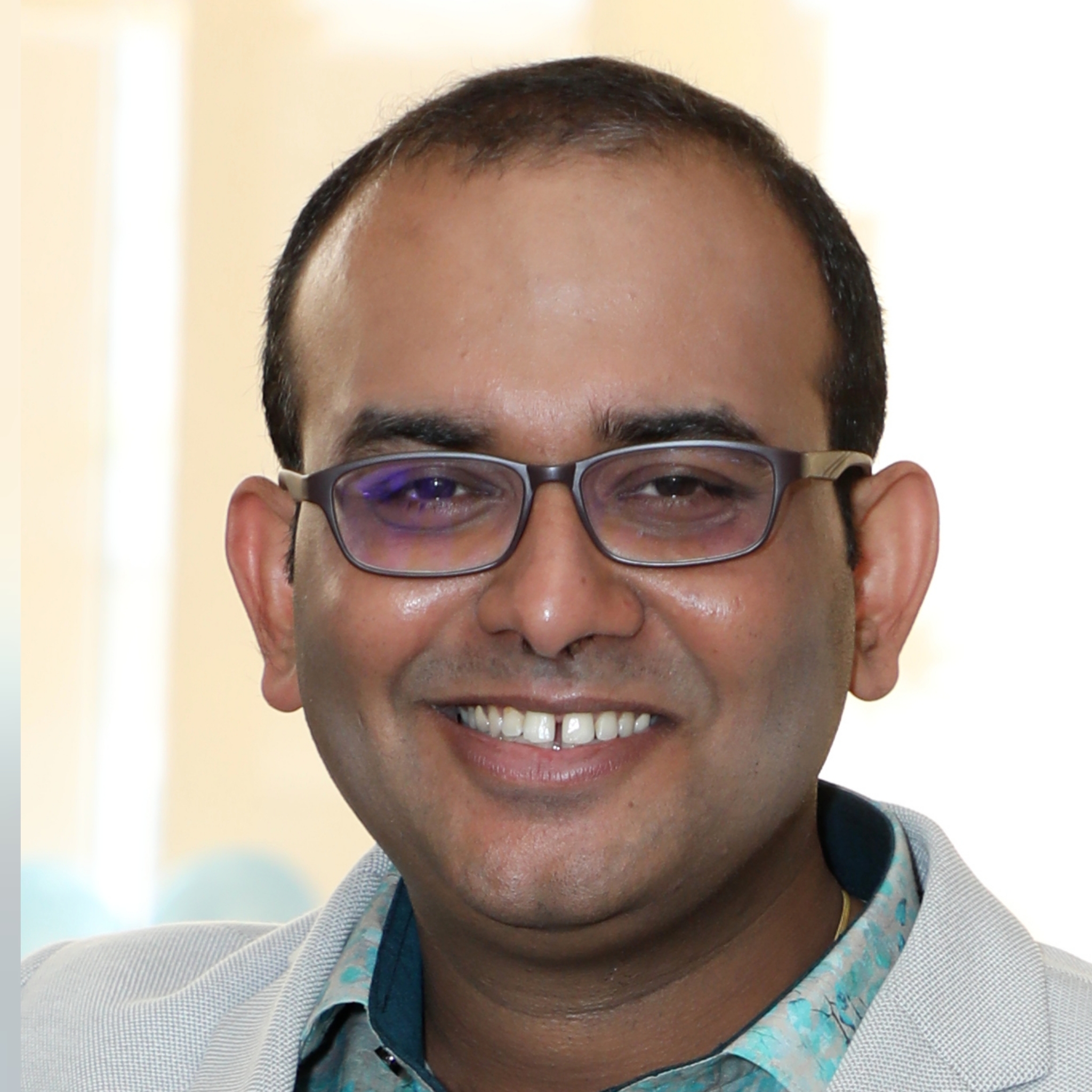
    Mumbai: DIZO, a TechLife brand from realme smartphone, announced the appointment of Abhilash Panda as CEO and official spokesperson for DIZO India. Panda joins DIZO India from Flipkart where he was director for its mobile phones vertical.

    As DIZO’s CEO and spokesperson, Panda will be responsible for all areas of operations including sales, marketing, Research & Development (R&D), supply chain, human resources, among others as well as the front-end for all official announcements by the brand, and he will attempt to position DIZO among the top brands in Artificial Internet of Things (AIoT) products category, the company said in an official statement.

    During his seven years of tenure at Flipkart, Panda has worked with several global and Indian technology and lifestyle brands, including realme since its beginning days and has been responsible to lead the planning and business development of these brands.

    “I am excited to join the super energetic and promising team at DIZO in India. I am looking forward to driving business momentum at DIZO and make it one of India’s top brands in AIoT products… Together with Realme’s strong support and Flipkart’s pan-India reach, we are confident of being able to offer a world-class experience to our consumers,” said Panda on his new role.

    “Today’s consumers are a discerning lot. They know their technology and are value-conscious and above all are ready to adopt solutions that make their lives easier. At DIZO it will be our mission to make this adoption easier for them,” Panda added.

  • KING OF REALITY TV PRINCE NARULA MAKES HIS WAY TO YOUR MOBILE SCREEN WITH FLIPKART VIDEO’S ‘KHEL PAHELIYON KA’

    KING OF REALITY TV PRINCE NARULA MAKES HIS WAY TO YOUR MOBILE SCREEN WITH FLIPKART VIDEO’S ‘KHEL PAHELIYON KA’

    Popularly celebrated as the king of Indian reality TV, Prince Narula is all set to don a new avatar on Flipkart Video’s latest riddle themed, interactive quiz show, Khel Paheliyon Ka. Launching today, the model turned actor will be seen playing host on the series that will feature 4-5-minute episodes each day on the Flipkart App.

    Khel Paheliyon Ka promises to be a unique anagram-based quiz show featuring topics ranging from Bollywood, sports, music, and fashion to famous personalities and more. In each episode, Prince will ask audiences three riddles, giving them 30 seconds to decode the clues, rearrange the jumbled letters, and solve the anagram. By correctly solving the riddles, audiences can win phenomenal prizes.


    Commenting on his collaboration with Flipkart Video, Prince Narula said, “I love to entertain everyone around me all the time whether that is through my social media or being part of a show. Getting the chance to host a show like ‘Khel Paheliyon Ka’ is an amazing adventure for me because it’s my first time hosting an interactive series but also because with the pandemic I had to shoot this from home for everyone’s safety. It’s a unique concept for my audience to be able to interact with me as a host so I’m very excited about this show.”

    It’s time to put on your thinking caps and win big, as ‘Khel Paheliyon Ka’ goes live on the Flipkart App. Users can access the show, free of cost, by clicking on the Video icon at the bottom right of the Flipkart app’s homepage.

    You can download the Flipkart App here: https://play.google.com/store/apps/details?id=com.flipkart.android&hl=en_IN

    https://apps.apple.com/in/app/flipkart-online-shopping-app/id742044692

  • Tata Digital acquires majority stake in Bigbasket

    Tata Digital acquires majority stake in Bigbasket

    New Delhi: Tata Digital Ltd announced on Friday that it has acquired a majority stake in the online grocery platform Bigbasket.

    Tata Digital is a 100 per cent subsidiary of Tata Sons. With this deal, one of India’s largest conglomerates has entered into direct competition with Flipkart, Amazon, and Reliance Industries which have continued to bolster their presence in the country’s fast-growing e-commerce space.

    “Grocery is one of the largest components of an individual’s consumption basket in India, and Bigbasket as India’s largest e-grocery player fits in perfectly with our vision of creating a large consumer digital ecosystem. We are delighted to welcome Bigbasket as a part of Tata Digital,” said Tata Digital CEO Pratik Pal in a statement on Friday.

    Exact details about the deal were not disclosed. But according to some media reports, the deal is worth about Rs 9,500 crore.

    E-grocery has been one of the fastest-growing sectors in the consumer e-commerce space. Its growth has been further propelled by the country’s rising consumption and digital penetration, especially in the aftermath of the Covid-19 pandemic which led consumers to increasingly opt for safer deliveries of groceries at home.

    “We are extremely excited about our future as a part of Tata Group. As a part of the Tata ecosystem we would be able to build stronger consumer connect and accelerate our journey,” said Bigbasket CEO Hari Menon. Founded in 2011, the Bangalore-based company has now expanded its presence to over 25 cities.

    Meanwhile, the Tata Group is now building a digital consumer ecosystem addressing consumer needs across categories in a unified manner. Online food and grocery is an important part of this ecosystem. The acquisition presents an attractive opportunity for the group in its overall vision of creating a digital ecosystem, it said in a statement on Friday.

  • E-comms ramp up vaccination drive for frontline staff

    E-comms ramp up vaccination drive for frontline staff

    Mumbai:  E-commerce companies have launched a rampant vaccination drive for their frontline staffers and delivery partners who interface with consumers who worry about possible transmission of the newer and more virulent strains of Covid-19.

    This comes in the wake of most e-tailer and logistics firms reporting infections among their frontline staffers who are on daily delivery missions of food and essential products such as medicines, healthcare packages and much more.

    While these customer interfacing personnel busily operated for the better part of the last 14 months, even in the wake of the pandemic, newer and more virulent strains currently in vogue for their high transmitting potential are a constant source of discouragement for customers who got used to remotely ordering the doorstep delivery of their various needs as they stayed locked down

    While the clear and present danger and high risk of infections of these frontline workers got exposed, as they shuttled door-to-door between eateries/ grocery stores/pharmacies and the customers to deliver packages e-tailer and logistics firms have gone into an accelerated mode of ensuring mass jabs for their frontline fleet.

    Online food delivery platform Swiggy started inoculations of its delivery agents and frontline staff in Bengaluru since Thursday. Apart from the delivery staff at the grocery delivery service Instamart, even the company’s cloud kitchens executives have been prioritized for getting the jabs.

    A few thousand delivery partners across varied age groups already received their first dose of the vaccination; Swiggy has announced and added in a public advisory that with drives planned across all major cities, all delivery partners and frontline staff will be covered over the next few weeks.


    Amid reports that Covid-19’s second wave was adversely impacting online shopping volumes over the past several weeks due to infection fears among consumers, many e-tailer companies are pushing ahead with vaccination drives on scale.   

    Last week, rival Zomato said it has begun vaccination of its delivery partners in the NCR. Founder Deepinder Goyal took to twitter last Friday and stated, “We are facilitating a free and safe vaccination drive for more than 150,000 of our frontline staff and employees. Thousands of our delivery partners are already vaccinated”:


    He added, “Vaccinations in Mumbai and Bangalore start tomorrow and multiple other cities (will be covered by) next week. The safety of our customers is the #1 priority for us as well as (the health of) our delivery partners who have selflessly and safely delivered hundreds of millions of orders during the pandemic.” He also thanked hospital chain Max Healthcare for facilitating the vaccination drive. 

    Many e-commerce firms have tied up with hospitals and government authorities while some are even procuring vaccines directly from manufacturers. This will, however, be subject to the continued availability of vaccines, as manufacturers prioritise supply obligations to states before meeting demand from private companies.

    Flipkart has also kicked off vaccination camps for frontline employees and so has Myntra for its units in Bengaluru. The effects of the current wave have especially hit consumer demand for non-essential segments, both in urban and rural markets, with Fashion bearing the brunt of diminishing orders due to infection fears.

    Ecommerce giant Amazon announced earlier this week that it is working to administer vaccines to its frontline teams. Over the coming weeks, it will be hosting on-site vaccination events run by licensed healthcare providers.

    Online marketplace for home services, Urban Company Cofounder & COO Abhiraj Singh Bhal also tweeted, “At @urbancompany_UC , our vaccination efforts continue in full swing. We have vaccinated thousands of service partners in the last one week, and are now close to 25% of our fleet having received at least one jab.”


    As demand slumped for online home delivery service providers amid customer fears of contracting the virus, brands like Urbancompany have begun public announcements declaring the vaccination status of their staff on their online platform.

    Other online delivery services like Swiggy and Zomato also plan to introduce Vaccine transparency on their apps, to notify users that the agent of delivery of goods is not a potential carrier of the infectious disease as well by emphasising the individual’s vaccination status.

  • Nykaa onboards Vikas Gupta as CEO – B2B Business

    Nykaa onboards Vikas Gupta as CEO – B2B Business

    MUMBAI: Flipkart’s head of customer, marketing and digital business Vikas Gupta has joined online beauty & personal care products marketplace Nykaa as CEO of its b2b business.

    The e-commerce portal posted the development on its LinkedIn page.

    “We are delighted to welcome on board, Vikas Gupta, the new CEO of our B2B business at Nykaa. Having held leadership roles for over two decades, Vikas is an expert at building business for digital-first enterprises that are data driven and fast-evolving. We are excited to have him on the team to drive a new wave of growth at Nykaa,” read the post.

    Gupta has over two decades of leadership experience at companies such as Unilever and more recently, Flipkart, where he was the head of customer and marketing function, the company said. 

    His work over the years has won him several recognitions including 14 effectiveness awards (Effies and AMEs), 27 innovation and creative awards (16 Cannes Lions) and 10 top Unilever awards.  

    Gupta shared the news of his appointment on LinkedIn saying, “Incredibly excited to start this new journey at Nykaa. Big Thank you to the wonderful people at #Flipkart for the lasting learnings and friendships and an everlasting gratitude to my family at #Unilever #hindustanunilever as I begin this new chapter of my life.”

    At Nykaa, Gupta will be setting up the e-distribution arm that aims to become the one-stop shop for retailers across the country to source beauty and personal care products, the company said.

  • E-comms step forward to help tide over Covid second wave

    E-comms step forward to help tide over Covid second wave

    MUMBAI: With India battling a deadly second wave of the pandemic, night curfews and partial-to-near-complete lockdowns seem to be the norm in many parts of the country. The last couple of weeks in particular have been more devastating with the nation witnessing an unprecedented pan-India surge in Covid cases. India Inc is stepping on the gas to ensure that employees and their families get vaccinated as soon as possible. MNC consumer goods company Procter & Gamble, on Monday pledged Rs 50 crores towards ten lakh vaccine doses covering five lakh Indians.

    E-comms are also going the extra mile to ensure protection of their associates, including delivery staff, while guaranteeing safe delivery of orders to customers. With movement restrictions being introduced in additional parts of the country, buyers are taking the safety route of shopping from home. This has resulted in driving bigger orders for e-commerce companies across India.

    Here are some of the efforts undertaken by online platforms in the fight against Covid2019:

    Food delivery app Swiggy last month took the initiative of supporting the vaccination cost for its entire delivery fleet. The company announced on its Twitter handle: “From essentials to food, delivery partners have always been our lifelines. We’re happy to announce that we’re supporting 100 per cent of the vaccination cost for our entire delivery fleet, and that this entire drive will be facilitated by us to keep them and you safe. #DeliveringHope”

    Food & Grocery app Grofers took the initiative of using its platform to set up a real-time data of all Covid2019 resources, including city-wise databases and helpline numbers. It shared on its blog, “A lot of people are currently overwhelmed and struggling to find relevant information on what to do and what measures to take if they or someone they know is currently affected by the virus. We thought we could use our platform to help a bit here. To help make this a slightly less cumbersome process we have aggregated some of the publicly available information for your convenience, so you do not have to go looking for it in different places.”

    Grofers has also partnered with UNICEF to encourage people across the country to get vaccinated. It tweeted :“When you get vaccinated, you potentially safeguard yourself and your family from Covid2019. Here is our little way of expressing our appreciation for those who have taken this important step.”

    E-commerce giant Flipkart went all-out in its measures to ensure a safe working environment for all its employees and stakeholders across the board. The company took to its twitter handle to share a video on the same. “We stand strong in our commitment to safety. Our priority remains the well-being of our employees, customers, sellers, and our entire ecosystem. Watch for the various measures we continue to implement to ensure  #SafeCommerce for all.”

    The firm has also been lending its helping hand to deliver Covid care medical kits. Official Twitter handle of infrastructure & industrial development department of the Uttar Pradesh government tweeted lauding the company’s efforts, which included delivering over 3,000 covidcare medical kits free of charge.

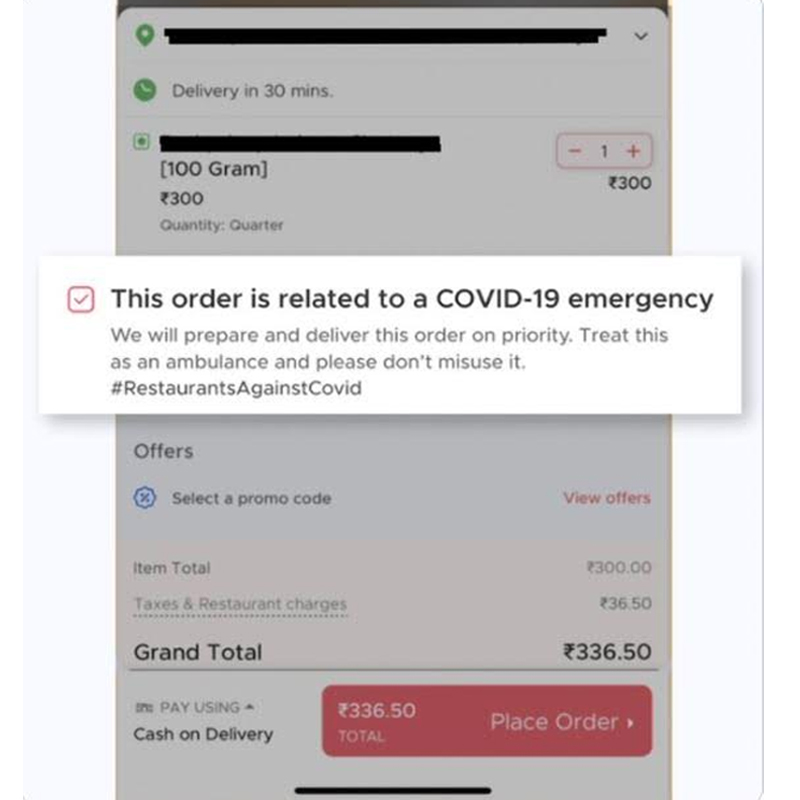
    Food delivery app Zomato had in 2020 taken steps to educate the riders and restaurants on safety and hygiene practices, provided them with COVID insurance, masks, and facilitated hand sanitisation stations at restaurants across the country. This time the Food delivery app has rolled out a feature for “Covid emergencies”. Zomato Founder Deepinder Goyal tweeted, “Today, along with thousands of our restaurant partners, we just rolled out a “priority delivery for covid emergencies” feature on the Zomato app. This feature will allow our customers to mark *This order is related to a Covid2019 emergency* option during checkout.

    These orders will be prioritised by providing fastest rider assignment, and dedicated customer support in case of queries. Thousands of restaurants have pledged to prioritise these orders in their kitchen above all others.

    In addition, the firm’s not-for-profit arm Zomato Feeding India has kickstarted a Help Save My India endeavour in association with @delhivery to source oxygen concentrators and related supplies to help hospitals and families in need.

    Early this month, Urban Company (formerly UrbanClap) – a managed marketplace for home services, committed towards getting 100 per cent of their fleet vaccinated, free of cost in the coming weeks. “We have already initiated phase 1 of this effort for service partners aged 45+, and are working closely with local govts and healthcare providers.

    With the government now allowing vaccination for all above 18 starting 1 May, @urbancompany_UC further reiterated its commitment. “ @urbancompany_UC is committed to getting all our front lines service professionals and employees vaccinated at the earliest possible availability,” tweeted Urban Company co-founder Abhiraj Singh Bhal  @abhirajbhal .

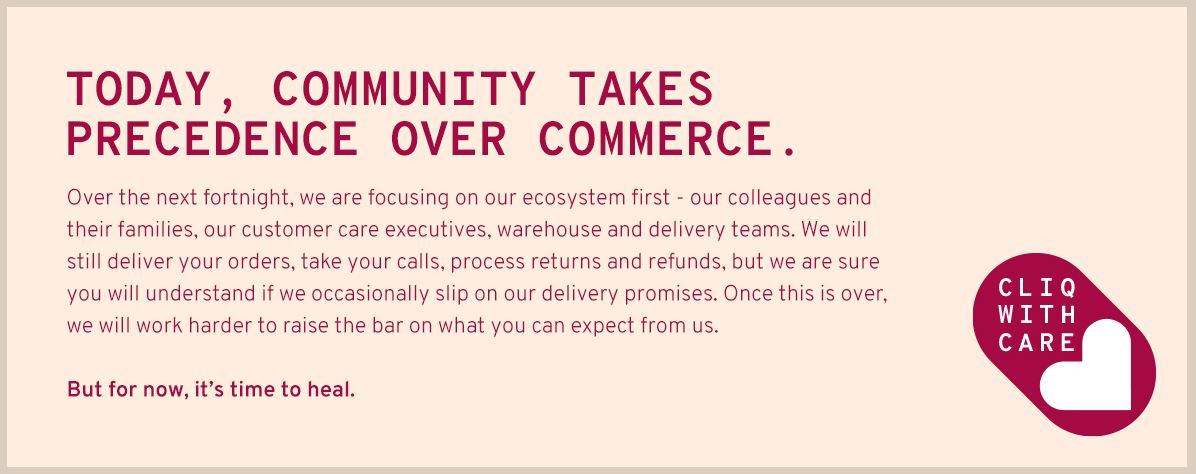
    Tata Group’s Online apparel brand TATA CLIQ chose to take a step back by reminding everyone that ‘It’s Time To Pause’. It urged its customers to think again before making a purchase on the app. Declaring that ‘Today Community takes precedence over Commerce’ the brand sent out communication to its subscribers and on its webpage saying “Sometimes it takes courage to pause, to listen to what the heart already knows. We encourage you to pause and ask yourself – do you really need to buy this now? Just because someone else carries it well doesn’t mean it isn’t heavy.”

    It added “Out of respect for our stakeholders, we are open for commerce – so we will still deliver your orders, take your calls, process returns and refunds – but we will not penalise our delivery team on road for a day of delayed delivery, we will not focus on the number of calls made in an hour by our customer care executives, we will not allow colleagues at our warehouse to travel via public transport and expose themselves and their families to risk.” 

  • E-commerce may become a major growth driver for FMCG in 2021

    E-commerce may become a major growth driver for FMCG in 2021

    NEW DELHI: If there is one business which has distinctly gained during the unprecedented Covid2019 pandemic, it is e-commerce. And this gain has occurred across product categories and sectors. Building on this advantage, there would be only more traction for e-commerce in the coming year. What will particularly be more noticeable is the entry of a whole lot of new players, both big and small, democratising the e-retail marketplace. However, this expanded and democratised e-commerce marketplace would co-exist with the physical brick-and-mortar retail spaces. These kirana stores significantly enough would forge partnerships with online delivery services while also digitally upgrading themselves with the help of the latter. Therefore, apart from the regular retail formats, there would be more tie-ups with different brands on e-comm platforms.

    The extraordinary growth of e-commerce

    In a report, the Indian e-commerce industry has been projected to grow by 40 per cent in 2020 as compared to 23 per cent in 2019. In fact, it has even been reported elsewhere how during the Covid2019 months, a decade of growth has been registered within just a few months this year. And in terms of cross border growth, the country’s e-commerce sector has been ranked ninth globally. Around the festival season in the second half of the year, major players such as Amazon, Flipkart, Myntra, and Snapdeal made sales worth $3.1 billion in the first four to five days of the festive season sale. And this growth has not remained confined to metros and big cities. An online player reported that 70 per cent of its orders were received from tier-2 and tier-3 towns during Diwali. Once we have seen the last of Covid2019 which is expected in 2021, these figures would grow to become even more impressive. In fact, the e-commerce penetration in the country is expected to cross 10 per cent in the coming five years from the current four to five percent.

    Emerging new players are intensifying competition

    While Covid2019 did pose a stupendous challenge to many small players in the early phases, several of those same affected players soon enough turned this adversity into an opportunity by upgrading themselves digitally and even recasting their product portfolios. While staying at home, a new generation of entrepreneurs called ‘homepreneurs’ has emerged, offering competition to existing players. This will only get bigger and a more competitive retail marketplace including both online and offline will emerge in the coming year.

    Kirana stores taking the digital leap

    At the same time, demonstrating massive momentum on the b2b front, several new players as well as existing players reinvented their business processes by forging links with other players and bigger and stable e-commerce businesses. Many new e-commerce start-ups have come up helping kirana stores or mom-and-pop stores digitize and expand their operational footprints. A cash and carry store had offered digitisation services to kirana stores promising complete digitisation in a span of 24 hours. So a vigorous drive for development of e-commerce platforms for local retailers and grocery stores underpinned by digital payment mechanisms has been underway. This trend is expected to continue in the present year democratising the marketplace further.

    Contactless delivery of ready-to-eat and packaged food to acquire permanence

    During Covid months, the trend towards partnerships between online delivery behemoths and FMCG companies including food brands has been a notable phenomenon. Also, the tie-ups between local food businesses and local e-commerce startups for final delivery of products have been equally noteworthy. In light of Covid-dictated explosion of cloud kitchens and food delivery apps, the near-institutionalization of highly-sanitised kitchen environment, double-layer packaging of food products, deployment of all-round safety gear equipped-delivery personnel, and contact-less delivery services would acquire a more permanent feature. The ripple effect of this new delivery culture would be seen even for the delivery of packaged food for final consumers.

    Trends in shopping spend across categories

    According to market research, in terms of average spend by online shoppers, electronics and accessories (39 per cent) had emerged as the largest product category followed by mobile and accessories (12 per cent); fashion, including apparel, footwear, and accessories (10 per cent); and appliances such as TV, washing machines, refrigerators (nine per cent) in the aftermath of Covid2019 outbreak. However, a management consultancy white paper has revealed that food, grocery, consumer electronics and apparel will be the top e-commerce product categories contributing to sales in the coming five years. Then based on a report by Goldman Sachs, online grocery and fashion/apparels are set to be the biggest drivers of incremental growth in e-commerce in the country.

    M&As and investments to impact domestic e-commerce space

    The last few months have seen considerable investment by foreign social media behemoths such as Facebook into domestic giants such as Reliance Industries which could allow the latter to play a bigger role in the e-commerce market. Then Reliance retail buying out Future Group has been another significant development.  

    Therefore, while 2020 was a year of crisis-driven instant improvisations and restructuring in a broadly subdued business environment, the coming year would see more stability and consolidation of the e-market space. Essentially, 2021 will see businesses adopting more of an omni-channel approach.

    (The author is director, Bikano. The views expressed here are his own and indiantelevision.com may not subscribe to them.)