Tag: Flipkart

  • Sara Ali Khan is taken by surprise in Flipkart Shopsy’s new TVC

    Sara Ali Khan is taken by surprise in Flipkart Shopsy’s new TVC

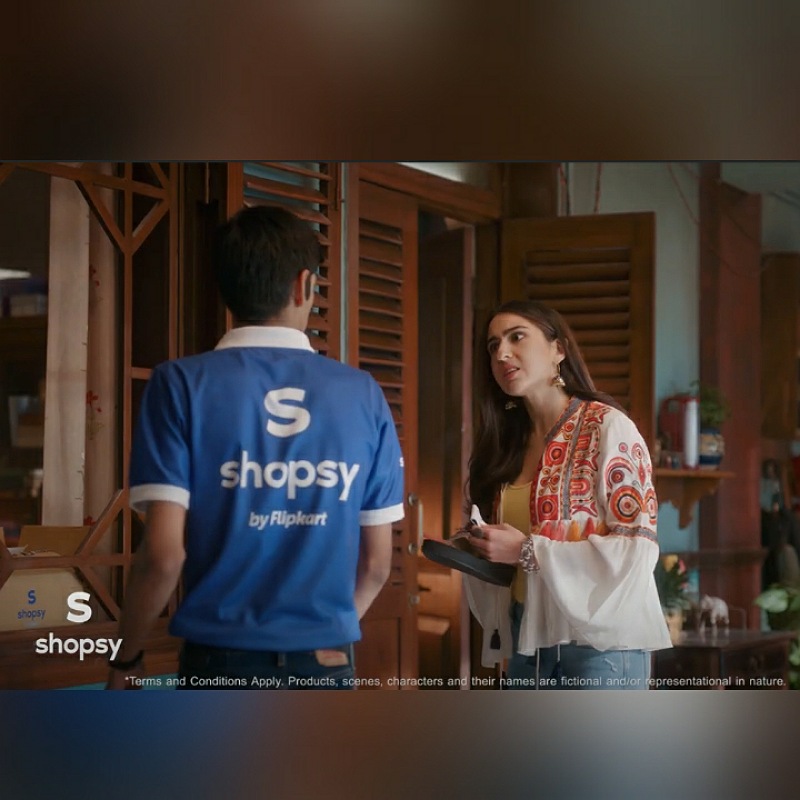
    Mumbai: Flipkart’s social commerce platform Shopsy has rolled out its latest campaign called ‘It happens only on Shopsy’ with Bollywood actor Sara Ali Khan.

    The campaign highlights the brand’s value proposition as a hyper value platform with unbelievably low prices depicted through its tagline ‘Shopsy Pe Prices Aise Lage Free Jaise.’ 

    Created by Tilt Brand Solutions, the campaign features two ad films that are based on the reality of the current market where customers are so accustomed to high prices that they are taken by surprise when they receive high value products at incredibly low prices. “The campaign aims to reach the masses specifically in tier 2 and beyond cities across the country,” said the brand in a statement.

    The two specially curated ad films are aligned keeping in mind Shopsy’s key value propositions – affordability and convenience. In the first one, Sara encounters with a delivery person who refuses to accept extra money for an item worth Rs five. She is awestruck by the price and her excitement soon turns into a dilemma as she cannot fathom the item being priced so low.

    In the second film, a woman, played by Ayesha Raza Mishra, is seen standing in the queue, when a girl, enacted by Sara, approaches towards her and requests the woman to hold her bag for a moment. It then suddenly turns into a conversation when the woman compliments the bag after which the girl offers to give her bag to the woman. The girl immediately empties her bag and gives it to the woman educating her about the unique offers and wide range of choices available on Shopsy.

    “Our priority with Shopsy since inception, has been to pay close attention to our customers’ nuanced needs and provide them with best offerings leveraging Flipkart’s established delivery networks, infrastructure and technology,” commented Flipkart SVP of growth and monetisation Prakash Sikaria. “Today’s shoppers prefer an expansive range of offerings that is both easily accessible and value driven. This campaign is yet another step towards establishing Shopsy as a one-stop destination that caters to customers’ various needs while committing to deliver value.”

    Commenting on the launch, Sara Ali Khan said, “I personally love to shop and can relate to the excitement of getting a good value deal. The youth of India are looking for accessible, trustworthy, and simple e-commerce solutions and Shopsy is the ultimate destination for every value shopper.”

    Launched in July 2021, Shopsy aims to make digital commerce accessible across India through a zero-commission marketplace to boost local entrepreneurship. 

  • E-commerce in India sees uptick of 77% between 2020 and 2021: Report

    E-commerce in India sees uptick of 77% between 2020 and 2021: Report

    Mumbai: E-commerce in India has witnessed an uptick of 77 per cent between 2020 and 2021 with tier-2, tier-3 cities leading maximum transactions according to a report by conversation media platform Bobble AI.

    While the tier-1 cities dominate the fashion festival figures, transactions in tier-2 cities like Jaipur, Guwahati, Lucknow, Kochi, Mysore, and Bhubaneswar are at an all-time high – up 82 per cent over the previous year, found the report based on over 50 million smartphone users’ (in 640+ Indian cities) data.

    The findings also show that majority of consumers are between the ages of 26 and 35 accounting for 37 per cent, and between the ages of 18 and 25, accounting for 26 per cent with 72 per cent males and 28 per cent females.

    Beauty and fashion lead e-ecom in India

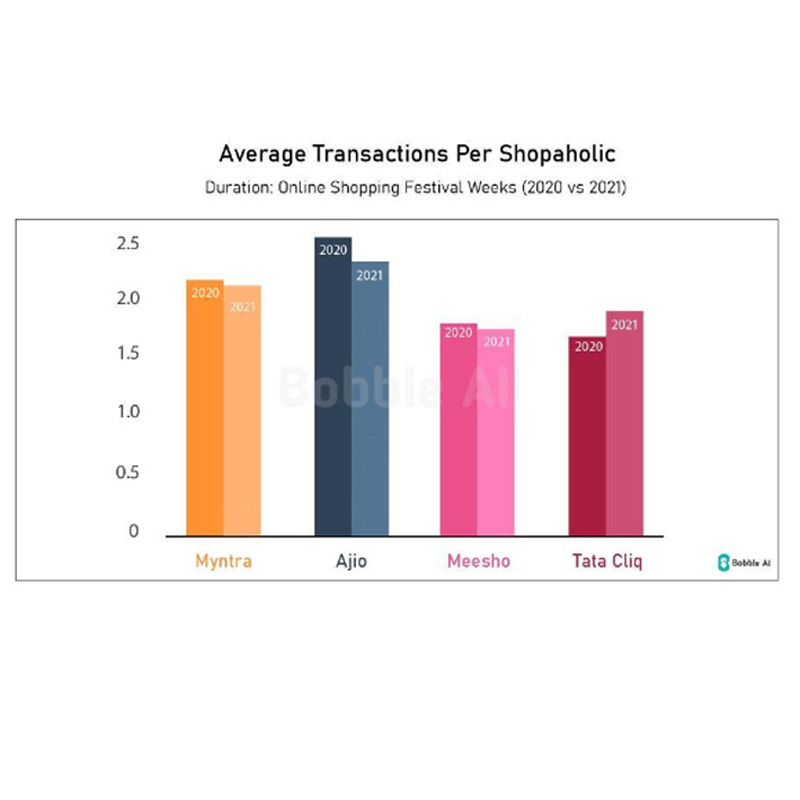
    Beauty e-commerce apps usage grew by 64 per cent, whereas fashion e-commerce grew by 368 per cent over the past year. The festive period has only led the two e-commerce domains to skyrocket, with at least two transactions completed by shopaholics during the fashion festivals.

    Competition heating up with new players

    As per the report, India’s fashion e-commerce industry has transformed from ‘Monopoly’ to ‘Ludo.’ Fashion giant Myntra faced tough competition from its competitive counterparts, Meesho, Ajio, and TataCliq. While almost 46 per cent of all transactions belonged to Myntra during the 2020 festive period, Ajio bagged around 69 per cent of all transactions in 2021. The share of Myntra’s active users, also using Meesho, Ajio, and TataCliq has also increased significantly, indicating how users are exploring multiple options this year.

    The battle of the e-commerce legends, Amazon, and Flipkart is also worth noting, with Flipkart’s active user base rising 83 per cent in 2021 online shopping festival compared to Amazon’s 72 per cent. Despite the fact that Flipkart is dominating in terms of engagement metrics like search frequency and active sessions, Amazon is winning in terms of transactions, significantly less average session times.

    Apart from fashion e-commerce, interesting insights have also emerged from the beauty e-commerce segment.

    Leading players Nykaa and Purplle locked horns this festive season – and Purplle took a piece from Nykaa’s pie. In light of Nykaa’s IPO, let’s look at their market share against Purplle, Nykaa’s pure-play fashion e-commerce competitor. Purplle had a 70 per cent growth in active users in the 2021 shopping festival, compared to a 50 per cent increase for Nykaa. With 15 per cent common user base in 2020, Purplle is now standing at 17 per cent in 2021, as per the report.

    Hypergrowth on the horizon

    The festive season trends point towards healthy and fast-evolving competition in the e-commerce market, which bodes well for customers who are looking for high-quality products at affordable prices.

    With the festive season coming to a close, it is exciting to anticipate how the competition will pan out in 2022. With India’s e-commerce market set to reach $120 billion by 2025, the future seems promising. Hypergrowth is definitely on the horizon for the segment, and according to Bobble AI’s findings, brands are poised to capture growth opportunities.

  • upGrad, Flipkart & Kia Motors come onboard as sponsors for ‘Shark Tank India’

    upGrad, Flipkart & Kia Motors come onboard as sponsors for ‘Shark Tank India’

    Mumbai: Sony Entertainment Television is set to telecast “Shark Tank India” starting 20 December every Monday to Friday at 9 p.m. Produced by Studio Next, the show will see upGrad as ‘presenting’ sponsor, Flipkart as ‘co-powered by’ sponsor and Kia Motors as ‘associate’ sponsor, announced the channel in a statement.

    The first edition of “Shark Tank India” will feature seven ‘Sharks’ including Ashneer Grover (BharatPe founder and managing director), Vineeta Singh (Sugar Cosmetics CEO and co-founder), Peyush Bansal (Lenskart founder and CEO), Namita Thapar (Emcure Pharmaceuticals executive director), Anupam Mittal (Shaadi.com – People Group founder and CEO), Ghazal Alagh ( Mamaearth co-founder and chief mama) and Aman Gupta (boAt co-founder and chief marketing officer). The show will be hosted by Rannvijay Singha who will act as a guide for the pitchers on the show and the audience alike.

    The selected applicants or the ‘Pitchers’ will find themselves face-to-face with the ‘Sharks’ or the investors who will understand, assess and make an offer based on the applicant’s final ‘pitch.’

    “This revolutionary show that celebrates entrepreneurship perfectly aligns with the current sentiments across the country and we feel that there couldn’t have been a better time to launch this show,” said head content – Sony Entertainment Television and digital business Ashish Golwalkar. “Shark Tank India is an extremely relevant show for us and I believe that it has the potential to connect with the Indian audience as well.”

    “At Studio Next, it’s our endeavour to present to our viewers ‘entertainment with a purpose’ and shows like KBC, Scam 1992, Dhadkan Zindaggi Kii or soon to be released Whistleblower are a testament to our efforts,” said head – Studio Next Indranil Chakraborty. “In line with this thought, we are excited to bring a show like Shark Tank India that offers a unique viewing experience to the audience not only educating them but entertaining them at the same time.”

    Sony Pictures Networks India has acquired the rights for the Indian adaptation of the globally successful business reality format – “Shark Tank,” which will be aired on Sony Entertainment Television. The format has reinvigorated businesses in over 40 countries since its first launch in 2001. With over 180 seasons; winning over 30 awards globally, “Shark Tank” is the world’s top business reality show. Since its first launch in 2001, as “Tigers of Money” in Japan, created by Nippon TV the format was later adapted as “Dragon’s Den” in 2005 in the UK and the show premiered in the US as “Shark Tank” in the year 2009. The format is distributed internationally by Sony Pictures Television.

  • Flipkart launches ‘India Ka Fashion Capital’ campaign with Ranbir Kapoor & Alia Bhatt

    Flipkart launches ‘India Ka Fashion Capital’ campaign with Ranbir Kapoor & Alia Bhatt

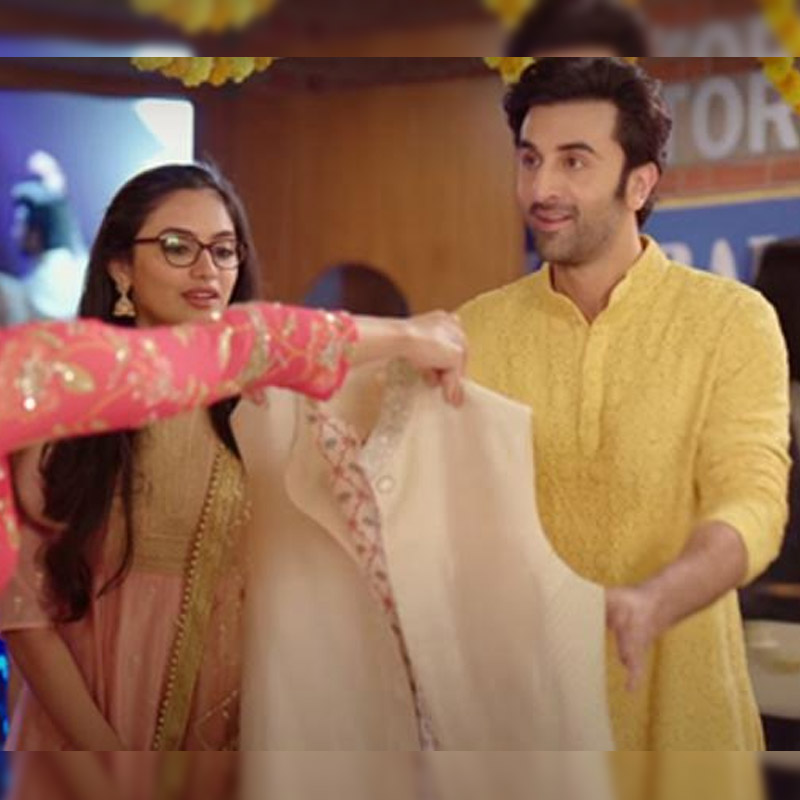
    Mumbai: Homegrown e-commerce marketplace Flipkart has launched the ninth edition of its ‘India Ka Fashion Capital’ campaign in a new avatar, featuring Bollywood’s It couple Ranbir Kapoor and Alia Bhatt. Conceptualised in collaboration with McCann World group, the campaign encourages customers to upgrade their fashion wardrobes.

    Directed by Shekhar Kamble and produced by Dreampunk Films, the ad films are set on a college campus, with Ranbir and Alia portraying characters who are college friends, showcasing their fun relationship with their quirky professor. The TVCs are aimed at the youth whose aspirations for high-quality fashion are ever-evolving but their self-doubts and the costs at times, come in the way of their desires.

    “Flipkart has a strong understanding of customer needs, which has helped us provide them with best-in-class offerings over the years. Today’s shoppers prefer to live a fashionable lifestyle that is both accessible and value-driven,” said Flipkart director of marketing Prasanth Naidu, speaking about the campaign.

    “With this campaign, our aim is to establish Flipkart as a value lifestyle destination that caters to various needs and appeals to a diverse demographic across the country. We are sure that Ranbir and Alia will create a unique connection with our target audience and inspire them to look at Flipkart as a one-stop-shop for all their lifestyle needs,” he added.

    Close on the heels of the wedding season, the new campaign showcases the latest influencer-inspired ethnic fashion, targeting aspirational customers who may be fence-sitters when it comes to making a purchase online. The campaign is live on television and digital platforms for a period of fourteen weeks.

  • Nandita Sinha to take charge as new Myntra CEO

    Nandita Sinha to take charge as new Myntra CEO

    Mumbai: Online fashion retailer Myntra has announced the appointment of Nandita Sinha as chief executive officer, effective 1 January 2022. Sinha will join Myntra from group company Flipkart, where, as vice president of customer growth and marketing, she is currently leading the overall charter for marketing.

    As a seasoned leader in the consumer internet space, Sinha has deep expertise in leading businesses and driving tech-pivoted growth and innovation. During her nearly eight-year stint at Flipkart, she has worked across multiple roles and categories, including beauty & personal care, books and general merchandise, home and furniture and has built a strong organisation, grooming several future leaders with her exemplary people skills, said the company in a statement.

    “Myntra is integral to the group as an organisation that leads the charter on fashion, beauty and lifestyle, solving the dynamic needs of the modern fashion-conscious consumer,” said Flipkart Group CEO Kalyan Krishnamurthy. “As the forerunner of several innovations and unique consumer experiences, our aspirations continue to grow for Myntra as a separate company. I am certain that with her strong background in driving businesses and an acute focus on customer-centricity, Nandita (Sinha) will be instrumental in defining the next phase of Myntra’s evolution as its CEO.”

    Sinha joined Flipkart in August 2013 after stints in Hindustan Unilever Ltd and Britannia Industries Ltd. Before joining Flipkart, she was the co-founder at MyBabyCart.com. She holds an MBA in marketing and strategy from FMS Delhi and is a BTech Graduate from IIT BHU.
    “I am very excited about my new role and look forward to the opportunity of driving Myntra’s vision of democratising fashion further while working with a very talented team at Myntra,” said Sinha on her new role.

  • Flipkart ropes in Richa Chadha to host ‘Incredible Sellers, Incredible Stories’ Season 2

    Flipkart ropes in Richa Chadha to host ‘Incredible Sellers, Incredible Stories’ Season 2

    MUMBAI: Despite several challenges, small and medium businesses (SMBs) continued to provide services all through the pandemic. Flipkart Seller Hub has released ‘Incredible Sellers, Incredible Stories’ in 2020, showcasing some of these success stories created on the platform to celebrate the efforts of this resilient community. 

    Conceptualised by ART-E Mediatech, the second season of the show will be hosted by actor Richa Chadha who will take viewers behind-the-scenes of the interesting growth stories while encouraging the seller community to keep going with the zeal and determination for achieving their goals.

    “Each year, we see sellers of Flipkart showing their unwavering trust in our marketplace platform and embracing digital transformation to cater to consumers across the country,” says Flipkart senior director and head – marketplace Jagjeet Harode. “Today, with 3.75 lakh sellers on our platform, we are proud of the success and growth that they’re achieving and the passion that they showcase for their business. Through ‘Incredible Sellers, Incredible Stories’, we want to highlight these growth journeys and motivate the seller community to continue driving success.”

    Further, Flipkart has launched its #BachonKaKhel digital campaign initiated to create awareness among existing sellers and build consideration among new sellers. The brand’s new show will also discuss tips and tricks to leverage the platform in an optimum manner. It will also feature invigorating anecdotes about stories of various businesses and multiple learnings of the successful sellers through relentless efforts on the e-commerce platform.

    Art-E Mediatech co-founder and chief business officer Rohit Sakunia said,’ “While working on ‘Incredible Sellers Incredible Stories’, we discovered many pearls of wisdom related to online business, life, and success. We feel truly humbled and inspired by them.”

    `Flipkart will further attempt to bring out the humbling stories of wisdom while encouraging people to continue driving transformation through the platform and never lose hope, no matter what shared the e-comm major.

  • Flipkart collaborates with Moj for video and live commerce

    Flipkart collaborates with Moj for video and live commerce

    Mumbai: Home grown e-commerce marketplace Flipkart has collaborated with short video platform Moj to enable video and live commerce experiences at scale. The collaboration will help Flipkart to scale video commerce in the country and engage the next 200 million e-commerce customers.

    Moj currently has over 160 million monthly active users. Besides making e-commerce accessible to millions of first-time users, this collaboration also incentivises content creators in the Moj ecosystem by enabling new commerce-led revenue streams to deepen socio-economic impact.


    “The strategic collaboration between Flipkart and Moj will play a key role in onboarding the next 200 million e-commerce users while creating an ecosystem that benefits all stakeholders involved – from brands and sellers to content creators,” Flipkart senior VP and head corporate development Ravi Iyer said. “Given the diverse cultural fabric of our country and with the intention to offer an inclusive e-commerce experience to every consumer, we continue to bridge the gap between audiences through our regional language interface experience which has played a key role in onboarding first-time consumers. Moj’s wide reach through the Indic languages it operates in is another step in this direction.”

    Mohalla Tech Pvt Ltd (parent company of Moj) chief financial officer Manohar Singh Charan said, “The creator economy led revenue streams are globally seeing a massive upsurge and this collaboration with Flipkart is a step towards developing a concrete revenue stream for creators in India, while also enhancing the social experience of our users on the platform. This also opens the universe for creative in-app integrations towards personalized marketing. The seamless amalgamation of content and commerce will push brands to reimagine how they connect with their consumers and ignite the digital social commerce revolution in India.”

  • Phanimohan Kalagara named new CTO at Pine Labs

    Phanimohan Kalagara named new CTO at Pine Labs

    Mumbai: Merchant commerce platform Pine Labs on Wednesday announced the appointment of Phanimohan Kalagara as its new CTO.

    Kalagara is an MS in computer science from Utah State University and has over two decades of experience working with companies in the United States and India. He has extensive experience in the field of technology having worked in e-commerce, financial technology, and the CAD/CAM industries. He also brings expertise in emerging technologies like virtual reality.

    “We have made several new appointments in the past one year to bolster our technology capabilities. I am delighted to welcome Phanimohan as the new CTO,” stated Pine Labs CEO B Amrish Rau. “Phani comes with a wealth of experience in product and engineering and is the right man to lead our technology team during this exciting phase of growth for the company. I would also like to acknowledge the role of his predecessor Sanjeev Kumar who will now move into a new role within the company and head the R&D vertical.”

    Prior to joining Pine Labs, Kalagara was with e-commerce company Flipkart where he was the SVP of product and engineering. He has also spent 12 years with global fintech company PayPal where he was leading product and engineering and spent nearly eight years in the United States working on several key assignments for the company.

    “It is not often that we get an opportunity to play a key role in a company that gets to shift the industry landscape. I have been blessed a couple of times earlier in my career to make a meaningful difference in such companies,” said Kalagara. “With Pine Labs, I see a massive opportunity to make a substantial difference to the future of merchant commerce in Asia. Looking forward to being part of this team that is set to shift the fintech landscape in Asia.”

  • ‘Hyperlocal’ is the latest buzzword for E-commerce sites

    ‘Hyperlocal’ is the latest buzzword for E-commerce sites

    MUMBAI: The Great Indian Festive sales have gotten underway with every e-commerce platform launching its biggest annual blockbuster sale campaign. The growth in internet users, reduction in data prices, and changing consumer behaviour fuelled by the pandemic have spurred the evolution of online retail to go beyond the metros and tier-1 towns. The rapid growth of Bharat online is re-shaping India’s e-commerce landscape like never before with ‘hyperlocal’ being the new buzzword.

    India’s e-commerce market is estimated to record sales worth $ 55 billion during 2021 with the addition of 40 million new online shoppers, as per a recent Indian Retail Industry Report. The number of online shoppers for 2021 is estimated to reach 190 million compared to 150 million in 2020. India is poised to become the third-largest online retail market by 2030 after the US and China with an annual Gross Merchandise Value (GMV) of S$ 350 billion. This changing e-comm landscape is largely driven by hitherto underpenetrated regions in the country, alongside the emergence and growth of multiple e-commerce platforms and D2C (direct-to-consumer) start-ups catering to these lesser explored segments.

    The growing popularity of online shopping has led the e-commerce players to further expand their consumer base into the country’s villages and towns, in time for the busy festive season. Online marketplaces have been localising various offerings in the areas of regional language, Voice, and Video in a bid to break the language barrier and make e-commerce more accessible and convenient for customers pan India.

    E-commerce giant, Amazon India announced that its website will now be available in Marathi and Bengali in addition to Hindi, English, Kannada, Malayalam, Tamil, and Telugu. The e-tailer plans to expand its regional language offering further with the launch of a voice shopping experience in Hindi. “Our aim is to make e-commerce accessible, relevant and convenient for customers. Every month, tens of millions of customers visit Amazon.in in regional languages and 90 per cent of the customers are from tier-2 and below cities,” said Amazon India director- customer experience & marketing Kishore Thota.

    Snapdeal too announced the expansion of its call center capabilities to speak to users in eight Indian languages, making customer support services available in additional local languages. “The pandemic has accelerated the adoption of digital channels, and today people in smaller cities are now purchasing items such as everyday fashion, home decor, kitchenware, and other items online. And as more and more people gravitate towards e-commerce, they will increasingly expect customer services to be in their languages,” said a Snapdeal spokesperson.

    Marketplaces like Amazon and Flipkart are leading the hyperlocal agenda by increasing Bharat’s presence into newer as well as niche markets, said WATConsult managing partner Sahil Shah. “E-tailers who are into mass-market products have shifted gears since the pandemic. There is a clear plan to capture the new India that comes from various parts of the country, using the most localised form of experiences that one can create,” he noted.

    While events like Big Billion Days and special sales on Independence Day and Republic Day offering were organised earlier too, it is only now that India’s e-tailers have sensed an opportunity in regional festivals like Ganesh Chaturthi or Onam to propel sales in different states.

    “E-commerce players are shifting focus to regional activations and are offering region-specific deals as people tend to shop more ahead of their own festivals. To achieve maximum penetration, e-tailers are using vernacular communication channels and deploying social media influencers popular in specific states or regions to promote such events,” said ClanConnect CEO and co-founder Sagar Pushp.

    The changes have become more pronounced since the outbreak of the COVID-19. There has been a three-fold rise in the number of influencers being engaged by e-tailers to promote their sale events through personalised messaging.

    With the Pujo and Navratri celebration underway, and Dusshera and Diwali just around the corner, lifestyle and fashion e-tailers like Myntra, Ajio, Meesho, Purplle have launched campaigns with distinctive regional flavour and feel in multiple vernacular languages. These shopping marts are trying to outdo one another in grabbing eyeballs and finger clicks onto their platforms with special offers & Pujo Makeup Guides and, exclusive launches, and cash-back schemes for their customers. E-tailers are leaving no stone unturned to increase their brand awareness through creative ad spend. After a brief lull in the April-June quarter, they are going all out to redefine KPIs and cater to the newly emerging consumer segments.

    “In terms of marketing spends, we have seen a shift of 20-30 per cent budget being allocated to regional campaigns compared to last year. Focus has moved from generic creatives to specific ones in various vernacular languages to garner more sign-ups,” said cashback and coupons app, CashKaro co-founder Swati Bhargava. Celebrities and brand ambassadors are also picked carefully, with a heightened focus on regional audiences. There also has been a 3x rise in influencer-led digital promotions.

    CashKaro has implemented measures like device-level and language-based targeting after studying the data from Tier-2 to Tier-6 cities, from where 45-50 per cent sale is expected. “At CashKaro, for instance, the activation rates for Tier-2 and beyond have shot up by 40 per cent because of integrating regionally popular creators into the pipeline. The organic impact has been massive as we’ve seen an 8x jump in our traffic during this sale time compared to last year,” shared Bhargava.

    The rise of micro and macro influencers from small towns has come into the spotlight over the last year, as people looked for somebody they could relate to. To leverage this want, many e-tailers have implemented activation of regional celebrities and influencers to acquire more users.

    Myntra’s celeb-heavy campaign features brand ambassadors with a massive regional following like Vijay Deverakonda, Dulquer Salmaan, Mallika Dua, Konkona Sen Sharma and Samantha Akkineni, in addition to those with a national following like Hrithik Roshan, Disha Patani and Kiara Advani. These stars will be seen in region-specific engagements through various content formats such as reels, videos, and stories. Apart from this, over 100 high-impact celebrities and influencers with heavy local presence from the worlds of Bollywood, OTT, reality TV, and digital will drive awareness through pre-buzz and event days for the e-tailer. Other Fashion e-sites like Ajio too have launched campaigns featuring a plethora of celebrities with each of the films voiced in a different regional language, targeting a particular zone across the country.

    Meesho released its latest TVCs which will be aired on major regional TV networks, such as SunTV, VijayTV, Gemini TV, AsiaNet, UdayaTV, TV9, and ETV, in addition to YouTube, and OTT platforms in Hindi, Tamil, Telugu, Kannada, and Malayalam, in order to reach deeper into the Tier 2+ markets. The etailer also plans to leverage regional content creators on multiple alternate channels like – Sharechat, Moj, MX TakaTak, and other favoured content channels for the target group.

    Purplle has also rolled out a 360-degree campaign across Television, Print, Digital, and Social Media channels which will see over 3000 regional influencers participating in a bid to reach out beyond metros to the tier 2, 3 towns.

    “From onboarding regional influencers who create content in local languages to adaptations of the videos and even static content in local languages, we have personalised offers to drive traffic from these locations,” said digital-first agency Lyxel&Flamingo co-founder and COO Shreyansh Bhandari, adding that the agency also maps traffic and revenue from these new towns. “Across campaigns, we have seen the View through rates, CTRs (click-through rates) have been much better when we have localised content for the TG.”

    Brands that were only focused on Tier-1 cities are now seeing exponential growth from smaller towns. What digital has been able to do so well is to provide them access to great content in their language. The confidence of creators, publishers, and OTT platforms is only increasing to keep investing and producing content for them.

    “Digital and e-commerce in the last decade were about India– its urban, English-speaking audience. However, this decade is all about Bharat– it’s rural, small-town audiences who prefer to consume content in a language that is native to them,” added Bhandari.
  • Online retail market in India to rise 3X in next 4-5 years: MMA & GroupM study

    Online retail market in India to rise 3X in next 4-5 years: MMA & GroupM study

    Mumbai: The online retail market in India is set to rise three folds in the next four to five years, majorly driven by under-penetrated categories like grocery, education, and health, as per a new study conducted by MMA India and GroupM.

    Online video spends have seen the highest growth rate of 46 per cent in 2020, as compared to other media channels. Online content consumption grew 35 per cent post Covid, with a total growth of 13 per cent in time spent on OTT from January 2020 to January 2021.

    The industry playbook titled ‘Modern Marketers Guide to Connected Consumer Journeys’ launched by MMA India on Tuesday, along with the AMMP Council and GroupM India is a compilation of learnings and insights by multiple industry experts and an analysis of the e-commerce landscape in India. In the context of the accelerated adoption of online channels, the playbook provides marketers with insights into the changing e-commerce landscape and the factors driving this shift. It also delves into the evolving customer buying journey and purchase patterns, sales-driving technologies such as Voice, AR/VR driving sales and effective channel strategy for improved business ROI.

    According to the playbook, ‘Voice’ is at a nascent stage Indians are leapfrogging on Voice adoption and the market is expected to grow by 40 per cent by 2022. Not just on Google Assistant, voice is rapidly growing as a preferred medium of input across Search and YouTube, driven by vernacular internet users’ preference of voice, who find it to be a more natural way of interacting with technology, helping reduces friction, found the study. Hindi on voice assistants is second biggest globally; 72 per cent Indians prefer non-English language.

    Urban internet users are relying on online platforms for product research. At least 62 per cent of urban users are researching products online before making any purchase either online or offline, as per the guide. As many as 50 per cent of offline shopping across categories involves online product research.

    The biggest retail trend is the increasing popularity of the direct-to-consumer or DTC model, according to the handbook. D2C brands are witnessing a high number of subsequent funding rounds and strategic sales to incumbents. Brands with a DTC model can leverage direct relationships through loyalty programs, special discounting and promotions, and unique and category-specific shopping experiences, says the study.

    The study also highlights that online retail is shifting from electronics to grocery and 73 per cent of customers have purchased through online shopping platforms in the past 12 months. The deciding factors, as per the guide are – product quality ( 63 per cent), price (55 per cent ) and product information (55 per cent), return and cancellation policy, and product warranty.

    There has been an interesting purchase pattern in the consumer journey in the last three months where Amazon, Flipkart, and Myntra were the top three online shopping destinations, notes the study. Groceries, fashion and health, beauty, and personal care were the most searched product categories.

    India today has 622 million internet users (8 per cent growth over 2019) and is expected to touch 900 million users by 2025. With affordable data prices, consumers are increasingly becoming more “digital Conversational Commerce, Voice Search, Video Streaming and Augmented Reality will also help brands drive their e-commerce strategies, says the guide.

    MMA India board member; country head – India, MMA Moneka Khurana said, the playbook outlines how organisations and digital business leaders can improve their understanding of the shift in consumer behavior and solutions that will drive the next phase of growth. “Consistent digital exposure, combined with the presence of available omnichannel touchpoints has resulted in the development of a new consumer purchasing process. MMA through its e-Commerce Council aims to build an overall understanding of the ecosystem and address cluster-specific issues improving capability in omnichannel marketing. We hope this playbook will assist marketers and brands to effectively re-strategise their market approach – from the customers they target to the channels they sell-through,” said Khurana.

    GroupM South Asia president – growth and transformation, Tushar Vyas said the growth in internet users, reduction in data prices, and changing consumer behavior are the key growth drivers for the evolution of eCommerce in India. “We understand the changing online retail market and how it is set to grow 3x in the next 4-5 years mainly driven by underpenetrated categories like grocery, education, health. Considering the emergence and growth of eCommerce platforms, this handbook provides A-Z solutions on how marketers can use eCommerce as a platform to enhance a brand’s reach in these rapidly evolving times,” said Vyas.

    According to Tata Industries Ltd. executive director, KRS Jamwal, going forward, platforms and brands will need to differentiate by providing customers with a better, preferably personalised, yet holistic buying experience that enhances the browse and purchase journeys, and even attempt to bring aspects of the in-store experience online, leveraging tech. “The MMA report provides an overarching view on consumer behavior shifts as well as identifies challenges those organisations may face as a result of those shifts, with best practices and possible solutions”, he added.