Tag: Firhad Hakim

  • MSO flat fee a hurdle, says CTMA while backing TRAI & WB’s underground cable

    MSO flat fee a hurdle, says CTMA while backing TRAI & WB’s underground cable

    MUMBAI: The West Bengal government is preparing to build an underground network of cable TV lines in an attempt to keep the city clean, a state minister has said. Urban development minister Firhad Hakim said, in New Town, they had done it and would start soon in Bidhannagar. In Kolkata, they would as early as possible start a pilot project for underground laying of cable TV lines.

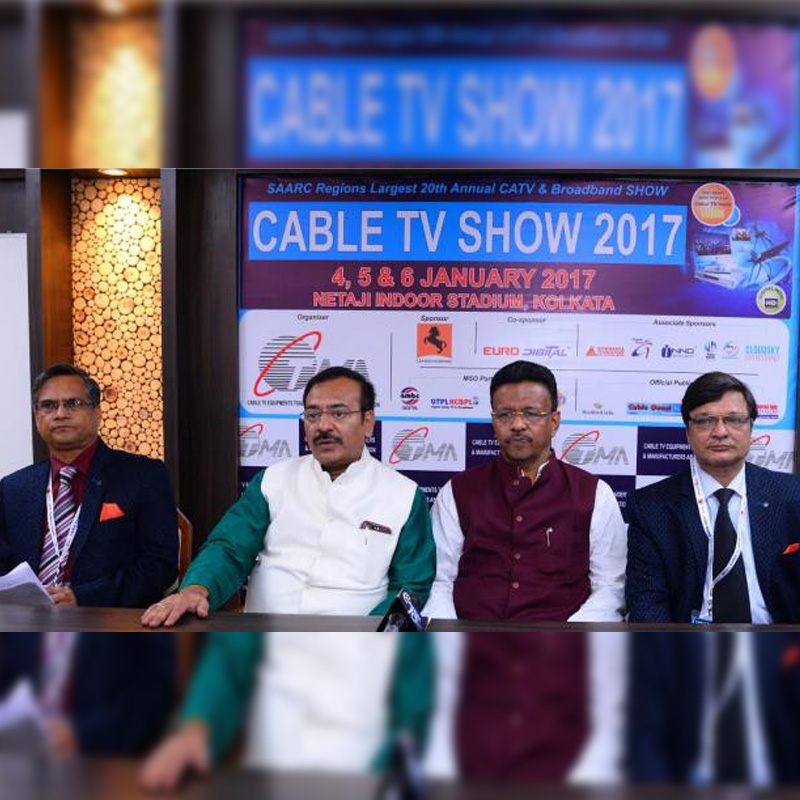
    It was part of a plan by the chief minister Mamata Banerjee who wants the city to look more beautiful without wires, Hakim said while inaugurating a three-day Cable TV Show 2017 from 4 January 4 — the 20th annual show arranged by the Kolkata-based Cable TV Equipment Traders & Manufacturers Association (CTMA).

    Over 10,000 cable operators, manufacturers, traders, channel partners, broadcasters, distributors, and multi-system operators (MSOs) from India and abroad are participating in the show.

    CTMA secretary K K Binani said the plan would minimise possibilities of outside disturbances in connectivity as sometimes wires get damaged during calamities. The industry body said that flat licence fees for multi-system operators had become an entry barrier for small entrepreneurs.

    Cable TV Show 2017 Kolkata, one of the biggest shows on satellite and cable television & broadband in India, was flagged off at the Netaji Indoor Stadium. Hakim inaugurated the event in the presence of minister-in-charge, housing & youth affairs, West Bengal, Aroop Biswas. There are 20 pavilions and 70 stalls erected this year for showcasing a wide range of state-of-the-art products and services related to the cable industry.

    CTMA treasurer & chairman -exhibition Pawan Jajodia said, with the steady digitization of cable television sector and the Digital India campaign, the scope and importance of Cable Television (CATV) had increased manifold. The CATV sector had come a long way to become an organised sector and one that was an important player in promoting digitalisation through the spread of broadband Internet services.

    This event has been sponsored by Darkhorse, and Euro Digital is the co-sponsor. Aishwarya Technologies, Inno Instrument, Globetek Infoway, RailTel, Meghbala, Cloudsky Broadband are associate sponsors.

    Binani said that digitisation of delivery of Cable TV service through set-top box was now in its final and crucial lap as the whole of India would be covered in Phase IV by 31 March 2017. The digital-delivery-enabled networks were now ready to be taken to the next level of delivering value-added services such as broadband internet service, movies on demand, games, pay per view channels, and education etc.

    Binani added that cable TV sector was ready for some sweeping transformation under regulatory intervention. The draft tariff order under consultation by TRAI would bring the addressable services from all delivery platforms such as HITS, MSO, DTH and IPTV under common regulation. The viewer might pay for only the channels that he wished to view/subscribe. Pay channel broadcasters would have to announce a genre and MRP for each of the channels. They must provide channels on terms universal to all delivery platforms. This would make the entry of new entrants feasible. Carriage fee was also proposed to be regulated, Binani said.

    CTMA president Rajesh Doshi said that digitisation has been a game-changer that has transformed the cable sector. The number of licenses issued for downlinking satellite channels into the country crossed 850 channels and the viewer was spoiled for choice with most of the MSOs providing 400 plus channels covering a wide genre and languages. The Cable TV networks in India were ready to play a significant role in helping Internet penetration across India, Doshi added.

  • MSO flat fee a hurdle, says CTMA while backing TRAI & WB’s underground cable

    MSO flat fee a hurdle, says CTMA while backing TRAI & WB’s underground cable

    MUMBAI: The West Bengal government is preparing to build an underground network of cable TV lines in an attempt to keep the city clean, a state minister has said. Urban development minister Firhad Hakim said, in New Town, they had done it and would start soon in Bidhannagar. In Kolkata, they would as early as possible start a pilot project for underground laying of cable TV lines.

    It was part of a plan by the chief minister Mamata Banerjee who wants the city to look more beautiful without wires, Hakim said while inaugurating a three-day Cable TV Show 2017 from 4 January 4 — the 20th annual show arranged by the Kolkata-based Cable TV Equipment Traders & Manufacturers Association (CTMA).

    Over 10,000 cable operators, manufacturers, traders, channel partners, broadcasters, distributors, and multi-system operators (MSOs) from India and abroad are participating in the show.

    CTMA secretary K K Binani said the plan would minimise possibilities of outside disturbances in connectivity as sometimes wires get damaged during calamities. The industry body said that flat licence fees for multi-system operators had become an entry barrier for small entrepreneurs.

    Cable TV Show 2017 Kolkata, one of the biggest shows on satellite and cable television & broadband in India, was flagged off at the Netaji Indoor Stadium. Hakim inaugurated the event in the presence of minister-in-charge, housing & youth affairs, West Bengal, Aroop Biswas. There are 20 pavilions and 70 stalls erected this year for showcasing a wide range of state-of-the-art products and services related to the cable industry.

    CTMA treasurer & chairman -exhibition Pawan Jajodia said, with the steady digitization of cable television sector and the Digital India campaign, the scope and importance of Cable Television (CATV) had increased manifold. The CATV sector had come a long way to become an organised sector and one that was an important player in promoting digitalisation through the spread of broadband Internet services.

    This event has been sponsored by Darkhorse, and Euro Digital is the co-sponsor. Aishwarya Technologies, Inno Instrument, Globetek Infoway, RailTel, Meghbala, Cloudsky Broadband are associate sponsors.

    Binani said that digitisation of delivery of Cable TV service through set-top box was now in its final and crucial lap as the whole of India would be covered in Phase IV by 31 March 2017. The digital-delivery-enabled networks were now ready to be taken to the next level of delivering value-added services such as broadband internet service, movies on demand, games, pay per view channels, and education etc.

    Binani added that cable TV sector was ready for some sweeping transformation under regulatory intervention. The draft tariff order under consultation by TRAI would bring the addressable services from all delivery platforms such as HITS, MSO, DTH and IPTV under common regulation. The viewer might pay for only the channels that he wished to view/subscribe. Pay channel broadcasters would have to announce a genre and MRP for each of the channels. They must provide channels on terms universal to all delivery platforms. This would make the entry of new entrants feasible. Carriage fee was also proposed to be regulated, Binani said.

    CTMA president Rajesh Doshi said that digitisation has been a game-changer that has transformed the cable sector. The number of licenses issued for downlinking satellite channels into the country crossed 850 channels and the viewer was spoiled for choice with most of the MSOs providing 400 plus channels covering a wide genre and languages. The Cable TV networks in India were ready to play a significant role in helping Internet penetration across India, Doshi added.

  • MSOs request WB UD minister to waive off amusement tax arrears

    MSOs request WB UD minister to waive off amusement tax arrears

    KOLKATA: The multi-system operators (MSOs) in Kolkata have requested the West Bengal Urban Development minister Firhad Hakim to waive off amusement tax arrears, thanks to the cable television digitisation which has revealed their business details to the government authorities.

    Cable TV sources said that the state government which is slated to get around Rs two to three crore every month as amusement tax from the MSO gets only Rs 15 – 20 lakh from the MSOs in the Kolkata Municipal Area (KMA) area now.

    “Seeing the present situation, it can be assumed that the state government has lost between Rs eight to 10 crore in the form of amusement tax in last three months,” said a cable TV analyst.

     After the DAS implementation, apart from the increased monthly subscription fee, the consumers are supposed to shell out Rs 10 more as amusement tax charged by the state government.

    Firhad Hakim after taking a note to the appeal made by the MSOs has asked the MSOs to write a letter to the government and accordingly the state would look into the matter.

  • WB UDM Firhad Hakim pleads TRAI to extend deadline for CAFs

    WB UDM Firhad Hakim pleads TRAI to extend deadline for CAFs

    KOLKATA: First it was Information and Broadcasting Minister Manish Tewari who appealed to the Telecom Regulatory Authority of India (TRAI) to delay implementation of ad cap for news channels till the completion of digitisation, and now it is the West Bengal Urban Development Minister Firhad Hakim who has appealed to the regulator to extend the deadline for customer application forms (CAFs) submission.

    Firhad Hakim has appealed to the regulator to extend the deadline for implementation of SMS rollout

    The request has come after TRAI confirmed last week that it will strictly adhere to the 23 August cut-off-date. “If subscriber details including channel preference is not done within this deadline, the operator’s connection is liable to be disconnected,” informed TRAI member R K Arnold.

    “After interacting with both the local cable operators (LCOs) and multi system operators (MSOs) at the ground level, we found that most of them are not aware about the registration work which they are mandated to do. TRAI before taking such decisions must spread awareness. I have spoken to the chief secretary to extend the deadline,” said Hakim exclusively to indiantelevision.com today.

    Hakim also said that TRAI must have an elaborate publicity campaign to inform the operators on the procedures involved. “How can TRAI ask the operators to disconnect its services without updating the operators about the whole process of CAFs,” he questions.

    Cable Operators Digitalisation Committee of the Association of Cable Operators convener Swapan Chowdhury informed, “So far only 30-35 per cent of cable consumers in the Kolkata Metropolitan Area have completed the form. It is not possible to meet the 23 August deadline.”

    TRAI officials who were in Kolkata last week said, “If not done within the set deadline, we will take action according to law,” said Arnold.

    Kolkata remains to be the last metro where DAS is yet to be implemented. Manthan Broadband Services director Sudip Ghosh when contacted said, “We will abide by the law and we are working towards meeting the deadline day and night.”

    While Hathway Cable managing director and CEO Jagdish Kumar G Pillai said the company is focused towards meeting the deadline.

    A MSO on the condition of anonymity said, “In the digitisation process, installation of set top boxes and offering of the channels account to more than 85-90 per cent of the work and remaining 10 per cent is clerical job which is letting the consumers to choose the channels. The LCOs have all the details of the customers, and now they just need to go and ask the customers to choose the package they want to go for. All this process will hardly take 10 minutes.”

    Can the cable operators breathe a sigh of relief after the appeal made by Hakim for the extension of deadline? Doesn’t seem like it is too easy to please TRAI, but they can only hope.

  • Kolkata misses DAS deadline the third time

    Kolkata misses DAS deadline the third time

    NEW DELHI: West Bengal government is again headed for a showdown with the Information & Broadcasting Ministry as the deadline for compulsory switchover to digital cable ends today, the third time since digitisation in the four metros was notified.

    The Multi-System Operators (MSOs) have been given strict instructions by the state government against switching-off analogue signals to cable TV homes.

    According to TAM, around 70 per cent of TV homes in Kolkata have gone digital by mid-December. Going by industry estimates, 25-30 per cent homes are still to be seeded with set-top boxes (STBs) required to receive signals of television channels in digital mode.

    West Bengal Urban Development Minister Firhad Hakim has made it clear that the central government cannot force cable operators in Kolkata to switch to digital addressable systems.

    The minister has also warned of action against operators who switch-off analogue signals, which will lead to television sets going blank with no STBs.
     
    He said, "The Centre cannot arbitrarily announce these deadlines for compulsory switchover to digital signals. We have written to the Centre and emphasised that such an exercise can only be attempted through a proper dialogue, but we have not received any response."

    Hakim said I&B ministry is yet to respond to the letters by him and the state‘s Chief Secretary Sanjoy Mitra on the matter.

    While analogue signals of some television channels would continue, the number of channels being carried by MSOs in analogue has reduced significantly. The MSOs had begun the process of switching off of analogue signals from 16 December. The Bengali language channels were expected to go dark by 27 December.

    "While we have switched off a lot of channels but at the same time we have to do a balancing act," an executive from a leading MSO said on the condition of anonymity.

    The executive said the off-take of STBs for installing in cable TV homes has been very good and complete switchover is only a matter of time.

    Echoing his sentiment, an executive from another MSO said, "We have to go along with the I&B Ministry as well as the state government. In the last one month, STB seeding progressed very smoothly."

    The executive said the state government has called for a meeting in the first week of January to take stock of the situation.

    Cable operators in the city told Indiantelevision.com that West Bengal Chief Minister Mamata Banerjee had been a member of the Union Cabinet when it had decided to go in for digitisation in four phases, beginning with the metros.

    But now the operators felt they were being put in an awkward situation with the centre and the state at loggerheads on the situation.

    "We have to operate in West Bengal and it will not be prudent to act against the instructions of the state government. But if the MSOs do not follow the directives of the Centre then they risk losing their licences," said Cable & Broadband Operators’ Welfare Association Secretary Swapan Chowdhury. 
     
    It must be noted that the original deadline for the first phase of digitisation in the four metros was 30 June which was extended to 31 October by the ministry to allow MSOs more time to prepare.

    While Mumbai and Delhi adhered to the 31 October deadline by switching off analogue signals (although pirated signals were available in many parts of Delhi), in Kolkata the signals were not switched off by MSOs on the state government‘s diktat.

    After maintaining a studied silence on the issue for more than a month, the ministry had finally cracked the whip on Kolkata MSOs to switch off analogue television signals in a phased manner in Kolkata by 27 December.

    Meanwhile, broadcasters have begun carrying scrolls on their channels about the 38 cities that will be digitised in the second phase by 31 March even as Chennai is yet to be digitised.