Tag: fireside chat

  • Our approach to local language deals is driven by talent: Beatrice Springborn

    Our approach to local language deals is driven by talent: Beatrice Springborn

    Universal International Studios has been leaning into local language productions over the last six months, reveals president Beatrice Springborn at the Series Mania Forum 2022 on Tuesday. The studio has partnered with French-Vietnamese writer and showrunner Quoc Dang Tran who is behind the series “Call My Agent!” and “Parallèles.”

    In a session moderated by Deadline international TV editor Max Goldbart, Springborn outlines Universal Studios’ ambitions as well as the company’s ability to meet global demand. Springborn has been an influential figure in TV for over two decades. She took over the reins at Universal International Studios in October 2020 after the exit of Jeff Wachtel. Before joining Universal, she was associated with Hulu and led the comedy and drama development, co-productions, and casting across Hulu’s acclaimed and award-winning slate of originals.

    Edited Excerpts:

    How has your past at Hulu shaped your experience at Universal so far?

    I was at Hulu for almost seven years. I don’t think I would have been able to do this job without having been a buyer. When I was a buyer, what was appealing to me about the studios that came to us was that they had a point of view and weren’t necessarily dictating to our mandate. I think it is important as a seller to have confidence in what you want to sell. Network mandates change all the time and our executives need to have a very strong vision of what they want to do and stand behind that. I think that’s appealing to a buyer. My experience at Hulu very much helped how I saw creativity.

    What are Universal International Studios’ ambitions to meet global demand in a world that is replete with content?

    Universal is in a unique place because we have a wide library, lots of IP and while that’s an overused word, when you look at the films we’ve made, the shows that we’ve scripted, our distributor networks, we’ve got amazing deals from executives around the world. We’ve been able to take advantage of that. 

    We always talk about how we’re Universal and while that sounds like a catchphrase, it applies to everything we do. I think about how as a studio you can add value. Our deals are the same as anyone else but we need to be great executives where we’re a partner, creative collaborator to talent. We don’t just want to have a business, we want to offer our point of view, our experience and our connections. A lot of the time we’ve arranged marriages across studios outside the studio based on our relationships as well. My experience has been very much based on book-based development. I love getting ahead of the book market and bringing a really special book to a piece of talent.

    What are the big projects coming down the track and something that you’re particularly excited about?

    After having developed nine exciting series for Hulu, I’m excited for us to be doing “Apples Never Fall” for Peacock (streaming service) with Melanie Marnich. She is producing the series with David Heyman.

    We’re also doing “While Justice Sleeps” with Stacy Abrams and she’s been a joy to collaborate with. It is an honour to be talking to someone who’s such a prolific creator and has been able to create a career for herself in novel writing. 

    We have some projects coming down the pipe which are our local language deals. We just did this deal with Quoc (Dang Tran) who did “Parallèles” for Disney+ and “Marianne” for Netflix. He’s also done “Call My Agent!” He’s got an incredibly wide range of genre experience from family TV to Netflix comedy and we’re excited to be working with him. He heads the projects that we’re already starting to talk about.

    Last year you struck a deal with Buendía Estudios in Spain, is this where you see the future, striking deals with top European talent in such a way?

    We’re looking to expand into new territories. We don’t necessarily want to go to Spain or Italy but we ask who’s the great talent there. We’re going to be announcing a few other deals in other territories like Spain but they’re going to be driven by people who we’re excited to be in the business with. The way we’re looking at our local language originals, we’re going to be more focused on talent. With the Quoc deal, we not only want to be in France but we want to be with the incredible writing talent and quality. We pursued him heavily to come and work with us especially because he could work across so many different genres so successfully. The additional deals that you will see us doing, will be driven from talent first and territory second.

    What’s your process to find the best talent?

    Typically, it comes from referrals from another talent. In some of the deals we’ve done across the studio, a showrunner has come to us and said I love this writer, you should get to know them. We love that because it is a referral network of people who have loved working with us in the past. Sometimes it is just sampling, like reading something amazing or watching a lot of films, plays and theatre. It is across the board in terms of how we’re discovering talent. 

    How does discovering talent dovetail with your taste? What are you enjoying at the moment?

    I have a nine-year-old daughter so we watch a lot of cooking shows across the board. Everything from “Nailed It!” where amateurs try baking and it doesn’t end up great. For the past two years, I’ve loved “It’s a Sin,” the Russell T Davies show. It was done with so much joy and has a great cast.

    My experience is from working at Hulu and a lot of the shows that we developed there, have started to come out now. You will see that some of the shows that we worked like “Only Murders in the Building” subvert genre and tone. That’s one of the things you’ll see from across the Universal studio while creating for Peacock. 

    “Apples Never Fall” which is coming out on Peacock shows my love for books. I’ve been really lucky in my career to have people who’ve trusted me and I feel the same way about the executives who work here. It is hard to have confidence in your creative opinion and be surrounded by people who have their point of view. I don’t want this studio to be worn in my image. I want everyone else to be contributing, coming with their input and hopefully getting shows for everyone which is borne from their passion.

    You’re focused creatively on European talent based on the stuff you’ve announced. What do you think is the current landscape for European content?

    When I’m talking to the creative about the studio, I’m talking about television, so it’s all the same and I don’t think people see those boundaries anymore. Everything from the often referenced “Squid Game” to “Normal People” and shows we’re seen across the board, people don’t look at a piece of content and say that’s an international show, I’m not going to watch it. We’ve seen the world open up in a way that is embracing all kinds of content. Shows like “Squid Game” ripped up the rulebook that defined the popularity of non-English language programming. I also think people want to travel after all this time and experience another culture. There’s a real openness in audiences today to embrace other cultures.

    We’re looking for local and foreign-language shows. Local for the global is a strategy but I also think looking global for local, there is a real emphasis on finding stories that you might not think may translate for the audience but people are just interested in the human experience without language boundaries. So, we’re looking for creators first even if they’re coming from a non-English background to speak to them and experience that universal human connection.

    There are a couple of Universal shows where authenticity comes out such as “We Are Lady Parts”. What’s the process for producers to make a show as authentic as it can be?

    Working Title Television, one of our production partners worked on “We Are Lady Parts” along with Nida Manzoor. Nida had such a specific experience, humour and heart to the show that no one else but her could have brought that authenticity. I think the best way to construct a show is by having the right people and the right chemistry. Like “We Are Lady Parts” could not have been made without Nida there are many shows like that which are lightning in a bottle not because it was a piece of IP that was reverse engineered but because of the amazing group of people that went into producing it.

    What are your key priorities for the next few months?

    I’m seeing a few other local language deals. We’re coming out in some bigger territories and some deals were borne out of us being in love with a certain show or having read a script from the creators. We reached out to them and wooed them to come to Universal. A lot of the deals are based on the relationships that we have with creators. There are some people who I worked with at Hulu and some of them were people, other people I knew worked with. All those deals have emerged out of collaboration and from a relationship perspective first. 

  • Need to create a new creative ecosystem for multiple platforms: Sameer Nair

    Need to create a new creative ecosystem for multiple platforms: Sameer Nair

    Mumbai: The OTT streaming business is not for the fainthearted and players with light wallets, said Applause Entertainment founder and chief executive officer Sameer Nair as he talks about the evolving streaming business at the CII Big Picture Summit.

    While there is an opportunity to make it big in the business, it’s important to ensure that it reaches a critical mass of subscribers. “And to do that you need to make investments,” said Nair, discussing how several OTT platforms turned out to be making losses.

    Elaborating on why he decided to enter the IP creation business, he said, “We are trying to work with a movie studio model. Attract a certain risk capital and produce some content. TV was funding IP creation and so the upside was being reaped by TV broadcasters. Producers did not get the upside of owning the IP. Today, there is an opportunity for content companies who take a degree of risk in content creation and license it to platforms.”

    Until now, TV was driving investments into original programming in India as it was catering to a mass audience. It was dominated by celebrity-led reality shows and daily soaps and that’s what consumers were watching for decades. But OTT has unlocked a new audience as it caters to a mass of niches. “For example, let’s say 10 per cent of the country likes the crime genre, that’s the size of a small European nation,” he said.

    But when it comes to paying for streaming services, then consumers look at the service that offers them the most value for money. “We never had HBO or Showtime in India in terms of producing original Indian content for a digitally-savvy audience. The creative ecosystem was catering to TV and films. We need to create a new ecosystem and content for multiple platforms,” he highlighted.

    According to Nair, OTT platforms also offer more data on consumers so decisions can become more informed, unlike TV where broadcasters always struggled to understand consumer behaviour because TRP was the only metric. The advantage for streamer is that can be “massy and classy”. A show can be created in a widespread spoken language but subbed or dubbed in multiple regional languages at the same time hence broadening its appeal.

    Talking about recommendation engines on OTT platforms Nair said that like any other algorithm the more you use it, the more you get out of it. “To say that I’m being shepherded by the recommendation engine and it is reducing my choice is not a fair comparison. Everyone knows that a consumer’s content viewing choices operate between new and comfort. That’s why Netflix has the ‘Play Something’ feature,” he said.

    There is a notion that TV is free and that the consumer has to pay for OTT. That’s why many consumers are still keen on ad-supported streaming services. Nair said that consumers were always paying cable distribution companies to watch TV. Similarly, today OTT services are built on top of broadband companies and telcos.

    Speaking about ad supported streaming, he said, “Every time you do anything regarding messaging and selling within a content experience, then it becomes an art.” There are all sorts of ways to monetise content and a lot of companies are trying to crack it. “Netflix has 214 million paid subscribers and it is the most premium streaming service globally. If five people are sharing a Netflix account then 200 million becomes one billion. If they’re watching Netflix two-three hours daily then that’s how many premium customers there are who don’t want to come into contact with regular advertising messages,” he observed.

    Nair said that the lockdown has been a uniform experience for nearly every human being on the planet. “We used to think TV is our window to the world but actually TV is only the window into your neighbourhood. The internet is the window to the world,” he said. The inevitable outcome of this is that the consumer has become used to the fact that there is a lot more content to watch.  

  • Virtual Fireside Chat with Puneet Gupt, Coo, Times Internet Ltd

    Virtual Fireside Chat with Puneet Gupt, Coo, Times Internet Ltd

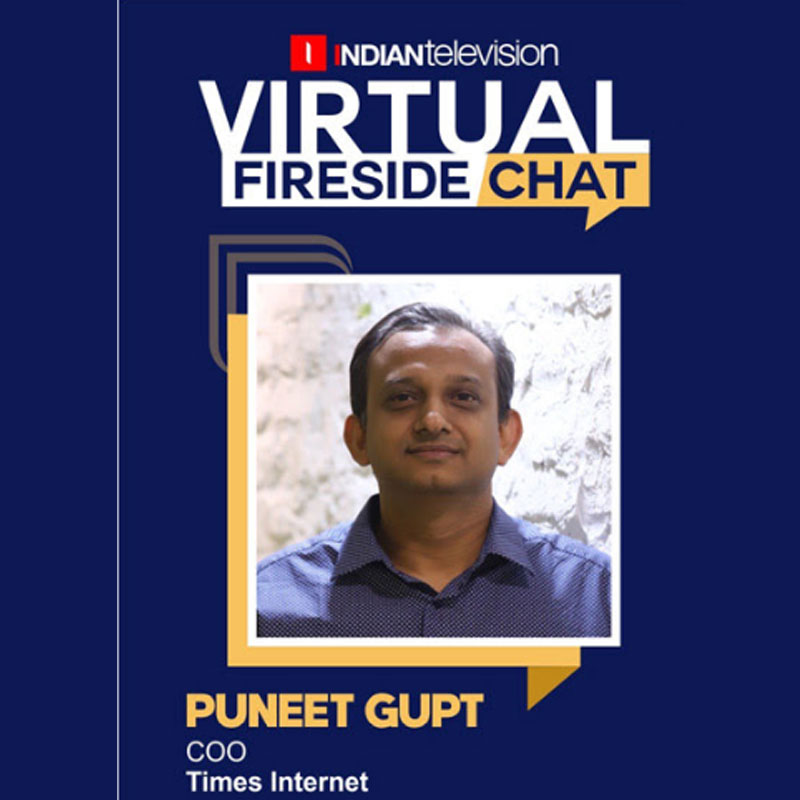
    Taking ahead its virtual fireside series with experts across media and entertainment industry, Indiantelevision.com will be hosting Times Internet COO Puneet Gupt on 25 November. The session will be hosted by founder, CEO and editor-in-chief Anil Wanvari.

    Gupt drives the strategy, vision and execution for all the internet mobile and properties of the group. He has close to two decades of experience in identifying market opportunities, product management, digital marketing, app growth and retention, monetisation of digital assets.

    He has been associated with Times Group over a decade. He was elevated as COO in 2018.He played a critical role in Times Internet’s news business when he was heading the segment.

    Tune in to know more!

  • Virtual Fireside Series: Watch BARC India CEO Sunil Lulla live on 25 September

    Virtual Fireside Series: Watch BARC India CEO Sunil Lulla live on 25 September

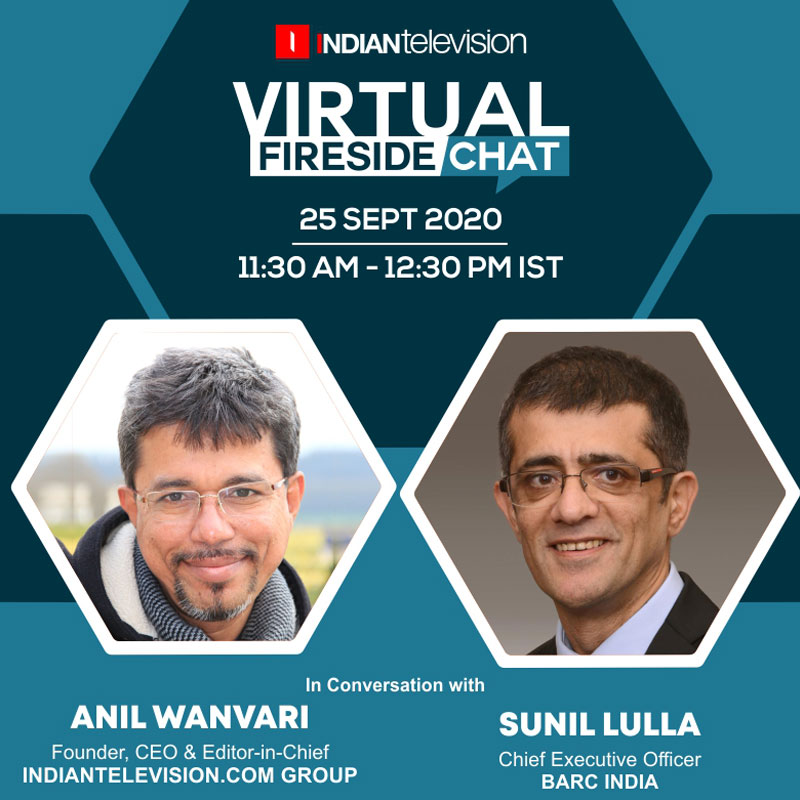
    MUMBAI: Taking ahead its virtual fireside series with leading professionals spearheading the broadcast industry in India, Indiantelevision.com will be hosting BARC India CEO Sunil Lulla on 25 September 2020. The session will be helmed by our founder, CEO, and editor-in-chief Anil Wanvari.

    During this chat, Lulla will be sharing the impact of pandemic on the television and broadcast industry, television viewership, technology, advertising, and much more. 

    Read more news on BARC

    With over 35 years of industry experience, Lulla has worked in leadership roles across media (TV, Digital), brands (marketing) and advertising (agencies). He has worked at J. Walter Thompson, Balaji Telefilms, HMV Saregama, MTV India, Diageo, Indya.com, Sony Entertainment Television, Grey Group, Times Television Network, and others. Lulla's longest stint was at J. Walter Thompson as director of client services for India, China and Taiwan between 1985 to 1996. He was also part of the which helped turn around Sa Re Ga Ma (HMV). Lulla played a key role in starting, shaping and developing the Times Television Network (owned by the Times Group) which comprises successful and leading TV channels: ET NOW, MOVIES NOW, ROMEDY NOW, TIMES NOW and zoom. 

    He is associated with several industry bodies and associations and drives policy and agenda setting for the advertising, media and entertainment industry. Simultaneously, he continues to be on the boards of multiple companies.

    Watch our previous virtual fireside chats with industry veterans

    The virtual fireside series in its previous sessions has hosted eminent industry professionals such as Zee Entertainment Enterprise Ltd chief growth officer – advertisement revenue Ashish Sehgal; Sri Adhikari Brothers Group MD Markand Adhikari; Applause Entertainment CEO Sameer Nair; Republic Media Network founder Arnab Goswami and several others.

    Keep watching this space to know more.

  • Virtual Fireside Series: Catch Viacom18’s Mahesh Shetty live on 17 September

    Virtual Fireside Series: Catch Viacom18’s Mahesh Shetty live on 17 September

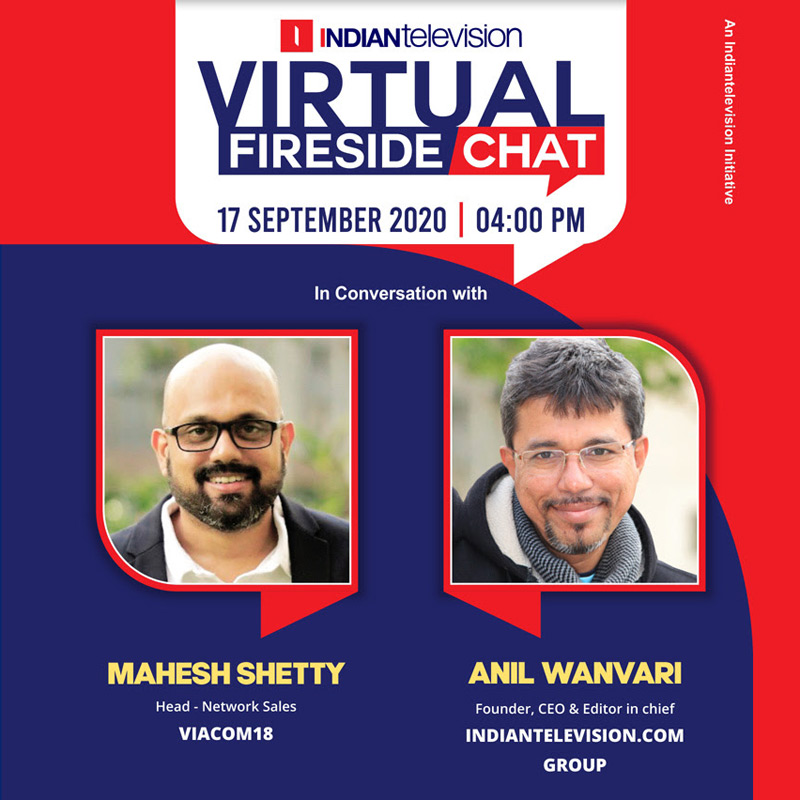
    MUMBAI: Taking ahead its virtual fireside series with eminent professionals of the media and advertising industry in India, Indiantelevision.com will be hosting Viacom18 network sales head Mahesh Shetty on Thursday, 17 September 2020 at 4:00 pm. The session will be helmed by our founder, CEO, and editor-in-chief Anil Wanvari.

    Shetty has been handling the Viacom18’s network sales and is associated with the company for the past year and a half. He comes with over two decades of experience in marketing, sales and general management across media and FMCG sectors. His last stint was at Radio Mirchi where he spent 12 years and played a key role in the expansion of the radio network to 66 stations, and eventually expanding its footprint in the international market. Shetty started his career with PepsiCo to lead the beverage major’s marketing outreach in Maharashtra and Gujarat and over his decade long stint grew within the organisation to become the general manager, national sales – organised trade.

    Read more news around Mahesh Shetty 

    He will be sharing his experiences of sailing through the past few months of nationwide lockdown, managing advertising revenues, and other insights from the world of broadcast, marketing, ad sales and general life. 

    The virtual chat series had earlier hosted industry veterans such as Zee Entertainment Enterprise Ltd chief growth officer – advertisement revenue Ashish Sehgal; Sri Adhikari Brothers Group MD Markand Adhikari; Applause Entertainment CEO Sameer Nair;  BCCL president – response Partha Sinha; DAN CEO APAC and chairman India Ashish Bhasin; and IPG Mediabrands CEO Shashi Sinha. During these interactions, these eminent industry leaders have shared their understanding of the  television business, advertising industry, content pipeline and strategies that will be leading the new world order in the post-pandemic era.

    Watch our Virtual Fireside Chats

    Keep watching this space to know more.

  • “India is not yet developed to venture into TV pay model”: Sri Adhikari Brothers’ Markand Adhikari

    “India is not yet developed to venture into TV pay model”: Sri Adhikari Brothers’ Markand Adhikari

    15 September 1959 saw a small transmitter and a makeshift studio in a corner of Delhi give birth to terrestrial television. Decades later in 1990, India saw the arrival of private television channels. When saas-bahu dramas ruled, SAB TV is credited for putting a smile on the face of the Indian audience with the launch of India’s first and only comedy channel. After acquiring relevant experience in the fields of advertising, marketing and media publicity, Markand Adhikari, along with his late brother Gautam Adhikari, started Sri Adhikari Brothers (SAB) Group – in 1985 as a partnership firm. Later, it went on to become the first publicly-listed television production company in India when it was listed on the BSE in 1995.

    The company initially created regional language programs in Marathi and Gujarati and then moved on to producing Hindi programs on the Doordarshan. With the advent of satellite channels in India, SAB started producing serials for Zee TV. The group had numerous channels like SAB TV (now owned by Sony Networks), Mi Marathi & Mastii. The group made regional channels for rural parts of India like Dabangg, Dhamaal and Dillagi. The duo further forayed into films.

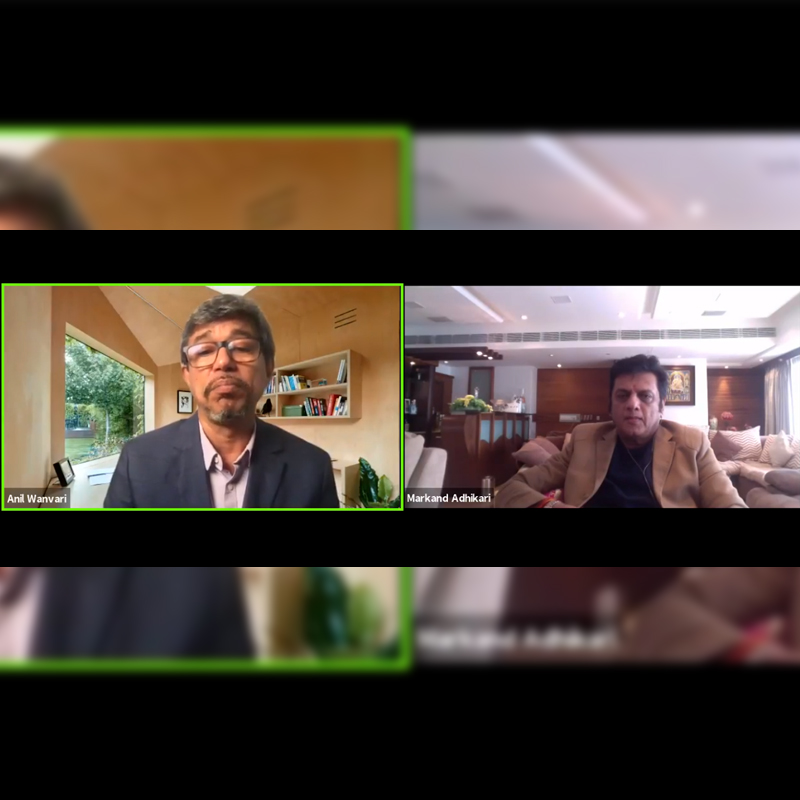
    Sri Adhikari Brothers co-founder Markand Adhikari, in an insightful fireside chat with indiantelevision.com founder, CEO and editor in chief Anil Wanvari, got candid about his journey, plan going forward, advertising and subscription model in television and more.

    Edited Excerpts:

    You have been a part of television industry for 40 decades; can you tell us more about your journey?

    When Doordarshan started in India, it only used to telecast an infotainment show called Krishi Darshan. When I was just a teenager, I met then information and broadcasting minister Vasant Sathe to discuss the chances of bringing commercial shows in India just like the west. At that time, he only asked me to look outside the window and asked me what do you see, I said I could see green trees and a colourful world. He explained to me about vision to bring colour television in India which was heavily criticised back then. Somehow, he accepted my proposal to create a show with Shashi Sharma. It started the era of sponsorship programs on television. We did sponsorship programs on Doordarshan for quite a few years then we ventured into regional space with LPTS (Low Power Transmission). We connected to the regional centres of Mumbai and Ahmedabad. Bandini became the first serial for Bombay Doordarshan. We carried a lot of shows for Doordarshan from the mid 80s to 1991.

    My late brother Gautam Adhikari’s name was registered in Limca book of world records for directing the maximum number of shows. I made Commander with Essel Group chairman Dr Subhash Chandra and I learned a lot from him. With the help of Jeetendra Kapoor (veteran Bollywood actor), I met Ketan Somaiya, a Nairobi-based entrepreneur who used to run an Asia channel in London with Amitabh Bachchan. We created a show called Waqt for him for $11,000 per episode and at that time import and export were free. The show had 52 episodes but due to some non-payment issues, the show was stalled at 26 episodes. After this, I again switched back to Doordarshan because Zee never used to give rights to the shows. DD Metro was recently launched where I did popular shows like Shriman Shrimati and All The Best. At that time, it was Rs 1,20,000 for 10-second spots on DD Metro. Doordarshan wanted us to make an afternoon soap within 15 days. I spoke to TV Asia about my 52 episodes out of which I was only paid for 26 episodes. I imported the pending episodes on half of the rate. Starting with 52 episodes I made Waqt Ki Raftaar which eventually had 600 episodes.

    What happened after you listed your company in 1995?

    Due to the Harshad Mehta Scam, the entire stock market suffered until 1998. Finally, in 1999 the economy was witnessing a boom then I realised it is the perfect time to start our own channel. The main challenge was we were always in production. Broadcasting was altogether a new experience. Our financial adviser only gave the plan of Rs 115 crore for the channel but to launch a channel it was too less. Then with the limited amount at my disposal, I started SAB TV in 2000. Again, due to Ketan Parikh’s scam, the economy was in shambles still we managed to run the channel for five years. We were a trend-setter by bringing a niche comedy channel. Sony Networks took over SAB in 2005, which till date is my biggest regret. However, I am happy that SAB is a big brand. After SAB TV we started two news channels Janmat and Mi Marathi which later I sold at a good price.

    What do you think about the future of television?

    Television in India is not going to die so soon, it will at least stay for another ten years. In the typical Indian household, it is still a culture to watch TV together. Most of the people are not aware of the multi-set concept or firesticks. However, one of the benefits with digital channels is that it is moving whereas television is static. Television is appointment viewing, on the other hand, digital is infinite. But digital requires a lot of capital investment. One cannot enter the digital market with a three-year plan.

    Are you looking at OTT content production?

    Our next-generation has already ventured to digital space with a series called Dheet Patangey that was uploaded on Disney+ Hotstar. It is directed by Gautam Adhikari’s son Ravi. My son Kailashnath and Ravi already have close to five shows which are almost done.

    Television is heavily dependent on advertisers; do you think subscription-based models will be a viable option in the long run?

    As far as television is concerned, I think in India most of the channels will be dependent on ad revenue. Also, I believe India is not yet developed to sustain on a pay model. There are broadcasters, MSO, semi-MSOs and then cable operators who collect money from individual households. So it has a lot of loopholes and layers in between which needs to be identified. There is a lack of transparency. At the same time advertising models will not work on digital platforms because audiences are now used to watching OTT content ad-free.

    What are your thoughts on IPL which is expected to happen during Diwali? Also, will it benefit all the channels or only sports channels?

    I believe it is good news; it is creating a moment with the advertising world and advertisers. IPL or any other cricket forms were running in the same manner as it was before Covid2019. Advertising spends were created keeping all the channels in mind; it was just not for sports channels. I don’t think so IPL will impact the revenue of any other channel.

    According to media planners, 30 per cent of advertising spends are kept for IPL, so do you think it will impact other channels?

    It is not a new scenario. In fact, it is a testing time for other channels, where we will get to see how they perform when IPL arrives.

  • Not the right time for brands to go dark; they must continue communication

    Not the right time for brands to go dark; they must continue communication

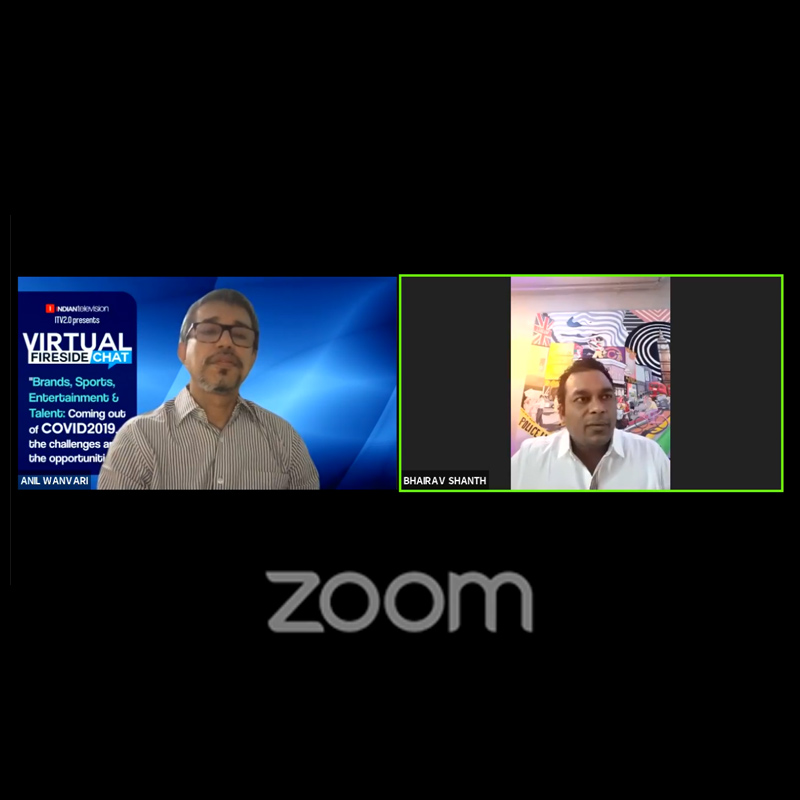
    MUMBAI: Brands cannot go dark in these troubled times, says ITW Consulting managing director Bhairav Shanth during a virtual fireside chat with Indiantelevision.com founder, CEO and editor-in-chief Anil Wanvari. According to him, the brands should instead strive to remain relevant and active in these tough times.

    He spoke about the future of the sports and live games and also how digital influencers have taken a centre stage, lately, to engage with masses on behalf of brands.

    “We have introduced in excess of thousand plus brands into global cricket for the first time. We make an attempt to be involved and develop commerce for various cricket boards,” says Shanth.

    The 12-year-old ITW Consulting seeks to fix the gap in the industry and do something different to give a single approach to every brand. With three verticals, Sports, Blitz and Playworx, the firm provides services such as sponsorship consulting, sports marketing, talent management among others.

    Says Shanth, “In the last two months, digital influencers have been buzzing for creating engagement. Today, every brand ambassador has become an influencer by default.” The consulting firm has been actively working with the brands to identify the right digital influencer in the current scenario, at a time when everybody is sensitive.

    During this testing time, not all brands want to sell their products through advertisement, but rather aim to create engagement and communication with consumers, believes Shanth. The firm has helped brands like Uber and Unacademy partner with the right digital influencers.

    ITW Consulting is currently operational in all cricket-playing countries as well as across cities and districts in India, and the global presence has helped them grow a lot, points out Shanth. “Along with cricket, we are also doing a lot of work around Rugby, as it is a favourite sport in many countries. We are also trying to build interest in newer sports,” Shanth said.

    Sports and events are the last priority of marketers while deciding media spends, which should not be the case. “Brands believe a traditional medium would deliver better, but we believe the hybrid model of sports with traditional medium would give more positive results,” says Shanth.

    “We have brands that are showing enormous faith and belief in the sports ecosystem. If the brands are assertive that they want to invest in sports, agencies will fall in line," says Shanth. “It’s important for brands to do 360-degree activation and not just sponsorships.”

    “Brands are cautious, but it is not all that bad. If the US can bounce back from the pandemic, so can other third-world countries,” points out Shanth. “Some brands are doing sports marketing right: BYJUS, Hero MotorCorp, etc. My favourite is Royal Stag; their sporting equipment contributed greatly to the sports ecosphere. Some new brands like Unacademy and Swiggy have shown great adaptability.”

    Taking a cue from Bundesliga league that received record-breaking viewership in Germany, Shanth hopes that the live games, including cricket, are going to bounce back across the globe. He believes the absence of an in-stadia audience won’t impact the soul of the game.

    “If people are thinking that sports in an empty stadium is not going to be exciting they are wrong. As television broadcast can create magical moments, it can adapt to the current requirement, and fill in with content, deep data and analytics that will keep the viewers engaged,” Shanth adds.

    Over a period of time, technology has evolved, so is the reach and penetration of the internet in our lives. Going forward, this would increase the digital audience and may overpower television audiences, feels Shanth. According to him, with the changing scenario the e-sports category is picking up steam but can't replace live sports, as both need to co-exist, one cannot survive at the cost of the other.

    Sports has acted as a band-aid every time the world has been under crisis and Covid2019 is no different than past situations, says Shanth. He cites an example of how sports helped the United States come out of the 9/11 shock. “Sport is a healer; people look at sports to create a sense of belonging and positivity. It is going to be back, and no one can take away the excitement of sports.”

    Having been associated with many sports talents and personalities, Shanth says, “Athletes are anxious, want this crisis to end soon and be back on the field practising, playing games”. Sporting community altogether has come out with never-dying optimism during this stressful situation.

    ITW Consulting is named after a favourite film Into The Wild. He says, “The company has seen enough changes for the past decade. And, we are getting better and by year and a half we will be stronger. We have never taken any situation for granted and will come up with a model.”

    Like any other business, Covid2019 has impacted ITW Consulting too. Shanth says: “We have not taken any single downsizing move, have not fired anybody. For us, our employees are an investment and wish to stick with every talent we have, for the time to come.”

    However, he admits that there have been substantial pay cuts in the company at the senior and mid-level management, but they all are aware that the reason for this is not profitability; rather it is a move to survive for the future if the situation worsens further.

    The consulting firm is optimistic about the whole situation and hopes down the line, everything will normalise and “we together will find alternative solutions to the ongoing problem.”

    “With Bundesliga about to start, we may see soccer leagues such as LaLiga, EPL to bounce back. The same would be the case with cricketing events,” Shanth said.