Tag: finance ministry

  • UPA government kept security lapses secret: Finance Ministry Enquiry Report

    UPA government kept security lapses secret: Finance Ministry Enquiry Report

    MUMBAI: TV18’s news English news channel CNN IBN acquired possession of an internal enquiry report by the finance ministry, which reveals that during the printing of Indian currency, security features were compromised. The lapses were also kept under wraps by senior officials working under Ministry of Finance. The incident happened during the previous UPA (United Progressive Alliance) regime in 2012.


    The use of a security thread is the most distinguishing feature of bank notes. The enquiry report, which says the security thread inserted in currency paper at the Hoshangabad Security Paper Mill were from an Islamic nation. The defect in the paper intended for 10 rupee notes was reported on 8 November, 2012, but was kept a secret.


    The report says:


    Examination of the 10 rupee notes showed indecipherable text on the security thread.


    The notes either had Arabic text inscribed on the security thread or did not have any security thread at all.


    The security thread was also found to be non-magnetic when examined on a quality control device.


    The currency paper with the defective security thread initially escaped at least four to five quality checks.


    It was later found that four boxes of sheets had defective currency paper. 


    At 5,000 sheets to a box, and 50 notes printed on each sheet, it works out to a whopping 10 lakh defective notes printed.


    The company, which supplied the defective security thread, New Delhi-based Aristocraft International, faced no action. The MD of Aristocraft refused to comment.


    The serious lapse was also kept under wraps by senior officers at Security Paper Mill and Security Printing and Minting Corporation of India for over three months. No report was sent to Home Ministry or Finance Ministry. In fact, officers allowed the supplier to change the security thread stock without punitive action. Even now no action has been taken against the officers or the supplier.


    It is yet to be verified if there was any corruption involved. But clearly the lapses were so serious that it could have impacted national security  exposing the country to allegations of counterfeiting its own currency.

  • Decision on Nick proposal for buying entire holding in Prism TV deferred

    Decision on Nick proposal for buying entire holding in Prism TV deferred

    NEW DELHI: The Government today deferred approval to a proposal by Nickelodeon Asia Holdings Pte. Ltd., Singapore for purchasing the entire holdings of Shinano Retail Private Limited, India.


    Nickelodeon Asia Holdings plans to purchase the holdings of Shinano in Prism TV Private Limited.


    The Finance Ministry on the recommendation of the Foreign Investments Promotion Board (FIBP) approved a proposal of Viacom 18 Media Pvt. Ltd. for the deletion of one condition in the amendment.


    However, this does not involve any foreign direct investment (FDI).

  • DoT in favour of 10 per cent custom duty on telecom gear

    DoT in favour of 10 per cent custom duty on telecom gear

    MUMBAI: Following the uproar after the union budget proposed imposing 10 per cent import duty on telecom products not covered under Information Technology Agreement (ITA) 1 of WTO to boost domestic production of telecom products, media reports suggest that the Department of Telecommunications (DoT) wants the Finance Ministry to retain the 10 per cent customs duty on specified telecom products as proposed in the budget.


    According to a report in Economic Times, a letter written by the DoT to the revenue secretary said, “Imposition of customs duty on specified telecom products will create a level playing field for domestic manufacturers who suffer severe disability due to poor infrastructure and inverted duty.”


    India is a signatory of ITA 1 as a member of World Trade Organisation. Under the pact, member countries should allow duty free import of products falling under eight categories covering telecom, computers and semiconductors like mobile phones and electronic chips.


    The telecom products mostly fall in the category of 2G, 3G as well as the 4G equipment, including switches and broadband equipment. These products are outside the list of about 220 electronic items on which India has a zero duty commitment under the World Trade Organisation’s Information Technology Agreement (ITA-1).  


    The Government, also, recently declared set top boxes as a part of telecom network. The move exempts STBs from various taxes and duties, bringing down prices, which the government hopes to pass on to consumers. In the first and second phase of cable digitisation, imported STBs accounted for about 95 per cent market share.  


    The letter also added that “India is under no obligation to allow duty free imports of items not covered in ITA-1.”

  • CNN-IBN’s initiative ‘Axe The Tax’ is back

    CNN-IBN’s initiative ‘Axe The Tax’ is back

    MUMBAI: “Axe The Tax” is an award winning initiative that India’s no.1 English News channel, CNN-IBN started in 2007. What started as a special program showcasing 5 personal Tax laws, unfair or unjustified from the perspective of the India Taxpayer, has become a unique campaign to take the common man’s voice to the government. These suggestions are then presented to the Finance Ministry for their consideration and the  request is made to axe or adjust these taxes. The initiative has garnered immense popularity among the viewers and has also, been awarded by the critics. It returns again this year with a view to raise 5 tax related issues that needs to be addressed by the newly elected government as they prepare to present the budget 2014. We ask our viewers to share their tax issues & concern on the biggest platform provided by the leading English news channel of the nation.

  • Dish TV’s appeal to the Finance Minister

    Dish TV’s appeal to the Finance Minister

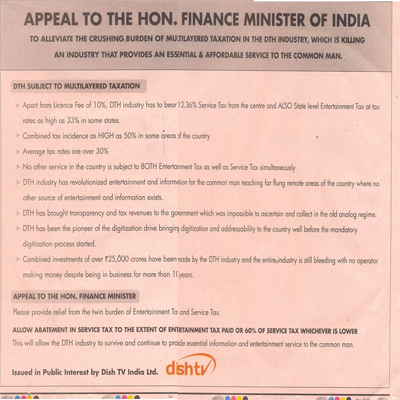
    MUMBAI: The Direct to Home (DTH) industry has been vehemently opposing the heavy taxation being levied on the various operators in the country. In view of the same, the country’s oldest DTH operator Dish TV has appealed to the new Finance Minister Arun Jaitley.


    The DTH operator in its appeal has requested the Minister to alleviate the crushing burden of multilayered taxation in the DTH industry which is in turn killing the industry. The operators are subject to several taxes such as 10 per cent licence fee, 12.36 per cent service tax from the centre and the state level entertainment tax which is as high as 33 per cent in some states. While the average tax rates in most states is 30 per cent, in some it is as high as 50 per cent.


    The appeal states that no other service in the country is subject to both service as well as entertainment tax at the same time. “DTH industry has revolutionised entertainment and information for the common man reaching far flung remote areas of the country where no other source of entertainment and information exists. It has brought transparency and tax revenues to the government which was impossible to ascertain and collect in the old analogue regime,” states the appeal.


    Dish TV says that the entire industry has made investments of over Rs 25,000 crore but is still bleeding with no operator making money despite being in business for more than 10 years.


    The request by the operator on behalf of the entire industry is to provide relief from the twin burden of entertainment tax and service tax. It requests to allow abatement of service tax to the extent of entertainment tax paid or 60 per cent of service tax whichever is lower.   

  • Sony gets permission to downlink more channels into India

    Sony gets permission to downlink more channels into India

    NEW DELHI: The government has approved a proposal by Multi Screen Media for increasing the foreign equity participation for production of television programmes in India.


    The approval has also been given to the company for downlinking certain TV channels, following a recommendation by the Foreign Investments Promotion Board.


    However, the Finance Ministry said this will not require any fresh inflow of foreign direct investment.

  • Finance Ministry defers three proposals related to FDI in broadcasting sector

    Finance Ministry defers three proposals related to FDI in broadcasting sector

    New Delhi: The Finance Ministry today deferred decision on a proposal by non-resident company P5 Asia Holding Investments, Mauritius, to purchase 50 per cent of the shares in an existing broadcasting company with 100 per cent FDI, from another existing NR investor.

    On the advice of the Foreign Investments Promotion Board, the ministry also deferred decision on a proposal by HBO India, New Delhi, to engage in the activities of down-linking non-news and current affairs television channels.

    A proposal by INX Music, Mumbai, was also deferred.

    INX Music, a company which aggregates and distributes music content for TV channels, having 70.85 per cent indirect foreign investment proposes to undertake the additional activity of broadcasting of non-news and current affairs channels.

  • I&B Ministry asks TRAI and PCI to accelerate views on the proposed FDI limits

    I&B Ministry asks TRAI and PCI to accelerate views on the proposed FDI limits

    NEW DELHI: In the light of the current scenario of demands for growth in the media sector escalating, Information and Broadcasting Ministry has asked the Telecom Regulatory Authority of India to speed up its comments on the reference made earlier regarding foreign investment limits in the broadcasting sector.

    In its communication to TRAI, the Ministry has sought comments regarding the paper prepared by the Finance Ministry relating to revision in existing FDI caps in the broadcasting sector. The paper had been forwarded to TRAI seeking its recommendations under Section 11(1)(a)(ii) and (iv) of the TRAI Act, 1997, which pertains to the terms and conditions of license to a service provider and measures to facilitate competition and promote efficiency in the operation of telecommunication services to facilitate growth in such services.

    In a similar separate communication, the ministry has requested the Press Council of India (PCI) to further its advice on the existing sectoral caps of FDI in print media under Section 13 of PCI Act 1978. The advice has been sought in view of the communication received from the Finance Ministry which aims to review policy of sectoral caps of FDI in print media. Section 13 authorises PCI to express its opinion in regard to any matter referred to it by the Central Government.

    The paper proposes to raise the existing FDI cap of 26 per cent which is through FIPB route to 49 per cent through automatic route in the news sector. In the non-news sector, the existing FDI cap is 100 per cent through FIPB route which has been proposed to be 100 per cent through automatic route without the requirement of FIPB’s approval.

    In a consultation paper issued in July following the ministry’s note of the same month, TRAI had reiterated its earlier proposal for increasing the foreign direct investment for FM Radio to 49 per cent, and said the FDI for teleports, DTH, HITS, mobile and cable television networks must be raised to 100 per cent.

    TRAI also conceded a long-standing demand of news and current affairs television channels by recommending that they should be permitted 49 per cent FDI.

    However, TRAI had said that in the cases of both FM Radio and news channels where the existing limit is 26 per cent, the clearance would be through the Foreign Investments Promotion Board.

    In the case of teleports, DTH, HITS, mobile and cable television networks where the limit was 74 per cent, TRAI said that it can be raised to 100 per cent of which 49 per cent would be automatic and the rest would be through FIPB.

    No change had been recommended in the case of downlinking of TV Channels and uplinking of general entertainment (non-news) channels where the upper limit is 100 per cent through FIPB.
    TRAI had earlier given recommendations on the same subject in April 2008 and again on 30 June last year following ministerial references, on the basis of which changes had been carried out. The last such change was on 20 September 2012.

  • Exemption of service tax to be limited to films exhibited in cinema halls

    Exemption of service tax to be limited to films exhibited in cinema halls

    NEW DELHI: The Government has decided to limit the benefit of exemption of service tax to films exhibited in cinema halls.

    Finance Minister P Chidambaram today said in his Budget speech for 2013-14 that he had accepted a request of the film industry in this connection.

    He pointed out that at the request of the film industry last year, full exemption of service tax was granted on copyright on cinematography.

    The Film Federation of India had in its memorandum to the Finance Ministry said that cinema theatres and digital distribution should not be subjected to service tax for Business Support Services.

    However, film industry sources said that they had expected more concessions in view of the fact that this year marks the centenary year of Indian cinema.

    Among other things, the Federation had appealed to the Government that entertainment tax imposed by states and local bodies should be subsumed in the proposed Goods and Services Tax (GST).

    The FFI said that the service tax on performing artistes should also be done away with. It was also demanded that the condition on filmmakers to fill a form under Section 52A of the Income Tax Act for all payments above Rs 50,000 should be confined to only cash payments.

    The Federation said the sale, distribution or exhibition of cinematographic films, not regarded as royalty under 9(1)(vi) of the Income Tax Act 1961, is nullified as it is not available under the Direct Tax Code 2010. As it is not regarded as royalty, it does not attract the 10 per cent with-holding tax under Section 194J of the Act. It had, therefore, said an amendment should be made to exclude this from the Code.

    Another demand was that exemption to digital conversion – and supply to cinemas – may be put in the Mega Exemption List.

    Film industry welcomes exemption move

    Film industry organisations today welcomed the benefit of exemption of service tax to films exhibited in cinema halls but felt that the Government had not taken note of the problems being faced by the film industry at a time when it was marking a centenary of Indian cinema.

    Film and Television Producers Guild of India president Mukesh Bhatt in a telephonic interview regretted that Chidambaram had not considered digital distribution of films for exemption. He said the government should realise that digital distribution is helping curb piracy of films and is, thus, helping the government earn in entertainment tax and other taxes.

    Exemption should have been given to all sectors relating to film exhibition and distribution, he told indiantelevision.com.

    Film Federation of India President Bijay Khemka told indiantelevision.com that while the industry welcomed the exemption of service tax to films exhibited in cinema halls, he wondered why the Minister had said the tax exemption would be ‘limited’ to this sector only. He said the Federation had in its memorandum to the Finance Ministry said that cinema theatres and digital distribution should not be subjected to service tax for Business Support Services.

    However, both Khemka and Bhatt felt that they would be able to say more after seeing the Finance Bill.

    Meanwhile reacting to the partial relief to the film sector, Ernst and Young Tax Partner Rakesh Jariwala said: ‘Partial relief for the film sector as the non-theatrical revenues of a movie are now brought back in the tax net. Producers and distributors will be able to recover a portion of their input credits with this change, thus mitigating a portion of the adverse impact created by the complete exemption granted last year.’

    He said for non-film business, impact of removal of exemption to copyright transactions will have to be measured in terms of eligibility of the service receiver to take credits.

    He said however that the question of double taxation of transactions in intangible rights (between service tax and Value added tax) remains unanswered.

  • NDTV secures Rs 5.85 billion FIPB clearance for entertainment, lifestyle channels

    NDTV secures Rs 5.85 billion FIPB clearance for entertainment, lifestyle channels

    NEW DELHI: News major NDTV’s plans to enter the broadcast entertainment arena has just moved up a gear. The finance ministry has approved foreign investment of Rs 5.85 billion by NDTV Networks UK in wholly owned subsidiary companies – NDTV Imagine and NDTV Lifestyle.

    The approvals for foreign direct investment in the two companies are for the upcoming launch of NDTV’s Hindi general entertainment and lifestyle channels.
    It was Indiantelevision.com that reported that NDTV Group had floated Networks Plc, UK, which would play a big role in bringing in investments for the entertainment and other non news channels.

    The Rs 5.85 billion funding that NDTV has secured corroborates an earlier media report that had said that $106 million would be invested into NDTV Imagine while $25.23 million would be pumped into NDTV Lifestyle, a channel dedicated to travel, food, fashion, shopping and health and wellness.

    The Foreign Investment Promotion Board (FIPB) cleared NDTV’s FDI application in its meeting held on 14 February.

    NDTV Networks will be driving the group’s new business initiatives worldwide comprising entertainment, lifestyle, convergence, outsourcing, new channels set up in different countries and software/technology development.