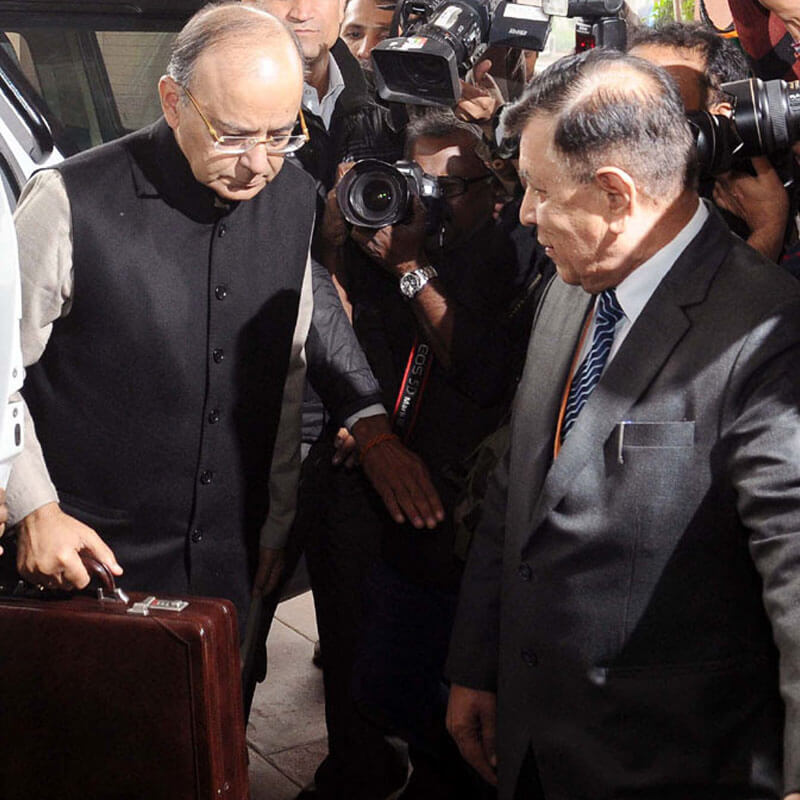
Tag: Finance Minister Arun Jaitley

  • Budget 2017: After DeMo, govt. announces sops for digital infra & economy

    Budget 2017: After DeMo, govt. announces sops for digital infra & economy

    NEW DELHI: Stating that the budget for 2017-18 was on the agenda to “Transform, Energise and Clean India” in a RAPID (Revenue, Accountability, Probity, Information and Digitisation) way, Finance Minister Arun Jaitley announced various concessions for pushing ahead digital economy, which indirectly may benefit some segments of the media and entertainment sector.

    Under the BharatNet Project, 1, 55,000 km optic fibre cable had been laid in the country. The allocation for BharatNet Project had been increased to Rs 10,000 crore in 2017-18. By the end of 2017-18, high speed broadband connectivity on optical fibre will be available in more than 1, 50,000 gram panchayats (village administrative offices), with wi-fi hot spots and access to digital services at low tariffs. A DigiGaon or digital village initiative will be launched to provide tele-medicine, education and skills through digital technology, Finance Minister Arun Jaitley said.

    The allocation for OFC-based network for defence services had also been increased from Rs 2710 crore in the last budget to Rs 3000 crore in 2017-18.

    Coupled with push towards digital payments for services, including in the broadcast and cable segments, investments in the internet infrastructure and telecom equipments will likely have cascading benefits for the media sector too, especially those offering video streaming services on phones and other hand-held devises.

    The finance minister said a shift to digital payments has huge benefits for the common man. The earlier initiative to promote financial inclusion and the JAM trinity were important precursors to government’s current push for digital transactions.

    In a budget, which for the first time since independence was presented on 1 February instead of the last day of the month, Jaitley said an eco-system was being created to make India a global hub for electronics manufacturing. Over 250 investment proposals for electronics manufacturing had been received in the last two years, totalling an investment of Rs 1.26 lakh crore. A number of global leaders and mobile manufacturers have set up production facilities in India. “I have therefore exponentially increased the allocation for incentive schemes like M-SIPS and EDF to Rs 745 crore in 2017-18. This is an all-time high,” he added.

    A major announcement by Jaitley was the abolition of the Foreign Investments Promotion Board (FIPB) and further liberalisation of FDI policy for which necessary announcements will be made in due course.

    Jaitley said: “Our government has already undertaken substantive reforms in FDI policy in the last two years. More than 90 per cent of the total FDI inflows are now through the automatic route. The FIPB has successfully implemented e-filing and online processing of FDI applications. We have now reached a stage where FIPB can be phased out”.

    He said the telecom sector was an important component of Indian infrastructure eco-system. He claimed the recent spectrum auctions have removed spectrum scarcity in the country and this will give a major fillip to mobile broadband and Digital India for the benefit of people living in rural and remote areas.

    In a boost to domestic industry, a special additional customs duty of 2 per cent is being levied on Populated Printed Circuit Boards (PCBs) for use in the manufacture of mobile phones, subject to actual user condition.

    Noting that India is on the cusp of a massive digital revolution, Jaitley said there was evidence of increased digital transactions. The BHIM (Bharat Interface for Money) app would unleash the power of mobile phones for digital payments and financial inclusion. A total 12.5 million people had adopted the BHIM app so far, Jaitley said, adding that the government will launch two new schemes to promote the usage of BHIM: referral bonus scheme for individuals and a cash back scheme for merchants.

    Aadhar Pay, a merchant version of Aadhar Enabled Payment System, was being launched shortly. This will be specifically beneficial for those who do not have debit cards, mobile wallets and mobile phones. A Mission will be set up with a target of 25,000 million crore digital transactions for 2017-18 through UPI, USSD, Aadhar Pay, IMPS and debit cards. Banks have targeted to introduce additional one million new PoS (point of sales) terminals by March 2017 and they will be encouraged to introduce two million Aadhar-based PoS by September 2017, the finance minister said.

    Jaitley said the Government will consider and work with various stakeholders for early implementation of the interim recommendations of the Committee of Chief Ministers on digital transactions. The Committee on Digital Payments, constituted by Department of Economic Affairs, had recommended structural reforms in the payment eco system, including amendments to the Payment and Settlement Systems Act 2007.

    In a boost for digitisation, the government has removed service tax on e-tickets booked through IRCTC (Indian Railways’ website).

    According to a PTI report, after a flat day time trading Sensex zoomed 485.68 pts to close at 28,141.64.

  • Budget 2017: After DeMo, govt. announces sops for digital infra & economy

    Budget 2017: After DeMo, govt. announces sops for digital infra & economy

    NEW DELHI: Stating that the budget for 2017-18 was on the agenda to “Transform, Energise and Clean India” in a RAPID (Revenue, Accountability, Probity, Information and Digitisation) way, Finance Minister Arun Jaitley announced various concessions for pushing ahead digital economy, which indirectly may benefit some segments of the media and entertainment sector.

    Under the BharatNet Project, 1, 55,000 km optic fibre cable had been laid in the country. The allocation for BharatNet Project had been increased to Rs 10,000 crore in 2017-18. By the end of 2017-18, high speed broadband connectivity on optical fibre will be available in more than 1, 50,000 gram panchayats (village administrative offices), with wi-fi hot spots and access to digital services at low tariffs. A DigiGaon or digital village initiative will be launched to provide tele-medicine, education and skills through digital technology, Finance Minister Arun Jaitley said.

    The allocation for OFC-based network for defence services had also been increased from Rs 2710 crore in the last budget to Rs 3000 crore in 2017-18.

    Coupled with push towards digital payments for services, including in the broadcast and cable segments, investments in the internet infrastructure and telecom equipments will likely have cascading benefits for the media sector too, especially those offering video streaming services on phones and other hand-held devises.

    The finance minister said a shift to digital payments has huge benefits for the common man. The earlier initiative to promote financial inclusion and the JAM trinity were important precursors to government’s current push for digital transactions.

    In a budget, which for the first time since independence was presented on 1 February instead of the last day of the month, Jaitley said an eco-system was being created to make India a global hub for electronics manufacturing. Over 250 investment proposals for electronics manufacturing had been received in the last two years, totalling an investment of Rs 1.26 lakh crore. A number of global leaders and mobile manufacturers have set up production facilities in India. “I have therefore exponentially increased the allocation for incentive schemes like M-SIPS and EDF to Rs 745 crore in 2017-18. This is an all-time high,” he added.

    A major announcement by Jaitley was the abolition of the Foreign Investments Promotion Board (FIPB) and further liberalisation of FDI policy for which necessary announcements will be made in due course.

    Jaitley said: “Our government has already undertaken substantive reforms in FDI policy in the last two years. More than 90 per cent of the total FDI inflows are now through the automatic route. The FIPB has successfully implemented e-filing and online processing of FDI applications. We have now reached a stage where FIPB can be phased out”.

    He said the telecom sector was an important component of Indian infrastructure eco-system. He claimed the recent spectrum auctions have removed spectrum scarcity in the country and this will give a major fillip to mobile broadband and Digital India for the benefit of people living in rural and remote areas.

    In a boost to domestic industry, a special additional customs duty of 2 per cent is being levied on Populated Printed Circuit Boards (PCBs) for use in the manufacture of mobile phones, subject to actual user condition.

    Noting that India is on the cusp of a massive digital revolution, Jaitley said there was evidence of increased digital transactions. The BHIM (Bharat Interface for Money) app would unleash the power of mobile phones for digital payments and financial inclusion. A total 12.5 million people had adopted the BHIM app so far, Jaitley said, adding that the government will launch two new schemes to promote the usage of BHIM: referral bonus scheme for individuals and a cash back scheme for merchants.

    Aadhar Pay, a merchant version of Aadhar Enabled Payment System, was being launched shortly. This will be specifically beneficial for those who do not have debit cards, mobile wallets and mobile phones. A Mission will be set up with a target of 25,000 million crore digital transactions for 2017-18 through UPI, USSD, Aadhar Pay, IMPS and debit cards. Banks have targeted to introduce additional one million new PoS (point of sales) terminals by March 2017 and they will be encouraged to introduce two million Aadhar-based PoS by September 2017, the finance minister said.

    Jaitley said the Government will consider and work with various stakeholders for early implementation of the interim recommendations of the Committee of Chief Ministers on digital transactions. The Committee on Digital Payments, constituted by Department of Economic Affairs, had recommended structural reforms in the payment eco system, including amendments to the Payment and Settlement Systems Act 2007.

    In a boost for digitisation, the government has removed service tax on e-tickets booked through IRCTC (Indian Railways’ website).

    According to a PTI report, after a flat day time trading Sensex zoomed 485.68 pts to close at 28,141.64.

  • Budget 2017 Wish-list: MSOs demand industry status, rationalisation of entertainment & services taxes

    Budget 2017 Wish-list: MSOs demand industry status, rationalisation of entertainment & services taxes

    NEW DELHI: Annually various sectors of the Indian industry draw wish-list and hope that the government will grant them some relief during the presentation of the annual Budget of the country. MSOs are no exception and the All India Digital Cable Federation (AIDCF) has not only demanded an industry status, which will give it related financial incentives, but also rationalisation of various other taxes, including service and entertainment taxes.

    “Grant us infrastructure status for the (distribution) industry and remove the 8 per cent AGR applicable for MSOs offering broadband via cable,” said AIDCF Secretary-general Saharsh Damani when asked by indiantelevision.com about what the organisation would like Finance Minister Arun Jaitley to announce during his Budget presentation on February 1, 2017.

    AIDCF has also exhorted the government to grant them parity with manufacturing sector vis-a-vis u/s 2A as a disparity between the service and the manufacturing sectors is “adversely affecting” the growth and consolidation of service sector of which the MSOs are part of.

    “The tax benefits under Section 72A of the Income-tax Act, 1961 in respect of amalgamation or demerger (carry forward and set off of accumulated loss and unabsorbed depreciation allowances) are currently limited to industrial undertakings or a ship, hotel, aircraft or banking. The definition of industrial undertaking should be widened to include service industry, broadcasters and content production companies,” Damani said.

    The AIDCF, which is said to be a new and digital avatar of MSO Alliance, would also like removal of dual applicability of service and entertainment taxes on the cable TV.

    According to the apex body of MSOs, till the time GST (Goods and Services Tax) comes in place, entertainment tax paid to a state government may also be made creditable against the service tax liability of the cable TV sector. What does it mean? When a cable TV network, for example, pays an entertainment tax of Rs 100, then it should be able to adjust the same against the service tax payable and get a credit there on, AIDCF said.

    “This will be a short term measure, but will give higher declaration of entertainment tax and will bring in sufficient numbers to ensure that (overall revenue) collection of the government on service tax does not drop,” AIDCF’s Damani explained.

    Originally GST was supposed to have rolled out from April 1, 2017, but because of political wrangling and some states raising doubts on their share of the tax collected under a GST regime, Finance Minister Jaitley, according to media reports, has opined the new tax regime could be rolled out some time middle of 2017.

    Apart from that, AIDCF has also urged the government to rationalise indirect taxes like import duties on network equipment. Further, the organisation has suggested allowing use of USO (Universal Service Obligation) Funds for broadband infrastructure expansion would greatly benefit the industry.

    Also Read:

    Broadcasters bat for parity with print medium under GST

    India, US should resolve IPR issues at earliest: IACC

  • Budget 2017 Wish-list: MSOs demand industry status, rationalisation of entertainment & services taxes

    Budget 2017 Wish-list: MSOs demand industry status, rationalisation of entertainment & services taxes

    NEW DELHI: Annually various sectors of the Indian industry draw wish-list and hope that the government will grant them some relief during the presentation of the annual Budget of the country. MSOs are no exception and the All India Digital Cable Federation (AIDCF) has not only demanded an industry status, which will give it related financial incentives, but also rationalisation of various other taxes, including service and entertainment taxes.

    “Grant us infrastructure status for the (distribution) industry and remove the 8 per cent AGR applicable for MSOs offering broadband via cable,” said AIDCF Secretary-general Saharsh Damani when asked by indiantelevision.com about what the organisation would like Finance Minister Arun Jaitley to announce during his Budget presentation on February 1, 2017.

    AIDCF has also exhorted the government to grant them parity with manufacturing sector vis-a-vis u/s 2A as a disparity between the service and the manufacturing sectors is “adversely affecting” the growth and consolidation of service sector of which the MSOs are part of.

    “The tax benefits under Section 72A of the Income-tax Act, 1961 in respect of amalgamation or demerger (carry forward and set off of accumulated loss and unabsorbed depreciation allowances) are currently limited to industrial undertakings or a ship, hotel, aircraft or banking. The definition of industrial undertaking should be widened to include service industry, broadcasters and content production companies,” Damani said.

    The AIDCF, which is said to be a new and digital avatar of MSO Alliance, would also like removal of dual applicability of service and entertainment taxes on the cable TV.

    According to the apex body of MSOs, till the time GST (Goods and Services Tax) comes in place, entertainment tax paid to a state government may also be made creditable against the service tax liability of the cable TV sector. What does it mean? When a cable TV network, for example, pays an entertainment tax of Rs 100, then it should be able to adjust the same against the service tax payable and get a credit there on, AIDCF said.

    “This will be a short term measure, but will give higher declaration of entertainment tax and will bring in sufficient numbers to ensure that (overall revenue) collection of the government on service tax does not drop,” AIDCF’s Damani explained.

    Originally GST was supposed to have rolled out from April 1, 2017, but because of political wrangling and some states raising doubts on their share of the tax collected under a GST regime, Finance Minister Jaitley, according to media reports, has opined the new tax regime could be rolled out some time middle of 2017.

    Apart from that, AIDCF has also urged the government to rationalise indirect taxes like import duties on network equipment. Further, the organisation has suggested allowing use of USO (Universal Service Obligation) Funds for broadband infrastructure expansion would greatly benefit the industry.

    Also Read:

    Broadcasters bat for parity with print medium under GST

    India, US should resolve IPR issues at earliest: IACC