Tag: Finance Minister

  • Chinese smartphone brands Oppo, Vivo India & Xiaomi under tax sleuths’ lens

    Chinese smartphone brands Oppo, Vivo India & Xiaomi under tax sleuths’ lens

    Mumbai: Chinese smartphone makers have once again come under the scanner of Indian agencies for cases of alleged tax evasion. Notices have been issued to Oppo, Vivo India and Xiaomi, finance minister Nirmala Sitharaman informed Rajya Sabha recently. The three Chinese mobile phone companies, between them, hold a major share of the Indian smartphone market.

    The Finance Minister said that the department of revenue intelligence (DRI) has issued a notice to Oppo for a total customs duty of Rs 4,389 crore. This is on the grounds that misdeclaration of certain goods leads to a short payment in customs duty.

    The duty evasion is about Rs 2,981 crore, Sitharaman said replying to a question in the Upper House.

    “Undervaluation of imported goods for the purpose of payment of customs duty, that we think is an evasion of Rs 1,408 crore,” she said.

    She stated that they came voluntarily to deposit Rs 450 crore, much less than the demand of Rs 4,389 crore.

    Regarding the other companies, she said Xiaomi, which deals with assembling MI mobile phones, has been issued three show-cause notices.

    “The approximate duty liability there is about Rs 653 crore. For the three show cause notices that have been issued, they have deposited only Rs 46 lakh,” the minister said.

    She informed Rajya Sabha that a demand notice has been issued for Rs 2,217 crore for which they have deposited Rs 60 crore as a voluntary deposit.

    “Besides these, the ED is looking at 18 companies that were established by the same group as Vivo, and there they have voluntarily remitted Rs 62 crore as deposits, but the parent company outside of India has total sales of 1.25 lakh crore.

    “Of the Rs 1.25 lakh crore total sales, Vivo has transferred through these 18 companies huge amounts of funds, and it is believed that Vivo India has, in turn, remitted 0.62 lakh crore to its parent company, which is outside India,” Sitharaman said.

    In her written reply, the finance minister said a show cause notice demanding Rs 4,403.88 crore has been served on Oppo Mobiles India based on the investigation conducted by the directorate of revenue intelligence (DRI).

    Five cases of customs duty evasion have been booked against Xiaomi Technology India, she said.

    “During the period 2019 to 2022, in respect of the central board of indirect taxes & customs (CBIC), cases against 43 other such companies have been booked.”

    “‘As regards to the central board of direct taxes (CBDT), investigation directorates have undertaken search and seizure actions in cases of five groups pertaining to the telecom sector, in which tax evasion has been detected,” Sitharaman added.

    Meanwhile, the market share of these three brands, which make up the top five smartphone brands in India, has been steadily growing, despite the scrutiny. Xiaomi remained the market leader in 2022 with a share of 24 per cent, followed by Vivo with 18 per cent share and Oppo with a ten per cent share, according to a report by Cyber Media Research (CMR). The three brands, along with Realme and Korean smartphone major Samsung, account for nearly three quarters of India’s smartphone market.

  • RBI recommends banning cryptocurrencies, industry shows concern

    RBI recommends banning cryptocurrencies, industry shows concern

    Mumbai: The crypto ecosystem in the country has once again come under the scanner after finance minister Nirmala Sitharaman stated in Parliament recently that the Reserve Bank of India (RBI) has expressed concerns over cryptocurrencies and sought a ban on them from the government.

    “In view of the concerns expressed by RBI on the destabilising effect of cryptocurrencies on the monetary and fiscal stability of a country, RBI has recommended the framing of legislation on this sector. RBI is of the view that cryptocurrencies should be prohibited,” said the FM in reply to a question raised in Lok Sabha on the stance of the government and the RBI on Cryptocurrency.

    This is even as India recorded the second-highest number of cryptocurrency users in the world last year, and the crypto market in the country grew by over 600 per cent, as per a report released by industry research firm Chainanalysis in 2021. The cryptocurrency sector in the country can no longer be termed niche, as it catches the fancy of an increasing number of traditional-minded investors looking to diversify their investments.

    However, on whether the government has any immediate plans to legislate a law restricting the use of cryptocurrency in India, the FM clarified that while cryptocurrency by definition is borderless, it requires international collaboration to prevent regulatory arbitrage. “Therefore, any legislation for regulation or for banning can be effective only after significant international collaboration on evaluation of the risks and benefits & the evolution of common taxonomy and standards,” she said.

    Despite this clarification on the long-standing matter of regulation of the digital asset class, and notwithstanding the boom in adoption of the virtual currency just last year, uncertainty continues to plague the crypto industry in the country. The crypto market has been on a downward trend since the start of the year due to various macroeconomic factors, according to industry insiders.

    Even so, most of the industry stakeholders Indiantelevision.com spoke to were sceptical about the ban on crypto becoming a reality.

    According to Optiminastic Media founder Akshae Golekar, with several first world countries, such as the UK, Australia, Denmark, France, Germany, and Spain, to name a few, accepting and working towards adopting the technology and adapting to the new trend, it will be outright foolish to ban crypto altogether.

    Secondly, he points out, the core of crypto is blockchain, and blockchain is a public global ledger. “If a particular country bans it, it would have no effect on the functionality or the application of the technology. Instead, it will be the country that is left behind. “

    So while it would be sad for the entire crypto ecosystem, it wouldn’t come to a point where the crypto ecosystem is so affected that it breaks down or the technology is aborted, Golekar asserts. “Brands can still emerge successful by focusing their marketing and operations in other countries of the world. Thriving and sustaining in India, though, would be a grave issue. Crypto ban would simply mean there’s nothing left for such brands in India,” he added.

    Already, some crypto startup founders are moving out of the country in a bid to shift base to more crypto-friendly destinations. The co-founders of India’s largest cryptocurrency exchange, WazirX, Nischal Shetty and Siddharth Menon, recently moved to Dubai with their families for clearer policies around digital assets.

    This comes on the back of the hefty tax imposed on crypto, amid a progressive clampdown on the virtual currency, including action by enforcement agencies against some platforms, and the basic lack of clarity on policy in the long run.

    They can’t work in an uncertain environment, and this literally affects the country, its economy, and the present and coming generations. “It is a concerning thing when it comes to the growth and development of the nation with respect to technology,” said Golekar.

    “The RBI is voicing concerns about the ‘adverse effects’ of digital assets on the Indian economy, alternating between ‘legislation’ and ‘prohibition’ and the government adopting a wait-and-watch strategy, India is on the brink of losing the opportunity to become a world leader in the cryptosphere,” feels crypto banking platform CEO and director Abhijit Shukla.

    “The central bank digital currencies are known to palpably denounce private cryptocurrencies. While the government is finalising a concrete stance on this, there seems to be a lack of understanding between money and currency,” he says. “While the RBI could be over-critical of the crypto assets considering their volatile nature and the risks involved for its investors, it is always better to gauge both sides of the same coin, looking at the positive effects of utilising this technology,” says Shukla, adding that a blockchain-based payment system with sovereign backing can’t be a replacement for cryptocurrencies on the whole.

    Digital assets technology company, Atato’s co-founder and head of partnerships, Maxime Paul, echoes the sentiment when he says that centralised banks may feel a greater need to regulate products which they find it hard to control considering the decentralised nature of crypto. “As a regulated and licenced wallet provider, we do see increased sandboxes for crypto by regional regulatory authorities that welcome cryptocurrency,” he continues. While being supportive of legislative frameworks on crypto, Paul believes an outright ban would not be easy to enforce considering India is one of the largest demographics for cryptocurrency.

    Armoks Media founder Arun Prabhudesai agrees with the majority opinion that banning cryptocurrency is not the solution. “Around two crore Indians have cryptocurrencies right now, whose value is estimated to be Rs 45,000 crore. It’s a trillion-dollar market globally, and we cannot just shut it down. Since crypto is essentially decentralised money, there is no point in banning it, he adds.

    India will close the doors for FDI as well as next-gen technological innovations if we ban cryptocurrency, says Prabhudesai. “We will be clubbed with China, and essentially tell the world that hey, we cannot handle the future.” He adds that the government should consider cryptocurrencies as investment instruments and should impose transparent taxes on them (which right now is a bit ambiguous).

    Industry experts agree that there has to be a balanced approach. Regulation of crypto is the solution for the long run, most believe.

    “We believe that a collaborative approach towards crypto investment aligned with India’s positioning to be an upcoming superpower would be the right approach considering the global acceptance and adoption of crypto,” says BuyUcoin CEO Shivam Thakral.

    The challenges he foresees for the crypto industry in the country mainly come in the form of “mainstream acceptance,” as crypto needs support from a regulatory perspective to be culturally accepted by the masses, says Thakral.

    Notwithstanding the RBI’s concerns about cryptocurrencies affecting monetary stability, global crypto investment platform Mudrex CEO and co-founder Edul Patel believes cryptos can create a more transparent environment for transactions using blockchain.

    “India has over 20 million stakeholders holding crypto assets worth $5.3 billion. If the government decides to ban cryptos, the act would directly impact them,” says Patel. “And this would also hinder the growth and innovation in the sector to a great extent in this digital era, taking the country’s performance down.”

    Bhavan’s SPJIMR associate professor of finance, Dr. Hemant Manuj, sums up the discussion when he says that cryptos have several positive features, but the counterparties have no resort if there is any kind of breach in the transaction.

    Based on their optimal design, he says, they can serve as fast and efficient modes of payment and also ensure privacy. However, regulators should be questioning whether public trading should be allowed in a security with no tangible underlying asset. And if so, what safeguards are required?

    Ironically, the large-scale acceptance of cryptos can happen only at the cost of the existing currency systems. That would have monetary, economic, and nationalistic implications. So, the anti-crypto stance of the regulators like RBI can be understood as partly logical and partly protective of the existing systems, notes Manuj.

    Crypto brands were also some of the biggest spenders in advertising and marketing in the last couple of years. Crypto exchanges took out full-page ads in newspapers and signed up top Bollywood stars to promote their offerings during popular marketing properties.

    However, there has been a drastic dip in the promotional activities of late-this year’s IPL being a case in point where the brands were glaring by their absence. It’s a remarkable turnaround from last year, when the crypto platforms were some of the country’s hottest brands.

    It is likely that, given India’s huge demographic, sponsors shying away from the IPL would like to not be in the spotlight while regulations are not defined, says Atato’s Maxime Paul. Uncertainty will divert marketing resources to crypto-friendly markets. He adds that this is also something to consider for regulatory authorities as part of the ecosystem of crypto.

    Industry stakeholders also believe the reason behind the brands’ going “missing in action” could also be the recession. The roots of these crypto brands are finance and the economy. These players knew that the macroeconomic indicators were not looking good and hence paused investing in marketing, says Optiminastic Media Golekar. At times like these, marketing spending needs to take a back seat and brands focus on sustainability and developing and improving the product and service.

    Whenever markets go through a bear phase, as is the case currently, belts need to be tightened, agrees the Coinswitch Kuber spokesperson, adding that the crypto sector is no different. “Volumes in the Indian crypto market have been following global trends. We believe that the bear market is temporary and that crypto is here to stay,” said the spokesperson for the cryptocurrency exchange platform.

    There were also a lot of concerns raised about the advertisement blitzkrieg by crypto brands last year, with several of them being flagged for misleading claims. Other industry experts opined that it is likely that brands are working with recent advertising guidelines and standards to create new, acceptable creative means of promotion.

    Amid a bull market last year, cryptos were the clickbait of social media platforms with ever-engaging ads and well-tractioned branded promotions, says Tarality’s Abhijit Shukla. This year established an alternative crypto-perspective, he says. “The ads promoting cryptos were toeing a fine line between ‘puffery’ and ‘misinterpretation’—luring Indians into investing in notorious asset classes for fluctuating price swings without comprehending the real risks involved.”

    With the prime focus on driving awareness with crypto exchanges, ads with extensive disclosures and disclaimers for a layperson’s investing decisions are the need of the hour, marketers believe.

  • Budget ’22: India to roll out 5G services in FY23, says FM Nirmala Sitharaman

    Budget ’22: India to roll out 5G services in FY23, says FM Nirmala Sitharaman

    Mumbai: Finance minister Nirmala Sitharaman on Tuesday announced that the 5G telecom services will be introduced within the financial year 2022-2023. The minister in her union budget 2022 speech said that the auctions will be held in the next fiscal year (FY2022-23), after which private companies are expected to roll out the service.

    The contracts for laying optical fibres will be done through public-private partnerships, Sitharaman further said.

    The minister added that five per cent of the annual collections Universal Service Obligation Fund will be allocated to enable affordable broadband and mobile penetration in rural and remote areas.

    Sitharaman also announced the inclusion of design-led initiatives for 5G and other technologies in the production-linked incentive (PLI) scheme.

  • Budget2022: Govt to set up task force to promote animation, video gaming industry

    Budget2022: Govt to set up task force to promote animation, video gaming industry

    Mumbai: The government has proposed to set up a specialised task force for the promotion of the animation, visual effects, gaming and comics (AVGC) industry. The announcement was made by finance minister Nirmala Sitharaman while presenting the annual budget 2022 on Tuesday.

    “Animation, Visual Effects, Gaming and Comics (AVGC) sector offers immense potential to employ youth. An AVGC promotion task force with all stakeholders will be set up to recommend ways to realise this and build domestic capacity for serving our markets and the global demand,” said Sitharaman.

    The announcement was welcomed by the industry, with Federation of Indian Chambers of Commerce and Industry (FICCI) hailing it as a big win for the sector.

    FICCI chairman – AVGC XR Forum and Punnaryug Artvision founder Ashish SK said that the budget announcement of the formation of task force for AVGC Promotion has come at the most appropriate time. “After setting a strong foundation in the last two decades the Indian AVGC – XR is poised to grow phenomenally in coming decade. The creative skills from India needs nurturing to a great extend to enable the growth of the sector. Setting up of a task force will definitely bring in a great focus on positioning Indian AVGC sector for services exports, co-productions, growth of Indigenous intellectual property and its consumption patterns within India and overseas,” he said.

    According to industry representatives, the Indian AVGC – XR sector is expected to have a major share of the media and entertainment industry. The horizon and use cases of AVGC – XR verticals have expanded beyond its day-to-day defined utility in architecture, life science, legal, education, industrial, urban planning, sports, digital universe, metaverse etc apart from media & entertainment.

    “The AVGC task force is a huge step by the government to promote the sector. We wholeheartedly welcome it and FICCI AVGC-XR Forum will continue to work closely with the government on various policy initiatives to realise the growth potential of the Industry. This industry vertical has tremendous scope for employment generation and exports,” said FICCI co-chairman – AVGC- XR Forum, and Graphiti Studio founder Munjal Shroff.

    In its latest report released last month, the Confederation of Indian Industry (CII) and Boston Consulting Group (BCG) had also projected that India’s media and entertainment industry which is currently valued at around $27 billion is all set to grow at 10-12 per cent CAGR to become a $55-70 billion industry by 2030. The report had also highlighted that the industry’s next phase of growth will be led by OTT, gaming, VFX and animation.

    The finance minister said the union budget seeks to lay a foundation and give blueprint of the economy over the next 25 years – from India at 75 to India at 100.

  • CNBC-TV18 announces fifteenth edition of India Business Leader Awards

    CNBC-TV18 announces fifteenth edition of India Business Leader Awards

    MUMBAI: Network18’s English business news channel CNBC-TV18 is all set to launch the fifteenth edition of India Business Leader Awards (IBLA) under the theme of the event ‘Leaders of Change’.

    The objective of IBLA is to celebrate the remarkable achievements of the country’s most dynamic business leaders and their businesses, which will be hosted on 28 February at Trident in Nariman Point, Mumbai.

    The event shall include eminent industry-leaders, policymakers, and change-makers who have contributed towards building a conducive and profitable economy, which will have a captivating confluence of stalwarts and engaging conversations.

    The chief guests for the event include dignitaries such as finance minister Nirmala Sitharaman along with Reserve Bank of India governor Shaktikanta Das.

    Other esteemed guests to grace the occasion include Reliance Industries chairman and managing director Mukesh Ambani, HDFC chairman Deepak Parekh, TCS chief executive officer and managing director Rajesh Gopinathan, HUL chief executive officer Sanjiv Mehta, National Stock Exchange managing director and chief executive officer Vikram Limaye, Nykaa, founder and chief executive officer Falguni Nayar, Dharma Productions filmmaker Karan Johar & Indian badminton player Pullela Gopichand amongst others will show their support to the most business awards of the network.

    Winners of the prestigious awards were adjudged by an esteemed jury steered by HDFC Bank managing director Aditya Puri. The power Jury comprised minister of state, finance & corporate affairs, Anurag Thakur, and industry veterans Britannia managing director Varun Berry, State Bank of India chairman, Rajnish Kumar, AZB & Partner founder and managing partner Zia Mody, ITC chairman and managing director Sanjiv Puri, and Standard Chartered Bank chief executive officer Zarin Daruwala.

    CNBC-TV18 managing editor Shereen Bhan says: “For two decades, CNBC-TV18 has proved to be a leader in its incisive and comprehensive reportage of the economy & business. Since its inception, 15 years ago, the CNBC-TV18 India Business Leaders Awards have recognised excellence, and honoured individuals and corporations for creating value and impact.”

    She adds, “This year, as we mark 20 years of CNBC-TV18 & 15 years of IBLA, we will recognise outstanding leaders of the year and also honour leaders of the decade in our IBLA Decadal awards. The finance minister, Nirmala Sitharaman and the RBI Governor will preside over a very special evening.”

  • News viewership grew by 60% during budget speech

    News viewership grew by 60% during budget speech

    MUMBAI: The biggest financial event of the country—Budget 2020 — has helped news channels, especially business news channels across segment to increase their viewership substantially, a data from Broadcast Audience Research Council (BARC) says.

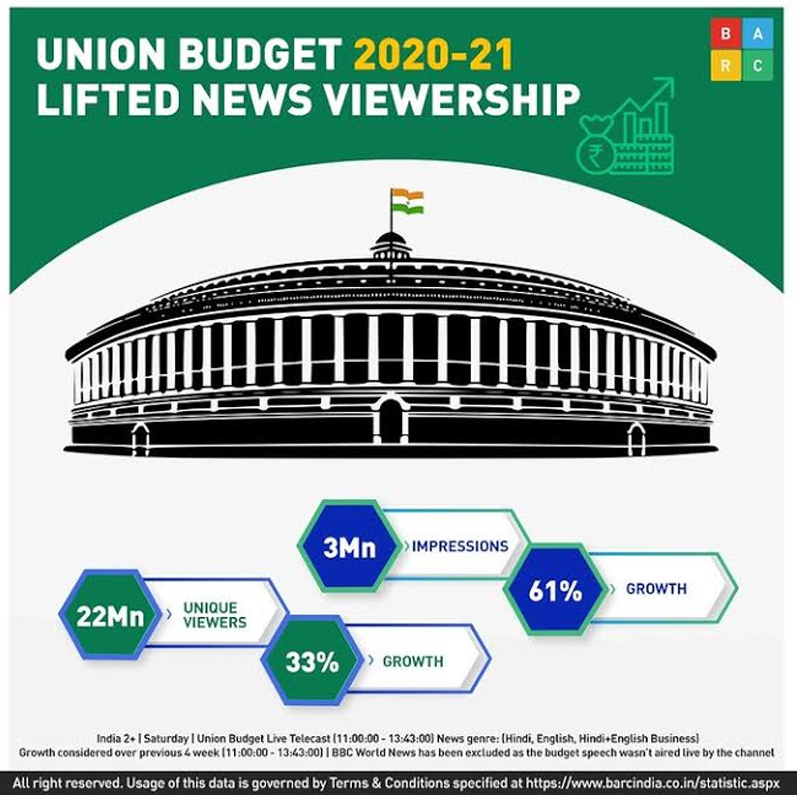
    Union finance minister Nirmala Sitharaman gave the longest budget speech from 11 am to 1.43 pm on 1 February. The Hindi, English and Hindi+English business news channels recorded a rise of over 60 per cent to 3 million impressions during these 2 hours and 43 minutes.

    Moreover, at least 22 million eyeballs of unique viewers were glued to the screen of business news channels across genre, which posted growth of over 30 per cent.

    BARC on its official twitter handle mentioned: “During #Budget2020, Indian news viewership saw an impressive growth with regards to impressions and unique viewers!”

    The budget viewership was recorded during week 5 of BARC that was compared to the same time slot of week 4 of the weekly impressions. BARC in its Twitter post said: “The growth in impressions were considered over the previous week 4 during the same time period from 11 am to 1.43 pm.”

    The audience measurement body also said in its micro-blogging post that BBC World News has been excluded as the budget speech wasn’t aired live by the channel.

    Despite Budget 2020, the viewership of general news channels across genre were slowed down in week 5 (1-7 February) as compared to week 4 (25-31january), the BARC mentioned on its website.

    However, the budget being the most important event for the business news channels, both CNBC TV18 of Network18 group and ET Now of Times News Network, in the English category, grew by over 100 per cent to 727 and 266 weekly impressions in week 5 respectively.

    The Reliance group-owned business news channel, CNBC TV18 being the leader in the business news channel in week 4 had garnered 275 weekly impressions. On the contrary, ET Now had received 123 weekly impressions in week 4.

    In the Hindi business news category, both Network18’s CNBC Awaaz, and Zee Entertainment Enterprise’s Zee Business grew by 21 per cent and 41 per cent respectively during Budget week. The former garnered 2492 weekly impressions, whereas the latter settled at 2131 impressions in week 5 as compared to 1965 and 1249 impressions in week 4 respectively.

    Week 5 was considered to be weak compared to week 4, as it had no major important event for news channels to keep viewers engaged except for the Budget 2020 and Delhi poll campaigns that concluded on February 6. Whereas, week 4 had seen many national importance events such as Republic Day, Delhi Assembly poll campaigns, and the Shaheen Bagh firing. 

  • Budget allocations for Digital India, northeast go up for Communication and Information Technology Ministry

    Budget allocations for Digital India, northeast go up for Communication and Information Technology Ministry

    New Delhi: The allocation for capital outlay on telecommunication and electronic industries is Rs 125 crore for the Departments of Telecommunications Communications and Information Technology (DeiTY), according to the Union Budget presented by Finance Minister Arun Jaitley on February 29.

    While the capital outlay on telecommunication and electronic Industries has been sharply increased for the telecommunications department from Rs 16 crore in the revised budget of 2015-16 to Rs 80 crore for 2016-17, it had been cut from Rs 69 crore in the revised estimates of the DeiTY for 2015-16 to Rs 45 crore for 2016-17.

    Interestingly, this works against the interests of the broadcasting industry, since set top boxes, antennae, headends and other equipment would fall under the DeiTY’ help to public or private industry under the head of  ‘capital outlay on telecommunication and electronic Industries.’

    The total budgetary outlay for the Telecommunication Department is Rs 21214.66 crore, while it is Rs 3328.82 crore for DeiTY for 2016-17

    Under Digital India programme, there are separate allocations for the Manpower Development Programme to ensure availability of trained human resources; Electronics Governance to deliver all Government services electronically to the citizens in his/her locality through integrated and inter-operable systems via multiple modes, while ensuring efficiency, transparency and reliability of such services at affordable costs; the National Knowledge Network with multiple gigabit bandwidth to connect Knowledge Institutions across the country; Promotion of Electronics/IT Hardware Manufacturing;  R&D in IT/Electronics/CCBT; and Foreign Trade and Export Promotion to reimburse Central Sales Tax to Electronics Hardware Technology Parks (EHTP) and Software Technology Park (STP) units.

  • Budget allocations for Digital India, northeast go up for Communication and Information Technology Ministry

    Budget allocations for Digital India, northeast go up for Communication and Information Technology Ministry

    New Delhi: The allocation for capital outlay on telecommunication and electronic industries is Rs 125 crore for the Departments of Telecommunications Communications and Information Technology (DeiTY), according to the Union Budget presented by Finance Minister Arun Jaitley on February 29.

    While the capital outlay on telecommunication and electronic Industries has been sharply increased for the telecommunications department from Rs 16 crore in the revised budget of 2015-16 to Rs 80 crore for 2016-17, it had been cut from Rs 69 crore in the revised estimates of the DeiTY for 2015-16 to Rs 45 crore for 2016-17.

    Interestingly, this works against the interests of the broadcasting industry, since set top boxes, antennae, headends and other equipment would fall under the DeiTY’ help to public or private industry under the head of  ‘capital outlay on telecommunication and electronic Industries.’

    The total budgetary outlay for the Telecommunication Department is Rs 21214.66 crore, while it is Rs 3328.82 crore for DeiTY for 2016-17

    Under Digital India programme, there are separate allocations for the Manpower Development Programme to ensure availability of trained human resources; Electronics Governance to deliver all Government services electronically to the citizens in his/her locality through integrated and inter-operable systems via multiple modes, while ensuring efficiency, transparency and reliability of such services at affordable costs; the National Knowledge Network with multiple gigabit bandwidth to connect Knowledge Institutions across the country; Promotion of Electronics/IT Hardware Manufacturing;  R&D in IT/Electronics/CCBT; and Foreign Trade and Export Promotion to reimburse Central Sales Tax to Electronics Hardware Technology Parks (EHTP) and Software Technology Park (STP) units.

  • Prasar Bharati’s grants-in-aid gets substantial increase, first-time separate allocation for strengthening broadcast services

    Prasar Bharati’s grants-in-aid gets substantial increase, first-time separate allocation for strengthening broadcast services

    NEW DELHI: The grants-in-aid for Prasar Bharati have gone up again for the third time over the last few years from the revised estimates of Rs 2708.29 crore in 2015-16 to Rs 3056.86 for 2016-17.

    In addition, there is a grant-in-aid of Rs 52 crore to Doordarshan’s Kisan Channel, which is double that of aid last year.

    In addition, there is an investment of Rs 200 crore in the pubcaster, which is the same as last year. Though the previous government had stopped investments in the pubcaster, Finance Minister Arun Jaitley had re-introduced this in 2015-16 after a gap of two years. 

    An explanatory note says the grants-in-aid is being provided to cover the gap in resources of Prasar Bharati in meeting its revenue expenditure.

    The grant in aid for Prasar Bharati in 2015-16 was Rs 2824.55 crore for 2015-16, apart from the grant-in-aid of Rs 26.26 crore in the revised estimates (as against the budgetary allocation of Rs 45 crore) on Kisan Channel.

    Expenditure on salaries of Prasar Bharati has fallen on the shoulders of the Government since all Prasar Bharati employees who were in employment as on 5 October, 2007 have been given deemed deputation status.

    The total budget of the Information and Broadcasting Ministry has been raised to Rs 4083.63 crore, which is a small raise in comparison to Rs 3711.11 crore for 2015-16, though the revised estimates for the year show an expenditure of Rs 3588.58 crore. 

    A major effort this year was to reduce the number of heads under which allocations have been made over the years. For example, there are no separate allocation for film certification or Press Information Services as in previous years.

    Interestingly, there is a separate allocation of Rs 30.83 crore for strengthening of broadcasting services, which includes Rs 28.83 on information and publicity and the balance on building and machinery. This provides for Electronic Media Monitoring Centre, contribution to the Asian Institute of Broadcasting Development, Community Radio movement in India, Digitalisation, Building and Machinery and private FM Radio Stations.

    The allocation under ‘Secretariat – Social services’ has been cut down to Rs 70.32 crore as against the budgetary allocation of Rs 235.23 crore in 2015-16 as the revised estimates show an expenditure of just Rs 91.44 crore. The explanatory note says that from 2016-17, this covers the expenditure under Non-Plan activities only which includes provision for Main Secretariat and Principal Accounts office.

    The allocation for the film sector has been raised to Rs 268.53 crore and covers art and culture, information and publicity, which takes the maximum share of Rs 213.64 crore. Subjects under this head include the National Film Heritage Mission, anti-piracy measures, promotion of Indian cinema overseas, production of films and documentaries, and setting up a centre of excellence for animation, gaming and visual effects. The explanatory note adds that Secretariat – Social services also covers expenses on development of community radio, and development support to the north-east as well as Jammu and Kashmir and ‘other identified areas.’

    Thus, there is an allocation of Rs 33.31 crore for Mass Communications, which covers (a) Indian Institute of Mass Communication, an autonomous body, which imparts training in mass media and conducts courses in journalism, and (b) New Media Wing, which collects basic information on subjects of media interest for providing assistance to the Ministry and to its Media Units, Indian Missions abroad and newspapers and media agencies.

    There is another provision of Rs 491.78 crore, which includes expenditure (a) Directorate of Advertising and Visual Publicity – for planning and executing publicity campaigns through advertising and other printed materials, as well as through Radio and Televisions, exhibitions and other outdoor publicity media; (b) Press Information Bureau – which serves as a link between the Government and the Press and attends to the publicity and public relations requirements of various Ministries/Departments, including grants to Press Council of India, a statutory organisations seeking to preserve press; (c) Field Publicity – covering expenditure of Directorate of Field Publicity and its district level field units engaged in inter-personal developmental communications through films shows, live media programmes, photo displays and seminars; (d) Song and Drama Division – for creating awareness amongst the masses, particularly in rural areas, about various activities of national developments of units spread all over the country; (e) Publications – for publishing priced books, journals and other printed material in English, Hindi and regional languages on a wide variety of subjects and ‘Employment News/Rozgar Samachar;’ (f) Information Wing Plan Schemes – for training, international media programme, Policy related studies etc.; and (g) Photo Division.

    For the seventh year in a row, the government has not announced any investment in the National Film Development Corporation (NFDC).

    There is a marginal increase in the lump sum provision for projects/schemes for development of North-eastern areas including Sikkim to Rs 80 crore against Rs 75 crore last year.

  • Prasar Bharati’s grants-in-aid gets substantial increase, first-time separate allocation for strengthening broadcast services

    Prasar Bharati’s grants-in-aid gets substantial increase, first-time separate allocation for strengthening broadcast services

    NEW DELHI: The grants-in-aid for Prasar Bharati have gone up again for the third time over the last few years from the revised estimates of Rs 2708.29 crore in 2015-16 to Rs 3056.86 for 2016-17.

    In addition, there is a grant-in-aid of Rs 52 crore to Doordarshan’s Kisan Channel, which is double that of aid last year.

    In addition, there is an investment of Rs 200 crore in the pubcaster, which is the same as last year. Though the previous government had stopped investments in the pubcaster, Finance Minister Arun Jaitley had re-introduced this in 2015-16 after a gap of two years. 

    An explanatory note says the grants-in-aid is being provided to cover the gap in resources of Prasar Bharati in meeting its revenue expenditure.

    The grant in aid for Prasar Bharati in 2015-16 was Rs 2824.55 crore for 2015-16, apart from the grant-in-aid of Rs 26.26 crore in the revised estimates (as against the budgetary allocation of Rs 45 crore) on Kisan Channel.

    Expenditure on salaries of Prasar Bharati has fallen on the shoulders of the Government since all Prasar Bharati employees who were in employment as on 5 October, 2007 have been given deemed deputation status.

    The total budget of the Information and Broadcasting Ministry has been raised to Rs 4083.63 crore, which is a small raise in comparison to Rs 3711.11 crore for 2015-16, though the revised estimates for the year show an expenditure of Rs 3588.58 crore. 

    A major effort this year was to reduce the number of heads under which allocations have been made over the years. For example, there are no separate allocation for film certification or Press Information Services as in previous years.

    Interestingly, there is a separate allocation of Rs 30.83 crore for strengthening of broadcasting services, which includes Rs 28.83 on information and publicity and the balance on building and machinery. This provides for Electronic Media Monitoring Centre, contribution to the Asian Institute of Broadcasting Development, Community Radio movement in India, Digitalisation, Building and Machinery and private FM Radio Stations.

    The allocation under ‘Secretariat – Social services’ has been cut down to Rs 70.32 crore as against the budgetary allocation of Rs 235.23 crore in 2015-16 as the revised estimates show an expenditure of just Rs 91.44 crore. The explanatory note says that from 2016-17, this covers the expenditure under Non-Plan activities only which includes provision for Main Secretariat and Principal Accounts office.

    The allocation for the film sector has been raised to Rs 268.53 crore and covers art and culture, information and publicity, which takes the maximum share of Rs 213.64 crore. Subjects under this head include the National Film Heritage Mission, anti-piracy measures, promotion of Indian cinema overseas, production of films and documentaries, and setting up a centre of excellence for animation, gaming and visual effects. The explanatory note adds that Secretariat – Social services also covers expenses on development of community radio, and development support to the north-east as well as Jammu and Kashmir and ‘other identified areas.’

    Thus, there is an allocation of Rs 33.31 crore for Mass Communications, which covers (a) Indian Institute of Mass Communication, an autonomous body, which imparts training in mass media and conducts courses in journalism, and (b) New Media Wing, which collects basic information on subjects of media interest for providing assistance to the Ministry and to its Media Units, Indian Missions abroad and newspapers and media agencies.

    There is another provision of Rs 491.78 crore, which includes expenditure (a) Directorate of Advertising and Visual Publicity – for planning and executing publicity campaigns through advertising and other printed materials, as well as through Radio and Televisions, exhibitions and other outdoor publicity media; (b) Press Information Bureau – which serves as a link between the Government and the Press and attends to the publicity and public relations requirements of various Ministries/Departments, including grants to Press Council of India, a statutory organisations seeking to preserve press; (c) Field Publicity – covering expenditure of Directorate of Field Publicity and its district level field units engaged in inter-personal developmental communications through films shows, live media programmes, photo displays and seminars; (d) Song and Drama Division – for creating awareness amongst the masses, particularly in rural areas, about various activities of national developments of units spread all over the country; (e) Publications – for publishing priced books, journals and other printed material in English, Hindi and regional languages on a wide variety of subjects and ‘Employment News/Rozgar Samachar;’ (f) Information Wing Plan Schemes – for training, international media programme, Policy related studies etc.; and (g) Photo Division.

    For the seventh year in a row, the government has not announced any investment in the National Film Development Corporation (NFDC).

    There is a marginal increase in the lump sum provision for projects/schemes for development of North-eastern areas including Sikkim to Rs 80 crore against Rs 75 crore last year.