Tag: Filmistaan

  • Netflix: The India story – the promise & challenges

    Netflix: The India story – the promise & challenges

    MUMBAI: For starters, Netflix is so easy to subscribe. Just log on, sign up with your email address and it prompts you for a password. And lo and behold you are in. You just have to put in your name, credit card details, and CVV number and presto you are a subscriber. Of course with a one-month free trial: the Rs 650 subscription package was on offer for me.


    Then it asked me for the kind of content I wanted to watch. I ticked some of the shows it is well known for and some Hindi flicks, which showed up. And then came up the dashboard that Netflix is so well known for with rows of offerings right from those Popular on Netflix, to Top Picks I made, to Indian movies and TV, binge worthy US dramas and so on. 


    For me, it was Netflix’s original drama series and movies, which drew me in.


    But for most Indians it will be Hindi movies and TV shows. Netflix at first look does not seem to have too wide a catalogue. C Kompany, Mickey Virus, Chittangong, Kyo Kii Main Jooth Nahi Bolta, Fandray, Double Trouble, Filmistaan, Gaddar – the Traitor, The Good Road, Kya Kool Hain Hum, Piku, Singh is Bliing, Hum Aapke Hain Kaun, Heropanti, D-Day, Gulaab Gang, Krishna Cottage, Revolver Rani, Shootout at Lokhandwala, Youngistaan, Andaaz Apna Apna, Chaar Sahibzaade, Shahid, Shor in the City are amongst the films that were thrown up for me to choose by Netflix’s recommendation algorithm. No TV shows at least at first blush.


    Indications are that there are about 85 movies from India available on the service. And most of these appear to be edgy, independent films screened at and critically acclaimed at festivals overseas along with some very old successful ones, which the youth might lap up.


    Apart from the fact that most of these movies, if not all, have already had multiple airings on Indian cable and satellite channelsthe other disadvantage is that this fare has already been either downloaded by the torrent download crazy Indian urban youth or sideloaded by mobile shopkeepers in interior India for a few hundred rupees.


    Will Netflix work in India offering the primary subscription video on demand (S-VOD) model only? When all the major long established Indian entertainment players are going in for A-VOD or advertising video on demand. Hotstar from 21st Century Fox’s Star India is A-VOD and has been doing so far for nearly a year. Voot from Viacom18 is taking the same tack. ErosNow is offering several packages – amongst which figures even T-VOD (transactional video on demand). OTT player HOOQ and Zee’s DittoTV are the only exceptions, which have been doing S-VOD and senior management in the Zee Network has been questioning whether they need to re-look that model.


    Will Indians take to it rapidly like they have in other markets that it has been launched, giving it a global 70 million subscribers? India has a billion mobile phone subscribers, about 400 million internet users – a number that has been exploding with 3G being prices falling and faster 4G and broadband services rolling out rapidly at competitive pricing. But 4G and 8 Mbps-100 Mbps speed wired broadband is mainly coming to the metros and first rung towns. In the interiors, it is still plain old 2G and slow internet, which appears pricey for the low income folks there.


    Netflix has recommended that users need a minimum of 0.5 Megabits per second for broadband connection speed and an Internet speed of 5 Mbps if they want to watch the HD quality stuff. According to the OTT service, an hour of watching movies or TV shows in standard definition hogs up 1 GB of bandwidth per stream, while HD viewing guzzles up to 3 GB per hour for each stream. Ultra HD is the biggest monster eating up 7 GB per hour of viewing.


    But viewers can adjust their data settings to control the amount of bandwidth consumed per hour by keeping them at low at 300 MB per hour and medium at 700 MB per hour of standard definition viewing.


    Most Indian broadband subscribers have packs of 1 to 4 MB per seconds with data caps of around 40-50 GB, after which the speeds fall to 512 kbps.


    With Netflix viewing being such a hunger guzzler of bandwidth for an hour, Indian subscribers could end up with their packs being consumed very quickly before slipping to 512 kbps, which may not make for a pleasant viewing experience. That’s something which Netflix and its members will have to deal with. Either their craze for the global provider’s content could incite them to up their bandwidth packs, which will mean a stiffer bill for them. Or they can pray for bandwidth prices to fall so that the monthly outgoing stays the same.


    Then there’s the question of the credit card. Even though e-commerce transactions have been growing by leaps and bounds and companies have been getting unbelievable valuations, a large part of India on the whole has yet to be open to sharing their credit card details online (only a fractional part of the large part of India have opted for the plastic anyway). 


    But that figure could run into a few millions, of which a million or so could sign up within the next two years (it could happen earlier, depending on the marketing blitz planned). That could prove good enough for Netflix to add to their global count and tom-tom at its next shareholder conference.


    Netflix CEO and co-founder Reed Hastings has one objective in mind: global domination of video viewing by changing the paradigm of its consumption – empowering consumers to watch what they want to watch, when they want to. And he is offering them a smorgasbord of original content produced in several countries right from Korea to Mexico to the US to the UK to what have you. Indian original content will come down the line, no doubt. The more that does and the sooner it does, the better it will be for Netflix.


    It seems like a long haul for the US paradigm shifter. The journey for Netflix has probably just begun.

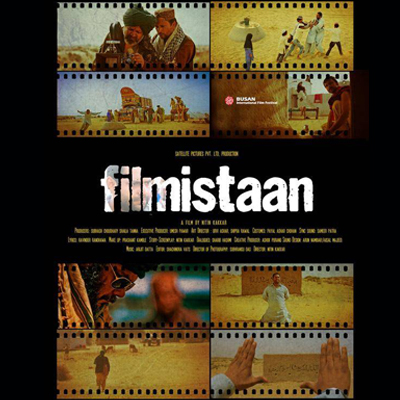
  • ‘Filmistaan’ to be released in more than 450 screens

    ‘Filmistaan’ to be released in more than 450 screens

    NEW DELHI: In a rare case, a film with no romantic angle or female character and based on the backdrop of terrorism is being released on 6 June in more than 450 screens across the country.


    The film, ‘Filmistaan’ by debutante director Nitin Kakkar, is about interplay for a no-man’s land where the only connect between the two main characters of whom one is an Indian prisoner is their love for Bollywood.


    Kakkar told indinatelevision.com in an interview that he wanted to highlight that cinema has no division of caste or religion.


    ‘Patriotism is the reality and jingoism is how one sells this sentiment’ he said in reply to a question on how filmmakers attempt to show patriotism.


    Asked why he had kept the end open-ended, he said he wanted to convey the message that people are standing at the borders even today in the hope that these will open someday. He had also ensured thereby that the film was neither romanticized nor gloomy.


    H also stressed that the focus was always on the love for cinema and not politics or terrorism. He attributed this to the fact that he had been seeing films from childhood which indulged in anti-Pakistani jingoism.


    ‘Filmistaan’ had won a National Award for 2012 and has received good response in several international festivals including Busan, across the United States and Europe and in Jaipur.


    The response had been very positive even from those from Pakistan who saw the film at these festivals, Kakkar said.


    Produced by Shyam Shroff and Balkrishna Shroff, the film stars Sharib Hashmi, Inaamulhaq, Kumud Mishra, Gopal Datt, Sanjay Mehta, Ravi Bhushan, Waseem Khan, Tushar Jha, Saroj Sharma, Manoj Bakshi, Sagnik Chakrabarty, Habib Azmi, Kavita Thapliyal, Punit Nijhawan, and Neela Gokhale. The lyrics are by Ravinder Randhawa and music is by Arijit Datta.


    Kakkar said he based the film at the Bhatinda-Rajasthan border which is very close to Pakistan and people often cross the border easily.


    The film was shot in just 20 days – 16 days in Bikaner, and two days each in Jaipur and Mumbai.


    Interestingly, the film did not face any problems with the Central Board of Film Certification and was granted a ‘U’ certificate.


    Asked about the involvement of UTV and Shringaar, he said they came in at the last minute.


    He said the cost of marketing a film was often more if not equal to making it, and therefore independent filmmakers had to prove themselves before any distributor put his money into the film. He said what Bollywood needed at this time was high content and catchy stories.


    The story is about affable Bollywood buff and wannabe actor Sunny who is kidnapped by an Islamist terrorist group when he is in Rajasthan with an American crew to work on a documentary, where an Islamic terrorist group kidnaps him. The house in which he is confined belongs to a Pakistani whose trade stems from pirated Hindi films. Soon the two realize that they share a human and cultural bond. .


    Born in Mumbai, Kakkar made his first short film “Black Freedom” in 2004 which won some awards at various short film festivals. Since then he has been working on some television projects. This is his first feature, but he said he had three scripts ready and would get down to making them as soon as this film is released.