Tag: Film

  • Content spending to top $250 billion by year-end, amid soaring demand

    New Delhi: Despite a year of uncertainty and production hiatuses due to the global pandemic, streaming platforms have set the global film and TV industry on a trajectory of accelerated growth with no imminent ceiling in sight. According to a latest assessment by London-based fin-tech platform, Purely Streamonomics, audience demand, production spending, and TV budgets reached all-time highs during the pandemic.

    While the actual number of films that went into production dropped last year, and TV series experienced shooting delays, more cash than ever was committed to content, reflecting continually rising production budgets and greater rights-buying activity.

    Production spending to top $250 billion by year-end

    Based on current trend lines, Purely expects production spending to top $250 billion by year-end, and then keep rising beyond that, especially as media mergers: Warner Bros Discovery, Amazon-MGM and Televisa-Univision start to flex their combined muscles around the planet.

    “What is remarkable about these record numbers is that the industry’s spending has yet to bump up against any natural ceiling. Every year there is talk of the industry being on the cusp of ‘peak television’ and yet it is clear from our own business dealings that the streaming of films and TV shows is only now starting to reach escape velocity,” said Purely, founder and CEO, Wayne Marc Godfrey, “Streaming is not just displacing traditional sources of entertainment revenue such as pay-TV and linear broadcasting, it is actually expanding the global marketplace for video.”

    The research shows that gross cash amount spent producing and licensing new entertainment content (excluding sports) soared by 16.4 per cent in 2020 to reach $220.2 billion, setting yet another milestone that is on track to be surpassed again this year. “But this is only the start of what’s to come. Even more spending growth is on the short-term horizon as a new wave of ad-supported platforms start gaining a stronger foothold around the world, alongside the subscription-funded services that have been driving the streaming marketplace until now,” says the report by the London-based fin-tech platform.

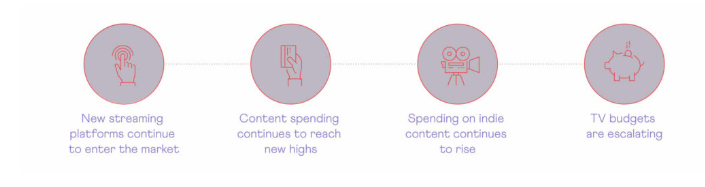
    Four emerging trends:

    Deluge of new streaming platforms:

    Since 2019, the number of global customers subscribing to streaming video platforms (has grown from 642 million to more than 1.1 billion, a 71 per cent leap that has been turbo-charged by months of enforced lockdowns at home. The pandemic not only drove rampant growth on existing platforms, it also accelerated the acceptance of powerful new global competitors including Disney Plus, Apple TV Plus, HBO Max, Peacock, Discovery Plus, Paramount Plus and Star. Joining these global platforms in the hunt for monthly customers are several regional Champions. Total number of subscribers is expected to reach at least 1.6 billion by 2025—representing about a fifth of the planet’s total projected population by then.

    Content Spending Reaches a New High

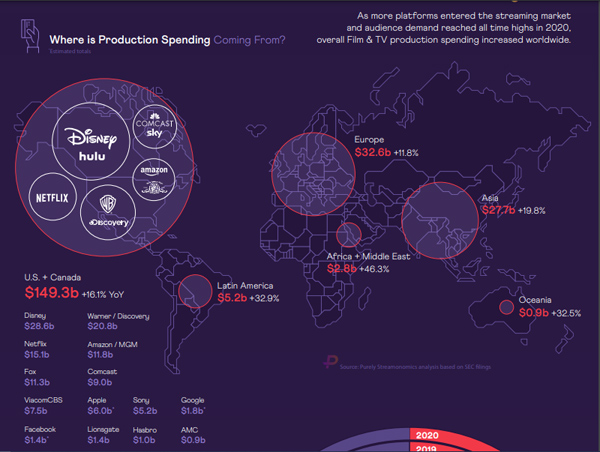
    As more platforms entered the streaming market and audience demand reached all-time highs in 2020, overall Film & TV production spending increased worldwide.

    According to the research, The Walt Disney Co remains the biggest single spender on content, with a grossed-up total of $28.6 billion for 2020 – which is more than spend across the whole of Asia ($27.7 billion) last year, followed by recently formed Warner Bros. Discovery and Netflix. Once Amazon completes its own acquisition of MGM, that combined entity would rank as the fourth largest North American production. On that basis these top four companies alone, with combined spending of $75.3 billion, almost equates to the entire worldwide spending outside of North America ($77.3)

    Spending On Indie Content Surges

    As much as Netflix and the five major Hollywood studios spend producing their own content, independently made and acquired content accounts for twice as much money globally. According to Purely Streamonomics’ global research, indie content spending jumped by 25.3 per cent year-on-year in 2020 and now accounts for 65.5 per cent of the world’s film and TV production activity.

    Budgets Are Soaring for TV shows

    As audiences continue to grow, and more competition enters the market, the stakes keep getting higher. In order to stay competitive, producers face pressure to up their production spending. As a result, budgets have risen in recent years, especially for TV shows. According to the research, average budgets across all new series in the US– scripted, unscripted, daytime and kids – was on the rise, up 16.5 per cent in 2020. The cost of introducing and monitoring COVID protocols in 2020 also added 20-30 per cent to production budgets.

    The findings of the research were presented in the form of infographics by Purely Streamonomics and created by digital publisher Visual Capitalist. The data is based on SEC filings by U.S. media conglomerates and tech giants, as well as reports published by national film and TV data-gathering organisations around the world.

  • ALTBalaji subscription up by 42% y-o-y in FY21

    KOLKATA: ALTBalaji seems to be driving the growth of Balaji Telefilms with a 42 per cent growth in subscriptions for FY21. The platform sold a total of 4.7 million subscriptions for the year, compared to Rs 3.4 million in FY20.

    Despite the speedy growth of ALTBalaji, overall financial performance for the year was impacted by the pandemic-led restrictions on the TV and movie business. Balaji Telefilms’ consolidated revenue stood at Rs 293.7 crore for FY21, compared to Rs 573.6 crore. TV business returned to more normal production in Q4 With 223 hours content produced in the quarter, the company stated in a statement.

    Four shows were on air during the quarter. Hourly realizations remained soft at Rs 30 lakh per hour and it is expected to remain soft as broadcasters continue to assess Covid 19 impact, the company stated.

    “ALTBalaji continues to drive subscription growth and we added 4.7m subscriptions during the year, the highest since our launch four years ago. We have also done strategic content-sharing deals with two large OTT players to drive creative synergies. We will continue to see strong subscriber additions with over 40 shows greenlit,” Balaji Telefilms managing director Shobha Kapoor said.

    “After the initial setback in the first half of FY21 our TV business has shown good recovery in terms of production hours and we hope to maintain this momentum. In the movie business, production for some of the exciting projects are at various stages of completion. We are closely monitoring the availability for theatrical releases as well and direct to digital launches. Overall, the business has performed well in very challenging conditions and I am confident we will build from the base created,” Kapoor added.

    Meanwhile, the Board has considered and approved a dividend of ten per cent (Rs 0.20 per share) subject to shareholder approval. It is going to highly focus on maintaining liquidity and balance sheet strength through the year with the current cash and cash equivalent balance at Rs 144 crore.

  • Cyclone Tauktae damages TV shooting floors, adds to producers’ woes

    Cyclone Tauktae damages TV shooting floors, adds to producers’ woes

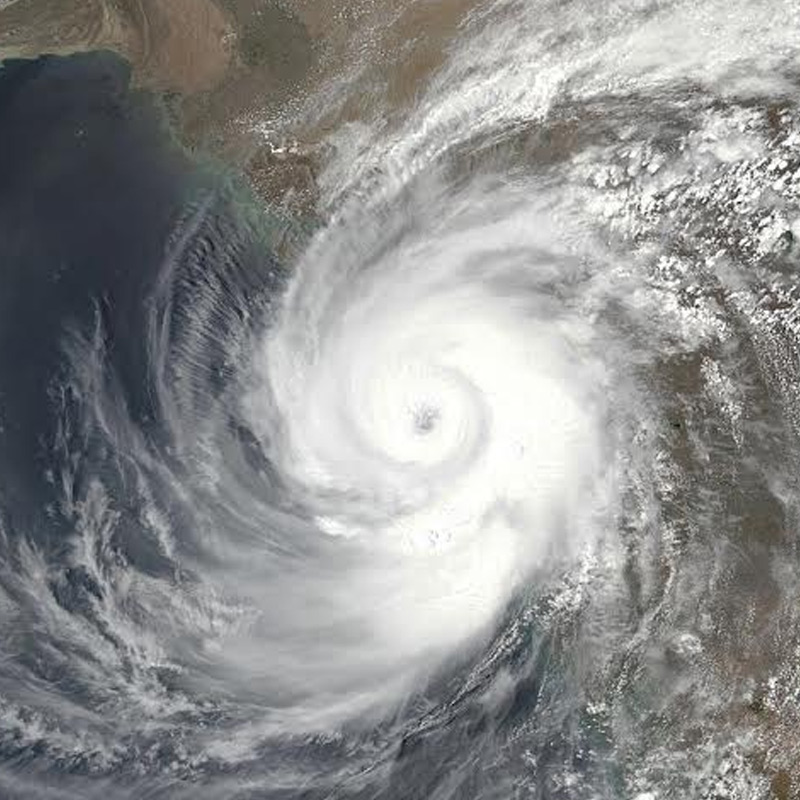
    Mumbai: As cyclone Tauktae wreaked havoc all along the western coast of India, along with it mauled Mumbai’s famed television industry. Gale-like winds and incessant rain battered not only homes and offices all through Sunday night and Monday, they also tore through TV production sets in different locations in Mumbai and its outskirts.

    According to an estimate, at least 20-30 shooting floors were severely damaged when water seeped into them, which could lead to losses running into crores of rupees.

    Said Indian Film & TV Producers Council (IFTPC) chairman JD Majethia: “Almost all sets, whether outdoors or indoors, were impacted and reported some damage at least. On the sets of my production house, a tree fall occurred and a boundary wall was also damaged. Besides this, water is seeping in through sections of the roof. It is really a daunting time for us.”

    Added IFTPC CEO Suresh Amin: “It is akin to rubbing salt upon one’s wounds. Television producers were already reeling under the Coronavirus pandemic. Shooting for several (popular) shows then got stalled due to the restrictions imposed. Now this cyclone has devastated at least 30 shoot-ready sets. It will cost Rs. 20 lakhs per film set for rebuilding the damaged sections. It is really a back-breaking predicament for producers and production houses.”

    Although forewarning cyclone advisories issued a week ago by weather department officials had sounded the alert, TV production units could not gear up sufficiently well during this time with preventive measures in place. The reason: under pressure to deliver daily episodes for the telecast, most of them shifted their shoots to other states after Maharashtra imposed a suspension of both indoor shootings as well as outdoor filming schedules. 

    According to Majethia, “challenges for the TV production community are increasing day by day. Usually around the middle of the month of May is the time, when producers focus on aspects of monsoon preparedness before rains are scheduled to arrive in the month of June. Unfortunately, the cyclone hit Mumbai now.”

    But he says no one from the production trade is willing to get beaten down by the continuous hammering their businesses have been getting over the past year, on account of the pandemic and then by nature’s fury. “We will immediately undertake repair efforts and rebuild our sets so that work may be restarted in right earnest once again. We accord high priority to safety over everything else,” revealed Majethia.

    The IFTPC chief also expressed hope that the Maharashtra government led by Udhav Thackeray would go-ahead green signal film and television shootings in the state given that the peak of the second wave appears to be ebbing and a decline in growing infections is being actively reported.

  • BookMyShow restructures senior leadership to bolster India operations

    BookMyShow restructures senior leadership to bolster India operations

    KOLKATA: Ticketing platform BookMyShow has rejigged its senior leadership, as the company strengthens its India management team across key business verticals.

    As part of the new structure, Anil Makhija will be in charge of scaling live entertainment operations as COO – live entertainment & venues, taking over from Albert Almeida who will head brand partnerships to nurture strategic and like-minded partnerships for BookMyShow in the journey ahead.

    The restructuring will help drive the next phase of growth and expansion for the company, further streamlining the core areas of the business, as BookMyShow doubles down on building a holistic platform for its customers, going forward, the company stated in a press statement.

    A veteran in the industry, Makhija joined BookMyShow in 2013 to lead ground operations and service delivery, while also overseeing deployment of new technologies across all physical events. Heading BookMyShow’s award-winning customer experience force along with ground operations at the firm, Makhija and his team have successfully enabled the use of technology to enhance the entire user experience until the last mile, on-ground. In a natural progression of his role here on, he will lead the operational strategy and execution of all live entertainment experiences across music, comedy, theatre, sports, live performances and more, bringing the complete range of touch points including experience fulfilment, production, venues and service delivery all under one roof.

    Almeida joined BookMyShow in 2018 to set the stage for the firm’s live entertainment business and shape its growth. In his new role, Almeida along with his team will focus on building strategic brand partnerships by unlocking the strength of BookMyShow’s critical assets – its premium IPs, vast community and the power of the platform.

    Further, BookMyShow’s foray into the streaming business with the transactional-video-on-demand model BookMyShow Stream will be helmed by Ashish Saksena, COO – Cinemas bringing all things movies, under one umbrella. Saksena has been leading the company’s cinemas business with continuous screen additions across the length and breadth of the country, expansion of BookMyShow’s POS business at cinemas in towns beyond metros, overseeing the growth of F&B as an able contributor to the vertical along with newer revenue enhancement measures within the movies business for the company, through long-term, marquee partnerships with production houses across the world and India.

    After playing an instrumental role in creating and building BookMyShow’s brand value over the last eight years, as also spearheading the effective utilization of the firm’s analytical capabilities to cement the firm’s leadership position in the entertainment ecosystem, Marzdi Kalianiwala will take on the role of senior vice president – Product & Design. He will drive the brand’s product strategy and innovation roadmap in line with consumer needs.

    Additionally, Mahesh Vandi Chalil has been made senior vice president – technology, wherein he will scale the firm’s technological prowess and strategic approach to development and delivery.

    BookMyShow founder & CEO Ashish Hemrajani said, “In its 21 year long journey, BookMyShow has been through its share of black swan events that have significantly changed not only the way we run business, but also the underlying consumer experience. However, with every such unpredictability, BookMyShow has only bounced back stronger and more ready to face the next big challenge. Without a shred of doubt, our tenacity is driven by the unwavering loyalty of millions of consumers who have stayed with us through the ups and downs of these past years and equally so, by a visionary leadership team that has always been one to think ahead of time and prepare for it today. This latest structural shift in BookMyShow’s leadership is an example of this foresight and one that will be our bedrock as we continue to future proof ourselves while moving forward swiftly, in a constantly evolving world of entertainment.”

  • Zee5 Global unveils fresh content line-up for April

    Zee5 Global unveils fresh content line-up for April

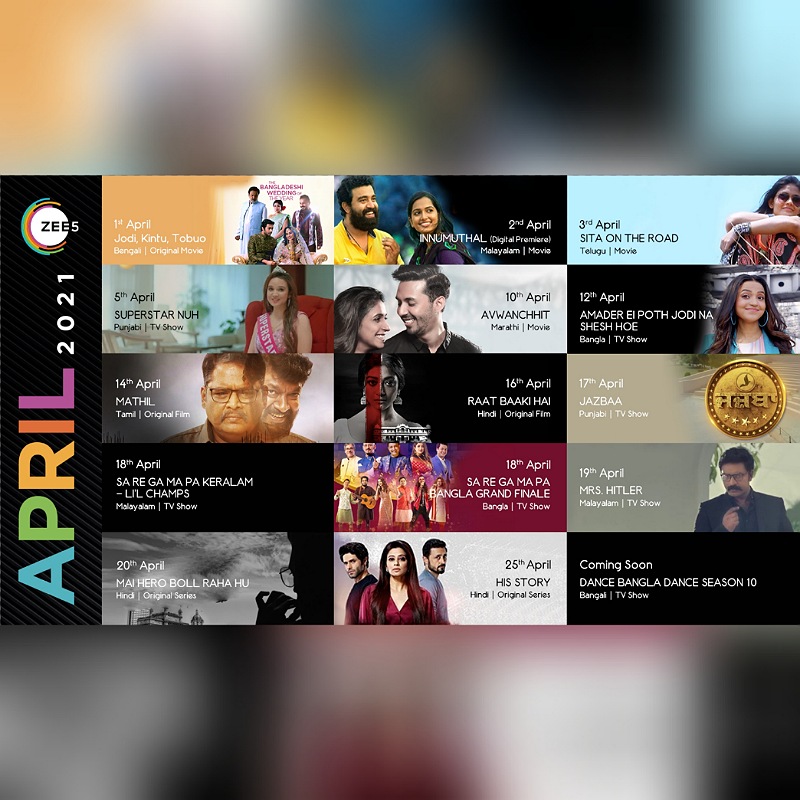
    KOLKATA: As we wind up the first quarter of the year, Zee5 Global has unveiled a fresh new line-up of content. Viewers can choose from a variety of Zee5 Originals, television shows, and non-fiction shows to enjoy their summer at home.

    Leading the April line-up is the much-awaited Zee5 Original Film Raat Baaki Hai starring Paoli Dam, Anup Soni, Rahul Dev, Dipannita Sharma and Akash Dahiya. Set to premiere on 16 April, the film is a remake of the popular play Ballygunge-1990, and has been directed by Avinash Das and produced by Samar Khan of Juggernaut Productions. The film revolves around a fateful meeting between two ex-lovers under strange circumstances: one of them is running away from the law for being a murder suspect.

    Zee5-ALTBalaji Original web series Mai Hero Boll Raha Hu starring Parth Samanth, Patralekha and late Asif Basra will drop on 20 April. Taking the viewers through Nawab’s rise as an underworld don in the late 1980s and 1990s, the intriguing drama documents how an amazing friendship and mentorship quickly turns sour when Nawab outperforms his mentor Lala. Next in line is His Story, a Zee5-ALTBalaji Original series starring Satyadeep Misra, Priyamani and Mrinal Dutt in lead roles. The Hindi series premierses on 25 April.

    Zee5 Tamil Original Film Mathil revolves around Laxmikanthan, a common man, who fights against a politician who usurps the wall of his dream house for an election campaign. Starring Mime Gopi and KS Ravikumar, Mathil releases on 14 April 2021 (Puthandu, the Tamil New Year); the trailer is already out. 

    Viewers can also enjoy a special Ramadan curation from 12 April onwards with a variety of delectable festive recipes from celebrity chefs Kunal Kapoor, Sakshi Batra and others. Furthermore, the platform will stream some of the most loved family movies, TV shows and Originals for audiences across markets. From Shabana Azmi’s Mee Raqsam to primetime legacy shows Razia Sultan, Jodha Akbar and popular originals including Daawat-e-Biryani, Jaadu Kadai and more.

    For Zee Tamil viewers, the platform is set to celebrate the grand success of Yaradi nee Mohini and Poove Poochudava crossing a landmark 1,000 episodes – the first ever shows to do so, with Vetri Vizha on 11 April.

    Zee Bangla viewers can enjoy a new fiction TV show Amader Ei Poth Jadi Na Sesh Hoy, where a rich girl Urmi decides to become a taxi driver, in an exciting journey of self-discovery and independence. Slated to be released on 12 April, the show stars Anwesha Hazra as Urmi. Zee Bangla will soon premiere Dance Bangla Dance Season 10, judged by Bollywood celebrity Govinda and popular Bengali superstar Jeet and Ankush. The exciting Sa Re Ga Ma Pa Bangla gears up to stream the grand finale on 18 April.

    Zee Punjabi viewers can celebrate Baisakhi with Neeru Bajwa and top Punjabi artists and TV stars in a special episode on 10 April, while in the popular Punjabi cooking show Swaad Aa Gaya, viewers can celebrate Baisakhi the whole week.

  • Curtains for Cinemas?: Industry pins hopes on vaccine roll-out amid second wave

    Curtains for Cinemas?: Industry pins hopes on vaccine roll-out amid second wave

    KOLKATA: The film entertainment segment of the M&E industry was perhaps the worst hit due to a long-term closure induced by the outbreak of Covid2019. With phased opening and beginning of theatrical releases, the allied segment had been on the course of recovery, but the second wave of the pandemic has abruptly derailed hopes of revival.

    After fresh lockdown guidelines were enacted in Maharashtra, shares of major multiplex chains like Inox and PVR slipped for two consecutive days, given the fact that the state contributes to around 35 per cent of all India box office.

    “As a responsible organisation, we completely relate to the Covid situation in Maharashtra. The revival process of the cinema industry had begun, and the recent curbs are much like a speed-breaker in the journey, which we shall surpass soon in a month’s time,” said Inox Leisure Ltd Alok Tandon.

    He went on to add that the performance of movies like Roohi and Godzilla Vs Kong showed that audiences are willing to turn up in big numbers for new and good quality content, even after an elongated lockdown.

    However, more than cinema occupancy, what’s adding to the woes of cinema owners is that the skyrocketing caseloads have once again disrupted the release calendar. Akshay Kumar-starrer Sooryavanshi, originally scheduled for March 2020, has been postponed indefinitely from its 30 April 2021 release date. Eventually other big ticket releases like Radhe will follow the same path, Elara Capital VP research analyst (media) Karan Taurani surmised.

    Like a playback of last year, this lockdown too will be lifted in a phased manner based on the number of daily cases, opined Taurani. But this time around it may not be as troublesome as 2020, and unlock will happen more swiftly thanks to the vaccine roll out being ramped up. However, he pointed out that theatres may well be the last to open up even if cases come down.

    On the other hand, Inox’s Tandon has reposed faith in upcoming content and increased turnout in the markets dependent on movies in other Indian languages, especially in the southern and eastern parts of the country. Over the past few months, movies like Master, Roberrt and Uppena had brought out the southern audiences in droves. Yuvarathnaa, Sulthan and Wild Dog are also currently performing exceedingly well in the South Indian markets, he added.

    “With Covid cases rising again, there are two major factors which will determine the future of theatrical revenues. One is the fear factor which can lead to lower footfalls even if theatres are open. Secondly, the slate: some films have again started postponing their releases. Unless there is a mass vaccination drive properly rolled out and a solid film slate of releases, the situation is probably not going to improve meaningfully,” EY India partner and media & entertainment leader Ashish Pherwani remarked.

    He also noted that the uncertainty around recovery timelines could result in further direct-to-digital releases, but that may not be a permanent trend. In a similar vein, Taurani mentioned that there is already a big backlog of films and April-June was supposed to be a period where cinemas could go back to 17-20 per cent occupancy on the back of big Hindi releases. Now, many of the mid-small budget producers will again go for OTT premieres. 

    Moreover, in-cinema advertising, which went down almost 90 per cent in 2020, will also be keenly impacted even if the theatres are open in some states.

    “Artificial intelligence has actively taken over the cinema advertising space and this allows for delivering appropriate content depending on location of the cinema, ticket price, demographic and occupancy,” said Harkness Screens Asia EVP Preetham Daniel. “Though the occupancy levels in the auditoriums are not as high as pre-Covid, the value of the advertisement, I believe will be equally impacted. Having said this, the revenue from advertising will definitely take a hit. We had seen the occupancy numbers and box office rising but given the second wave, we may see it drop again as some large releases will now get pushed to June.”

    The advantage of AI is the decision to play a particular ad will now be more accurate based on the heaps of data available on people behavioural pattern, he explained. This allows for brands to sign on long term as opposed to a weekly or monthly run. While Covid2019 also has affected the on ground activation campaigns for the brands, Daniel remained optimistic that it will eventually pick up as and when hyped movies hit cinema screens.

    “Thanks to a huge pent-up demand and a stellar line up of movies, 2021 is destined to be a blockbuster year for us, and we are still certain about it. In the current situation, we have pinned our hopes on the rapid and widespread vaccination drive, which we hope would arrest the surge in cases,” Tandon said.

  • Eros STX reports $144 mn revenue for first 6 months of FY21

    Eros STX reports $144 mn revenue for first 6 months of FY21

    KOLKATA: Multinational media entertainment company Eros STX Global Corporation has reported $144 million revenue million for the six months ended 30 September 2020, compared to $210 million in the prior year period. 

    The decline in revenue has been attributed to significant reduction in global film releases resulting from the negative effects of Covid2019, partially offset by revenue growth from the STX film library.

    Operating expenses stood at $152 million and, excluding merger related costs, were $134 million, for the period, compared to $276 million in the prior year period. This decline was driven by significantly lower film release marketing and distribution costs due to the pandemic.

    “The company is in the process of finalising its complete financial statements for the six months ended 30 September 2020. Completing the full financial statements has required additional time and resources due to the complexities associated with converting legacy Eros from IFRS to US GAAP and to legacy STX’s accounting policies, and the ongoing deployment of a new and integrated SAP accounting platform. The company expects to issue complete and reviewed financial statements for the interim period by 30 April 2021,” it stated in a filing.

    As legacy STX was deemed the accounting acquirer in the business combination, the consolidated financial results for the six-month period ended 30 September 2020 include only two months of legacy Eros, starting on 31 July 2020 when the merger of Indian film and entertainment studio Eros International, and the American film studio STX Entertainment closed.

    Net cash provided by operating activities was $13 million and, excluding merger related cash costs, was $27 million, for the six months ended 30 September 2020.

    Operating Loss of $7 million and, excluding merger related costs, operating profit of $10 million, for the six month period compared to an operating loss of $65 million in the year ago period.

    As of 30 September 2020, total debt was $384 million and cash on hand was $82 million. The company’s fiscal 2021 ending net debt balance is expected to be below the $325 million guidance provided on the investor call held on 4 November 2020.

    These interim results are a subset of the previously announced preliminary financial results for the first nine months of fiscal 2021, ended 30 December 2020. 

  • M&E sector witnessed 24% degrowth in 2020: FICCI & EY report

    M&E sector witnessed 24% degrowth in 2020: FICCI & EY report

    KOLKATA: Following a pandemic hit year, the Indian media and entertainment (M&E) sector declined by 24 per cent to Rs 1.38 trillion in 2020, compared to Rs 1.82 trillion in 2019. However, the allied sector is already seeing recovery with improvement in revenues for most segments in the last quarter of 2020. It is expected to recover 25 per cent to reach Rs 1.73 trillion in 2021, touching almost pre-Covid level scale, according to a report by FICCI and E&Y.

    The report titled ‘Playing by New Rules: India’s M&E sector reboots in 2020’ states digital and online gaming were the only segments which grew in 2020, adding an aggregate of Rs 26 billion and consequently, their contribution to the M&E sector increased from 16 per cent in 2019 to 23 per cent in 2020.

    Other segments dropped by an aggregate of Rs 465 billion. Largest absolute contributors to the fall were the filmed entertainment segment (Rs 119 billion), print (Rs 106 billion) and television (Rs 102 billion). The share of traditional media (television, print, filmed entertainment, OOH, radio, music) stood at 72 per cent of M&E sector revenues in 2020.

    However, television stood as the largest sector despite a 22 per cent downturn in advertising revenues on account of highly discounted ad rates during the lockdown months. Moreover, the sector also witnessed a seven per cent fall in subscription income, led by the continued growth of free television, reverse migration and a reduction in ARPUs due to part implementation of NTO 2.0.

    On the other side, digital advertising did not see much impact, led by increased allocation from traditional advertisers who accelerated their investments in digital sales channels. SME advertisers continued to spend on the medium and experimented more with e-commerce platforms like Amazon and Flipkart.

    For the first time ever, OTT subscriptions surpassed the 50 million mark. From 28 million paid subscriptions, it went up to 53 million in 2020 leading to a 49 per cent growth in digital subscription revenues. Growth has been attributed largely to Disney+ Hotstar, which put the IPL behind a paywall during the year. Increased content investments by Netflix and Amazon Prime Video and launch of several regional language products also catalysed the growth, the report added.

    Online gaming crossed all the marks with 18 per cent growth helped by work from home, school from home and increased trial of online multi-player games during the lockdown. Online gamers grew 20 per cent to reach 360 million in 2020.

    Among the pandemic hit sectors, print’s revenue declines were led by a 41 per cent fall in advertising and a 24 per cent fall in circulation revenues. Theatrical revenues plummeted to less than a quarter of their 2019 levels, partly offset by direct-to-digital releases.

    “While the M&E sector usually grows faster than GDP, it also falls more than GDP degrowth, given the discretionary nature of advertising. In 2020, when the GDP fell by eight per cent advertising fell over 25 per cent while the sector overall fell by 24 per cent,” the report read.

    The M&E sector is expected to rebound in 2021 and double to around Rs 2.68 trillion by 2025, the recovery of various segments will vary albeit. TV, film, music will take one to two years, animation and VFX will take two to three years; print, radio, OOH will take the longest time, even more than three years.

  • Only 8% HOD positions in Indian films in 2019-20 were held by women: Ormax Media Report

    Only 8% HOD positions in Indian films in 2019-20 were held by women: Ormax Media Report

    MUMBAI: On the occasion of International Women’s Day (8 March ) this year, media consulting firm Ormax Media and entertainment platform Film Companion have released a report on representation of women in Indian films, titled O Womaniya! 2021. This first-of-its-kind report will be an annual initiative that aims to start necessary conversation about the need for gender parity in Indian cinema. 

    The report is based on analysis of 129 Indian films released in 2019 & 2020 across five languages, i.e., Hindi, Tamil, Telugu, Malayalam & Kannada. The list includes the top 100 theatrical films based on their footfalls in India, and 29 direct-to-OTT films that were promoted prominently in this period. The report looks at three aspects of representation: Talent, Content & Marketing. 

    In the Talent section of the report, five key HOD positions for the chosen films were analysed, namely direction, writing, cinematography, editing and production design. Only 8 per cent HOD positions were held by women. Direction and Cinematography are particularly lopsided, at just 6 percent and 2 percent female representation respectively. 

    While female HOD representation in Hindi cinema is low at 16 per cent, it is almost non-existent in South cinema, at just 1 per cent 

    The Content section of the report uses the Bechdel Test. The Bechdel Test is an Internationally-accepted measure of female representation in film stories. For a film to pass the Bechdel Test, it needs to meet a basic requirement: It should have at least one scene in which two female characters are talking, and the conversation is about a topic other than a man/men. As many as 59% films, including some of the biggest Hindi and South blockbusters, failed the Bechdel Test. 

    In the Marketing section, trailers of the 129 were analysed, and the speaking time allotted to male and female characters in these trailers was measured. The report reveals that with 81% speaking time, male characters ‘outspeak’ female characters by more than four times in film trailers, thus concluding that most films are being marketed via male actors and characters. Only 10 out of 129 films had trailers where women spoke more than men. 

    Film Companion founder & editorbAnupama Chopra said: “We all know that the playing field is skewed in favour of men, but the numbers reveal how stark the difference is. I’m thrilled that we could partner with Ormax Media on this report, and I hope that the O Womaniya! report will ignite a conversation and hopefully, change."

    Ormax Media founder & CEO Shailesh Kapoor said: “The extremity of the numbers in the report should serve as an eye-opener for all stakeholders. Single-digit percentage representation in key HOD positions is a sign that there’s a deep-seated cultural issue to address. By tracking these factual metrics year-on-year, we will be able to conclude whether the shift in views related to gender equality in cinema are real or merely perceptual”. 

  • #Throwback2020: Scriptwriters on the new normal

    #Throwback2020: Scriptwriters on the new normal

    MUMBAI: The great irony about the year 2020 is that a year that will forever be defined by one of the worst pandemic known to humankind is also one that redefined entertainment and paved the way for many millions. It would not be wrong to say that 2020 was the writer’s year. Over the course of the last 12 months, streaming platforms served us gems like Scam 1992, Mirzapur, Paatal Lok and Panchayat, to name a few. The television industry is also experimenting with content. While film and TV producers are grappling with challenges in production, writers are swamped with creating content to meet the consumption demand.

    Production houses are in need of scripts more than ever – a kind of a blessing in disguise for writers, who are working furiously to wrap up pending episodes and current seasons. From the lows of lockdown to the highs of the post-Covid production boom, writers have one thing in common: they have had to adapt swiftly to a new normal.

    The lull of lockdown

    Screenwriters Association member Satyam Tripathi revealed that with the abrupt imposition of lockdown, work came to a grinding halt, and just like any other industry, writers were also affected. But personally for him, working in the confines of his home and coordinating through online platforms was a welcome change, as otherwise a lot of time is wasted in the physical meetings.

    Zoom also provides a workaround, albeit a rather clumsy one, to the key feature of the writers room – the whiteboard, where character arcs and plot lines are scribbled, erased and obsessively rearranged until final things get into place.

    “For a creative person, perhaps this was a time where a lot of introspection was happening in terms of the content we write, in the manner in which we approach our work. When you face a hard time it is then you realise how much you are really connected with the emotions you write about. In those times there was so much insecurity around us in terms of money, work, and life itself,” Tripathi mused. 

    Author, writer, documentary filmmaker Jaya Mishra, who has written for shows like Kehne Ko Humsafar, Cold Lassi aur Chicken Masala, spent her time dashing off scripts in the first few months of the lockdown. “There was pressure to deliver the scripts because nobody realised how much time it would take to get back to normalcy. People wanted to finish the writing processes of all the shows; basically that was the only work we were doing at that moment,” she shared. “But how does one write about normal life when life was not at all normal? The world was at a standstill. I couldn’t focus because all my shows are romantic comedies and there was no romance, I mean how do two people even meet anywhere without the fear of the virus?”

    She went on to add that shows which were almost ready to go on floors required last-minute changes. So, there was a lot of rewriting that happened during that time. 2020 eventually gave Mishra the chance to take a pause from hurtling between writing and delivering scripts. She devoted this free time to her other love – crocheting.

    At present, her in-tray is overflowing. She has started work on her second book, which has been a long time coming. Mishra’s first book was the fiction novel Kama~the story of Kama Sutra published by Om Books. She has her hands full writing for Alt Balaji’s Toxic, Married woman, United, and is also penning screenplay dialogues for an unnamed original series with One Life Productions.

    Director, lyricist, and Happy New Year writer Mayur Puri defined the first few months of lockdown as tough, with shoots cancelled and no dubbing taking place. Apart from this, Puri’s company which does a lot of translation projects for OTT platforms saw a period of lull.

    Said he: “Before the lockdown, my company produced 30 hours of content and the idea was to make it to 45 hours of content till 2021 but now it looks quite difficult to achieve. In fact, for the first three months, there was no work but from October onwards we have reached our monthly targets. I am hoping by the first quarter we will be back on track as far as bulk business is concerned.”

    On the bright side, more projects have started flowing in from June and July onwards. Puri now has three projects lined up for release this year, including Disney and Marvel Studios’ Black Widow, and Free Guy. All the movies were commissioned in 2020.

    Besides volume, the nature of work has also changed for writers. People who were earlier writing two movies are now working on four projects. The past year has also been a wake-up call for screenplay writers. “For instance, when it comes to OTT, there is more pitching and development before actual writing happens. So, writers are becoming more disciplined, they now understand that style of working. Since the writing activities have increased, hopefully it will harbinger better content for us.”

    Production blues

    The industry breathed a sigh of relief when the government allowed filming to resume, under strict guidelines. Of course, production while being Covid compliant comes with its own share of hassles.

    Writers are now being asked to rethink what could be feasible as there are restrictions in terms of shooting, budget, people and much more. They are asked to lean on fewer characters along with special effects and VFX to provide scale and make the show more relatable.

    To make the scripting process more convenient, multiple staff are splitting into mini-rooms, with senior-level producers doing Zoom sessions while lower-level personnel work offline on script changes or other details. Some showrunners are also scheduling one-on-one Zoom or Google Meet sessions with members of the staff in an effort to ensure that everyone is getting the support they need.

    Despite the occasional technical hiccups, like bad internet connections, sound and the transition to teleconferencing has been a source of comfort to many in this new quarantined world.

    Mirzapur writer and creator Puneet Krishna is currently basking in the success of his original series. But the behind the scenes story is not so sunny. Mirzapur was in the middle of post-production, so it was an ordeal for him to shoot while following Covid protocols. Due to this, the dubbing process became elongated.

    Tripathi, who is busy developing an OTT series with Reliance Big Synergy, did not have any programmes on air so he did not face any immediate challenges. He got an ongoing show – Zee TV’s Ishq Subhanallah – just when the lockdown was lifted. The only problem he encountered was when somebody on set tested Covid positive, forcing him to rewrite certain scenes.

    Regardless of directives, that vary from studio to studio, screenwriters say their anxiety lies largely in the uncertainty looming over them. 

    Puri asserted that it is important for a writer to have the freedom to take his pick of work. “What we look at is we get enough choice of projects and decide what is best suited for me and when the work stops you are not left with any choices,” he noted. “Not having a choice of subject was one big challenge. I am a small entrepreneur who runs a business of writing. For me, it was very difficult because payments stopped coming and I have a team of writers I need to pay. Thankfully, when work started my team picked up the pace and we started working harder and we accommodated Diwali bonuses also. I think the worst has passed and we are in a better position.”

    The silver lining

    The emergence of OTT platforms has been a gamechanger for writers. Puri said that thanks to these streaming services, writers are now getting recognised. In addition, with most theatres shit or running at 50 per cent capacity and no big budget movie releases happening, the race for box-office numbers is virtually non-existent. Now, it is completely a contest of skills, which is why Puri believes the overall quality of writing should go up.

    He quipped, “With OTT there are so many stories which can be now explored which are not conventionally box-office. The only criteria is to make the content right and think of the audience as an intelligent audience. The value of writers is going up, in terms of the value, payment, and respect for their work. I am hoping this continues even when the theatres are open.”

    Acknowledging that there has been a spike in OTT consumption, Krishna noted that people who were releasing films in cinema halls are now opting for OTT release –so it has become a level playing field. At the same time, he is hopeful that once things normalise, people would flock back to movie theatres.

    Forecast for the future

    Digital adoption in various walks of life surged by leaps and bounds in 2020 and writing is no exception. For a while now, more and more people have voiced that TV, movie and OTT scripts shouldn’t be made with paper, as paper scripts being tossed around a set might cause problems. So, writers suggested alternatives such as electronic scripts and electronic sign-in/out should be explored in the post-Covid world.

    But what about the big picture? Mishra was of the view that the entertainment industry is going very strong.

    “Fortunately, the market has been pretty good to writers. A lot of ideation went on, it has helped me to work on new shows. All this work came to me in the last five months. We are still in a better position compared to directors, actors and producers,” he said.

    Tripathi opined that the market is still picking up and will take time to settle. The entertainment industry was already facing issues after TRAI’s intervention, digitisation, and then the BARC incident happened. And while the OTT juggernaut is no blip on the radar, traditional linear TV still has a lot going for it. “The industry was kind of settling in when the pandemic knocked on our doors. I also believe that the OTT spike is just a rumour, it is more of an urban phenomenon. Because during the lockdown we have realised that reruns are doing much better than any form of content,” he added.

    A lot of negativity that has come to be associated with daily soaps will decrease, and audiences will react to it, claimed Tripathi. That is why a lot of older shows are working as they bring a sense of nostalgia and good times.

    Writers also echoed the view that smaller budgets and fewer crew on sets would force directors to tell more intimate and pertinent stories.

    These are exciting times to be a screenwriter, with the industry in transformative stage, new forms being explored and a burgeoning need for content among new and diverse consumers. The page is fresh and the quill is ready, now it remains to be seen what story they write.