Tag: Film industry

  • Aanand L Rai’s Colour Yellow names Harini Lakshminarayan as COO

    Aanand L Rai’s Colour Yellow names Harini Lakshminarayan as COO

    MUMBAI: Colour Yellow Productions, helmed by filmmaker Aanand L Rai, has appointed Harini Lakshminarayan as chief operating officer. She brings over two decades of experience in IP development, production and strategy to the Mumbai-based production house.

    In her new role, Lakshminarayan will oversee strategic operations and business development while maintaining the studio’s focus on storytelling and IP creation. She joins the company as it plans to expand its content slate across markets.

    “Harini brings a unique combination of creative foresight and strategic expertise that aligns perfectly with our mission,” said Colour Yellow Productions founder Aanand L Rai. “Together, we will continue to raise the bar for what Indian cinema can achieve in both domestic and global markets.”

    Lakshminarayan said she was excited to join the studio known for films like Raanjhanaa, Tanu Weds Manu, and Tumbbad. “Aanand L Rai’s incredible vision for storytelling that consistently pushes boundaries is truly inspiring,” she noted.

    The appointment comes as Colour Yellow, established over a decade ago, looks to build on its legacy of creating culturally rooted content that appeals to wider audiences. The studio has previously produced critically acclaimed films like Newton, Mukkabaaz and Shubh Mangal Saavdhan.

  • South India Film Festival (SIFF) set to illuminate the cinema landscape with its inaugural edition

    South India Film Festival (SIFF) set to illuminate the cinema landscape with its inaugural edition

    Mumbai: The South India Film Festival (SIFF), heralded as a celebration of cinematic excellence and cultural diversity, proudly announces its inaugural edition set to unfold on 22 March 2024 in Hyderabad.

    This year, the festival takes immense pride in presenting a stellar line-up of luminaries from the South Indian film industry, embodying the essence of regional storytelling and artistic brilliance. Among the distinguished guests gracing the event are renowned actors, directors, producers, and industry experts, promising an unforgettable showcase of South Indian cinema.

    The festival serves as a testament to the rich heritage and creative ingenuity of South Indian cinema, bringing together visionaries from various corners of the industry to share their insights, experiences, and expertise with audiences eager to delve into the world of cinema.

    Leading the line-up is megastar Chiranjeevi, who have been awarded with The Padma Vibhushan the second-highest civilian award given in the country, whose presence promises to infuse the festival with star power and cinematic excellence. Alongside Allu Arvind, Vishwa Prasad, Shailesh R Singh, Deepak Dhar, Sujay Ray, and Shetanshu Dixit among others, audiences can look forward to engaging with a diverse array of talents, including Mayank Shekhar, Rajeev Masand…, each bringing their unique perspective and contribution to the festival.

    Check out the list of esteemed guests:

    https://southindiafilmfestival.com/

    Attendees can anticipate a captivating blend of screenings, panel discussions, and networking opportunities, offering a holistic immersion into the world of South Indian cinema. From thought-provoking debates on industry trends to insightful conversations on the future of regional cinema, the festival promises to be a dynamic platform for dialogue and exchange.

    The presence of these esteemed guests underscores the significance of the South India Film Festival as a cornerstone of the regional film industry. Their collective talent, experience, and passion for cinema will undoubtedly elevate the festival to new heights, enriching the cultural tapestry of South Indian cinema.

    Register yourself for the South India Film Festival here:

    Register yourself for the South India Film Festival here: https://in.bookmyshow.com/events/south-india-film-festival/ET00377474

    Stay tuned for more updates and announcements as we embark on this exhilarating journey of celebrating the magic of South Indian cinema at the inaugural South India Film Festival.

  • WFCN to revolutionise global film industry with visionary economic model

    WFCN to revolutionise global film industry with visionary economic model

    Mumbai: The World Film Communities Network (WFCN) has announced a groundbreaking initiative to bring about a colossal shift in the world of the film industry. The new economic model aims to decentralise the film industry by distributing creative control and financial support to different global communities.

    The new economic paradigm known as the “Community-Driven Film Economy,” aims to reshape the dynamics of the global film industry. The film industry has historically placed a strong emphasis on a centralised system in which major studios control both the production and distribution stages. By utilising decentralised finance principles and blockchain technology, WFCN disrupts the long-standing norm and establishes a more inclusive and democratic ecosystem. With this, WFCN establishes the notion of community engagement throughout a film’s entire production process. Through WFCN, filmmakers will be able to show their projects directly to a global film audience, who can then become stakeholders by contributing to the production via a decentralised crowdfunding platform.

    The ability to monetise films through various channels, which gives filmmakers the freedom to select between pay-per-view and ad-based revenue, is one of its primary features. This enables producers to modify their tactics according to the type of content they produce and the tastes of their target audience.

    Commenting on this ingenious initiative towards the betterment of the film industry, WFCN’s CEO, Marcello Villiagram, stated, “This eliminates the traditional reliance on major studios and financiers, giving independent filmmakers’ greater agency over their creative visions.”  WFCN emerges as a comprehensive solution, serving not only as a gateway to film festival submission but as a transformative force in the industry. WFCN’s founder, Shailik Bhaumik expressed enthusiasm about the potential of the model. “This model empowers filmmakers and film enthusiasts alike. It breaks down the barriers between creators and their audience, creating a more symbiotic relationship that transcends geographical boundaries.

    As part of a bigger initiative to digitise the audio-visual entertainment sector, WFCN is set to introduce new features, such as chances for filmmakers to publish scripts, pitch to OTT platforms, and take advantage of crowdfunding and sponsorships. The World Film Communities Network (WFCN) is a comprehensive platform that facilitates professional networking and festival submission. It’s an online community where artists can interact, share, and submit their creations. Its goal is to house the world’s creative personalities under a single dome.

  • Ormax Media, Film Companion to launch ‘O Womaniya!’ report in June

    Ormax Media, Film Companion to launch ‘O Womaniya!’ report in June

    Mumbai: Media consulting firm Ormax Media and entertainment journalism platform Film Companion have announced the launch of the second edition of their initiative on female representation in the Indian entertainment industry titled ‘O Womaniya!’. The report will be released in June this year.

     The 2022 ‘O Womaniya!’ report is supported by the Producers Guild of India, Active Telugu Film Producers Guild, Amazon Prime Video, Zee5, Voot, Hoichoi, and SonyLIV.

    Unlike the 2021 report which focused only on films released in 2020, the 2022 edition will also look at the streaming category extensively analysing the major digital-series and direct-to-OTT films, along with theatrical films, released in 2021 across Hindi, Tamil, Telugu, Kannada, and Malayalam entertainment industries, said the statement.

    “The latest edition will also analyse female representation in the boardrooms of the top media and entertainment companies in India, and how the industry can work towards creating a nurturing environment that helps women grow into leadership roles,” it added. 

    “I believe that cinema can shape the world. Which is why inclusivity and diversity is paramount. ‘O Womaniya!’ is our attempt to push the needle to move faster,” said Film Companion founder and editor Anupama Chopra. “We hope that data will trigger conversation, which will trigger change. We are happy to collaborate with industry bodies like the Producers Guild of India and Active Telugu Film Producers Guild, and streaming services like Amazon Prime Video, an important part of India’s rapidly evolving creative ecosystem, to take this conversation forward meaningfully. With multiple industry players joining hands with us for the second edition of ‘O Womaniya!’ we believe we are moving the needle, slowly but significantly on this important subject.”

    “With every edition, we want to expand the ambition of this report, such as covering digital series this time,” said Ormax Media founder and CEO Shailesh Kapoor. “But the section of the 2022 report that I’m keenly looking forward to is on the representation of women in the senior management of Indian entertainment companies. These are the decision-makers who have the ability to shape the industry’s future, and hence, the analysis must start from the top.”

    The initiative has associated with Sunitha Rangaswami who is an independent consultant and has expertise on the subject of gender and women’s economic empowerment.

    “The previous report highlighted how we are missing a trick on promoting gender equality in the Indian Entertainment industry,” said Rangaswami. “I see this report more as a provocation (catalyst) on how each of us can engage in charting new pathways – through small actions and big – to make change possible. And motivate Indian entertainment companies to adopt a whole new gender paradigm in sync with the times we live in. The audience is ready for it…. are we?”

    The report will employ various qualitative and quantitative methods including trailer talk time, Bechdel Test, and more to report the findings.

    “On the corporate side, the report will ask some hard questions on creating equitable opportunities and a supportive environment, while on the creative side it will take a deep dive into the type of content being created, how women are being profiled in it and how it is being marketed,” said the statement.

  • Producers Guild & Times Now settle civil suit over defamatory remarks

    Mumbai: The Producers Guild of India has announced that it has settled the civil suit filed against Times Now over alleged “irresponsible, derogatory and defamatory remarks” against the film industry.

    According to a joint statement from the Guild and Times Now shared on social media, the channel has agreed to abide by provisions of the Programme Code under the Cable TV Networks Rules.

    Four film industry bodies and 34 producers had filed a plea in Delhi high court last year seeking to restrain Republic TV and Times Now from making allegedly defamatory remarks against the Hindi film industry and conducting media trials against its members on various issues following the death of actor Sushant Singh Rajput.

    The lawsuit by four Bollywood industry associations and thirty-four leading producers, including those owned by Aamir Khan, Shahrukh Khan, Salman Khan, Karan Johar, Ajay Devgan, Rohit Shetty, Anil Kapoor, Yash Raj Films and R S Entertainment, had sought that the channels be restrained from interfering with the right to privacy of persons associated with the industry. The associations included the Producers Guild of India, Indian Film and TV Producers Council (IFTPC), Screenwriters Association (SWA), and Cine and TV Artist’s Association (CINTAA).


    “The Plaintiffs and Times Now are pleased to confirm that they have settled the matter, and the application for settlement along with Consent Terms is pending for acceptance before the Hon’ble Delhi High Court. As per the Consent Terms agreed, Times Now reaffirms its commitment to abide by the Programme Code under the Cable Television Network (Regulation) Act, 1995 and the Cable Television Network Rules, 1994 and undertakes not to publish or air anything that is defamatory to the Plaintiffs (the Hindi film industry) on the Times Now channel,” the statement read, “With this matter settled, the Plaintiffs and the Times Group can look forward to building on their historically cordial relationship.”

  • Producers Guild issues statement, slams attackers who are maligning film industry’s reputation

    Producers Guild issues statement, slams attackers who are maligning film industry’s reputation

    The Producers Guild of India (PGI) today issued a statement related to the countless attacks against the film industry. The guild has accepted that the Indian film industry has its own imperfections, but it also highlights that the industry is also one of the most important sources of soft power for the nation at a global level.

    Following the death of Bollywood actor Sushant Singh Rajput, celebrities like Kangana Ranaut have re-ignited the nepotism debate and highlighted the drug abuse in Bollywood. While she has been targeting influential filmmakers for favouring celebrity kids, Ranaut recently claimed that 99 per cent of Bollywood was on drugs.

    “The last few months have seen relentless attacks on the reputation of the Indian film industry across all media. The tragic death of a promising young star has been used by some as a tool to defame and slander the film industry and its members,” the statement read.

     “A picture has been painted of the industry as a terrible place for outsiders to aspire to; a place that treats those who dare to enter it with contempt and derision; a murky den of substance abuse and criminality. This narrative is salacious enough for the media to exploit to great effect in order to boost its ratings, readership and page views. But it is not the truth” the guild added.

     “Like any other sector, there is no doubt that the film industry has its imperfections, and there must always be an ongoing attempt by any industry to improve upon itself, learn and evolve while weeding out unsavoury elements or improper practices that hold it back. But to paint an entire industry with the same brush is a gross misrepresentation of reality,” the guild further said.

    On the positive aspects of the industry, the guild shared, “The film industry employs hundreds of thousands of people, boosts travel and tourism and is one of the most important sources of soft power for India across the world. It has entertained hundreds of millions of people for over a century and has brought joy, honour, and glory to the nation. It has welcomed and embraced talent from across the country – from the worlds of literature, poetry, art and music – and has drawn them in to create a unique cinematic language.”

    The statement read, “This has ensured that we are one of the few countries in the world to still have a vibrant and thriving local film industry across multiple languages, despite the decades-long onslaught of Hollywood.” It also mentioned that the industry has always contributed generously to national causes in times of need, and has offered its resources – name, recognition, time and funds – whenever needed.

    The guild also agreed that it’s not easy to enter the industry.

    “We do not negate the personal experiences of anyone from the industry, and undoubtedly many of those entering the business and seeking to establish themselves have faced numerous hardships, struggles and disappointments in the course of building a career here. But that is no different from the challenges and obstacles faced by new entrants in any field that they are not born into – be it politics, law, business, medicine or the media,” the guild further added.

    It said, “However, a concerted effort has been made to single out the film industry as one that specifically inhibits and prohibits new talent from the outside from thriving. This could not be further from the truth.”

    The letter also mentioned that there are scores of talented actors, directors, writers, musicians, cinematographers, editors, sound designers, production designers, costume designers, art directors, and numerous other film professionals across multiple disciplines who had absolutely no connection in the industry, but they have flourished and done pathbreaking work, which has redefined Indian cinema.

    The statement further read: “Being born into the industry most definitely affords you the privilege of access and a first break, but after that it is up to each individual’s talent, hard work and drive to propel them forward. This is a place that ultimately rewards your talent, work ethic and ability to connect with an audience – regardless of your religion, gender, caste or economic strata.”

    It agreed that the industry is undoubtedly more difficult for an outsider to get that first chance to display their talent. However, with perseverance, persistence and a little bit of luck – it could be achieved.

     “These are difficult times for our country and the world, so rather than venting our fears and frustrations on each other with vile and vicious trolling, it is more important than ever to come together instead of tearing each other apart. Members of the industry on both sides of this debate, especially women, have been subjected to rape threats and death threats. This is unacceptable and must stop now,” the statement said.

  • UFO Moviez to forego 100% salary at MD, JMD level for team’s sake

    UFO Moviez to forego 100% salary at MD, JMD level for team’s sake

    MUMBAI: India’s largest cine media network UFO Moviez has decided to forego 100 per cent salary at MD, JMD level and 50-60 per cent salary at the entire leadership team level so that each and every member of its team is taken care of in this difficult time. According to a company press release, the cine network will continue to do whatever it takes to ensure the wellbeing of its team and the society at large.    

    The ongoing nationwide lockdown has severely impacted all segments of the economy, and more so for the cinema exhibition industry as theatres have shuttered across the country. Cinema being an out-of-home entertainment option, the film industry has been significantly impacted and will take the longest time to recover.

    “The leadership team of UFO acknowledges the current crisis and its challenges and are determined to ensure that every employee down to the frontline/lowest level is protected and does not lose his/her livelihood. UFO firmly believes that the show must go on, come what may,” stated the release.

    Simultaneously, the company is developing long-term survival strategies to insulate it from such unforeseen events in future. UFO employees have been encouraged to give their ideas and suggestions on cost optimisation, identifying newer revenue streams by utilising its current strengths and infrastructure.

  • Govt working to provide seamless work environment to film industry: Rathore

    Govt working to provide seamless work environment to film industry: Rathore

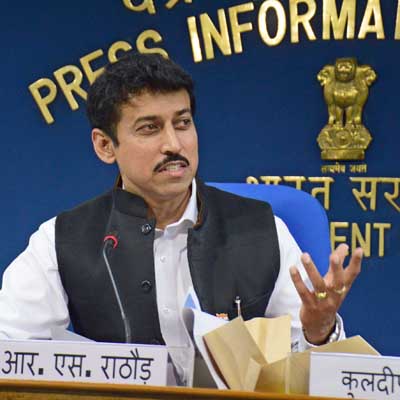
    NEW DELHI: Minister of State for Information and Broadcasting Rajyavardhan Rathore today said that the government was rigorously working towards providing a seamless work environment for the film industry by establishing a single window clearance mechanism.


    Inaugurating the India Pavilion at the Cannes International Film Festival in France today, he said a centre of excellence for gaming and visual effects had been announced. The government would do its best to be an infrastructure partner and would like to have faculty coming from the industry itself and looks forward to more faculty exchanges. 


    Rathore said, “India had already signed coproduction agreements with a slew of countries. In the last one year, five co-productions had been undertaken with France alone. We need to take these partnerships to the next level now.”


    He said the film industry is an important part of campaigns like ‘Make in India’ and ‘Skill India’ given its tremendous potential towards job creation. 


    The session also saw unveiling of the 46th IFFI 2015 regulations and ‘India Film Guide’ by the Minister.


    The India Film Guide is a comprehensive booklet with information on policy initiatives by the government pertaining to film sector, the listing of Indian companies at Cannes Film Market, Indian Films at Cannes and contacts of important people in the business of filmmaking. 


    The session was attended by Indian Ambassador to France Mohan Kumar, Bobby Bedi, Nandita Das, Karnataka Information and Public Relations Minister Roshan Baig, I&B ministry joint secretary (films) K Sanjay Murthy and Film Federation of India former president Ravi Kottarakara. 


    Bedi in his welcome address said, “India’s presence at Cannes had increased tremendously over the past decade and we have seen an increase in representation in terms of quantity and an improvement in the quality of content as well.”


    Kumar added that the aim should be to get Indian films in the most important category of films at Cannes. He added that over the next two to three years he would strive to work on that. The quality of films from India had been rich in content and quality. 


    Kottarakara felt that India has on offer some of the best shooting locations. “There has been a tremendous change in the Indian film landscape and the sector is definitely going to grow by leaps and bounds. We should try to experiment more to have a wider global acceptability. Also, India’s linguistic cinema which includes films in Tamil, Malayalam, Bengali, Marathi, Bhojpuri are as good as mainstream Bollywood films and should get an equal opportunity to be showcased,” he said.


    Talking about the much-debated issue of censorship in India, Das said, “As we mature, it is important to promote freedom of expression rather than curtailing voices.”


    On his behalf, Baig suggested that it will be great if the regional film industry is showcased as a part of the delegations to some of the major international film festivals.


    Murthy added that over the next few days,he hoped to learn from various film commissions and carry back new partnerships and learning experiences.

  • “Govt. doesn’t recognise the importance of cinema”: Subhash Ghai

    “Govt. doesn’t recognise the importance of cinema”: Subhash Ghai

    Born to a dentist father in Delhi, Subhash Ghai entered the film industry in 1970 after attaining his diploma from Film and Television Institute of India (FTII). The film director, producer and screenwriter, known for his works predominantly in Bollywood has given notable films like Kalicharan (1976), Karz (1980), Hero (1983), Meri Jung (1985), Karma (1986), Ram Lakhan (1989), Saudagar (1991), Khalnayak (1993), Pardes (1997), Taal (1999) and Black & White (2008).


    In 2006, he set up his own film institute Whistling Woods International in Mumbai. The institute trains students in filmmaking: production, direction, cinematography, acting, animation. Ghai has done brief cameos in his directorial ventures.


    Mukta Arts managing director Rahul Puri spoke to Ghai to know about changing times, new vertical of the business, the market scenario and much more.


    Excerpts:


    Tell us about the differences in the film industry today from when you joined? How has the influence of branding and other media (like television and digital) changed the way that the film industry is perceived now?


    The main difference in the film industry is that now it has become broad in terms of media, technology, and communication from what it was in 1970s. Earlier in 70s, films were the only mass media to entertain people whereas today there is a huge growth in terms of content and reach in television, radio, digital and social media, which has taken entertainment to a different level. Nowadays, branding has become ‘THE’ thing for today’s generation. A sports man, a fashion designer or a chef, everyone has turned themselves into brands and tell me who hasn’t? Film industry might be only one dimension of the entertainment world, but it still holds a major importance and impact in media.


    The film industry continues to be iconic yet the size and scale of the industry is comparatively smaller than many others. Is the mindspace the industry occupies today in terms of influence and marketing justified? 


    No. The film business is a showmanship and a business we term as ‘Showbiz’, which influences all other industries like television, digital, music, events, fashion, and festivals with a big dividend. So, if you have a look at the film business in the theaters, it is very discouraging. But on the other hand, we are also involved in other aspects of media business such as satellite rights, music, events, branding, franchising that brings more money than theater business. Henceforth, marketing has become a bigger gamble to attract initial draw towards theaters and even to other aspects of media. 


    Where do you see the film industry reaching in the next decade? Will this growth/change come from new content or new delivery platforms (digital/theatres/mobile)? Where is the best hedge for risk in the industry today?


    Film industry always survived because of its bigger frame images in cinema halls. Cinema experience is a social bonding for people, it is a collective gathering, it is an event, a festivity! It can cover many weekends if the movie is really brilliant, and to create its presence such films run in maximum theaters. And now with the changing technology and improving higher standards, we will see a drastic change in theaters with 180/360 angle big screens to draw audiences from their homes. 3D, 4D and 5D theaters, mobiles, big watches and so on, the digitisation will bring Rs 100 crore to Rs 200 crore on first day of release in theater and television screens simultaneously. Content will be improvised accordingly, and more fantasies genre will be touched upon as I firmly believe that ‘a child in a man will never die’.


    People talk about a new type of content coming into to Indian films. Is this a hype? Are we actually telling newer stories or is the format of our storytelling changing but the core remains the same?


    Content keeps developing with time. Film content will soon adapt the following and some of which are already taking place such as:

    1.     Real life issues/biopics
    2.     Super star fantasies in mainstream style treatment
    3.     Science fiction
    4.     Animation – mythology/kids fantasies


    India has a lot of rich content in terms of stories in its heritage; soon, maybe by 2015, it would dominate internationally with its content. Though, it is said that there are only 36 plots in human drama, Shakespeare and Mahabharta says it all.


    There is a trend today about remakes. Some of your own films are being remade. How do you feel about that and do you think the remake trend is causing original content to suffer?


    Honestly, if you ask me I think nothing is original. Art itself is an imitation of universal existence and its various versions thereafter. A film like Aurat in 1940 was made Mother India in 1957 which was remade as Dewaar in 1975. We all should look at remake as an adaptation, transformation, inspirations of same plot which touched millions of hearts and souls… and the adaptation from a different filmmaker’s perspective makes the content looks fresh. Every remake comes with new packaging as ‘old wine in a new bottle’, but only classic stories will be repeated like our epics which are evergreen.

    What is the key to being successful in the content creation business? There are so few people who are able to sustain it. What do you attribute your success to?


    According to me the key factors are – develop your skill for the business, do market research, have a talent for ideation and innovation! My quest is to observe life and to present current and old dishes in new plate and that is my strength.


    You are very active on social media platforms. What do you feel is the benefit of this media and is it really something that will revolutionise marketing of entertainment?


    My only personal factor in being active in social media is to connect with the people I do not know as it widens my horizon and I can express directly to them. So we talk about our work to people and take feedback from strangers too, it develops your skill to improve as well. Such open platforms are good ways to communicate.


    What are your hopes from the new government, both at the centre as well as in Maharashtra. The film industry, as mentioned, is iconic in brand and has a lot of brand value but this doesn’t always deliver incentives to the industry from the government. Do you think this will change?


    Unfortunately, the government at the center or state level has never recognised film industry what it deserves, they don’t share the vision as it can be powerful media to influence people. It’s a major device to develop a culture in children of tomorrow. With the government, it’s not only the financial issue; it’s the issue of recognition of ‘importance of cinema’ that the government needs to look into. Please study what American cinema has done to its own country and how it has influenced other major countries and India is nowhere close to it, yet. Cinema speaks about your country, culture and brings tourism and business.


    The government has set up a new Skills Ministry. Given your involvement with education at Whistling Woods, what do you think will be the benefit of this to the film industry?


    This is the first positive step taken by the new government, which brings big hope to fulfill my dream to see India to be known as the ‘Big Think Tank’, an ‘ideator’ rather than just a doer. Whistling Woods has been doing this since its inception in 2003. If you look at most of our alumni, they all are actively working towards bringing a new change in cinema and media industry.  They are doing brilliant in their respective cinema and media jobs. I only hope and wish that government should be able to recognise this soon.

  • Bollywood pins hope on the new Maharashtra government

    Bollywood pins hope on the new Maharashtra government

    MUMBAI: As the new Maharashtra Chief Minister took oath to serve the state, the Film and Television Producers Guild of India has come up with a list of issues and challenges the industry currently faces. 


    The entertainment capital of India – Mumbai has been the centre of the Indian entertainment industry since its inception and this industry provides employment directly or indirectly to almost 5 million people in the country. However, serious implications caused by the various archaic laws and heavy burden of taxation on the Hindi film sector has stunted the growth of this industry and made several stalwarts displeased with the system, said the statement issued by the organisation.


    According to the Film and Television Guild of India, the high taxes imposed on the Hindi film industry in the state, like the Entertainment Tax on films, applicability of VAT on television production business and stamp duty to keep local bodies taxes out of the proposed GST, have cast a dark spell for the ‘Film Guild’.


    The absence of single window mechanism has resulted in systematic harassment and malpractices over the years, and has increased costs for the producers thereby significantly discouraging producers from shooting in the state. In addition to this, the lack of adequate cinema halls in the state (much lower than southern states) has hampered the growth of the film industry and directly resulted in increase in piracy and loss of revenues to the government, as well as the industry, states the guild.


    These issues are not only detrimental to the growth of the industry but will result in an inevitable breakdown of the entire film industry, it added.


    Speaking about the various concerns weighing down the sector, Film and Television Producers Guild of India president Mukesh Bhatt said, “Maharashtra has always been the home for the Hindi film industry. Sadly, we have been made to feel like an orphan in our own home state. Leave aside any support; we are penalized for making films in a language which does not belong to any other state in the country including Maharashtra. The impartial treatment given to Hindi film industry in our own state in the past is obvious when it comes to the high tax structure, archaic laws and multiple complications restricting growth of the film industry in the state.”


    However, showcasing hope in the new chapter of Maharashtra politics, he added, “We are confident that the new BJP government in Maharashtra will address these pending issues and help the film industry achieve newer heights.”


    Mumbai has been the dream city for a lot of Bollywood actors, who have carved their space in the history of cinema and in the hearts of their fans over the years. It’s time that the entertainment industry is rewarded for all these years of service to the people and required changes be made in the system, as they hinge their hope on the newly elected BJP government.