Tag: Fifa World Cup

  • Brazilian Coach Luiz Felipe Scolari leaps ahead in online popularity;emerges as the most searched coach on Google

    Brazilian Coach Luiz Felipe Scolari leaps ahead in online popularity;emerges as the most searched coach on Google

    MUMBAI: FIFA World Cup is well underway and the host country, Brazil, has notched up their first win, beating Croatia on the opening day of the 2014 FIFA World Cup. Joy, excitement and thrill – the feeling is ubiquitous among the fans during each battle; as their favourite teams and players play in the biggest football tournament in 2014.


    Roaming anxiously on the side-lines, formulating and implementing strategy and tactics on a real-time basis and commanding the team, the national coach plays a key role in enabling optimal performance by his team and more importantly ensuring the only thing that matters – a win!


    Naturally the media and fans interest and attention on national coaches is almost as much as it is on the players. With the World Cup now well underway, Google search trends reveal some interesting insights on some of the top national coaches in tournament history.


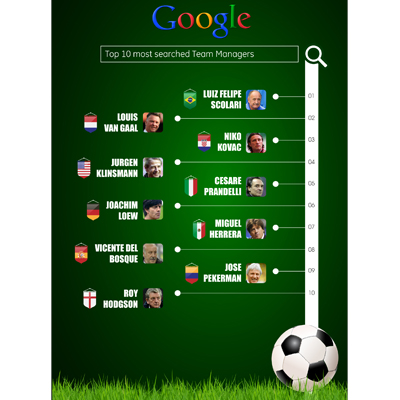
    Based on Google search trends for past two weeks, here’s a list of the 10 coaches who are being searched by fans.


    Looking to build on the success of last year’s Confederations Cup triumph, Brazilian coach Luiz Felipe Scolari remains the most searched among the coaches of all the teams participating in the 2014 FIFA World Cup on Google. Luiz is serving a second spell as Brazil’s manager after winning the World Cup with them in 2002.


    Netherland’s Coach Louis van Gaal is no doubt one of the finest managers in world football. Staging a humiliating defeat in the group match against Spain, he has already impressed football fans both offline and online taking the no. 2 spot on the list.  


    Coratian Coach Niko Kovac appointed last October has been successful in getting the right connect with the fans and players. Kovac who stood at third position on search popularity appeared in three World Cups as a player and captained Croatia in 2006.


    The US men’s soccer national team may not be among the top 10. However US team’s Jurgan Klinsmann is the fourth most searched coach with his constant attempt to overhaul this USA side. Appointed in 2011 as the Coach of the USA national football team, Klinsmann was a key member of the West Germany side that won the 1990 World Cup.


    Following their group stage exit in the 2010 World Cup, Italy has worked a long way under Coach Cesare Prandelli. Ranking fifth on the search populairty chart he recently signed a two-year contract extension that will take him through to Euro 2016 with the team.


    Others leading coaches who peaked on the online front with high search popularity included Joachim Low, Coach German Football team followed by Mexico’s national coach Miguel Herrera and Spanish coach Vicente del Bosque.  Colombian Coach Jose Pekerman and English Coach Roy Hodgson.


    Interestingly, the coaches largely do not hail from the countries they are coaching. Eighteen of the 32 teams have coaches from their own country. Fourteen teams are in the hands of foreigners.

  • Football is a game not be spoken, but seen:  Vinit Karnik

    Football is a game not be spoken, but seen: Vinit Karnik

    FIFA being a marquee event that happens once in four years is certainly growing in India in terms of both viewership and fan following. The non-followers also contribute to the viewership along with the core football following lot. A high quality and closely fought game will lead to a bigger audience base and this is what we should aim from this tournament.

    FIFA as a property has performed well in the last two editions in India. And with the buzz around football growing in India, this edition is expected to perform even better. With Sony Six launching two football shows, there has been a huge media hype created around the game.

    With properties like the IPL and now the FIFA World Cup in their kitty, this should provide the head start the channel is looking at but unlike the IPL, football is less of entertainment and is more structured. It is a game that is to be seen rather than to be spoken about.

    From a marketers’ POV, a good performance by the property is good news as it opens doors to a newly found consumer passion point for them to leverage. With Sony Six tying up with restaurants like Hard Rock café football today is clearly a gen-next sport. My estimation is about a younger audience getting engaged to the sport. Eight year olds, 10 year old as well as 14 year olds have been captured by the spirit of football.  And such tie ups help groups to come together and enjoy the game.

    Any engaging show on football will help build hype around the sports will eventually help to increase the audience base. With a huge fan expected now, it will also help the Indian Super League which slated to begin in September. The ISL is a brilliant combination of investment and money by corporate sand celebrities. This will be a big developmental aspect for the game in India and I am sure this will go a long way in promoting the game at the grassroots level which is where most of the football fans are based.

    (These are purely personal views of GroupM ESP national director – Entertainment, Sports & Live Events Vinit Karnik and indiantelevision.com does not subscribe to these views.)

  • DD’s FIFA offering

    DD’s FIFA offering

    NEW DELHI/MUMBAI: Reaching out to a wider audience so that the FIFA fever isn’t missed by all, India’s public broadcaster Prasar Bharati has got into an agreement with official FIFA World Cup broadcaster Sony Six.


    The deal is mandatory under the Sports Broadcasting Signals (Mandatory sharing with Prasar Bharti) Act 2007 for telecasting a few games of the mammoth event.


    These games include the opening ceremony (which was telecasted yesterday), the maiden match (played out between Brazil and Croatia), two semi finals and the final match.


    However, DD will be showcasing different advertisements during the simulcast of select matches.


    Officials from Sony Six confirmed saying that since FIFA World Cup is a mandatory listed event under the mentioned Act, therefore it had to share its feed with the pubcaster.


    Surprising, the marketing department of DD quoted higher ad rates than those quoted by Sony Six for a 10 second slot. Therefore following the modalities that come under the Act, DD will retain 25 per cent of the ad revenues while 75 per cent will be handed over to Sony Six.


    Meanwhile, keeping at bay all apprehensions,  the World Cup opening ceremony finally got off to a colorful start with American singer Jennifer Lopez along with rapper Pitbull and Brazillian singer Claudia Leitteto belting out the  official World Cup song  “We are One” together on stage.


    Kids who were draped as football referees created formations around a giant LED flower in the center of the stadium that displayed Brazillian colours and many languages. The famous Brazilian dance, Samba, was showcased as men and women in fancy colours put their best foot forward. The opening match between the host country Brazil and Croatia ended with a 3-1 victory with Brazil winning it. The lone goal for Croatia was only because Brazilian defender Marcelo scored Brazils own goal in the 11th minute.

  • Anthems to raise football fever

    Anthems to raise football fever

    MUMBAI: When an energetic game like football and music collide, it’s a magical treat for fans.


    In a country where cricket is a religion, official football songs and anthems have been instrumental in getting the fans together. During the 2010 WC Waving Flag by K’nan and Waka Waka by Shakira saw fans cheering and dancing to the popular chartbusters even before the commencement of the tournament.  A hit at parties and sports gatherings, helped more fans on board.


    This year, there are three top anthems generating enough and hype.


    The biggest hit has been from international pop icon Shakira who is seen gyrating to the unofficial FIFA anthem La La La (Brazil 2014). The Columbian’s second World Cup anthem features her 27-year-old beau and Spanish footballer Gerard Piqué alongside other players like Radamel Falcao, Cesc Soler, Sergio Aguero, James Rodríguez, Eric Abidal, Neymar and Lionel Messi. But the star of the video is none other than, Shakira and Gerard’s son Milan. The official video on her YouTube channel has so far garnered close to 100 million views.


    The video is not just limited towards promoting the game but also has Shakira and Activia coming together to support the World Food Programme (WFP).  According to online reports, Shakira and Activia will be donating funds to support the WFP’s School Meals Programme, which will help deliver around 3,000,000 additional school meals for children in developing countries.

    Meanwhile, the official anthem called We Are One (Ole Ola) of the mega event will see international rapper Pitbull and Jeniffer Lopez coming together, again.


    Though the video has famous Brazilian landmarks and footballers, it has not gone down too well with the host country’s citizens. Brazilians are unhappy that the video is devoid of local notes and flavor and the focus in mainly on creating another ‘Waka Waka’.


    Not to forget, the Ricky Martin’s Vida which has got close to 15 million views on his official YouTube channel. The video is a mosaic of people coming together to celebrate the spirit of football on the sun kissed beaches of Brazil.


    Now with three songs in the fray, it remains to be seen which one succeeds in remaining at the top of the charts till 13 July when the WC culminates.
     

    Click here to watch Pitbull Official FIFA Anthem

    Click here to watch Shakira FIFA Anthem

    Click here to watch Ricky Martin FIFA Anthem


  • Sony Six launches two shows for 2014 FIFA World Cup

    Sony Six launches two shows for 2014 FIFA World Cup

    MUMBAI: Sony Six, a sports and entertainment channel from the Multi Screen Media (MSM) bouquet, on account of the 2014 FIFA World Cup has announced the launch of a flagship prime time football wrap around show ‘Cafe Rio’ and an invigorating live breakfast show ‘Football Extraaa’ on all match days.

    It comes with the promise of encapsulating the most interesting and entertaining aspect of the tournament.

    True to the channel’s philosophy of staying inclusive, the shows will captivate both the football purist and the fringe viewers. The shows will feature some of the most eminent names from national and international football as studio guests including Peter Crouch, Robbie Fowler, Peter Shilton, Mikael Silvestre, Ellyse Perry, Sunil Chhetri along with Bollywood star and football enthusiast John Abraham interacting and analysing the game.

    Sony Six business head Prasana Krishnan said, “2014 FIFA World Cup is the biggest and most anticipated football tournament of the world and keeping with the scale of the tournament we are excited to present to our viewers the most renowned and eclectic line up of current and erstwhile football stars as studio guests. I believe John’s presence will render our show a generous dose of glamour and entertainment while the guests will bring in a lot of wisdom and insight, offering our audience an unmatched primetime football viewing experience. The hosts and experts on the shows are sure to keep the audience assimilated and glued to their television sets.”

    Coming on board as a studio guest John Abraham said, “I am really excited to be a part of ‘Cafe Rio’ the prime time wrap around show on Sony Six. It’s a great platform where you can see me interact and analyse matches with some of the greatest legends of football. I am sure with this convenient match timings and great line up of shows, the viewers will be glued to Sony Six to watch their favourite teams sweat it out.”

    The two shows come with their own unique flavours, with ‘Cafe Rio’ a live primetime show at 8 pm leading up to the match kick-off at 9.30pm is a blend of sports and entertainment, the show entails interesting facts about victorious teams, historical venues and stalwart players along with in-depth analysis and discussion about squads, player forms, group standings and strategies.

    The live breakfast show ‘Football Extraaa’ is a daily morning round up show for viewers to relive the excitement and fun of the previous day matches. The breakfast show will be telecast between 8.00 am and 9.00 am and will review and provide in-depth analysis of the earlier matches. This show will also be interactive where audience can dial in and share their perspective or ask questions to our studio guests.

    The set has been designed to replicate the essence and the fervour of Brazil’s animated and lively carnival, simultaneously evoking the sheer magic of the game. The dynamic palate of colours integrated into the set resonate the Brazilian spirit and passion for football. As an endeavour to enable the audience to experience the magic of 2014 FIFA World Cup, the set reflects the football mania with portraits of eminent players and a background that recreates the ambience of a stadium.

  • Get Glued To GOAL: The Ultimate Football Extravaganza On Zee News

    Get Glued To GOAL: The Ultimate Football Extravaganza On Zee News

    MUMBAI: It’s action time once again. The biggest sporting extravaganza of all time ‘FIFA World Cup’ is all set to kick start soon and all you football freaks can rejoice as Zee News will give you all the latest updates and interesting action from FIFA World Cup 2014, straight to your TV screens through its new programme- GOAL! which is to be telecast daily at 8.30 am and 6. 30 pm respectively.

    New Delhi, 05 June, 2014: It’s action time once again. The biggest sporting extravaganza of all time ‘FIFA World Cup’ is all set to kick start soon and all you football freaks can rejoice as Zee News will give you all the latest updates and interesting action from FIFA World Cup 2014, straight to your TV screens through its new programme- GOAL! which is to be telecast daily at 8.30 am and 6. 30 pm respectively.

     
    Ongoing with the sporting extravaganza, Zee News is the only Indian television channel that has associated with Mr. Shobhan Saxena (the only journalist of Indian origin in Latin America) who is going to share exclusive report & minutes by minute’s developments from 11th June – 15th July from Brazil to millions of football enthusiasts in India.


    Amid the growing popularity of football in the country, the program is an endeavor by Zee Media Corporation Limited to provide a platform to the football enthusiasts to watch, participate and rejuvenate with every aspect of this great game loved by millions worldwide.


    A total of 32 teams from across the globe will participate in the event which will be held from 12th June to 13th July in Brazil. This much awaited, high-on-adrenalin, sports event would be played across 12 venues of the country.


    Zee News, a part of Zee Media which is one of the largest and leading media houses in the country is planning to showcase the largest football coverage of this mega sports event. Speaking on this occasion, Mr. Sudhir Chaudhary, Editor, Zee News said, “The channel has lined up interesting programming throughout the day, like- best goal of the day, top players, etc along with a dedicated half an hour special segment in the evening. Viewers can watch the highlights of the World Cup through the 30 second vignettes on upcoming matches-Top 5s: Top 5 Goals/Top 5 Saves/Top 5 Players, Goal of The Day and general stories on the venue, Brazil and its culture and climate.”


    All these will be telecast under the umbrella of GOAL, which will be a one stop programme for all you need to know about the FIFA World Cup 2014. The programme will also provide a peek in the past, the famous clashes of yester years and controversies associated with it. ‘GOAL’ will also keep you updated about who is in the running for “Golden Boot” and the most valuable player of the tournament.


    Elaborating in details about the programme, Mr. Rohit Kumar, Vice President Marketing, Zee Media Corporation Limited said, “Though India is a Cricket crazy country, millions of people also follow football very closely. The programme “GOAL” is an endeavour to broadcast all the elements they want to watch or know about Football World Cup 2014. The programme is packaged in a manner that it is a must watch for  football freaks”.


    So let the fervour and passion for football run high as Zee News calls upon football enthusiasts, to join the ultimate football extravaganza on GOAL!

  • FIFA World Cup coverage promises to be a game-changer

    FIFA World Cup coverage promises to be a game-changer

    NEW DELHI: Unlike the 3D that dominated the best viewing of the last FIFA World Cup, the second biggest tournament on the global sporting calendar after the Olympics, the entire media is concentrating on 4K and even more superior technologies.


    Bedeviled by significant infrastructure problems that have reached all the way from the airports that will receive the international arrivals to the stadia of the 12 host cities that will stage the games, hamstrung by the communications problems caused by an overloaded telecoms system and marred by protest and unrest, broadcasters the world over have learnt the painful lessons that modern Brazil is at best an awkward place to operate in.


    With the tournament just around the corner (12 June- 13 July in Brazil), the consensus is that host broadcaster HBS has done its best in ensuring diversity connections and implementing an impressively redundant form of production that has seen 12 identical, containerised production centres built in Germany and shipped over to Brazil.


    Moving equipment around the country, especially after the group stages are over, was always going to be a major problem, and it is one that HBS has decided it does not want to be involved with. All of which is part of the reason why EVS loaded 234 servers on a container ship bound for Rio sometime in March. But it is what some of those servers are doing when they are installed that is probably the real story from Brazil 2014.


    Apart from the Ultra HD effort, it is remote production that this year’s World Cup really moves the goalposts. Not just simply an add-on, remote production lies at the heart of the HBS production workflow in Brazil, according to a report by the National Association of Broadcasters in the United States.


    16 EVS XT3 servers are to be installed at each venue and, alongside them, two of the company’s C-Cast Agents which represent the sharp end of its connected content production architecture.


    C-Cast Contribution will be used to link the IBC and the 12 venues across the country together, live streams passing through the two C-Cast Agents at each venue where they will then be transcoded and transferred into an Amazon Cloud-based infrastructure. About 45 seconds later at the most they will then hit the C-Cast Central servers, which will then govern the material’s distribution on the network. This means passing the footage on to the Adobe Premier-based HBS production teams (there are 36 Premier suites in the IBC) and other rights holders at the IBC and further afield too. The servers automatically generate proxy files, allowing the various remote teams to access content at low resolutions, create clips and then import a high bandwidth version.


    “I think in total there are 75 media rights licenses distributed for the IBC in Rio, and in addition there are offsite production teams that have web browse access from their own home cities, and there are 83 licenses distributed so far for that,” comments EVS SVP Marketing Nicolas Bourdon.


    There have probably been more distributed, as this is far more than just a plain vanilla distribution of the nine feeds from each venue round the world. Mirroring the way the C-Cast second screen app works, the remote teams can add content — including camera angles and highlights — that have not been made part of the world feed into their coverage, switching it from a gallery as if they were in a truck outside the stadium.


    With this new solution, the number of broadcasters deciding to ‘dial-in’ from their home territories into the FIFA MAX server in Rio makes it feel like a genuine game-changer.


    FIFA’s estimates are that around 50 million people will be downloading its official application, which is being white labelled and has been picked up by more than 100 rights holders so far.


    “Broadcasters can have a white label app that they can put their own logo on,” explains Bourdon. “Viewers can then access different types of content, up to six live camera angles, clips and key actions from a game, statistics, and a full language translation of all the logs and captions.”


    C-Cast Central manages availability of material via APIs, and while the white label smartphone and tablet apps, not to mention a customisable web player (based around deltatre’s Diva system), are proving popular, many of the major broadcasters around the world are folding the multiple C-Cast streams into their own fully-featured apps. Add these figures to FIFA’s 50 million and you undoubtedly have the biggest outing yet for the technology.


    Content will reside on an Amazon server farm controlled by EVS from where it will be passed to deltatre’s platform (deltatre is also the main data provider from the tournament). From there it will be either be encoded for delivery using Elemental technology over the Akamai CDN or, if the stream is to be integrated into a broadcaster’s own efforts and a third-party CDN, via the Microsoft Azure cloud platform.


    Expect to see some interesting new features crop up too. HBS will be using the as yet unreleased C-Cast 3.0 out in Brazil, with the idea that this will then be productised into C-Cast v3.1 in time for IBC.


    Four years ago, Sony was limbering up to broadcast 25 matches from South Africa in stereo 3D. Measured against that, the 4K effort for Brazil 2014 seems relatively minor: a mere three matches being captured in the format, all from Rio’s Maracan? Stadium.


    However, the significance is the same: the company is using the World Cup to seed demand for the format that it hopes will break through to the mass market by the time of the following Olympics. Maybe this time it will work.


    4K trials — indeed trials of pretty much all of the World Cup workflow — were held at the Confederations Cup last summer and though the Telegenic truck that was shipped from the UK for them isn’t available this summer, the crew will still be sourced from the British OB provider, albeit working in a 4K-capable Globocast truck.


    The matches will probably represent the most comprehensive coverage afforded a 4K production yet, with 12 Sony F55 cameras slated for each game and a number of the speciality cameras from the standard HD broadcast also being upconverted for the occasion.


    It seems that the final will now be actually broadcast in 4K format as opposed to being simply beamed into cinemas or destined for a souvenir film for online distribution. Names are not being discussed as yet, but it seems that there is a queue of interested broadcasters and, according to Sony, “More than one will broadcast the feed.”

  • Coca-Cola is all set to bring the Football Frenzy to India

    Coca-Cola is all set to bring the Football Frenzy to India

    MUMBAI: The Countdown has begun for the arrival of the ultimate FIFA World Cup™ Trophy Tour by Coca-Cola in Kolkata.


    Football fans will get a chance to dive into the madness of Football and be part of Football history with a once-in-a-lifetime photo op with the original, solid gold FIFA World Cup™.


    The Trophy is currently in Bhutan and is all set to fly to Kathmandu tomorrow, following which it will be coming down to Kolkatta for a 3-day football festivity


    Over the last one month, Kolkata has been living the football madness with celebrations across city paras and communities as part of Coca-Cola’s 2014 FIFA World Cup™ Campaign. Special events were held across the city in celebration of Kolkata’s passionate love for the game. Thousands of fans got the opportunity to win tickets to a special Trophy interaction open for consumers, to be held on 23rd December.


    The FIFA World Cup™ Trophy Tour by Coca-Cola is on its longest journey to date, visiting 88 countries over a span of 9 months.


    On this third global FIFA World Cup™ Trophy Tour by Coca-Cola, World Football’s greatest prize will be travelling 149,576.78 km (That’s 3.75 times round the world!!) reaching to over 800,000 people with this special Football experience.

    Did you know these facts about the Trophy ?
    · The Trophy bears the engraved years and name of each FIFA World Cup winner since 1974
    · The authentic, one of a kind FIFA World Cup™ Trophy weighs 6.175 kg and is made of solid 18ct Gold
    · The Trophy cannot be won outright – The winners receive a gold plated replica
    · The Trophy can only be held by former winners, current winners and the heads of State

  • HS&E join forces with Music Dealers

    HS&E join forces with Music Dealers

    MUMBAI: Brand engagement network, Havas Sports & Entertainment (HS&E), and Music Dealers, an international music licensing agency, have announced a global strategic partnership to provide an innovative music offering for brands interested in effectively integrating music into their communications. India will also be extended this offering.

    This partnership forms part of HS&E’s strategy to strengthen its brand engagement and entertainment services by providing clients with unique music industry expertise and guidance as brands look to develop more unique and meaningful content.

    Chicago-based, with offices in the US, Mexico City, and London, Music Dealers’ extensive knowledge of the global music industry, coupled with a roster of more than 20,000 emerging artists spanning 80 countries, complements HS&E’s global footprint of 35 offices in 20 markets. Music Dealers is helping provide HS&E’s extensive client portfolio with a wide range of specialised music-related communications services including content creation, strategic music programs with the freshest breakout artists, brand music partnerships and live music activations among others.    

    In addition, HS&E and Music Dealers are currently working together to engage fans around a number of large-scale events for mutual client, The Coca-Cola Company.

    Through its experiential marketing arm ignition, HS&E is organising Coca-Cola’s sponsorship of the Olympic Torch Relay for the 2014 Sochi Winter Olympic Games to bring the Olympic flame to Russian fans in 2,900 towns and cities across 123 days. As the strategic music lead for Coca-Cola’s Olympic Torch relay, Music Dealers is supervising the creation of the official Coca-Cola Olympic Anthem, as well as live music performances throughout the relay. 

    For the 2014 FIFA World Cup, HS&E, through ignition, is also organising the FIFA World Cup Trophy Tour on behalf of Coca-Cola, which will travel to 95 destinations in 86 countries, while Music Dealers will be creating adapted versions of the official Coca-Cola World Cup anthem using local artists from select key markets. 

    HS&E president and global CEO Lucien Boyer comments, “We are delighted with this unique collaboration that will provide our mutual clients with an unprecedented global offering in the areas of sports, music and entertainment marketing. Brands are looking for content that creates conversations and connections with people. As such, we look forward to helping them leverage music in innovative and locally-relevant ways, thanks to Music Dealers’ unrivalled industry knowledge and our understanding of fan communities. Our common entrepreneurial spirit and global reach will help us expand the reach of music and create personalized experiences that meaningfully engage fans everywhere.”

    Music Dealers CEO and co-founder Eric Sheinkop comments, “Music Dealers provides the most authentic music for today’s advertising and marketing, television, film and gaming industries, while breaking new bands across the globe. We’re honoured and excited to be working with such an experienced and trusted network as Havas Sports & Entertainment to provide brands with ways to maximise the power of music to engage their audiences across multiple communication platforms. From discovering and sourcing the best artists and music through our Discovery Tool to receiving bespoke creations via our professional crowdsourcing community, this partnership is one of many exciting new initiatives from Music Dealers which reinforces our vision of creating more value for brands through music.”

  • “We will focus on compelling sports content, across multiple sports and languages”

    “We will focus on compelling sports content, across multiple sports and languages”

    By the end of 2011, Star had clearly established itself as the premier entertainment network in India and for Indians worldwide, with 400 million people watching our drama and movie channels in seven languages every day. In one of the most competitive markets in the world, we had established substantial leadership in every genre and in most geographies.And while Star and Fox had built an attractive franchise in entertainment, in sports, very unlike our traditional approach, we had tucked the business away in a joint venture with ESPN that was not managed or controlled by us.
     

    Starting in April 2012, this started to change. We acquired the rights to India’s international cricket calendar that month; a few months later, our parent company bought out its partner from the ESPN Star Sports joint venture in Asia with the intent to roll the Indian part of the joint venture into Star; we launched two new domestic leagues in university cricket and hockey; and we renewed the rights to English Premier League football with a substantive bid. All in all, we invested a billion dollars in less than six months.As a result, by the end of 2012, we had established ourselves as India’s leading sports broadcaster.

    So, why did we get aggressive on a business where the traditional wisdom is that no one makes money?

    Many experts mused loudly that Star had found a way to quickly kill a highly profitable franchise built on leadership in entertainment across genres and languages. I still run into these questions every day. Just two days ago, a leading Indian business daily ran a big story wondering why Star had entered a business that usually never makes money. After all, one sports broadcaster had gone bankrupt trying to pay the bills for the Indian cricket rights, another is struggling to break even and yet another is trying to run a sports business without much sports content. Why would Star make such a big, bold move particularly at a time when the overall

     sentiment on the India story has gone cold?

    So, again, why did we do this? Did we lose the plot?

    In order to answer this question, it is important to take a close look at a few facts, some conventional wisdom and many myths that surround the Indian sports business.

    Everyone in this industry knows one thing. India is a single sport country. It is a country where cricket is a religion, where passion for the game is deep and where the country shuts down when the national team is playing.

    And yet, this is only half the truth. Even for a big match where India plays arch rival Pakistan, consumers do not view the entire match, they view only 15 per cent of the match on an average. The reality outside of really big tournaments is even starker. Out of more than 1000 hours that an Indian viewer spent watching television last year, only 20 hours was on cricket, about 2 percent.This is actually less than the time spent on a single successful show on Star Plus!Consumption of domestic cricket is even worse. Although matches are played round the year, only 50 matches are broadcast on television in a year.And very often, the best of the country’s talent do not participate in these games.

    Imagine if soccer crazy England manifested its interest in the game only by watching the FIFA World Cup once in four years and only really paid attention when England played Spain or Italy. That is the equivalent of India’s current state in cricket viewership. In fact, until the Board of Control for Cricket in India introduced the Indian Premier League, there was not even a domestic league, the equivalent of an EPL or an NFL.

    So, India is not a single-sport country, it is at the moment a zero-sport country that occasionally follows 11 Indian cricketers when they play a big marquee tournament.

    For us, though, the more interesting question is why this happened, and what has led to the current state of affairs. We believe that the biggest culprit is the Indian sports broadcaster. Let me explain why.

    A big shift happened in the last twenty years in cricket in the profile of its followership. It moved from being a sport for the urban elite to one that has a mass following across the country.The BCCI deserves credit for this transformation by making substantial investments to improve the quality of stadiums and infrastructure around the country.Today, some of the country’s best cricketers come from outside the large cities; and small towns host international matches on a regular basis. It is also a country where less than 1 per cent of the population has actually watched any sport in a stadium.

    And, yet, sports broadcasters have not made any effort to make their programming more relevant to the new audience.

    In a country where less than 10 per cent of the population understands English, and a much smaller number are native speakers, sports broadcasters programmed only in one language: guess which one? English. This, despite the fact that everyone knew that the big growth in entertainment consumption in the country came when programming on satellite switched to Hindi and other local languages. And even for the very few that actually understand English, it is quite a world they have to navigate to understand the diversity of commentator accents on television: from the Westernised Indian accent to the local Indian accent to the Aussie accent to the Kiwi accent to the Scottish accent to the West Indian accent. It is almost as if the sports broadcasters were not relaying sports, they were running extraordinarily painful accent training programs on television for the very small English speaking audience that came to watch in the first place.

    The pain did not stop there. Around the world, sports graphics is used to bring the game closer to the viewer and to help the viewer understand the game. Yet, in cricket, graphics is more a nuanced tool meant to tickle the sensibilities of the few deep masters of the game, not the 99 per cent of the country that has never even been to a stadium. The same story extends to television commentary too. Rather than being the anchors of the game who explain the game and bring the excitement of the stadium to the viewer’s living room, the cricket commentator is invariably an expert talking to his peers.

    It is no surprise then that the Indian viewer does not spend much time on sports on television.

    But, it would be unfair to put all the blame on just the sports broadcaster. The broadcaster has had many fellow partners-in-crime in ensuring that sports viewership remains miniscule.

    It’s biggest partner has been the cable and satellite platform. Around the world, sports have been a huge driver of revenue and profit for pay television operators. In India every operator complains about the low ARPUs they get from the business. And yet, instead of using compelling sports content to get more money from consumers and reduce churn, the cable and satellite operators make it difficult for their subscribers to discover and develop a habit of consuming sports.

    And this attitude shows up in the distribution of sports channels, which are treated less like the mass product that they should be, and more as premium add-on products for a small, rich, niche audience.

    To make matters worse, these platforms turn off the channel when a marquee event is not on. While this may have made sense in the old, bandwidth-limited analog world where you could only put 20-30 channels, it makes no sense that even DTH operators are employing the same tactic when they have 300 channels to offer. Compare this to other content categories. They do not switch off a news channel when a breaking news event is not on; they do not turn off the movies channel when a blockbuster is not on. But this is exactly what they do in sports. It is the worst kind of behaviour that limits the ability to build habit for the sports fan.

    Even worse is the behaviour of a few platforms that have created their own channels that switch to the most marquee sports events of multiple broadcasters. While they hide under the pretence that they are addressing a consumer need, what they are really doing is illegal piracy. But what is distressing is that they do not understand the long term damage they are doing to the business. Instead of multiplying choices and triggering demand, they are creating a structure that will ensure that viewers only watch a few cricket events.

    Put together, it is therefore not a surprise that the reach of sports channels lags that of even niche channels like Discovery and MTV!

    So in a zero-sport country, sports broadcasters and pay-TV platforms have worked very hard to make sure that it is only the deeply committed, rich expert fan comfortable with English that actually watches a match on television.

    Of course, if the sports broadcaster and the platform have done their part in eroding the value of sports franchise, the regulator and the government have not been far behind.

     
    For the regulator and the government, the overwhelming objective must be to further consumer interest. It is in the interest of consumers to have more and more sports available for them. It is in the interest of any country to have more and more people play sports. And the reality is that people play sports only when they passionately follow games and teams. If India has to break its poor status in international sports and use sports to create a virtuous cycle for the larger society, then the regulator and the polityhave a powerful role to play.

    I am reminded of an incident that happened in Canada last year. When the hockey union went on strike, the prime minister of the country got involved because his fear was that a prolonged strike would have an adverse impact on the GDP of Canada! More than anything, it showed the power of sports and its ability to be a huge economic growth engine. It also shows the lens with which politicians and executives approach sports globally.

    However, the regulator, the bureaucracy and the political class have not shown such an enlightened approach to sports in India.

    Of all things, the regulator has imposed a cap on prices. A price cap is never good for the long term health of a business but it is especially absurd in the context of sports, where the market we operate in is truly global, where the acquisition costs for rights reflects a global market.

     What is even more absurd is that a news channel, a general entertainment channel, an education channel and a sports channel are all capped at the same level, without any linkage to the underlying cost of content or the relevance of its shelf life. Shockingly, Star Sports which has the most compelling portfolio of content in the country can charge no more than the country’s weakest sports channel with practically no sports on it.

    To make matters worse, the government has mandated that the most expensive sports events are events of national importance that need to be made available to the public broadcaster – who in turn not only retransmits an unencrypted signal to all its subscribers for free, but also makes it available to private platforms to carry the content under a statutorily mandated ‘must carry’ law. So even as you are making no effort to ensure wider coverage for all sports for the long term, you are killing the economics of the sports broadcaster by forcing it to share the most popular content today without adequate compensationand also legitimizing piracy by permitting access to sports content by platforms for free.

    The entire eco system has therefore unwittingly conspired to ensure that sports broadcast is unprofitable, sports consumption is limited and sports followership is minimal.

    So, the question comes back to: if things are looking so bad, why did Star decide to make a big push into sports?

    For only one reason.The current state of affairs is just not right, is not sustainable and is not good for anyone. Somebody needs to change this unhealthy equilibrium which is hurtingthe country, the consumer and the media industry.

    And as the country’s media leader, and as a company that has faced such hurdles before and still managed to build an outstanding franchise, we believe that we can shape this change.

    Clearly, change will not happen overnight. It will require a lot of effort to break the status quo. We will have to ensure that we create compelling sports content, across multiple sports, across multiple languages, with an economic structure that will add value for all.

    But, we are patient, as we always have been in India. And our history, our parentage and the coherence of our approach gives us confidence that we will build India’s first successful and profitable sports franchise.