Tag: Ficci

  • Ofcom-based news code set for public debate

    NEW DELHI: A clear chapter on news content code based on Ofcom, the independent regulator and competition authority for the UK communications industries, will be put up on the website of the I&B ministry in the next few days, early enough to be well debated before the FICCI seminar on the issue on 23 July.

    Sources in the ministry told Indiantelevision.com, that the broad features of the news content code has been taken from Ofcom, though they clarified that “we have not bodily lifted the Ofcom regulations, but modelled it on the same principles.”

    One official explained: “No regulation can be lifted form one country and cultural base and grafted on to another cultural context. So we have adjusted it according to our cultural context, but it will have the same principles, especially on accuracy and privacy and such issues.”

    Does that mean it is a loose regulation that could be open to governmental interpretation and arbitrary clamp downs?

    “We have said and I am reiterating that the government does not want to play the editor. But yes, there will be reasonable restrictions within the boundaries of Indian sensitivities,” officials stressed.

    The code on news, though, will not be as watertight as that of Ofcom: “We have not been so rigid like Ofcom, which makes the Ofcom regulaton so bulky… we did not want that.”

    The official also clarified that there will not be two separate bodies of codes, one generak and one on news. “It does not make sense, but this will be a clearly delineated chapter in the overall code.”

    One of the key issues as revealed by officials arises out of the government’s concern over privacy, which had been breached, it feels, by TV channels covering court cases. Officials said that there are going to be parameters set for that.

    However, officials sought to dismiss the fears that sting operations would not be allowed: “We have never said that, but there must not be intrusions into privacy and they must have a broader and larger social interest.”

    Basically that means sting expose on official corruption or issues of public interest would still be allowed, so long as they do not indulge in vulgarity or invade privacy.

    Officials said also that it has to be more self-regulatory because no regulator could possibly monitor the content of 300-odd channels.

    “But the concerned persons need to understand that though the debate would be started soon with the code being uploaded in the MIB website, it is not something which will be put into effect in any hurry,” officials said.

    The code will not come into effect unless the Broadcast Act is past and the Broadcast Regulatory Authority of India is set up, which will take some time in coming.

    The reason that the ministry is hurrying with the publication on the website is that on 23 July, the Ficci is organising a government-industry interface on the issue of content.

    Currently, the code is awaiting the clearance of I&B minister PR Dasmunshi. As he is deeply involved with the presidential elections, the code is expected to be put on the site around 20 July, if not earlier, sources said.

  • Frames to have sessions on radio, animation

    Frames to have sessions on radio, animation

    MUMBAI: Frames, the convention for the business of Indian entertainment organised by Ficci, will take place from 26 – 28 March in Mumbai.

    Radio and animation are two of the topics that will have sessions devoted to them.
    One session is called Creating Compelling Content for Radio. The oldest electronic medium in the world is one of the newest rage in India. Viewers will learn what it takes to create a compelling content for Radio

    Then there is a Plenary Session called Radio: Music & Beyond. In India, radio is going through a resurgence phase. The medium which once looked out and not in trend is now very much in fashion and is escalating in term of its reach day by day. Viewres will get a feel of the future on basis of success stories, which have turned around the radio business all across the globe.

    As far as the aniomation track is concerned there will be a session on gaming. Gaming offers strong business opportunities. In the US, it is believed that gaming is as big as Hollywood. In India gaming industry is expected to grow at CAGR of 78 per cent . In addition to mobile gaming, PC and console are also expected to add to pie. Lets explore…

    Theer will also be a Master Class: Scriptwriting for animation. The success of animation relies on the strength of the story telling. There is no denying that art and technology are significant but the praana of any animated product is the script. Even a good fable could wobble if scripted badly. What does it take to write an animated script?

    The plenary session looks at visual effects.

    Visual effects have become the integral part of any project. The entertainment industry is witnessing an increased amount of usage of visual effects. VFX is primarily a Hollywood phenomenon. Viewers will get an understanding of the same.

    Another session is called Developing Animation Content: 360 Degrees. As Indian animation industry is maturing the studios are fast realizing that the real action lies in creating its own IP and having it own shows. Shows produced for not just the local market but the global market. The idea behind this panel is to have broadcasters, producers, writers and licensors to share their insights. This will provide the audience a 360-degree perspective on how internationally content is created, produced and licensed.

    Frames will also look at the process of moving From Comics to Animation. One of the old means of kid’s entertainment; comics is a powerful tool of story telling. Comics are very effective in imparting cultural and social values to kids besides being highly entertaining. Now animation is the modern way of story telling, which can serve as direct extension of comics.

    Frames also looks at creating an Animation IP with Global appeal. As the market is maturing, the Indian studios are moving up in the value chain and coming out with their own IPs. Though these properties may be well accepted in India, but where do they stand in the global market? What does it take to create a product that is internationally marketable and acceptable?

  • Ficci faults increase in indirect taxes as wrong signal to corporates


    NEW DELHI: The president of Ficci, H Khorakiwala, I congratulated the finance minister’s “terrific budget” on the social sector front, but said he has lost an opportunity due to the indirect taxes imposed, which has given a wrong signal to the corporate world.

    He specially lauded increased spendings on health, education and agriculture, and also the GDP spending that has been raised.

    He said however that the corporate sector is not happy with the indirect and direct tax burdens, especially various instances of multiple taxation, and it would have been better had he taken measures to ensure keeping the growth rate at 9.2 per cent.

    Responding to a question, he refused to term this as an anti-growth budget, stressing that not that there will be no growth, but it would have been better had he taken this opportunity.

    He also said that the inclusive economic development is sustainable in the long term.

    There will be somewhat retardation in the IT sector due to the taxes imposed and this is a disappointment for the sector.

    Ficci Secretary General Dr Amit Mitra further clarified the body’s stand, saying that it is not as if the 9 per cent growth rate will slow down, because that has happened due to the private sector and corporates, as well as public participation, but the industry had expected something in the budget that would perhaps push the growth rate beyond what is there now, to 10 per cent.

    “That is an opportunity that the finance minister has missed and this is disappointing,” he said.

    Specifically on the IT sector, Mitra held the imposition of MAT is “too premature. The government could have done this when the IT industry would turn more mature, when we started dealing with imbedded technologies, rather than the preliminary technology we are dealing with now.

    He also said that the tax on stock options for employees is also a deterrent for the industry.

    “The government could have lowered taxes and asked for better collection and that would have helped industry, since the minister admitted that tax collection has increased. Instead, he imposed taxes, which is not the right thing.

    However, he said that the reduction of the fiscal deficit, “for the first time in 25 years, will help curb inflation, added with the benefits that the farm sector has been given, which lies at the core of inflation.

  • Ficci seeks widespread benefits, exemptions for digital cinema

    NEW DELHI: The Federation of Indian Chambers of Commerce and Industry (Ficci) has demanded various benefits for the digital cinema industry, including tax holiday under Income Tax, exemption from MAT and DDT, 100 per cent depreciation benefit, sales tax exemption and customs benefits.

    Topping the list of demands is a 10-year income tax holiday, just as is done in the case of various types of infrastructure development, including creation of trunking, broadband network and tax holidays multiplexes.

    The Ficci document has also strongly stressed the definite need for removal of service tax in the case of this “fledgling industry”,


    It has shown that at various stages, from conversion of analogue images to digital and the time of being actual screening, the players – operators, distributors, rentals for service providers, etc. pay several times.

    “All the services described in the business model above attract a levy of service tax at 12% plus 2% education cess thereon, albeit under different service categories. It is submitted that for an industry in its infancy, a cost of 12.24% of its revenues will have a significant adverse affect on its prospects, if not serve to destroy it altogether,” Ficci has emphasised.

    The document spelling out Ficci’s budgetary wishlist says that digital cinema has tremendous benefits, not the least of which is less burden on the environment, which is the ground on which it has demanded 100 depreciation benefit for the sector.

    The document argues that analogue prints are made from polyester films and are destroyed by burning, which is a huge bio-hazard. Digital prints are mere digital files and can be simply erased from our server’s memory. Hence, film waste removal is taxing on the environment, because polyester films cannot be recycled.


    Ficci has suggested the development of digital cinema infrastructure that would benefit the industry hugely.

    It argues that this will increase box office collections, generate rural employment and curb piracy, as well create savings in foreign exchange and minimize wastage in print.

    “In India”, the document argues, “software piracy has assumed gigantic proportions. Ficci studies estimate that the Indian film industry loses almost 42 per cent revenue due to piracy.

    “In absolute terms this amounts to approximately Rs 2,000 crore on account of piracy. This is money on which the government earns neither Entertainment Tax nor Income Tax.

    “An early and widespread release of movies, enabled by digital cinema will act as an effective deterrent to piracy,” it says.

    Ficci also says that early migrants to the digital cinema system have reported more than 100 per cent increase in revenue collections by way of increased box office collections due to early screening of movies.

    “Needless to mention, this has also translated into enhanced collections of Entertainment and Income Tax,” stressed the document.

    Digital cinema makes niche cinema and regional language films more commercially viable. This will, in turn, generate employment for local artists and technicians and other regional film industry related infrastructural suppliers, holds Ficci.

    It has stressed that digital cinema infrastructure equipment, particularly the digital projector and digital movie compressor, which attract the peak rate of custom duty, be given exemption.

    “Since these items are not manufactured in India and are a very heavy cost burden to the provider these should be treated at par with hi-tech and information technology sector items with customs duty being reduced to nil,” suggests Ficci.

    Ficci has also recommended that the state governments give lease tax exemption to the new industry.

    Considering the way digital cinema infrastructure is poised to revolutionise the films and visual arts exhibition in the country, with multi-fold advantages to all the constituents of the society, (viz. the content owner, the theatre owner, the tax administration, and the general public as the ultimate consumer), it certainly deserves a whole hearted support from the Government of India, Ficci feels.

    “And as elucidated above, a strong Digital Cinema Infrastructure would, in the long run, pay back more than what it is requesting for now.”

  • Ficci moots 10-yr tax holiday for animation, gaming industries


    NEW DELHI: With the annual budget coming up, the Federation of Indian Chambers of Commerce and Industry (Ficci) is lobbying for a 10-year tax holiday for the animation, gaming and VFX industries.

    Ficci says the sector, which holds tremendous promise, is suffering because the present government policy is to subsidise foreign productions in India, whereas Indian companies are burdened with a slew of taxes.

    Ficci has raised an important cultural point that insiders say might sit well with I&B minister Priya Ranjan Dasmunsi, who has been talking of Indian values rather loudly of late. Ficci feels that due the tax burden, Indian animation companies are not able to produce Indian content and hence an entire generation of Indian children are growing up on a staple of foreign superheroes.


    The industry body has also proposed the removal of CVD duty for a period of 10 years. The high-end machines used for the production attracts an import duty, Ficci says, adding that at present the duty structure is high: basic duty of 12.5 per cent, CVD of 16.32 per cent, special CVD of 4 per cent.

    After including educational cess, the overall duty comes out to be 36.8 per cent, it explained.

    The provision for Service Tax is financially hitting Indian animation studios extremely hard, Ficci has said in its budget wishlist.

    “Most of these studios are those that are developing a large amount of original content. Those studios that are export oriented and are thus under STPI are not exposed to the Service Tax at all, whereas the ones that are making or planning to make any Intellectual Property (original Indian content) in India for any client or broadcaster have to pay a service tax of 12.2% (this is going to be @ 12% in the new financial year, as per the latest budget),” says the Ficci paper that indiantelevision.com accessed.


    “We all have seen a rapid boom in the software industry, thanks to their exemption from the service tax. There is a big potential for Indian animation studios to grow manifold from where they are right now, the major success of the animation sector will be in creating the original Indian content and distributing it globally,” says the paper.

    It argues that if the country can make special efforts and can exempt animation industry from paying service tax, it would really contribute to a great extent towards promoting the industry and also the traditional and creative artists.

    Explaining the issues in the sector, the Ficci note despairs that the animation as an industry in India is covered under STPI, but STPI predominantly holds good for a BPO nature of work, where outsourcing is the main module and most of the studios which are getting benefited from STPI have to make sure of an export commitment of more than 85 per cent.

    As a result, it holds, many Indian studios wanting to produce original content based intellectual property and use art and talent from India to produce animation stories do not get any such benefits.

    As creating original content in India attracts custom duty and also the freshly levied sales tax (VAT) on off the shelf software, sales tax of 12.2% (which might increase further) and further also the income tax component, the Ficci paper has held.

    Together, these act as a major deterrent against studios producing and creating original content with an Indian heritage base or any other indigenous original content creation within the shores of the country.

    Currently, there is just no encouragement of developing original Indian content to be put forth to the entire world in the form of animation.

    This is leading to more and more studios working on foreign content and is leading to a severe lack of animated Indian stories in our domestic television schedules. In fact in the current scenario there is not one television channel that is exclusively dedicated to the kids showing original Indian content.

    “Hence,” Ficci argues, “our next generations of kids are growing up on a staple diet of foreign superheroes and legends while their exposure to Indian history, culture and heritage is being restricted to school textbooks. Storybooks and comics are being quickly replaced by television content and specially animated television content.

    Ficci has also demanded that the tariff barrier on gaming consoles be reduced, as it is acting as a hindrance to developing such consoles in India and putting the related software sector in a tight spot.

    The paper has argued that the entire tariff of approximately 36.74 per cent is passed through to the customers, translating to high prices for such consoles, which affect affordability and therefore access.

    High tariffs, it says, also lead to the growth of a grey market in products, which for the gaming consoles market in the country stands at 300,000 units, and leads to a loss of revenue to the government.

    Ficci feels the growth of the grey market also limits the government’s ability to ensure high quality and safe experience for customers that desire this exciting entertainment device.


    Pricing and affordability are key aspects that can enable the development of the gaming consoles market in India. Rationalization of the tariff structures will therefore mean a more affordable pricing structure that will enable greater market access for such consoles.

    “A recent study conducted by a market research agency, estimates that by lowering the CVD alone, which currently stands at 16.32 per cent, will result in projected import of gaming consoles to the tune of 400,000 units in the next five years,” the paper says.

    Ficci quotes a Nasscomm study and says: “According to Nasscomm, a game that would cost around $3 million to $6 million to develop in the United States can be produced for only $500,000 to $3 million in India.

    “In fact 25 per cent to 30 per cent of the revenues from a blockbuster console-based game, which often match those of a blockbuster Hollywood movie, amounting to $250 million or upwards, is the developers cost,” it adds .

    In addition to this competitive edge of development cost arbitrage, Indian software developers also have the potential to tap into the potentially diverse domestic market for gaming and develop customized games in vernacular languages, thereby broadening the scope of the Indian gaming market.

    Though the Nasscomm study acknowledges that currently the gaming market in India is undeveloped, it projects a potential growth with a CAGR of 78 per cent, amounting to $ 300 million by 2009 . It also projects that the current employment scenario in India in this sector can grow from approximately 600 people employed in the gaming industry in 2005 to approximately 2,000 professionals in 2007.

  • Ficci gears up for Frames convention

    Ficci gears up for Frames convention

    MUMBAI: Frames, the convention for the business of Indian entertainment organised by Ficci, will take place from 26 – 28 March in Mumbai.

    Business delegation from over 20 countries is expected for the event which is in its eight year. This year Italy is a partner country.

    The television track kicks off with a plenary session – Regulatory Framework for Entertainment Industry on the opening day.

    There has been a regular debate among various stakeholders on regulation. How much of regulation should be there? Should the content regulation be consistent across all delivery mediums such as TV, radio, films and print? Should there be a price regulation? Or the industry should be left to market forces to evolve on its own?

    With the boom of news channels, there will be a session on Changing face of News. In order to survive, news channels along with newsworthiness should have something different. Along with managing editorial content, the gatekeepers are also acting as brand managers.

    Viewers wanting a global perspective of television can attend Fresh TV around the World. This special session, now a regular item at the television trade events in Cannes, France Mip TV and Mipcom, presents the world’s freshest and most popular TV shows of the season, specially edited for Frames participants.

    This includes clips from the world’s most successful, innovative and most talked about TV shows. Based on the monthly The Wit Fresh TV Report which spots new shows launched in more than 30 markets worldwide, the presentation also covers the most creative trends in different programming genres.

    With Cas and DTH already introduced, Frames will have a Plenary Session on The Last Mile: Battle of reaching consumers. The challenge of retaining existing consumers is going to be tough. Are existing distributors well equipped to take up this challenge?

    Another plenary session examines the importance of content. Innovative marketing and promotional campaigns can be of little hope unless it is fuelled with winning content. Irrespective of platform, the key to success is high quality content. Can anybody afford to disagree?

    There will also be a focus on the Asian TV Market in a session. Asia has common cultural values thereby having huge potential of sharing content with countries like Sri Lanka, Pakistan, Nepal, and Singapore. How the trade of content can be further strengthened among these countries?

    The Film Track kicks off with the crucial topic of marketing and distribution. This has always been an integral part of the business plan for film producers. The success of a film no longer depends on just the content, storyline and the starcast, but also on how well the film is marketed. The successes of Krissh, Don and Dhoom 2 in India scenario are prime example.

    The session will discuss the new methods employed to get to the target audience especially in international markets. Another session looks at digital cinema. From Celluloid to digital …Indian multiplexes and stand alone theatres are adopting the digital technology. Earlier business models were driving the technological applications. The scenario is just the opposite now, it’s the technology driving the business of Indian Cinema. The digital technology is changing the way the movies are being watched…. What lies in the future?

    Another session examines whether remakes and sequels revisits the past or is it the result of intellectual bankruptcy. Indian films now have a lot of sequels and remixes. Sequels of Munnabhai, Krissh, Hera Pheri, Dhoom and remakes like Don and Umrao Jaan and their success has added a new dimension to the Indian film industry. Some see it as a case of intellectual bankruptcy. In the era of commercialisation does storytelling hold a chance?

    What makes popular cinema tick? Is there a magic formula for success at box office? Increasingly the taste and sensibilities of the Indian audiences are changing. This is reflected in the different genres of movies making box office history this year. Films like Dhoom 2, Krishh, Rang De Basanti and Munnabhai have generated mass hysteria. There is a radical change in the scripts, treatment and presentation. The changing trends of Hindi films will be looked at in a session.

  • Tim Mewton selected to produce ‘India Trade and Culture’ documentary

    Tim Mewton selected to produce ‘India Trade and Culture’ documentary

    MUMBAI: US-Asia Business Forum (USABF) has selected Tim Mewton to produce the official documentary for the 2007 India Trade Delegation and Culture Tour.

    Earlier Mewton directed and produced a documentary on the economic growth of India and the benefits of a strong US-India partnership, asserts an official release.

    The completed documentary will premiere at a major film festival in 2007. It will then be screened for the CEOs of Fortune 500 companies, and distributed to governments, schools, colleges, universities, museums and libraries around the world, adds the release.

    USABF founder and president Kevin Kaul said, “Tim’s work has been instrumental in creating positive change in the growing relationship between the U.S. and India. We are delighted that Tim has accepted our offer to produce the official documentary for this historic event.”

    Mewton was chosen for the project from over 500 potential candidates, including directors from the United States, United Kingdom, India and Australia. The selection process focused on exceptional creativity and understanding of the subject matter, as demonstrated through a track record of significant achievement, asserts an official release.

    Commenting about his plans for the project Mewton said, “This important film will provide an insight into the cultural, social, economic and political aspects of India. By recording the findings and experiences of the trade delegation, we are helping others to learn about India from both a business and cultural perspective.”

    The Trade Delegation will comprise USABF officials and U.S. investors visiting India from 8 to19 January 2007. USABF and the Federation of Indian Chambers of Commerce and Industry (FICCI) will guide delegates to explore investment opportunities in India.

    The event has the support of many leaders and political figures. U.S. President George Bush stated, “I appreciate the USABF members and all those committed to promoting economic relations and prosperity between our two nations.”

  • Government aims to give community radio a leg-up

    Government aims to give community radio a leg-up

    NEW DELHI: For the investors in radio projects, there is some good news. Stating that the government is trying to look into the investments made by entrepreneurs, the secretary, Information and Broadcasting ministry, government of India, said today that “we must look into how to help them realise their business projections on which the investments are based.”

    The government has decided to further liberalise norms for setting up Community Radio projects as the third arm of the radio policy that includes AIR and FM Radio channels to revolutionise the air waves and make radio entertaining, socially relevant and commercially viable.

    Arora said this while inaugurating the seminar on “Indian Radio Industry: the way forward”, organised by Federation of Indian Chambers of Commerce and Industry (FICCI). The seminar was the first interaction between industry and policy makers after the bids for Phase-II of FM Radio were finalised.

    Arora said, “We are waiting for the results of the Phase-II policy and after a due process of consultation with the stakeholders, and will tweak the policy and then go Phase-III of the radio policy.” He expressed satisfaction that in Phase-II, the number of radio stations was expected to jump from 20 to 270 by the end of the current fiscal year.

    He said competition to AIR from private FM radio channels had given the government radio station a run for its money but expressed confidence that this would force the station to provide quality programme and the available infrastructure that would enable them to withstand competition. “We are trying mix and match the bouquets for the listeners and asking AIR to revive programmes like Hawamahal dramas and skits which were once the hallmarks of Akashwani.

    Trai member AK Sawhney, noted that at while the process of roll-out of services by Phase-II licence is currently on, what is increasingly becoming clear is that the spectrum that was so far lying unutilised has the potential to allow a much greater variety in the offering of radio that was hitherto considered possible.

    He said the focus of Trai has been to expand the markets, provide room for more services and more competition and to allow new technology to come in without fresh approvals being taken at every stage. A key element of the approach is to reduce the cost of licences and spectrum and also to push the industry towards a low price-high growth scenario. The focus of changes in the policy for Phase-III should be in tune with this approach, Sawhney pointed out.

    ENIL Chairman FICCI Radio Forum and CEO and MD AP Parigi, empahsised the need for a continuing dialogue between all stakeholders so that the level of regulation can be decided on a consensual basis. Such dialogue, he said, would provide answers to questions of FDI and the participation of Indian financial institutions (FIs) in the growth of the FM Radio industry.

    FICCI Secretary General Dr Amit Mitra, said the radio industry which was Rs 2,400 million in 2004 is expected to grow to Rs 12,000 million by 2010, representing a 32 per cent growth CAGR when the entire media and entertainment industry is slated to grow at 19 per cent CAGR. This makes the radio industry the fastest growing medium in the media and entertainment sector.

    He announced the launch of the FICCI Radio forum under the chairmanship of Parigi. Among other objectives, the Forum will seek to consolidate the radio industry for effective lassoing with the government, promote interface of the industry with significant international players, support R&D in radio technology and provide facilitation, guidance and interface with government and key radio players for new start-ups.

    During the interactive session on “Regulatory Framework on Radio Industry”, Neil Curry of BBC expounded on the system that governs broadcasting in the UK, said that there are parallels from and lessons to be drawn from the model that has been developed in Britain. The main aim of the regulatory body should be to ensure freedom of speech from economic and political forces. He also emphasised in the UK, the key aspect of regulation is now shifted focus from outlet (that is what audiences hear) rather than input.

    T Sengupta Associates CEO Tamali Sengupta who was the moderator for the second session, asked a seminal question that somehow got buried later: through seeking a voice vote, she remarked that radio was loosing the youth factor, and that most young me were not listening to radio, rather choosing to use on-demand technology like the iPod.
    Issue of FDI and FII cropped up during the interactive session.

    Most speakers felt that radio was being discriminated against vis-à-vis the print medium since the latter had a FDI/FII cap of 26 per cent, where as radio had a cap of 30 per cent.
    Rajiv Sethi, S&R Associates, also raised the issue why private radio FM channels are debarred from hosting news and current affairs programmes. “All the FM channel owners are cleared by the ministry of home affairs in any case, and they have paid a 10-year licensing fee, so why they are debarred from hosting news programmes, whereas the TV channels are not, defies logic.”

    A major section of the debate in this session related to the upcoming broadcasting bill 2006. Questions were raised about the Code of Conduct, and speakers said that since the Supreme Court of India has been issuing orders that have more or less crystalised a sort of code of conduct, is there a need to have a fresh one. One of the major recurring irritants that surfaced was that the proposed bill is more biased towards the TV industry rather than the radio, and it was also stated that the Broadcasting Regulatory Authority proposed does not encapsulate the orders of the Supreme Court.

  • Regional television struggles to find its voice

    Regional television struggles to find its voice

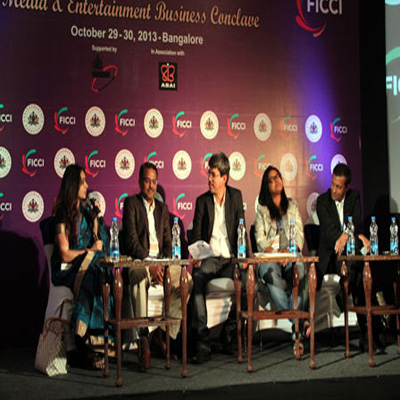
    BENGALURU: What good would a FICCI MEBC event be in Bengaluru without a discussion on the current status of regional TV, ratings, content and formats? The session moderated by indiantelevision.com CEO and editor in chief Anil Wanvari saw four personalities – TAM CEO L V Krishnan, Asianet and Star Suvarna Business Head Anup Chandrashekaran, TV serials director Shruthi Naidu and actress Malavika Avinash – talk about the evolving genres in the south TV market and the tussle that that the industry has with the TAM ratings.


    According to the FICCI Deloitte report, the south Indian TV industry was valued at Rs 13, 470 crore in FY 2013 and is set to grow at an estimated CAGR of 20 per cent over the next four years. TAMs Krishnan added that it also accounts for 20 per cent of national viewership. To top it all, south Indian viewers are glued to their TV sets almost 30 per cent more than their northern cousins. The former spend 150-200 minutes a day watching soaps, series, movies, drama and non-fiction as compared to HSM viewers who spend 100-110 minutes disclosed Krishnan.


    Kannada TV is in a strange predicament and its viewership is eroded because of the fact that the state shares its borders with others such as Tamil Nadu, Andhra Pradesh, Kerala and Maharashtra which means viewers in these regions watch TV shows in the languages prevalent in those states. To make matters worse, only 35-40 per cent of Bengalurus populace speaks Kannada. This despite, Krishnan is optimistic that Kannada TV will do well. It has grown by 25 to 30 per cent in the last five years in terms of engagement and the next four years will see the viewership increase by 20 to 25 per cent, he says.


    Chandrashekaran said that the south TV industry is experiencing changing consumption patterns. Fiction consumption is growing here as compared to HSM where non-fiction is taking over, he said. There has been de-growth of film consumption in the states of Karnataka, Andhra Pradesh and Kerala. Movies are unviable on TV today everywhere else except in Tamil Nadu, he said. We pay Rs 2.5 crore to acquire a title; but we spend around Rs 70,000 to Rs 80,000 an episode for fiction and we get the same or better viewership. Then, big ticket formats are also slowly spreading such as the Kannada and Tamil versions of KBC, he added. Then ETV produced Bigg Boss in Telugu and Kannada.


    Both Avinash and Naidu bemoaned the fact that budget restrictions in Kannada have led to creativity and innovation being stifled in the region. The protagonists in most shows are becoming younger – in their late teens or early twenties, which leaves limited scope for actors like us who have been around for 15 years, wailed Avinash. She, however, added that her Oprah Winfrey-like conflict resolution show has given her a good platform for her to exploit her creativity.


    Chandrashekaran said that the younger protagonist strategy is being resorted to because broadcasters are trying to draw in younger audiences – apart from the plus 45 year olds – to watch television. Krishnan pointed out that the broadcasters strategy is on the button as TAM Media research has shown that boys 14 and above tend to follow what their fathers are watching, mainly sports while girls follow their mothers and watch serials.


    Chandrashekaran said the economics of programming dictate that higher budgets for shows will work in a broadcast network scheme. If we can produce and amortise our costs over various languages like Tamil, Telugu, Malayalam and Kannada it will make our shows viable, he explained.


    Naidu agonised over the fact that Kannada broadcasters are increasingly resorting to making adaptations of successful Hindi shows rather than encouraging and experimenting with original stories from Karnataka. Chandrashekaran said that this was happening because there is a paucity of scriptwriters in the region and the novelists and literature writers from the state tend to look down on TV as below their creative dignity. We do a lot of interactions with our viewers and we only focus on filling whatever our focus group studies throw up as viewing need-gap. Avinash pointed out that emotion and drama work very well with TV audiences which is why adaptations of Hindi shows in the form of soap, drama and series are working on regional television.


    The topic also shifted to the credibility of TAM with her asking whether TAM data is rigged due to inconsistent ratings as compared to the popularity and visibility of shows. To this, Krishnan said that they have checks and balances in place to prevent any penetration or doctoring of the data. Yes, I am honest enough to say, one can reach out to our people meter sample, but we have policing mechanisms in place which will immediately penalise anyone who is trying to do that, he emphasised.


    Niche genres are missing in the south with most of the channels being GECs or film channels. But Chandrashekharan says that the potential to harvest niche genres is there.


    With the 10+2 ad cap coming in, we will see a lot of advertiser funded programs (AFPs) specially in Tamil Nadu because its base is huge, he said. I am very optimistic about our future and I can only see rosy pickings for everyone.

  • I&B announces initiatives to boost film industry

    I&B announces initiatives to boost film industry

    MUMBAI: The Central Government has taken the following initiatives for facilitating the growth of film sector, as announced by the minister of Information & Broadcasting and Parliamentary Affairs, P R Dasmunsi in Lok Sabha today. 
    The initiatives include:

    – Institutional financing is now available to the film industry.

    – 100 per cent foreign direct investment is permitted in the film sector.

    – Government has encouraged participation in global markets with a view to enhancing the visibility of the film industry abroad.

    – Film weeks and festivals are held on reciprocal basis with various countries.

    – Audiovisual co-production agreement has been signed with the Republic of Italy and Government of UK and similar proposals from other countries are being explored to expand avenues of finances and markets for the Indian film industry.

    – The recommendations of the Committee for the Development of entertainment sector have been conveyed to all the State Governments.

    – The National Film Development Corporation, a public sector unit under this Ministry provides financial assistance and other services to the film industry.
    The endeavor is to facilitate the entertainment sector to achieve its potential and promote growth in exports, so that this sector is able to increase its contribution towards generating income and employment in the country, informs an official press statement.

    The Federation of Indian Chambers of Commerce and Industry (FICCI) has also submitted a memorandum on film industry for the 11th Five Year Plan. The memorandum deals with various issues relating to the film sector. It contains suggestions to mitigate video piracy, levy of uniform entertainment tax across all States, fiscal and tax benefits, review of the Cinematograph Act, incentives for setting up polytechnics, institutes and film schools and an Export Promotion Council for films.