Tag: Ficci

  • NDTV lawsuit may trigger Govt action on BARC

    NEW DELHI: The petition filed by NDTV against TAM in New York may force the Government to speed up BARC‘s progress on revamping the television audience measurement system, particulary since the Indian Broadcasting Foundation (IBF) has failed to do so.

    In fact, the Government had expressed its concern to IBF officials over a month earlier about the delay in moving the Broadcast Audience Research Council (BARC) forward so that the first audience survey report could come by July next year.

    In a meeting held at the initiative of the Information and Broadcasting Ministry a few weeks earlier, Additional Secretary Rajiv Takru had told IBF that the government may step in to ensure that the timeline is met.

    The IBF had taken cognizance of the Committee headed by former Secretary General of the Federation of Indian Chambers of Commerce and Industry (FICCI) Amit Mitra on TRP ratings.

    The Committee had said though self-regulation is the best way forward for the broadcasting industry, it expressed “the fear that in case significant progress is not made within defined timelines, the Government may be left with no option but to step in, primarily because of the nature of public concerns that have been raised and debated across many platforms”.

    The IBF, the Indian Society of Advertisers (ISA) and Advertising Agencies Association of India (AAAI) had late last year set up BARC, a nationwide audience research joint body. Its primary aim: not to exclude or work outside TAM but to model itself like BARB (Broadcasters’ Audience Research Board) in the UK; it would not conduct audience measurement directly but commission it.

    Late last week, NDTV filed the lawsuit in New York seeking injunction against publication of television ratings by TAM Media Research. NDTV also sought $810 million as compensation for the loss in revenues it suffered over the years and $580 million in penalty for negligence by Nielsen and Kantar officials.

    Also read:

    NDTV sues TAM, Nielsen for manipulation of data

  • Rohit Samarth is head of Terra in DDB Mudra Max

    Rohit Samarth is head of Terra in DDB Mudra Max

    NEW DELHI: Rohit Samarth has joined DDB Mudra Max as senior vice president, heading the operations of Terra, its rural marketing agency.

    Samarth comes from Percept Out of Home, where he was the business head of its rural vertical responsible for all its communication and marketing strategies. With more than 25 years of experience in the industry, Samarth has had the opportunity to work with some of the largest and the most recognised brands in the country.

    He started his career with Nestle India, and later worked with various other companies like Media Workshop India, Amar Ujala Prakashan, India Infrastructure Publishing, UCP Integrated Marketing Solutions, Federation of Indian Chambers of Commerce and Industry (Ficci) and Linterland.

    DDB Mudra Max president and head Mandeep Malhotra said, “I am excited for the positive change brought into the BOP offerings at DDB Mudra Max. Apart from great knowledge and experience, Rohit brings with him passion and energy to take the existing momentum of the team and the work to a whole new level.”

    Samarth said, “I have some very exciting plans in mind and the focus this year will be to make DDB Mudra Max a serious contender for the top spot in the BoP space. Development of strong teams in all disciplines is another of my initial focus areas. I have no doubt that Terra will grow to be one of the most preferred and specialised rural communication solutions provider within the next two years.”

  • Facebook an effective tool for brand promotion: Carolyn Everson

    Facebook an effective tool for brand promotion: Carolyn Everson

    MUMBAI: Facebook has changed the way the present generation all over the globe communicates, and the world has become smaller with various social media platforms providing opportunities to draw people closer.

    In this environment, Facebook can be quite an effective tool for brand promotion, especially if it is consumer interaction that one is targeting.

    Facebook had a reported 845 million users all over the world as on December 2011. Having been on the scene for the past eight years, the social media website has seen a lot of changes, the latest being the Facebook Timeline. Earlier a Facebook profile only consisted of the individual’s personal information, photographs and interests etc.

    Speaking at the 13th FICCI Frames in Mumbai, Facebook VP Global Marketing Solutions Carolyn Everson said, “The Facebook Timeline can be considered a digital container where one can capture a person’s or a brand’s entire life span in photos, notes and videos.” With the introduction of the timeline, Facebook now enables people and brands to have a more expressive and visual online identity.

    Along with the timeline, Facebook has also adopted the opengraph technology which enables seamless sharing on multiple media. As a result the site tied up with the Washington Post in the US and introduced the Washington Post reader application. In a matter of eight weeks the application’s readership exceeded the readership of the regular print copy. In India a similar tie up has been done with CNN.

    News is just one aspect of media and entertainment that Facebook has partnered. The other fields include music (Spotify and Saavn), gaming (Zynga) and films. Everson explained, “In the US a new film does not release without significant campaign or presence on Facebook. Now Facebook allows integration on large scale across media like TV, print and phones which helps accessibility.”

    Decoding the success of Facebook, Everson explained that the site’s psyche is based on an anthropological study. Throughout history, people have existed in communities. These communities have varied from 130 to 140 individuals over time. Interestingly, this corresponds to the average number of friends a Facebook user has. It draws from the basic instinct of humans to co-exist in communities, have networks and seek recommendations by friends and peers.

    When it comes to marketing and branding, Facebook provides an opportunity for consumer interaction and allows brands to open up a two way channel for communication and actually listen to it. As Everson explained, “Social discovery is the most powerful driver of human behaviour in the world today.” With the scope and scale that Facebook offers, it can help in driving human behaviour which is the main goal of any advertising or marketing initiative.

    The world is now moving from ads to stories. Hammering is a thing of the past as the trend now is to share stories. With Facebook’s timeline feature, stories can now appear as news feeds on different platforms like smartphones which helps in targeting a specific audience. According to Everson, 800 million brands have shifted to the new timeline.

    Also, the Like button which was introduced a couple of years earlier Timeline can also be used to create a buzz about brand and measure the effectiveness of campaigns online.

    Concluding the session, Everson said Facebook is conscious about the content it uploads and strives to operate according to the feedback of the various communities it functions in. She said, “We would say we are one per cent along in our journey and are always open to partnerships.”

  • Industry doing nothing to transform biz models for digital world: Uday Shankar

    Industry doing nothing to transform biz models for digital world: Uday Shankar

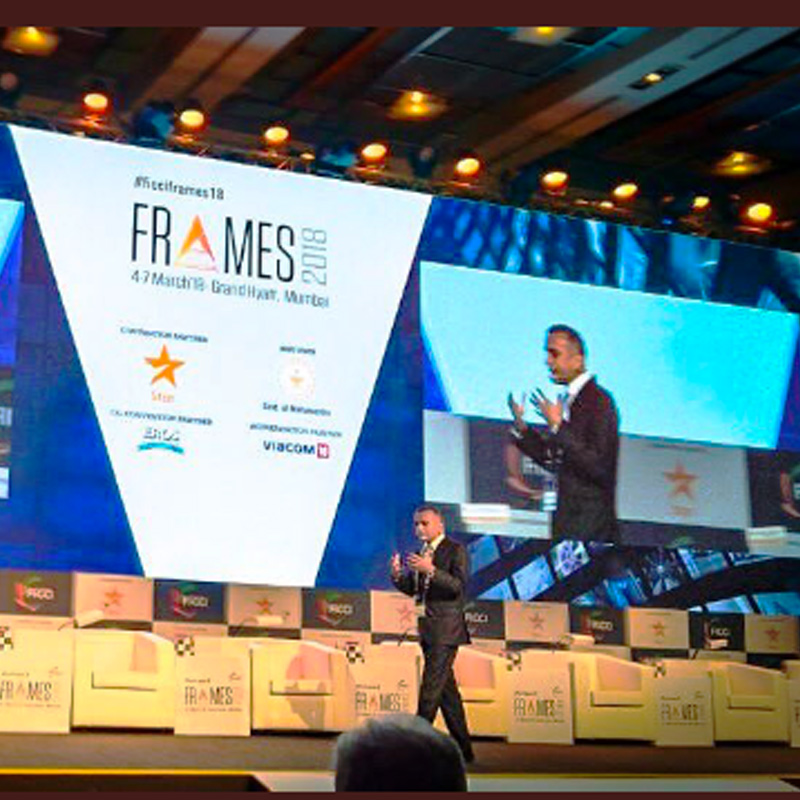
    MUMBAI: Star India CEO and Ficci Broadcast Forum chairman Uday Shankar set the ball rolling at the inaugural of the 13th edition of the Ficci Frames by saying that the industry is at the cusp of what is set to completely transform broadcasting in India, forever.

    Shankar was talking about the universal digitisation of television distribution. A subject that has dominated all discussions at all forums last year and which he presumed will continue to do so for a long time to come.

    “Most of the discussions that I have participated in are still around whether digitisation will happen and if it indeed were to go through, how chaotic it would be. With all humility may I suggest that it is a meaningless discussion triggered by a bunch of retrograde interests who are living in denial,” he said.

    The Cable Television Networks Amendment Act is not the beginning of digitisation. Digitisation of distribution is a big reality and the 40 – 45 million homes that have bought DTH boxes at some point or the other are a conclusive evidence of that. “In fact as we speak, India may just have overtaken the United States as the world’s largest DTH market,” he said.

    Shankar added, “The critics and the cynics who are still wondering whether digitisation would happen, my answer is: Look around, it is already happening and the rest of it is bound to happen because even in this country it would be difficult to undo such a momentous shift. To those who wonder how chaotic it would be, my response is that there would be some chaos, but chaos is not necessarily bad if the alternative is status quo or regression.”

    However, he also cautioned that his biggest concern now is a chaos of another kind that we are all set to create by our inaction. “Whether we like it or not, in a few years time, the vast majority of this country will receive its content through digital media – digital cable, DTH, 4G, wireless and Internet. But are we preparing for that? The answer is a big no,” he regretted.

    He said that while we debate a digital future day-in-and –day-out, the industry is doing nothing to transform or find business models for a digital world. “Let’s face it. Universal digitisation is going to force us to change the way we do business and we are not ready for it. We often blame the cable operators and MSOs that they are not ready but I am afraid that even the broadcasters and the content creators are not ready for a digital world. Are we then setting ourselves up to become uncompetitive and irrelevant?,” he asked.

    DTH has launched services like HD, Dolby sound and digital video recorder” and yet the broadcasters are doing nothing differently to service this segment. DTH has been around now for about six years and broadcasters or the content community have done nothing as an example of a strategy to exploit the new technology. This, he said, is despite an intuitive and an experiential understanding that the behaviour and the consumption patterns in DTH homes are significantly different from analogue homes. “The data also show that the average time spent on content in digital homes is much more and yet we do not treat them differently,” he said.

    Shankar said that it is scary how “we have force-fitted an analogue broadcasting model into the digital domain.”

    Is that what we are going to do even after cable goes digital, he asked. “I am afraid if the past behaviour is anything to go by, we are not ready to offer anything significantly different and therein lies the biggest crisis and risk of a chaos,” he said.

    He said there is enough global experience to suggest that digitisation leads to decentralisation, regionalisation or localisation of content creation and distribution.

    “Creatively, it is a huge catalyst for innovation and diversity. Essentially what it means is that with universal digitisation the business models of broadcasting, which are built on centralised creation and distribution of content and even a centralized advertising revenue model, may come under a huge pressure,” he cautioned.

    Shankar said that the cable community is still busy lamenting the potential loss of carriage fees and not realising what an amazing opportunity it has to participate in the local economic boom that is sweeping most parts of this country.

    “The first phase of digitisation that covers the 4 metros will be a huge unshackling of broadcasting and content opportunities. These are the cities that have crumbled under the weight of analogue frequency limitations. Just imagine the opportunities that these metros also our economic hotspots present when, from the first of July access to frequency will no longer be a constraint. So to my mind the MSOs and the cable operators may potentially become a powerful content creator that the traditional broadcasters have to contend with. There may be new creative talent ready to ride this technological transition. As the subsequent phases roll on, the decentralisation of broadcasting is bound to gain enormous momentum. However, I don’t see anyone trying to race ahead to take a pole position here,” he said.

    He also pointed out that HD TV sets have been available in this country and while many people were buying them, their off-take was still low primarily because there was no HD content and nobody was willing to invest in HD content because there were not enough HD consumers. “It was the classic chicken and egg problem. However early last year, when we at Star launched 5 HD channels with Dolby 5.1 surround sounds, even we were surprised by the rapidity with which HD gained acceptance. Today, in less than a year there are around 25 HD channels. But, I have to admit with a touch of disappointment that I am yet to see an adequate recognition of the potential of HD and a superior sound possibility by my fraternity. It is a classic case of the old mindsets struggling with a new technology,” he rued.

    Are we going to stay locked into this struggle or are we going to create a new generation of television which would be designed for the digital world?, he asked.

    Shankar said he has been an admirer of the current information and broadcasting dispensation which he thinks has shown more vision than any other dispensation in his two decades of interaction with the broadcasting establishment. “However, let me point out that we still need a lot of official and legislative enablers to remove the bottlenecks on this expressway. For instance, a clear policy to enable multiplicity of beams and splits would be a powerful trigger for proliferation of content and revenue opportunities,” Shankar said.

    He ended his keynote with the example of the latest Oscar success from Hollywood – The Artist – which is a portrayal of how a talented and accomplished artist from the silent era could become completely irrelevant because he refused to see that the times have changed.

    “Let’s not try to thwart a revolution which people are crying for. We will only hurt ourselves. The question is whether we will lead the change or whether we will vacate the space for a new set of entrepreneurs and visionaries who will replace us. It is up to us to use it or lose it,” he said.

  • Indian film industry attracts investors amid challenges

    Indian film industry attracts investors amid challenges

    MUMBAI: The Indian film industry is buoyant and is generating a lot of investor interests globally. However, it is marred by multiple challenges including a huge gap between investors and creative pieces, industry experts opined at a panel discussion at the 13th edition of Ficci Frames here.

    India is one of the biggest producers of films. “However, out of 1,200 odd films that were released last year, only 100 were studio produced,” said Moxie Entertainment MD and independent filmmaker Soumo Ganguly. “This clearly means that the other 1,100 films were made of independent funding either by banks or with the help of high net worth individuals, family, friends and relatives.”

    Ganguly said it is a challenging task to always depend on such funding and, hence, difficult to find finance.

    Speaking about a large pool of capital available by the way of private equity, Ambit Group CEO Ashok Wadhwa pointed out that while securing finance from high net worth individuals is an option, the challenge arises when the investor does not understand creative pieces.

    On a different note, Wadhwa also advised aspiring filmmakers to be absolutely certain about their finances. “I would like to advise aspiring movie makers to not start their projects unless they have 100 per cent of the film expenditure secured in their bank accounts,” he said.

    Speaking about revenues generated through selling of television rights, Blackstone senior managing director of private equity Mathew Cyriac said that the producers are generating more revenue from selling movie telecast rights to broadcasters rather than box office collections.

    “Television is becoming a bigger distribution point for movies. In Kerala, 50-60 per cent of movies get acquired by general entertainment channels. Similar is the case with Karnataka and other southern markets,” Cyriac said.

    Talking about the challenges in movie making business, he said that the studio model is yet to emerge in India.

    “Studio business in India is the early 1950s equivalent of business in the United States. Hence venture capital flavour of investment is seen more in India,” he said.

    Speaking of combining the best of investor and creative pieces to create a hybrid model, Hollywood-based The Allegiance Theater founder and partner Daniel Dubiecki said that it would be fruitful to bring together venture capitalists and studios models.

    “Group of angel investors have increased, which it is good news for the movie business,” he pointed out.

  • BARC expected to commence TRP reports from July 2013

    BARC expected to commence TRP reports from July 2013

    NEW DELHI: The Broadcast Audience Research Council (BARC) to be set up by the Indian Broadcasting Foundation (IBF) will commence publication of television and radio ratings from July 2013.

    This has been conveyed to the Information and Broadcasting Ministry by the Foundation, which had been forwarded the report of the Mitra Committee on the subject early this year, sources told indiantelevision.com.

    The Committee headed by former Secretary General of the Federation of Indian Chambers of Commerce and Industry (Ficci) Amit Mitra had said that even as self-regulation is the best way forward for the broadcasting industry, it expressed “the fear that in case significant progress is not made within defined timelines, the Government may be left with no option but to step in, primarily because of the nature of public concerns that have been raised and debated across many platforms”.
     
    The Committee established by the I&B Ministry had said “it is our emphatic preference that all the stakeholders collectively create institutions and corrective mechanisms to improve the accuracy to television audience measurement. The media as a key pillar of democracy must remain independent and free”.

    The 75-page report noted that the present sample size of both Tam (8150 homes) and A-MAP (6000) is very inadequate for a country of India‘s size with 129 million TV households.

    It suggested an increase to 15,000 urban and rural TV households in the next two years and then to 30,000 in three years. The rating system should keep pace with the new emerging technologies, and the recommendations of Trai about mobile people‘s meters and so on should be studied, the TRP Committee said.

    It also said to avoid conflict of interest, there should be no cross-holding between the rating agencies, broadcasters, or advertising agencies. Furthermore, the frequency of the TRP reports should be weekly, and the BARC which has been formed by broadcasters, advertisers and advertising councils should have the discretion to change this to fortnightly if it so desires.

  • South Indian film industry urged to create a global platform akin IIFA

    South Indian film industry urged to create a global platform akin IIFA

    MUMBAI: The two day conclave of the Federation of Indian Chambers of Commerce and Industry (Ficci) concluded by welcoming the recommendation from Wizcraft International that the South Indian film industry should join hands to create a global platform that presents the South Indian film industry at key markets across the world.

    Sharing the IIFA success story wherein key global markets opened up for the Hindi film industry that led to a quantum growth, Wizcraft International founder-director Sabbas Joseph averred, “The talent in the South Indian film industry is enormous. We wanted to seize this opportunity to establish a platform for talent to be promoted and honoured on a national level and international level for South Indian films. Regional and Indian cinema have grown into a global phenomenon and we would surely look at promoting and leveraging them on a global platform through brand IIFA.”

    The IIFA story also demonstrated the attention that is being given to Indian culture and business by global counterparts. Akin to the Bollywood weekend, the weekend for the South Indian film industry would be a huge step towards recognizing the growing importance of South Indian cinema by celebrating it on a global platform, Joseph felt.

    Regional films have been well received at the Berlin film festival and have also won best film awards. With contemporary story lines, advanced technology and fresh talent in the regional entertainment world regional cinema is becoming popular. Films like Enthiran – Robot won the accolades of critics all over the globe.

    IIFA is one of the most respected South Asian film academies and its main highlight, the IIFA Weekend and Awards are India‘s biggest media event. In its 12 years around the globe, IIFA has forged relationships with countries, enabling the promotion of Indian cinema. IIFA has introduced multiple distributors and exhibitors such as Nu Metro, Ster Kinekor, Pathe in markets that IIFA has traveled to. 

  • Jagmohan Mundhra passes away

    Jagmohan Mundhra passes away

    MUMBAI: Film director Jagmohan Mundhra passed away in Mumbai on Sunday.

    The 62-year-old died of peptic ulcer and was in the hospital for the last couple of days.

    Mundhra was known for issue-oriented films like Bawandar and the Aishwarya Rai Bachchan-starrer Provoked.

    Born in 1948 in a conservative Marwadi family, Mundhra studied engineering at IIT Mumbai and then moved to the US to do his M.Sc. But his ultimate calling was filmmaking. In 1982, he made Suraag with Sanjeev Kumar and Shabana Azmi in lead roles. This was followed up Kamla, a women-centric film which had Shabana Azmi and Deepti Naval.

    A regular at FICCI, Mundhra was immensely interested in different aspects of the current-day filmmaking.

    His last directorial venture was Naughty@40. He was preparing to shoot a satire, Kissa Kutte Ka. He was very keen to make a film on Congress president Sonia Gandhi.

  • Self-regulation with credibility only option for checking TV ratings: Mitra Committee

    Self-regulation with credibility only option for checking TV ratings: Mitra Committee

    NEW DELHI: Even as self-regulation is the best way forward for the broadcasting industry, this should be of a credible nature which continuously provides improvement in the quality and methodology of the rating procedure to provide accurate and up to date findings.

    A Committee established by the Information and Broadcasting Ministry to study the rating system in the broadcasting industry has, however, expressed “the fear that in case significant progress is not made within defined timelines, the Government may be left with no option but to step in, primarily because of the nature of public concerns that have been raised and debated across many platforms.”

    The Committee has in this connection referred to judicial concerns, anxieties raised by the Telecom Regulatory Authority of India in its report, the report of the Standing Committee of Parliament, perspectives of the industry and civil society.

    At the same time, it says “it is our emphatic preference that all the stakeholders collectively create institutions and corrective mechanisms to improve the accuracy to television audience measurement. The media as a key pillar of democracy must remain independent and free.”

    The report of the Committee is to be submitted to Information and Broadcasting Minister Ambika Soni by Committee Chairman Dr Amit Mitra, Secretary General of the Federation of Indian Chambers of Commerce and Industry (Ficci), and other members on 10 January.

    The 75-page report has been prepared by the eight-member Committee which also comprised Rajiv Mehrotra from the Public Service Broadcasting Trust, eminent journalist Neerja Chowhury, Indian Institute of Management (Ahmedabad) Director Professor S K Barua, retired Secretary to the Government D S Mathur, and Professor Ashis Sen Gupta of the Indian Statistical Institute of Kolkata, apart from I&B Ministry Joint Secretary (Broadcasting) Arvind Kumar. He took the place in August 2010 after his appointment, from his predecessor Joint Secretary (Films) D P Reddy who had been holding additional charge of the Broadcasting portfolio when the Committee was set up in May 2010.

    Noting that the present sample size of both Tam (8150 homes) and a-MAP (6000) was very inadequate for a country of India’s size with 129 million TV households, the Committee suggested an increase to 15,000 urban and rural TV households in the next two years and then to 30,000 in three years. The rating system should keep pace with the new emerging technologies, and the recommendations of Trai about mobile peoplemeters and so on should be studied, the TRP Committee said.

    It also said to avoid conflict of interest, there should be no cross-holding between the rating agencies, broadcasters, or advertising agencies. Furthermore, the frequency of the TRP reports should be weekly, and the Broadcast Audience Research Council (BARC) which has been formed by broadcasters, advertisers and advertising councils should have the discretion to change this to fortnightly if it so desires.

    BARC should have representation from broadcasters, advertisers, and advertising agencies and have a 12-member Board constituting seven members from broadcasters (six private and one public service broadcaster), three members from advertisers, and two from advertising agencies including one from the Directorate of Advertising and Visual Publicity of the I&B Ministry.

    The BARC should be guided by a high-powered committee of a broad- based nature consisting of 12 members including a statistician of national repute from among the top institutions such as the Indian Statistical Institute, National Council of Applied Economic Research, Measurement technology expert, a renowned individual from civil society or judiciary, a demographer, a sociologist, an economist, a business management expert from one of the IIMs, nominee of an eminent institution/individual engaged in media research, a leading woman of national stature, and three special invitees from BARC to guide and supervise the various processes.

    The primary intent was to broaden the participation of different types of experts including eminent members from civil society who would guide BARC to ensure greater accuracy, total transparency and appropriate representation of viewer stratification and diversity.

    To break the duopoly of Tam and aMAP in the TRP metering market, BARC must invite more players to come into the field and call for competitive tendering for best pricing without compromising on quality.

    The High Powered Committee will also provide the key eligibility norms for selecting the agencies.

    The agencies should be engaged through an open, transparent and competitive bidding process. BARC should have a complaint redressal mechanism in place to handle complaints, shortcomings, and deficiencies in a time-bound manner.

  • FICCI submits its wishlist to Fin Min for M&E sector

    NEW DELHI: National industry body Ficci has demanded that the government must give several tax exemptions and holidays to let the animation, gaming and VFX industries, which is growing faster than the overall entertainment industry, realise its full potential.


    Ficci has demanded in the budget for 2008, the government must give a 10-year tax holiday, removal of service and sales taxes on the software used for production for 10 years, exemption of import duty on hardware for 10 years, and other facilitating measures.

    Interestingly, it says also that as there is no Indian channel with 24 X 7 indigenous animation content, 10 per cent of the time on entertainment channels must be reserved for such content. This will give local content and talent a major boost.

    The memorandum from Ficci says that though the animation, gaming and VFX industry is growing in leaps and bounds, the full potential is yet to be tapped, despite the projection that the industry would grow hugely by next year.

    Ficci estimates show that the animation industry today stands at Rs 13 billion and is expected to grow to Rs 43 billion by year 2009, with a CAGR of 35 per cent.

    Similarly, the gaming industry is expected to grow from Rs 360 million to Rs 13.50 billion by 2009, with a CAGR of 78 per cent.

    “The growth rate in these sectors are much higher than overall media & entertainment sector, which is expected to grow at a rate of 19 per cent,” says Ficci. The industry could be a major export revenue earner as well as provide massive employment.

    Ficci says that after Information Technology, the biggest export earners for India are Animation, Gaming and VFX, but the overall business model existing at present, which is a low-end BPO approach, is stunting its growth.

    The Ficci document stresses: “Exports in this vertical can be looked in two ways: one, a purely outsourcing model in which production houses provide services to overseas studios. This is low-end work in the value chain with more of a BPO approach.

    “The other is revenues earned from exporting the finished product (the intellectual property developed in India for domestic / foreign markets) to global audiences.

    “Both the models have tremendous potential for foreign exchange earning for India. But it is better in the long term if we move up the value chain and have indigenous content with both domestic and foreign appeal.”

    Ficci estimates that in the next five years, India would require more than 30,000 trained animators and gaming professionals.

    “If this industry is nurtured properly, it can meet the government‘s objective of employment generation, and the latter should aid in the setting up of centres of excellence on the lines of IITs and IIMs for the animation and gaming industry,” says Ficci.

    Ficci feels that the other direct impact of aiding these industries would be building Brand India better, by engaging the country‘s massive talent pool in creating content for Indian as well as global audiences by transferring India‘s 5,000-year-old time- tested legends into the new media.

    “Animation could be another way of creating “Brand India” among NRIs / PIOs and other global audiences. Currently when India is increasingly garnering attention in the world arena, it is the right time to reach outwards through this medium,” Ficci says.

    Ficci points out to models of Korea, China, Singapore, etc., which enjoyed their respective government support, so much so that 40 per cent of the animated content in the US is Japanese.

    “The reason for such a pattern is that countries like Japan and Canada have developed very strong domestic markets, and once a domestic market gets enough consumable content, the same can be routed for exports,” says the memorandum.

    Ficci reminds that the Korean government sees animation as the most competitive industry for the 21st century, and has provided massive tax reliefs.

    “(Korean) application guidelines specify that companies whose projects have been accepted by a Korean broadcaster can apply for up to 40 per cent of their production budget,” Ficci says, demonstrating the massive support system there.

    So far as the animation industry is concerned, Ficci says that it is now covered under Software Technology Parks of India.

    The problem, says Ficci, is that this holds good for a BPO nature of work where outsourcing is the main module and most of the studios which are getting benefited from STPI have to make sure of an export commitment of more than 85 per cent.

    “As a result many Indian studios wanting to produce original content based intellectual property and use art and talent from India to produce animation stories do not get any such benefits,” explains the memorandum.

    Creating original content in India attracts custom duty and also the freshly levied sales tax (VAT) on off the shelf software (12.2 per cent, which might increase further) and further also the income tax component.

    “This is leading to more and more studios working on foreign content and a severe lack of animated Indian stories in our domestic television schedules,” laments Ficci.

    Hence Ficci‘s key proposals for the animation, gaming and VFX industries are

    • Tax holiday for 10 (ten) years, so that cost of creating intellectual property (original content) comes down drastically and the industry becomes viable
       
    • Removal of Service Tax
       
    • Removal of Sales Tax on the Software used for Animation, Gaming & VFX production for a period of 10 years
       
    • Exemption of Import duty on hardware for a period of 10 years
       
    • Market Development Assistance for overseas business promotion
       
    • 10 per cent mandatory local content on the networks to began with

    “Finally, we feel there is negligible revenue accruing to the exchequer currently as no new Indian IP is getting created. If a tax holiday is given, revenue will flow into the exchequer funds in a couple of years as the industry will gain impetus and encouragement to grow. In this regard the IT sector can be looked at as a role model,” says the Ficci memorandum.