Tag: FICCI MEBC

  • Kamal Haasan roots for Bengaluru to hold FICCI MEBC in future

    Kamal Haasan roots for Bengaluru to hold FICCI MEBC in future

    BENGALURU: The fifth edition of the FICCI MEBC (Media and Entertainment Business Conclave) came to a new location this year to IT City Bengaluru. MEBC president and actor Kamal Haasan rooted for Bengaluru to be a recurring location for the conclave to be held.


    Among the people present at the inaugural function were Karnataka chief minister Siddaramaiah, Information and Broadcasting secretary Bimal Julka, Film Federation of India president Ravi Kottarakara, Karnataka Film Chamber of Commerce president H D Gangaraju, Karnataka government IT BT and S&T secretary Srivatsa Krishna and Association of Bangalore Animation Industry president and technicolor India head Biren Ghose.


    “Bengaluru is the second largest IT hub in the world after Silicon Valley and in the years to come we want to surpass even Silicon Valley to become the hub of innovation and convergence of media and entertainment,” said Krishna.


    Kamal Haasan said that Bengaluru has all the things needed to make it an IT hub as well as keep FICCI MEBC going in the city. “We will give a push to the digital medium,” he added.


    Siddaramaiah emphasised the need for building qualitative online content that will give advertisers innovative ways to reach out to people. “The industry should look at remaking old movies with good value and rich in vernacular content,” he said. He also urged the need for creating programming and growth friendly policies for industry.


    Issues that were concerning the film industry were also raised by Kottarakara such as service tax and lack of support from banks for movie funding. “Film making is put in the ‘sinful’ industry along with gambling, drinking and smoking. It is not so,” he said.


    The sessions for the two day event included ‘formulating and implementing a viable media and entertainment policy for a state’, ‘reshaping mobile entertainment in the era of digital revolution’, ‘the challenge of news: defining number one in the dizzying newscape’, ‘the broadcasting ecosystem in the digital era’, ‘customising global VFX for Indian cinema’, ‘emerging trends of Indian IP in animation and their exploitation’, ‘the emerging gaming industry in southern India’, ‘emerging technologies and the impact on media and entertainment industry’ and ‘changing trends in regional TV: ratings, content and formats’.

  • Regional television struggles to find its voice

    Regional television struggles to find its voice

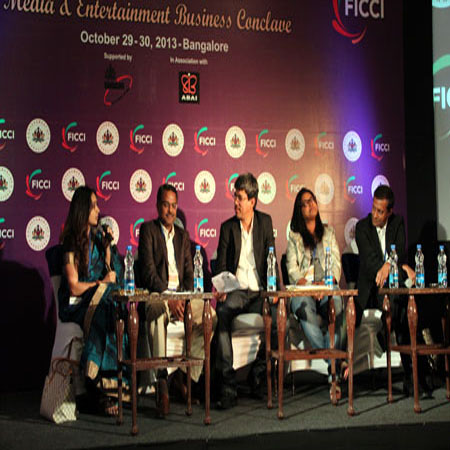
    BENGALURU: What good would a FICCI MEBC event be in Bengaluru without a discussion on the current status of regional TV, ratings, content and formats? The session moderated by indiantelevision.com CEO and editor in chief Anil Wanvari saw four personalities – TAM CEO L V Krishnan, Asianet and Star Suvarna Business Head Anup Chandrashekaran, TV serials director Shruthi Naidu and actress Malavika Avinash – talk about the evolving genres in the south TV market and the tussle that that the industry has with the TAM ratings.

    According to the FICCI Deloitte report, the south Indian TV industry was valued at Rs 13, 470 crore in FY 2013 and is set to grow at an estimated CAGR of 20 per cent over the next four years. TAM’s Krishnan added that it also accounts for 20 per cent of national viewership. To top it all, south Indian viewers are glued to their TV sets almost 30 per cent more than their northern cousins. The former spend 150-200 minutes a day watching soaps, series, movies, drama and non-fiction as compared to HSM viewers who spend 100-110 minutes disclosed Krishnan.


    Kannada TV is in a strange predicament and its viewership is eroded because of the fact that the state shares its borders with others such as Tamil Nadu, Andhra Pradesh, Kerala and Maharashtra which means viewers in these regions watch TV shows in the languages prevalent in those states. To make matters worse, only 35-40 per cent of Bengaluru’s populace speaks Kannada. This despite, Krishnan is optimistic that Kannada TV will do well. “It has grown by 25 to 30 per cent in the last five years in terms of engagement and the next four years will see the viewership increase by 20 to 25 per cent,” he says.

    Chandrashekaran said that the south TV industry is experiencing changing consumption patterns. “Fiction consumption is growing here as compared to HSM where non-fiction is taking over,” he said. “There has been de-growth of film consumption in the states of Karnataka, Andhra Pradesh and Kerala. Movies are unviable on TV today everywhere else except in Tamil Nadu,” he said. “We pay Rs 2.5 crore to acquire a title; but we spend around Rs 70,000 to Rs 80,000 an episode for fiction and we get the same or better viewership. Then, big ticket formats are also slowly spreading such as the Kannada and Tamil versions of KBC,” he added. “Then ETV produced Bigg Boss in Telugu and Kannada.”

    Both Avinash and Naidu bemoaned the fact that budget restrictions in Kannada have led to creativity and innovation being stifled in the region. “The protagonists in most shows are becoming younger – in their late teens or early twenties, which leaves limited scope for actors like us who have been around for 15 years,” wailed Avinash. She, however, added that her Oprah Winfrey-like conflict resolution show has given her a good platform for her to exploit her creativity.

    Chandrashekaran said that the younger protagonist strategy is being resorted to because broadcasters are trying to draw in younger audiences – apart from the plus 45 year olds – to watch television. Krishnan pointed out that the broadcasters strategy is on the button as TAM Media research has shown that boys 14 and above tend to follow what their fathers are watching, mainly sports while girls follow their mothers and watch serials.

    Chandrashekaran said the economics of programming dictate that higher budgets for shows will work in a broadcast network scheme. “If we can produce and amortise our costs over various languages like Tamil, Telugu, Malayalam and Kannada it will make our shows viable,” he explained.


    Naidu agonised over the fact that Kannada broadcasters are increasingly resorting to making adaptations of successful Hindi shows rather than encouraging and experimenting with original stories from Karnataka. Chandrashekaran said that this was happening because there is a paucity of scriptwriters in the region and the novelists and literature writers from the state tend to look down on TV as below their creative dignity. “We do a lot of interactions with our viewers and we only focus on filling whatever our focus group studies throw up as viewing need-gap.” Avinash pointed out that emotion and drama work very well with TV audiences which is why adaptations of Hindi shows in the form of soap, drama and series are working on regional television.

    The topic also shifted to the credibility of TAM with her asking whether TAM data is rigged due to inconsistent ratings as compared to the popularity and visibility of shows. To this, Krishnan said that they have checks and balances in place to prevent any penetration or doctoring of the data. “Yes, I am honest enough to say, one can reach out to our people meter sample, but we have policing mechanisms in place which will immediately penalise anyone who is trying to do that,” he emphasised.

    Niche genres are missing in the south with most of the channels being GECs or film channels. But Chandrashekharan says that the potential to harvest niche genres is there.

    “With the 10+2 ad cap coming in, we will see a lot of advertiser funded programs (AFPs) specially in Tamil Nadu because its base is huge,” he said. “I am very optimistic about our future and I can only see rosy pickings for everyone.”

  • News should be a ‘paid’ asset

    News should be a ‘paid’ asset

    BENGALURU: Whether it’s the political battle that’s unraveling in the country, or it’s a terrorist attack, news always interests people. But is news as interesting as a gossip piece about a celebrity? This and a lot of other points were raised at the first day of the FICCI MEBC (Media and Entertainment Business Conclave) that saw a session that discussed the news genre. The discussion brought up several points including viewership data, content that is being broadcast and the current situation of the genre as a whole.

    The panellists included BBC World News India COO Preet Dhupar, Udayvani group editor Ravi Hegde, Suvarna News editor Anantha Chinivar, Former CNN IBN journalist Veeraraghav, columnist Aakar Patel, NDTV resident editor Maya Sharma and IIM Bangalore dean Dr S Raghunath. The session was moderated by journalist Prakash Belawadi.

    After the entire discussion, the panelists concluded that the genre relies heavily on advertising, thus restricting the kind of content that can be produced. At the same time, viewership data such as TAM (Television Audience Measurement) is needed because advertisers depend on such data to pool their money where they want to. “Producing news is expensive and that is why all channels have panel discussions in their primetime slot. It is cheaper than sending an OB van to some far off place and spend huge amount,” said Sharma. 

    Another point brought up during the discussion was about “sensationalising news”. The reason why many times news is sensationalised is because entertainment is more prominent than news. So, news journalists need to adapt to the entertainment form of style in order to grab eyeballs. But at the same time just getting viewers will not help because everyone is also looking for credibility of news, including the people watching it and the ones dispersing the news. Channels keep a close watch on other channels to know what they are reporting.

    However, Hegde differed as he remarked that “media was not entertainment but a serious job”. Hegde, who comes from a print background, said that it’s a newspaper’s job to clear the confusion that channels have created the previous night for the viewers.


    Talking about the revenue generated through advertising, Hegde said that most of the advertisements to newspapers come for the editions in the metros, making it difficult to distribute papers in the rural areas.

    To this, Chinivar pointed that in order to beat entertainment news, the need to sensationalise news comes up.

    Columnist Patel thinks that the standard of journalism in India is poor because of lack of good training and low salaries.

    Veeraghav brought to fore the speculative nature of the Indian viewers that the channels have to continuously face. He remarked how many people question news channels’ nature to delve into the future, but they always want to know the future not what has happened. “If I tell a viewer that elections are going to happen, the first thing he will ask me is can you tell me who is going to win?” he said.

    Although many channels have taken a strong stand against the TAM accusing it of fudging data to benefit advertisers, all the panellists agreed that there needs to be some kind of tracking to know the viewership for channels and newspapers because it is ultimately a business.

    The fact that news is free is what makes it so volatile. “When you have to pay for your news, it will be taken seriously and that’s when the kind of news you get will also become better,” said Sharma. With digitisation coming in, they hope that some system will come in to place to help them get more revenues. News will become a paid asset in the future. “As long as news is free you cannot live without TAM or IRS,” Veerraghav ended.