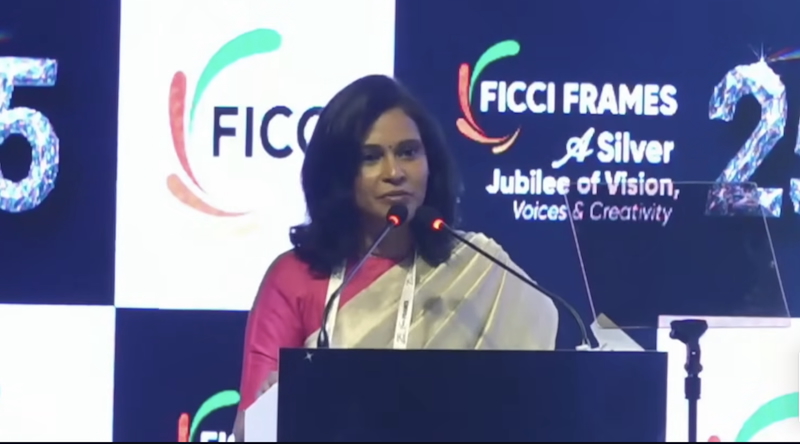
MUMBAI: At the 25th edition of Ficci Frames, Meta’s top leadership: Sandhya Devanathan, vice president, Meta India, and Meta India managing director and country head Arun Srinivas, laid out a comprehensive view of how India’s digital, entertainment, and creator ecosystems are evolving at breakneck speed.
From the rise of Gen Z as the dominant consumer force to the explosion of short-form video, AI-driven content, and micro-dramas, both leaders stressed on how India is not just adapting to global digital trends, it is carving them.
“India’s growth is unique and inevitable,” Devanathan said, opening her session on New Age Tech Platforms: Redefining Access, Innovation and Scale. “One trillion dollars of our future economy will be driven by digital.”
With over four billion reels shared globally every day, she noted, India stands out as both the largest creator market and a leader in the innovation of content.
That digital drive, she explained, rests on India’s growing online base of over 650 million social media users and 270 million online shoppers. Yet, she noted that to make prosperity more inclusive, more small businesses need to come online. Only about five million of India’s 65 million SMEs are currently digitally enabled.
“The Indian creator economy is among the most vibrant in the world,” Devanathan noted. “Creators here aren’t just entertainers, they are entrepreneurs, cultural catalysts, and small businesses rolled into one.”
Meta, she explained, continues to invest heavily in tools that empower creators to monetise their craft: from performance insights and AI-powered production aids to immersive advertising formats that help brands connect authentically with their digital-native audiences.
Devanathan also highlighted the versatility of “many Indias”: the digitally savvy India, the vernacular-first India, and the emerging India Each requires its own approach to content, access and engagement. “Winning in India,” she said, “means understanding these layers of India and building for all.”
Meta, she noted, sits at the heart of this digital revolution. India is now home to the largest community of Instagram creators and the biggest user base for Meta AI worldwide. The country also boasts one of the world’s largest Whatsapp communities, with over 200,000 small businesses using “Click to Whatsapp” to drive sales every month.
Beyond platforms, Meta is investing in digital infrastructure, from the Project Waterworth subsea cable (a subsea cable network that will span 50,000 kilometres and will reach depths of up to 7000 metres) to supporting data centres that fuel AI innovation. Devanathan also spoke about Meta’s work with the Nudge Institute and Pragati AI for Impact, which harnesses artificial intelligence for social good.
Building on that foundation, Arun Srinivas focused on the behavioural shifts defining media and entertainment consumption in India today, particularly among Gen Z and gen Alpha audiences.
“Gen Z isn’t the future; they’re the present,” he exclaimed. “They are already shaping how content is discovered, processed, and shared.”
According to Srinivas, the average Gen Z consumer processes information three times faster than previous generations and takes less than 1.5 seconds to decide whether to engage with a piece of content. “They need less attention, but more repetition,” he noted, explaining how frequency, rather than single exposure, now drives brand recall and conversions.
He also pointed to India’s massive short-form video boom, with 97 per cent of Indians watching short videos daily, surpassing television viewership. “Linear TV time is declining month on month,” he said, adding that this isn’t limited to urban India, “rural and small-town audiences are consuming just as much, if not more.”
Among the new frontiers Srinivas spotlighted was the rise of micro dramas: serialised short videos running between one and five minutes per episode.
“This is storytelling redesigned for the mobile-first world,” he said. “India’s short-form drama market could touch 10 billion dollars by 2030, driven by vernacular content and tier-II and tier-III audiences.”
Startups and creators are already experimenting with dubbed Korean and Chinese mini-series adapted for Indian viewers, marking a new phase in the fusion of entertainment and digital innovation.
Both Devanathan and Srinivas emphasised the transformative role of artificial intelligence across Meta’s platforms, from content creation and personalisation to ad optimisation and discovery.
“AI isn’t replacing creativity; it’s amplifying it,” Devanathan said. “It’s enabling creators to produce higher-quality work faster, and helping brands find the right audiences with precision.”
Srinivas added that more than four million advertisers globally used AI-generated creatives last quarter, producing over 15 million ad assets and achieving double-digit ROI improvements compared to campaigns created by humans.
Outlining Meta’s larger ambition, he noted that the company aims to make Meta AI the world’s most widely used personal assistant. “With more than 100 billion dollars invested in AI in just four years, we’re building systems that make digital creativity more accessible and intelligent for everyone,” he said.
Bringing that vision to life, Devanathan closed her session with an AI-generated video: a vivid cascade of colours that unfolded into the words, “Change is the canvas from which opportunity paints its masterpiece.”
Both leaders saw eye to eye on one message, that India’s digital future will be built at the intersection of creators, commerce, and connection.
Srinivas highlighted how Meta’s latest tools, such as the Edits app for easy video production and new AI-powered creative platforms, are enabling India’s vast creator base to thrive. Meanwhile, Devanathan emphasised Meta’s partnerships with brands, small businesses, and policymakers to foster a sustainable, inclusive digital ecosystem.
“Our goal,” she said, “is to ensure that India’s creative economy doesn’t just grow in size, it grows in diversity, opportunity, and global influence.”
Concluding the session, Srinivas offered a peek into Meta’s newest innovation, the Ray-Ban Meta smart glasses, designed to merge content, communication, and AI assistance in one device.
“These glasses are a glimpse of a future where connection becomes truly immersive,” he said.
As both Devanathan and Srinivas made clear, India’s digital landscape is entering a new chapter, one driven by speed, creativity, and intelligence. With the next generation of consumers redefining how content is created and consumed, Meta’s vision is not just to keep pace, but to help build the infrastructure of tomorrow’s digital culture.