Tag: FICCI Frames 2024

  • Role of skilling, education in media and entertainment sector critical in realizing vision of Viksit Bharat: Secretary, Skill Development & Entrepreneurship, GoI

    Role of skilling, education in media and entertainment sector critical in realizing vision of Viksit Bharat: Secretary, Skill Development & Entrepreneurship, GoI

    MUMBAI: Govt of India, secretary, ministry of skill development & Entrepreneurship Atul Kumar Tiwari said that the Indian media and entertainment sector is growing rapidly and there is immense potential for skilling in this sector. This sector has been growing with a CAGR of over 13 per cent in the last few years and employes 30 lakh people directly and 55 lakh indirectly. Skilling combined with education and scaling can help India achieve the vision of Viksit Bharat 2047, there by supporting the GDP as well as establishing the prowess in India’s soft power, he added.

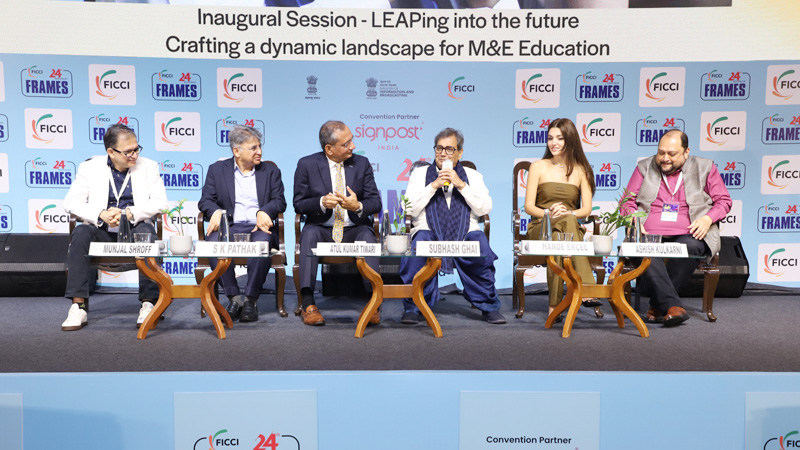
    Addressing the session on ‘LEAPing into the Future’, at FICCI FRAMES 2024, Tiwari said that in order for India to prosper, there is a need for creating a mass awareness about skilling. The New Education Policy (NEP) along with all government policies focuses on skilling. All sectors of the economy are recognizing that skilling is going to be a game-changer for India. With our country’s demographic advantage, having the youngest and the world’s largest number of working-age individuals, skilling will lead to a significant enhancement in productivity and employment. We have the youngest population in the world, largest number of working population and skilling them will lead to a great deal of enhancement in productivity and employment along with competitiveness, he noted.

    Tiwari also emphasized spreading awareness on ‘LEAP – Leveraging Education to Accelerate Progress’, which is the need of the hour. That nothing is more creative than making a film. The government, he said, is working to identify and bridge the skilling gap through policy initiatives along with industry and academia collaboration. “There is a need for us to identify the opportunities and create awareness among people, especially in tier 2,3 cities to attract more talent,” he emphasized.

    He further stated that the M&E sector has experienced a remarkable transformation with the advent of the internet, revolutionizing entertainment consumption. The dynamics of content creation have shifted, leading to a buzzing M&E landscape that not only entertains but also promotes and preserves cultural heritage, added Tiwari.

    He also stated that the Indian media and entertainment sector not only provides support to nation’s GDP but also promotes tourism, increase in cultural exchanges and strengthens India’s soft power.

    Whistling Woods International (WWI) filmmaker & founder and chairman Subhash Ghai highlighted the role of education and skilling in media and entertainment sector. He added that we are currently relying on memory-based education rather than skill-based education. It is crucial to develop skill-based education in the country, noted Ghai.

    FICCI, secretary general SK Pathak said, “In the 25 edition of FICCI FRAMES in 2025, we will identify the transformational changes required in the media and entertainment industry, focusing on the initiatives needed for India in 2030.”

    Ashish Kulkarni, chair, FICCI AVGC-XR Forum and Founder, Punnaryug delivered the vote of thanks.

    Hande Ercel, Turkish actress was also present during the inaugural session.

  • Streaming is seeing phenomenal growth in India: Prime Video India’s Sushant Sreeram

    Streaming is seeing phenomenal growth in India: Prime Video India’s Sushant Sreeram

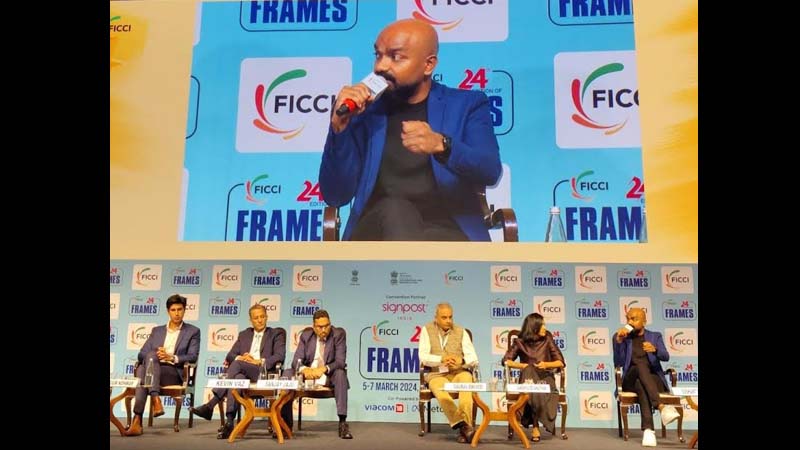
    Mumbai: In a highly engaging panel curated on the opening day of FICCI FRAMES 2024 titled ‘Reinvent: Navigating the Future of the Media and Entertainment Industry’, Prime Video India country director Sushant Sreeram delved into the dynamic landscape of the streaming industry in India, exploring growth trends while highlighting Prime Video’s business and content commissioning strategy.

    Moderated by Ernst and Young partner Ashish Pherwani the panel began with a keynote from Ministry of Information and Broadcasting secretary Sanjay Jaju.  In addition to Sushant Sreeram, the panel saw the participation of industry leaders from multiple M&E sectors, including Prasar Bharti CEO Gaurav Dwivedi, FICCI Media and Entertainment Committee chair and Viacom18 CEO – broadcast entertainment Kevin Vaz; FICCI Media and Entertainment Committee co-chair and Meta India VP and head Sandhya Devanathan; FICCI Media and Entertainment Committee co-chair and Warner Bros Discovery general manager – India & South Asia Arjun Nohwar, and Signpost India chairman & managing director Shripad Ashtekar.

    Responding to a question on key trends across SVOD, TVOD and AVOD business models, Sushant said, “Streaming is seeing phenomenal growth in India. It has, in fact, become a dominant use-case for internet in the country, and a large part of that growth is coming from outside the metros.  We have about as many people streaming content in India, as those watching linear TV. This is a very significant inflection point for the video streaming industry in India.”

    He went on to share, “Another key point to note is that there is no one single customer for streaming, our customers sit across the spectrum of accessibility, affordability, and the languages in which they prefer to consume entertainment. Therefore, our strategy for building solutions for India has always been to focus on “AND” solutions, rather than making choices between “this” or “that”. That is exactly why Prime Video’s entertainment hub – where all the different VODs come into play, continues to do incredibly well. In fact, India is one of the frontrunners on new customer adoption for Prime Video globally. Also, our Channels proposition, where consumers get access to content from popular streaming services with add-on subscriptions, has grown well, with more than 20 partners on the service. Further, our Movie Rentals service where consumers – both Prime members and those who aren’t yet Prime Members, can rent movies ala carte, is seeing great consumer uptake across the country. Mini TV, Amazon’s free ad-supported service, also posted steady great growth in 2023. When we think about how to serve India, we prioritize what is important for customers – great value, great selection, and convenience. It is true for what we do at Amazon overall and the same holds true for Prime Video as well.”

    Responding to a question on the cost of content, Sushant spoke about the fact Amazon and Prime Video is invested for the long-term in India. Elaborating on the same, he said, “It is important to place this in context – our investment thesis is built on developing this category over a fairly long period of time. That’s the time horizon that we operate with for all our investments at Amazon, and the same holds true for Prime Video. The second is that we want to create a category of great cinematic storytelling and we know that consumers value that. We realized that creating an ecosystem across the board, not just the service, but creators and the technical ecosystem is an investment that is well made.”

    He went on to add, “The other thing about our investment thesis is that we look at it through the lens of how we bring in customers to enjoy this multi-benefit proposition for Prime, which is a unique proposition for customers and Prime Video is a part of that. That changes how customers evaluate what is value for money, and that gives us the impetus to continue to make investments. And finally, we want to make all the great stories that we can, but we realize that we can’t make all of them. We’re therefore always excited about the collaborations that we can forge, with creators, Channel partners and studios to build out a true video entertainment marketplace. The fact that Prime Video has close to 100 projects right now in various stages of production and development is a clear indication that there is appetite for great stories in the country!”

    To wrap up the highly engaging session, each participant was asked their Mantra for 2024, to which Sushant replied, “For us, it’s still Day one!” Day one is both a culture and an operating model that puts the customer at the center of everything Amazon does. Day one is about being constantly curious, nimble, and experimental.

  • FICCI FRAMES 2024: From playgrounds to pixels: Evolution and emerging trends in kids entertainment

    FICCI FRAMES 2024: From playgrounds to pixels: Evolution and emerging trends in kids entertainment

    Mumbai: The discussion traced the trajectory of this evolution, examining the impact of technology on content consumption, educational aspects, and the evolving preferences of young audiences. Emphasising the fusion of entertainment and education, the panel delved into the latest trends, such as interactive media, augmented reality, and immersive storytelling, offering valuable insights for creators, educators, and parents alike. The panel aimed to unravel the past, present, and future of kids’ entertainment, navigating the fascinating intersection of play and pixels.

    The moderator of the panel was Powerkids Entertainment CEO Manoj Mishra.

    “The essence of our content has remained consistent since the beginning. While storytelling and content creation have seen minimal alterations, there was a notable shift when I entered the industry. Initially, we relied heavily on foreign content, merely dubbing it for local audiences. However, over time, we began crafting our narratives that resonated more deeply with our audience, particularly children. The fundamental stories haven’t changed; it’s the platforms that evolve continually, and our adaptability has allowed us to broaden our horizons.” : Viacom18 kids TV network business head Anu Sikka.

    “In the future, animation will undeniably continue to hold a prominent position, Drawing insights from diverse channels, including online platforms like Netflix, and learning from the successes of digital endeavors, whether on Netflix or other platforms, we’ve adeptly tailored these achievements to suit the Indian landscape.”: Warner Bros Discovery head, kids network Uttam Pal Singh.

  • FICCI FRAMES 2024: Lights, camera, action: Golden era of storytelling

    FICCI FRAMES 2024: Lights, camera, action: Golden era of storytelling

    Mumbai: This session brought together seasoned storytellers and content creators to unravel the transformative impact of disruptive technologies on narrative formats. Delving into the shift from traditional blockbusters to the era of binge-watching, the panel explores how storytelling has evolved. Participants witnessed a dynamic discussion on changing audience dynamics, emerging platforms, and the innovative strategies employed by storytellers to captivate and engage audiences in an era marked by a constant evolution in entertainment consumption.

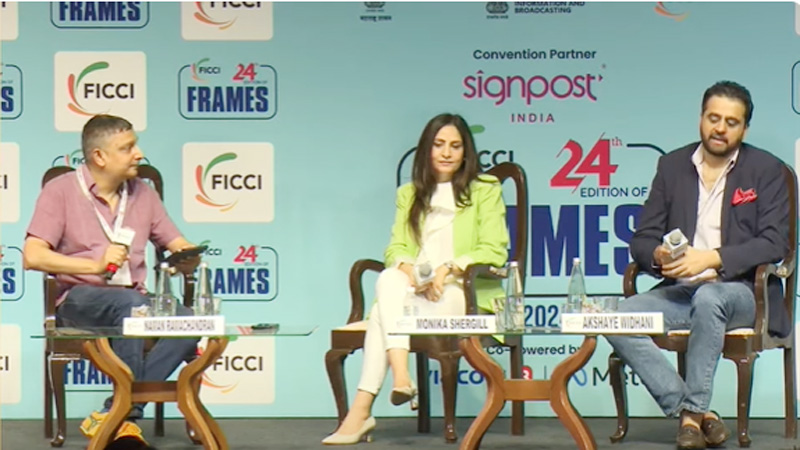
    The fireside chat was moderated by Indian critic and journalist Naman Ramachandran.

    “We are here to serve our audience with the most diverse & high-quality content. We find ourselves at an intriguing juncture in our streaming journey. Despite being a nascent industry, it is evolving rapidly, with people adopting it at an exceptionally fast rate.”: Netflix India VP – content Monika Shergill.

    Answering the question about the secret sauce in the theatrical business, Yash Raj Films CEO Akshaye Widhani said, “As an organisation, we don’t punish failure. That is the secret sauce at YRF.”

    Answering the second part of the question on what YRF looks for when commissioning a film or a series, Widhani said, “It is a creative business. Either you go right or wrong, but it’s about the story. The north star for us is the story. We’ve been telling stories for the last five decades and we hope we’ll keep telling stories much after that. When it comes to what we decide on how we decide to greenlight, it’s pretty much based on what that story is and how it appeals to us.”

  • FICCI FRAMES 2024: #Reinvent: Navigating the future of media and entertainment industry

    FICCI FRAMES 2024: #Reinvent: Navigating the future of media and entertainment industry

    Mumbai: The Indian media and entertainment industry is witnessing significant changes, with shifting consumer preferences for high-quality content, new broadcasting technologies, pressures on advertising spend, and the advent of AI. The #Reinvent session at FICCI Frames 2024 examined the dynamics driving this transformation and explored a range of enabling policies designed to support an industry navigating through a period of significant upheaval.

    The keynote of this session was given by Ministry of I&B secretary Sanjay Jaju, who said, “As we move forward, the Government of India’s focus is on creating a conducive environment for the Media and Entertainment industry to thrive.”

    The session was moderated by Ernst and Young partner Ashish Pherwani.

    “In the last one year, the skilling ecosystem of Maharashtra has supported 48,000 youths from Maharashtra to be trained only in media and entertainment. This was something of a record under M&E skill council. A big thank you to Mangal Prabhat ji and his government for their proactive efforts to train rural and urban youths,” FICCI India AVGC-XR Forum chair Ashish Kulkarni.

    “Globally, the media and entertainment industry is witnessing remarkable shifts with digital innovation reshaping consumption patterns and content creation dynamics,” FICCI Media and Entertainment Committee chair and Viacom18 CEO – broadcast entertainment Kevin Vaz.

    “India is a significant priority market for Meta globally. We have invested considerable time in developing products tailored to the diverse needs of the hundreds of millions of people using our platforms. We are dedicated to serving both users and businesses by continually enhancing our offerings,” FICCI Media and Entertainment committee co-chair and Meta India VP and head Sandhya Devanathan.

    “There is no one single customer. Customers sit across a spectrum of accessibility, affordability, of languages in which they want to watch their entertainment and what their entertainment needs are. For us, building solutions for India has always been about what we need to build as an end solution and not making piecemeal choices,” Amazon Prime Video country head Sushant Sreeram.

    “Free dish has been growing continuously and consistently. In 2003, when it started, the industry was at a very nascent stage and it set the context for the rest of the industry to grow and develop,” Prasar Bharati chief executive officer Gaurav Dwivedi.

    “We usually focus on the who, what and where. Who is consuming us, what kind of content they are consuming and where do they prefer to consume. I think the new dynamic that is now emerging is for us to focus on when and traditionally linear TV networks didn’t focus on that. By when, I mean consumption patterns that are arising from the situation that you are in – like in an elevator, waiting for a bus or picking your child from school. And in that 30-second to five-minute moment, do you have content form that they find engaging,” FICCI media and entertainment committee co-chair and Warner Bros Discovery Sr VP and general manager  – India & South Asia Arjun Nohwar.

    “Out-of-home advertising is playing a great role in sustenance of smart cities because when we see any social spaces – roadside shelters, libraries or any basic first mile or last mile connectivity solutions, it is the responsibility and obligation of out-of-home player where they invest in basic infrastructure. It is beyond billboards and includes investing in smarter solutions like charging points too,” Signpost India chairman & MD Shripad Ashtekar.

  • The Indian M&E sector anticipated to achieve Rs 3.1 trillion by 2026: FICCI-EY report

    The Indian M&E sector anticipated to achieve Rs 3.1 trillion by 2026: FICCI-EY report

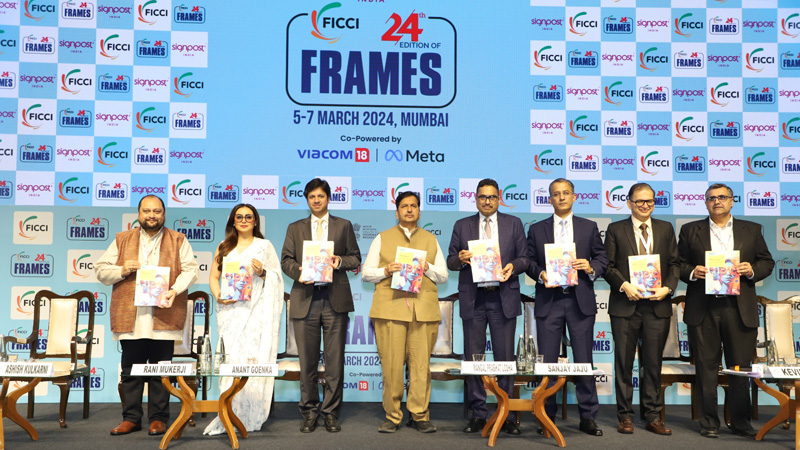
    Mumbai: The latest FICCI-EY report titled ‘#Reinvent: India’s media & entertainment sector is innovating for the future’, launched at the FICCI FRAMES 2024 in Mumbai, revealed that the Indian M&E sector grew by eight per cent in 2023, reaching Rs 2.3 trillion (US$27.9 billion), 21 per cent above its pre-pandemic levels in 2019.

    New media, comprising digital and online gaming, emerged as the frontrunner in growth, contributing Rs 122 billion of the overall increase of Rs 173 billion, and consequently, increased its contribution to the M&E sector from 20 per cent in 2019 to 38 per cent in 2023.

    Experiential (outside the home and interactive) segments continued their strong growth in 2023, and consequently, online gaming, filmed entertainment, live events, and OOH media segments grew at a combined 18 per cent, contributing 48 per cent of the total growth. With the exception of television, which experienced a marginal decline of 2 per cent, all other segments experienced positive growth in 2023.

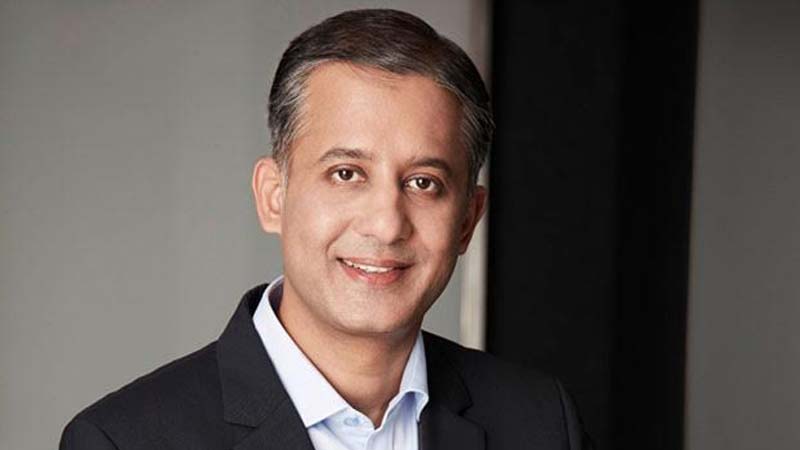
    FICCI Media and Entertainment committee chairman and Viacom 18 chief executive officer – broadcast entertainment Kevin Vaz said, “India is a unique market where the M&E sector distinguishes itself through a harmonious fusion of tradition and innovation. Here, technology-enhanced entertainment channels, OTT platforms, AI-powered newsreaders, traditional print media, flagship films, and short-form content not only coexist but thrive together, showcasing the vibrant diversity and dynamic growth of our industry. The Government of India’s thrust on improving digital infrastructure in the country combined with our ambition to be at the forefront of the next big technological thrust in media and entertainment, our sector is primed for a massive transformation.”

    EY India partner and media & entertainment leader Ashish Pherwani said, “I believe the M&E sector is at the “inflection point” we foresaw in 2018, with the dominance of digital channels over traditional media. In 2023, new media comprised 52 per cent of total advertising revenues, yet, unlike in many other countries, Indian traditional media also grew. This underscores the unique Indian market where while we are witnessing a seismic shift towards digital consumption, there is still adequate headroom for traditional media to grow.”

    Key highlights:

    Indian advertising reached Rs1.1 trillion:

    Digital advertising grew 15 per cent in 2023 and surpassed traditional advertising for the first time. Social, sports, e-commerce and SME advertisers will continue to drive growth in the sector moving forward.

    A billion screens by 2030:

    India is expected to have almost a billion active screens by 2030. Of these, around 240 million will be large (TV, laptop, PC), while the remaining will be small (mobile phones, phablets). pay TV, free TV, and connected TV are expected to emerge as significant markets, each comprising between 60 to 80 million homes. The 3:1 ratio in favour of mobile phones will sustain the demand for short videos and social commerce.

    Online gaming is expected to reach Rs 388 billion by 2026:

    The segment will see growth across all its verticals, including esports, fantasy sports, casual gaming, and other games of skill to reach an estimated 150 million daily users. Revenue growth will be led by mobile-based real-money gaming and casual gaming.

    Segmental performance in 2023

      . Television: Linear viewership increased by two per cent over 2022, the number of smart TVs connected to the internet each week rose to 19 to 20 million, up from around 10 million in 2022. Television advertising declined by 6.5 per cent due to a slowdown in spending by gaming and D2C brands, impacting revenues for premium properties. The Hindi-speaking market (HSM) experienced softness, resulting in a three per cent overall ad volume de-growth. However, subscription revenue saw growth after three years of decline, driven by price increases, despite a decrease of two million pay TV homes.

     .  Digital advertising: Digital advertising grew 15 per cent to reach Rs 576 billion, constituting 51 per cent of total advertising revenues. This figure includes advertising by SME and long-tail advertisers totalling over Rs 200 billion, and advertising earned by e-commerce platforms amounting to Rs 86 billion.

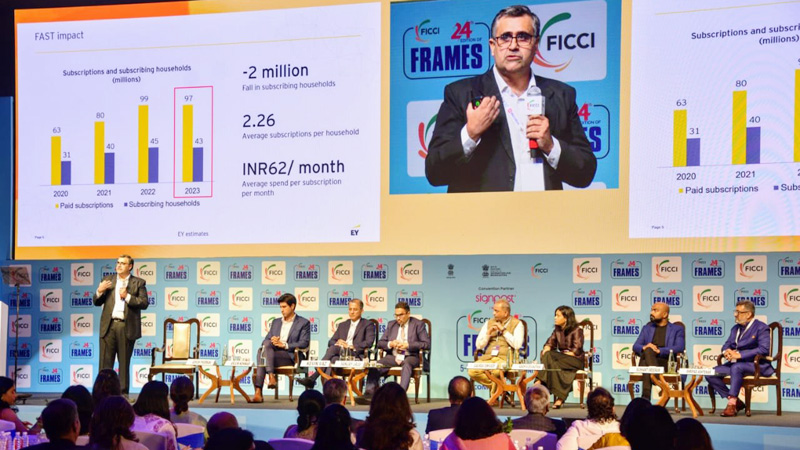
     .  Digital subscription: Digital subscription grew 9 per cent to reach Rs 78 billion accounting for a third of 2022’s 27 per cent growth, as premium cricket properties were moved in front of paywalls. Paid video subscriptions decreased by two million in 2023 to 97 million, across 43 million households in India. However, paid music subscriptions grew from five million to eight million, generating Rs 3 billion, while online news subscriptions generated Rs 2 billion.

     .  Print: Contrary to the global trend, print media continued to thrive in India, with advertising revenues growing by four per cent in 2023. Notably, there was significant growth in premium ad formats, as print remained a preferred medium for affluent metro and non-metro audiences. Subscription revenues also grew by three per cent due to rising cover prices.

     .  Online gaming: The segment’s growth slowed to 22 per cent in 2023, reaching Rs 220 billion. It surpassed filmed entertainment to become the fourth largest segment. India saw over 450 million online gamers, with approximately 100 million playing daily. Over 90 million gamers paid to play, with real money gaming comprising 83 per cent of segment revenues. Larger players absorbed the impact of a higher GST levy, hurting their margins but safeguarding growth.

     .  Film: The segment grew 14 per cent to reach Rs 197 billion in 2023. Over 1,796 films were released in 2023, and theatrical revenues reached an all-time high of Rs 120 billion. The number of screens grew four per cent. 339 Indian films were released overseas.

     .  Animation and VFX: The Hollywood writers’ strike impacted global supply chains, and consequently, the segment grew just six per cent in 2023. Potential mergers and falling ad revenues also reduced the slate of animated content produced for broadcast in India. A revival in demand in the second half of the year led to growth, boosted by the trend of using more VFX in Indian content.

     .  Live events: The organized segment grew 20 per cent exceeding pre-pandemic levels. Growth was driven by government events, personal events, weddings, and ticketed events, including several international formats and acts that came to India.

     .  OOH: OOH media grew by 13 per cent in 2023, surpassing its 2019 levels. Growth was led by premium properties and locations. Active digital OOH screens crossed 1,00,000 contributing nine per cent of total segment revenues.

      . Music: The Indian music segment grew by 10 per cent to reach Rs 24 billion in 2023, slower than previous years as certain music OTT platforms went pay and stopped or reduced their free services. 87 per cent of revenues were earned through digital means, though most of it was advertising led on YouTube, there being around only eight million paying subscribers despite music streaming’s reach of 185 million.

     .  Radio: Radio segment revenues grew by 10 per cent in 2023 reaching Rs 23 billion. This growth was driven by increased retail and local advertising, as well as alternate revenue streams. Ad volumes increased by 19 per cent in 2023 as compared to the previous year, although ad rates remained below their 2019 levels.

  • “Traditional media in India is also experiencing a steady growth”: Kevin Vaz

    “Traditional media in India is also experiencing a steady growth”: Kevin Vaz

    Mumbai: Viacom18 CEO- Broadcast entertainment Kevin Vaz reflected on the Media & Entertainment sector, both on a global scale and within the Indian context at FICCI frames 2024 event. He said, “In 2023, our industry witnessed a remarkable era of content creation, with over 200,000 hours of content produced annually. Indian content has transcended international boundaries, captivating audiences in more than 160 countries and topping streaming charts on global platforms. In 2023, Indian content bagged not one but two Oscars for the best song and the best documentary respectively. Indian music talent has bagged 3 Grammys recently. 2 Indians (Vir Das And Ekta Kapoor) won the prestigious International Emmy’s awards. This shift indicates a new era where local flavors and stories are embraced by audiences worldwide, showcasing the universal appeal of Indian stories and our storytelling.

    The integration of digital technologies in the Indian M&E industry is at a scale without parallel amongst the comity of nations. Driven by accessible and affordable internet, with Commercial 5G services rollout propelling the growth of India M&E, we must recognise the virtuous cycle of investments in creativity that drive the expansion of affordable internet in India. We can be proud of the fact that Indian companies, Indian creators, Indian producers, are at the forefront of the digital content revolution, be it in films, music or gaming.

    Platforms like JioCinema have revolutionized sports viewership in India, offering accessible and affordable access to live matches like the IPL. This goes to show the importance of internet accessibility in driving the growth of the M&E industry. Unlike other industries, M&E has caught the digital transformation wave early and stand ready to reap the benefits with supportive developments in the all-critical triad of infrastructure readiness, consumer market growth, and enabling public policies.

    The surge in digital media is forecasted to propel the M&E sector’s growth to a 10% annual rate, reaching INR 3 Trillion by 2026. Technological innovations have brought with it a paradigm shift in consumer preferences. Consumers now demand more personalised, interactive, and immersive content. This creates another facet to the growth of the entire digital media segment, including online curated content, digital advertising, online gaming, to name a few. Each of us need to reflect on how these preferences will change the way we think about the future of M&E, and the business models that are most suited to respond. To navigate the future, all of us at various intersections of the industry need to adopt innovative strategies and create engaging content across multiple platforms, leverage big data analytics, collaborate with global partners, and explore new revenue streams.

    Despite this digital boom, traditional media in India is also experiencing a steady growth, showcasing India’s diverse media consumption habits. While this might appear to be a paradox when viewed through a singular global lens, this is the truth of India – a market of AND, not OR.

    As we reflect on the journey of 2023, it becomes clear that it was a year marked by both challenges and triumphs. The first half was subdued, with modest growth rates across various segments of the industry. However, as raw material prices stabilized and marquee events like the ICC Cricket World Cup and Assembly Elections unfolded, we witnessed a significant uptick in the second half. And while the M&E industry is estimated to grow at 10% CAGR through the next few years led by digital, traditional mediums such as Television and print are also poised to grow.

    This growth underscores the enduring appeal of linear TV, particularly among established advertisers who value its unmatched brand-building capabilities at scale. It’s essential to acknowledge the continued significance of traditional media, including television, print, and outdoor advertising, in reaching diverse audience segments, especially in regional markets.

    The road ahead for the industry is brimming with possibilities and challenges alike. The integration of artificial intelligence promises to reshape the landscape of content creation, distribution, and consumption. Particularly generative AI, which is now an inexorable part of M&E supply chains. Advances in generative AI, while still relatively nascent, have produced an explosion of possibilities in the creative sector. It has ushered in a new dimension to the creative process, allowing the industry to explore uncharted territories of creativity and push the boundaries of productivity.

    As AI technologies continue to evolve, they offer unprecedented opportunities for personalized experiences and targeted advertising. However, this next-gen transformation also presents challenges such as data privacy concerns, reskilling and the need for ethical considerations – concerns that the industry and government together need to explore and address.

    Amidst these dynamics, the industry must also address the pressing need for stronger intellectual property rights protection to safeguard the integrity of our creative ecosystem. The proliferation of digital platforms and content creation tools has exponentially increased the avenues for creative expression, yet it has also heightened the risk of copyright infringement. Strengthening our IPR laws is essential to foster a conducive environment for innovation and creativity while ensuring fair compensation for content creators. The National Intellectual Rights (IPR) Policy, established in 2016, is due for review. This presents an occasion for all of us to engage on how we think about monetisation, commercialisation of content as well as the protections required for it, in a fast-evolving technological environment.

    The road ahead encompasses both opportunities and challenges in equal measure. As we navigate this complex landscape, as stakeholders of this vibrant sector, we must all remember that at the heart of it, our industry is about our consumers in a very human sense – their emotions, relationships, talents – their stories. All of us here today are simply facilitators – connecting stories to audiences and audiences to stories.

    As we begin FICCI Frames 2024, I look forward to the next three days filled with enlightening discussions, insightful sessions, and meaningful collaborations. Let us seize this opportunity to chart a course towards a future that embraces innovation, leverages technology, and upholds the timeless values of creativity and expression.

    Finally, I’d like to express my gratitude and admiration for Leena Jaisani and her team for putting FICCI Frames 2024 together. This is the 24th edition of India’s biggest media and entertainment symposium and it just keeps getting bigger and better. So kudos to the team for scaling this up consistently!” he concluded.