Tag: FICCI Frames 2019

  • Kids prefer home-grown content, feature films on TV

    Kids prefer home-grown content, feature films on TV

    MUMBAI: The TV industry is growing and so is kids’ viewership. Since 98 per cent of India is still single TV homes, co-viewing is extensive and leads to better targeting options while demand for localised content and regional content are a boon to creators. Broadcast Audience Research Council (BARC) India unravelled its findings on ‘Catching the youngest viewers’ at FICCI Frames 2019 held on the third day of the event. BARC India senior VP business development partnerships Elbert D’silva shared that 21 per cent of total viewership on linear TV sets comes from kids. With one in every four viewers being a kid, there is a high engagement level and time spent is also increasing.

    Just 12 per cent watch kids’ content, a whopping 49 per cent of kids watch general entertainment channels (GECs), followed by 24 per cent of them watching movies. Likewise, a large chunk of viewership doesn’t only come from kids’ category; in fact, it comes from age-groups as well. 38 per cent of the viewership comes from 2-14 years of age group, followed by 10 per cent from 15-21 years of age group, 14 per cent and 18 per cent fall under the 22-30 years and 31-40 years of age group respectively. This is due to co-viewing. But kids from NCCS households watch more of kids’ genre because premium homes are multiple TV households. Here kids’ genre gets about 16 per cent of viewership.

    He highlighted that females aged 31-40 years spend 30 per cent of their co-viewing time with kids and this offers significant targeting options to the advertisers. Bifurcating the female audiences across different age groups that spend the highest time in co-viewing, the report revealed that 15-21-year-olds spend 12 per cent, 22-30-year-olds spend 22 per cent, age group from 31-40 spends 30 per cent while 9 per cent and 7 per cent time are spent by the females that fall under 41-50 years and 51-60 years respectively.

    D’silva further shared that feature films give better ROI with higher per minute impressions. It stated that 76 per cent of the avg imp/min comes from the game, talk or quiz shows, followed by 155 avg imp/min from cartoons and animations and 508 avg imp/min from feature films.

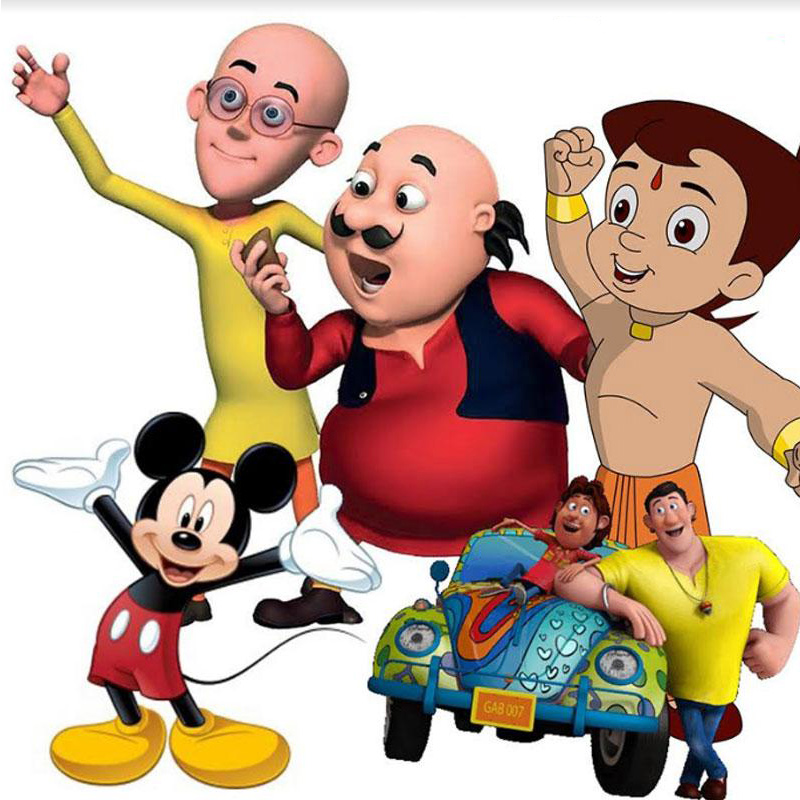
    Talking about home-grown content, he said that there has been a rapid increase of localised content on the kids’ genre and duration of it on national kids channels has gone up by 18 per cent. Comparing the growth in 2018 to 2016, the jump has been from 33 per cent to 39 per cent of overall content. Preference of content amongst kids changes as they grow older and so the preference for Indian content is higher among younger age groups.

    Apart from this, kids channels that broadcast in multiple languages enjoy a clear lead in the viewership. The report disclosed that 84 per cent of kids viewership accrues to the 11 channels that have multi-language feeds, 7 per cent from Hindi, 3 per cent from Tamil, whereas Telugu, Malayalam and Kannada gain 2 per cent viewership for each language respectively.

    Regional kids channels also have a high growth potential. The Sun Network’s Chutti TV in Tamil Nadu commands 17 per cent share with the rest going to national kids’ channels, Chintu TV in Karnataka gets 23 per cent, Kushi TV in Andhra Pradesh/Telangana gets 16 per cent while Kochu TV in Kerala gets the highest share of 40 per cent viewership.

    Top advertised products are those which are consumed by the children, but mothers are also the target audience since they are the decision makers. Boost and Fisher Price are brands targeting kids while Colgate, Harpic and Vicks are focused on the mothers watching TV. 

  • Monetisation is the biggest challenge for regional industry

    Monetisation is the biggest challenge for regional industry

    MUMBAI: The growth of the regional sector in the media industry was discussed on the third day of FICCI Frames 2019. Experts from the television sector discussed on the topic ‘Regional: is it the giant waiting to be awakened?’ It had panellists Viacom18 head regional entertainment Ravish Kumar, Reliance Broadcast Network Thwink Big country head Sunil Kumaran, Discovery communication VP head of advertising sales and business head of regional cluster Vikram Tanna, Westland Publications head language publishing Minakshi Thakur, Network18 CEO languages Karan Abhishek Singh and Google industry head media and entertainment Sandeep Ramesh.

    Talking about the challenges in the industry while creating the content as against monetisation, Ramesh said that the latter depends on macroeconomic conditions which are the GDP, per capita income, advertising or subscriptions coming in as a source of income.

    Tanna highlighted that looking at the overall scenario of English as against regional languages, perception is bigger than performance and that will change over a period of time. “If you look at pure regional form in TV or digital, there are two markets of monetisation—one is coming in from the regional local businesses and the other is coming from the national advertisers. If you actually add the pricing of both these buckets in any medium, the indexes for regional are quite higher and the reason is that this hyper looking market can calculate ROI much better beyond a simple measurement ROI system,” he added.   

    Singh chipped in and said that it is also incumbent upon them as content creators to do what it takes. “We need to create an environment where regional content formats are not seen as ‘long tail’ for media planners,” he said.

    Meanwhile, an interesting observation was put across where a homogenisation culture was happening, such as the influence of Diwali, Holi and other festivals are witnessed in the Bengali culture these days, which in reality are not so famous in these cultures. Speaking about the trend, Kumar said, “These festivals are actually making the culture larger than life. Of course, there is homogenisation in these cultures, consciously or unconsciously, but it’s the desire to be larger than life because people want entertainment and we look at it very differently.”

    Though Baahubali is one regional movie that has travelled internationally the question still remains as to why we can’t make more such innovative content. Kumar replied that we are lazy. He added that we are very good at learning the markets or develop from the ecosystems but not as good as putting out originality. “I would love to see Indian dramas like Turkish content and these are not just working in one market, they are working in multiple markets. We need to come up with something new and innovative and way bigger than what it is.”

    A major reason why no content is created for the north-eastern part of the country is budget constraint. Kumar added, “But we can’t put the blame just on budgets. Give us four to five years to offer the content of your choice.”

  • Ad industry not kept pace with consumer and digital changes

    Ad industry not kept pace with consumer and digital changes

    MUMBAI: The last decade has been disruptive for media, advertising and marketing with the evolution of digital. However, Sam Balsara, the veteran in advertising industry, feels that media buying has not been able to keep pace with that change. He also said that the currency that really should be looked at from marketing point of view is cost per unit of brand outcome rather than CPRP or CPT.

    Throwing light on the magnitude of the change, Balsara said that the advertising market has tripled in size in the last ten years, moving up from Rs 20,000 crore to Rs 61,000 crore in 2018. He also added that the growth came on the back of digital while the share of the digital medium itself has reached 19 per cent from merely four per cent ten years back. According to him, digital will replace print as the second largest medium in the next two to three years.

    “The only thing that has not changed, I will say regretfully, is the way media buyers and media agencies buy media. It has, probably, not changed as dramatically as the media scene has,” Madison World chairman Sam Balsara commented in a session “Advertising, Media, Marketing: #10yearChallenge” on the third day of FICCI FRAMES 2019 while highlighting all the changes in the last decade.

    Ultratech joint executive president, marketing head Ajay Dang also expressed his concern on the same. Dang seemed sceptic about whether the industry, including creative agencies, marketers, content generators, has been able to keep pace with audience evolution. He also expressed his concern about the industry’s understanding of the needed change in storytelling and measuring the reach of the story to the final audience.

    “We are constantly in a phase of catch-up, we are falling behind. That’s my take. Because of our lack of putting it all together, at the end of the day our return on investment that we are supposed to deliver to our organisations is suffering,” he commented.

    Balsara also spoke on the “democratisation of advertising”. While the top 50 advertisers accounted for as high as 43 per cent of total adex in 2009, the number came down to 35 per cent last year thanks to the huge growth of regional brands.

    “We have to look at efficiency, effectiveness and innovation. I think today we are in a scenario where there is democratisation of data as well and data is threatening to become a deluge to drown companies if they do not do something about it. That’s largely becoming a priority for us to take up now,” Marico media and digital marketing head Ankit Desai said.

    BARC CEO Partho Dasgupta also pointed out the lack of talent in terms of media analytics tool. While sectors like BFSI and telecom have data analytics talent but in media finding people who understand the media domain and the big data tools of analytics is a big problem.

    It was also noted in the session that the FMCG brands are ever-inclined to TV despite the rapid growth of digital growth. On the issue of bias towards TV, experts think as the communication journey of many companies has been built around the medium over all these years, TV still plays the role for audience aggregator for these brands. However, it has also been said that the shift towards other mediums like digital has started.

    Viacom18 Hindi Mass Entertainment & Kids TV Network head Nina Elavia Jaipuria concluded the session calling for unity among all three parties including the media owner, advertiser and the media agency. She said that there is a need for all three to come together as the common goal is to drive market share for brands but sometimes a conflict of interest is good for the growth of the business.

  • Industry experts discuss OTT growth, need for measurement system

    Industry experts discuss OTT growth, need for measurement system

    MUMBAI: To measure or not to measure? Despite the humongous growth of OTT in the country, experts still can’t seem to agree on this question. While some of the experts believe a TV like measurement system will bring more transparency in the ecosystem, other players think third-party tools are already serving the purpose.

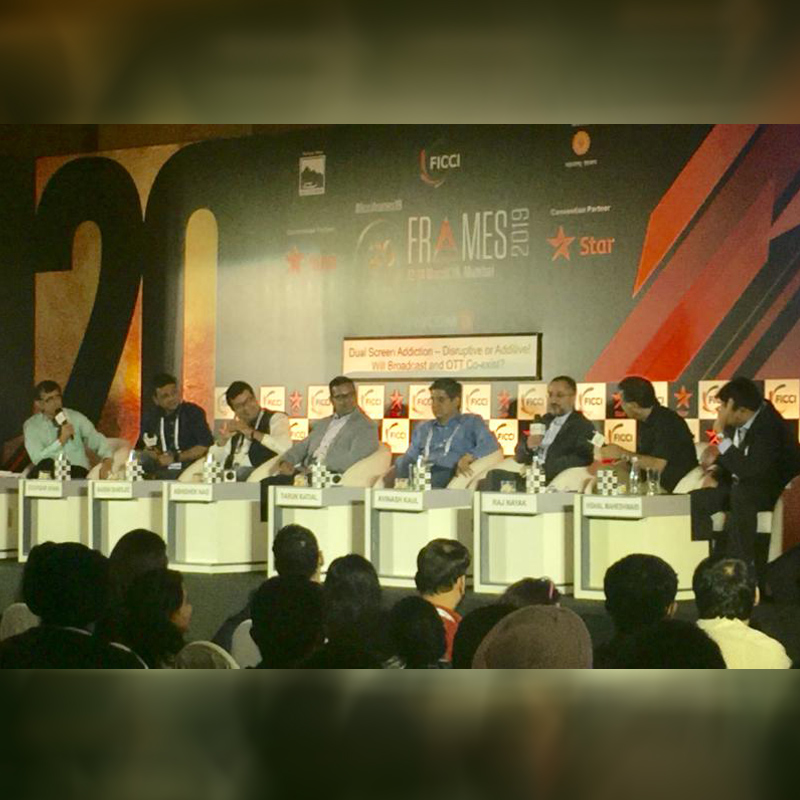
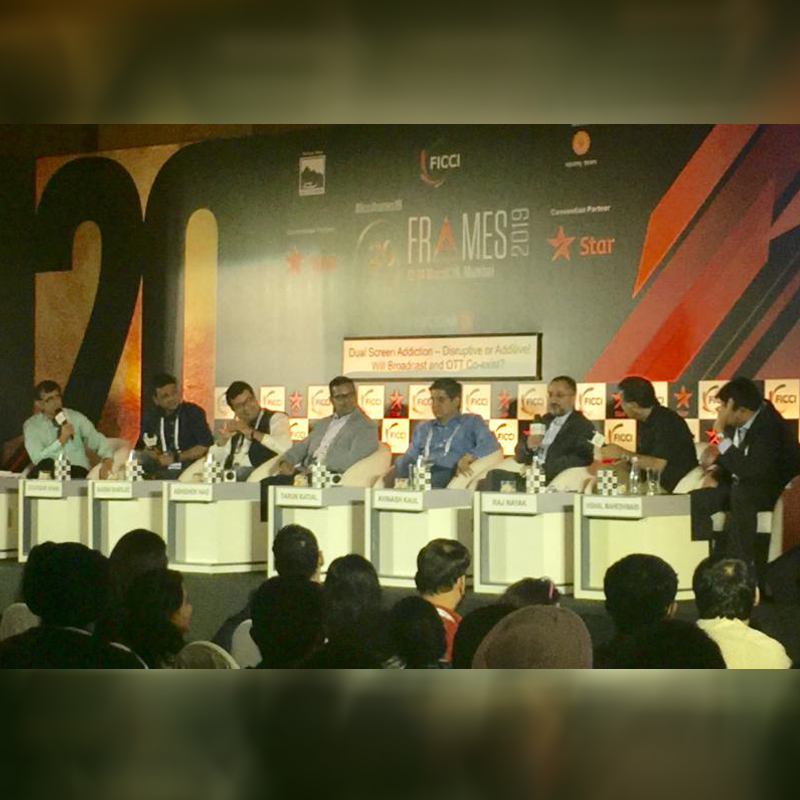
    A session on Dual Screen Addiction saw panellists Star India Hindi GEC president and head Gaurav Banerjee, ZEE5 CEO Tarun Katial, Network 18 COO, A+E Networks MD Avinash Kaul, media veteran Raj Nayak, Netflix partnerships director Abhishek Nag, Hooq India MD Zulfiqar Khan, Vuclip country head Vishal Maheshwari and moderated by Balaji Telefilms group CEO Sunil Lulla.

    Speaking at a session in FICCI FRAMES 2019 Banerjee emphasised on the need of a unified measurement system. “As we have entered into digital, we have not thought of putting in place a measurement system which is extremely robust,” he said. Banerjee thinks it will make assessments of watch-time easier for the advertisers.

    Katial strongly disagreed and argued that there are robust third-party tools in the market. He also cited the example of YouTube and Facebook’s strength in digital advertising. According to him, if there was no credibility in measurement, advertisers would not have put so much money.

    “In the case of TV, when consumers now exercise their choice some channel may lose its base of 198 million and drop to 20 million but that also shows the affluence of the customer who can pay Rs 20 a month. Otherwise, channels on DD Free Dish would have retained revenue three times greater than Star Plus,” Kaul commented.

    Nayak said that advertising money is going to get fragmented and it’s going to get worse with more players coming in. “In the OTT space, the number of players will shrink. I predict that in the next 3-5 years there won’t be more than 10 players in this space. I think then the realisation of value will happen both in terms of subscription and advertising,” he added.

    Talking about monetising on OTT through advertising, Katial said the volume of content on the platform is a necessity. He added that when ZEE5 was launched it kept the faith on three ‘v’s – voice, vernacular and video which worked. According to him, CPM is also rising on the contrary to popular belief in the industry.

    However, the experts agreed to the growing subscription model in the country. Netflix partnerships director Abhishek Nag said this is a great time for subscription business in India. The use of credit cards for online payment without fear of fraud and mobile wallets especially the ones with low bandwidth has opened up revenue channels for the platforms. Nag also thinks bundling of telco or broadband plans with live TV and OTTs can make it stronger.

    ZEE5 CEO said along with B2B2C, the B2C model is growing. According to him, proper bundling and pricing play a major role in B2C revenue. In the case of B2B2C, he said partnerships with e-commerce platforms like MakeMyTrip will add value to the model in future.

  • Broadcasters need to relook at content to cope with OTT platforms

    Broadcasters need to relook at content to cope with OTT platforms

    MUMBAI: With the upsurge in demand for OTT platforms in India, the future of broadcasters has been debated much. TV still has enough headroom to grow thanks to underpenetrated households. While the players in the ecosystem firmly believe that TV is not going to die soon, they also think broadcasters need to rethink their content.

    On the second day of FICCI Frames 2019, experts from the television and OTT industry discussed on ‘Dual Screen Addiction –Disruptive or Addictive! Will Broadcast and VoD Co-exist?’ It had panellists Star India Hindi GEC president and head Gaurav Banerjee, ZEE5 CEO Tarun Katial, Network 18 COO, A+E Networks MD Avinash Kaul, media veteran Raj Nayak, Netflix partnerships director Abhishek Nag, Hooq India MD Zulfiqar Khan, Vuclip country head Vishal Maheshwari and moderated by Balaji Telefilms group CEO Sunil Lulla.

    Banerjee said they are in the business of curating stories where making purposeful stories is important. He thinks it should be left to consumers what stories they want to watch together and on which personal device.

    Agreeing with Banerjee, Katial said, “It’s good to tell stories, eventually you have to make money and yes, we are all trying to monetise content in different formats. What OTT brings to the table is totally different from TV which is a high degree of personalisation and segmentation, and the ability to discover content at your own convenience. That’s not going away. Consumers are going to want more and more of that. I think we all say linear TV should stay, the convenience aspect of digital is huge.”

    Lulla raised the question of how broadcasters should defend their turf with all these changes. Media veteran Raj Nayak said that he is a big believer that television is here to stay. He added that families in small towns, even today, sit together to watch TV in the evening. According to him, OTT and TV will co-exist in India at least for another ten years.

    Banerjee also echoed Nayak’s view that OTT is not going to kill linear TV. According to him, three generations watching TV together and having a conversation is very important in Indian society. He added that TV consumption is only on the upward side in the country.

    But Nayak also reminded the fact that amid ongoing changes in the ecosystem, consumers now compare the quality of TV and OTT content. Hence, Nayak thinks TV channels will have to course correct to give content on linear TV which is as compelling as OTT.

    Hooq India MD Zulfiqar Khan added that streaming services have a direct connection with consumers which helps them to have great knowledge of consumer choice. On the other hand, linear TV has been a consumer facing brand but not consumer facing business. Hence, he said that at a content level as well as business level there has to be a rethink.

    “The households not yet penetrated by TV will continue to be the main stake of linear TV. Most of it is coming from the northern and eastern parts of India. OTT and TV will obviously co-exist. The question is how they will compete with each other and take best practices from each other,” Kaul said while adding that OTT ‘s biggest advantage is its one-on-one relation.

    Vuclip country head Vishal Maheshwari said India is the only country where broadcasters are so well organised on their OTT businesses. According to Katial, broadcasters created a catch-up content environment in the early days and went slow on premium content compared to platforms like Netflix.

    The industry experts agreed that rather than having a debate about TV content and OTT content, the debate should be on linear and non-linear consumption and the need for compelling content.

  • Need to focus on self-regulation and less regulation: Amit Khare, Secretary, I&B at FICCI FRAMES 2019

    Need to focus on self-regulation and less regulation: Amit Khare, Secretary, I&B at FICCI FRAMES 2019

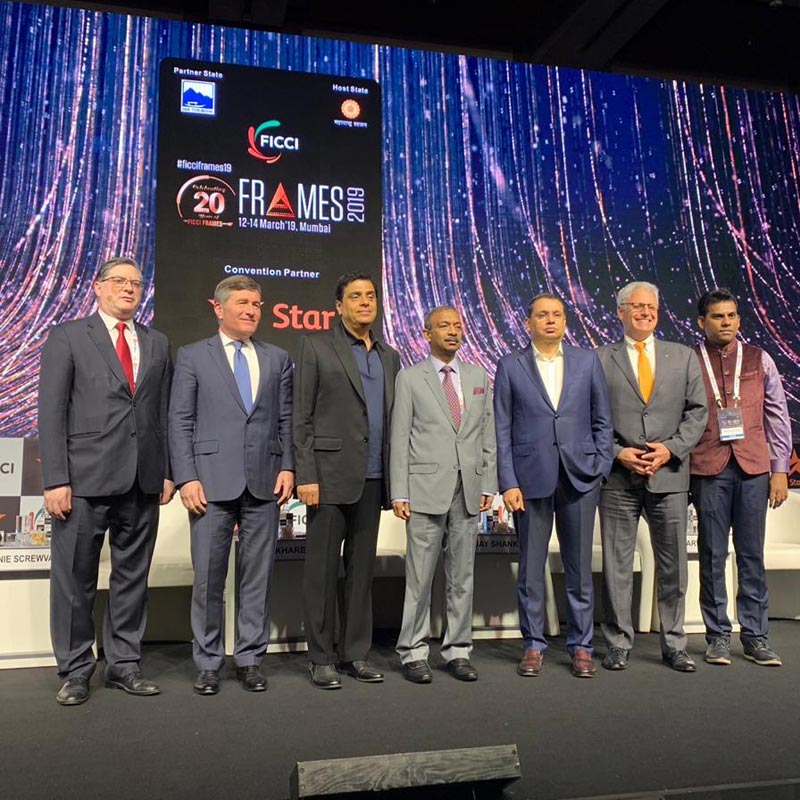
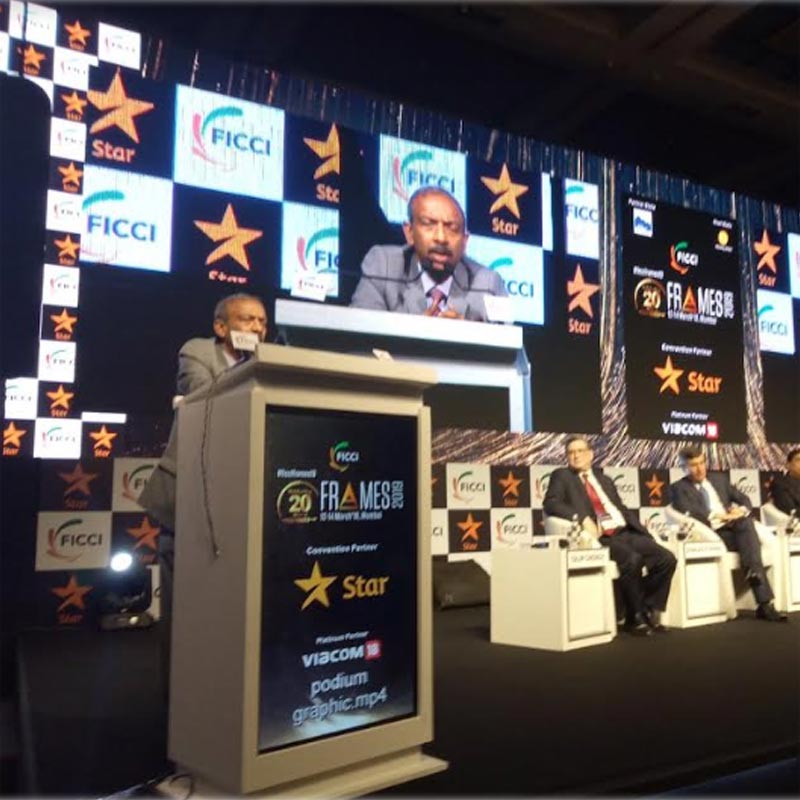
    MUMBAI: The 20th edition of three-day global convention covering the entire gamut of media and entertainment industry, FICCI Frames 2019, saw its inauguration today at Grand Hyatt in Mumbai.

    Mr. Amit Khare, Secretary, Ministry of Information & Broadcasting, delivered the keynote address.

    “One should encourage co-production so that content could be greatly enhanced, joining more countries, that will lead to better viewership.” Said Amit Khare.

    “We have taken an initiative of having a national broadcast policy. One should consider self-regulation and less regulation if we want the system to grow.” He added talking about the regulations in Media and Entertainment industry.

    While Mr. Uday Shankar, Vice President, FICCI took to stage for opening remarks, where he mentioned how the media and entertainment industry and FICCI FRAMES is growing by leaps and bounds. “India is one of the most exciting markets for the Media & Entertainment industry. The great Indian media story has just begun,” he said.

    Mr. Ronnie Screwvala in his ‘Media Mastermind Keynote: An Indian Entrepreneur’s Journey’ said he had seen the industry and FICCI FRAMES for so many years and was happy to note that business people were at the centre stage of the conclave.

    “The companies of tomorrow need to be more consumer companies and not just media companies. The Media and Entertainment sector cannot just function with passion, we also need leaders, founders and entrepreneurship,” said Mr. Screwvala talking about how the media and entertainment industry needs to focus on consumers.

    “Learning is story-telling,” Mr. Screwvala concluded.

    The other speakers in the opening session were Mr. Charles H. Rivkin, Chairman & Chief Executive Officer, Motion Picture Association of America and Mr. Gary Knell, Chief Executive Officer, National Geographic Partners. 

    FICCI-EY 2019 report on Media and Entertainment was also unveiled along with the law book of Cyril Amarchand Mangalda,s and Odisha Film Policy by Dr. Nitin Bhanudas Jawale, Managing Director Odisha Film Development Corporation.

    Apart from the 2nd edition of content market, an initiative to bring together content creators and content buyers from across the globe, another new initiative call 'Frame Your Idea' has been set up this year to help promote script writers in the industry. While the fraternity has been talking about the importance of stories and scripts writers within the industry, FICCI FRAMES will provide a platform as an opportunity for writers to pitch their content to various renowned production houses like Aamir Khan Productions, Balaji Telefilms, Dharma Productions, Disney Studios, Eros Now, RSVP, Kabir Khan Films, SPE Films India Pvt Ltd., Viacom18 Motion Pictures and Fox Star Studios to name a few.

    The pitching sections will be divided into Films, Television, Web shows and short films to make it smoother for the writers to book appointments and to pitch their stories to interested production houses for fruitful associations.

  • Sudhanshu Vats says content, platform and technology key to good storytelling

    Sudhanshu Vats says content, platform and technology key to good storytelling

    MUMBAI: On day 1 of FICCI Frames 2019 in a session titled ‘Looking back as we move ahead’, Viacom18 group CEO and MD Sudhanshu Vats was in conversation with Indian Express executive director Anant Goenka. The burning question that came out to dominate this conversation was ‘does the industry even realise how to and what to evolve to?’

    Vats began by stating that a lot has changed in the industry for the better. He went on to state, from the content space, the first thing that has changed, irrespective of the platforms, is that the industry has moved away from broadcast to micro-cast online. The industry has moved from beaming things to having more conversations making things more interactive.

    According to him, the second most important change led by technology is that it isn’t necessary to tell stories to everyone, rather tell it to a limited number of people and tell it successfully. 2018 has seen films target certain audience and these films performed exceedingly well in spite of not being blockbusters such as Andhadhun, Badhai Ho, etc. 

    The third and most interesting thing he pointed out to is the changes and differences between curator, creator and consumer. It used to be much simpler to differentiate between these three in the past but today the lines have completely blurred. And this is also followed by audiences across, where audiences have also become content curators.

    While reiterating the fact that the industry is experiencing many important changes, he states a welcoming change is the narration of diverse stories in a classical content sense.

    He stated that because the TV model is an ad-driven model, telling stories in an authentic manner has become a little difficult as compared to the past as it's driven by ratings. He noted that while playing with the original story, many times the industry is taking away from the story. He stressed that importance must be given here and that the focus must be on the ability to tell stories which will eventually sell rather than looking at only selling the stories.

    Speaking about ‘Formula’ as a safety net, Vats believes that formula works as a safety net at some level. With minds being patterned in a particular format, and sometimes from the commercial point of view, one must believe in intuition. With reference to the western world, he added that the media industry in the West follows a pattern format leading to success.

    Sudhanshu Vats believes that there will be a lot of custom use in the story and segmentation in the audience. According to him, there will be a set of audience that will love, and there will be one that doesn’t. But in the future, it won’t matter as every story can reach its audience and every audience their story.

    The session ended on the note that the future can be rafted only from lessons learnt in the past. The media industry is in interesting times today, as it witnesses a disruptive process of embracing change to redefine itself for the future.

  • MIB secy Amit Khare says national broadcast policy in the works

    MIB secy Amit Khare says national broadcast policy in the works

    MUMBAI: MIB Secretary Amit Khare did some plain talking here while addressing industry and said bowing to needs of the stakeholders, a national broadcast policy is in the offing.

    “We have thought of having a national broadcast policy. The draft is being prepared and we are working with FICCI and other stakeholders so that Indians can have that national broadcast policy,” Khare said at a session on the opening day of the 20th edition of FICCI Frames.

    The government official did not reveal much details, but said the policy could be in place within a few years.

    He also spoke of a strategic paper that is being prepared for the film and entertainment industry which will focus on issues like what incentives should be given by the central or the state government and the type of regulatory changes which are required for improving the screen density.

    “The way we develop, particularly in India or in other Commonwealth countries, it was platform-wise. We have different regulations for print, for online, for films and for broadcasts. But now with the technological change and the convergence that has taken place, there is a need to rethink, there is a need to beat this challenge and also which is a great opportunity in terms of the content which is viewed by the customer,” he commented while talking about the importance of change in technology for the sector.

    The  secretary also spoke about the importance of the conversations that will take place during the FICCI Frames. According to him, it will be very helpful for the government to know the views of the private sector, the stakeholders and then taking a considerate view about regulations or the type of policies that the authority wishes to have for this sector in 2025 or 2030.