Tag: FICCI Frames 2016

  • Challenges faced by the OTT players in India; the way ahead

    Challenges faced by the OTT players in India; the way ahead

    MUMBAI: With the majority of the OTT players operating on a freemium model, subscriptions are enjoying a new prominence as a revenue model for digital content and apps. While India saw Ditto TV working on the subscription revenue model, Balaji is all set enter the digital space with its digital platform Alt Digital Media.  

    The panel discussion on ‘Cracking the money code- Challenges and solutions for Digital Subscription models’ at FICCI FRAMES 2016 discussed the revenue models and the profit generation formula for this sector. Industry stalwarts included VUClip CEO Nickhil Jakatdar, Nazara Technologies CEO Manish Agarwal, ALT Entertainment chief strategy officer Eklavya Bhattacharya, Eros Digital COO Karan Bedi and Spuul India CEO Rajiv Vaidya. The session was moderated by BBC World News presenter Ros Atkins.

    After throwing light on the revenue models that each of the platforms followed, the panellists broadly discussed the revenue models that are followed in India with their positives and negatives and the various challenges that OTT was facing due to certain issues like infrastructure, piracy, etc.

    Initiating the discussion with how the ‘freemium’ model helped the OTT platforms, VUClip’s Jakatdar said, “The thing with such an emerging market is that if you don’t give content for free to the viewers, they will switch to some other place where they are getting it. You need to have content beyond the subscription pay wall. For example, in Malaysia, we found that Korean content works well there and is extremely popular. We got the simulcast content rights for Korea which they had to pay for, but the library content was for free.”

    He further added that, “We believe in micro payments which means that viewers can pay per content they view.  This means that they can buy data for a single day and don’t have to pay a monthly subscription. This is working well for us.”

    “Even as we use the freemium model, the free content for is important. If we look at the free content on the platforms as an ad-revenue driver, then we may find it difficult to sustain in this space ,” he further added.

    Differing with Jakatdar, ALT Entertainment’s Bhattacharya opined, “I don’t agree that the consumers will move to a different platform if you charge them. That’s going happen if you provide the same content on different platforms. It is definitely a challenge to provide exclusive quality. People don’t want to watch free content. They want to watch good content. The key for such platforms is to target the most loyal audiences and to provide them good quality and exclusive content which they can’t resist to buy. If you are creating content and hoping that you can break-even on advertising, it’s not going to work out. If you are confident about your content, people will definitely pay for it irrespective of the cost. If you create content that the consumers can’t get anywhere, they will come to you.”

  • Challenges faced by the OTT players in India; the way ahead

    Challenges faced by the OTT players in India; the way ahead

    MUMBAI: With the majority of the OTT players operating on a freemium model, subscriptions are enjoying a new prominence as a revenue model for digital content and apps. While India saw Ditto TV working on the subscription revenue model, Balaji is all set enter the digital space with its digital platform Alt Digital Media.  

    The panel discussion on ‘Cracking the money code- Challenges and solutions for Digital Subscription models’ at FICCI FRAMES 2016 discussed the revenue models and the profit generation formula for this sector. Industry stalwarts included VUClip CEO Nickhil Jakatdar, Nazara Technologies CEO Manish Agarwal, ALT Entertainment chief strategy officer Eklavya Bhattacharya, Eros Digital COO Karan Bedi and Spuul India CEO Rajiv Vaidya. The session was moderated by BBC World News presenter Ros Atkins.

    After throwing light on the revenue models that each of the platforms followed, the panellists broadly discussed the revenue models that are followed in India with their positives and negatives and the various challenges that OTT was facing due to certain issues like infrastructure, piracy, etc.

    Initiating the discussion with how the ‘freemium’ model helped the OTT platforms, VUClip’s Jakatdar said, “The thing with such an emerging market is that if you don’t give content for free to the viewers, they will switch to some other place where they are getting it. You need to have content beyond the subscription pay wall. For example, in Malaysia, we found that Korean content works well there and is extremely popular. We got the simulcast content rights for Korea which they had to pay for, but the library content was for free.”

    He further added that, “We believe in micro payments which means that viewers can pay per content they view.  This means that they can buy data for a single day and don’t have to pay a monthly subscription. This is working well for us.”

    “Even as we use the freemium model, the free content for is important. If we look at the free content on the platforms as an ad-revenue driver, then we may find it difficult to sustain in this space ,” he further added.

    Differing with Jakatdar, ALT Entertainment’s Bhattacharya opined, “I don’t agree that the consumers will move to a different platform if you charge them. That’s going happen if you provide the same content on different platforms. It is definitely a challenge to provide exclusive quality. People don’t want to watch free content. They want to watch good content. The key for such platforms is to target the most loyal audiences and to provide them good quality and exclusive content which they can’t resist to buy. If you are creating content and hoping that you can break-even on advertising, it’s not going to work out. If you are confident about your content, people will definitely pay for it irrespective of the cost. If you create content that the consumers can’t get anywhere, they will come to you.”

  • How ready is India for the digital disruption?

    How ready is India for the digital disruption?

    MUMBAI: The Indian media and entertainment industry is enamoured by the possibilities that the digital world poses for it. Within digital, ‘video’ and ‘mobile’ seem to be most used and often abused words. To tap in and make the most of this ‘digital video’ revolution that  the country is set to see in 2016, several small and big players have rolled out or planned VOD or OTT services..

    But is India ready for this digital disruption? Have those who are betting high on the success of the video business really taken into consideration the groundwork and infrastructure needed to actually make profit?  Moderator and Bloomberg TV India consulting editor Vikram Oza raised these questions at FICCI Frames 2016 during a panel discussion – ‘And the walls came tumbling down : Digital disruption.’ In front of him on the panel were  – SPN digital business EVP Uday Sodhi, Viacom18 Digital Ventures COO Gaurav Gandhi, HOOQ cofounder and content head Krishnan Rajagopalan, Arre COO Ajay Chacko and Elemental Tecnologies SVP Daniel Marshal  – each a pioneer of digital world in his own right.

    Within the first fifteen minutes into the discussion, the audience had a good idea of where things stood in the digital video business. “While a fair bit of 3G and 4G is taking off, the industry is still at a nascent stage to make assumptions. Monetization, bandwidth and content needed to fall in place to set the groundwork going,” said Sodhi summing it up.

    When posed a query on bandwidth costs and subscription issues, Gandhi gave an optimistic perspective. “Currently the data prices are very high. So much of the consumption behaviour we are seeing will drastically change as the bandwidth opens up and becomes cheaper. We need to aim for a setting when data prices become part of everyone’s utility bill. That is when no one will hesitate from paying for an OTT service.”

    Marshal added his take from his experience of the international market and how it played out there. “What I have observed in the US is that there are more users with multiple subscriptions since the combined cost is still less than what people used to pay for their cable subscriptions. If India has to really see the end of this convergence, adaptability and bandwidth needs to be worked on heavily,” he suggested.

    Another variable that is a hindrance for digital convergence is the complicated and poor payment gateways. “It is true that in India the present payment gateway options are a major challenge to both the service provider and the consumers. From my experience, a huge part of willing consumers put off payments because of the payment method. It is indeed a big challenge and a part of it is that people are still hesitant to trust their money with online payments. Thus the adoption is lower. TRAI tried to deal with the issue by strengthening the security process in the transaction and sort of got overzealous with it, which is costing the industry in a different way. I would say it will take another 5 years for the payment options to be easy and secure and ready to handle the digital disruption,” Sodhi opined.

    With everyone jumping on the mobile video bandwagon and promising an on demand video service, was there a need for the players to differentiate their offerings? After all, according to Google research, the current range of smartphones in the market allowed users to have only few apps before their devices slowed down. While the industry remained a free market, this clearly meant that only few services would survive this tough competition and make their way to the users’ handsets.

    To put matters into perspective, Gandhi said, “Currently 85 per cent of the content is owned between the five major TV networks and the two TV studios. The content offered by their OTT players may look homogenous because our first natural instinct is to put forth the existing content from our TV and movie library. But newer original content for the web is also being produced currently.”

    Rajagopalan shared that his OTT service HOOQ, which already has a large presence in the international market, is banking on its large Hollywood movie library as the differentiating factor. “Apart from that we have also identified regional and smaller studios that don’t have a contract with major broadcasters’ networks in India to provide us with fresh content. So ours is an international and regional approach.”

    Acknowledging the need to create web only content, instead of banking on existing libraries, Chacko added, “What an audience individually consumes is different social viewing. The content itself needs to be disruptive if it were to survive these initial years of just investment and to break even eventually. Each player will work on its strengths and try everything and anything between micropayments (or pay per view revenue model) to ad-funded content.”

    It is obvious from the discussions that there is a long way to go for India to reach a point when these OTT players can reap the optimum benefits of what they are sowing as investment today. Will they be able to make it through the dry years ahead until the infrastructure and country is ready? Is it worth the time and money that they are putting in?

    Chacko addressed this with a simple comparison to the eCommerce markets. “Compared to the eCommerce business there is almost no customer acquisition cost when it comes to digital media. What we gain organically is what these eCommerce brands pay millions of dollars for. Therefore, with an almost zero marketing budget one can sustain oneself in the industry as long as one has strong content,” Chacko said.

    The panel also pointed out that digital video business paves way for an exponential growth. With better devices and network, the business will grow not just by tens but thousands so it made sense to invest in it.  

    The moderator then rolled the ball in the panellists court by asking them if their advertisers were buying these arguments that they gave in favour of the OTT/ digital business. The panellists unanimously agreed that media planners and buyers were excited about this newly evolving media. They were happy about giving an alternative to their clients and so were the advertisers, given the measurability and reach the media gave them.

  • How ready is India for the digital disruption?

    How ready is India for the digital disruption?

    MUMBAI: The Indian media and entertainment industry is enamoured by the possibilities that the digital world poses for it. Within digital, ‘video’ and ‘mobile’ seem to be most used and often abused words. To tap in and make the most of this ‘digital video’ revolution that  the country is set to see in 2016, several small and big players have rolled out or planned VOD or OTT services..

    But is India ready for this digital disruption? Have those who are betting high on the success of the video business really taken into consideration the groundwork and infrastructure needed to actually make profit?  Moderator and Bloomberg TV India consulting editor Vikram Oza raised these questions at FICCI Frames 2016 during a panel discussion – ‘And the walls came tumbling down : Digital disruption.’ In front of him on the panel were  – SPN digital business EVP Uday Sodhi, Viacom18 Digital Ventures COO Gaurav Gandhi, HOOQ cofounder and content head Krishnan Rajagopalan, Arre COO Ajay Chacko and Elemental Tecnologies SVP Daniel Marshal  – each a pioneer of digital world in his own right.

    Within the first fifteen minutes into the discussion, the audience had a good idea of where things stood in the digital video business. “While a fair bit of 3G and 4G is taking off, the industry is still at a nascent stage to make assumptions. Monetization, bandwidth and content needed to fall in place to set the groundwork going,” said Sodhi summing it up.

    When posed a query on bandwidth costs and subscription issues, Gandhi gave an optimistic perspective. “Currently the data prices are very high. So much of the consumption behaviour we are seeing will drastically change as the bandwidth opens up and becomes cheaper. We need to aim for a setting when data prices become part of everyone’s utility bill. That is when no one will hesitate from paying for an OTT service.”

    Marshal added his take from his experience of the international market and how it played out there. “What I have observed in the US is that there are more users with multiple subscriptions since the combined cost is still less than what people used to pay for their cable subscriptions. If India has to really see the end of this convergence, adaptability and bandwidth needs to be worked on heavily,” he suggested.

    Another variable that is a hindrance for digital convergence is the complicated and poor payment gateways. “It is true that in India the present payment gateway options are a major challenge to both the service provider and the consumers. From my experience, a huge part of willing consumers put off payments because of the payment method. It is indeed a big challenge and a part of it is that people are still hesitant to trust their money with online payments. Thus the adoption is lower. TRAI tried to deal with the issue by strengthening the security process in the transaction and sort of got overzealous with it, which is costing the industry in a different way. I would say it will take another 5 years for the payment options to be easy and secure and ready to handle the digital disruption,” Sodhi opined.

    With everyone jumping on the mobile video bandwagon and promising an on demand video service, was there a need for the players to differentiate their offerings? After all, according to Google research, the current range of smartphones in the market allowed users to have only few apps before their devices slowed down. While the industry remained a free market, this clearly meant that only few services would survive this tough competition and make their way to the users’ handsets.

    To put matters into perspective, Gandhi said, “Currently 85 per cent of the content is owned between the five major TV networks and the two TV studios. The content offered by their OTT players may look homogenous because our first natural instinct is to put forth the existing content from our TV and movie library. But newer original content for the web is also being produced currently.”

    Rajagopalan shared that his OTT service HOOQ, which already has a large presence in the international market, is banking on its large Hollywood movie library as the differentiating factor. “Apart from that we have also identified regional and smaller studios that don’t have a contract with major broadcasters’ networks in India to provide us with fresh content. So ours is an international and regional approach.”

    Acknowledging the need to create web only content, instead of banking on existing libraries, Chacko added, “What an audience individually consumes is different social viewing. The content itself needs to be disruptive if it were to survive these initial years of just investment and to break even eventually. Each player will work on its strengths and try everything and anything between micropayments (or pay per view revenue model) to ad-funded content.”

    It is obvious from the discussions that there is a long way to go for India to reach a point when these OTT players can reap the optimum benefits of what they are sowing as investment today. Will they be able to make it through the dry years ahead until the infrastructure and country is ready? Is it worth the time and money that they are putting in?

    Chacko addressed this with a simple comparison to the eCommerce markets. “Compared to the eCommerce business there is almost no customer acquisition cost when it comes to digital media. What we gain organically is what these eCommerce brands pay millions of dollars for. Therefore, with an almost zero marketing budget one can sustain oneself in the industry as long as one has strong content,” Chacko said.

    The panel also pointed out that digital video business paves way for an exponential growth. With better devices and network, the business will grow not just by tens but thousands so it made sense to invest in it.  

    The moderator then rolled the ball in the panellists court by asking them if their advertisers were buying these arguments that they gave in favour of the OTT/ digital business. The panellists unanimously agreed that media planners and buyers were excited about this newly evolving media. They were happy about giving an alternative to their clients and so were the advertisers, given the measurability and reach the media gave them.

  • Govt admits low production of STBs, urges more players to manufacture under Make in India Initiative

    Govt admits low production of STBs, urges more players to manufacture under Make in India Initiative

    MUMBAI: The government today admitted that less than 10 per cent set top boxes being used in India were Indian made. However, Information and Broadcasting Secretary Sunil Arora said the government and his ministry were completely committed to the digitization programme.

    Arora said, “We want the industry to look at this opportunity under the Make In India initiative and produce more STBs in India under the Electronics Manufacturing scheme”.

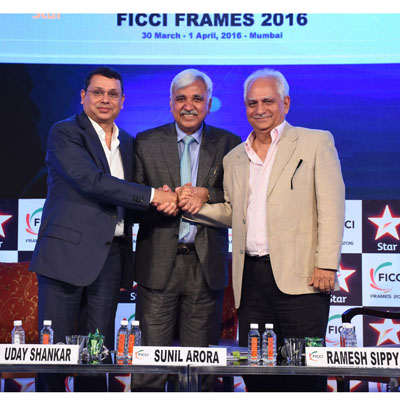
    The ministry remained committed to promoting ease of doing business in the media and entertainment sector, Arora said in a dialogue with Star India CEO Uday Shankar and veteran filmmaker Ramesh Sippy at FICCI Frames 2016.

    He said the Ministry was also guided by the ‘minimum government, maximum governance’ philosophy. “One of our primary objectives is to bring down the number of visitors to Shastri Bhavan to a trickle. We want to move towards less regulation and facilitate India to become the hub of media and entertainment industry.”

    Arora claimed that clearance for new TV channels had been expedited over the last six months under a liberalized regime. He said the home ministry had agreed to most of the suggestions made by the I&B ministry about liberalizing several conditions. Arora stressed that the ministry intends to play a role of a facilitator for the media and entertainment industry to flourish in the country.

    He said a decision had been taken to set up the National Centre of Excellence in Animation, Gaming and Visual Effects in Mumbai.  The Maharashtra Government is providing a 25 acre land near the Film City in Goregaon for the institute.

    The secretary also said the government had approved the Rs 598 crore National Film Heritage Mission to preserve and promote India’s rich film and cultural heritage. He also referred to the National Museum of Indian Cinema coming up in Films Division Complex on Peddar Road in Mumbai with several interactive exhibits. “Prime Minister Narendra Modi has taken a keen interest in this museum which is being curated by the National Council of Science Museums, Kolkata.”

    Focusing on ease of doing business, Arora said a Film Facilitation Office had opened in the National Film Development Corporation to function as a single window service for film related clearances. The secretary said an award had been instituted as part of the National Film Awards from this year to honour the states that are most film friendly. In 2016, Gujarat has been adjudged the most film friendly state, followed by UP and Kerala.

    Participating in the discussion, Shankar, who is also FICCI Entertainment Panel Chairman expressed concern over the viability of stand-alone news channels. He also said the entry of fringe elements in the news broadcasting field for ‘ancillary facilities’ was affecting credibility. Sippy expressed concern over low theatre density in India.


  • Govt admits low production of STBs, urges more players to manufacture under Make in India Initiative

    Govt admits low production of STBs, urges more players to manufacture under Make in India Initiative

    MUMBAI: The government today admitted that less than 10 per cent set top boxes being used in India were Indian made. However, Information and Broadcasting Secretary Sunil Arora said the government and his ministry were completely committed to the digitization programme.

    Arora said, “We want the industry to look at this opportunity under the Make In India initiative and produce more STBs in India under the Electronics Manufacturing scheme”.

    The ministry remained committed to promoting ease of doing business in the media and entertainment sector, Arora said in a dialogue with Star India CEO Uday Shankar and veteran filmmaker Ramesh Sippy at FICCI Frames 2016.

    He said the Ministry was also guided by the ‘minimum government, maximum governance’ philosophy. “One of our primary objectives is to bring down the number of visitors to Shastri Bhavan to a trickle. We want to move towards less regulation and facilitate India to become the hub of media and entertainment industry.”

    Arora claimed that clearance for new TV channels had been expedited over the last six months under a liberalized regime. He said the home ministry had agreed to most of the suggestions made by the I&B ministry about liberalizing several conditions. Arora stressed that the ministry intends to play a role of a facilitator for the media and entertainment industry to flourish in the country.

    He said a decision had been taken to set up the National Centre of Excellence in Animation, Gaming and Visual Effects in Mumbai.  The Maharashtra Government is providing a 25 acre land near the Film City in Goregaon for the institute.

    The secretary also said the government had approved the Rs 598 crore National Film Heritage Mission to preserve and promote India’s rich film and cultural heritage. He also referred to the National Museum of Indian Cinema coming up in Films Division Complex on Peddar Road in Mumbai with several interactive exhibits. “Prime Minister Narendra Modi has taken a keen interest in this museum which is being curated by the National Council of Science Museums, Kolkata.”

    Focusing on ease of doing business, Arora said a Film Facilitation Office had opened in the National Film Development Corporation to function as a single window service for film related clearances. The secretary said an award had been instituted as part of the National Film Awards from this year to honour the states that are most film friendly. In 2016, Gujarat has been adjudged the most film friendly state, followed by UP and Kerala.

    Participating in the discussion, Shankar, who is also FICCI Entertainment Panel Chairman expressed concern over the viability of stand-alone news channels. He also said the entry of fringe elements in the news broadcasting field for ‘ancillary facilities’ was affecting credibility. Sippy expressed concern over low theatre density in India.


  • FICCI Frames 2016: Digitization is a boon, but subject to how it is utilized by all stakeholders

    FICCI Frames 2016: Digitization is a boon, but subject to how it is utilized by all stakeholders

    MUMBAI: Even as a general consensus emerged on digitization being a boon, questions were raised at the ongoing FICCI FRAMES meet on whether the concept and advantages of the concept have been fully understood.

    Even as the TV industry has leapfrogged to more than 800 channels, and Indian Pay TV made the leap from analogue to digital and travelled from single to multi-platforms, the session on ‘Future Proofing Broadcast Distribution’ showed there are still some apprehensions on how the new technology can be used.

    The panelist included Times Network MD& CEO MK Anand, Ortel Communication CEO Bibhu Prasad Rath, Indusind Media and Communication MD & CEO Tony D Silva and Microsoft Corporation India Microsoft Azure and server business country head Srikanth Karnakota. The session was moderated by Zee Network president (Legal & Regulatory) Avnindra Mohan.

    Mohan set the ball rolling with a perplexing question on whether the industry had fully understood the implications of ditigization and convergence and whether stakeholders realized that they can use the same network for delivering different content through different modes of mediums. Thus, he said it shows a paradigm shift in the entire gambit of the distribution system.

    “Digitization has been a boon for the broadcast industry. From the broadcaster point of view, digitization started when the Direct to Home (DTH) system launched in 2003 in India. English news and other English general entertainment channels were being treated as the outsiders for the broadcast business. We had 65 million viewers in English from 2000 to 2005 whereas the total number of television viewers was 400 million. The number of English viewers has grown to 200 million now and that happened because of digitization,” says Anand.

    Anand added that in the next five to ten years, the English entertainment viewership should cross 300 million which is almost close to Hindi general entertainment channels viewership due to digitization.  “Times Now has a very strong and loyal audience in a month we cross the viewership of two and half crores but people don’t know that we have 13 crores of viewers on New Media platform,” informs Anand.

    Being a multi-system operator sharing views on the kind of business opportunities Ortel Communication can have in such a scenario, Rath felt India has grown in a unique fashion for the last two decades but the quality of the networks has been compromised. “The Set Top Box is not a solution to a network and we need to handle Phase III and IV in a different manner and not as Phase I and II”, he added.

    Noting that “we in India do not have one definition for Digitisation.It has been portrayed differently by others”, D’silva asked what the country wanted to achieve through digitization. “I believe there should a national objective about what they want to achieve from digitization. In most the industry today including DTH, 50 per cent of revenue goes in tax”. He felt progress was difficult unless the tax was supportive, but this was not going to happen. “It is the MSOs who are putting up the money and buying the STBs. So there has to be a logical regime of taxation. The STB is the only starting point of digitization. There should be an environment where technology and digitization should go hand in hand,” he felt.

  • FICCI Frames 2016: Digitization is a boon, but subject to how it is utilized by all stakeholders

    FICCI Frames 2016: Digitization is a boon, but subject to how it is utilized by all stakeholders

    MUMBAI: Even as a general consensus emerged on digitization being a boon, questions were raised at the ongoing FICCI FRAMES meet on whether the concept and advantages of the concept have been fully understood.

    Even as the TV industry has leapfrogged to more than 800 channels, and Indian Pay TV made the leap from analogue to digital and travelled from single to multi-platforms, the session on ‘Future Proofing Broadcast Distribution’ showed there are still some apprehensions on how the new technology can be used.

    The panelist included Times Network MD& CEO MK Anand, Ortel Communication CEO Bibhu Prasad Rath, Indusind Media and Communication MD & CEO Tony D Silva and Microsoft Corporation India Microsoft Azure and server business country head Srikanth Karnakota. The session was moderated by Zee Network president (Legal & Regulatory) Avnindra Mohan.

    Mohan set the ball rolling with a perplexing question on whether the industry had fully understood the implications of ditigization and convergence and whether stakeholders realized that they can use the same network for delivering different content through different modes of mediums. Thus, he said it shows a paradigm shift in the entire gambit of the distribution system.

    “Digitization has been a boon for the broadcast industry. From the broadcaster point of view, digitization started when the Direct to Home (DTH) system launched in 2003 in India. English news and other English general entertainment channels were being treated as the outsiders for the broadcast business. We had 65 million viewers in English from 2000 to 2005 whereas the total number of television viewers was 400 million. The number of English viewers has grown to 200 million now and that happened because of digitization,” says Anand.

    Anand added that in the next five to ten years, the English entertainment viewership should cross 300 million which is almost close to Hindi general entertainment channels viewership due to digitization.  “Times Now has a very strong and loyal audience in a month we cross the viewership of two and half crores but people don’t know that we have 13 crores of viewers on New Media platform,” informs Anand.

    Being a multi-system operator sharing views on the kind of business opportunities Ortel Communication can have in such a scenario, Rath felt India has grown in a unique fashion for the last two decades but the quality of the networks has been compromised. “The Set Top Box is not a solution to a network and we need to handle Phase III and IV in a different manner and not as Phase I and II”, he added.

    Noting that “we in India do not have one definition for Digitisation.It has been portrayed differently by others”, D’silva asked what the country wanted to achieve through digitization. “I believe there should a national objective about what they want to achieve from digitization. In most the industry today including DTH, 50 per cent of revenue goes in tax”. He felt progress was difficult unless the tax was supportive, but this was not going to happen. “It is the MSOs who are putting up the money and buying the STBs. So there has to be a logical regime of taxation. The STB is the only starting point of digitization. There should be an environment where technology and digitization should go hand in hand,” he felt.