Tag: FICCI FRAMES 2015

  • Research imperative to exploit big sports leagues

    Research imperative to exploit big sports leagues

    MUMBAI: The year 2014 witnessed the emergence of sports as it rekindled the nation’s hope and sports channels played a huge role in creating buzz in the arena of sports.


    The successful league models in Kabaddi, Cricket, Hockey, Football, Badminton and Tennis paved the way to create viable career options for young Indians. However, the key to success remains in monetization and return of investment for stakeholders and the sustainability of their business models.


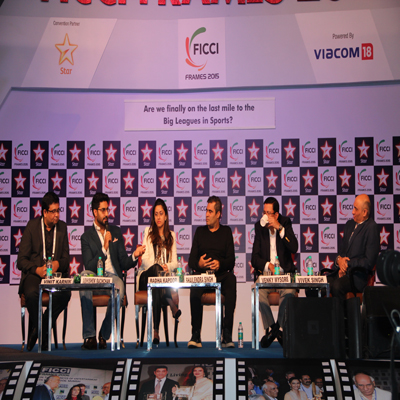
    In a session of FICCI Frames moderated by Group M national director sports and entertainment Vinit Karnik, which had Percept joint MD Shailendra Singh, DOIT media founder Radha Kapoor, KKR CEO Venky Mysore and various sports franchise owner Abhishek Bachchan, panelists spoke on the issues relating to a national policy on sports.


    Infrastructure status to build stadiums and facilities, challenges before rights holders to monetise sports content, franchisees business models and a national curriculum on sports were some of the topics that were touched upon.


    The panel spoke aggressively against federation becoming a regulatory body and intruding into business strategies of a privately owned entity. Speaking on the same Singh said, “The growth is determined by demand and supply, you can make money of something you go for it. India has a large youth population desperately waiting for an opportunity to make a career out of sports but what’s stopping them is poor infrastructure and that is where Narendra Modi is going wrong. The federations are unwanted obstacles headed by corrupts. They make things difficult and people walk off from doing a business. I organised a similar tournament like IPL in 1999 but Dalmiya called it Masala and asked me to stop it immediately. Today BCCI cherishes the IPL.”


    While Venky Mysore, who closely works with the BCCI being the CEO of Kolkata Knight Riders (KKR), emphasised on the commercial sector saying, “While it’s easier to work with the BCCI considering the fact that one has to deal with less number of people compared to the sports ministry, their intrusion in the business and strategic affairs of the franchisee is a bit irrational. KKR has made money out of IPL and we are a debt free franchisee – a fact that I am proud of. For any brand to work in India you need fans and the ratings show that KKR matches always bag the pole position. So every new sport has room but it should not be rushed as the loss is immense.”


    While non-cricketing sports are also emerging in the major sporting league category, making money out of them is difficult for broadcasters, addressing the issue Bachchan said, “When Charu came to me with the Pro Kabaddi concept, I was shocked. But after seeing the ground reality my perception changed. There are more than 1500 Kabaddi clubs in Mumbai desperately looking for an opportunity and a platform to showcase their talent and Star and Pro Kabbadi League opened it up for them. The Indian Super League (ISL) is another example of broadcasters and corporates coming together to put up an exquisite event. Due to the ISL deal that ensures ground level improvement of the sport, more kids are getting the infrastructure they deserve, which will show its relevance 10 years down the line.”


    DOIT Media founder served for more women participation and declared new platforms for women in India. “We are launching a new kabaddi league dedicated to women, which will ensure their participation and it’s just the beginning. Every sport in future may have a female version too because the talent exists but gets rusted due to lack of use.”


    Every major sport now has two leagues but all of them are not profitable for the broadcaster. Kabbaddi changed rules to rope in more revenue generating opportunities and the federation supported it, cricket also did the same with innovations like strategic time out. While it is very important not to lose the authenticity of the sport, generating revenue is a big necessity in order to ensure longitivity.     

  • Print or digital; what redefines a traditional paradigm?

    Print or digital; what redefines a traditional paradigm?

    MUMBAI: While circulation of newspapers is still in the positive and print continues to have the lion’s share of the ad spend pie; digital is gaining ground rapidly. So is there a reason for fear amongst print players?


    Discussing this was a panel comprising The Indian Express Group wholetime director Anant Goenka, Mid-Day editor Sachin Kalbag, BBC Online editor Nidheesh Tyagi, Danik Bhaskar Group SVP – sales, market development and brand marketing Vinay Maheshwari and Percept Allied Media CEO Shripad Kulkarni. The panel was moderated by MXM editor-in-chief and CEO Pradyuman Maheshwari.


    Goenka recalled that when he started handling the digital side of The Indian Express Group, the important factor was to stick to the funda of ABCD – Astrology, Bollywood, Cricket and Devotion. He went on to say that politics became the hot topic interest on the Internet, thanks to the issues related to Narendra Modi, elections and Arvind Kejriwal. He believes that Internet, gives them an opportunity to reach out to a wider range of audience where print can’t be reached at this point of time.


    Goenka believes that it is a very complimentary medium. “It is clearly about finding a way to create content that works for both mediums (digital and print). Content has to be exclusively for each medium. Both mediums in India are comfortable and are here to stay,” he said.


    According to Danik Bhaskar’s Maheshwari, both the mediums always do not have the same set of audience. He opines that print and digital are going to co-exist and for long. He believes that newspapers act as an advantage for any consumer. “It reaches people at 7 am in the morning at their doorsteps and people are fresh to read it. In tier II and III cities, literacy, income and readership is on a rise. On top of all this, affordability is also on the rise. The reach that print delivers today is worth mentioning,” he said, adding that regional languages papers are also consumed well.


    Kalbag said that what digital is doing right now is putting a lot of strength to what print delivers in the morning. “Where you break big stories in print, it is a big worry for any journalist and editor for how to do justice post 8 am for internet. To viralise it on social media platforms is the best way to reach out to the whole world.” He asserted that social media platforms have become curated platforms where all print news is curated in the best manner for each of the digital platform.


    “What works for Twitter may not necessarily work for Facebook or Pintrest and vice-a-versa. So each of these platforms need to have a perfect tactic or strategy to put all of the content together and every journalist and editor should know how to do justice to each of the platforms,” said Kalbag.


    Kulkarni had a different opinion altogether. He believes that the industry is definitely witnessing a change, thanks to digital platforms entering into the market. “We have spoken about India and Bharat but for the first time, digital has had a heavy impact. Look at all the generations, from old generation like me to a new generation like my daughter. I still prefer newspapers and she prefers reading it online. This is the change and more changes are yet to come.”


    To conclude, most of the parties believed that print and digital are equally important for different set of audiences and both are here to stay for a very long time.


  • “Women must develop a thick skin in order to survive in the media:” Barkha Dutt

    “Women must develop a thick skin in order to survive in the media:” Barkha Dutt

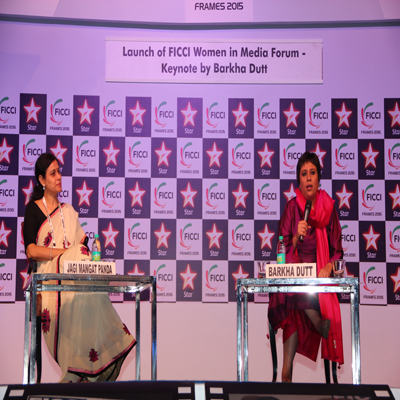
    MUMBAI: Veteran journalist Barkha Dutt, who recently stepped down from her post as NDTV group editor to start her own business venture, said that in order to survive in the media business, women should develop a thick skin.


    Speaking at the launch of FICCI Women in Media Forum, Dutt specifically addressed women journalists and said, “There are two key things that you should keep in mind. One is that you have to perform better than the men and secondly, be prepared to be scrutinised or even being deconstructed in the media room. Develop a thick skin in order to survive.”


    Dutt spoke on the role of women in the Indian news room space and shared some key insights from her own experience. She began her keynote about the role and depiction of women 20 years ago in the industry. “I want to talk about my mother’s generation working in the media. Today, we are not the norms but the exception. When my mother was 19 years old and walked into Hindustan Times asking for a job, the then editor told her that there was no space for her in the media room. After persisting, she was told that she would get to cover a flower display show in Delhi. She later went on to head the news bureau,” Dutt said.


    Sharing an interesting anecdote, Dutt, who is synonymous for her coverage of the Kargil War, said that it was her mother who should be given due credit. “During India’s war with Pakistan in 1965, my mother took a few days off and went to cover the war at the war front in Punjab. She did this after she was not allowed to cover the war by the newspaper. In Punjab, my mother sent dispatches back to the news paper desk, which got featured prominently,” Dutt shared.


    Moving on to her own experience, Dutt said that in 1999, the army was uncomfortable with a woman at the war front. “They were not comfortable protecting a woman. I told them that if soldiers were going to go behind a rock and use it as a loo, so will I. Today, we women journalists want to be judged for our work as journalists,” she stated.


    Dutt also mentioned that while today there were many women journalists, she could not even name 10 women editors or CEOs in the news room space. She shared insights of a UN survey, which analysed profitable film industries world over. “One third of the screen space or less was given to women in speaking roles in Bollywood. However, India did well in sexualising women.”


    She highlighted how disparity in wages existed in Bollywood. “Why didn’t Kangana Ranaut get the same profits that her male contemporaries do even after performing well with a film like Queen? Why is Anoushka Sharma questioned if she has got a lip-job done, while the male actors are not asked if they have resorted to botox?” the popular TV anchor reasoned.


    In conclusion Dutt said, “I sit here as a 43 year old and with 20 years of journalism experience and I look at it in dismay. There is a certain kind of glamorising of journalism that is taking place in the studio today. How is it that the three Khans of Bollywood are going strong enough at 50 years but not a single actress over 40?” she implored.


  • FICCI Frames: Internet has increased distribution pipe but lacks monetization

    FICCI Frames: Internet has increased distribution pipe but lacks monetization

    MUMBAI: India is going through a sea change when it comes to content and technology and the country is still grappling with the changes. With sudden boom of multiple distribution systems, the internet and satellites have started playing a larger role in distribution of content. The traditional distribution system has also undergone change and this is not only in the area of production and distribution, but also in the space of marketing.


    With the increase in the number of distribution platforms, what the country is witnessing is convergence of businesses. “While we have been talking about convergence in telecom and entertainment for over two decades, it is now that we see it is becoming more relevant,” said Department of Telecom, Government of India special secretary Rita Teaotia in her opening remarks, on day two of FICCI Frames 2015.


    According to Teaotia, one of the most important feature of convergence is the heightened significance of the internet in actually delivering content. “This has led to increased choices to consumers, which in turn has led to changed consumer behaviour. They are no longer captive audience,” she said, while addressing the keynote for the session ‘Dancing or Dueling? – the Interplay of Content and Carriage in a Converged World.’


    Convergence has also seen a fragmentation around the value chain. While there are a number of players, including the telecom, cable TV, broadcasting stations, equipment vendors, content distribution owners, content owners among others, one can see blurring of boundaries of those in the value chain.


    Teaotia pointed out that the huge explosion for demand of data had led to the transformation of existing networks. “So broadcasters are looking at broadband to offload content, mobile networks are converging with fixed networks and alternate platforms are being developed to speed up the process of delivering content,” she said, adding that there was increasing competition between mobile, fixed network operators and broadcasters for content delivery.  


    With convergence has come challenges. “One of the major concerns is how to respond to the new regulations and regulatory challenges emerging from convergence and ensure that customers continue to obtain full benefit of the emerging technologies,” questioned Teaotia.


    While traditionally there has been a clear division for regulation of telecom networks and broadcasting content with separate regulatory regimes, content regulation has been focused largely to address movie and TV content over traditional broadcasting platforms. “The blurring which we are seeing now of the vertical supply chains for production and delivery of content and new business models for monetizing it have generated new and complex regulatory issues and questions about how effective our current regulation are,” pointed out Teaotia.


    Content Monetisation in Converged Environment


    Even with more and more content being distributed using different pipes, there is little or no monetization opportunity in the country. “Monetization is still a suspect in the short term, in the long term we have to see how traditional media evolves in India. The big money is still in traditional media and if you want to monetize the content, you will have to rely on traditional media,” said Indiacast Media Distribution group CEO Anuj Gandhi.


    According to Gandhi, the industry needs to evolve. “We need to get a structure to the windowing business we do. Everybody will need to have access. As we see more screens and content, we will have to monetize the content on each window opportunity and I think that will become a reality,” he opined.


    The industry, needs to come up with a formula for clever windowing. “The west has done it effectively where consumers pay a premium to watch content first and then the cost keeps coming down with advertisements,” pointed out Gandhi. 


    India: A Global Entertainment Superpower


    With the huge amount of content being created in India, IT industry establishing a strong footprint globally with almost 55 per cent market share globally and the entertainment industry growing from Rs 1 lakh crore in 2014 at 40 per cent to Rs 2 lakh crore by 2019, India is right on the path of becoming a global entertainment superpower. However, while this seems a very natural ambition, is it that simple?


    Answering the same was NASSCOM president R. Chandrashekhar. “With convergence, there is blurring of lines between businesses. But with this, you have to worry about competition not just within your business, but from other businesses as well, which can wipe out everything,” he said.


    The advent of internet as an extremely dominant medium for distribution of content, has lowered the many barriers that content producers faced in the past to distribute their content.


    According to 9.9 Media CEO and founder ISB Ashoka University founder Pramath Sinha, convergence has helped in bringing down the barriers to distributing content. “Not only this, it has also led to lowering of the cost of distribution,” he said.


    Chandrashekhar, however said that while distribution of content has become easier, its discovery in the huge space could be a challenge. “We need to find out who the gatekeepers are who are standing between finding that content and how is interplay between the gatekeepers being managed,” concluded Chandrashekhar.


  • Indian pubcaster needs to re-invent in era of digital advancement

    Indian pubcaster needs to re-invent in era of digital advancement

    MUMBAI: While the general consensus on the role of a public service broadcaster (pubcaster) is that it provides not much “newsy” content, the BBC definitely remains a role model, even for private news channels.


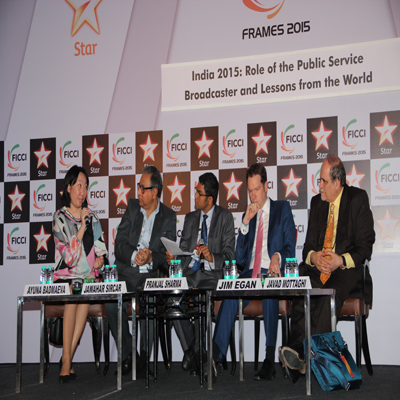
    This was the underlying theme that was discussed on a panel discussion titled ‘India 2015: Role of the Public Service Broadcaster and Lessons from the World’ at FICCI Frames 2015.


    The panel comprised Prasar Bharati CEO Jawhar Sircar, BBC Global News CEO Jim Egan, ABU secretary general Javad Mottaghi and VGTRK Digital Television Russia deputy CEO Ayuna Badmaeva. The session was moderated by Zee Network’s The Appointment host and FICCI advisor Pranjal Sharma.


    The session began with Sircar speaking on the role of Prasar Bharati in the country so far. According to him, the pubcaster had been able to streamline the entire country’s emotional unity together in a multi culture nation. It also played the heritage aspect role as it broadcast mythological shows like the Ramayana. “Show me a single broadcaster, who covers every island of the country across its geographical spectrum. India’s cultural unity was achieved because of a public service broadcaster,” he emphasised.


    Elaborating on how her network functions in Russia and on its role, Badmaeva informed that the network had 18 brands under its umbrella. “We started in 2009 with a factual entertainment channel. We work across Russia and our role is to fill the gap where other networks do not cover its citizens,” she said.


    Egan added, “What is most important for a public service broadcaster is to make the good popular and make the popular good. It is very important that a pubcaster reaches out to every citizen.”


    Posing a question, Sharma asked whether the government should decide what’s good for the public? Mottaghi replied saying that the first word “public” of Public Service Broadcaster referred to all groups of society. Hence its duty was to serve the public. “It has to be public oriented content versus commercial oriented content. We talk about issues such as health, culture, education and what society needs, which is not so much part of commercial news channels,” he opined.


    On being questioned by Sharma as to how Doordarshan ensures that it gets viewers to watch its content, Sircar conceded the fact that DD’s content was definitely not at par as compared to what the BBC was known for world over.


    For Sircar, the issue was related to both creativity and funding. “If the BBC could use 75 per cent of its funding on content, India could use only 10 per cent,” he said.


    Throwing an insightful statistic, which governed the theme of the discussion that followed, Sircar said, “While internationally, double digits dollars were spent per person for creating content. However, in India only 40 cents per person is spent on creating content. If you spend 40 cents, you get content worth 40 cents too.”


    Badmaeva then spoke on how the pubcaster tried remaining relevant in Russia in the ever-evolving digital age. She said, “While linear TV ratings are going down, people consumed content via smartphones and tablets. People also bought their content from cable operators. For us, our network is driven by both profit and reach.” She went on to add the Russian pubcaster has in recent time produced a documentary, which delivered the same rating as the Winter Olympics.


    Egan informed on how the BCC stayed relevant in a dynamic media space. “Every household is driven by a $20 subscription. The idea is about universality. While a part of it to remain relevant is about content, it is also about access, technology and reach. We innovate based on demand. In the digital age, it is how audiences engages with the content,” he said. He then added that around 270 million of the BBC’s audiences was out of the United Kingdom.


    Speaking on the now banned documentary India’s Daughter, which was a joint co-production between various production houses and the BBC, Egan said, “It had the highest values of journalism and the challenge is to avoid being ghettotised as just a pubcaster.”


    Sircar added that DD Sahayadri too had much of its content produced by private production houses. “Own it, don’t stone it,” he said. He also mentioned that when the pubcaster decided to air the Aamir Khan-helmed show Satyamev Jayate, he was questioned by ministers if a show where people washed their dirty linen in public was good for the channel. Sircar was of the opinion that because the show touched public issues, the pubcaster should air it.


    Touching upon the case of Star Sports, which went to court over the pubcaster airing the ICC Cricket World Cup, Sircar said that the pubcaster just followed a court order, which stated that in addition to profit making, the people of India are to be allowed to watch games via cable through terrestrial means. “Because of a very small cartel, which has a few channels, it will lead to monopolising of sports events,” he highlighted.


    Sircar informed that his goal was now focussed on two things. Firstly, increasing the number of channels on Free Dish from the current 50 to 112 and secondly, to use DD’s 1400 transmitters to create FM bands. “If FM has to reach mobiles, smaller circles of 50 kilometers will be created,” he said.


    He went on to add that a process was underway where 15 out of 20 channels could be auctioned. However, he refused to share details.


    Touching upon Sircar’s “40 cent” remark, Egan concluded the session saying, “In a country like India with a large population, 40 cents could add up to $500 million a year. It is a question about a national strategic choice. In some countries a pubcaster would weep tears of joy with this amount of money.”

  • FICCI Frames: Don’t ignore the numbers; investment experts tell filmmakers

    FICCI Frames: Don’t ignore the numbers; investment experts tell filmmakers

    MUMBAI: A panel discussion on Making the Impossible Possible: Dating and Investor and Getting Funded,’ on the second day of the FICCI Frames 2015 saw the participants focussing on the key value drivers that investors look at.


    The discussion, moderated by KPMG India Transactions and Restructuring director Girish Menon centred on finding money to release small, medium and regional cinema at a profit. The participants were NASSCOM co-founder and past chairman Saurabh Srivastava, Indian Angels Network CEO Padmaja Ruparel, Zodius Capital MD Gautam Patel, Blume Ventures Sanjay Nath and Idyabooster founder Nandini Mansinghka.  


    Srivastava spoke about how the success of investment in technology can be replicated in entertainment. “It’s all about venture capital,” he said.


    Today, the manner in which we communicate or travel, or even access healthcare and education has changed dramatically from a few years ago. This change has happened “because we found a way to finance innovation,” said Srivastava.


    The old paradigm of low risk funding does not apply to innovative technology, which is high risk. So new investment models that fund several innovations at a time with high annualised returns came into the market and that made Google, Facebook and Twitter possible. That hasn’t happened with movies because the dynamics of the investment structure are flawed. “The success rate is low because if you have a scenario where you cannot take it to enough people, then a movie that could make money will not, and people will not take risks,” Srivastava added. In his opinion, this will change with the new technology that will disrupt how movies are made, distributed, and what screens they are made for.


    Ruparel shared her experience of two decades in the entrepreneur ecosystem. When she started, angel investment did not have the foothold that it has today. Start-ups today get a lot of backing. The work was hard, but it has brought them success. What worked for them was leveraging the expertise of “like minded people with different domain expertise to bring complementary strength.” They brought in huge value and created a mechanism where start-ups were able to thrive. “Dropping costs and new technology are enabling content to get aggressive, which is what angels and venture capitalists look for. The good thing is that entertainment has its own chutzpah,” she added.


    Nath agreed that the investment climate has matured with the new disruptive technology. Highlighting the challenges, he said that there is a gap between media and entertainment executives and venture capitalists. E-commerce, on the other hand, is more investor friendly. “Companies are easier to evaluate because of the transactions. Content companies haven’t got funded because of monetization,” said Nath.


    Getting around monetisation will be a huge factor, he felt. He also saw a similarity in the movie or entertainment business and venture capitalism. Both are a ‘hits’ business. They talk to almost the same crowd, but there is a chasm in the way investors think, because the objective of investment is to make money.


    Mansinghka described her work as looking for a way “to reduce the entry barrier for people to invest in creative projects.” According to her, the challenges are that funding levels are higher, production houses are unwilling to experiment, and there is a differential in the primary objective of producers and investors. “When you go and pitch for money, you have to talk about numbers.” Without a change of mindset, investors will not come on board. She also felt that mere passion is not enough. “There has to be a business person who knows how to run this as a business that makes money,” she said.


    Echoing the same thoughts, Srivastava said, “The risk-reward scenario needs to make sense.” Investors are willing to take risks; those investments that succeed should bring in good returns. “Position yourself as a savvy filmmaker. Don’t look at 10 million, see what you can do for one or two million,” he advised.


  • “Broadcasters need to stop relying on advertisers for revenue”: Sameer Nair

    “Broadcasters need to stop relying on advertisers for revenue”: Sameer Nair

    MUMBAI: Broadcasters need to stop relying solely on advertisers as their main source of revenue. Moreover as digitisation reaches the third phase, it is imperative to for them to come up with new content strategies.


    A FICCI Frames session moderated by media analyst and columnist Vinita Kohli Khandekar saw an aggressive discussion by top level media and broadcast executives on the future of content creation keeping in mind the emergence of digital platforms.


    The panel comprised Balaji Group CEO Sameer Nair, Disney India VP and content head Vijay Subramanium, Reliance Broadcast CEO Tarun Katial, Zee TV business head Pradeep Hejmadi and Star Plus GM Gaurav Banerjee.


    There are approximately 815 channels, which places India amongst the top five video consumers of the world and it is crucial to have varied and captivating content, which caters to the need of the viewers. The biggest question that arises from the scenario is – What should be changed to make better content?


    A pertinent point raised by Nair was that channels need to cut down their dependence on advertisers as their main source of revenue and find alternate sources in order to dish out quality content.


    Nair asserted, “The content we have been producing is often termed as trash, which in reality is not because we all remember the content and no one remembers trash. We are a growing industry and content takes time to transit. We have to give it the necessary amount of time as a sudden transition may lead to confusion. Some years back there were 25 million TV homes and now we have 100 million homes. This proves that we are growing. Like every business, content is dominated by economics. We need to stop our heavy reliance on advertisers. Our need to earn high ratings is because of advertiser pressure and that is what is stopping us from aggressively experimenting with content. We need to start discovering other sources of revenue.”


    Talking about the necessities, Banerjee added, “A lot has changed from where we were a few years back. We are a lot more ambitious from what we used to be. The budget for a half an hour fiction show has risen from Rs 7 lakh– 8 lakh to Rs 15 lakh– 20 lakh and that speaks volumes. Television industry’s biggest power is its reach. We reach twice the audience of the biggest viewed film release and hence with the reach comes responsibility, which we should not forget, while making content. The need of the hour is devoting more time and money to research and development. We need to research in depth before putting up any content as it might have its repercussion and have socio-economic fabric of our nation..”


    During the course of the discussion, an issue that was constantly debated was whether films or TV shows make for better content. Firmly defending TV content over films, Banerjee said, “We should have a more distinguished measurement phenomenon when it comes to cinema and we should also not forget the fact that the number of screens is shrinking. There are a lot of opportunities to improve and no reason to rate films over TV content as of now.”


    Supporting Banarjee’s opinion, Katial added, “Films in recent times have lost their purpose and contribute very little in creating a social impact.”


    “What comes from the production house is just a one line concept and the channel gets into it and executes what is shown on TV. Another part that plays a vital role in improvising content is measurement, which comes from research because what TAM shows is post airing analyses and does not favour in deciding if the content is appropriate. So overall, while we are setting ourselves for the new era of TV content production we have to test, try and excel,” said Hejmadi.


    Now it remains to be seen if TV content makers raise the bar and produce quality content instead of jumping for  quantity and following herd mentality. More importantly, the need of the hour also is for broadcasters to discover alternate source of revenue for their business in order to make compelling content.

  • FICCI Frames: The roadmap for success in broadcasting

    FICCI Frames: The roadmap for success in broadcasting

    MUMBAI: In its three decades of existence, the promising broadcast narrative in India continues to be challenged on issues such as transparency, pricing, taxation, consumer choice and lack of a coherent regulatory and policy framework.


    To find a solution to these and similar questions, a panel anchored by media analyst, author and columnist Vanita Kohli Khandekar highlighted a session on the Future of Vision 2020 – laying a transformative roadmap for Indian broadcasting. The panelists stressed issues for unlocking value in Indian broadcasting on the first day of the FICCI Frames convention held on 25 March in Mumbai.


    Speakers who shared their opinion and views were I&B Ministry additional secretary JS Mathur, TRAI principal advisor SK Gupta, BBC Global News CEO Jim Egan, Siti Cable CEO VD Wadhwa, Star India COO Sanjay Gupta, Tata Sky CEO Harit Nagpal, Viacom 18 Group CEO Sudhanshu Vats and Discovery Networks Asia-Pacific south Asia and southeast Asia GM and executive VP Rahul Johri.


    According to Wadhwa, in order for the media and entertainment sector to grow, digitisation should be completed. “Digitisation must be completed and that will bring in transparency. Secondly, we need to work together to see how can we monetise the business far better.”


    It may be recalled that in phase I and II of digitisation, average revenue per user (ARPU) had witnessed a significant jump in places where people were consuming cable broadband. In response to that, Nagpal said, “We can either have monopolies or regulations but one has regulation where there are monopolies. I believe that I am digging my own grave if I am not serving my customers and as a regulator, we need to make sure that he is getting adequate infrastructure to do his job well.”


    Sharing his views on the media and entertainment sector, Star’s Gupta said that today the industry size is close to Rs 30,000 crore and the big challenge going forward will be on how to make it a Rs 300,000 crore industry. Gupta opined that the one fundamental issue that plagues the industry is that they have regulated the industry from a wrong perspective. “You need to get the capital to invest high, while creating innovation for consumers. That’s how industries have grown. However, that is the challenge for the M&E industry.”


    When on the one hand broadcasters believe that regulation is not required, on the other hand TRAI’s Gupta had a different opinion. “If regulation is not required then what is required? Is it that we are required to keep quiet on the customer front if they are not getting any choice?” he questioned.


    He went on to add that the country has 30 million DTH customers, 30 million DAS customers and 10 million addressable systems. However, the question was how many consumers have the choice of individual channels? “If I ask a consumer if he/she is watching all the channels given to them, the answer will be a big no. Therefore the price can be deregulated and total selection of the channel should be given to the consumer at the desired price. And for this to happen certain broad guidelines should be created and this should be done soon.”


    Picking up points from Sanjay and S K Gupta, Vats said that in order to drive the size of the pie, pricing is the difficult thing. “If we focus on the price of the analogue cable, in some way, we are constraining the ‘X’ to increase and my request is that if we become open to it, we will allow the ‘Y’ to increase. The moment we allow the ‘Y’ to increase, I think we will define the problem collectively better between LMOs, MSOs, broadcasters etc.”


    Vats was of the view that competition needs to be encouraged, even though there is enough competition in the media and entertainment industry. “Competition itself will ensure that we are reaching out to every possible Indian, outside India as well. It happens in every industry, why has it not happened here?”  A firm believer of  a free market, Vats is confident that it will drive the industry and take it to the next level.

  • TV industry to touch Rs 975 billion in 2019: FICCI KPMG Report

    TV industry to touch Rs 975 billion in 2019: FICCI KPMG Report

    MUMBAI: There is some good news for Indian broadcasters, who even after digitisation of phase I and II cities, have not been able to reap its full benefits. According to the ‘FICCI KPMG Indian Media and Entertainment Industry Report 2015,’ the sector will see a higher subscription revenue growth, which will outstrip advertising revenue increases.


    The report, which was released on 25 March highlights that the subscription revenue will grow at an annualized 16 per cent; higher than ad revenue’s 14 per cent annualised growth. This will be on account of better monetisation, courtesy digitsation. According to the FICCI KPMG report, television industry in India, which is estimated at Rs 475 billion in 2014, will grow at a CAGR of 15.5 per cent to reach Rs 975 billion in 2019. 


    Highlights of the report: 


    Paid C&S penetration of TV households 


    The number of TV households in India increased to 168 million in 2014, implying a TV penetration of 61 per cent, even as the Cable and Satellite (C&S) subscribers increased by 10 million in 2014, to reach 149 million. Excluding DD Freedish, the number of paid C&S subscribers is estimated to be 139 million, implying a paid C&S penetration of 82 per cent. The paid C&S subscriber base is expected to grow to 175 million by 2019, representing 90 per cent of TV homes. 


    DTH ARPU Growth


    While subscriber addition for direct to home (DTH) operators was muted in 2014, they had a healthy revenue growth due to sustained increase in the average revenue per user (ARPU). DTH operators have seen an ARPU increase of around 12 to 15 per cent in 2014. While some of the ARPU increase was driven by DTH operators’s ability to continue to push price hikes, the more promising trend is that DTH operators are able to increase collections from customers by providing additional services such as HD channels, premium channels and other value added services (VAS).


    There are close to four million HD subscribers, accounting for 10 per cent of all DTH subscribers, while 15 to 20 per cent of incremental subscribers in 2014 were HD subscribers. 


    Broadcasting


    Television advertising revenue bounced back in 2014 led by the Indian general elections and the improved macro economic outlook due to a stable government at the centre. 


    The total TV advertising market is estimated to have grown at 14 per cent in 2014 to Rs 155 billion. Going forward, TV advertising in India is expected to grow at a CAGR of 19 per cent to reach Rs 299 billion by 2019. 


    In 2014, the subscription revenues for broadcasters grew at only 10 per cent to Rs 75 billion. This is expected to grow at a CAGR of 22 per cent from 2014 to 2019 to Rs 201 billion. 


    The increase in declared subscriber base and increase in revenue share of broadcasters of the subscription pie is expected to drive up the share of subscription to total broadcaster revenue from 33 per cent in 2014 to 40 per cent in 2019.


    Content Production


    The size of Indian TV content production industry is RS 30 billion, excluding news, animation and sports. Of this, Hindi language content contributes to two-third of the market, with regional languages contributing the rest. 


    Digital Media


    Digital ad spends accounted for 10.5 per cent of the total ad spends of Rs 414 billion in 2014. Digital media advertising in India grew around 45 per cent in 2014, and continues to grow faster than any other ad category.


    The number of internet users in India is closing on to 300 million, thus dethroning USA as the second largest internet enabled market, the largest being China. The year on year growth stands at 31 per cent. 


    The total number of wired internet connection stands at 20 million, whereas there are 210 million wireless internet connections in the country. Smartphone penetration is 10 per cent, which is lower than the average global penetration which stands at 25 per cent. Driven by reduction in tariffs of 2G, 3G and introduction of 4G, the number of wireless internet connections is estimated to reach 402 million by 2017 and 528 million by 2019. 


    It is estimated that 52 million new internet users will login to the digital world by mid-2015. India is expected to reach 640 million internet users by 2019. 


    Internet users to grow faster than TV viewers


    In 2014, the number of TV viewers in India was 825 million, as compared to the number of internet user at 281 million. The CAGR for TV viewership is estimated to be around three per cent from 2014 to 2019, whereas the number of internet users is expected to grow by 18 per cent during the same period.


  • India could have 1000 radio FM channels by 2016: JS Mathur

    India could have 1000 radio FM channels by 2016: JS Mathur

    MUMBAI: By the year 2016, India could have close to 1000 radio FM channels. Speaking at the FICCI Frames 2015 convention in Mumbai, Information and Broadcasting Ministry additional secretary JS Mathur said, “It is an exciting time for the radio industry. The FM radio expansion in the country, which has also got the nod of the government of India, will see the first batch of phase III e-auction very soon. This will be covering 69 cities and 135 channels.”


    Mathur added that while it is was exciting time for the industry, but with that also comes challenges. “The new government needs to meet these challenges and meet them in best possible manner,” he said.


    During his address, he agreed that there were issues of content diversification as also of newer business and revenue models. “For the new government under Prime Minister Narendra Modi, these are exciting times as there are things, which have started rolling out, while the others that have been proposed, needs to be rolled out,” he opined.


    He said that while the digitisation of phase I and II has been completed, the rollout of phase III and IV will digitise the entire country. “It is a major step forward. There is a lot at stake for all the stakeholders, which includes the broadcaster, the consumer and the platform providers. Everyone will have to ensure that the consumer gets the best product, while every stakeholder gets his due,” said Mathur.


    While congratulating the media for the great work, Mathur emphasized the role of the media as well. “Media can play an important role in spreading awareness about critical issues amongst consumers,” he opined.


    Mathur concluded by showing hope in the new government. “The Narendra Modi led government is prompt in ensuring that the M&E sector grows,” he concluded.