Tag: FICCI-EY report

  • The Indian M&E sector anticipated to achieve Rs 3.1 trillion by 2026: FICCI-EY report

    The Indian M&E sector anticipated to achieve Rs 3.1 trillion by 2026: FICCI-EY report

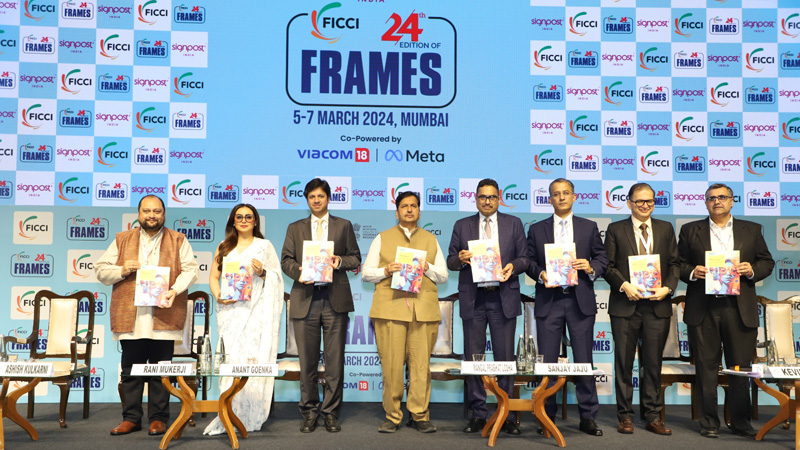
    Mumbai: The latest FICCI-EY report titled ‘#Reinvent: India’s media & entertainment sector is innovating for the future’, launched at the FICCI FRAMES 2024 in Mumbai, revealed that the Indian M&E sector grew by eight per cent in 2023, reaching Rs 2.3 trillion (US$27.9 billion), 21 per cent above its pre-pandemic levels in 2019.

    New media, comprising digital and online gaming, emerged as the frontrunner in growth, contributing Rs 122 billion of the overall increase of Rs 173 billion, and consequently, increased its contribution to the M&E sector from 20 per cent in 2019 to 38 per cent in 2023.

    Experiential (outside the home and interactive) segments continued their strong growth in 2023, and consequently, online gaming, filmed entertainment, live events, and OOH media segments grew at a combined 18 per cent, contributing 48 per cent of the total growth. With the exception of television, which experienced a marginal decline of 2 per cent, all other segments experienced positive growth in 2023.

    FICCI Media and Entertainment committee chairman and Viacom 18 chief executive officer – broadcast entertainment Kevin Vaz said, “India is a unique market where the M&E sector distinguishes itself through a harmonious fusion of tradition and innovation. Here, technology-enhanced entertainment channels, OTT platforms, AI-powered newsreaders, traditional print media, flagship films, and short-form content not only coexist but thrive together, showcasing the vibrant diversity and dynamic growth of our industry. The Government of India’s thrust on improving digital infrastructure in the country combined with our ambition to be at the forefront of the next big technological thrust in media and entertainment, our sector is primed for a massive transformation.”

    EY India partner and media & entertainment leader Ashish Pherwani said, “I believe the M&E sector is at the “inflection point” we foresaw in 2018, with the dominance of digital channels over traditional media. In 2023, new media comprised 52 per cent of total advertising revenues, yet, unlike in many other countries, Indian traditional media also grew. This underscores the unique Indian market where while we are witnessing a seismic shift towards digital consumption, there is still adequate headroom for traditional media to grow.”

    Key highlights:

    Indian advertising reached Rs1.1 trillion:

    Digital advertising grew 15 per cent in 2023 and surpassed traditional advertising for the first time. Social, sports, e-commerce and SME advertisers will continue to drive growth in the sector moving forward.

    A billion screens by 2030:

    India is expected to have almost a billion active screens by 2030. Of these, around 240 million will be large (TV, laptop, PC), while the remaining will be small (mobile phones, phablets). pay TV, free TV, and connected TV are expected to emerge as significant markets, each comprising between 60 to 80 million homes. The 3:1 ratio in favour of mobile phones will sustain the demand for short videos and social commerce.

    Online gaming is expected to reach Rs 388 billion by 2026:

    The segment will see growth across all its verticals, including esports, fantasy sports, casual gaming, and other games of skill to reach an estimated 150 million daily users. Revenue growth will be led by mobile-based real-money gaming and casual gaming.

    Segmental performance in 2023

      . Television: Linear viewership increased by two per cent over 2022, the number of smart TVs connected to the internet each week rose to 19 to 20 million, up from around 10 million in 2022. Television advertising declined by 6.5 per cent due to a slowdown in spending by gaming and D2C brands, impacting revenues for premium properties. The Hindi-speaking market (HSM) experienced softness, resulting in a three per cent overall ad volume de-growth. However, subscription revenue saw growth after three years of decline, driven by price increases, despite a decrease of two million pay TV homes.

     .  Digital advertising: Digital advertising grew 15 per cent to reach Rs 576 billion, constituting 51 per cent of total advertising revenues. This figure includes advertising by SME and long-tail advertisers totalling over Rs 200 billion, and advertising earned by e-commerce platforms amounting to Rs 86 billion.

     .  Digital subscription: Digital subscription grew 9 per cent to reach Rs 78 billion accounting for a third of 2022’s 27 per cent growth, as premium cricket properties were moved in front of paywalls. Paid video subscriptions decreased by two million in 2023 to 97 million, across 43 million households in India. However, paid music subscriptions grew from five million to eight million, generating Rs 3 billion, while online news subscriptions generated Rs 2 billion.

     .  Print: Contrary to the global trend, print media continued to thrive in India, with advertising revenues growing by four per cent in 2023. Notably, there was significant growth in premium ad formats, as print remained a preferred medium for affluent metro and non-metro audiences. Subscription revenues also grew by three per cent due to rising cover prices.

     .  Online gaming: The segment’s growth slowed to 22 per cent in 2023, reaching Rs 220 billion. It surpassed filmed entertainment to become the fourth largest segment. India saw over 450 million online gamers, with approximately 100 million playing daily. Over 90 million gamers paid to play, with real money gaming comprising 83 per cent of segment revenues. Larger players absorbed the impact of a higher GST levy, hurting their margins but safeguarding growth.

     .  Film: The segment grew 14 per cent to reach Rs 197 billion in 2023. Over 1,796 films were released in 2023, and theatrical revenues reached an all-time high of Rs 120 billion. The number of screens grew four per cent. 339 Indian films were released overseas.

     .  Animation and VFX: The Hollywood writers’ strike impacted global supply chains, and consequently, the segment grew just six per cent in 2023. Potential mergers and falling ad revenues also reduced the slate of animated content produced for broadcast in India. A revival in demand in the second half of the year led to growth, boosted by the trend of using more VFX in Indian content.

     .  Live events: The organized segment grew 20 per cent exceeding pre-pandemic levels. Growth was driven by government events, personal events, weddings, and ticketed events, including several international formats and acts that came to India.

     .  OOH: OOH media grew by 13 per cent in 2023, surpassing its 2019 levels. Growth was led by premium properties and locations. Active digital OOH screens crossed 1,00,000 contributing nine per cent of total segment revenues.

      . Music: The Indian music segment grew by 10 per cent to reach Rs 24 billion in 2023, slower than previous years as certain music OTT platforms went pay and stopped or reduced their free services. 87 per cent of revenues were earned through digital means, though most of it was advertising led on YouTube, there being around only eight million paying subscribers despite music streaming’s reach of 185 million.

     .  Radio: Radio segment revenues grew by 10 per cent in 2023 reaching Rs 23 billion. This growth was driven by increased retail and local advertising, as well as alternate revenue streams. Ad volumes increased by 19 per cent in 2023 as compared to the previous year, although ad rates remained below their 2019 levels.

  • Bengali OTT platform Mukti Prime to launch on 8 March

    Bengali OTT platform Mukti Prime to launch on 8 March

    Mumbai: Mukti Production LLP is set to launch a new Bengali OTT platform Mukti Prime on 8 March. Interdisciplinary artist Sujoy Prasad Chatterjee will oversee the content on the app, which has been created by Partha Chatterjee.

    The app will be available for download on the Google Play Store for Android users and App Store for iOs users. “It will showcase content such as web series, Bengali films, short videos, short films and other original content across genres,” said the statement. 

    The platform has already announced a slew of Mukti Prime originals including the series “Condom Kelenkari,” “Ganesh Murti,” “Morichika” and “Chittorgarh Murder Case.” 

    “Mukti Prime is offering subscribers three plans – basic, standard and premium that give access to all its content for a period of 12 months. The basic plan priced at Rs 199 can be accessed using a single device, the standard plan priced at Rs 299 can be accessed by up to three devices and its premium plan at Rs 599 can be accessed by up to six devices,” according to the statement.

    India’s regional OTT space is increasing in competitiveness with the share of regional language consumption on OTT platforms expected to cross 50 per cent of time spent by 2025 from 30 per cent in 2019, overtaking Hindi at 45 per cent as per FICCI-EY report. There are more than 45 OTT platforms in the country.

  • M&E to cross Rs 2 trillion by 2020: FICCI-EY report

    M&E to cross Rs 2 trillion by 2020: FICCI-EY report

    MUMBAI: FICCI Frames 2018 saw the launch of its annual media and entertainment (M&E) report, this year by Ernst & Young (E&Y) titled ‘Re-imagining India’s M&E sector’ which captures key insights from the exciting and fast growing Indian M&E sector.

    Launched on Sunday in the presence of the Information & Broadcasting minister Smriti Irani and other industry stalwarts like Star India MD Sanjay Gupta, Siddharth Roy Kapoor, filmmaker Karan Johar and others, the FICCI-EY report highlights that the M&E sector continues to grow at a rate faster than the GDP growth rate, reflecting the growing disposable income led by stable economic growth and changing demographics.

    The report suggests that the Indian M&E sector reached Rs 1.5 trillion in 2017, a growth of around 13 per cent over 2016 and is expected to cross Rs 2 trillion by 2020, growing at a compounded annual growth rate (CAGR) of 11.6 per cent. The digital segment led growth, demonstrating that advertising budgets are in line with the changing content consumption patterns.

    The report states that subscription growth outpaced advertising growth in 2017 but advertising will continue to grow till 2020 led by digital advertising. The report estimates that approximately 1.5 million consumers in India today are digital only and would not normally use traditional media. It is expected that this customer base will grow to 4 million by 2020 generating significant digital subscription revenues of approximately Rs 20 billion. Going forward, micropayment, enabled through the Unified Payment Interface (UPI) and Bharat Interface for Money (BHIM) platforms developed by the National Payments Corporation of India (NPCI) will further accelerate subscription revenues for entertainment content.

    EY India partner and M&E leader Ashish Pherwani expects digital and gaming sectors to grow between 2 to 3 times by 2020.

    Television
    While advertising is 41 per cent of the total revenues today, the report expects it to grow to 43 per cent by 2020. There are over 30 per cent households in India which are yet to get television screens, but being at the bottom of the pyramid, these households will tend to move first towards free and sachet products. 

    EY report states that the TV industry grew from Rs 594 billion to Rs 660 billion in 2017 and advertising grew to Rs 267 billion while distribution grew to Rs 393 billion. At a broadcaster level, however, subscription revenues including international subscription made up approximately 28 per cent of revenues. 

    Digital media

    250 million people viewed videos online in 2017 and the figure is expected to double to 500 million by 2020. 93 per cent of time spent on digital videos is in Hindi and other regional languages and OTT subscription in India is expected to touch Rs 20 billion by 2020.

    Digital media has grown significantly over the past few years and continues to lead the growth charts on advertising. Subscription revenues are emerging and are expected to make their presence felt by 2020. In 2017, digital media grew at 29.4 per cent on the back of a 28.8 per cent growth in advertising and a 50 per cent growth in subscription. Subscription, which was just 3.3 per cent of total digital revenues in 2016, is expected to grow to 9 per cent by 2020.

    Print

    Today, 98 per cent of readers read dailies and 20 per cent read magazines. Reader base is 395 million, or 38 per cent of the population. Readership has grown by 110 million over the last 3 years. Rural (52 per cent) reader base is larger than urban (48 per cent). 44 per cent of children aged between12-17 years read a newspaper or magazine. Magazines have a higher readership in urban area (57 per cent) as compared to rural areas (43 per cent).

    Print accounted for the second largest share of the Indian M&E sector, growing at 3 per cent to reach Rs 303 billion in 2017 and is estimated to grow at an overall CAGR of approximately 7 per cent till 2020. 

    This growth is expected despite the FDI limit remaining unchanged at 26 per cent and therefore, restricting access to foreign print players and the imposition of GST at 5 per cent on the advertising revenues of the print industry for the first time in history.

    Films

    Regional movies drove the growth in number of releases in 2017. Screen count increased from 9481 in 2016 to 9530 in 2017. Number of Hindi movies crossing the Rs 1 billion mark was highest in 2017 in the past five years. From 31 movies in 2016, Hindi dubbed movies increased more than three times to 96 in 2017.

    The Indian film segment grew 27 per cent in 2017 on the back of box office growth – both domestic and international, coupled with increased revenues from sale of satellite and digital rights. All sub-segments, with the exception of home video grew and the film segment reached Rs 156 billion in 2017. 

    The Hindi films comprise the majority component of the Indian film segment. They contribute almost 40 per cent of the net domestic box office collections annually, despite comprising only 17 per cent of the films made. Films in 29 other Indian languages account for approximately 75 per cent of the films released but they contribute approximately 50 per cent to the annual domestic box office collections. Hollywood and international films comprise the balance.


    M&A in M&E

    The Indian M&E sector witnessed a relatively new trend in deal activity with emerging segments such as gaming and digital gaining momentum, while the deal activity in the traditional media segments was slower. The slowdown can be partially attributed to challenges faced by the advertising segments of the industry due to demonetisation and GST. Overall, the number of transactions in the M&E sector decreased from 56 deals in 2016 to 40 deals in 2017.