Tag: Ficci

  • Government to launch centralised digital music licensing registry within two months

    Government to launch centralised digital music licensing registry within two months

    NEW DELHI:  India’s information and broadcasting ministry will roll out a centralised digital music licensing registry by October 2025, in partnership with rights societies, as part of a wider push to unlock the country’s live entertainment sector.

    The decision was sealed at the inaugural meeting of the joint working group (JWG) on promoting live events, chaired on 26 August at the National Media Centre by Sanjay Jaju, secretary in the information and broadcasting ministry.

    Officials from the ministries of culture, youth affairs and sports, skill development, finance and DPIIT joined, alongside the Sports Authority of India and state governments from Maharashtra, Delhi, Uttar Pradesh, Telangana and Karnataka. Industry bodies Ficci, CII, Eema and Ilea sat across the table from companies including BookMyShow, Wizcraft, Saregama, District by Zomato and Touchwood Entertainment. Rights societies IPRS, PPL, RMPL and IMI Trust were also present.

    Key outcomes included integrating live-event approvals into the India Cine Hub portal to cut red tape, drafting a model policy for multi-use of stadiums and public spaces, and embedding live-entertainment skills in the national skills framework. Financial incentives—from GST rebates and blended finance to subsidies and MSME recognition—were also discussed.

    Prime minister Narendra Modi has recently described live entertainment as an engine for jobs, tourism and cultural influence. The sector was worth Rs 20,861 crore in 2024 and is growing at 15 per cent annually, buoyed by demand in tier-one and tier-two cities and a rising appetite for music tourism.

    Jaju said the government’s target is to place India among the world’s top five live-entertainment destinations by 2030, with potential to create 15–20m jobs. “The JWG will work to harness the concert economy as a driver of infrastructure growth, employment, tourism and soft power,” he said.

    The JWG was formed in July on the orders of union I&B minister Ashwini Vaishnaw. It will meet regularly to review progress and feed policy recommendations, building on the white paper India’s Live Events Economy: A Strategic Growth Imperative unveiled at the Waves 2025 summit.

  • India’s M&E sector tipped for third place, Vaz declares at FICCI Frames curtain raiser

    India’s M&E sector tipped for third place, Vaz declares at FICCI Frames curtain raiser

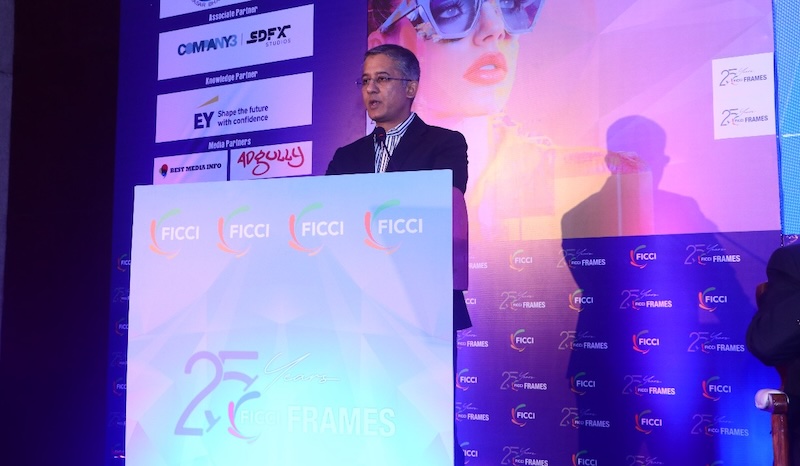
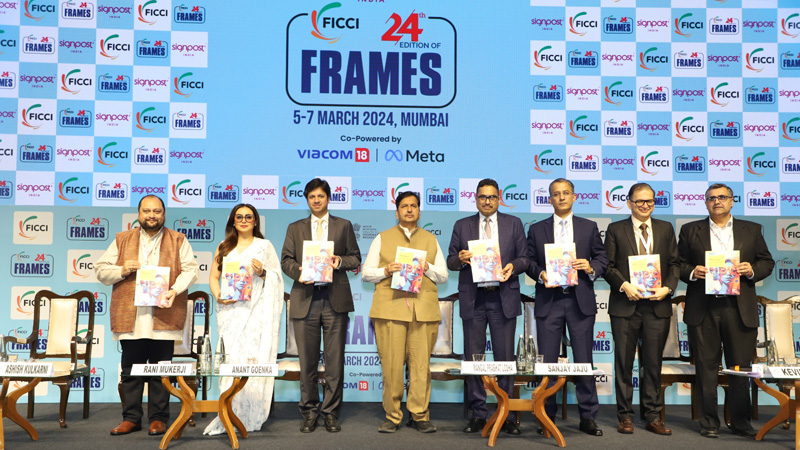
    MUMBAI: JioStar chief executive officer -entertainment business TV & digital and chairperson of the Ficci media and entertainment committee Kevin Vaz, kicked off the Ficci Frames curtain raiser with a bullish assessment of the nation’s entertainment sector, predicting it will be the third largest globally by 2028. He unveiled the 25th edition of the Ficci IEY M&E Report 2025, the industry’s official bible, amidst a flurry of industry heavyweights.

    “We are not an ‘OR’ market, but an ‘AND’ market,” Vaz declared, emphasising the co-existence of television and digital platforms. “Television will grow from 190 million households in 2024 to 214 million households by 2026, while digital platforms continue to soar.” A rather tidy bit of growth, one might say.

    He highlighted India’s global clout, citing Cannes and Oscar wins, and its emergence as a VFX powerhouse. Southern cinema, he noted, has reached “unprecedented heights,” showcasing some rather grand storytelling.

    Sports, particularly the IPL, is driving content consumption like a runaway train. “IPL 2025…it will be exciting to see how it reaches new heights and break records across both TV and digital platforms once again,” Vaz quipped, clearly anticipating a right royal viewership bonanza. He reported the 2024 IPL reached 525 million viewers on TV and a staggering 550-600 million on streaming platforms.

    OTT, he asserted, is set to become a “major force,” while television remains the “bedrock,” commanding over 30 per cent of the market. A rather sturdy foundation, then.

    Vaz welcomed industry luminaries including Sylvie Forbin, Gaurav Dwivedi, Ashish Pherwani, Arjun Nohwar and Munjal Shroff. He also plugged the Best Animated Frames (BAF) Awards, adding a touch of animated flair to the proceedings.

    “Let’s celebrate our achievements and the exciting opportunities ahead,” Vaz concluded, urging attendees to engage in discussions that would “propel the Indian M&E sector to the global stage.”

  • FICCI MEBC south kicks off with star power

    FICCI MEBC south kicks off with star power

    MUMBAI: Tamil Nadu’s media and entertainment industry took centre stage as deputy chief minister Udhayanidhi Stalin and cinematic legend Kamal Haasan inaugurated the FICCI MEBC South Conclave in Chennai. The two-day event, aimed at exploring the evolution of films, television, OTT, gaming, and digital media, saw an array of industry stalwarts mapping out the future of India’s creative economy.

    Stalin unveiled plans for a state-of-the-art film city in Chennai spanning 152 acres. The ambitious project will feature cutting-edge post-production studios, animation and VFX facilities, virtual production tech, LED walls, and even a five-star hotel for industry professionals.

    Further honouring Kalaignar’s (M. Karunanidhi) vision, Stalin announced that 90 acres near Kelambakkam, previously allocated for industry housing, would now be reinstated for its original purpose following a revised government order.

    A highlight of the event was Haasan’s appointment as chairman of the FICCI Media and Entertainment Committee, south. Speaking at the conclave, Haasan emphasised the need for progressive regulations that integrate, rather than hinder, emerging technologies in cinema.

    “Indian cinema is our cultural ambassador, and we need a long-term vision for it. Both state and central governments must frame policies that encourage technology adoption without stifling existing markets,” said Haasan. He also urged the Tamil Nadu government to reform entertainment tax policies, ensuring greater ease of doing business for filmmakers.

    The conclave featured key insights from JioStar chairman of FICCI media and entertainment committee and CEO – entertainment Kevin Vaz, who celebrated south Indian cinema’s meteoric rise from regional to global prominence, thanks to blockbusters like RRR and KGF-2.

    “With digital media’s rapid expansion, India is an ‘AND’ market where TV and digital will continue to coexist. The industry is primed for a global breakthrough,” Vaz stated.

    The event will feature workshops, masterclasses, and exhibitions on key industry trends, including the global rise of Indian cinema, OTT and television’s transformation, and AI-driven innovations in broadcasting and music. With gaming, animation, and VFX booming, discussions will also focus on regulatory policies shaping the sector. PlayNext – Developer’s Day will spotlight India’s growing esports and interactive entertainment industry, reinforcing its leadership in AVGC-XR.  

    The inaugural session saw participation from Meta India’s Sandhya Devanathan, Warner Bros. Discovery’s Arjun Nohwar, FICCI Tamil Nadu State Council’s G.S.K. Velu, and a stellar line-up of media executives including Ashish Pherwani, Sanjay A. Wadhwa, Ankur Vaish, Krishnan Kutty, Ravikant Sabnavis, Munjal Shroff, Vaibhav Chavan, Jakes Bejoy, and Bejoy Arputharaj.

  • Diageo India ropes in Devashish Dasgupta as corporate relations director

    Diageo India ropes in Devashish Dasgupta as corporate relations director

    MUMBAI: Devashish Dasgupta began his career at Arthur Andersen in the business a& tax advisory services in 1994. In 2024, he is corporate relations director & member of the executive committee at spirits major Diageo India, a position he took up in early December 2024.It his second innings with the firm.  He has been on the Ficci national executive committee for the past four years or so.

    Along the way, he has been mainly involved in corporate, government affairs and relations over the past 34 years. He even  founded a management and entry strategy consulting firm Corporate Catalyst which he ran for 10 years from 1995 to 2005.

    Dasgupta then moved on to APCO as managing director of the public affairs & government consulting firm for three years. What followed was a two-year stint with Diageo india as executive director corporate relations. The next placement was at Google India as country head public policy and advocacy for eight months.

    A little over two-year assignments each with MNCs like Yum Restaurants, SAB Miller, GSK Consumer Healthcare, came next in a corporate relations and government affairs role.

    Just prior to re-joining Diageo, Devashish was at Hindustan Unilever as corporate and government affairs head for a good five years.


  • FICCI, IBDF oppose TRAI’s proposed framework for broadcasting under Telecom Act

    FICCI, IBDF oppose TRAI’s proposed framework for broadcasting under Telecom Act

    MUMBAI: Imagine walking a tightrope without a safety net, knowing that a single misstep could send you plummeting.

    That’s exactly the precarious position the Telecom Regulatory Authority of India (TRAI) finds itself in after daring to blur the lines of its statutory jurisdiction. Like a rebellious teenager ignoring well-meant advice, TRAI’s bold move to propose a framework for regulating broadcasting services under the Telecommunications Act, 2023, has sparked a firestorm of backlash. Industry heavyweights, including the Indian Broadcasting and Digital Foundation (IBDF) and the Federation of Indian Chambers of Commerce & Industry (FICCI), are up in arms, accusing TRAI of overstepping its authority by attempting to shoehorn content regulation into licensing conditions. The result? A Pandora’s box of controversy that could reshape the broadcasting landscape.

    IBDF and FICCI argue that content regulation should remain under dedicated legislation, overseen by the Ministry of Information and Broadcasting (MIB), and not be conflated with telecommunications services. TRAI’s role, they assert, should focus solely on carriage-related aspects such as signal transmission and spectrum allocation.

    IBDF’s submission criticised TRAI’s proposal as an overreach. “The framework attempts to regulate content, which is beyond TRAI’s jurisdiction as defined by the TRAI Act, 1997,” IBDF stated. The association emphasised that Section 11(1)(a) of the TRAI Act limits TRAI to recommending licensing terms and conditions, not fundamentally altering the regulatory structure of broadcasting.

    Similarly, FICCI highlighted the historical context, noting that broadcasting was placed under telecommunication services in 2004 as a stopgap measure to regulate distribution services. “Broadcasting is a distinct sector, and equating it with telecommunications disrupts industry operations and consumer satisfaction,” FICCI stated.

    The News Broadcasters and Digital Association (NBDA) also opposed the move, cautioning that the framework could impose restrictive telecommunications-style authorisations on broadcasting. “TRAI should collaborate with MIB to develop a coherent strategy that avoids overregulation and supports self-regulation mechanisms for content,” NBDA recommended.

    Both IBDF and FICCI called on TRAI to focus on carriage issues and exclude content from the proposed framework. FICCI further suggested strengthening self-regulation for content and maintaining the sector’s distinct regulatory framework under the MIB.

    TRAI has concluded the consultation process and will announce the date for an open house discussion with stakeholders to finalise the framework.

  • Union cabinet clears AVGC National Centre of Excellence

    Union cabinet clears AVGC National Centre of Excellence

    MUMBAI: The Modi-led central government is putting its might behind the AVGC (animation, visual effects, gaming, comics &XR ) component of the media & entertainment sector. It has followed up its announcement a couple of weeks ago about the setting up of a National Centre of Excellence (NCoE)  in Mumbai by getting the plan cleared by the  union cabinet.

    The NCoE is planned to be set up as a section 8 company under the Companies Act 2013 with equity participation from the Federation of Indian Chambers of Commerce & industry  (Ficci) and the Confederation of Indian Industry (CII) and the Indian government. More than  Rs 500 crore is to be pumped into the centre by the government, possibly through the National Film Development Corporation (NFDC). .

    Provisionally named the Indian Institute for Immersive Creators (IIIC), the center aims to revolutionise the AVGC sector and foster innovation in immersive technologies. It is planned  to be modelled after the Indian Institutes of Technology (IITs) and Indian Institutes of Management (IIMs) with a sharp focus on creating content for India and the world.

    A press release issued by the ministry of information &  broadcasting on 29 September said that the idea is to create “a world class talent pool in India to cater to the Indian as well as global entertainment industry and make India a global hub for AVGC.”

    With rapidly evolving technology and increasing internet penetration all across the country, coupled with one of the cheapest data rates, the usage of AVGC-XR globally is poised to grow at an exponential pace.  This is bound to create abundant opportunities, particularly through the National Centre of Excellence (NCoE).

    Some of its key objectives are:

    * Focusing on creating Indian IP
    * Leveraging India’s cultural heritage in new age
    * Create a multiplier effect in the industry
    * An industry led initiative, in partnership with state and academia
    * Integrated focus on education, skilling industry, development, innovation
    * Hub and spoke model of development to be followed
    * IIIC as the hub and several centers as its spokes dedicated innovation and research fund to promote start-up ecosystem.

    The NCoE is being planned to provide a fertile platform for immersive tech – including virtual reality, augmented reality, mixed reality, 3D modelling, animation, comics and gaming – by offering cutting-edge training and integrate India’s rich cultural heritage with modern technology, fostering the creation of indigenous intellectual property (IP) and building the future of India’s digital creative economy.
    The target is to create an estimated 500,00 jobs,  with students gaining  practical experience through industry-driven courses, ensuring they are job-ready upon graduation. Those graduating will be provided with internships while start-ups will be mentored.  

    It may be recalled that union minister of finance & corporate affairs Nirmala Sitharaman had announced in the 2022-23 budget that an AVGC task force would to created. The NCoE is one of the recommendations of the task force.

  • Creators’ economy, a wonderful tool to showcase our rich cultural heritage and way of life: Ashwini Vaishnaw

    Creators’ economy, a wonderful tool to showcase our rich cultural heritage and way of life: Ashwini Vaishnaw

    Mumbai: Union minister of Information and Broadcasting (I&B), Ashwini Vaishnaw has launched 25 challenges as part of the ‘Create in India Challenge – Season 1’ for World Audio Visual & Entertainment Summit (WAVES). Speaking at the launch, Vaishnaw said that todays’ launch is a reflection of our growing and evolving economy. A totally new creators economy has been created and the same is also recognised by the prime minister of India as reflected in the first-ever National Creators Award presented by him in March 2024.

    Growing creators economy: Opportunities, infrastructure, and job creation

    While highlighting the immense potential in this economy, the union minister mentioned that the creators’ economy has become a wonderful tool to showcase our rich cultural heritage, way of life, yoga, traditional medicine system, and diversity in our cuisines. The Government of India is leaving no stone unturned to encourage this economy and therefore, we need to ensure the talent & skill development and availability of necessary infrastructure in this sector.


    To further develop this creators’ economy, the government is focused on creating world-class talent development programs and infrastructure. There are plans to establish world-class universities and facilities that will enhance the capabilities of creators in media and entertainment, he added.

    Harnessing new technologies in filmmaking: Job creation

    Emphasising that filmmaking is one of our strengths, Vaishnaw mentioned that in today’s era there is a great scope of using new technology and tools in this sector thereby ensuring a good scope for employment generation. It is estimated that if successfully executed, the program can generate 2-3 lakh jobs in the sector.

    Social Responsibility

    At the same time, the union minister also reminded that citizens have to ensure that the society is not harmed in this journey and the responsibility lies not just with the government but also with society, industry and all of us.

    To capitalise on the immense potential in this sector, WAVES is being organised and is set to emerge as a big phenomenon in future, he added.

    Secretary, Ministry of I&B, Sanjay Jaju, additional secretary, ministry of I&B, Neerja Shekhar, director general, FICCI, Jyoti Vij, vice chairman, CII National Committee on Media & Entertainment, Biren Ghose were also among the dignitaries who attended the event.

    ‘Design in India, Design for the World’

    While speaking at the occasion Sh. Sanjay Jaju mentioned that this initiative is a significant milestone in our ongoing mission to nurture and elevate India’s creative ecosystem. “It aligns seamlessly with our Prime Minister’s visionary call of ‘Design in India, Design for the World’ as articulated during his 78th Independence Day address.”, he added. Highlighting the immense potential and talent within our nation, he said that WAVES stands as a testament to this potential and will serve as a global platform where the brightest minds, most talented creators, and visionary leaders from around the world will converge to share knowledge, exchange ideas, and push the boundaries of creativity.

    ‘Create in India Challenge – Season 1’

    These challenges, hosted by leading industry associations and organisations, cover a wide range of disciplines including animation, filmmaking, gaming, music, and visual arts. These challenges are being done in the run up to the main event.

    List of ‘Create in India’ Challenges – Season 1

    1. Anime Challenge by Media and Entertainment Association of India 
    2. Animation Filmmakers Competition by Dancing Atoms 
    3. Game Jam by India Game Developer Conference 
    4. Esports Tournament by Esports Federation of India 
    5. City Quest: Shades of Bharat by E-gaming Federation 
    6. Handheld Educational Video Game Development by Indian Digital Gaming Society 
    7. Comics Creator Championship by Indian Comics Association 
    8. Young Filmmakers Challenge by Federation of Indian Chambers of Commerce & Industry and Whistling Woods International 
    9. XR Creator Hackathon by Wavelaps and XDG 
    10. AI Film Making Competition by InVideo 
    11. WAVES Promo Video Challenge Indian Broadcasting & Digital Foundation 
    12. TruthTell Hackathon by India Cellular & Electronics Association 
    13. Community Radio Content Challenge by Community Radio Association 
    14. Theme Music Competition by Indian Music Industry 
    15. WAVES Hackathon: Adspend Optimizer by Advertising Agencies Association of India 
    16. WAVES AI Art Installation Challenge by Internet and Mobile Association of India 
    17. WAVES Explorer by Internet and Mobile Association of India 
    18. Reel Making Challenge by Internet and Mobile Association of India 
    19. Film Poster Making Competition National Film Archive of India – National Film Development Corporation 
    20. Virtual Influencer Creation Contest by AVTR meta labs 
    21. Battle of the Bands by Prasar Bharati 
    22. Symphony of India by Prasar Bharati 
    23. India: A Bird’s Eye View by Broadcast Engineering Consultants India Limited 
    24. Anti-Piracy Challenge by Confederation of Indian Industry 
    25. Trailer Making Competition by Federation of Indian Chambers of Commerce & Industry

  • Bharat Pavilion at the 77th Cannes Film Festival inaugurated with fanfare

    Bharat Pavilion at the 77th Cannes Film Festival inaugurated with fanfare

    Mumbai: In a year that spells magic for Bharat at the 77th Cannes Film Festival, with numerous official selections across sections, The Bharat Pavilion was inaugurated amidst much fanfare today at the 77th Cannes Film Festival in France.

    Organized each year at the prestigious Cannes Film Festival by FICCI as a industry partner and NFDC under the aegis of the Information and Broadcasting Ministry, this significant milestone marks India’s continued commitment to showcasing its rich cinematic heritage and fostering international collaborations with the global film fraternity.

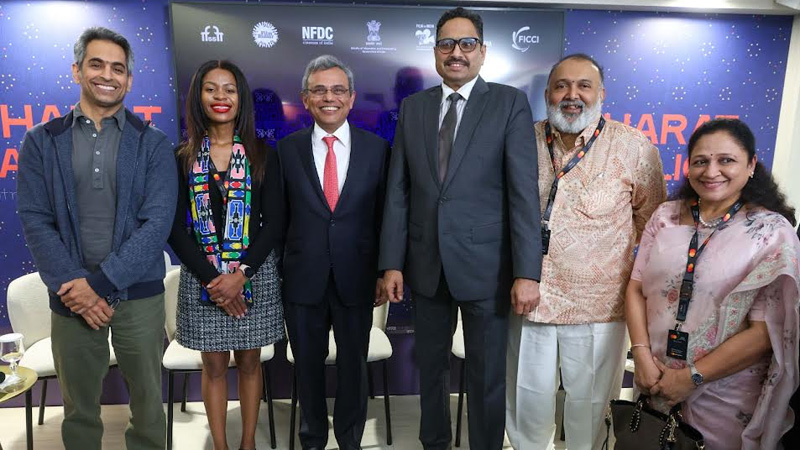
    The grand inauguration ceremony was led by secretary of ministry of information and broadcasting, Sanjay Jaju along with H.E. Jawed Ashraf, ambassador of India to France.

    The momentous inauguration was also witnessed by esteemed dignitaries, renowned filmmakers, and industry leaders coming together to celebrate the essence of Indian cinema. Guests present included Tholoana Rose Ncheke, chairperson, the National Film and Video Foundation, South Africa, Christian Jeune, director of films department, deputy general delegate, Cannes Film Festival, and Filmmaker Richie Mehta among others.

    Speaking at the inauguration, Shri Sanjay Jaju said “Heartening to have more Indian projects in the Cannes official selection this year, one each in the competition in uncertain regard and let me also confess that both these projects have been the beneficiaries of the support from the government in terms of the incentive as well as the official core productions.”

    “The Bharat Pavilion here would serve as a hub for networking, collaboration, promotion of Indian Cinema on the global stage. We would like to foster a greater collaboration between the Indian audiovisual industry and international counterparts, thereby enhancing the visibility and accessibility of Indian Cinema worldwide and serve the national goal of using the power of Cinema to enhance the country’s soft touch.” Added the Secretary.

    “India is gaining attention worldwide, both geopolitically and economically, due to its philosophical contributions, thoughts, and ideas. Its role in a multipolar world of great uncertainty is significant as we transition from the existing international order into a new one. All these aspects are interconnected, making it increasingly important for us to have a greater presence abroad, particularly in cinema” Said H.E. Jawed Ashraf.

    “It’s such a momentous occasion of Indian cinema here. Personally, for me, I wouldn’t have a career if not for the film festival community. The festivals have helped me unlock a career. It’s a real honour to be a part of this inaugural.“ said Richie Mehta.

    Many states like Jammu & Kashmir, Karnataka, Goa and Maharashtra among others are present representing India at Cannes Film Market this year.

    The Bharat Pavilion serves as a dynamic platform, providing a gateway to the diverse landscape of Indian films, talent, and industry opportunities and is set to host a series of scintillating panel discussions and networking sessions during the 77th Cannes Film Festival.

  • YFLO appoints Dr Payal Kanodia as chairperson for Delhi chapter

    YFLO appoints Dr Payal Kanodia as chairperson for Delhi chapter

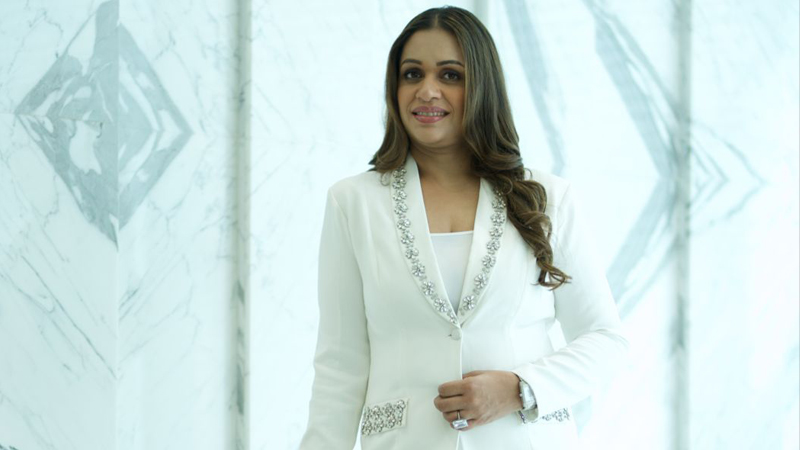
    Mumbai: The Young FICCI Ladies Organisation (YFLO), Delhi, the women’s wing of FICCI, has appointed Dr Payal Kanodia as the new chairperson for the year 2024-25. Dr Payal Kanodia is a chairperson & trustee of M3M Foundation, and a promoter in M3M Group.

    Popularly known as a ‘change-maker’ for her contribution to the society, Dr Kanodia  believes in aligning with the government vision to achieve better reach and impact towards women empowerment. On her appointment as chairperson of YFLO, she said, “I am quite delighted to be elected as the Chairperson of YFLO – Delhi chapter, for the year 2024-25 and looking forward to working with the best of minds at YFLO. Every year, the Chairperson of YFLO introduces a new theme, and this year, being Chairperson of YFLO Delhi, I have chosen the theme as – ‘Unleash Mind, Body, Soul’.  The theme would reflect on our collective journey towards self-discovery, growth and empowerment. The power and limitless possibilities that our soul, our bodies and our mind holds has always been inspiring.”

    “I have always said that India is a country that has high potential to utilize and mobilize women force to achieve the distinction of a $10 trillion economy. There are about 16 million businesses owned by women that provide employment to about 30 million people. Over 10 million working women in India have set their priorities in excelling into corporate world at leadership roles. About 15-17000 Startups out of 90,000 Startups in India are led by women. In the Indian MSME sector, women-led businesses are more than 20 per cent and contribute around about 25 per cent of the labour force. Even the IMF estimates that equal participation of women in the workforce can increase India’s GDP by about 30 per cent. Even globally, women control about $20 trillion in annual consumer spending, and that figure could climb as high as $28 trillion in the next five years. Women produce about 60 percent of the world’s goods and services and are also the largest buyers and investors. YFLO would play its role to align and develop as much women entrepreneurs from not just cities but also from rural India” Dr. Kanodia added.

    YFLO represents over 9500 women entrepreneurs and professionals and Delhi chapter alone has over 500 women entrepreneurs. With over 40 years of experience, YFLO has been promoting entrepreneurship and professional excellence among women through workshops, seminars, conferences, training and capacity building programs etc.

    Dr Payal Kanodia has been felicitated with many national and international acclamations including – “Times 40 under 40”,  “Karamveer Global Fellowship”, instituted by #iCONGO, in partnership with United Nations – “Mahatma Award” and “CSR Person of the Year Award 2022”. She has been recently recognized as the “Leader of Hope” during the Indian Brand and Leadership Conclave & Awards 2024 in Goa. She is also the Director General of India-Kosovo Trade Relations, and a listed member with Royal Asiatic Society – Great Britain, English Heritage – UK, and Royal Society of St. George – England.

  • The Indian M&E sector anticipated to achieve Rs 3.1 trillion by 2026: FICCI-EY report

    The Indian M&E sector anticipated to achieve Rs 3.1 trillion by 2026: FICCI-EY report

    Mumbai: The latest FICCI-EY report titled ‘#Reinvent: India’s media & entertainment sector is innovating for the future’, launched at the FICCI FRAMES 2024 in Mumbai, revealed that the Indian M&E sector grew by eight per cent in 2023, reaching Rs 2.3 trillion (US$27.9 billion), 21 per cent above its pre-pandemic levels in 2019.

    New media, comprising digital and online gaming, emerged as the frontrunner in growth, contributing Rs 122 billion of the overall increase of Rs 173 billion, and consequently, increased its contribution to the M&E sector from 20 per cent in 2019 to 38 per cent in 2023.

    Experiential (outside the home and interactive) segments continued their strong growth in 2023, and consequently, online gaming, filmed entertainment, live events, and OOH media segments grew at a combined 18 per cent, contributing 48 per cent of the total growth. With the exception of television, which experienced a marginal decline of 2 per cent, all other segments experienced positive growth in 2023.

    FICCI Media and Entertainment committee chairman and Viacom 18 chief executive officer – broadcast entertainment Kevin Vaz said, “India is a unique market where the M&E sector distinguishes itself through a harmonious fusion of tradition and innovation. Here, technology-enhanced entertainment channels, OTT platforms, AI-powered newsreaders, traditional print media, flagship films, and short-form content not only coexist but thrive together, showcasing the vibrant diversity and dynamic growth of our industry. The Government of India’s thrust on improving digital infrastructure in the country combined with our ambition to be at the forefront of the next big technological thrust in media and entertainment, our sector is primed for a massive transformation.”

    EY India partner and media & entertainment leader Ashish Pherwani said, “I believe the M&E sector is at the “inflection point” we foresaw in 2018, with the dominance of digital channels over traditional media. In 2023, new media comprised 52 per cent of total advertising revenues, yet, unlike in many other countries, Indian traditional media also grew. This underscores the unique Indian market where while we are witnessing a seismic shift towards digital consumption, there is still adequate headroom for traditional media to grow.”

    Key highlights:

    Indian advertising reached Rs1.1 trillion:

    Digital advertising grew 15 per cent in 2023 and surpassed traditional advertising for the first time. Social, sports, e-commerce and SME advertisers will continue to drive growth in the sector moving forward.

    A billion screens by 2030:

    India is expected to have almost a billion active screens by 2030. Of these, around 240 million will be large (TV, laptop, PC), while the remaining will be small (mobile phones, phablets). pay TV, free TV, and connected TV are expected to emerge as significant markets, each comprising between 60 to 80 million homes. The 3:1 ratio in favour of mobile phones will sustain the demand for short videos and social commerce.

    Online gaming is expected to reach Rs 388 billion by 2026:

    The segment will see growth across all its verticals, including esports, fantasy sports, casual gaming, and other games of skill to reach an estimated 150 million daily users. Revenue growth will be led by mobile-based real-money gaming and casual gaming.

    Segmental performance in 2023

      . Television: Linear viewership increased by two per cent over 2022, the number of smart TVs connected to the internet each week rose to 19 to 20 million, up from around 10 million in 2022. Television advertising declined by 6.5 per cent due to a slowdown in spending by gaming and D2C brands, impacting revenues for premium properties. The Hindi-speaking market (HSM) experienced softness, resulting in a three per cent overall ad volume de-growth. However, subscription revenue saw growth after three years of decline, driven by price increases, despite a decrease of two million pay TV homes.

     .  Digital advertising: Digital advertising grew 15 per cent to reach Rs 576 billion, constituting 51 per cent of total advertising revenues. This figure includes advertising by SME and long-tail advertisers totalling over Rs 200 billion, and advertising earned by e-commerce platforms amounting to Rs 86 billion.

     .  Digital subscription: Digital subscription grew 9 per cent to reach Rs 78 billion accounting for a third of 2022’s 27 per cent growth, as premium cricket properties were moved in front of paywalls. Paid video subscriptions decreased by two million in 2023 to 97 million, across 43 million households in India. However, paid music subscriptions grew from five million to eight million, generating Rs 3 billion, while online news subscriptions generated Rs 2 billion.

     .  Print: Contrary to the global trend, print media continued to thrive in India, with advertising revenues growing by four per cent in 2023. Notably, there was significant growth in premium ad formats, as print remained a preferred medium for affluent metro and non-metro audiences. Subscription revenues also grew by three per cent due to rising cover prices.

     .  Online gaming: The segment’s growth slowed to 22 per cent in 2023, reaching Rs 220 billion. It surpassed filmed entertainment to become the fourth largest segment. India saw over 450 million online gamers, with approximately 100 million playing daily. Over 90 million gamers paid to play, with real money gaming comprising 83 per cent of segment revenues. Larger players absorbed the impact of a higher GST levy, hurting their margins but safeguarding growth.

     .  Film: The segment grew 14 per cent to reach Rs 197 billion in 2023. Over 1,796 films were released in 2023, and theatrical revenues reached an all-time high of Rs 120 billion. The number of screens grew four per cent. 339 Indian films were released overseas.

     .  Animation and VFX: The Hollywood writers’ strike impacted global supply chains, and consequently, the segment grew just six per cent in 2023. Potential mergers and falling ad revenues also reduced the slate of animated content produced for broadcast in India. A revival in demand in the second half of the year led to growth, boosted by the trend of using more VFX in Indian content.

     .  Live events: The organized segment grew 20 per cent exceeding pre-pandemic levels. Growth was driven by government events, personal events, weddings, and ticketed events, including several international formats and acts that came to India.

     .  OOH: OOH media grew by 13 per cent in 2023, surpassing its 2019 levels. Growth was led by premium properties and locations. Active digital OOH screens crossed 1,00,000 contributing nine per cent of total segment revenues.

      . Music: The Indian music segment grew by 10 per cent to reach Rs 24 billion in 2023, slower than previous years as certain music OTT platforms went pay and stopped or reduced their free services. 87 per cent of revenues were earned through digital means, though most of it was advertising led on YouTube, there being around only eight million paying subscribers despite music streaming’s reach of 185 million.

     .  Radio: Radio segment revenues grew by 10 per cent in 2023 reaching Rs 23 billion. This growth was driven by increased retail and local advertising, as well as alternate revenue streams. Ad volumes increased by 19 per cent in 2023 as compared to the previous year, although ad rates remained below their 2019 levels.