Tag: FDI

  • MIB directs digital media entities with FDI to share details within one month

    MIB directs digital media entities with FDI to share details within one month

    KOLKATA: A month ago, the department for the promotion of industry and internal trade (DPIIT) clarified certain aspects of 26 per cent foreign direct investment (FDI) in digital media. The ministry of information and broadcasting (MIB) has now directed the entities having foreign investment to share details of the company and its shareholding pattern along with the names and addresses of its directors and shareholders within one month.

    They have to share other details like names and address of promoters, significant beneficial owners, a confirmation with regard to compliance with pricing, documentation and reporting requirements under the FDI Policy.

    Entities which, at present, have an equity structure with FDI exceeding 26 per cent will have to inform MIB and take necessary steps for bringing down the foreign investment to 26 per cent by 15 October 2021 and seek approval of the ministry. To bring any fresh investment, the entities have to seek prior approval of the government.

    “Every entity has to comply with the requirements of citizenship of board of directors and of the chief executive officers (by whatever name called). The entities are required to obtain security clearance for all foreign personnel likely to be deployed for more than 60 days in a year by way of appointment, contract or consultancy or any other capacity for the functioning of the entity, prior to their deployment. For this purpose, the entities will apply to MIB at least 60 days in advance and the proposed foreign personnel shall be deployed by the entity only after prior approval of this ministry,” the ministry added in the notification.

    Earlier DPIIT clarified that the rule would apply to:- 

    ·        Entities uploading/ streaming news and current affairs on websites, apps, other platforms;

    ·        News agencies which supply news to digital media entities and/or news aggregators;

    ·        News aggregators which, using software / web applications, aggregate content from various sources in one location.

  • DPIIT issues clarification on 26% FDI in digital media

    DPIIT issues clarification on 26% FDI in digital media

    KOLKATA: While significant growth in media is coming from digital media consumption, the government amended the foreign direct investment (FDI) policy last year. As a part of the reform, it had announced an approval of  26 per cent FDI in digital media. However, there was a lack of clarity about the niggling details. 

    Mire than a year later, the department for the promotion of industry and internal trade (DPIIT) has thrown some further light on it:

    The rule would apply to :

    ·   Entities uploading/ streaming news and current affairs on websites, apps, other platforms;

    ·    News agencies which supply news to digital media entities and/or news aggregators;

    ·    News aggregators which, using software / web applications, aggregate content from various sources in one location.

    These news organisations would be required to align their FDI to 26 per cent level with governmental the approval, within a year from today. To comply with the FDI policy, the majority of directors on the board of the company and CEO should be Indian citizens.

    "Security nod must for foreign personnel deployed for more than 60 days in India if security nod for any foreign personnel gets denied, the employee has to resign/employment terminated," DPIIT said.

    In this context, the ministry of information and broadcasting (MIB) has announced that it will consider in the near future to extend the following benefits, presently available to traditional media (print and TV), to such entities also:

    ·      PIB accreditation for its reporters, cameramen, videographers enabling them with better first-hand information and access including participation in official press conference and such other interactions.

    ·     Persons with PIB accreditation can also avail CGHS benefits and concessional rail fare as per the extant procedure.

    ·     Eligibility for digital advertisements through Bureau of Outreach and Communication.

    Moreover, MIB has suggested forming a similar self-regulating body in digital media like print and electronic media.

  • Expectations from the government in formulating national retail trade policy in Budget 2020

    Expectations from the government in formulating national retail trade policy in Budget 2020

    India is the fifth-largest global destination in the retail space. With the budget 2020 being around the corner, there is a hope that the new policies will have a positive impact on the retail and the consumer sector. The retail sector is the most dynamic sector in recent times, there has been drastic changes and has witnessed high consumer activism, supply chain model, marketing and advertising activities and introduction of new players in the market. 

    A joint report by Assocham and MRRSIndia.com suggest that the retail the Indian retail / consumer market is set to cross the $1 trillion mark by 2020 due to rise in per capita income and consequent expenditure. 

    Below are the 8 challenges which were faced by the retail sector in 2019:

    • Higher GST rates for retail players have been resulting in accumulation of non-refundable credit due to substantial spend on advertising and branding spending capacity. 
    • There has been multiplicity of laws and regulations governing the sector
    • Restrictive conditions under the foreign direct investment (FDI) policy for single-brand retail trading leading to ambiguities and hurdles for the e-commerce sector. Improvising conditions and minimalizing restrictions will further give a boost to FDI.
    • Lack of clarity and understanding of regulations/guidelines governing imposed on online retail trading. 
    • Lack of proper physical and digital infrastructure, developed supply chain resulting in inefficiencies and higher costs. 
    • Growth in retail sector has resulted in a growing demand in the real estate sector thus resulting in a rise in overall real estate cost
    • Lack of effective supply management. Solid infrastructure and developed supply chain will improvise the foundation and overall profitability
    • Lack of incentives for the new players in the retail market. 

    Budget 2020 gives an opportunity to the government to address the main problems faced by the retail sector and push the economy to a higher growth. Some of the expectations from the government in Budget 2020 are listed below.

    • GST slab to be simplified and successful / structured implementation of new mechanism that will help ease the process. We also look forward to the reduction of the GST which will encourage more people to spend.
    • The budget may focus on simplification of the government laws will have a positive impact on the sector and will give freedom to try new techniques and introduce new trends. Also Clarifications on open issues and introduction of measures for ease of doing business would be of great help.
    • The budget should consider educating the retailer and traders and clarifying regulations for retailers ensuring sound risk management practices and KYC (know your client) mechanisms.
    • Promoting partnership and collaboration for accessing new channel capabilities, digital technologies and easier entry into new market may help in optimizing costs.
    • A further initiative by the government by introducing laws and rules to reduce the real estate cost would prove to be of great help to common man who look forward to live in beautiful homes or for investment purposes. Stabilisation of tax policies on properties would also be beneficial since there is a constant change in rate slabs.
    • Introducing new incentives and bold reforms will encourage the new-bees in the retail industry to expand their activities across various platforms.
    • Supporting rural growth and expecting positive initiatives like MGNREGA, increase in the MSP for select crops, focus on electrification of villages, farmer friendly technologies, etc.
    • We expect new entrants/ investors in the FMCG space with the introduction of simplified tax structures, stability in custom duty and a less aggressive tax administration.
    • A special start-up growth fund to support start-ups will boost the start-up ecosystem immensely.
    • We expect the budget to provide impetus for digital payments (Debit and credit cards, UPI)

    With all believe in the government we expect new reforms in budget 2020 keeping in mind the betterment of the retail sector and in the best interest of retailers and common man.

    (The author is retail head, Kalpataru Ltd. The views expressed are his own and Indiantelevision.com may not subscribe to them)

  • DPIIT to issue clarification on capping FDI in digital media

    DPIIT to issue clarification on capping FDI in digital media

    MUMBAI: Amid certain stakeholders raise concern over government’s decision to allow 26 per cent FDI in digital media sector, the Department for Promotion of Industry and Internal Trade (DPIIT) is likely to issue a clarification soon on the same, Economic Times reported.

    According to some stakeholders, the idea to cap FDI (foreign direct investment) in digital media sector to 26 per cent must be clarified  by government as these stakeholders, who were looking to raise funds through FDI is now put on hold.

    There are two main concerns stakeholders have raised and sought clarification: 1) How the FDI policy of the sector would treat news aggregators, and 2) what would happen to those digital media companies where overseas investment is over 26 per cent

    Taking the views of the Information and Broadcasting Ministry on the issue, the DPIIT is expected to issue clarification shortly, Economic Times said quoting sources.

    In this regard, Deloitte India partner Jehil Thakkar had said that the clarity needed was on how to treat cases of television broadcasters that stream news online, but are allowed 49 per cent FDI.

    He questioned, “What happens to those, whether they qualify fewer than 26 per cent or 49 per cent (FDI)? What happens to news websites which are 100 per cent foreign entity?”

  • DPIIT seeks MIB views on issues regarding 26% FDI in digital media sector

    DPIIT seeks MIB views on issues regarding 26% FDI in digital media sector

    MUMBAI: As the cabinet recently amended the foreign direct investment (FDI) policy allowing 26 per cent overseas investment in digital media with government approval, the Department for Promotion of Industry and Internal Trade (DPIIT) has sought the views of the Ministry of Information and Broadcasting on issues raised by certain stakeholders over the new policy.

    "The extant FDI policy provides for 49 per cent FDI under approval route in up-linking of ''News & Current Affairs'' TV channels. It has been decided to permit 26 per cent FDI under government route for uploading/streaming of news and current affairs through digital media, on the lines of print media," an official statement said.

    There was a lack of clarification since the amendment that how the new policy would pan out. According to a PTI report, issues which were raised on the decision have been sent that to the MIB. The ministry is looking into it for suitable clarification, as per an unnamed official quoted by the report.

    The Internet and Mobile Association of India stated in a presentation to the DPIIT that the decision would have an impact on the startup ecosystem as continued FDI is critical to enable Indian digital media startups to achieve global scale. The association also said it would be critically harmful if there is not any clarification.

    “The scope of the impact will be determined by the wording of the provision in the FDI policy. News and current affairs are present on social media platforms, on digital platforms that are subsidiaries of foreign brands etc. How would you differentiate between TV channels which have 49% and their online streams, which will effectively have 26%?” Eros International group chief marketing officer Manav Sethi also said.

  • Cabinet approves 26 per cent FDI in digital media

    Cabinet approves 26 per cent FDI in digital media

    MUMBAI: As the cabinet government amended the foreign direct investment (FDI) policy, it has also given the nod to 26 per cent overseas investment in digital media with government approval.

    "The extant FDI policy provides for 49 per cent FDI under approval route in up-linking of ''news & current affairs'' TV channels. It has been decided to permit 26 per cent FDI under government route for uploading/streaming of news and current affairs through digital media, on the lines of print media," an official statement said.

    While the FDI policy has not touched digital media for a long time, the cap has been introduced along the lines of print media where 26 per cent FDI is allowed through government approval route.

    “The scope of the impact will be determined by the wording of the provision in the FDI policy. News and current affairs are present on social media platforms, on digital platforms that are subsidiaries of foreign brands etc. How would you differentiate between TV channels which have 49 per cent and their online streams, which will effectively have 26 per cent?” Eros International group chief marketing officer Manav Sethi commented.

    The previous time when FDI norms in media were relaxed was in November 2015 to attract overseas funds. The FDI limit in news channels and private FM radio was raised to 49 per cent,up from 26 per cent, while 100 per cent foreign investment was allowed in entertainment channels.

    “FDI in digital media is a welcome development. Clarity around this fast-growing segment of the media industry will act as an enabler for capital infusion. Significant value will be unlocked going forward,” Deloitte partner Jehil Thakkar commented.

  • MIB mulls national b’cast policy to ease stakeholders’ woes

    MIB mulls national b’cast policy to ease stakeholders’ woes

    NEW DELHI: India’s Ministry of Information and Broadcasting is exploring formulating a national broadcast policy or NBP with an aim to ease lengthy and time consuming government processes that media and entertainment industry players have to go through while conducting their businesses.

    According to MIB secretary Amit Khare, his ministry is also formulating the internal FDI policy to align the overall framework with that of the Commerce Ministry. The government had liberalised investment norms for many sectors, including media and entertainment, in 2016, and later dismantled Foreign Investment Promotion Board too making sectoral nodal ministries responsible for greenlighting FDI proposals.   

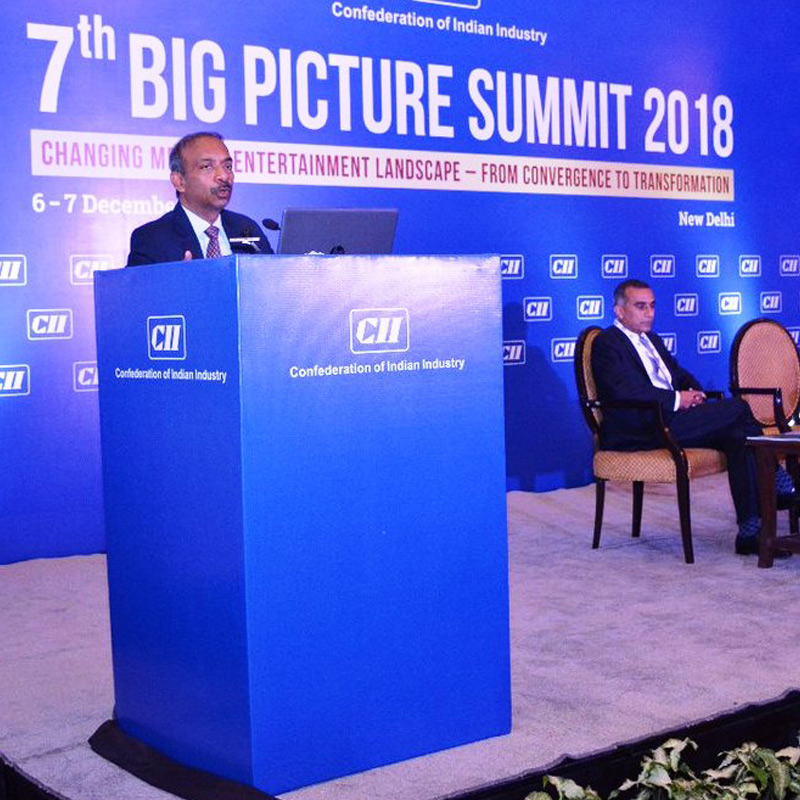
    “The media and entertainment sector should grow in a way that has less hurdle and more motivation,” Khare said here yesterday while addressing the concluding day audience at the CII Big Picture Summit 2018.

    Expanding on the NBP, Khare said government was exploring ways to ease processes, including a rethink on existing regulations for India’s M&E sector, which, not only has clocked impressive growth, but is also a big generator of employment for people. A new DTH policy, which is in the offing, is an indicator of the government's thought process.

    Admitting that regulation has failed to keep pace with changing technologies, the senior government official said, “Regulating everything is not desirable and even if desirable, it may not always be feasible.”

    However, he did not elaborate on the government’s thought process on content regulation for the digital space that’s fast becoming home to bold themes and bolder content if compared to traditional media of print and television.

    Pointing out that the government faced challenges while formulating policies or reviewing existing ones, Khare gave the example of expanding outlets for distribution of content that now, according to him, can be created practically by anyone with newer digital platforms offering creators enough number of outlets to showcase such creations.

    “In such a scenario, policy reforms [become] a little difficult,” Khare said, adding that the present government, however, was keen to review irksome government processes and clearances without being the “monitor” to mind a “grown-up” industry like media.

    Dwelling further on technology and the transformation it was bringing about in society, in general, Khare said MIB was in talks with regulator TRAI and BECIL to hold workshops to explore actively how broadband services could be delivered via existing cable TV networks to approximately 40 million households that presently don’t have internet facilities.

    Broadcast Engineering Consultants India Limited or BECIL, a government organisation under the ambit of MIB, provides project consultancy services and turnkey solutions encompassing the entire gamut of radio and television broadcast engineering.

    Later speaking to the media on the sidelines of the event, Khare said consultations will start with industry stakeholders on the formulation of NBP, but refused to give a time frame of it being legislated into some form of a policy document or guidelines.

    Info Tech Minister advocates robust digital measurement norms

    Facebook, Twitter, YouTube and WhatsApp have changed the manner in which users consume content and communicate with each other, but the social media platforms need to be mindful of "certain dos and don'ts" and guard against any misuse of their platforms, Information and Technology Minister Ravi Shankar Prasad said on Friday.

    Speaking at the CII Big Picture Summit, Prasad said that social media platforms' large focus on India underscored the sheer size and opportunities presented by the market here.

    "Facebook, Twitter, LinkedIn and WhatsApp are coming to India not only because they are giving some service. India offers a robust market, by its sheer size. I always say, come do business, but remember certain dos and don'ts…you must follow," Prasad said.

    The minister said that social media firms should also guard against any potential misuse of their platforms. In particular, these "public platforms" must not be misused by those with wrong intentions for the purpose of exploitation and denigration of others, he said.

    Outlining India's rising digital clout on the back of its large smartphone user base, strong IT outsourcing industry, electronic manufacturing capabilities and biometric programme Aadhaar, the minister asserted that the country will never barter its digital sovereignty and is, in fact, bringing a strong data protection law to safeguard its digital information.

    The right of accessing the internet is "not negotiable" and if the internet is designed for common good, it should be safe and secure, he added.

    He also called for a robust mechanism for measuring the ratings of digital platforms.

  • FDI in telecom jumped 5X in 3 years

    FDI in telecom jumped 5X in 3 years

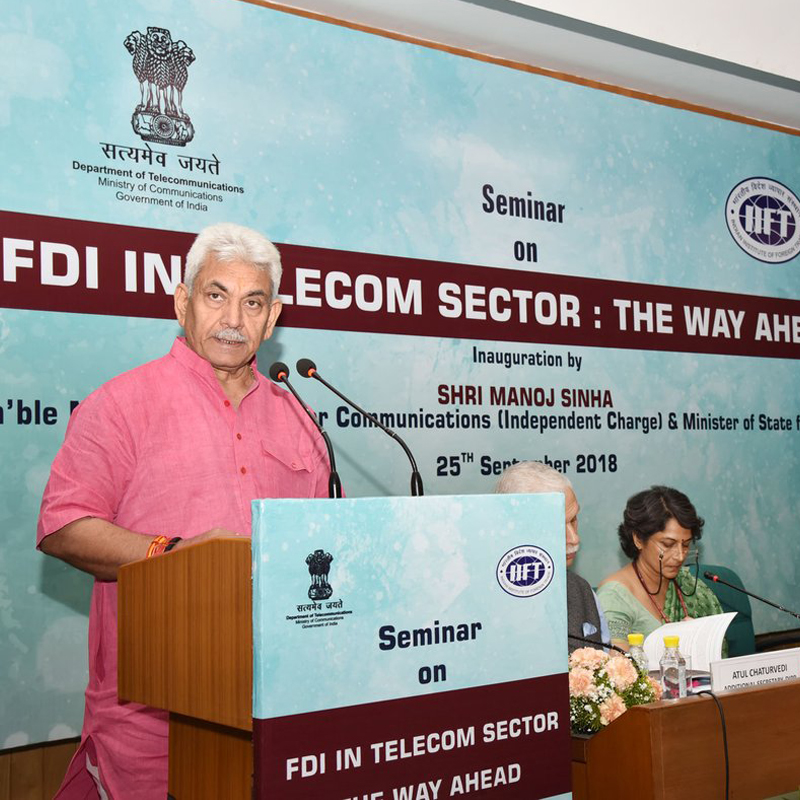
    MUMBAI: During the last three years, the Indian telecom sector has not only witnessed major disruptions but also nearly five times jump in foreign direct investment (FDI). While the amount of investment stood at $ 1.3 billion in 2015-16, it reached $ 6.2 billion in 2017-18, Communications minister Manoj Sinha said. The government is also looking at the funding of $100 billion for the draft National Digital Telecommunications Policy.
    “India needs massive investment in developing newer technologies which are accessible and affordable to the people and at the same time creates productive employment. For India to utilise its demographic dividend it is absolutely necessary to create semi-skilled jobs in short run, and the telecom sector will play an important role in creating those employment opportunities,” he added.
    The sector has also seen a few mergers, acquisitions in the same period. Highlighting that, Sinha said consolidation in the sector will strengthen it. He also calls international investors and telecom players to take part in the growth of the sector as Indian economy is back on the growth trajectory.
    He also added India already announced plans to launch commercial 5G networks by the year 2020. The 5G rollout will leave big opportunities for investing in the newer emerging technologies like AI, IoT, data analytics.
    Telecom secretary Aruna Sundararajan was also present at the occasion. She emphasised the fact that foreign investment is necessary to secure scientific, technical and industrial knowledge. The expert pointed out that the telecom sector has always been one of the core sectors attracting highest FDI inflows and overall this trend has been positive for the past two decades.
    “National Digital Communications Policy, 2018, will be the new platform for convergence of all the stakeholders, where we will be working with growth-oriented investment perspective, rather than with fiscal perspective alone,” she added.

  • TRAI bats for issuing DTH licences for 20 years

    TRAI bats for issuing DTH licences for 20 years

    MUMBAI: The Telecom Regulatory Authority of India (TRAI) has reiterated its recommendation to the Ministry of Information and Broadcasting (MIB) that direct-to-home licences be issued for a period of 20 years and then renewed for 10 years, and a one-time entry fee of Rs 10 crore be charged in the new DTH licensing regime.

    In July 2014, the TRAI had made a number of recommendations regarding the issues related to the new DTH licensing regime.

    However, the MIB had proposed, after considering comments from other ministries and departments, to grant DTH license for an initial period of 10 years and thereafter, renewal of license after 10 years.

    The ministry had sought TRAI’s views on the proposal.

    In its response yesterday, the telecom regulator said, “It is felt that a longer licence period would provide certainty in the market.

    Keeping a short license period may adversely affect the potential investment in the sector and would also negate the efforts of the government, inter alia, including the liberalisation of the FDI regime”.

    Stating that a longer duration of license helps in better futuristic business planning, the TRAI noted that in the telecom sector, the license period under the Unified License (UL) regime is 20 years and renewal is 10 years at a time.

    “In view of the growing convergence between the broadcasting and telecom sectors, it is logical to align the license period for DTH sector with that in the telecom sector under the UL.

    In view of above, TRAI reiterates its earlier recommendations,” it said.

    Under the UL, operators are free to provide all telecom services with one licence.

    Currently, the license is valid for 10 years.

    The TRAI also reiterated its recommendation of one-time entry fee of Rs 10 crore to be charged in the new DTH licensing regime.

    The MIB, however, proposed to increase the one-time entry fee to Rs 25 crore for the license period of 10 years.

    In its response, the TRAI said, “In order to encourage more entrants in the DTH industry, and to compete with the cable industry, wherein there is no entry fee, the TRAI recommends to retain the entry fee to Rs 10 crore”.

    Currently, the DTH operators also need to pay an initial entry fee of Rs 10 crore.

  • Star’s Uday Shankar on distribution challenges, IPL, FTA vs. pay TV, innovations, Made in India content…and much more

    Star’s Uday Shankar on distribution challenges, IPL, FTA vs. pay TV, innovations, Made in India content…and much more

    From the thirty seventh floor room, consisting of a table for the occupant to stand and work, some thought-provoking books and a huge TV screen, apart from other knick-knacks, the city life and environs below look scenic. Rather, most of the surrounding sea-facing skyscrapers in between the  green patches of land that could be seen below belie the image that it’s India. Until a Mumbai local train passes by, giving away the address of  Urmi Estate (which houses Star India’s Hq) , it could have been located anywhere in Hong Kong or Singapore for that matter.

    But in sharp contrast to the tranquil view of Mumbai from behind big glass windows of the thirty seventh floor, in most of the other 14 floors occupied by Star India in a tony building in South Mumbai’s Lower Parel business area, there is a sense of urgency — and excitement. And, why not? After all one of the biggest media companies in India — some say it’s the largest in terms of revenues — has many things on the plates of every employee, including the top honchos residing in the top floor. Bagging the global media rights for the  much-coveted IPL  is just one of the many issues engaging Star India’s employees. Though, in all fairness, it won’t be wrong to state that IPL probably could be one of the most important issues presently. Simply because, as the dust settles on the euphoria of this massive win , the difficult task of planning for returns on  the investment of $ 2.55 billion starts now.

    Ushered into the room with a view, its occupant and Star India chairman and CEO Uday Shankar shakes my hand warmly, exuding the same camaraderie that he did almost three decades back when we used to meet as journalist colleagues sometimes in the New Delhi house of one of his early mentors, Siddharth Ray (India’s first general manager  for Star TV  – yes, in the 90s it carried that name officially). Over tea (for him) and strong Espresso coffee for Indiantelevision.com’s consulting editor Anjan Mitra, a wide range of media matters were debated for about 90 minutes. Edited excerpts from a free-wheeling interview follow. Read on:

    How do you view the Indian broadcast and entertainment industry as of today?

    There are two or three things that I feel very strongly about. From a consumer point of view it’s a great time for them because large volumes and range of domestic and global content is being made available to them at increasingly competitive prices. But when it comes to the industry itself, it’s a bit of a mixed bag. Though the industry has grown dramatically in terms of the number of players in the last several years, the business case of the industry looks under pressure. When I say business case, I don’t mean just the profit model, which is under pressure for a large segment, but the sustainability itself for the whole industry. 

    I think, the IPL bidding is a very interesting case in point and an indicator of things to happen in future in the media sector.  This is probably the only place and example where for a major content right, the contenders included two very strong media companies (Star and Sony Pictures Networks India), two big telecom companies (Airtel and Reliance Jio) and a couple of global digital/technology companies (including Facebook). And, they all valued the property almost equally as important and almost in the same ballpark.

    So, media is no longer the sole domain of traditional media companies. We have heard this being said for some time now, but it played out for the first time in broad day light here. What is more significant is that such competitive bidding for content has not happened in the UK or the US, which are considered mature and big media markets with good broadband infrastructure, but in a country where the digital distribution of content is of very recent vintage.

    I think in some way we set ourselves up for such high inflation by creating Hotstar, which led everybody to realize that there is a value in that kind of a business model. So, for the industry this is time to wake up and take note.

    Third, while parts of the media and entertainment businesses have leaped forward as has the consumer, the distribution and the regulatory models remain locked up in legacy issues and that’s creating a bit of a mismatch. That’s a challenge that we need to solve together as an industry.

    What are the problems besetting video content distribution in India?

    There are various aspects. If you are talking about it in the digital domain, I think with the launch of Reliance Jio there has been a huge disruption. But access to data still remains limited and expensive. The broadband infrastructure has improved in the last 12 months or so, but is still nowhere where it should be. The number of smart phones has grown dramatically in India, but is still a small percentage of the total mobile penetration.

    On the TV side, the industry has done a great job on many fronts. Still, we have to realize that we are competing with global companies with great resources and scale, and the benchmarks too are global. Whether it is story telling or quality of production or marketing or brand strategy, benchmarks are global. So, we the content industry need to step up our game.

    The competition for Star will not be only from similarly placed media companies in India but will come from technology and other global companies; from the likes of Amazon, Alibaba, Google and Facebook. Are we ready for that as an industry? Individual companies may be ready for such competition, but I am not sure if we are ready as the content industry.

    Part of the problem is because the monetization models haven’t evolved much. We still have regulatory issues, which are challenges, though I don’t want to go into too many details on that aspect.

    Still, the entire TV distribution industry, according to me, has done an amazing job of creating 180+ million connected homes. Now that segment has to make sure each one of those homes is going up the value chain rather than trying to offer them discounts, etc. The stakeholders are competing only on the price front. If you are competing only on the price point, then you are compromising on the consumer experience and soon the consumer will start questioning whether it is worth having a cheap service, minus the experience. So, there is this whole challenge of getting the consumer up the value chain.

    Where do you see Star India placed in the scenario that you have painted where both challenges and the opportunities abound?

    There are things that an individual or a company can do with its own enterprise. Then there are things that all of us can do as an industry. I believe that if the whole industry is not progressing, individual companies can only progress so much. In that context, at Star India, we have done a good job and I am satisfied. Can we do more? Of course we can always do better. But we have managed to create a fairly deep and diverse entertainment platform on television and have leadership in a large number of entertainment markets.

    To give you an example of the enterprise we have shown, take sports for instance. Five years ago we got into sports (management and broadcasting) and have created, perhaps, some of the most exciting franchises anywhere in the world. We have not limited ourselves to the sport that guarantees success (cricket), but have gone and experimented too. We have put our faith behind new initiatives in sports whether they are kabaddi or badminton or hockey or football. Our mission is to try turning India from a one-sport nation to a multi-sport one, while maintaining the pre-eminence of cricket. Some progress in that direction has been made and it’s satisfying.

    Can Star make it a mission to get India the Olympic gold considering its continued investments in sports?

    Star is a media and entertainment company and I would not want to have the arrogance to say we can make India win an Olympic gold medal. All I can say is that we’d be happy to partner with any agency or initiative that is designed to get India closer to the Olympic gold(s). Our job is to make sure that we showcase sports’ growth and breakout stories. I think we have done that job very well. I would like to believe that with Star Sports we are able to showcase the new (sporting) heroes far more prominently today than what we could have done few years back. If national team members of various sports, who were relatively unknown, now are recognized by ordinary citizens, I think we have done our job — in fact we are doing just that.

    That being said, I would like to add that private investment in sports ought to be welcome as it is this investment that helps sporting organizations plough funds into infrastructure, training and facilities, which in turn contribute to sporting success.

    What are the changes on the content distribution front that you have seen and what are the continuing challenges for the industry, considering Star has had limited exposure to the distribution business?

    If you look at how much we have moved in the last 10 years, it’s an impressive story.  The problem is that the process of digitization, which started essentially with DTH, and then picked up steam in 2011-2012 hasn’t delivered the full value.

    Digitization still remains an unfinished agenda though it was meant to have been over quite some time back. It was supposed to have meant that people had access to better content at competitive prices and for good content to get easier distribution avenues. That hasn’t happened. The idea of digitization was also to allow content creators like us to offer integrated services to the consumers. That too hasn’t happened and the story has really not moved. Broadband access may have improved dramatically, but the participation of cable and DTH sector in that is miniscule.

    public://Uday Image--1_1.JPGDigitisation still remains an unfinished agenda. People should have access to better content at competitive prices, and for good content to get easier distribution avenues

    To put it bluntly, a bunch of people, who have got used to the idea of benefitting from an economy of shortages or scarcity, continue to create scarcities or continue to create conditions of scarcities (of content) and benefit. Fundamentally, it hurts the society and the industry. That is the disappointing side of the distribution business.

    Star could have continued contributing by remaining a stakeholder in the distribution business. Comment.

    While we were a minority shareholder (in Hathway) our ability to influence the business was limited. That is why we decided to get out because we were not shaping the (distribution or the company) agenda. We do have a minority investment in Tata Sky, but, again, our ability to set the agenda of that company is limited.

    Will Star review its distribution business exit or its paring down, now that the government has liberalized investment norms for the DTH and cable sectors?

    Government has allowed (increased FDI in DTH and cable companies) only at a headline level. The problem is that we were restricted even before the FDI investment limits went to 100 per cent. I think the Prime Minister has eased the investment norms facilitating more FDI in this sector, but we are hampered by other regulations. Cross media restrictions, which in any case is a discriminatory piece of regulation, has only blocked a company like Star from investing in the distribution sector more aggressively. This restriction is applicable only to DTH/HITS ventures but not to cable or IPTV, which in itself appears to be an arbitrary measure. And, we don’t want to skirt around regulations to create business entities to be in a business. We don’t want to invest and create a value when our say in a company remains locked. In that sense, our ability to invest more in Tata Sky is still restricted.

    Is the business model in India changing for content aggregators and owners like Star? Has it now boiled down to free-to-air (FTA) vs. pay TV?

    I am glad you asked this question. It is amazing how in this country we indulge in polarized arguments where none needs to exist.  Where does the question on pay TV versus FTA arise? Why should it exist at all? In most other countries, there is a place for FTA and pay TV businesses. The problem starts arising when they start competing with each other and that does not need to happen. In this country, a major part of the broadcasting business that developed in the last 20 years was primarily done by pay TV broadcasters. As access to FTA broadcasting, which is mostly terrestrial, was not open to private broadcasters it remained in the hands of the public broadcaster. Until Doordarshan FreeDish came along.

    Now technology has opened up an opportunity creating a space for FTA and pay TV broadcasting.  I personally believe that the two should and could co-exist in this country — pay TV for those who want to pay and have access to a much diverse and richer range of content and FTA platform for those who don’t want to pay as much for all of it but still want to get some basic content.

    Does it happen vice versa too when pay TV content or channel is brought onto a free platform just to botch up the competitor’s business plans?

    I think that should not happen. My public position has been that we should not take pay TV content onto a free platform (like DD FreeDish) because it not only undermines a pay TV consumer, but also a pay TV platform. In my opinion that is a wrong strategy. I personally started a dialogue between platforms and broadcasters to stop such a practice but it has not been too fruitful. We launched Star Bharat on the FreeDish platform, but it has fresh content.

    Q: Will Star Bharat continue to remain a pay channel also as per media reports?

    Don’t trust everything that you read in the media. However, there is nothing that prohibits a channel being available on DD FreeDish and on pay TV platforms. A whole bunch of channels in the past have done this; almost the entire language news category is on pay TV and FreeDish platforms at the same time. A whole bunch of entertainment channels too have followed that practice. So, what you hear about Star Bharat is simply mischievous.

    Q: Please clarify whether for Star Bharat a consumer will have to pay if available on DTH or cable platforms?

    Yes, a consumer of a DTH service or a cable platform will continue to pay for Star Bharat just as he did for Life OK for the time being. We sought permission from the government saying the channel will be rebranded as Star Bharat and would be offered on DD FreeDish as well. So, the pricing issue remains where it is.  Some people have chosen to find a problem with Star Bharat, while being totally comfortable with their own friendly channels. We are the only ones to have fresh original content for a channel on FreeDish like Star Bharat. Quality of production is high on Star Bharat as we are spending the same amount of money per hour or per half hour that we would have spent on Star Plus, which is a premium channel.

    Q: James Murdoch said in an investor call that Star India is on course for $ 500 million EBIDTA for year 2018 and that cricket bids would have to be disciplined. Do you agree?

    (Smiles) If my bosses have said that we are on course, then I would have to follow the directions. However, those statements were made in a responsible manner as we do have a plan and are working towards the goal. If the Indian economy remains on course, we are on course for all that.

    As far as disciplined bids (for cricket rights) are concerned, of course it was a disciplined bid for IPL. Everybody has seen how close it was where the margin of victory was just three per cent. So, what more can I say in defense? Six years ago when we signed up for BCCI rights (media rights to Indian cricket), we paid Rs. 430 million (per match). At that time critics said Star had probably paid too much. It turns out now that we didn’t and that worked out really well for us. Today that (figure) has become the new normal. Now people are saying we are paying too much for IPL (US $ 2.55 billion for a five-year global media rights) only because 10 years ago it went at a much lower price. But then ten years ago the world was different, India was different and IPL was an untested product.

    Q: Would you agree with Indiantelevision.com’s analysis that Star actually got a good bargain for the $ 2.55 billion it bid for IPL rights?

    I don’t understand why people are so excited about it. Hardly ever a sports media rights been awarded at such a close margin. Why are people asking ‘why has Star paid so much’? Clearly there were a whole bunch of people who were willing to pay and it was evident in the bidding numbers.

    public://Uday Image--2_2.JPGEach media company has its strengths. I respect Zee enormously

    As an aside, my personal view is that BCCI (Indian cricket board) lost a lot of value because of the duration of the contract. If it had been for 10 years, the value would have gone up dramatically. And, I am not just saying so because of the length (of the contract). Had it been for a longer period, per year value too would have increased tremendously —shorter the period, lesser is the flexibility. 

    Q: What are your plans to monetize the IPL property?

    These are still early days, so you have to give us time to think through our strategies, which will unfold in due course. But I certainly won’t share with the media what I am trying to do.

    Whether we have bid high or not will be judged by the fans of cricket. All I know is that IPL’s a very powerful tournament and cricket runs really deep in everybody’s bones in this country. To be successful, you just need to work on intensifying and heightening the experience of cricket further.

    I believe that power of sports is such that you don’t need to give it steroids. You just need to be true to the spirit of the game and make sure that the experience for the fans is evolving continuously.  That is where our strength comes in and I would like to believe that as Star is the company that successfully created a few sports franchises that didn’t exist in the public domain earlier. We should be able to do that with IPL too. With cricket it’s not a one shot affair, it’s a process where you need to continuously evolve and we will work on that.

    Q: Will you continue to work on Pro Kabaddi League too and bring it up to the IPL level?

    We have brought PKL already in the limelight. But to be honest, though PKL still has some distance to travel to reach the levels of IPL, its growth has been phenomenal. When we were looking for franchisees for the inaugural edition, it took Anand Mahindra’s personal charm to get people in. This time round, when we added four new teams, there was a problem of plenty — a large number of top corporate houses and individuals were extremely keen to get associated with PKL. So, clearly people believe in what we are trying to do. Look at the Indian Super League (soccer) story, which is in partnership with Reliance Industries. Except a few loyal pockets in the country, football nowhere figured in the country’s psyche or much in public debates. However, we have managed to turn the passion for football into a serious commitment for fans all over the country.

    Q) Is that why you are picking up another indigenous game kho-kho to try its rediscovery?

    Are we? We haven’t taken a decision on that sport yet. 

    Q) Which media company is the closest competitor of Star whom you respect?

    Each media company has its strengths. I respect Zee enormously.  I think it is very strong on discipline and doesn’t get distracted by what others are doing. It works hard to execute a plan it has. Similarly, other companies have their own strengths.

    This is a business where competition is very dynamic and the power lies in the hands of the consumer. One half hour gone wrong can swing things away from you. As we have such a diverse portfolio, it is not about one competitor. Even if we are the leaders in one segment, in some other part of the business we are facing heat. But the entire business, hopefully, will not face heat from any one competitor.

    Q: So Star is in a dominant position.

    I don’t like the `dominant’ word. Especially because I feel this whole idea of dominance in a business — especially a media business — is a spurious claim. Either it comes from a complete lack of understanding of the business or it’s a mischievous allegation. Simply because there is no one product called Star India. For viewers and advertisers, it is a combination of multiple TV channels and each of those channels consist of large number of shows. You may have a show at 8 pm that is chart-busting and then at 8.30 pm you may have a show that nobody is watching, which usually is the case. A show that was doing really well three months ago can go into a total free fall if one artist is not there or there’s twist in the story-line.

    Take sports, for example, again. You go and get rights of a property for a number of years and after that it goes to the public when anybody else can also bid for the rights and participate. On the digital front, the competition is even crazier. So this argument of anybody building dominance, not only Star, is totally mischievous and spurious.

    Q: Let us rephrase the question. Isn’t it a great feeling to continue being a leader?

    In some parts of the business, we continue to stay ahead and that’s because we work harder. We spend more money on our content and are less focused on profits. We reinvest (in the business) more than probably anybody else in this sector in the country. Media and critics have written for the last five years or so that Star was not making profits in sports after investing heavily in sports content and now people are saying otherwise. We have now started investing in Hotstar, a digital platform. I think the one big difference between us and everybody else, and which gives us leadership and a little more of steadiness, is that we are always trying out new things.

    We have tried to explore new horizons and boundaries. Not all such initiatives have been successful, though. I would like to believe that we have pushed the creative envelope in a responsible way far more than what has been done in the past. Are we trying to future-proof ourselves, as you ask? I wish it could have been possible. But, yes, we are investing in the future.

    Q: Critics and some industry players feel that Star India has become so big that it can challenge the sector regulator too. Comment.

    First, we have not taken on any regulator. We have had some fundamental and limited issues, which became sharper in the new tariff order (of TRAI, the broadcast regulator). Our understanding of the TRAI Act says that the regulator has jurisdiction over distribution/transmission of content, but not the content itself, which in our case can be determined only under the ambit of the copyright law of the country. The law of the land gives every aggrieved person the freedom to go to a court for adjudication. And, that’s what we have done. There is nothing like challenging the jurisdiction of the TRAI.

    Q: Is the India market over regulated compared to some other markets in Asia or the west?

    I would not make such a blanket statement. There are parts of the market that are over regulated and there are parts which are not. All I would like to humbly submit is that there are some parts in the existing regulations — especially those dealing in relationships between distributors and content owners — that are debatable. If the proposed regulations were to come into effect today as they are, any new entrant to the Indian broadcast industry would find it a difficult and expensive proposition.

    Q: What more would you like the government and regulator to do to be a bigger facilitator of doing business apart from what they have already done?

    We don’t have to create a shoe to fit every foot as there are different feet sizes. Similarly, there are different needs for different set of people in terms of content. However, let me make it clear that I am not making a case for smut because Star doesn’t do sleazy content.

    TV is a family medium and we should be mindful of that; Star certainly is. There may be families where kids also watch television along with elders, but there are homes where there are no kids. Hence, the need (for content) of the latter family might be different and mature. So, content creators should be allowed to factor in all such diversities and create a spectrum of content rather than just uniform content in a one shoe-fits- all model. TV is an instrument of change and also a huge driver of employment and wealth creation.

    While agreeing there are areas where some restrictions are needed, I would say policy-makers should allow the whole eco-system to come together and be more flexible. Take, for example, the number of people who are dependent, formally or informally, on the TV industry as a category. That number would be around five million if the whole value chain is taken into consideration. I feel the number can increase manifold.

    Q: How do you see the Hotstar growth story now that it has been launched in the US and Canada?

    I find that space very exciting. It’s a market with an affluent South Asian diaspora with huge appetite for Indian content whether sports or drama or movies. They pay high subscription money presently to watch Indian content on American platforms as the structure for getting access to South Asian content is complicated and expensive. We think with Hotstar we can make a difference by offering people living abroad high quality content and world class experience at prices far more competitive than what they are paying now.

    Q: Does Star have a time frame, say 12 months, to rollout Hotstar worldwide?

    I don’t have a hard and fast deadline. For me it is more important to first build a business, stabilize it and then scale it up. We are not playing a valuation or a stock market game. I would like to build things on a solid foundation. So, to answer your question, I think it is clearly not going to happen in one year’s time.

    Q: How closely is IPL’s monetization linked with Hotstar?

    We have got the global rights for IPL and we will explore internally what trade-offs we can do. We would have to examine whether we can get better business value by offering it (IPL) ourselves or we should license it to other companies. The financial case will influence those decisions.

    Q: Is Star still in the lookout for properties to acquire to fill gaps?

    We are not a big M&A company. In my 10 years at Star India, we have acquired MAA TV and before that Asianet (both companies located in South India).  In this company, my bosses, my colleagues and I like to build things ourselves as that way we can shape the business the way we want to. Such initiatives are also more sustainable and self-sufficient and, remember, we have an exceptionally high quality plan execution team.

    However, I would admit there are always gaps, but you need not fill all of them. Also, there are not many quality assets available in the media space presently.

    Q: What about the regional space? No opportunities there?

    There would always be opportunities, but I don’t think we are considering any (M&A) in the regional language side in the foreseeable future and going deeper in the regional markets. We already have much on the plate.

    Q: Would Star like to review an earlier decision and return to news business in India?

    There is no plan to get back into the (television) news business. Moreover, with my limited understanding, news on television globally faces challenges these days as second on second updates are available on one’s hand-held devices. So, what new proposition can one create for people to come back night after night, 365 days on television, to spend some time watching you? Those who had created a brand on news television and are carrying on can continue to benefit from a legacy habit. But creating new news brands on television is lot more difficult today than in the past. People also have access to news on digital platforms as there is so much news available in one form or the other, including professionally produced and user generated. So, at the moment there are no plans to revisit our decision to exit news business in India.

    Q: Hotstar seems to have a special affinity for Republic TV and is it filling Star’s news need?

    (Smiles) In the same way Hotstar offers Sky News, Republic too is offered to consumers. If others are interested, we will give them a platform too. Don’t read too much into the agreement with Republic TV; it’s a simple distribution arrangement.

    Q: Would you agree that because of the audience ratings game, entertainment is becoming news and news is becoming entertainment in India?

    I would, rather, not get into that argument at all. However, since you have asked, I don’t think TRP(s) is a bad word. In the business that we are in, which is called mass media, if you take out the mass there is no business left. If it is mass media, measurement of the masses comes from ratings. The question is: what all would you do to get ratings? The answer lies in each individual and each company’s value systems. At Star, we have decided that we would do certain things and we would never do certain other things to get ratings. Some other people have defined that differently.

    Q: You have said in the past media and entertainment industry is not throwing up young talents because of inadequate human resources R&D. Do you still believe so and what has Star done to counter the inadequacy?

    The industry was not geared for creating so much of output as it is today between films and TV. Look at these small shops that have mushroomed all over.  We have been unable to expand the pipeline of training creative talent whether it is at the MCRC or the FTII, for example. In the meantime, requirement has grown manifold.

    I, generally, believe that our ability to compete with companies that are modern, resourceful and global will depend on the (human) resources and talent we create in the country. In a country where formal institutions are not geared to identify and shape new talent, the industry has to do it. I have been an advocate of that for a long time. Though we need to do this collectively as an industry, a beginning has been made by Star. We have created a big academy where we have got a respected name from Hollywood to be based in India to teach.

    Q: What are your thoughts on Made in India content for the world market?

    We are doing some things on that front by creating products that we can take outside India. We have succeeded in that endeavour with few Hindi films like `Neerja’ and ‘Dhoni’.  Hopefully, we will be able to open up that market more. At some stage, hopefully, some of the sports leagues that we have created, especially kabaddi, will be of interest to people outside India.

    public://60371509.jpg

    Technology has created space for FTA and pay TV. The two could co-exist — pay TV for those who want diverse and richer content, FTA for those who want basic content

    However, I don’t see Indian drama in its current form travelling outside India for a long time. Such shows are culturally too specific and too rooted in our family culture. Moreover, our business model is different that works the best when we offer large number of episodes. When you do that, given the monetization model, limited revenue comes from the investments made in a show with huge number of episodes. Until a totally distribution driven business model for premium content comes along, I think Indian entertainment content would not be competing in the global market.

    Q: What’s your perception on linear TV continuing as a medium in India?

    In this country TV will continue for a long time. I am not one of those who believe that linear TV would disappear in five years time and people would go completely digital. First, in a country where the family values are still strong, TV continues to act as glue for the family to get together. I don’t think, and hope, it would change very soon. Second, TV’s biggest comparative advantage comes from it being very affordable. Despite prices of broadband having dropped, if you take into account the cost of data and content, a digital platform is still way more expensive than TV. For anything between Rs 150-Rs 400, people can get more content than they can ever watch on TV.

    Then there is a long tail of households that is still waiting to get into the television world. The question is: can we create innovative price models for different user groups so it’s a win-win for the creative people and the business too? 

    It is also a mistake to think that television is only competing with television. No. TV also competes with digital platforms and people only have finite time to spend watching shows. Again, are we innovating enough? I think we are not innovating enough for TV to be at the cutting edge of competition with digital.

    Q: In terms of management of Star’s Indian operations some structural changes happened two years ago. Are some more in the offing?

    We created a new structure, as you have said, where we pushed decision making further down. I think Star India is, probably, the most decentralized media company in this country. We have different CEOs for sports, entertainment, digital and South Indian markets, and a head for international business. Not only it is fairly deep, but also diverse and aimed towards creating more entrepreneurship.

    Q: Having begun your career as a print media journalist, you have gone on to head Star India, an entertainment company. What would be the achievements over the last 10 years for the company, people and you?

    We have created a healthy and robust company with a bench of high quality talents across all segments of our business. Not only at Star we have encouraged innovation and entrepreneurship, but have created serious consensus on a whole bunch of issues in the industry ranging from content creation to brands. Personally, I take a lot of satisfaction in driving initiatives like self-regulation in content, etc. Above all, it is a matter of huge satisfaction that we have taken initiatives that have gone beyond the remit of a traditional media company like Star — like create and build sports leagues.

    I keep talking about it (various sports leagues) only because it’s only a matter of time before other companies will also get into it and then the transformation would really impact the country. I would like to see the same transformation in India that has been seen in places like parts of Latin America, Africa and Europe where the power of sports has acted as a social glue to create opportunities for people who would otherwise be totally on the margins of society. Being able to be part of such a transformation has been hugely motivating for me all these years.

    Q: Where do you see yourself five years from now?

    I am typically the kind of person who doesn’t forget his background and my base has been in news where I was extremely focused on tonight’s headlines as tomorrow is another day. So, I am very focused on clarity for today without worrying about tomorrow. I believe that one thing leads to another. Honestly, I have never planned my life, but it has been a great ride till now.

    ALSO READ:

    Major restructuring in Star India; Uday Shankar, chairman & CEO, Sanjay Gupta, MD

    Comment: With IPL rights Uday Shankar gambles audaciously, must plan pragmatically

    TRAI can only regulate transmission, not broadcast material: Star tells Mds HC

    Jawahar Goel raises alarm of emerging Star cricket monopoly (updated)

    Life OK rebranded as Star Bharat may start from 15 Aug