Tag: FCC

  • FCC chief Tom Wheeler to address NAB Show in Las Vegas

    FCC chief Tom Wheeler to address NAB Show in Las Vegas

    NEW DELHI: Federal Communications Commission (FCC) chairman Tom Wheeler is expected to provide insights into the FCC’s policy and regulatory objectives related to broadcasting, technology and communications law generally at the 2015 Show of the National Association of Broadcasters (NAB) in Las Vegas.


    The address will be held on 15 April.


    “This is a great opportunity for NAB Show attendees to hear first-hand from the FCC Chairman on the FCC’s progress on the TV spectrum incentive auction and a host of other items currently under consideration at the Commission,” said NAB President and CEO Gordon Smith.


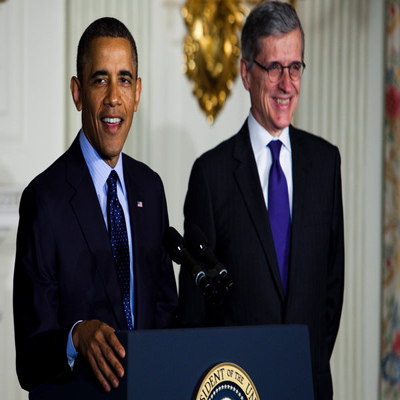
    Wheeler became the 31st chairman of the Federal Communications Commission on 4 November, 2013. He was appointed by President Barack Obama and unanimously confirmed by the United States Senate.


    For over three decades, Wheeler has been involved with new telecommunications networks and services, experiencing the revolution in telecommunications as a policy expert, an advocate, and a businessman. As an entrepreneur, he started or helped start multiple companies offering innovative cable, wireless and video communications services. He is the only person to be selected to both the Cable Television Hall of Fame and The Wireless Hall of Fame, a fact that caused President Obama to nickname Wheeler “The Bo Jackson of Telecom.”


    Prior to joining the FCC, Wheeler was managing director at Core Capital Partners, a venture capital firm investing in early stage Internet Protocol (IP)-based companies. He served as president and CEO of Shiloh Group, LLC, and co-founded SmartBrief, the internet’s largest electronic information service for vertical markets.


    From 1976 to 1984, Wheeler was associated with the National Cable Television Association (NCTA), where he was president and CEO from 1979 to 1984. Following NCTA, Wheeler was CEO of several high tech companies, including the first company to offer high speed delivery of data to home computers and the first digital video satellite service. From 1992 to 2004, Wheeler served as president and CEO of the Cellular Telecommunications & Internet Association (CTIA).


    Wheeler is a graduate of The Ohio State University and the recipient of its Alumni Medal.

  • FCC: Dish Network resists Comcast-Time Warner Cable merger

    FCC: Dish Network resists Comcast-Time Warner Cable merger

    BENGALURU:  Citing irreparable harm to competition and consumers, and no discernible benefits, from the proposed union of the first and second largest cable companies in the nation, Dish Network Corp (Dish Network) filed its reply at the FCC to Comcast-Time Warner Cable’s (TWC) Opposition to the Petitions to Deny their proposed merger.


    “Everyone who likes to watch high-quality online video has particular reasons to worry about the proposed merger,” said Dish Network senior vice president and deputy general counsel Jeff Blum. “More than 54 per cent of the country’s high-speed broadband connections would be controlled by the combined company, and all online video distributors would be at the mercy of Comcast-TWC.”


    Some of the key points of Dish Network reply include:


    Comcast-TWC will be able to destroy OVDs with impunity. And destroy them it will: Dish’s experience based on the business case for Dish World and Dish’s soon-to-be-launched domestic OTT service demonstrates that an OTT could still turn a profit if it were to suffer foreclosure at the hands of a standalone Comcast, but not if the effects of the foreclosure spread across both of the Applicants’ systems. Based on his analysis of that business case, Dish’s expert economist Professor David Sappington concludes that, while foreclosure conduct on the part of Comcast today is probably survivable for an OVD such as Dish’s new OTT service, the same conduct would be lethal if undertaken by Comcast-TWC.


    As the petitions and comments demonstrate, high-speed cable broadband connections are the lifeblood of over-the-top (“OTT”) video services that typically target national audiences. For that reason, among others, the relevant geographic market for this transaction is national. Furthermore, the relevant product market should include only those services capable of supporting the robust online video services that consumers demand, which requires a household to have actual and consistent download speeds of at least 25 Megabits per second (“Mbps”). If approved, the combined Comcast-TWC would control more than 54 per cent of the broadband pipes in the United States that have speeds of at least 25 Mbps, and will be on a path to virtual dominance of the high-speed broadband market given that the combined company will pass nearly 70 per cent of pay-TV households in the US.


    Use of the Commission’s own method for estimating actual departures of a rival’s subscribers due to temporary foreclosure with a time horizon of six months leads to the conclusion that Comcast-TWC can reap eye-popping gains from denying its competitors NBCU programming. This will affect competition in a number of ways. It will cause subscribers to leave the competing distributor in favour of Comcast-TWC; it will cause dissatisfied Comcast-TWC subscribers to stay put instead of losing their access to NBCU; and it will let NBCU extract higher prices for its own programming by leveraging the fear of foreclosure.


    The merger’s claimed benefits, if any, cannot outweigh the merger’s harms. In the Opposition, the Applicants devote hundreds of pages to extolling the purported benefits of the merger. Many of these benefits are illusory or speculative—characteristically, the Applicants offer no more precise quantification than “hundreds of millions of dollars.” Many of the benefits are also not merger-specific. The upgrade of TWC systems, supposedly made possible thanks to the merger, is a prime example. Public documents show that TWC had planned to complete this transition itself as a standalone company. This means that large portions of the claimed benefits attributed to TWC upgrades (again left unquantified) should be disallowed in their entirety.


    Conduct conditions would fail to address the merger’s many harms. Conduct conditions did not work for Comcast-NBCU, and they would not work for this transaction, which poses substantially greater risks of harm. There is little reason to believe that Comcast will alter its pattern of repeatedly breaking promises. Moreover, the complexity of the gatekeeping function over the Internet choke points alone promises a myriad of technicalities that would likely allow circumvention of, and/or interpretive debate over, any conditions. Ultimately, if the Commission approves the merger believing that conditions are sufficient to address all the harms, there is no going back. The consequences of getting it wrong are too great, the risks too high. The public deserves better.

  • Obama wants FCC to remove roadblocks on internet, private sector disagrees

    Obama wants FCC to remove roadblocks on internet, private sector disagrees

    NEW DELHI: President Barack Obama has urged the American telecom regulator Federal Communications Commission (FCC) to keep the internet open and free.

     
    But this plea will give a blow to top US wireless carriers who are looking to control price and quality of internet services.


    The FCC is already in the process of considering new rules for how to safeguard competition and user choice. “Ensuring a free and open internet is the only way we can preserve the internet’s power to connect our world,” Obama said.

     
    “We cannot allow internet service providers (ISPs) to restrict the best access or to pick winners and losers in the online marketplace for services and ideas. I am asking the FCC to answer the call of 4 million public comments, and implement the strongest possible rules to protect net neutrality,” said Obama.

     
    However, the Telecommunications Industry Association (TIA), an association representing the manufacturers and suppliers of high-tech communications networks, said: “We are concerned over President Obama’s endorsement of reclassifying the internet as a Title II utility-like telecom service. Such a move would set the industry back decades, and threaten the private sector investment that is critically needed to ensure that the network can meet surging demand.”

     
    “We saw a significant negative impact on investment the last time restrictive Title II regulation was in place, and no one will benefit from returning to that failed policy.  As manufacturers and suppliers who build the internet backbone and supply the devices and services that ride over it, our companies strongly urge regulators to refrain from reclassification that will guarantee harm to consumers, the economy, and the very technologies we’re trying to protect,” said TIA CEO Scott Belcher.

     
    Four years ago, the FCC tried to implement rules that would protect net neutrality with little to no impact on the telecommunications companies that make important investments in the economy.

     
    Earlier, the court reviewing the rules agreed with the FCC that net neutrality was essential for preserving an environment that encourages new investment in the network. The court ultimately struck down the rules because it believed the FCC had taken the wrong legal approach.

     
    Obama said there should be no blocking and throttling by ISPs. There should be more increased transparency. Some sites should not get more treatment.

     
    Some companies should not enjoy paid prioritisation. Wireless carriers should not keep some services in “slow lane” because it does not pay a fee. “That kind of gatekeeping would undermine the level playing field essential to the internet’s growth. I am asking for an explicit ban on paid prioritisation and any other restriction that has a similar effect,” Obama said. FCC should reclassify consumer broadband service under Title II of the Telecommunications Act — while at the same time forbearing from rate regulation and other provisions less relevant to broadband services.

     
    Referring to the White House proposal, AT&T senior executive VP, external & legislative affairs Jim Cicconi said, “If the FCC puts such rules in place, we would expect to participate in a legal challenge to such action.”

     
    Time Warner Cable, a top cable company, remains committed to an open internet, but disagrees with President Obama’s statement that an open internet can only be achieved by reclassifying broadband as a public utility.

     
    “Regulating broadband service under Title II, as the President proposes, will create uncertainty, lead to years of litigation and threaten the continued growth and development of the internet. The FCC has sufficient tools without reclassifying broadband to protect the openness of the internet, while at the same time encouraging continued investment and innovation in the internet ecosystem,” said Time Warner Cable chairman and CEO Rob Marcus.

  • FCC chairman Wheeler ready to discuss national broadcast plan

    FCC chairman Wheeler ready to discuss national broadcast plan

    NEW DELHI: Federal Communications Commission Chairman (FCC) Tom Wheeler has asked broadcasters to share channels, migrate to the Internet and use next year’s incentive auction to adopt a new transmission standard.


    “We’ve just been through one TV transition,” Wheeler said in his remarks at the National Association of Broadcasters (NAB) show in Las Vegas. “We both know the magnitude of that challenge … Government and broadcasting will need to work together on this, because it will be a long and heavy lift.”


    Wheeler’s NAB show debut as chairman came just days after the Commission passed an order cracking down on joint-service agreements (JSAs) and collective retransmission negotiations among certain TV stations. He acknowledged the contention. He admitted: “It’s no secret that broadcast has been critical of some of my actions at the FCC.”


    He said he took NAB president and CEO Gordon Smith’s suggestion for a national broadcast plan “very seriously.” He added: “If Congress were to approve, I guarantee you we’ll support this.”


    Smith suggested such a plan could include an ownership review and transition to a transmission standard based on orthogonal frequency-division multiplexing — a radical change from the current 8-VSB technology mandated by law.


    “When it comes to OFDM, particularly ATSC 3, the FCC will be ready and responsive when the standard is completed,” he said. “If it is possible to get a multiple of throughput on spectrum with OFDM, we as stewards of the spectrum need to be supportive.”


    Wheeler said the Commission would use discretion in reviewing JSAs and shared service agreements.


    “When JSAs and SSAs serve the public interest … they will have no problem passing the FCC,” he said, “so long as they do not impair competition, diversity and localism. Some have impaired that. Those actions have encouraged … us to enforce the rules of the statutory mandate.”


    Smith asked why the FCC focused on broadcast JSAs without taking the same approach to cable interconnects — multiple pay-TV operations that team up on ad sales. Wheeler said the JSA order specifically asked for evidence that interconnects were anticompetitive so the issue could be addressed.


    The chairman pitched the incentive auction as an opportunity for broadcasters, as he has since being confirmed. While his JSA and retrans rulings cast him as a broadcast foe, he said there was “no conspiracy.”


    “The FCC is carrying out the mandate of Congress,” he said. “Those who want to participate, can. Those who do not, do not have to.”


    He said the auctions could provide the cash for TV stations to become over-the-top providers. “OTT represents an open field for stations because of their local news operations,” he said.


    “You have the opportunity to deliver local news down to the neighborhood,” he added. “The Internet has failed to serve localities the same way.”


    With OTT migration in mind, he encouraged broadcasters to support network neutrality, quoting a Pew study saying one-third of Americans consume news online.


    “Many stations, most stations, many people in this room, have websites that deliver news video,” he said. “That means stations are positioned to leverage that trend … Assuring an open Internet is directly relevant to the opportunity the digital future presents to you.”


    He encouraged more exploration of channel-sharing, and said the recent test of the methodology in Los Angeles proved its efficacy.


    “It will allow you to maintain your existing business, while taking home an auction check,” he said. “It’s an once-in-a-lifetime business opportunity to expand your business model on somebody else’s dime” — one that wouldn’t happen again anytime soon. “Neither government nor broadcasters will want to deal with another repacking.”


    Repacking TV channels into less spectrum is expected to be complicated for everyone involved, including over-the-air viewers, whose numbers are growing, Smith noted. Wheeler concurred, offering a personal anecdote.

  • lost 2.5 mn viewers between 2010 and 2012: FCC

    lost 2.5 mn viewers between 2010 and 2012: FCC

    MUMBAI: According to recently released FCC data from their annual report on cable industry competition, the cable industry lost roughly 2.5 million video subscribers between 2010 and 2012. According to the FCC, cable operators laid claim to 57.3 million pay TV subscribers at the end of 2012, down from 59.8 million in 2010. 

    Most of these customers flocked to telcoTV, with AT&T U-Verse increasing their subscriber total from three million to 4.1 million between 2010 and 2012, and Verizon FiOS’s total subscriber total going from 3.5 million to 4.5 million during the same stretch. Verizon and AT&T recently announced they’ve both passed the five million cable TV subscriber mark, giving them more TV customers than all but the nation’s two largest traditional cable companies: Comcast and Time Warner Cable.

    Cord cutters make up a very small but growing part of the equation as well, with even the industry’s biggest cord cutting deniers now acknowledging the glacial but inevitable trend toward less expensive internet options for many users.

    Meanwhile, the FCC report also pointed out that the soaring costs of programming is slowly but surely driving many of the nation’s smaller cable operators out of business. “800 cable systems serving over 35,000 subscribers have closed mostly in small and rural communities, leaving those communities without any wireline MVPD (cable video) service,” claims the report.

  • Three out of 10 rural Americans do not have access to high-speed internet: FCC

    Three out of 10 rural Americans do not have access to high-speed internet: FCC

    NEW DELHI: Cable is down, DBS and telcoTV is up, and more than 80 per cent of American broadcast TV signals are now high-definition, says the latest Federal Communications Commission’s annual Video Competition Report. 

    “As of the end of 2011, 1,501-82.2 per cent-of full-power stations were broadcasting in HD, up from 1,036 stations in 2010,” the report said.

    Household adoption of HDTV sets also rose. As of 2012, 85.3 million (74.4 per cent) of US TV households had sets capable of displaying HD signals, up from 75.5 million (65.1 per cent) in 2011. DVR adoption rose as well, from 46.3 million households (40.4 per cent), to 50.3 million households (43.8 per cent).

    However, Acting FCC chairwoman Mignon Clyburn said she was concerned because “Not all of our citizens are realising the promise of these competitive benefits. Nearly three out of 10 rural Americans do not have access to high-speed internet, sufficient to receive online video distributors’ services, and I sincerely hope that these consumers are not forgotten.”

    Reliance on over-the-air TV has remained steady at around 11.1 million households, according to the report. This figure is in agreement with one proffered by Nielsen in January, but far short of another published last month in GfK’s Home Technology Monitor, an annual survey that found 19.3 per cent of U.S. TV households rely exclusively on over-the-air reception. 

    Broadcast TV station revenue followed the political cycle-$22.22 billion in 2010; $21.31 billion in 2011; and a projected $24.7 billion for 2012, a rise in part attributed to retransmission consent fees. However, TV stations were said to make about 88 per cent of their revenues through advertising, “A slight decline from the last report.”

    Prime-time ad rates for a 30-second spot in the top 100 TV markets, based on composite figures, rose from $26.76 CPM (cost per thousand households) in 2010, to $28 in 2011, and $32.08 in 2012.

    Local news is said to account for 35 to 40 per cent of advertising revenues. In 2011, the average TV station aired 5.5 hours of local news per weekday, up from 5.3 hours in 2010.

    Network compensation, once paid to TV station affiliates by the networks, has “All but disappeared,” the report said. Network compensation dipped from $48.2 million in 2010 to $25.1 million in 2011, according to SNL Kagan numbers cited in the report. The 2012 figure is projected at $287,000. Networks have reversed the compensation model by taking a percentage of retransmission fees from stations.

    Retrans fees comprised 8.1 per cent of TV station revenues in 2011, or $1.76 billion; and 9.4 per cent or $2.36 billion in 2012.

    Ancillary DTV revenues were nearly negligible. Broadcasters can use a portion of their spectrum for revenue-generating activities such as subscription video or data transfer, but they must pay the FCC five per cent of those revenues. In 2012, 81 licensees made total ancillary DTV revenue of $499,970. The peak year was 2010, when 99 licensees brought in more than $7.1 million in ancillary revenues.

    Clyburn said she was “Encouraged by the pro-consumer trends it reveals,” adding “Options for accessing video programming are swelling,” she said. “Nearly all consumers now have a choice among three. MVPDs, and today, more than one-third of all households can choose from four or more providers. I note that broadcast TV remains one of the most affordable sources of entertainment and news,” she continued. “As the report shows, 11 million American [households] still rely on free, over-the-air broadcast signals as their exclusive source for TV viewing.”

    While the commission has been bullish on reducing the spectrum available for TV broadcasting, it did give stations props for public service: “Since the last report, full-power television stations have continued to take advantage of digital broadcasting technology to offer improved service to the public. In addition to high-definition content, broadcasters are using multicasting to bring more programming to consumers by expanding the availability of established networks and adding new startup digital networks-including networks targeting minorities and programming targeting niche audiences-and Spanish language offerings.”

    Multicast diginets include Bounce TV, which now has 154 affiliates, This TV, with 133, and Retro TV with 44 affiliates. Established networks have also benefited from multicasting. The CW is on 115 multicast channels; MyNetworkTV, on 92.

    Total day audience share for the network affiliates held steady between 2011 and 2012 at 28, per cent with the total broadcast share at 33 per cent, compared to 52 per cent for ad-supported cable networks. In prime time, network affiliates held 33 per cent of the audience; all broadcast, 38 per cent; and ad-supported cable, 51 per cent.

    The availability of mobile DTV grew between reports, from 60 stations in 2010 to 105 stations at the end of 2011. 

    The National Association of Broadcasters said the total now stands at 130 stations in 30 states delivering 150 channels.

    Despite ongoing reports of cord-cutting, the FCC found that pay TV subscriptions rose slightly between the end of 2010 to June 2012, from 100.8 million to 101 million households. Cable’s share fell however, from 59.3 per cent to 55.7 per cent as of June 2012. Direct broadcast satellite TV providers picked up 600,000 subscribers in the time period to end June 2012 with 34 million, or 33.6 per cent of all pay U.S. pay TV subscribers.

    TelcoTV grew by 1.7 million subscribers during the period, to 8.6 million, according to the report. However, it noted that the total comprised “AT&T’s Uverse and Verizon’s FiOS services,” but not other small telcoTV providers around the country.

    Technologically, cable systems are catching up with telcoTV, which delivers only the channels being watched at a given time versus the entire package a la traditional cable. At the end of last year, more than half of the footprint of the top eight cable providers was all-digital, with 43 per cent of that portion using switched digital video delivering only those channels watched.

    The average price of a basic cable subscription increased by 6.2 per cent to $20.55 between 2011 and 2012, with expanded basic up 4.8 per cent to $61.63. The basic price-per-channel was up 1.5 per cent to 63 cents, while expanded price-per-channel fell one-tenth of a penny in the 50 cent range.

    The Video Competition Report divides TV distributors in to three types-broadcast, multichannel video programming distributors (cable, satellite and telco pay TV), and online video providers, or OVD. The commission cited SNL Kagan numbers indicating that the number of internet-connected TV households grew from around 26.6 million (22.8 per cent) at the end of 2011, to an estimated 41.6 million (35.4 per cent) by the end of 2012.

    The commission said OVD accounted for a growing portion of internet traffic during peak hours, and noted that most major cable operators imposed bandwidth caps or metered pricing during the first half of 2012. Phone companies are said to be following suit.

  • Samsung supposedly working on CableCard video set top box

    Samsung supposedly working on CableCard video set top box

    MUMBAI: Samsung is planning to bring to the market a new Smart Media Player set top box with a CableCard slot for traditional subscription video services and a broadband connection for over-the-top (OTT) streaming video services, according to a recent filing with the FCC.

    The device is slated for a summer release, though no other launch details have been confirmed since the filing still has to meet FCC approval.

    TiVo already makes a DVR set top box with CableCard that covers both traditional TV and OTT video, and actually requested the same allowance from the FCC previously, but the governing body has yet to make a ruling.

    The FCC stipulated new rules in December 2012 that allows cable operators to add basic tiers to their all-digital systems. Samsung‘s proposed media player would apparently include a QAM digital tuner, but not an analog one. The company cites fall in demand now that cable operators are almost fully digital as its reason. Adding analog tuners to conform to the FCC rules would make the device more expensive because of power requirements and other factors.

    Samsung hopes the FCC can expedite the waiver to enable the company to launch the box this summer. Since TiVo also petitioned for a similar change, it might give the regulatory body the chance to broaden the scope of the waiver so as to cover CableCard-enabled devices in one fell swoop.

    Eager to get the device to market, Samsung issued a statement: “If Samsung cannot provide Smart Media Players to retailers by the end of the summer, it risks losing the opportunity to obtain any shelf space in 2013, including during the all-important holiday season. This would delay consumer access to the Smart Media Player until early in 2014, an unnecessary wait that would be unfair to consumers and serve no purpose.”

  • Obama nominates Tom Wheeler as next FCC chairman

    Obama nominates Tom Wheeler as next FCC chairman

    MUMBAI: US President Barack Obama has nominated Tom Wheeler, a technology investor and former head of two major trade associations, as the next chairman of the media watchdog Federal Communications Commission (FCC).


    Obama announced Wheeler’s nomination at the White House and joked, “Wheeler is the only member of both the cable television and the wireless industry hall of fame. So he’s like the Jim Brown of telecom or the Bo Jackson of telecom”.


    If the US Senate approves Wheeler’s nomination, he will replace outgoing chairman Julius Genachowski, who had announced in March that he would step down from his post after four years. Until the Senate vote occurs, democratic commissioner Mignon Clyburn will serve as FCC interim chairwoman after Genachowski leaves in the middle of the month.


    National Association of Broadcasters (Nab) president and CEO Gordon Smith said, “Nab welcomes the nomination of Tom Wheeler as chairman of the FCC. He has the experience and temperament to serve the agency with distinction, and we look forward to working with him.”


    Meanwhile AT&T has called Wheeler an inspired pick, saying that his high intelligence, broad experience, and in-depth knowledge of the industry may, in fact, make him one of the most qualified people ever named to run the agency.

  • FCC rules TV channels to disclose political ads

    MUMBAI: US media and telecommunications regulator Federal Communications Commission has approved a controversial proposal requiring television stations to disclose details of political ads aired on their channels.

    The FCC pushed through the legislation 2-1 despite stiff opposition from broadcasters with the Democratic commissioners in favour and the lone Republican opposed to the measure.

    With the proposal through, local television stations like ABC, NBC, CBS and Fox need to publish detailed information about political advertising, including the cost of specific commercials on their websites. Starting 2014, all the TV stations will be brought under the ambit of the new rule.

    The move has come in from criticism from National Association of Broadcasters which believes the rule will jeopardize the competitive standing of stations.

    The broadcasters have criticised the FCC‘s proposal to include specific rates for individual advertisements contending that the disclose will hurt them financially and will put them at a disadvantage vis-a-vis their rivals. The broadcasters are also unhappy that the new rules won‘t apply to cable or other media platforms as well.

    The television broadcasters stand to rake in more than $3 billion in political ads this year, say media watchers.

    The commission staff spent 61 hours and incurred nearly $1,700 in copying costs to get the public file from eight stations in Baltimore, FCC chairman Julius Genachowski said before the vote.

    Earlier he had termed broadcasters who resisted the move as “against technology, against transparency and against journalism”.

  • FCC firm on political ad rate proposal

    FCC firm on political ad rate proposal

    MUMBAI: The Federal Communications Commission has defended its proposal that requires stations to post online the rates they charge politicians for commercials.

    The proposal has not gone down well with broadcasters who fear that disclosing commercial rates online would hurt them competitively.

    Speaking at the National Association of Broadcasters, FCC chairman Julius Genachowski said broadcasters who resist the move are “against technology, against transparency and against journalism.” He noted that estimates put broadcast political ad spending at $3 billion in 2012.

    Genachowski said the FCC will vote on the proposal later this month.

    Congress requires TV stations to make public information. However, the idea of moving from the file cabinet to the Internet is bothering the broadcasters.

    “Despite the proud history of broadcast journalism and the many innovative products broadcasters deploy today to harness digital technology to inform, explain as well as entertain, broadcasters and a few others have strongly resisted online disclosure,” Genachowski told the audience at a NAB event.

    “Congress explicitly requires broadcasters to maintain, and make available for public inspection, a complete record of a request to purchase broadcast time that is made by or on behalf of a legally qualified candidate,” he added.

    The new rule, if passed, would go into effect by late summer or early fall at the latest, still in time for the 2012 US general elections.