Tag: Fastway

  • SN Sharma gets AIDCF responsibilities once again

    SN Sharma gets AIDCF responsibilities once again

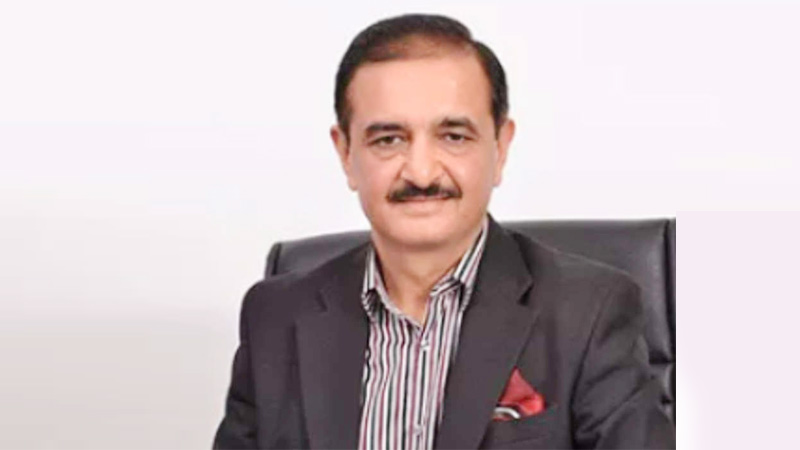
    MUMBAI: It’s back to being president of the All India Digital Cable Federation (AIDCF). DEN Networks CEO S.N. Sharma who led the AIDCF from April 2019 to March 2021 as its president has once again been appointed to that post. His term will continue till March 2025 when a new head will hopefully be selected. 

    The AIDCF was set up in 2014 with VD Wadhwa, the then CEO of Siti Networks as its head.

    Sharma, a veteran and popular figure in the cable TV industry, succeeds Fastway CEO Peeush Mahajan, who stepped down from the position in May 2024 due to personal reasons (apparently, he’s migrated to Canada and won’t be coming back). Peeush took over as president in April 2023 and his term was supposed to end in March 2025.

    Sharma had been acting president of the association since then. 

  • Watcho partners with Fastway and Netplus

    Watcho partners with Fastway and Netplus

    Mumbai – Watcho has partnered with Fastway and Netplus to introduce a comprehensive entertainment bundle with seamless connectivity. This strategic collaboration marks a significant expansion of Watcho’s regional footprint and addresses the growing demand for integrated entertainment solutions.

    The newly launched bundle seamlessly combines Fastway’s IPTV services, Netplus’s high-speed internet, and Watcho’s extensive OTT content into a single, unified package. This holistic entertainment solution eliminates the need for multiple service providers and complex billing processes, offering customers a streamlined entertainment experience. Subscribers can access 500+ live TV channels, Including 100+ channels with popular regional content via IPTV Set-top-box, robust internet connectivity, and a diverse range of OTT content from top providers such as Hotstar, SonyLIV, ZEE5, Chaupal, and many more, all under one Watcho subscription.

    The package features IPTV + Broadband Plans + Watcho OTT Bundles starting at Rs 598, providing an internet speed of 50 Mbps along with 500+ TV channels, a Catch-Up TV feature allowing users to access content up to 7 days, and content from 17 OTT apps. With this partnership, customers will benefit from simplified access to a wide array of entertainment through Watcho’s extensive content library and aggregated services from over 17 popular OTT platforms such as Disney+ Hotstar, Zee5, Sony Liv, Hungama Play, Chaupal, FanCode, Watcho Exclusives and many more, spanning genres like drama, romance, fantasy, and more.

    Dish TV India Ltd. CEO Manoj Dobhal said, “At Dish TV and Watcho, we always aim to deliver exceptional value and convenience to our customers. Our partnership with Fastway and Netplus embodies this commitment by offering a seamless bundle that integrates IPTV, high-speed internet, and extensive OTT content. This all-in-one solution simplifies access to diverse entertainment and enhances convenience for our customers across Punjab. We hope this package meets the increasing demand for integrated entertainment solutions, aligning with our mission to provide high-quality experiences while expanding our footprint and addressing a variety of entertainment needs with unmatched ease and efficiency.”

    Jujhar Group founder & chairman Gurdeep Singh commented, “We are excited about our partnership with Watcho. This launch represents a power-packed value proposition that both the brands proudly offer to its consumers. It delivers the most cost-effective and affordable form of entertainment. The brand is deeply committed to understanding and addressing the needs of its customers, consistently providing the best solutions tailored to enhance their viewing experience.”

    “The IPTV STB will also facilitate access to OTT content, powered by Watcho, thereby presenting a variety of premium regional and national content from top providers. We hope this collaboration will simplify access to quality content and set a new standard for convenience and innovation in the entertainment industry,” added Singh.

  • Fastway entertainment industry launches IPTV set-top box

    Fastway entertainment industry launches IPTV set-top box

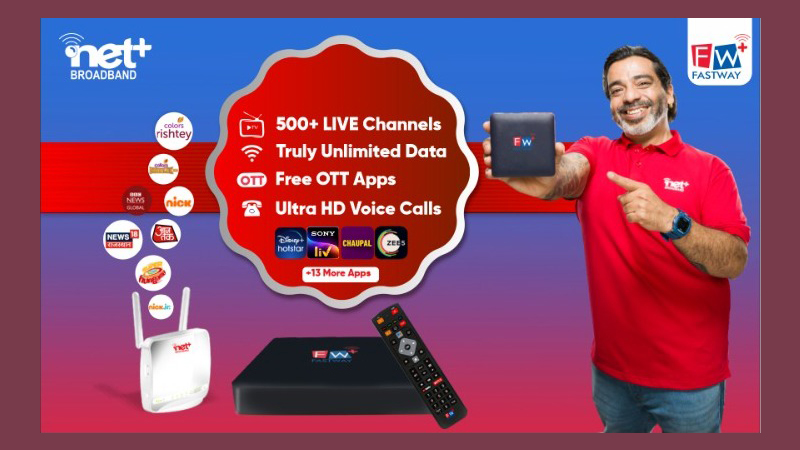
    Mumbai: Fastway, a provider of digital cable TV & broadband services, has announced the launch of Next Gen IPTV Set Top Box, which is set to revolutionise the way consumers experience entertainment.

    The all-new IPTV STB offers many features designed to enhance the overall entertainment experience. Subscribers will have access to over 500 live TV channels, Including 100 channels with popular regional content ensuring that there is always something to watch for every family member.

    The powerful Catch-Up TV feature allows users to access content up to 7days, ensuring they never miss out on their favourite shows. Whether you missed a live broadcast or want to re-watch your favourite part of a show, Catch Up TV has you covered.

    The Video on Demand (VOD) feature provides access to a staggering 10,000+ movies giving users unlimited options for entertainment.

    In a statement at the press conference, Dr Prem Ojha CEO expressed his excitement about the launch of the IPTV STB. “We are extremely delighted to bring to you next-gen IPTV STB which offers world-class converged services including high-speed unlimited Broadband, Video, Voice and OTT on a single platform. The launch of IPTV services will further enhance value for our consumers and take their experience to the next level.

    Jujhar Group founder & chairman Gurdeep Singh commented, “This launch represents a power-packed value proposition that the brand proudly offers to its consumers. It delivers the most cost-effective and affordable form of entertainment. The brand is deeply committed to understanding and addressing the needs of its customers, consistently providing the best solutions tailored to enhance their viewing experience.”

    The IPTV STB will also facilitate access to OTT content, thereby presenting a variety of premium regional and national content from top providers such as Hotstar, SonyLIV, ZEE5, Chupal, and many more. From regional and national channels to truly unlimited data and free OTT apps, with HD voice calls, IPTV STB offers something versatile and facile.

    The launch of IPTV STB underlines Fastway’s commitment to delivering innovative and high-quality digital services to consumers. With its unparalleled features and content offerings, the IPTV STB is certainly going to rewrite the rules of entertainment and present an unrivalled viewing experience to users.

  • VBS 2024: The Churning Video Distribution Ecosystem – What’s next?

    VBS 2024: The Churning Video Distribution Ecosystem – What’s next?

    Mumbai: India is in the grips of seisnic changes regarding video and broadband consumption. Pay TV cord-cutting is rampant even as free TV subscriptions are on the rise and OTT buy-ins are churning with the signs up for certain platforms stagnating even as others are seeing rapid increases and some are seeing cataclysmic drops. Aggregators of OTTs are popping up on the horizon promising cheap bundles along with value-added services for cable TV and DTH. There’s a rush to set up free advertising-supported TV channels by TV set manufacturers and smart TV device makers. There’s the Jio factor where it seeks to convert most pay TV customers to free streaming of video content by offering free access to consumers at no cost. The consumer continues to demand bandwidth higher than ever imagined even as prices drop. Margins are under pressure as every player goes one-up on each other acquire and retain customers.

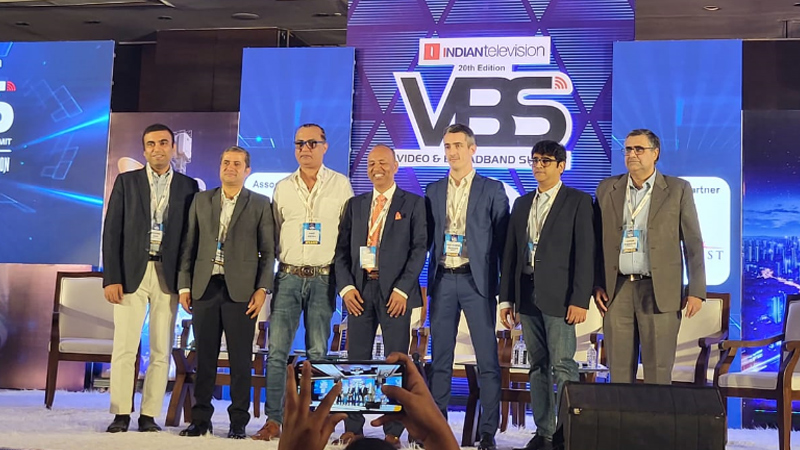
    The video and broadband distribution landscape has not been as vibrant as it is now.. How long will this pot-boiling continue? What will the magic potion of video and broadband look and taste like? And what’s the end game? Indiantelevision.com has held the 20th edition of Video and Broadband Summit better known as VBS at Sahara Star Hotel, Mumbai.

    The session chair for this panel was Ernst and Young LLP partner, media & entertainment advisory services Ashish Pherwani along with panelists: Fastway group CEO Prem Ojha, IndiaCast president Amit Arora, Dish TV CEO Manoj Dobhal, Warner Bros. Discovery & Eurosport South Asia head of distribution Ruchir Jain, Shemaroo Entertainment COO-broadcasting business Sandeep Gupta and Harmonic EMEA-APAC streaming market development director Alexandre Paugam

    Pherwani started off by saying by 2028, the TV world be breaking up into three largely equal partners and will have about 70 to 80 million pay TV and 65 to 70 million free-to-air services.

    Jain said, “We are very hopeful about the future right now. If you look at this, what’s going to happen is one is that the entire set of consumers are increasing in number. So I’m talking about how pay TV is gonna grow, connected TVs, and also about the free-to-air services, etc, so it’s the number of people coming into the media, who is going to invest. So that’s one big factor, the second big factor is the time scale

    Ojha opined that, “Our job is to keep the ground ready so that all this beautiful content and all these absorbing content can reach out to consumers the way they want it today.”

    Arora said, “So it is select all 3 platforms to seem to be consuming a lot of common content assets and that is going to change in the future formats will change may be the price point. I agree with that.”

    Dobhai said, “ We are brands with long-run legacies. And new ones coming up. Fortunately, unfortunately, I’m on the receiving end of it because we are the ones who showed the word of it all the country that you know what experience it brings when you watch an immersive content technology, upgraded version of it, satellite, and all that.”

    Gupta added that for Shemaroo, Gujarati is like building our own Prime Video. Because we are devoted ourselves to Gujrati. We are trying to expand on more areas as well. Other than that Shemaroo and ShemarooMe are mostly devoted to Gujarati.

    Lastly, Paugam replied, “Coming from the technology, part of things, especially the broadcast infrastructure, I think we see a big trend, and DTH cable stays strong. And for us, it stays at a huge part of our business helping protesters and operators distribute their content through those networks and optimize it. But the big growth is in streaming. And we’ve seen a tipping point globally, the number of subscribers from pay TV subscribers, being outpaced by the number of streaming subscribers. We’re moving from sending a unified feed and broke it down to everyone to sending unique guests and a unique feed to the end user. That gives us the ability to customize this unique feed. I think a lot of innovation and new technology that are emerging are around how do we leverage that streaming vessel to have the experience as personalized as possible.”

  • Star India urges Airtel Digital subscribers to switch

    Star India urges Airtel Digital subscribers to switch

    MUMBAI: The slugfests were bound to happen in TV distribution. The time for agreement renewal is nigh between distribution platform operators and broadcasters with content contracts coming to an end. The Telecom Regulatory Authority of India’s (TRAI) proposed  tariff  and interconnection agreements are being passed  around from the High Court of Chennai to the Supreme Court and back without any resolution.

    Earlier this month, the Star Network issued a disconnection notice to one of India’s better-managed DTH operators Airtel Digital in an announcement that made waves in TV distribution circles.  Now, with the spat between the two continuing, India’s leading TV network has taken the fight to Airtel’s camp.

    It has started a digital campaign-for now at least-asking the DTH player’s subscribers to switch to other distribution platforms. Says the network on its Twitter handle: “Attention Airtel Digital  subscribers! Star has not increased channel tariffs. Airtel Digital TV  is misleading you and unilaterally increasing the prices of Star channels. To continue watching high quality Star entertainment switch to new DTH/cable operator now.”

     The digital  video,  which is doing the rounds on social media, has a voiceover that states: “You used to pay Rs 200 for the HD pack on Airtel. Now why are you being charged Rs 1,000? You can still get the same price for the same HD channels at around Rs 200! Change to another service provider. To get Star channels in a packet, make the switch.

    The video then lists operators like DEN, Fastway, SUN, Hathway, GTPL and Tata Sky that Airtel subscribers can opt for.

    We will have to wait and watch how Airtel responds to this direct attack. Will it buckle and give into the rates that Star India is asking for? Or will it hold firm and wait to see if the broadcaster will blink first?

    After all, Star has a lot at stake with the IPL coming up in the next fortnight. And it has to recover the humungous amounts it is pumping into the most prized cricketing property globally!

    Keep reading indiantelevision.com for further updates!

    Also Read:

    Airtel Digital TV disconnects Star India channels

    TDSAT tells Airtel DTH, Star to negotiate

    Tata Sky woos new customers with free Star Sports channels


  • TDSAT ‘reserves’ order on landing-page case

    TDSAT ‘reserves’ order on landing-page case

    NEW DELHI: Telecoms and disputes tribunal TDSAT on Thursday reserved its order—the judge will pronounce the verdict later—on a case filed by a few multi-system operators (MSO) on sector regulator Telecom Regulatory Authority of India’s (TRAI) decision to ban the use of boot-up or landing page for anything else other than promotion of the distribution platform’s services.

    TDSAT, after hearing all sides, including TRAI, will now give a direction later. The arguments, amongst other issues, revolved around the fact whether all laid down norms and procedures were followed by the regulator before passing an order on the landing page matter on 8 December 2017.

    “In order to protect the interest of service providers and consumers, and orderly growth of the sector, [TRAI] directs all broadcasters and distributors of TV channels to restrain from placing any registered satellite TV channel, on the landing page LCN or landing channel or boot-up screen within 15 days from the date of issuance of this direction,” the regulator had stated in its order, asserting it was well within its right and powers to do so.

    Soon after this directive was issued, a clutch of MSOs and TV channels, including Fastway (operating in Punjab and Haryana states), DEN Networks and the Times group, moved the TDSAT challenging the regulator’s diktat.

    The landing or the boot-up page is what a viewer sees first when a TV set and the connected set-top box are switched on. This page on the screen remains for a certain period of time after which the EPG or the electronic programming guide of the distribution service provider comes up. The landing page, considered hot real estate, usually carries paid advertisements of a TV channel programme or messages (like audience-measurement data relating to a particular TV channel or even initial sampling of a new channel). The commercial use of the landing page results in sizeable revenue for distribution platforms.

    Asked about the legality of the whole issue, lawyer Abhishek Malhotra, a partner in Bharucha & Partners, a law firm specialising in media sector-related cases, said, “The legal position on transparency required to be followed by TRAI under Section 11(4) of the Act is very clear and has been reiterated by the Supreme Court. It seems likely that non-observance by TRAI of this basic condition could result in the matter being remanded back before the merits of the matter are taken up.”

    While passing the directive on use of the landing page, TRAI had said it had received a number of representations from stakeholders stating the practice of placing a registered TV channel—whose audience data was recently released—on the landing page had the potential to influence TV-audience measurements.

    The genesis of this TRAI order is connected to the rousing debut of an English news channel last year, which got high viewership ratings from the audience-measurement agency and the data was questioned by a section of the competition on the grounds that some unethical practices were followed. It had then resulted in a public spat.

    Also Read :

    TRAI tightens landing-page norms

    Republic TV curiosity factor wanes, NBA channels data absent in week 21

    Republic TV, TRAI, NBA and the case of multiple LCNs

    News channel controversy: BARC India fires riposte to NBA

    “Dual LCNs is not the best thing to do” — Chrome Data CEO Pankaj Krishna


  • Punjab govt to levy entertainment tax on cable, DTH

    Punjab govt to levy entertainment tax on cable, DTH

    MUMBAI: The Punjab government is cracking down on errant cable ops by getting them to be accountable. It has added entertainment tax to cable and DTH connections. All local gram panchayats and state bodies will collect Rs 5 per month on a DTH connection and Rs 2 a month on cable TV from operators.

    The cabinet has approved the move. Once the governor gives the nod, the charges will begin from the date of notification.

    The state government aims to make Rs 9.6 crore via the DTH tax from 16 lakh connections and Rs 36.96 crore through 44 lah cable connections.

    Interestingly, no entertainment tax will be levied on other sources of entertainment such as cinemas, multiplexes, and amusement parks.

    The government is cracking down on cable mafias by getting them to clearly account their subscriber base. In the limelight is Fastway Transmission which is the mega player in the state and had the support of the previous Punjab government.

    When GST was introduced on 1 July, the power to collect entertainment tax was withdrawn from the state governments. This has now been given to the panchayats and municipalities by amending the seventh schedule of the constitution. Instead of requiring the centre to approve, The Punjab Entertainment and Amusements Taxes (Levy and collection by local bodies) Act 2017 was amended to get approval at the state level itself.

    Also read: 

    Supreme Court stays order on entertainment tax by LCOs

    M&E items get GST relief from 15 November 2017

    Entertainment tax: MSOs & LCOs must collect & pay, HC halts Delhi ‘action’

  • Retransmission law contravened: Sidhu, Fastway refutes ‘monopoly’ charge

    MUMBAI Punjab minister Navjot Singh Sidhu intends to bring an ordinance for auditing the tax the previous government collected from cable operators. Putting the chief minister Capt Amarinder Singh in a fix, Sidhu has asked him to decide on recovering the ‘tax evaded’ by the MSO — Fastway Cable Network.

    The Punjab Government, he said, was committed to break the monopoly situation and to have a level playing field in cable TV industry.

    In the Indian states where there is competition among MSOs, Sidhu said, rates being charged from LCOs (local cable operators) are Rs 75 in Rajasthan, Rs 60 in UP, and a whopping Rs 130 in Punjab. It was being done without any legal agreement and without raising any invoices, whereby LCOs had no option but deposit the same — which is in contravention of the law of retransmission of cable TV signals. By creating the monopoly, Sidhu said, MSOs have an unequal bargaining power with the broadcasters but extracting huge carriage/placement revenue from the broadcasters.

    Sidhu said that he would procure a GPR (ground penetrating radar) to assess where cabled had been laid and whether the operator had paid due taxes. Since the subject related to excise and taxation is under the CM, he said, the matter would have to be taken to Singh and the cabinet.

    In 1995, Sidhu said, the entertainment tax in Punjab was Rs 50 per television set. But, the Badal government amended the provisions to keep Fastway out of tax net and imposed a tiny tax of Rs 15,000 per annum. A Fastway release later stated that the Supreme Court lawyer Vineet Bhagat (Sidhu’s advisor) was defeated by Fastway in several cases, and hence he had twisted the facts and presented figures to show the MSO in a poor light.

    Calculating the impact of the loss to the state exchequer by taking into account a conservative figure of 40 lakh Fastway connections (as stated in 2012 Competition Commission of India report, it would come to (40 lakh x 50 x 12 x 6) Rs 14.4 billion, the minister alleged. Sidhu said the actual figure could go up to Rs 200 billion. Despite having over 80 lakh connections today, Sidhu said, Fastway had grossly under-declared its connections at around 24 lakh to TRAI, continuing to short-change the regulator and the government.

    Refuting, Fastway CEO Peeush Mahajan said his company had no monopoly as Godfather Cable, Hinduja and MC Transmissions were operating in the state. Punjab had six DTH companies as well, he said.  Fastway, he said, had a tamper-proof system and it has been audited by broadcasters and the central government agency BECL (Broadcasting Engineering Corporation of India Limited).

    ALSO READ :

    Probe Punjab ‘cable mafia,’ demands minister, Fastway refutes charges

    Punjab Govt falters in first leg of breaking cable monopoly

    Punjab govt. vows to break cable monopoly, rules out blocking MSO Fastway

    Hinduja’s NXT Digital enters Fastway-dominated Punjab


  • Punjab Govt falters in first leg of breaking cable monopoly

    MUMBAI: Even as the Punjab government recently vowed to break the cable monopoly, the Municipal Corporation Bathinda (MCB) has been unsuccessful in completing its door-to-door cable survey in the city. As per the orders of the Local Bodies Department, the MCB was scheduled to complete its survey by 31 July, and submit its report to the department.

    After receiving instructions from the local bodies minister Navjot Singh Sidhu to start a grassroots-level investigation against Fastway Cable, the MCB had sent officials of the rank of JE and SDO to conduct a door-to-door survey in the Bathinda, Tribune reported.

    Even though the Congress government in Punjab made it clear it would not tolerate monopoly in information and news distribution via cable TV, the state government clarified no particular MSO company or TV channel would be targeted and action would be taken if found guilty of tax law violations.

    Sidhu had alleged that Fastway had caused a loss of around Rs 6840 million to the state exchequer. The state government had ordered a tax evasion notice to be slapped on Fastway. Sidhu also demanded a separate investigation into the alleged under-reporting of TV connections and cable operators engaged by Fastway. Of over 8,000 cable operators in the state, 6,500 were working for Fastway, he alleged.

    MSO Fastway, which holds sway in Punjab resulting virtually in a monopoly, is allegedly owned and operated by close aides of former Punjab chief minister’s family — the Badals. The decade-old MSO company also has sizable presence in neighbouring states of Himachal Pradesh, Haryana and Union territory of Chandigarh. In an official statement, the present CM Captain Amarinder Singh made it clear that action would be taken against media companies if charges of tax violations are proved to be correct.

    Around 70 Bathinda officials were deputed for the survey. In the city, these officials were to collect information of cable network from around 70,000 households. After this survey, Sidhu planned to impose entertainment tax on cable network because, as per the Municipal Act, 1976, his department had the right to collect the tax. The Union Government had kept the cable business out of the GST. As per MCB record of the last 10 years, Fastway had not paid requisite charges for using poles. After the earlier record, many new connections and areas had increased manifold.

    MCB commissioner Sanyam Aggarwal admitted that he did not know how much survey work had been completed.

    ALSO READ :

    Probe Punjab ‘cable mafia,’ demands minister, Fastway refutes charges

    Hinduja’s NXT Digital enters Fastway-dominated Punjab

    Punjab govt. studying Arasu & other regulatory models on distribution

    Punjab govt. vows to break cable monopoly, rules out blocking MSO Fastway


  • Punjab govt. studying Arasu & other regulatory models on distribution

    NEW DELHI:  The Punjab Government is said to be studying Tamilnadu Arasu Cable TV Corporation (TACTV) model as also some other regulatory setups as part of a proposal to explore bringing about more transparency in  cable TV distribution system in the State, while breaking any monopoly that exists.

    A source in the state government confirmed to indiantelevision.com that structuring and functioning of Asasu is being studied by legal eagles. The source added that some other regulatory models are being studied too to explore setting up of a mechanism ensuring that any “monopoly in cable TV distribution”, if it exists, could be broken. The final aim: make the whole system transparent and democratic for all players to operate in Punjab.

    Former-cricketer-turned-politician-cum-TV-personality Navjot Singh Sidhu, a minister in the present Congress government in Punjab, had alleged in the state assembly some time back that  MSO Fastway Transmission Private Limited, under the “patronage” of the previous Akali government, had caused a loss of around Rs 6840 million to the state exchequer. Because of political patronage, Fastway monopolised the cable TV business in Punjab, a PTI report had stated, basing its observations on Sidhu’s claims.

    In a laudable step Punjab chief minister Amrinder Singh, despite his cabinet colleague’s outbursts, in a public statement few days later assured the TV industry  ruling out “vendetta politics”  or any witch-hunt against any MSO or TV channel. Still, he did say any allegations of  tax evasion would be probed as per the law.

    However, the Punjab government source was unable to fully explain to indiantelevision.com how studying the Arasu model would help as the TN MSO is a state government-run organization, which itself has been accused of  trying to monopolise cable TV distribution business in the south Indian state.

    In a set of recommendations first made in 2008, then in 2012 and reiterated in August 2014, broadcast and telecoms regulator TRAI had suggested barring government or government backed organizations from entering the business of TV broadcast or  distribution. The suggestions, part of media ownership’s proposed norms, have been gathering dust in the Ministry of Information and Broadcasting under successive governments.

    TRAI had observed: “Given that about six years have elapsed without any concrete action being taken by the government, the Authority strongly recommends that …political bodies, religious bodies, urban, local, panchayati raj, and other publicly funded bodies, and Central and State government ministries, departments, companies, undertakings, joint ventures, and government-funded entities and affiliates be barred from entry into broadcasting and TV channel distribution sectors…(and)  in case permission to any such organisations have already been granted, an appropriate exit route is to be provided.”

    ALSO READ:

    Punjab govt. vows to break cable monopoly, rules out blocking MSO Fastway

    Probe Punjab ‘cable mafia,’ demands minister, Fastway refutes charges