Tag: FAST channels

  • Vida unveils agentic AI-powered media factory at IBC 2025

    Vida unveils agentic AI-powered media factory at IBC 2025

    LONDON:  Vida, the London- and Los Angeles-based cloud-native media management outfit, has launched Media Factory, an agentic AI-powered workflow automation engine set to debut at IBC 2025.

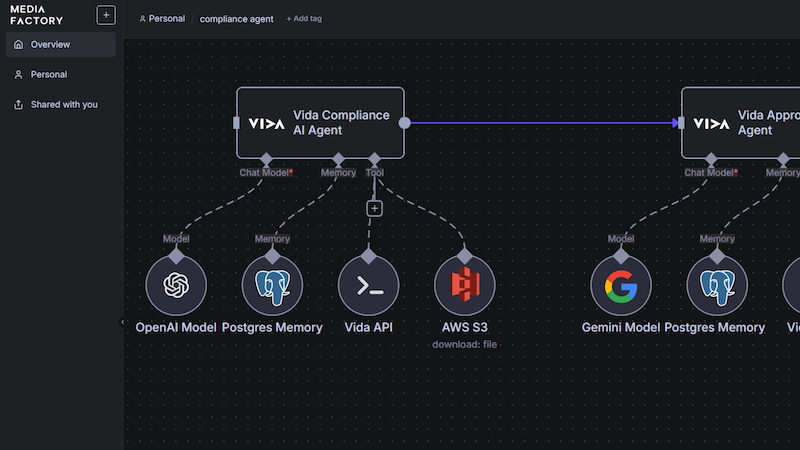
    Billed as a “smarter, faster way” to run the digital media supply chain, Media Factory integrates directly into Vida’s content OS and ships with more than 300 pre-built connectors, from AI tagging and transcription to compliance checks and delivery to fast channels, YouTube and social platforms. What once took weeks of bespoke software coding can now be built, tested and deployed in hours.

    “Media Factory is about giving teams the tools to connect content, configure any workflow, and integrate with any business system. The possibilities are mind-blowing,” said Vida managing director Symon Roue.

    The tool uses a visual drag-and-drop interface to let both humans and AI models orchestrate ingest, metadata packaging, age-appropriateness flagging, analytics integration, and trigger-based delivery. Workflows can be fired by events, webhooks, asset changes or file activity. Unlike legacy systems demanding top-tier software engineers, Media Factory is pitched at operations and technology teams asked to do more with less.

    Vida’s customers already manage over 43m assets and 26 petabytes of content on its platform. The new engine will be available to enterprise clients and partners from September 2025. Demonstrations will run at IBC 2025 in Hall 5, stand 5.D50.

  • EY-AIDCF report: Indian cable TV faces dire times unless government and regulator step in with regulatory reforms

    EY-AIDCF report: Indian cable TV faces dire times unless government and regulator step in with regulatory reforms

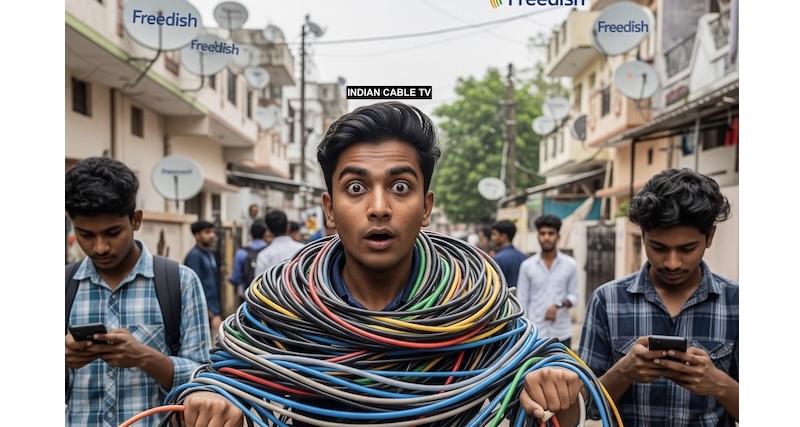
    NEW DELHI: India’s cable TV industry is on the ropes, reeling from a perfect storm of digital disruption, regulatory overkill, and changing viewer habits. A blistering new report by EY and the All India Digital Cable Federation (AIDCF) reveals a 40 million plunge in pay TV homes since 2018—down from 151 million to just 111 million in 2024—and warns that the bleeding isn’t over yet.

    By 2030, the figure could drop to as low as 71 million, as Indians flock to OTT, Free Dish, and smart TVs offering slicker content, better tech, and zero monthly bills. The fallout? A staggering 31 per cent collapse in employment across the Local Cable Operator (LCO) network, with up to 1.95 lakh jobs on the chopping block.
    The pay TV playbook, once defined by “kam daam, zyada samaan,” is now buckling under rising channel rates, bundling woes, and what LCOs call a “regulatory regime rigged for broadcasters.”

    A whopping 93 per cent of LCOs surveyed reported a drop in take-home income, with 79 per cent saying their earnings have nosedived by over 20 per cent since 2018.

    * Revenue for major distribution platform operators (DPOs) has shrunk by over 16 per cent since 2018, while EBITDA margins have plunged by 29 per cent.

    * Cable TV subscriptions have halved to 60 million, while smart TVs connected to the internet hit 50 million monthly active sets in 2024.
    * Pay TV now makes up just 58 per cent of the TV pie, down from 81 per cent in 2018, even as India’s TV household base touched 190 million.

    Despite being the backbone of India’s broadcast reach—physically connecting over 500 million people—LCOs remain the industry’s ignored foot soldiers, calling out a “top-heavy system” that allegedly favours deep-pocketed broadcasters and digital players.

    AIDCF proposes radical surgery: from activating over 20 million inactive set-top boxes and offering subsidies in “TV dark” zones, to limiting near-simultaneous OTT releases of pay TV content, and ensuring a level playing field between cable, OTT, Free TV and FAST channels.

    But with TRAI’s piecemeal tariff reforms (NTO 1.0 to 4.0) fuelling more legal duels than industry stability, stakeholders are demanding a full-blown reset. As OTT juggernauts steam ahead and content increasingly lives in the cloud, the cable industry’s survival may hinge not just on policy support but on reinventing itself as a digital services hub, not just a pipe.

    As the report bluntly puts it: without immediate intervention, the sun may set on the 30-year reign of India’s cable TV kings.

  • Lightning International strikes with 14 Fast channels on myTV Super

    Lightning International strikes with 14 Fast channels on myTV Super

    MUMBAI:  Lightning International has unleashed a storm of entertainment on Hong Kong’s leading streaming service, myTV Super, with the launch of 14 brand-new free ad-supported streaming TV (Fast) channels. From action-packed blockbusters to toe-tapping tunes and jaw-dropping documentaries, the new channels promise a binge-worthy bonanza – all for free.

    The partnership marks myTV Super’s first-ever Fast channel collaboration, powered by Amagi Media Labs, and is set to transform the streaming landscape in Hong Kong. With the new channels, viewers can dive into a world of diverse content across smart TVs, myTV Super boxes, the myTV Super app, and the web.

    Lightning International  CEO James Ross couldn’t hide his excitement: “This collaboration with myTV Super is a game-changer. We’re bringing a treasure trove of content to viewers, catering to every taste and passion.”

    The channel lineup is an eye-pleasing buffet:

    * Action Hollywood Movies – Big hits, bigger thrills. 
    * Concerto – Classical music that strikes a chord.
    * Docsville – Documentaries that dare to inspire.
    * Globetrotter – Travel tales for the restless.
    * NewsWorld – Headlines and happenings, 24/7.
    * Now 70s, Now 80s, Now 90s00s – Nostalgia with a beat.
    * Now ROCK – Rock your world, one riff at a time.
    * Pet Club TV – Furry friends and adorable adventures.
    * Pulse – Wellness and wellbeing in a click.
    * Rialto Classic Movies (RCM) – Golden era films in all their glory.
    * TRACE Sport Stars – The world’s sporting elite in action.
    * TRACE Urban – Hip-hop and urban vibes that never stop.

    myTV Super, the OTT platform of Television Broadcasts Ltd (TVB), has cemented its position as a streaming powerhouse in Hong Kong, and this partnership with Lightning International adds a bolt of variety to its content arsenal.

    (Photo: James Ross, CEO of Lightning International with Rex Ching, President, myTV Super)

  • TRAI issues recommendations for ground-based broadcasting

    TRAI issues recommendations for ground-based broadcasting

    MUMBAI: India has far been a cable and satellite TV country, apart from the single government-owned pubcaster Doordarshan which is the sole terrestrial network. That could likely change if one goes by the recommendations which the Telecom Regulatory Authority of India (TRAI) has come up with for ground based broadcasting (GBB). The recommendation are aimed at establishing a regulatory framework for GBBs in India. They focus on defining operational parameters and facilitating the use of terrestrial communication mediums by broadcasters.

    The key highlights of the TRAI recommendations are:

    * Definitions: The authority has clarified key terms such as “broadcaster,” “ground-based broadcasting,” and “terrestrial communication medium” to reflect updated practices in the industry, distinguishing between satellite-based and ground-based broadcasting.
    Regulatory Framework: TRAI recommends creating a framework for GBBs that aligns with existing guidelines for satellite broadcasters but excludes satellite-specific regulations. Ground-based broadcasters will not require authorisation from In-Space for frequency assignments but must secure other necessary clearances.
    * Delivery Mechanism: GBBs will provide channels to distribution platform operators (DPOs) using various terrestrial technologies, gaining the flexibility to utilise multiple systems as per their business strategies.
    * . Fee Structure: An annual authorisation fee of Rs seven  lakh per channel for GBBs has been proposed.
    *  Operational Areas: The service area for GBBs will be national, ensuring broad reach across the country.
    * Channel Migration Options: GBBs wishing to switch to or adopt satellite communication for their channels, and satellite broadcasters (SBBs) looking to embrace terrestrial methods, may do so with prior government approval while maintaining existing permission validity.
    * Compliance and Reporting: GBBs must report the primary language and sub-genre of their channels at the time of application, which will be displayed on the Broadcast Seva portal to assist in electronic programming guide (EPG) arrangement.
    * Examination of FAST Channels: TRAI recommends that the MIB assess the compliance of free ad-supported streaming television (FAST) channels with existing guidelines and develop policies as needed.
     

    These recommendations aim to enhance the operational landscape for broadcasters in India, promoting the effective use of emerging technologies while ensuring compliance with regulatory standards.
     

  • GRB Media Ranch appoints Will Marks as principal advisor for digital (FAST)

    GRB Media Ranch appoints Will Marks as principal advisor for digital (FAST)

    Mumbai: GRB Media Ranch CEO Gary R Benz has announced the company’s continued growth with a new digital strategy, with soon-to-launch FAST (free ad-supported TV) channels and AVOD (ad-supported video on demand) distribution platforms. Industry veteran Will Marks was retained to develop and implement the forward-facing strategy. He will attend MIPCOM next month to expand the Company’s relationship with content and distribution partners.

    Two FAST channels are planned for launch in Q4 ‘24 across the US and many English-speaking territories (US, UK, Ireland, Canada, Australia, and New Zealand). Each channel will launch with over 400 hours of programming, adding additional content regularly. Additional territories will be launched throughout 2025, along with more channels.

    A paranormal-themed FAST channel, titled ‘The Unseen’ (wt) will include shows from the GRB Media Ranch ‘Dark Zone’ programming collection, including Paranormal Files and Paranormal Quest.

    Also, a travel, food, and culture-themed FAST channel, titled ‘WNDR’ (Wander) will carry programming including Top Travel; South Africa with Hayden Quinn; World of Wonder; and many more globe-spanning series.

    Several more FAST channels are in development for distribution worldwide for next year.

    Marks comes to GRB Media Ranch with sterling credentials as a seasoned industry executive. He was previously SVP, business development & digital at Ovation Television where he founded and led the digital portfolio, including the TV-Everywhere app OvationNOW and the FAST channels Mystery Alley and JOURNY. Marks led the channels to distribution on 300mm plus devices across the US and Canada on connected TVs and video platforms including Amazon Fire, Roku, Samsung TVPlus, Vizio WatchFree+, Plex; and the Apple iOS and Google Android mobile platforms. JOURNY, a perennial ‘Top 3’ travel network on Roku also won the ‘Best AVOD Service’ award from Cynopsis in 2021. Marks had previously served in executive roles leading business development, strategy, and digital teams at ComcastNBCU, Intel Corp, and The Walt Disney Company.

    Benz stated, “GRB Media Ranch is truly excited to launch our digital strategy with two FAST channels in 4Q and we are pleased that Will Marks will share his expertise and distribution savvy to help with this next step in our company’s evolution. We feel fortunate to have many hours of premium programming in paranormal and travel for our launch.”

    Marks added, “GRB Media Ranch built a tremendous content library and continuously acquires compelling programming   across diverse genres. We can’t wait to thrill and chill viewers with the ghosts and haunts on The Unseen; and then take consumers on amazing adventures around the world on WNDR. These new FAST channels are a cornerstone of GRB Media Ranch’s new distribution approach, bringing captivating programming to worldwide audiences. I look forward to working with Gary and the entire GRB Media team in helping them increase the company’s reach around the world.”

  • Innovation in content distribution: FAST channels, streaming, and more

    Innovation in content distribution: FAST channels, streaming, and more

    Mumbai: The Sports Video Group is held its first event in India on 30 April 2024. Hosted by Star Sports in Mumbai, the event brought together top-level executives from the TV sports production community for a day of networking, tours, panel discussions, technical presentations, and much more.

    FAST (free ad-supported television) is a global phenomenon and for sports leagues, networks, and even teams it could be a new way to reach fans in an efficient way. The panel dived deep into the world of FAST channels and streaming platforms to learn how they are innovating in this ever changing world.

    The panel was moderated by Indiantelevision.com and founder, chairman, and editor-in-chief Anil Wanvari, and had panelists including AWS, principal and business development manager, global sports Paul Devlin; Amagi, director of sales Imran Khan and Disney Star India, head – broadcast technology and operations (BTO) Gajendra Tijare.

    Wanvari began the session by asking, “What is the best FAST sports channel?”

    Devlin replied saying, “I’m a massive sports fan, and have been working in sport full time. I’ve been in sport my whole life. What makes a good FAST channel for me, for sports is, I heard a lot today and I’m really impressed by it. On Amazon we talk about working backwards from the customer, working backwards from the fan.”

    He added, “I think, let’s call it a world class FAST channel, to use a sporting metaphor, is the one that I want to watch. Which is probably different from the one that each of the panelists wants to watch. So I think it’s a personalised FAST channel, that is kind of world class, that would be my opinion on it.”

    Answering Wanvari’s question, Khan said, “A linear FAST channel which is live, it won’t be relegated to the Star Sports HD channel. It would be somewhat like, I just want to watch fourth and sixth, that’s it. I’m more interested in pre-match and post-match. I don’t want to watch that seven hours of live match or three hours of live match. So I need something personalised, that’s number one.”

    Imran added, “When you see FAST, that ‘A’ stands for advertisement and that’s not a random advertisement. So based on my preference, I would like to see the ad which is based on my preference, be it automobile, technology or apparel. I’m not just seeing any random advertisement. For me, the FAST channel, well curated for me, which is only pre-match, post-match with some highlights and with the ads that I want to watch. FAST is all about advertisement. The only source of revenue for FAST channel is advertisement. There is no paywall behind that. I’m not talking about a premium channel which is the source, I mean revenue generator for this. I would rather make money from the advertisement rather than asking someone to pay for subscription.”

    Replying to Wanvari, Tijare said, “I think before we say which is a good fast channel for sports. We should understand the entire reason why FAST came to me. It’s a question between linear TV subscription and streaming. Honestly, it’s a late mover in the business of fast channels. But if you look at FAST on the entertainment way, it has actually made quite an impact. It’s a billion dollar plus industry and we’ve seen that most streaming platforms are now looking at ad, whether it’s Amazon or Netflix, etc.”

    Tijare added, “What we’ve seen over the period is that on FAST, there is a lot of legacy content that’s played. It’s curated to the user by content being curated automatically. You have advertisements that can be curated; you have return path which gives you information about who’s watching and what are their preferences and accordingly you can do a lot of curation of content. When it comes to sports, it’s not that simple unfortunately. Firstly, because while there is an opportunity, there is also a disadvantage as most of the live main events are rights driven. And live of a big game like Super Bowl won’t be possible because it’s already given as rights. But the opportunity lies in the pre, the post, the build up towards that game, the personalisation. There’s a lot of opportunity in creating content and putting it out on platforms which can aggregate consumers, which can build that traction towards that event, which will actually get a lot of stickiness towards that event. This can be used for that ‘A’. So I think that’s one great opportunity. The bigger opportunity I think is what now D-Zone.”

    Tijare further went on to add, “There are sports that are in the making, that don’t see the light of day. Where you have channels that could see light of day using FAST. There are sports that can be curated which can not be on the big four or the big five networks, but they can be curated through FAST channels and you get a lot of new sports that can come on platforms like that.”

    Talking more about what’s a world-class FAST channel, Devlin said, “It allows that linear broadcaster to collect data on what their audience likes. That’s the key to personalisation is data, knowing what they want, what they’ll watch, and actually, potentially opens doors to sports rights within a certain market that you didn’t realize you’ve got an audience for. Again, consciously, it could be the Olympics.”

    Talking about FAST rights, which is another layer that the federation will start demanding money for, Wanvari asked Tijare if he’s happy with that.

    To which Tijare said, “The good thing is I don’t know how that works, because usually highlights are also bundled up into the live events. But it depends on sport to sport. However, I think that’s something that can be a possibility. Platforms will give the services but at the end of the day, FAST channel is, or any other thing, as technologists, we are supposed to give opportunities where we can monetize. These are new ways of monetizing content and at the same time, you create a spot. You have an opportunity to build a spot.”

    He added, “In fact, in Australia, I was reading there was this FAST channel called acTVe. They’ve got a surfing channel on board right now. Who wants to put surfing on TV in India? But as a FAST channel, there would be few surfers who are really interested and they could get that on a platform. There are sporting events that are not really seen openly. That’s the opportunity. That’s what we can see that can come on and we can make money, obviously.”

    Moving on, Wanvari asked Khan, “You’re working with a lot of companies that are launching FAST channels in India. So what are some of the new developments you’ve seen as far as fast is concerned in India? And what can and what cannot work in India and in the area of FAST?”

    Khan replied saying, “In India, the biggest growth which we have seen is in news channels. Right now, it’s around 17 news channels across different languages, which is live on fast platforms and hey have started making money. Initially, we always had this question that everybody is on fast, but nobody is making money. So I’m putting it on record that everybody is making money from news channels. So the way I said, they’re making money, for entertainment channels, they are the second mover.”

    Khan added, “India has always been a difficult market when it comes to sports. So the way we look at the US market or Europe market is completely different. Even if we talk about the ad spend in the entire ecosystem of TV, in the US, it’s 29 percent, in Europe, it’s 21 percent. In India, it’s surprisingly 22 percent including IPO. That’s the ad campaign report we just got published yesterday (29 April). So there are a couple of levers which we have been in discussion with the team. It’s not only the lines which we can take advantage of. You have a plethora of content sitting idle somewhere, which is not very monetised. So the way we do it in the US is like Super Bowl of 70s, 80s, 90s, a particular season, just highlights of corners, highlights of this course. So we can create something like that because cricket is not just a sport in India. It’s a religion. Wherever you invest, you will get the audience and you get real time analysis. So you can always see what’s working, what’s not, and based on that, you can see whether you create more channels or can you add some like tier 2 sports, tier 3 sports, because those are something which are really happening across the world.”

    Khan further said, “There are players who have been game changers in this part of the world. Fancode is one,  SportVot is another one. One doesn’t need to be in the tier 1 segment. A district level player can be a famous player. In terms of technology, we have made it more flexible. Initially there was only one version. So irrespective whether you use it or not, you are going to pay some. Now we have made it like different tiers. If you are a content owner, your content is sitting somewhere in the library. We need to curate the content. There is no live and no heavy graphics. The channel can be made in a very economically viable.

    Then you have some channel which is only for a certain duration. You can come up with a documentary or an infotainment channel just for the election duration. I can only charge you for two or three months. So that is a pop-up channel which is very common in the US. For instance, during the election time or Christmas time, you can come up with a channel, run it for three months, then you shut it down. That product got awarded the first Emmy award for Amagi, which is called DYNAMIC. So you can only pay for the amount of hours you have used.

    Wanvari then asked Devlin, “Where do you guys come into play in terms of delivering content production on the cloud? What about distribution on the cloud?”

    Devlin replied, “Well, we work practice from customers and so live production in the cloud has advanced in two years. I’ve been speaking at SVG events for two years. We were talking about the art of the possible with live cloud production, and I enjoyed this morning’s sessions talking about potential and challenges around running live production in the cloud. But there’s undeniable progress we’ve made over the last two years, and I love hearing about the experimentation. A great quote actually from our CEO, Andy Jassy, is ‘Innovation requires two things. The ability to try a lot of experiments and not living with the collateral damage of failed experiments’, which I really like.

    ‘In sport, you know, today’s home run, won’t win tomorrow’s ball game.’ – it’s a Babe Ruth quote. You have to constantly look for better ways to do things and in sport, that happens all the time. In the high performance teams, the world that I came from, we’re constantly looking for a better way to do things. I’ve been so inspired by today’s sessions that nothing is perfect. But what we’re looking for is, is there a better way to do certain things? And we’re certainly working with lots of our customers around the world and trying to find a better way of doing things. When I say better, better means a lot of things. It could mean more climate friendly, it could mean the ability for people who’ve got, who are exceptional, an example is a customer in the US – Media Monks who do some remote and live cloud production.”

    Devlin added, “Their CEO told me that they had one of the best audio switches in the world. They did nothing in the UK, but was able to stay at home whilst they were producing in the cloud, basketball in the US, which is great. So when I say a better way of doing things, it doesn’t mean perfect and flawless. One thing that COVID did teach us is, people mobility, and when there’s a lack of that, when the net comes around you and you can’t move, it forces you to innovate and look at different ways of doing things. So I suppose in summary, we’re really keen to help customers continue to innovate, be it through live cloud production or be it through fast channels. Collect data on your audience to be able to personalise for lots of other innovations.”

    Wanvari then went on to ask both Khan and Tijare, “What are the challenges in terms of FAST channels in India? Are the CPMs low, or programmatic is not delivering that much revenue, or is the technology in place? Are the device manufacturers, whether it’s TV sets, whether it’s Roku, all of them, is it working out right?”

    Khan said, “ I don’t see any technical challenges. AWS has been very cooperative, especially for markets like India”

    Wanvari immediately asked if they are giving Indian prices. To which Khan replied saying, “Yeah, obviously. We have a different pricing structure because one number is equal to 23 rupees. It’s a different volume altogether. But having said that, when I’m talking about 29, 21, 2 per cent of the total adder’s expense, we need to consider the CPM rate cycle. In US, the worst case, your CPM is $3. In India, the best case is about $2, $2.5. Your tech cost, even after having a special pricing for India, it’s not justified. But over the last 12 months, we have seen a lot of improvement. The technology cost has gone down.

    There is CPM pricing, which is really attractive for larger broadcasters. At the same time, the advertisers have started looking at CPM, because of the real-time analytics.”

    Interjecting him, Wanvari asked, “Do you think the advertisers are looking at a time when the market is shrinking, the ad market?”

    Khan said, “No, it’s not shrinking. There was a conference two weeks back in Mumbai, where Maruti’s CEO was there and he was talking about why he’s spending more money on digital than traditional broadcast. He said, if my ad, like Nexa ad, is getting watched in a tier 4 village, I’m 100 per cent sure that nobody’s going to watch my Nexa ad in that village. So that’s $1 spent, which is waste. So rather, I’ll put something which is like a true value.

    When you go on CTV, or you go on any digital platform, you at least have the visibility that people are watching your ad. You can understand that if you have spent $100, what was the return on that. That is something which is working really well. Based on that, there are a couple of leading fast platforms who have led the way with contextual ads, digital brand information, personalized ads. So within the same household, we four have different preferences. Though we are watching the same content, I’ll be getting a different ad than the other person. So these are the different challenges, actually.”

    Khan went on to add, “In India, the study market, which is for ad duration, it traditionally has been the longest across the globe. The minimum ad duration for an ad in a news channel will be seven to eight minutes. Internationally, it’s two minutes. So you need to come up with the technology so that you can recover that. What we did, we didn’t shrink the study, we put more ad spots there so that you can go and search for more and more ads so that it can bring you more revenue. These are additional things which we have been doing for Indian platforms. But at the same time, we are trying to experiment it in US market as well, which is working really well.”

    Tijare said, “I think Imran touched on one point, the cost of technology. I think that’s the biggest challenge. Also, I think when we talk about FAST, we have to be very clear about the genre we’re talking about. There are three large or four large genres that we can talk about. There’s sports, there’s entertainment, there’s news, and there’s infotainment also. I think Imran is referring more on news.

    I think the COP is not as high as what you would go to curate a movie or a show where the cost of production is very high. Hence, the return on that is very low or significantly low to what you would expect. So that’s one of the bigger challenges.

    Also, what’s happened is it’s a learning curve. The initial way of being or launching a FAST channel was taking a channel and launching a fast channel. That’s not the perspective anymore.”

    Tijare added, “In entertainment, we realize that it’s not the channel to launch FAST, but it could be events, it could be sequences, it could be situations. These are things that we need to curate to actually get more revenue. What we’ve seen in launches is that yes, there are many other mediums. YouTube could be one. It is profitable. There is a demography. We are exploring all those. But in fact, India per se has been a really, really slow starter for us to be very honest. Whether it’s on LG, Samsung, the other platforms are largely in the US. And we are looking at that because even in the US and Middle East, which are our international markets, that’s our priority. We see that the return on the investment is looking better now. And as we speak, we are in the process of probably launching on a few platforms. At the end of the day, FAST channel stand-alone versus FAST channel being on a platform which has that reach, which has to get further diced and sliced into the demography. What you give is an Indian dice for a cricket as a game or football. I’m just saying, it won’t go. But even if it has to go, you need to have in a market like US, how many people really look at cricket? What is the slice and dice? What is the reach? Which platform gives us that reach? So all that information is being collated as now and we are making slow and steady steps into that.”

    He further said, “In terms of cost of getting activated on that platform, these two gentlemen here have to support us even more. Because if the hunger is on our side, I think the ask is also from their side. I think the ROI at this point in time is really the concern. It’s not a major issue, but I’d see in the next couple of months or maybe in less than a year or a year or so, we should be on a few platforms.”

    Wanvari then asked, “Are we seeing more sport-influencer-driven FAST channels coming into being? Are we going to see more of metaverse VR experiences with Apple Vision Pro coming up, What do we see in the future for FAST?”

    Devlin replied saying, “I am from Northwest England. I support Everton Football Club in the Premier League for those who may not like football or soccer, depending on where they’re from. I would personally love to see an Everton FC FAST channel that shows the content I want to see in short form. So hopefully there’s more FAST channels coming for that. To tell everybody who are listening about this, so for a long time I wanted to come to India and the second thing I wanted to do was go to an IPL game when I was here. Really frustrating that there isn’t one on in the next three days whilst I’m here. But it takes me back to, again, related to Everton Football Club, the remote fan experience.

    So when the Apple Vision Pro came out, my first thought was, maybe finally we’re going to get to the point where someone is going to be able to enable me, as a massive sports fan who just cannot get to those games, to put on those goggles and be in an IPL game.”

    He added, “I remember thinking about cricket. I was telling someone earlier about the India versus Pakistan game at MCG. That made a lot of headlines. I think it was two years ago. Absolutely unbelievable game. But you fill that MCG, biggest stadium in Australia, it’s like 100,000 people. But actually, in talking to the people involved, they could comfortably have filled it multiple times over, and so that’s impossible. You can’t just keep building stadiums significantly bigger than 100,000. But it feels to me like we’ve still not got to the point of being able to genuinely create a remote fan experience that is truly immersive. I think that would be fascinating. Again, we hear a lot of stuff around the ability to project data and analytics, which is another passion area of mine.

    For people in stadiums, and I think I’m not sold that’s something that the fans would love at the end of the day. It’s the atmosphere. Can you imagine pulling your phone out for anything other than recording? But certainly to access stats and data in the last over in that game at MCG, you probably wouldn’t. But if you were in a remote fan experience, you might be able to just slide it across and have it there, and you don’t need to take your eyes off the game. I’d love to see that. I was hopeful a number of years ago when Metaverse became a big deal. I was thinking, here we go, we’re on now. We’re going to be able to do that and got close. I do think it will come back, because I think it’s not that far away. But yeah, I’d love to see that in the future as a tragic sports fan who unfortunately can’t fly around the world at major sporting events.”

    Wanvari  then asked “Would you like to see fan-based commentary on influencer-driven FAST channels?”

    Devlin said, “Yeah, I love some of the stuff that some of the presenters earlier talked around the use of Gen-AI and AI for commentary. I think that’s really cool. Another thing I found really interesting, and again, I’m sorry about Gen-AI too much, but one of the really interesting ways I think, and we’ve actually run a few proof of concepts with a number of sports in APJ at the moment on this, is when you’ve got all that archived data on data analytics from name your sport, and then you’ve got a live feed coming in. Gen-AI is really good at creating insights from that data. Now, facts are that some of them actually aren’t on context because it requires a human to apply context to it. But a really interesting way of improving the ability of the talent, the amazing talent that we use in live broadcasts to tell stories is by making those insights available to them. In Australia, they talk about the great Shane Warne and how unbelievably he was able to predict what was going to happen in the game and then tell a story around why. We can’t all be like Shane Warne, unfortunately. He is a one in a million genius. Maybe Gen-AI can enable some really, really world-class storytellers and talent to tell even deeper stories that they wouldn’t have been able to create otherwise.”

    Devlin added, “The way I describe it when I talk to sports is having those data scientists and data analysts looking for what they think matters. Actually, it’s having machines creating insights that they can just filter instead. Actually, this one is really interested in a lot of that storytelling and then obviously, through the natural language screen, you can dive into it and start to expand upon it. I think that’s a potential in the near future. That’s quite cool. I mean, around commentary and helping humans to tell better stories. But I also love some of the innovations around language, which I thought was fascinating.”

    Wanvari then asked Khan to share hi thoughts, to which he replied saying, “We are already doing a lot of things on regionalisation, personalisation, localisation. But there is one thing which is my personal interest. You see that based on your mood, it’s 45 per cent of the song. If you can get the accent of the entire archival of a song, based on my mood, something comes up. So that is something I would like to see.”

    Moving on, Tijare said, “Kudos to the Star Sports lab team, including Harshad and Rahul, for their continuous efforts in exploring new possibilities. They’ve been instrumental in pushing boundaries and finding innovative solutions across various platforms, whether it’s Hotstar, TV, or now with Fast. This additional channel offers a unique blend of features, bridging the gap between OTT and linear platforms while providing valuable data insights.

    You can actually have a platform to curate that using all the new gadgets and the toys that are available, you know, to create that kind of an experience which could mean influencer, fanbase, or whatever you said in Everton. I think the opportunity is huge. How do you personalize this? Sky’s the limit. It’s just about putting on your thinking cap, using partners like AWS and Amagi to see how you can bring it to life. I think also we need platforms to really support and take that to the players.”

    Khan added, “There is a myth that whenever we meet any broadcaster who are into live broadcasting and they want to migrate to cloud, they say, we want exactly the same thing which you see today. So when you go on CTV, people don’t like Elban. They don’t like zigzags. They want to have a neat and clean view. So when we go and try to convince the broadcasters on that front, they’re like, ‘okay, so you’re trying to cut the cost’. But in reality, in CTV, that’s the way. I mean, you guys are doing so many things on Disney Hotstar app. Look at the feel, it’s so soothing. There is no distraction. So CTV is a completely different world.”