Tag: Fareed Zakaria

  • CNN to air India’s Big Chance from 11 June

    CNN to air India’s Big Chance from 11 June

    MUMBAI: India is the fastest growing economy in the world. In the past two years, the country even managed to benefit from the global crude oil price crash. The largest democracy on earth has a young and vibrant population and is poised for a technological boom. As it opens up to a globalised world, India still has a depth of history and intensity of culture that awes and fascinates tourists from all parts of the world.

    During the half-hour special, CNN’s Indian-born Fareed Zakaria speaks with some of India’s key figures including:

    • Mukesh Ambani, India’s richest man and Chairman of Reliance Industries Limited, the country’s second most profitable company

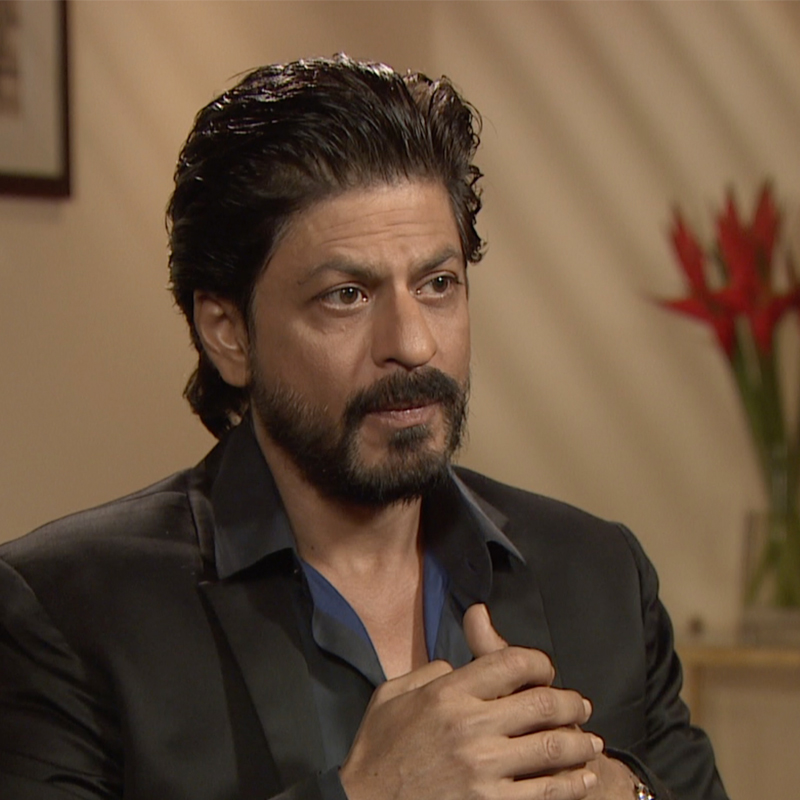
    • Bollywood’s #1 superstar Shah Rukh Khan

    • Kunal Bahl, founder and CEO of SnapDeal, India’s leading e-commerce platform

    Coming from different professional branches, the portrayed personalities try to find out if now is India’s big chance.

    Airtimes (New Delhi/Mumbai)
    Saturday June 11 at 1900 IST
    Sunday June 12 at 1100 IST
    Monday June 13 and at 0000 IST
    Tuesday June 14 at 2200 IST
    Wednesday June 15 at 1400 IST

  • CNN to air India’s Big Chance from 11 June

    CNN to air India’s Big Chance from 11 June

    MUMBAI: India is the fastest growing economy in the world. In the past two years, the country even managed to benefit from the global crude oil price crash. The largest democracy on earth has a young and vibrant population and is poised for a technological boom. As it opens up to a globalised world, India still has a depth of history and intensity of culture that awes and fascinates tourists from all parts of the world.

    During the half-hour special, CNN’s Indian-born Fareed Zakaria speaks with some of India’s key figures including:

    • Mukesh Ambani, India’s richest man and Chairman of Reliance Industries Limited, the country’s second most profitable company

    • Bollywood’s #1 superstar Shah Rukh Khan

    • Kunal Bahl, founder and CEO of SnapDeal, India’s leading e-commerce platform

    Coming from different professional branches, the portrayed personalities try to find out if now is India’s big chance.

    Airtimes (New Delhi/Mumbai)
    Saturday June 11 at 1900 IST
    Sunday June 12 at 1100 IST
    Monday June 13 and at 0000 IST
    Tuesday June 14 at 2200 IST
    Wednesday June 15 at 1400 IST

  • “To make in India, but to benchmark it in the world:” Fareed Zakaria

    “To make in India, but to benchmark it in the world:” Fareed Zakaria

    MUMBAI: With PM Narendra Modi inaugurating the Make in India Week 2016 on 13 February, the second day of the week started with the CNN Asia Business Forum 2016. With seven sessions lined back to back, the forum enthralled delegates with a series of dynamic dialogues. The interactive discussion briefly explored new ideas, growing technology, secrets of leadership and the challenges Asia faces plus the tactics.

    Gracing the forum with their presence were eminent personalities like Finance Minister of India Arun Jaitley, Cisco executive chairman John Chambers, GE president and CEO South Asia Banmali Agrawala, Mahindra Group chairman Anand Mahindra, Aditya Birla Group chairman Kumar Managalam Birla, Emerson Electric Co. president Edward Monser, Google India and South East Asia MD Rajan Anandan, Snapdeal co-founder and CEO Kunal Bhal, Vinnova director general Charlotte Brogren, DJI director of strategic partnerships Michael Perry, AirAsia group CEO Tony Fernandes, Kerry Logistic Network chairman George Yeo and US Ambassador to India Richard Verma.

    The sessions were moderated by CNN’s business anchors Fareed Zakaria, Richard Quest and CNN Asia Pacific editor Andrew Stevens.

    With a mission to make the viewers understand about the world around us, Zakaria addressed the ‘State of the World’ by providing a snapshot of the global geopolitics.

    “The world is in a mess almost everywhere you look but you certainly have to start with the Middle East to understand how the people are anxious and uncertain about things,” Zakaria said.

    With countries like Lybia or Syria facing crisis in the current scenario against to what it was 40 years back, Zakaria strongly believes that the states system, which was built back during the World War I is essentially collapsing. “The states at that time were ruled by highly repressive dictators who knew law and order very well. But what has happened 10 years back is that these dictatorships have one by one have proved to be more and more fragile,” he says.

    The one characteristic that remains common and extremely important is that in these nations, the dictator left and what was noticed later on is the fact that there was no state or administrative institution to maintain political order. Going further, he explains that underneath the state it was noticed that there was no civic society or organisation to maintain social order and underneath that what you discover is that there is no nation.

    Zakaria points out, “People have retreated to identities that make them unavoidably hostile to one another. When order collapses you look for something that gives you security and stability and that security does not come in the Middle East from your national identity. These nations were created recently. It’s coming from much older identities like Siaa, Sunni, Arabians, etc, who are 1000 – 2000 year old identities. They have created an inbuilt sectoring of religious conflicts that persist and is going to take some time to be sorted out.”

    US engine has become the largest engine for producing liquid hydrocarbon in the world. The unbalanced supply and demand are the two engines that rightly explain the crisis. Zakaria explains, “The one engine in the US, which saw a growth from $1 million – $10 million in 10 years and the other engine being the declining demand in China.”

    Zakaria sheds light on how Europe faced crisis and how in the past 25 years the European Union has solved every economical challenge. “Every time the people thought the European Union is going to collapse, it endured, deepened and strengthened itself. Those were economic challenges but now they are facing political challenges about national identity and that proves to be harder to solve,” adds the CNN anchor.

    “If you look at the western hemisphere, the US is still probably the most powerful economy today. It’s growing fast at a pace twice as Europe and four times faster than Japan and is growing past many emerging markets like Brazil or South Africa. What is happening in Asia is an export dominated growth and a move that is shifting more to domestic consumption. For these countries, the decline of all has been an avoid depressing,” he says.

    The challenge that India has to face is how it deals with the issues and the opportunities from the global perspective. One of the discussions shed light on how India is doing compared to China, Turkey, Vietnam or Indonesia and that comparison is the key issue for India to recognise that there is a global competition for investment, for tropical, for talent and how does India solves this key issue.

    “When Manmohan Singh announced reforms for India in early 1990s, he compared it with South Korea. At that time, the GDP for the two countries were same but later South Korea became bigger by contributing 13 times more to the GDP than India. But India has potential to grow and has done well from then to now. Today South Korea’s per capita GDP is 20 times that of India’s. So the world moves on and India is doing extremely well but it needs to look around and make sure it does as well as what the rest nations are doing,” concluded Zakaria.

  • “To make in India, but to benchmark it in the world:” Fareed Zakaria

    “To make in India, but to benchmark it in the world:” Fareed Zakaria

    MUMBAI: With PM Narendra Modi inaugurating the Make in India Week 2016 on 13 February, the second day of the week started with the CNN Asia Business Forum 2016. With seven sessions lined back to back, the forum enthralled delegates with a series of dynamic dialogues. The interactive discussion briefly explored new ideas, growing technology, secrets of leadership and the challenges Asia faces plus the tactics.

    Gracing the forum with their presence were eminent personalities like Finance Minister of India Arun Jaitley, Cisco executive chairman John Chambers, GE president and CEO South Asia Banmali Agrawala, Mahindra Group chairman Anand Mahindra, Aditya Birla Group chairman Kumar Managalam Birla, Emerson Electric Co. president Edward Monser, Google India and South East Asia MD Rajan Anandan, Snapdeal co-founder and CEO Kunal Bhal, Vinnova director general Charlotte Brogren, DJI director of strategic partnerships Michael Perry, AirAsia group CEO Tony Fernandes, Kerry Logistic Network chairman George Yeo and US Ambassador to India Richard Verma.

    The sessions were moderated by CNN’s business anchors Fareed Zakaria, Richard Quest and CNN Asia Pacific editor Andrew Stevens.

    With a mission to make the viewers understand about the world around us, Zakaria addressed the ‘State of the World’ by providing a snapshot of the global geopolitics.

    “The world is in a mess almost everywhere you look but you certainly have to start with the Middle East to understand how the people are anxious and uncertain about things,” Zakaria said.

    With countries like Lybia or Syria facing crisis in the current scenario against to what it was 40 years back, Zakaria strongly believes that the states system, which was built back during the World War I is essentially collapsing. “The states at that time were ruled by highly repressive dictators who knew law and order very well. But what has happened 10 years back is that these dictatorships have one by one have proved to be more and more fragile,” he says.

    The one characteristic that remains common and extremely important is that in these nations, the dictator left and what was noticed later on is the fact that there was no state or administrative institution to maintain political order. Going further, he explains that underneath the state it was noticed that there was no civic society or organisation to maintain social order and underneath that what you discover is that there is no nation.

    Zakaria points out, “People have retreated to identities that make them unavoidably hostile to one another. When order collapses you look for something that gives you security and stability and that security does not come in the Middle East from your national identity. These nations were created recently. It’s coming from much older identities like Siaa, Sunni, Arabians, etc, who are 1000 – 2000 year old identities. They have created an inbuilt sectoring of religious conflicts that persist and is going to take some time to be sorted out.”

    US engine has become the largest engine for producing liquid hydrocarbon in the world. The unbalanced supply and demand are the two engines that rightly explain the crisis. Zakaria explains, “The one engine in the US, which saw a growth from $1 million – $10 million in 10 years and the other engine being the declining demand in China.”

    Zakaria sheds light on how Europe faced crisis and how in the past 25 years the European Union has solved every economical challenge. “Every time the people thought the European Union is going to collapse, it endured, deepened and strengthened itself. Those were economic challenges but now they are facing political challenges about national identity and that proves to be harder to solve,” adds the CNN anchor.

    “If you look at the western hemisphere, the US is still probably the most powerful economy today. It’s growing fast at a pace twice as Europe and four times faster than Japan and is growing past many emerging markets like Brazil or South Africa. What is happening in Asia is an export dominated growth and a move that is shifting more to domestic consumption. For these countries, the decline of all has been an avoid depressing,” he says.

    The challenge that India has to face is how it deals with the issues and the opportunities from the global perspective. One of the discussions shed light on how India is doing compared to China, Turkey, Vietnam or Indonesia and that comparison is the key issue for India to recognise that there is a global competition for investment, for tropical, for talent and how does India solves this key issue.

    “When Manmohan Singh announced reforms for India in early 1990s, he compared it with South Korea. At that time, the GDP for the two countries were same but later South Korea became bigger by contributing 13 times more to the GDP than India. But India has potential to grow and has done well from then to now. Today South Korea’s per capita GDP is 20 times that of India’s. So the world moves on and India is doing extremely well but it needs to look around and make sure it does as well as what the rest nations are doing,” concluded Zakaria.

  • “Media should hold the government’s feet to the fire to realise Make In India:” CNN’s Fareed Zakaria

    “Media should hold the government’s feet to the fire to realise Make In India:” CNN’s Fareed Zakaria

    MUMBAI: The Make In India week inaugurated by Prime Minister Narendra Modi on 13 February has made Mumbai a site of several activities. All for a united cause — to spearhead a thriving environment of manufacturing industries in India and invite foreign direct investment (FDI) in several industry sectors.

    While the vision of Make In India has gone from being a popular Twitter hashtag to actual substantial talk about the real issues that need to be addressed about manufacturing in India, there is a long way to go before India establishes credibility among global investors as a nation of producers and innovators. As the pressure on the government to deliver on the already established brand of ‘Make In India’ increases, one can’t go without wondering the role of media in the scheme of things.

    Make In India week has given media, especially Indian media, enough fodder to make several headlines. From broadcasters allotting dedicated programming on the topic, to publications releasing special editions on the same; it seems media has had a field day since the ‘week’ was launched. And rightly so, thinks popular CNN news anchor Fareed Rafiq Zakaria of the Fareed Zakaria GPS fame.

    “I think that if there are more efforts like this, it does help the media play a more substantial role. What the Indian government is realising is that they have a serious image and brand problem. I have noticed that in Indonesia; the finance minister and trade ministers are much more attentive towards the communication of their reform policies than their Indian counterparts,” Zakaria shares while attending the CNN – Asia Business Forum 2016, which was part of the day two activities at Make In India week in Mumbai.

    He later had a one-on-one with Finance Minister Arun Jaitley to expand on the government’s executive strategy when it comes to reforms aimed at manufacturing.

    “But that is changing now,” Zakaria says adding on the significance of media in propagating the government’s brand building campaign for Make In India. “People are realising they have to sell, and to sell they need to build credibility for which presentation is essential and that is where Indian media will play a role.”

    On the flip side however, one has to ask if Make In India is a marketing effort or a reform effort? Even if there is a marketing element to it, the next question is if it will only scratch the surface with the campaigns, or will Make In India really address the issues that are at the grass root of manufacturing in India? Wherein comes the crucial role of media in connecting the two realities instead of being swept away by the hype.

    Expressing his take on it Zakaria adds, “The problem with manufacturing is that you have significant regulatory, tax and infrastructure problems. Those are the reason that you don’t get manufacturing booming in India. Now, could that change? Yes, but I haven’t seen the big bang reforms. I have noticed some good improvement reforms that the government is undertaking but it still needs that big push. For that the Indian media has to step in and be the mouthpiece of the people who are part of the manufacturing industry. They have to keep putting pressure on the government to see the deliverance of such reforms.”

    Expanding on the role of media in making Make In India successful, Zakaria says, “India has a lot of natural constituencies for natural reforms. There are many who still want the old system because they get patronage from it like subsidies, employment for families. Those are the people you hear from… who you don’t hear from are the unemployed youth, the under employed people in agriculture. We hear a lot from the voices of the past but we need to hear more from the country’s future.  Media can be the voice of the future for India’s aspirations and hopes. They should hold the government’s feet to the fire and keep them there. Right now, frankly the government isn’t facing a serious opposition so the media has to play that role,” Zakaria signs off.

  • “Media should hold the government’s feet to the fire to realise Make In India:” CNN’s Fareed Zakaria

    “Media should hold the government’s feet to the fire to realise Make In India:” CNN’s Fareed Zakaria

    MUMBAI: The Make In India week inaugurated by Prime Minister Narendra Modi on 13 February has made Mumbai a site of several activities. All for a united cause — to spearhead a thriving environment of manufacturing industries in India and invite foreign direct investment (FDI) in several industry sectors.

    While the vision of Make In India has gone from being a popular Twitter hashtag to actual substantial talk about the real issues that need to be addressed about manufacturing in India, there is a long way to go before India establishes credibility among global investors as a nation of producers and innovators. As the pressure on the government to deliver on the already established brand of ‘Make In India’ increases, one can’t go without wondering the role of media in the scheme of things.

    Make In India week has given media, especially Indian media, enough fodder to make several headlines. From broadcasters allotting dedicated programming on the topic, to publications releasing special editions on the same; it seems media has had a field day since the ‘week’ was launched. And rightly so, thinks popular CNN news anchor Fareed Rafiq Zakaria of the Fareed Zakaria GPS fame.

    “I think that if there are more efforts like this, it does help the media play a more substantial role. What the Indian government is realising is that they have a serious image and brand problem. I have noticed that in Indonesia; the finance minister and trade ministers are much more attentive towards the communication of their reform policies than their Indian counterparts,” Zakaria shares while attending the CNN – Asia Business Forum 2016, which was part of the day two activities at Make In India week in Mumbai.

    He later had a one-on-one with Finance Minister Arun Jaitley to expand on the government’s executive strategy when it comes to reforms aimed at manufacturing.

    “But that is changing now,” Zakaria says adding on the significance of media in propagating the government’s brand building campaign for Make In India. “People are realising they have to sell, and to sell they need to build credibility for which presentation is essential and that is where Indian media will play a role.”

    On the flip side however, one has to ask if Make In India is a marketing effort or a reform effort? Even if there is a marketing element to it, the next question is if it will only scratch the surface with the campaigns, or will Make In India really address the issues that are at the grass root of manufacturing in India? Wherein comes the crucial role of media in connecting the two realities instead of being swept away by the hype.

    Expressing his take on it Zakaria adds, “The problem with manufacturing is that you have significant regulatory, tax and infrastructure problems. Those are the reason that you don’t get manufacturing booming in India. Now, could that change? Yes, but I haven’t seen the big bang reforms. I have noticed some good improvement reforms that the government is undertaking but it still needs that big push. For that the Indian media has to step in and be the mouthpiece of the people who are part of the manufacturing industry. They have to keep putting pressure on the government to see the deliverance of such reforms.”

    Expanding on the role of media in making Make In India successful, Zakaria says, “India has a lot of natural constituencies for natural reforms. There are many who still want the old system because they get patronage from it like subsidies, employment for families. Those are the people you hear from… who you don’t hear from are the unemployed youth, the under employed people in agriculture. We hear a lot from the voices of the past but we need to hear more from the country’s future.  Media can be the voice of the future for India’s aspirations and hopes. They should hold the government’s feet to the fire and keep them there. Right now, frankly the government isn’t facing a serious opposition so the media has to play that role,” Zakaria signs off.

  • Narendra Modi speaks to Fareed Zakaria on India’s world relations

    Narendra Modi speaks to Fareed Zakaria on India’s world relations

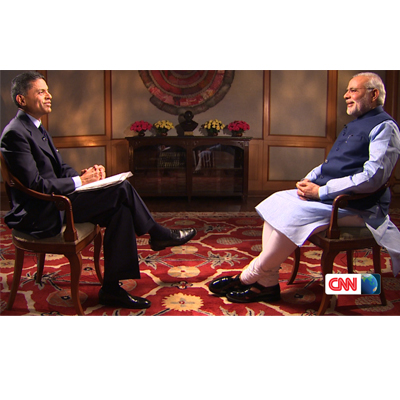
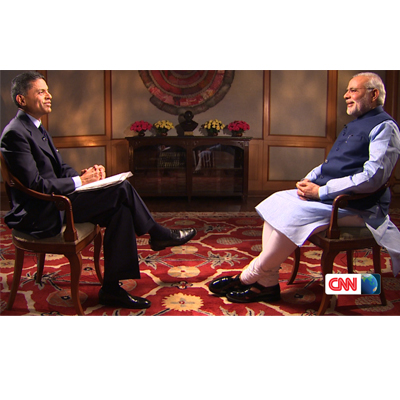
    MUMBAI: Narendra Modi’s much awaited interview with CNN International took place on 21 September 2014. Here is the transcript of the interview with CNN’s Fareed Zakaria.


    Fareed Zakaria, Host, CNN GPS: Prime Minister thank you so much for doing this.


    Narendra Modi, Prime Minister, India:  Thank you.


    Zakaria: After your election people have begun asking again a question that has been asked many times for the last two decades, which is, will India be the next China. Will India be able to grow at 8-9% a year consistently and transform itself and thus transform the world?


    Modi: See, India does not need to become anything else. India must become only India. This is a country that once upon a time was called ‘the golden bird’. We have fallen from where we were before. But now we have the chance to rise again. If you see the details of the last five or ten centuries, you will see that India and China have grown at similar paces. Their contributions to global GDP have risen in parallel, and fallen in parallel. Today’s era once again belongs to Asia. India and China are both growing rapidly, together.


    Zakaria: But people would still I think wonder can India achieve the kind of 8 & 9% growth rates that China has done consistently for 30 years and India has only done for a short period.


    Modi: It is my absolute belief that Indians have unlimited talent. I have no doubt about our capabilities. I have a lot of faith in the entrepreneurial nature of our 1.25 billion people. There is a lot of capability. And I have a clear road-map to channel it.


    Zakaria: China’s behavior in the East China Sea and the South China Sea over the last two years has worried many of its neighbors. The head of the governments in Philippines and Vietnam have made very sharp statements worrying about it. Do you worry about it?


    Modi: India is different. It is a country of 1.25 billion people. We can’t run our country if we get worried about every small thing. At the same time, we can’t close our eyes to problems. We are not living in the eighteenth century. This is an era of partnership. Everyone will have to seek and extend help mutually.  China is also a country with an ancient cultural heritage. Look at how it has focused on economic development. It’s hardly the sign of a country that wants to be isolated.  We should have trust in China’s understanding and have faith that it would accept global laws and will play its role in cooperating and moving forward.


    Zakaria: Do you look at China and feel that it has been able to develop as fast as it has, really the fastest development in human history, because it is an authoritarian government, because the government has the power to build great infrastructure, to create incentives for investment. Do you look at that and think to yourself that that would be — that there is a price to democracy that you have to do things a little bit more slowly.


    Modi: If China is one example, then democratic countries provide another example. They have also grown fast. You can’t say that growth is not possible because of democracy.  Democracy is our commitment. It is our great legacy, a legacy we simply cannot compromise. Democracy is in our DNA.


    Zakaria: So you don’t look at the power of the Chinese government and wish you had some of that authority.


    Modi: See, I have seen the strength of democracy. If there were no democracy then someone like me, Modi, a child born in a poor family, how would he sit here? This is the strength of democracy.


    Zakaria: From the strength of democracy to the strength or weakness of the crucial relationship between the US and India. Mr. Modi goes to the White House next week.  This after he was actually banned from even stepping on U.S. soil for many years. How does he see relations between the two nations?  Also, I ask about India’s recent record of terrible crimes against women. The Prime Minister will tell me what his government intends to do about it.


    ..BREAK..


    Zakaria: And we are back with more of my exclusive interview with India’s Prime Minister, Narendra Modi. Next week, he will make his first trip to the White House, warmly welcomed by the Obama administration. That’s quite a turnaround for a man who was placed on a blacklist by the George W. Bush administration in 2005 and, for many years, denied a visa to enter the United States. The ban stemmed from an incident in 2002, when he was chief minister of India’s state of Gujarat. Modi was criticized for failing to quell riots there, riots that, according to a U.S. government report, killed more than twelve-hundred people, the majority of the dead were Muslim.  Modi is Hindu.  Modi has been exonerated three times by India’s Supreme Court, notes the New York Times.  The Obama administration reversed the ban and has been courting Modi actively. Has Modi any qualms about warmer ties with India? I asked him.


    Zakaria: There are many people in the United States and some in India who wish that the United States and India were much closer allies. The world’s oldest democracy, the world’s biggest democracy, but somehow that has never happened and there have always been these frictions and difficulties. Do you think it is possible for the United States and India to develop a genuinely strategic alliance?


    Modi: I have a one word answer: Yes. And with great confidence I say “yes”. Let me explain. There are many similarities between India and America. If you look at the last few centuries, two things come to light. America has absorbed people from around the world and there is an Indian in every part of the world. This characterizes both the societies. Indians and Americans have coexistence in their natural temperament. Now, yes, for sure, there have been ups and downs in our relationship in the last century. But from the end of the 20th century to the first decade of the 21st century, we have witnessed a big change. Our ties have deepened. India and the United States of America are bound together, by history and by culture. These ties will deepen further.


    Zakaria: So far in your contacts with the Obama administration, you have had several cabinet members come here. Do you feel that there is a genuine desire from Washington to try to upgrade the relationship with India substantially?


    Modi: Relations between India and America should not be seen within the limits of just Delhi and Washington. It’s a much larger sphere. The good thing is that the mood of both Delhi and Washington is in harmony with this understanding. Both sides have played a role in this.


    Zakaria: With regard to Russia’s action in Ukraine. India has not been particularly active.  Do you, how do you view Russia’s annexation of the Crimea.


    Modi: Firstly, whatever happened there, innocent people died in a plane accident. That’s very saddening. These are not good things for humanity in this age. There is a saying in India that the person who should throw a stone first is the person who has not committed any sins. In the world right now, a lot of people want to give advice. But look within them, and they too have sinned in some way. Ultimately, India’s view point is that efforts need to be made to sit together and talk, and to resolve problems in an ongoing process.


    Zakaria: One of the areas that India has come on to the world scene or people have read about and heard about it, which has been unfortunate has been violence against women. This issue of rape. Why is it do you think that there is this problem of, it seems persistent discrimination and violence against women in India and what do you think can be done about it?


    Modi: Look, us political pundits shouldn’t tangle ourselves up in knots by searching for the root cause of this problem. More damage is done by statements from political pundits. Dignity of women is our collective responsibility. There should be no compromise in this matter. There should be no erosion in the law and order situation. We have to revive the family culture in which a woman is respected and considered equal, her dignity encouraged. The main thing here is girl child education. By doing so the possibility of empowerment will increase. On August 15, my government pushed ahead a movement called: educate the girl, save the girl.


    Zakaria: Next on GPS, the head of al Qaeda says he’s opening a franchise in India. What does Prime Minister Modi have to say about that? I’ll ask him.  Also, when you lead 1.25 billion people, the pressures mount.  How does Mr. Modi relax? You’ll find out, when we come back.


    ..BREAK..


    Zakaria: Earlier this month, Osama bin Laden’s successor as head of Al Qaeda – Ayman Al-Zawahiri – announced in an almost-hour long video that the terror organization was going to open a new branch in India. India’s Muslims are a minority – just over 13 percent of the population, versus more than 80 percent of the population that is Hindu. And, thus far, the cause of “jihad” amongst that Muslim minority in India hasn’t taken off at all, certainly not as it has across the border in Pakistan. At a time when terror is atop the headlines, I wanted to get Mr. Modi’s thoughts on al Qaeda’s plans for his country.


    Zakaria: Ayman al-Zawahiri the head of al Qaeda has issued a video and an appeal trying to create an al Qaeda really in India. In South Asia he says but the message was really directed towards India and he says he wants to free Muslims from the oppression they face in Gujarat, in Kashmir. Do you think, do you worry that something like this could succeed?


    Modi: My understanding is that they are doing injustice towards the Muslims of our country. If anyone thinks Indian Muslims will dance to their tune, they are delusional. Indian Muslims will live for India. They will die for India. They will not want anything bad for India.


    Zakaria: Why do you think it is that there is this remarkable phenomenon that you have a 170 million Muslims and there seem to be almost no or very few members of al-Qaeda. Even though al-Qaeda is in Afghanistan and of course there are many in Pakistan. What is it that has made this community not as susceptible?


    Modi: Firstly, I am not the authority for doing a psychological and religious analysis on this.  But the question is, whether or not humanity should be defended in the world? Whether or not believers in humanity should unite? This is a crisis against humanity, not a crisis against one country or one race.  So we have to frame this as a fight between humanity and inhumanity. Nothing else. 


    Zakaria: A year or two from now, what would you like people to say, that these are the things Narendra Modi has managed to accomplish in terms of actions in office.


    Modi: See the biggest thing is that the people of the country have faith. That trust should never break. If I can win the confidence of the people of India, not from my speeches, but by actions, then the power of 1.25 billion Indians will come together to take the country forward.


    Zakaria:  One final question. How do you relax? What do you enjoy doing when you are not working?


    Modi: Look, I’m not the “not-working” type. I derive pleasure from my work. Work gives me relaxation too. Every moment I am thinking of something new: making a new plan, new ways to work. In the same way that a scientist draws pleasure from long hours in the laboratory, I draw pleasure in governance, in doing new things and bringing people together. That pleasure is sufficient for me.


    Zakaria: Do you meditate? Do you do Yoga?


    Modi: I’m fortunate that I was introduced to the world of yoga. That has been very useful to me. I always advise everyone to make this a part of their lives


    Zakaria: You gave a long speech about the benefits of Yoga. Explain what you see them as.


    Modi: See, sometimes we notice our mind works on one thing, the body on another, and time brings us in conflict. Yoga synchronizes the heart, the mind, and the body. That is Yoga.


    Zakaria: And that was Narendra Modi, the new prime minister of India in his first interview in office.
  • Narendra Modi speaks to CNN’s Fareed Zakaria

    Narendra Modi speaks to CNN’s Fareed Zakaria

    MUMBAI: India’s Prime Minister Narendra Modi has been touring Asia over the last few weeks. In a first interview that will introduce him to the world audience, Modi has given an interview to CNN International’s show Fareed Zakaria GPS.


    The interview was taped on Saturday 13 September at the Prime Minister’s official residence at 7 Race Course Road in New Delhi and will go on air on 21 September. It will mark Modi’s first global interview after being elected as the Prime Minister of India.    


    During the interview, Modi will be discussing a wide range of topics such as India’s economic growth, relations with China and the United States, terrorism and much more.


    In India the interview will be first telecast at 4:30 pm on 21 September.  This will be further followed by a repeat on 22 September at 7:30am.


    Before being elected as the PM, Modi had created a lot of hype among the media fraternity with his choice of channels to speak to. This included ETV Gujarati, Times Now, India TV, Aaj Tak, CNBC Awaaz, NewsX, News 24 etc.


    This will be Modi’s first interview after assuming charge. He has kept the media at arm’s length since May 2014.

  • Fareed Zakaria Takes Viewers to India for a Look at a Nation at a Crossroads

    Fareed Zakaria Takes Viewers to India for a Look at a Nation at a Crossroads

    MUMBAI: CNN’s and TIME’s Fareed Zakaria travels to and across India for an extraordinarily insightful look at the world’s largest democracy from the inside – its complexities, challenges, and achievements. The one-hour in-depth special report, India at a Crossroads – A Fareed Zakaria GPS Special will debut Sunday, Dec. 29 on CNN International at 5.30pm IST.

    While much of the world has experienced sluggish economic times in recent years, Zakaria reports India’s average economic growth (GDP) over the last decade has been robust – around seven percent. And, Zakaria points out, in 2014, India will exercise the “largest democratic process in human history” as hundreds of millions of Indians, using 800,000 voting booths and 1.3 million voting machines, will engage in the world’s largest democratic action by voting in the national elections.

    Watch the video: Our new positioning: Burson-Marsteller, Being More
    Yet, in addition to having democracy in common with America, India’s governance is also experiencing a crisis of political dysfunction – and on a grand scale. Widespread corruption threatens some of its economic opportunity, and India’s social caste system and endemic disparities faced by women threaten to incite a home-grown Indian version of an ‘Arab Spring’.

    To give global viewers greater perspective into the opportunities and obstacles faced by the one-sixth of humanity that is India, Zakaria spoke with leaders in business, politics, Bollywood, and more. For insights on India’s multicultural, multi-class, multilingual, multi-religious society, Zakaria spoke with: the Deputy Chairman of India’s Planning Commission Montek Singh Ahluwalia; chairman and managing director of Reliance Industries Limited Mukesh Ambani, the wealthiest man in India; actress and human rights activist Shabana Azmi; former CEO for Procter & Gamble in India Gurcharan Das; politician and anti-corruption activist, Arvind Kerjriwal; actor and talk show host Aamir Khan; tech entrepreneur Nandan Nilekani; Member of Parliament from the Indian state of Odisha, Jay Panda; and chairman emeritus of India’s largest conglomerate, the Tata Group, Ratan Tata.

    More information about why India – and the success of India – is essential for the world may be found at www.cnn.com/gps. During the special broadcast, producers of the special will engage with viewers using the hashtag “#CrossroadsIndia” via Twitter.

  • CNN to launch global weekly show Fareed Zakaria – GPS

    CNN to launch global weekly show Fareed Zakaria – GPS

    MUMBAI: CNN is launching a global weekly show Fareed Zakaria – GPS (stands for Global Public Square). The international news and discussion programme with author and foreign affairs analyst Fareed Zakaria will be aired every Sundays at 5.30 pm and 10.30 pm.

    The show will take an in-depth look at foreign affairs and the policies shaping the world. Each week, it will feature an in-depth interview with a world leader, as well as a panel of international analysts who will examine the major global developments of the week.

    The new Sunday programme is a weekly global get-together focusing on international topics. The programme will boil down complex international issues from key positions around the world. Its centre-piece will be in-depth interviews and roundtable conversation with the world’s great thinkers, which will provide invaluable information to viewers about how their everyday lives are impacted by what is going on in the world.

    “This is a unique opportunity to do a program that brings the world to America and America to the world, and only CNN has the global platform to make this possible,” Zakaria said.