Tag: Facebook

  • Facebook introduces new features for lead ads

    Facebook introduces new features for lead ads

    MUMBAI: After the success of its lead ads that makes signing up for business information easy for people and more valuable for businesses, Facebook has announced new features for lead ads.  In order to save time and effort, advertisers can now duplicate lead ad forms and edit specific fields across ad sets and campaigns.

    The social media giant has also added new companies to the list of CRM partners that integrate with lead ads, including Constant Contact, InfusionSoft, Sparkroom and Salesforce Marketing Cloud. It has also partnered with Zapier and MailChimp to develop a solution that can automatically add Facebook leads to advertisers’ MailChimp lists.

    Acknowledging that video is a powerful way to engage people and convey messages, Facebook now allows video to be used with lead ads before they click through to the form.

    Another new feature that Facebook announced is customizable disclaimers. Advertisers now have additional options in the disclaimer portion of their lead ad form, including a new checkbox to give permission to share their information, a feature that may be helpful in countries where double opt-in may be required.

    To further help out advertisers, especially in small businesses, Facebook has also introduced Ad create tool support.  In addition to Power Editor and the API, lead ads are now available in the ads create tool, giving advertisers more flexibility in ad creation. More information including success stories can be found in the Facebook for Business blog post.

  • TLC celebrated this year with #TakeTheLeap digital campaign

    TLC celebrated this year with #TakeTheLeap digital campaign

    New Delhi: March 8, 2016: TLC, India’s favourite lifestyle destination celebrated the leap day this year by inspiring people to create a memory by indulging in their passion. With a unique digital campaign – #TakeTheLeap, TLC connected with thousands of millennials urging them to tick off items from their bucket list.

    From jumping off a cliff to starting a new fitness regimen to helping people in need, fans expressed the change they wanted to bring about this leap day on TLC’s social media pages. The campaign gave fans a reason to turn their dreams into reality take the leap from thinking to doing.

    The month-long campaign gained immense popularity on Facebook, Twitter and Instagram, and invited fans to make the most of the bonus day by sharing their experiences on social media with the hashtag #TakeTheLeap. Thousands of fans participated in the contest on the TLC India Facebook and Twitter pages and won exclusive merchandise.

  • TLC celebrated this year with #TakeTheLeap digital campaign

    TLC celebrated this year with #TakeTheLeap digital campaign

    New Delhi: March 8, 2016: TLC, India’s favourite lifestyle destination celebrated the leap day this year by inspiring people to create a memory by indulging in their passion. With a unique digital campaign – #TakeTheLeap, TLC connected with thousands of millennials urging them to tick off items from their bucket list.

    From jumping off a cliff to starting a new fitness regimen to helping people in need, fans expressed the change they wanted to bring about this leap day on TLC’s social media pages. The campaign gave fans a reason to turn their dreams into reality take the leap from thinking to doing.

    The month-long campaign gained immense popularity on Facebook, Twitter and Instagram, and invited fans to make the most of the bonus day by sharing their experiences on social media with the hashtag #TakeTheLeap. Thousands of fans participated in the contest on the TLC India Facebook and Twitter pages and won exclusive merchandise.

  • Digi Osmosis unique campaign for ‘Ki & Ka’

    Digi Osmosis unique campaign for ‘Ki & Ka’

    MUMBAI: Digi Osmosis has crafted a unique campaign for R Balki’s latest production Ki &Ka from the T-Series Films stable by creating a special app for the Ki & Ka facebook page. Once the viewer has watched the trailer on Facebook, a question pops up asking the viewer ‘Who are you in your life, Ki or Ka?’. It further asks  viewers if they are the independent, career-oriented, outspoken Ki or the homely, loving and caring Ka. 

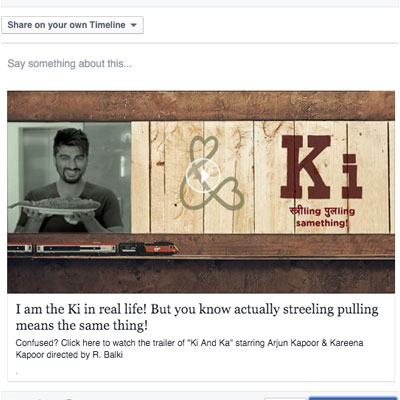
    After the viewer answers and clicks the share button, the trailer is shared on the user’s timeline on Facebook with another caption – ‘I’m Ka in real life but you know, ??????ling (Feminine) and ???ling (Masculine) means the same thing!’

    Commenting on the campaign Digi Osmosis founder Manish Kumar said, “For this trailer, the strategy was simple; there are thousands of people who identify with Ki&Ka on a very personal level. They will find it to be a very interesting activity and in turn share it with their friends. Their friends in turn, find it a quirky and engage with the trailer, repeating the process. This encourages share-ability, a factor crucial for social media and creates a simple viral chain garnering the reactions required. ”

    Ki & Ka director and producer R Balki mentioned that “It has been a terrific learning experience for me working with the Digi Osmosis team. I gave them the trailer of Ki & Ka and they just had a few hours to convert it into an active engagement piece rather than a passive experience. They developed an app embedded in the trailer to make the viewer see herself/ himself as the characters in the story and respond. Simple. Innovative. And really on the ball.”

  • Digi Osmosis unique campaign for ‘Ki & Ka’

    Digi Osmosis unique campaign for ‘Ki & Ka’

    MUMBAI: Digi Osmosis has crafted a unique campaign for R Balki’s latest production Ki &Ka from the T-Series Films stable by creating a special app for the Ki & Ka facebook page. Once the viewer has watched the trailer on Facebook, a question pops up asking the viewer ‘Who are you in your life, Ki or Ka?’. It further asks  viewers if they are the independent, career-oriented, outspoken Ki or the homely, loving and caring Ka. 

    After the viewer answers and clicks the share button, the trailer is shared on the user’s timeline on Facebook with another caption – ‘I’m Ka in real life but you know, ??????ling (Feminine) and ???ling (Masculine) means the same thing!’

    Commenting on the campaign Digi Osmosis founder Manish Kumar said, “For this trailer, the strategy was simple; there are thousands of people who identify with Ki&Ka on a very personal level. They will find it to be a very interesting activity and in turn share it with their friends. Their friends in turn, find it a quirky and engage with the trailer, repeating the process. This encourages share-ability, a factor crucial for social media and creates a simple viral chain garnering the reactions required. ”

    Ki & Ka director and producer R Balki mentioned that “It has been a terrific learning experience for me working with the Digi Osmosis team. I gave them the trailer of Ki & Ka and they just had a few hours to convert it into an active engagement piece rather than a passive experience. They developed an app embedded in the trailer to make the viewer see herself/ himself as the characters in the story and respond. Simple. Innovative. And really on the ball.”

  • A majority of Facebook’s 3 million advertisers are SMBs’

    A majority of Facebook’s 3 million advertisers are SMBs’

    MUMBAI: Facebook announced that a vast majority of its three million active advertisers are small and midsize businesses (SMBs’). The number of advertisers is up by fifty per cent in one year. Small businesses are mobile and a million advertisers create an ad directly on mobile for Facebook. The social media giant says that the three top advertising brand categories are services, local commerce and eCommerce.

    As per data shared by Facebook 70 per cent of the three million companies are from outside the US, with the fastest growing region being south east Asia. 57 per cent of people on Facebook in India are connected to small businesses.

    What’s more, as of October 2015, nearly 2 million small businesses in India actively use Facebook Pages because they’re free, easy to use, and they immediately give businesses a digital and mobile strategy.  It is interesting to note that of 142 million monthly active users are in India alone, 133 million are active on mobile, facilitating over 1.99 billion interactions generated between businesses and people in India

    Keeping the India market in mind, Facebook had also up the SME India Council for the first time in Asia Pacific, while an India Client Council with global advertisers was established in 2014.  The SME India Council will meet few times over the coming months to discuss progress on solutions, business ideas, discuss new successes and challenges and meet the Facebook teams.

    Currently more than 50 million small businesses use Facebook’s free Pages product to grow. Going by their analytics, more than one billion people on Facebook are connected to at least one business. 

    To celebrate these businesses, the social media giant has also announced the development of Your Business Story, a new movie tool that makes it easy for business owners to showcase what their company brings to the world. As part of the tool, businesses are able to upload their photos from their Page, overlay with music and share “what they are in the business of” doing.

  • A majority of Facebook’s 3 million advertisers are SMBs’

    A majority of Facebook’s 3 million advertisers are SMBs’

    MUMBAI: Facebook announced that a vast majority of its three million active advertisers are small and midsize businesses (SMBs’). The number of advertisers is up by fifty per cent in one year. Small businesses are mobile and a million advertisers create an ad directly on mobile for Facebook. The social media giant says that the three top advertising brand categories are services, local commerce and eCommerce.

    As per data shared by Facebook 70 per cent of the three million companies are from outside the US, with the fastest growing region being south east Asia. 57 per cent of people on Facebook in India are connected to small businesses.

    What’s more, as of October 2015, nearly 2 million small businesses in India actively use Facebook Pages because they’re free, easy to use, and they immediately give businesses a digital and mobile strategy.  It is interesting to note that of 142 million monthly active users are in India alone, 133 million are active on mobile, facilitating over 1.99 billion interactions generated between businesses and people in India

    Keeping the India market in mind, Facebook had also up the SME India Council for the first time in Asia Pacific, while an India Client Council with global advertisers was established in 2014.  The SME India Council will meet few times over the coming months to discuss progress on solutions, business ideas, discuss new successes and challenges and meet the Facebook teams.

    Currently more than 50 million small businesses use Facebook’s free Pages product to grow. Going by their analytics, more than one billion people on Facebook are connected to at least one business. 

    To celebrate these businesses, the social media giant has also announced the development of Your Business Story, a new movie tool that makes it easy for business owners to showcase what their company brings to the world. As part of the tool, businesses are able to upload their photos from their Page, overlay with music and share “what they are in the business of” doing.

  • How advertisers have ‘reacted’ to Facebook Reactions

    How advertisers have ‘reacted’ to Facebook Reactions

    MUMBAI: So, the social media giant Facebook has rolled out a whole new range of emoticons for users to ‘react’ with. This has come after the long standing legacy of the ‘like’ button. The new reactions, namely ‘Haha’, ‘Wow’, ‘Love’, ‘Sad, and ‘Angry’, were highly anticipated by the advertising fraternity until  Facebook  revealed that it won’t be letting advertisers use these new reactions as a way to create targeted ads. For now, reactions would only be counted as additional ‘likes’, meaning that an “angry” reaction would be treated the same as a “wow”.

    Though initially put off by Facebook’s decision to keep the new reactions out of their reach, advertisers and digital marketers have found ways around this. What makes these new reactions such a lucrative tool for digital marketers is its immense power to look into consumer insights.

    “There is a lot of learning from it on a broader scale, but since Facebook as of now isn’t revealing the exact numbers of ‘angry’ or ‘wow’, advertisers are having a hard time in making the most of it. But, you can actually can see who has liked it or ‘loved’ it if you hover over the new emoticons. Once you physically count that list, you can put a number of it. Though tedious, but not impossible,” points out Isobar India MD Shamsuddin Jasani Aka Shams.

    Now why would a marketer go through the trouble of physically counting these reactions? What’s in it for her or him?

    “It’s a great tool to understand, learn your consumers for a brand. You can see what tonality and emotions consumers have for content. We can figure out what kind of posts, communication and content that are working with a brand’s TG. Beyond that, the use is still limited and it will take some time before people start using it extensively,” Shams shares, adding that the new offering is all about analytics.

    PnB Metlife digital marketing, ecommerce and digitization head Abhishek Rathi too feels that the new reactions can prove to be a powerful tool for marketers like him. Especially for re-targeting of campaigns. The net adoption of these features is what marketers are closely paying attention to, Rathi says. “Right now we have to wait and watch if people are actually using it or not to make a significant difference. Currently the majority of what we can work with on Facebook are likes and shares. Comments can give you some consumer insight but isn’t a huge help. Similarly we need to wait and see exactly how we can use these features in marketing.”

    “The first thing that I predict is the number of engagements on the posts going up,” Shams observes, “ It’s not always that you like something, you might really like it, love it, or dislike it. Having more to the spectrum to react with also makes people interact with the site more. Earlier people were restricted by only the dislike button, but now the new emoticons are making engagements go up.”

    Given its potential use for brands, media planners especially on the digital front, are contemplating on how to incorporate these reactions under their bouquet of services. Shams feels that reactions have a huge scope when it comes to accentuating data and analytics further.

    “Of course the planners, who need to buy the right kind of inventory for their client will have to take the new reactions into consideration. It is still difficult to correlate who liked it or loved it and accordingly bought it, as the analytics are not in place right now,” shared another well-known media planner who wished to remain anonymous.

    But it is the creatives or the content creators who can make the most of this new feature. Content creators will be able to gauge what reactions their work is getting and where they need to tweak to get the desired result.

    “When we are talking about corporate social responsibility or a social cause, it helps to know how our viewers and consumers are reacting to the campaigns; the emotions behind their likes. It’s the next level of engagement,” says Rathi.

    Brands which are most likely to jump on this bandwagon and try out the new Facebook reactions for their campaigns are the youth oriented brands, brands with brand language that lets them experiment and try new things. Citing an example from his own client base, Shams says, “Myntra’s brand Anouk, which we handle, has a communication that many like while others may also dislike. It is very clear in what it wants to say to its audience. These reactions can be a help to the brand. Brands which are steadier in their brand communication will wait and watch first.”

    Ecommerce and digital start-up companies will be the next to take the new feature seriously for their marketing. “Then you have the likes of Coke and Pepsi who will soon follow,” Rathi adds. The sport leagues can also be big takers for this new feature, Rathi feels. “The IPLs, ISLs, kabaddi leagues and tennis leagues of the world can make a huge advantage from these as it is an association of pride and entertainment. Anything which involves a whole community will try to make the most of this tool,” he adds.

    Another advertiser who wants to stay ahead of the curve is United Beverages Limited. UBL has started to look at how these new reactions can affect its marketing strategy. Not only that, UBL, Marketing SVP Samar Singh Sheikhawat shares that UBL is also keeping the ‘angry’ reaction in mind.

    “Brands need to be more responsible and responsive now. We need to be more on the ball, because unlike earlier, the ‘angry’ button can become the new ‘dislike’. Not that it has never happened before. In the real world, there are consumers who like one product, others love the same and there are few who can even hate it. Earlier that emotion seldom got reflected to the brands, but now the game is changing,” he says.

    With so much excitement among brands in making use of Facebook reactions in marketing, one has to wonder if it’s ethical to use such data at all. “That’s true. We need to be careful how the information is used and it needs to be monitored well. As a marketer I am thrilled about the opportunities this gives us but personally I am not comfortable with my personal data, likes and dislikes being shared with companies who can make use of such data. But if it is an aggregate that you are sharing, it will not be so much of an issue. Suppose 50 per cent of ‘love’ or 20 percent of ‘angry, etc. From a privacy standpoint I don’t think it’s in the interest of customers to share individual data points.”

    Sheikhawat on the other hand has a slightly different perspective. “I don’t see how it can become unethical. The fact of the matter is when you sign up for Facebook. you share your personal data.  When you get a new app or service, you let it access your Facebook data, including your preference. When you make any of your reactions public, you are sharing it with the rest of the world. It is already happening and consumers are aware of it.

    On a positive note, many marketers also observe that NGOs and campaigns for social causes can get a huge help from the added feature. Several marketers are of the view that if the data is readily available to marketers, consumers who are aware will not adopt the feature as much and therefore its effectiveness even from an aggregate standpoint will go down.

  • How advertisers have ‘reacted’ to Facebook Reactions

    How advertisers have ‘reacted’ to Facebook Reactions

    MUMBAI: So, the social media giant Facebook has rolled out a whole new range of emoticons for users to ‘react’ with. This has come after the long standing legacy of the ‘like’ button. The new reactions, namely ‘Haha’, ‘Wow’, ‘Love’, ‘Sad, and ‘Angry’, were highly anticipated by the advertising fraternity until  Facebook  revealed that it won’t be letting advertisers use these new reactions as a way to create targeted ads. For now, reactions would only be counted as additional ‘likes’, meaning that an “angry” reaction would be treated the same as a “wow”.

    Though initially put off by Facebook’s decision to keep the new reactions out of their reach, advertisers and digital marketers have found ways around this. What makes these new reactions such a lucrative tool for digital marketers is its immense power to look into consumer insights.

    “There is a lot of learning from it on a broader scale, but since Facebook as of now isn’t revealing the exact numbers of ‘angry’ or ‘wow’, advertisers are having a hard time in making the most of it. But, you can actually can see who has liked it or ‘loved’ it if you hover over the new emoticons. Once you physically count that list, you can put a number of it. Though tedious, but not impossible,” points out Isobar India MD Shamsuddin Jasani Aka Shams.

    Now why would a marketer go through the trouble of physically counting these reactions? What’s in it for her or him?

    “It’s a great tool to understand, learn your consumers for a brand. You can see what tonality and emotions consumers have for content. We can figure out what kind of posts, communication and content that are working with a brand’s TG. Beyond that, the use is still limited and it will take some time before people start using it extensively,” Shams shares, adding that the new offering is all about analytics.

    PnB Metlife digital marketing, ecommerce and digitization head Abhishek Rathi too feels that the new reactions can prove to be a powerful tool for marketers like him. Especially for re-targeting of campaigns. The net adoption of these features is what marketers are closely paying attention to, Rathi says. “Right now we have to wait and watch if people are actually using it or not to make a significant difference. Currently the majority of what we can work with on Facebook are likes and shares. Comments can give you some consumer insight but isn’t a huge help. Similarly we need to wait and see exactly how we can use these features in marketing.”

    “The first thing that I predict is the number of engagements on the posts going up,” Shams observes, “ It’s not always that you like something, you might really like it, love it, or dislike it. Having more to the spectrum to react with also makes people interact with the site more. Earlier people were restricted by only the dislike button, but now the new emoticons are making engagements go up.”

    Given its potential use for brands, media planners especially on the digital front, are contemplating on how to incorporate these reactions under their bouquet of services. Shams feels that reactions have a huge scope when it comes to accentuating data and analytics further.

    “Of course the planners, who need to buy the right kind of inventory for their client will have to take the new reactions into consideration. It is still difficult to correlate who liked it or loved it and accordingly bought it, as the analytics are not in place right now,” shared another well-known media planner who wished to remain anonymous.

    But it is the creatives or the content creators who can make the most of this new feature. Content creators will be able to gauge what reactions their work is getting and where they need to tweak to get the desired result.

    “When we are talking about corporate social responsibility or a social cause, it helps to know how our viewers and consumers are reacting to the campaigns; the emotions behind their likes. It’s the next level of engagement,” says Rathi.

    Brands which are most likely to jump on this bandwagon and try out the new Facebook reactions for their campaigns are the youth oriented brands, brands with brand language that lets them experiment and try new things. Citing an example from his own client base, Shams says, “Myntra’s brand Anouk, which we handle, has a communication that many like while others may also dislike. It is very clear in what it wants to say to its audience. These reactions can be a help to the brand. Brands which are steadier in their brand communication will wait and watch first.”

    Ecommerce and digital start-up companies will be the next to take the new feature seriously for their marketing. “Then you have the likes of Coke and Pepsi who will soon follow,” Rathi adds. The sport leagues can also be big takers for this new feature, Rathi feels. “The IPLs, ISLs, kabaddi leagues and tennis leagues of the world can make a huge advantage from these as it is an association of pride and entertainment. Anything which involves a whole community will try to make the most of this tool,” he adds.

    Another advertiser who wants to stay ahead of the curve is United Beverages Limited. UBL has started to look at how these new reactions can affect its marketing strategy. Not only that, UBL, Marketing SVP Samar Singh Sheikhawat shares that UBL is also keeping the ‘angry’ reaction in mind.

    “Brands need to be more responsible and responsive now. We need to be more on the ball, because unlike earlier, the ‘angry’ button can become the new ‘dislike’. Not that it has never happened before. In the real world, there are consumers who like one product, others love the same and there are few who can even hate it. Earlier that emotion seldom got reflected to the brands, but now the game is changing,” he says.

    With so much excitement among brands in making use of Facebook reactions in marketing, one has to wonder if it’s ethical to use such data at all. “That’s true. We need to be careful how the information is used and it needs to be monitored well. As a marketer I am thrilled about the opportunities this gives us but personally I am not comfortable with my personal data, likes and dislikes being shared with companies who can make use of such data. But if it is an aggregate that you are sharing, it will not be so much of an issue. Suppose 50 per cent of ‘love’ or 20 percent of ‘angry, etc. From a privacy standpoint I don’t think it’s in the interest of customers to share individual data points.”

    Sheikhawat on the other hand has a slightly different perspective. “I don’t see how it can become unethical. The fact of the matter is when you sign up for Facebook. you share your personal data.  When you get a new app or service, you let it access your Facebook data, including your preference. When you make any of your reactions public, you are sharing it with the rest of the world. It is already happening and consumers are aware of it.

    On a positive note, many marketers also observe that NGOs and campaigns for social causes can get a huge help from the added feature. Several marketers are of the view that if the data is readily available to marketers, consumers who are aware will not adopt the feature as much and therefore its effectiveness even from an aggregate standpoint will go down.
  • Facebook introduces immersive product for advertisers

    Facebook introduces immersive product for advertisers

    MUMBAI: Facebook has launched a new product called Canvas for advertisers, which allows them to combine video, photographs and copy in an ad.

    Canvas was originally announced in September last year. These immersive advertisements aim to draw more attention of the user into their ads, by blocking out all other content. When users click a Facebook News Feed ad connected to Canvas, it opens a full-screen, rich media page inside of Facebook rather than forcing users to wait for a mobile website to load.

    In a blog post, Facebook said, “We’re committed to building great mobile experiences for people and doing so also opens up new creative possibilities for advertisers. We’ve invested in engaging experiences like video and the carousel format to empower advertisers with more creative space to share their brand and products on mobile.”

    Said to load 10 times faster than other ads would otherwise, Facebook also stated that in their research 53 per cent of people viewed more than half of the ad and average view time was 31 seconds. Currently, these ads are available for Android and iOS, while the social media giant evaluates how to expand this option to other versions and apps such as Instagram.

    “This space was designed and invented and inspired by our relationship with the creative community,” Facebook CCO Mark D’Arcy said at a press event.

    Canvas is an evolution of the earlier Carousel ads, which allowed users to swipe through multiple product or brand photos if they were interested in more information.