Tag: Facebook

  • Facebook’s move to limit use of third party data brokers angers advertisers

    Facebook’s move to limit use of third party data brokers angers advertisers

    MUMBAI: As a direct reaction to Camebridge Analytical scandal, social media platform Facebook has decided to block third-party data providers from its advertising platform. 

    To regain people’s faith, Facebook is conducting a broad review of all its data practices. Many of the advertising agencies, however, have not welcomed the step very well.

    On Wednesday, Facebook announced that it would be shutting down Partner Categories. This product enables third party data providers to offer their targeting directly on Facebook. “While this is common industry practice, we believe this step, winding down over the next six months, will help improve people’s privacy on Facebook,” it said.

    The move restrains third party data brokers to obtain data which they later sell to other broker or marketers to target consumers in social media sites. The third-party data integration made it easy to spend ad dollars on Facebook but now the marketing will become less convenient for advertisers.

    According to reports, many industry insiders believe that the move is just a kind of eyewash. It will only increase Facebook’s control over data and advertisers’ dependency on it. Hence, Facebook will gain more control over its relationships with advertisers. 

    Many industry people think it will do nothing much to protect user data.

    “It feels like a knee-jerk reaction and Hail Mary to stop the bleeding of #deletefacebook – although TBD on if that’s actually making an impact – but more importantly to show Wall Street that they can protect consumer data,”, group media director for advertising agency Noble People Matt Borchard said as quoted by CNBC.

    Also Read:

    Mark Zuckerberg says ‘sorry’ for Facebook’s privacy crisis

    Facebook data fiasco gets murkier 

  • Guest column: How to leverage social media for advertising

    Guest column: How to leverage social media for advertising

    At a time when social media’s exact worth for most businesses continues to be hard to pin down, trying to comment on trends that will ‘make or break your business’ can sound like puffery.

    And yet, the last couple of years have shown that dominance of social media can shape the destiny of the world’s largest democracies, swing elections (even when not aided by Russian interference) and change the world quite literally.

    If it works for them, it just might work for you. It is therefore vital that you have the most updated maps of these ever-shifting but powerful forces. Here are the key drivers for the next few months:

    VIDEO (+ LIVE VIDEO)

    While there is a lot of action and froth in video (and mobile data), and consumers are reeling from the unprecedented oversupply of high-end content, the trend is undeniable. Brands have absolutely no reason to stay on the sidelines. This is the year to go all in with your DVCs, webisodes, video podcasts, guides, unboxings, ‘virals’ – just do it. And do it now, because live video is another growing in-demand feature on Instagram. It is still a bit more complex to work with, so use sparingly.

    NEW PLATFORMS: WHATSAPP AND MORE

    WhatsApp has become substantially more business-friendly, and even more change is around the corner. Ignore this behemoth at your own risk. It is time to look at all the presentations and plans you made for chatbots, Twitter, social CRM etc. because WhatsApp can be all those things and more.

    Meanwhile, Twitter continues to attempt doing push-ups while still in the ICU. It is getting harder to justify this in a marketing plan (apart from scoring brownie points with a trend). Snapchat is still an edge-case for the cool kids, who now seem just as comfortable with Instagram. The one dark horse to put money on this year may be Reddit. The strong community moderation makes it a much easier place to hang out, the interface is getting better, and the Indian early-adopters have already seen some success stories emerge.

    VOICE

    Indians traditionally do not like to speak to appliances – no voice mail, no answering machines, and definitely not those dreaded customer service voice portals. But Alexa and her counterparts are rapidly bringing us out of our shells. Formal opportunities for marketing are still emerging, but globally, brands have already started to guerrilla their way in. At the same time, listening to voice aka audio podcasts has grown from being a geek-and maven stronghold to a content form with legit commercial-grade numbers and mainstream hits. Not to be conflated with radio/digital radio, podcasts are a low-cost, high-engagement form of content. While the landscape is still relatively less crowded, it may be a good time to give a call to experts like IVM to evaluate opportunities.

    NEW CONTENT FORMATS: STORIES

    Even as we got used to the relaxed 280-character tweets that made things easier for content writers, we ran head-on into the ‘status update’ or ‘story’ (depending on which platform you were on). Disposable, time-limited updates that built for rapid consumption, restricted engagement and minimal intellectual overhead. This new weird creature, evolved from Snapchat, is here to stay on Instagram, on Facebook, and even WhatsApp. They are even selling ad inventory around it, for crying out loud. The challenge will be to rapidly create content for these, because it doesn’t fit into well-established content processes between clients and agencies. These stories need to be fresh, near real-time to be effective. Fortunately, you needn’t update this like clockwork, ‘sporadic’ and ‘irregular’ work just fine as posting intervals.

    SECURITY

    While you may not have to worry about Russian operatives infiltrating your company just yet, you can’t afford to ignore the other risks that have exponentially increased: comment spam is just an irritant now, but things rapidly get more sinister with malicious code injections into your blogs, social media impersonation, and debilitating ransomware blockades. The challenge is that these issues are black-swan events for most businesses, so there are no processes to address them quickly and effectively, especially when they can often fall into the canyon between client responsibility and agency scope.

    MOVEMENT

    Consumers are loving brands that take proactive stands and taking responsibility for improving the world. Burger King talking about net neutrality can’t have really sold many burgers, but it drew global respect for their gentle activism. Brands don’t have to grandstand, even small gestures like a no-creepiness ad targeting policy can build respect. The important thing is to do, not talk.

    BEST PRACTICES AND PROCESSES

    For a domain that goes through a sea-change every three months, benchmarking can be a moving goalpost. Recent structural changes like Facebook reducing organic reach for branded content may, ironically, help create a more stable world. As ‘hygiene’ posts lose their raison d’être, clients and businesses should consider how to best utilise their agency best. Here is a test structure for the coming future:

    • The agency becomes a content marketing brand custodian, handling ‘spikes’ and campaigns with analytics and listening, design/UX, plus media buying.

    • Taking a page from classic B2B practices, hygiene content becomes an in-house deliverable – hire smart creators who haven’t yet hit fame levels (example, talent from the ATKT college creator community, or the talent house network). With such talent, casual content like Instagram stories become easier, with faster turnarounds and more depth.

    • The corporate communication team can be the right strategic base for these.

    • Develop branded entertainment with publishers that have deep community roots (or sponsor it) and let it deploy from the creator/publisher pages rather than from your restricted reach brand pages.

    public://Saurabh-Kanwar_Co-founder-of-ATKT.jpg

    The author is the co-founder of ATKT.in. The views expressed here are his own and Indiantelevision.com may not subscribe to them.

    Also Read :

    Guest Column: Invest NOW in Indian TV industry

    Guest column: Remarketing and its significance for brands
  • Facebook data fiasco gets murkier

    Facebook data fiasco gets murkier

    MUMBAI: Data has been touted as costlier than oil in the new digital era. While it may not be the case, the Cambridge Analytica (CA) data scandal has at least indicated that it is partially true. Raising questions on users’ data security on social media platforms, the controversy has dented Facebook’s credibility enormously. Now, the hullabaloo is not only limited to the US, from where it started but is also becoming a subject of debate in other parts of the world.

    Over the last few days, British data analysis firm CA has been at the centre of attention worldwide because of its alleged leak of more than 50 million Facebook users. The firm illegally obtained data to target US voters during the 2016 presidential election, which witnessed Donald Trump’s landslide victory.

    Russian-American psychology professor at Cambridge University Aleksandr Kogan built an app in June to harvest data for the scandal-hit British firm. Under the guise of academics, Kogan accessed data of users who used the ‘This is Your Digital Life’ app to participate in a survey. Facebook grossly denied terming it a “data breach” because it routinely allows researchers to have access to user data. It does not, however, allow sale or transfer of such information.

    In the wake of the entire controversy, Facebook CEO Mark Zuckerberg has apologised in full-page ads in seven British newspapers and three American dailies on Sunday. “This was a breach of trust and I’m sorry we didn’t do more at the time,” wrote Zuckerberg. “I promise to do better for you.” He has also pledged that the company would restrict third-party apps from acquiring such data.

    This time, though, a mere apology won’t help Facebook to mend its reputation. From Russian interference in the US presidential elections to Brexit, Facebook has been constantly been in the spotlight in failing to protect users from fake news. This CA controversy has wiped out nearly $75 billion of the company’s market capitalisation in one week.

    This single incident acts as an eye-opener for a far more deep-rooted problem at hand. The entire tech industry views user data as a commodity, which can be mined any time without permission. While users give permissions to several apps, allowing the access of personal data, including location or credit scores or anything linked to the device, organisations trade with data by circumventing regulation.

    Companies other than Facebook have also been hit by data breaches, weakening public confidence in them. Facebook’s connection to people’s social and personal lives has brought to light the magnanimity of the issue. It is time to bring such platforms under a regulation to plug the problem of data misuse.

    While both sides of the Atlantic were shaken up, India has also started taking the problem seriously. The country with Facebook’s largest user base of over 241 million is obviously concerned thanks to the whole fiasco. Minister for law and IT Ravi Shankar Prasad on 21 March sent out a warning to Zuckerberg that any kind of “data theft” would not be tolerated and he could even be “summoned”.

    Later, the Ministry of Electronics and Information Technology sought a response from CA on whether it was involved in the misuse of data to profile Indians and influence their voting behaviour.

    The ministry wants to know by 31 March 2018 the methodology used by the firm for possession of data as well as whether it took consent from the users or not. It has also asked for information on entities that have engaged the firm for the data breach.

    Though it is not sure till now whether the Indian election suffered any problem from the entire scam which started in 2015, Ovleno Business Intelligence (OBI), an Indian affiliate of CA’s parent firm Strategic Communications Laboratories (SCL), listed both the BJP and the Congress as its clients. Even the company website says “CA was contracted to undertake an in-depth electorate analysis for the Bihar Assembly Election in 2010.”

    The Congress and the BJP both accused each other of alleged connections with OBI. A report in The Print states that CA CEO Alexandar Nix came down to India and worked with several others from its parent firm SCL to create an electoral database in India and to hunt clients.

    Before the 2019 legislative election, the entire revelation may help regulators to protect constitutional sanity and look into the loopholes. Facebook is now widely used by political parties and politicians. Fake news or any data breach could be dangerous for a large democracy like India. In an interview with CNN,  Zuckerberg himself mentioned the “big election in India”. The data disaster demands regulators to take a call, consumers to be more aware of being used and the whole tech industry to reinvent security to gain the faith of users.

    Also Read:

    Mark Zuckerberg says ‘sorry’ for Facebook’s privacy crisis

    Facebook to ban cryptocurrency ads

  • Mark Zuckerberg says ‘sorry’ for Facebook’s privacy crisis

    Mark Zuckerberg says ‘sorry’ for Facebook’s privacy crisis

    MUMBAI: Mark Zuckerberg has finally broken his silence five days after the Cambridge Analytica data scandal engulfed Facebook over the weekend.
    The Facebook CEO pledged on Wednesday to take a series of steps to protect data and fix what he called a “breach of trust” between the social network and its users.
    “We have a responsibility to protect your data, and if we can’t then we don’t deserve to serve you,” Zuckerberg wrote in a Facebook post. “I’ve been working to understand exactly what happened and how to make sure this doesn’t happen again.”

    In an interview to CNN yesterday, Zuckerberg told Laurie Segall that “I’m really sorry that this happened.” 

    News broke this weekend that Cambridge Analytica, a data firm with ties to President Donald Trump’s campaign, reportedly accessed information from about 50 million Facebook users without their knowledge.
    Facebook says the data was initially collected by a professor for academic purposes in line with its rules. The information was later transferred to third parties, including Cambridge Analytica, in violation of Facebook’s policies.
    “I wish we’d taken those steps earlier,” Zuckerberg told Segall. “That is probably the biggest mistake that we made here.”

    In 2014, Facebook changed its platform to limit the amount of data that third-party developers could access.
    Aleksandr Kogan, the data scientist who passed along data to SCL Group and its affiliate Cambridge Analytica, built a Facebook app that drew data from users and their friends in 2013. He was allowed access to a broad range of data at the time.

    Though Kogan’s data was properly obtained, he breached Facebook’s policy when he shared that information with a third party, Facebook has said. When Facebook learned about the information being shared, it asked Cambridge Analytica to destroy the data. Cambridge said it had.

    Zuckerberg said Facebook plans to alert everyone whose data was accessed by Cambridge Analytica. But he added that he wished the company hadn’t waited so long to tell people what happened.

    Also Read :

    Facebook to ban cryptocurrency ads

    RoW, APAC revenue grows fastest for Facebook in 2017

  • Unilever threatens to pull the plug on digital advertising

    Unilever threatens to pull the plug on digital advertising

    MUMBAI: International major FMCG player Unilever has threatened Facebook and Google that it will withdraw its advertising on the social media platforms if they fail to remove content that creates division in society and promotes hate.

    The biggest multinational player said in a conference held at California that, “As one of the largest advertisers in the world, we cannot have an environment where our consumers don’t trust what they see online.”

    Unilever’s stern step comes while technology and social media companies are facing major criticism for failing to protect children and to erase fake news, hate speech and extremism.

    Unilever chief marketing officer Keith Weed said at the conference that the brand cannot continue to prop up a digital supply chain that delivers over a quarter of their advertising to consumers – which at times is little better than a swamp in terms of its transparency.

    While mentioning that such messages are toxic for the society and only take us backward, Weed added, “Fake news, sexism, toxic content aimed at children, terrorists spreading hate messages are all a part of internet now and we have ended up with a million miles from where we thought it would take us.”

    He goes on to add, “It is in the digital media industry’s interest to listen and act on this. Before viewers stop viewing, advertisers stop advertising and publishers stop publishing.”

    A third of the company’s advertising spend is on the digital medium today and Unilever has decided to cut down on the 3000 ad agencies it uses globally and further cutting costs by making 30 per cent fewer ads. Unilever has promised to boost more ‘responsible content’ that will tackle concerns like gender stereotypes. It will only work with digital networks that agree to use industry standards of ad metrics and improve consumer experience. Discussions with Facebook, Google, Twitter, Amazon and SnapChat are already on.

    Facebook and Google are said to account for nearly three-quarters of the total digital advertising in the US. Last year Procter & Gamble (P&G) issued a similar warning before cutting $100 million of its digital ad spend without any negative impact on sales.

    On the other hand, in the UK, Facebook and Google have more than 60 per cent of digital advertising and 90 per cent of all new digital spending.

    A move like this could adversely impact the digital industry and major advertising agency’s revenue.


  • Aajtak.in is the Bahubali of Hindi Digital Media

    Aajtak.in is the Bahubali of Hindi Digital Media

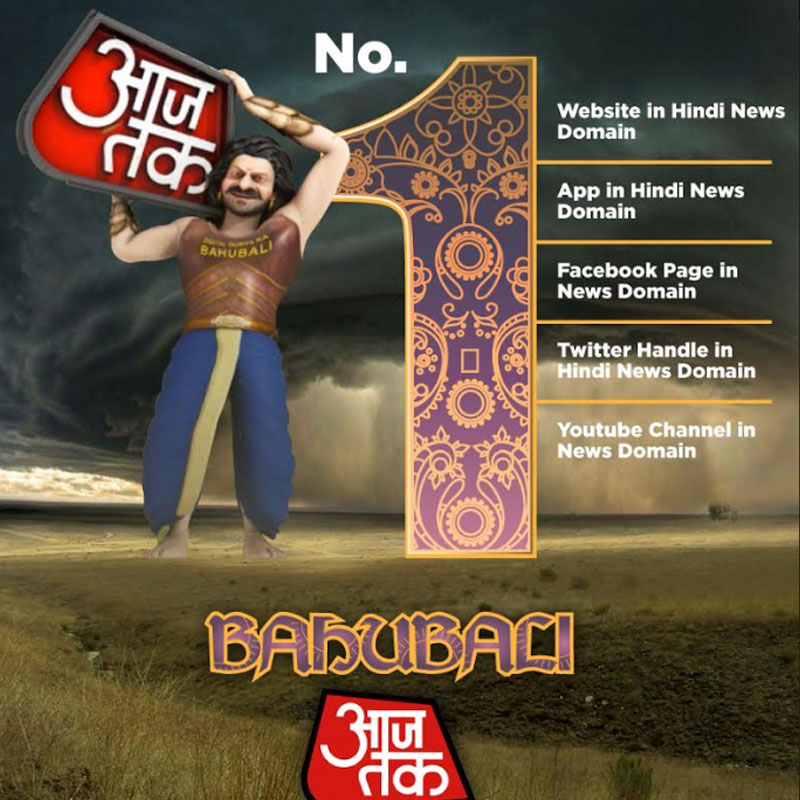
    Aaj Tak, leading Hindi news channel’s web avatar Aajtak.in has broken all records and set an industry benchmark on election coverage in December 2017.Aajtak.in has now become country’s number No.1 Hindi News Brand with its No. 1 position on Website, Mobile App, Facebook, Twitter and YouTube channel.

    According to latest comScore data released, Aajtak.in hit 3.6 million unique visitors mark (comScore, MMX, December 2017, News & Information, Hindi News Website) and managed to race far ahead of Bhaskar.com (1.8 M UVs), Navbharattimes.com(1.6 M UVs), Jagran.com (1.3 M UVs) and  Amarujala.com(1.1 M UVs) . Also, Aajtak Mobile App is continuously No. 1 Hindi News Mobile App since February 2017 (comScore, Mobile Matrix, News & Information, Mobile App).

    With the brand Aajtak.in leadership position across digital platforms, Aajtak.in will be showcasing its might, by releasing a Bahubali theme based  campaign. Aajtak.in also added laurels by becoming No. 1 Indian Media News Page on facebook with 20.10 Million likes, No. 1 Hindi News YouTube channel with a subscriber base of 4.69 Million & No. 1 Hindi News Twitter Handle with 7.09 Million followers.

    Aajtak.in has become the preferred choice for news updates with unmatched user experience and exclusive breaking news pouring in by the minute. The final word in reportage   – be it political, national, international or sports- the mega news brand of the Hindi heartland has rightfully achieved the No.1 place in the online world too.

  • Law & Kenneth Saatchi & Saatchi, FB India collaborate on Sabse Saste 5 Din

    Law & Kenneth Saatchi & Saatchi, FB India collaborate on Sabse Saste 5 Din

    MUMBAI: Law & Kenneth Saatchi & Saatchi partnered with Facebook and Big Bazaar for the World First 24 Hour Facebook Live Shopping Entertainment Show. The campaign broke through shopping festival clutter and bridged the gap between a digital first millennial consumer and the offline retail giant.

    This was the first time in the world that a retail giant reached out to its customers individually on their phones – not just with exciting exclusive deals but with live entertaining content crafted around those deals.

    Big Bazaar revolutionised the way Indians shopped back in 2006 when it started one of the country’s biggest shopping festivals—the Sabse Saste Din Sale. For the last 12 years, every year Sabse Saste Din takes over the country around 26th January.

    Campaign link:

    https://www.facebook.com/events/1787556964652314/

    Future Group group head – digital Pawan Sarda said, “24 Hours Facebook live for “Sabse Sasta 5 Din” is one of the most exciting marketing ideas we have built in recent times. Thanks to Facebook and Law & Kenneth Saatchi & Saatchi to come together with us to make this happen. It was a challenging project as we had to create content for 24 hours. We created an entertaining programme with leading Bollywood and television influencers for our viewers and with M-coupons we were able to drive them to the stores. The most exciting part though, is that 10 million people viewed it real time. I am not sure if anyone has done anything like this before, but I can imagine this to be the biggest online to offline initiative.”

    Added Law & Kenneth Saatchi & Saatchi managing partner Anil K Nair, “Our biggest challenge was how to make the country’s biggest shopping festival interesting for millennials, especially considering habitual discounting has become such a hygiene across both offline and online retailers. We were very clear that we didn’t want to use social media for the sake of it. This 24-hour live entertainment event turned a monotonous transactional exchange into an authentic engaging experience for our customers and fans. We couldn’t have done this without the Big Bazaar team and Pawan Sarda supporting this maverick idea all the way. It is a matter of great pride that an Indian brick and mortar retail brand is showing the way to the rest of the world by creating such a world class contextual branded content and digital event.”

    Millennials are now surrounded by shopping festivals from every offline and online retailer, turning exciting deals and discounts into an annual monotonous ritual. Big Bazaar wanted to break out of this clutter and create a more authentic connect with millennials who spend hours on social media everyday looking for ways to keep themselves entertained.

  • RoW, APAC revenue grows fastest for Facebook in 2017

    RoW, APAC revenue grows fastest for Facebook in 2017

    BENGALURU: Social media giant Facebook (FB) reported 47.1 per cent revenue growth for the year ended 31 December 2017 (FY 2017, the year under review) at USD 40,653 million as compared to USD 27,638 million for FY 2016. Growth during the year under review was led by 55.2 per cent and 54.1 per cent growth in revenue from Rest of the world (ROW) and the Asia-Pacific (APAC) regions respectively. The contributions to FB’s revenue from these regions also grew in FY 2017 as compared to the previous year. ROW’s contribution to FB revenue increased to 10 per cent from 9.5 per cent, while the A-Pac regions contribution increased to 16.6 per cent from 15.9 per cent. FB reports revenue from four regions–ROW, APAC, Europe and the US and Canada (US).

    Contribution to FB’s revenue from the European region grew 24.3 per cent in FY 2017 from 23.7 per cent in FY 2016, while the contribution from the US region declined in FY 2017 to 49.1 per cent from 50.9 per cent in the previous year.

    However, during the quarter ended 31 December 2017 (Q4 2017, quarter under review), it was the European region that led FB’s growth in revenue. FB’s revenue in Q4 2017 grew 47.3 per cent to USD 12,972 million from USD 8,809 million in the corresponding year ago quarter (y-o-y). FB’s revenue from the European region grew 57.4 per cent followed by the A-Pac region with 52.6 per cent. Revenue from ROW and the US grew 51.5 per cent and 40.3 per cent respectively.

    FB’s advertisement revenue increased 48.6 per cent in FY 2017 to USD 39,942 million from USD 26,885 million in FY 2016. Revenue from payments and other fees declined 5.1 per cent during the year under review to USD 711 million from USD 753 million in the previous year. Ad revenue in Q4 2017 increased 48.1 per cent y-o-y to USD 12,779 million from USD 8,629 million. Revenue from payments and other fees grew 7.2 per cent y-o-y to USD 193 million from USD 180 million.

    In Q4 2017, about 38.9 per cent (828 million) of FB’s 2,129 million monthly active users were from the RoW region, 32.5 per cent (692 million) were from the A-Pac region, 17.4 per cent (370 million) were from Europe and 11.2 per cent (239 million) were from the US region.

    Facebook’s average revenue per user (ARPU) in Q4 2017 grew 28 per cent y-o-y to USD 6.18 from USD 4.83 in Q4 2016; APRUs from ROW grew 31.9 per cent to USD 1.86 from USD 1.41, from -Pac grew 22.7 per cent to USD 2.54 from USD 2.07, from Europe grew 48,2 per cent to USD 8.86 from USD 5.98 and from US grew 35.1 per cent to USD 26.76 from USD 19.81.

    In its earnings release, FB says that mobile advertising revenue represented approximately 89 per cent of advertising revenue for the fourth quarter of 2017, up from approximately 84 per cent of advertising revenue in the fourth quarter of 2016.

    “2017 was a strong year for Facebook, but it was also a hard one,” said Facebook founder and CEO Mark Zuckerberg. “In 2018, we’re focused on making sure Facebook isn’t just fun to use, but also good for people’s well-being and for society. We’re doing this by encouraging meaningful connections between people rather than passive consumption of content. Already last quarter, we made changes to show fewer viral videos to make sure people’s time is well spent. In total, we made changes that reduced time spent on Facebook by roughly 50 million hours every day. By focusing on meaningful connections, our community and business will be stronger over the long term.”

    Also Read :

    Facebook to ban cryptocurrency ads

    YouTube, FB to corner major ad spend globally over 5 years

    Social media most significant for snackable content: NBA India MD

  • Facebook to ban cryptocurrency ads

    Facebook to ban cryptocurrency ads

    MUMBAI: Facebook is banning ads on its social network that promote cryptocurrencies, initial coin offerings and binary options saying they’re “frequently associated with misleading or deceptive promotional practices.”

    In a blog post on Tuesday, the company outlined a new policy prohibiting ads that “promote financial products and services that are frequently associated with misleading or deceptive promotional practices.”

    The policy will be “intentionally broad” while Facebook works to understand which ads are deceptive or misleading, from companies “not currently operating in good faith,” the company said in the post. Facebook, along with its other properties including Instagram, won’t allow ads that say “Use your retirement funds to buy Bitcoin!” for example, or those that promote binary options trading, a risky derivative with an all-or-nothing payoff.

    As public interest in bitcoin and other digital currencies has skyrocketed, Facebook users may have seen an uptick in ads for investing in cryptocurrencies. Late last year, bitcoin’s popularity and value surged. In December, one bitcoin was worth $17,000. It has since fallen to $10,000.

    “We want people to continue to discover and learn about new products and services through Facebook ads without fear of scams or deception,” Facebook product management director Rob Leathern wrote in the post. “That said, there are many companies who are advertising binary options, ICOs and cryptocurrencies that are not currently operating in good faith.”

    A spokesman for Facebook said ad policies will be enforced through both automated and manual reviews, and ads that lead to websites where the main business model is cryptocurrency, ICOs, or binary options won’t be allowed. Facebook users can also report ads that they believe violate the policy.

    Also Read:

    YouTube, FB to corner major ad spend globally over 5 years

    Social media most significant for snackable content: NBA India MD

    MIB to collect data on satellite capacity needs, digital chatter

  • YouTube, FB to corner major ad spend globally over 5 years

    YouTube, FB to corner major ad spend globally over 5 years

    NEW DELHI: New data from UK-based Juniper Research has found that advertising spend on FVoD (free video on demand) content, such as media on YouTube and Facebook, will surge over the next five years reaching $37 billion by 2022. This is up from an estimated $16 billion in 2017.

    In addition, unique users of such content will reach just under 4.5 billion globally by 2022 as the appetite for free video media continues its expanse, a statement from Juniper Research said on Tuesday.
     
    The new research, Digital TV & Video: Network and OTT Strategies 2017-2022, found that leading FVoD provider YouTube, which sees over 1 billion hours watched per day, will face increasing competition from social media platforms. It observed that the delivery of live video content via social media channels will be one of the growth areas for 2018 as users increase the volume of live broadcast content posted to these platforms. Such examples include Instagram, which has over 800 million monthly active users, and Snapchat which has 178 million daily active users.

    Said research author Lauren Foye, “This content will increasingly be of interest to advertisers, especially in view of Facebook’s monthly active user base of over two billion people. The company has launched an app and website ‘Facebook for Creators’ to help users refine video content and generate viewership.”

    Juniper found that this will aid growth in content consumption, with data usage from OTT content surpassing 840 exabytes by 2022, the equivalent of 129 billion hours of 4K streaming.
     
    Recent changes to YouTube’s Partner Programme means that it will only accept channels with more than 1,000 subscribers and 4,000 viewing hours acquired across a year to its shared advertising revenue programme, the research highlighted. This change in strategy results from increased advertiser pressure following several high-profile, offensive, video posts by users.
    Nevertheless, Juniper forecasts YouTube to account for almost a quarter of all FVoD adspend by 2022.

    Juniper Research provides research and analytical services to the global hi-tech communications sector, giving consultancy, analyst reports and industry commentary.

    Also Read :

    We are seeing consumption in languages & low-connectivity areas, says Facebook India’s Saurabh Doshi

    Health & beauty YouTube’s fastest growing vertical in 2017 for India

    Apple commits $4.2 bn for original content

    News Corp’s new ad network takes on Facebook, Google