Tag: Facebook

  • Okinawa Autotech launches Facebook campaign #FreedomFromFuel

    Okinawa Autotech launches Facebook campaign #FreedomFromFuel

    MUMBAI: The astronomical rise in fuel-run vehicles in the country has resulted in a massive problem of air pollution in India. As the pollution levels shoot up in an unprecedented manner, Okinawa Autotech Private Ltd, one of India’s fastest growing and most disruptive e-automobile manufacturer is striving to curb pollution with its power-packed electric two-wheelers. This Independence Day, the e-automobile manufacturer has launched a unique Facebook engagement campaign called #FreedomFromFuel, as part of its constant fight against pollution. Okinawa has rolled out a selfie contest, which ends on August 20 2018.

    Through this campaign, Okinawa aims to power India’s freedom from pollution and inspire people to think about green mobility solutions for a better tomorrow.

    Commenting on the Independence Day campaign Okinawa Autotech MD Jeetender Sharma said, “As an electric two-wheeler manufacturing company, we want people to start thinking about fuel-free vehicles and embrace green mobility solutions as the way ahead for the nation. We thought of Independence Day as the perfect occasion to celebrate India’s growing awareness about the power of EVs. With the #FreedomFromFuel campaign, our objective is to drive home the point that with electric vehicles, India can truly ride into a healthy and sustainable future that is free from over-dependence on fossil fuels and pollution.”

    Participants of the #FreedomFromFuel campaign have to share a selfie with their fuel-free ride and post their comments on how they plan to help the environment or what made them switch to a fuel-free mode of transport. The results will be announced on the evening of 20 August, where lucky winners stand a chance to take home a smartwatch from Okinawa Scooters.

  • Laliga lands on facebook in indian subcontinent

    Laliga lands on facebook in indian subcontinent

    MUMBAI: In a first-of-a-kind agreement, LaLiga and Facebook today announced that the platform will become the official home for all LaLiga Santander matches in the Indian subcontinent.

    The three-season deal commences with the 2018/19 campaign kicking off on Aug. 17. All 380 first division matches of Spain’s topflight football league will be available for free to people on Facebook in eight countries: Afghanistan, Bangladesh, Bhutan, India, Nepal, Maldives, Sri Lanka and Pakistan.

    The move marks a new dawn in sports broadcasting, bringing LaLiga and its clubs closer to fans than ever before. The Facebook community in the eight countries will be able to watch LaLiga Santander coverage on a live and on- demand basis via multiple devices. Every match will be available on the official LaLiga Facebook Page as well as individual club Pages.

    Fans will be closer to the action than ever before, with the opportunity to watch matches on the go and engage directly with the broadcast. For major matches, viewers in the region will be treated to interactive studio coverage hosted by one of the subcontinent’s faces of football, Joe Morrison.

    Analysis will be provided by a pool of experts including former Real Madrid defender and four time LaLiga champion Michel Salgado, as well as former Barcelona and Atletico Madrid midfielder Luis Garcia.

    In addition to the live matches, shoulder programming, including a full range of weekly preview shows and highlights, will be offered.

    LaLiga features the world’s best players and the world’s best clubs. The league prides itself in being at the forefront of broadcast innovation, delivering many hours of sporting spectacle to millions of viewers every matchday. Now with Facebook, LaLiga has broken new ground, signing its first broadcast agreement ever with a social media platform.

    LaLiga President Javier Tebas hailed the agreement: “We are thrilled to team up with Facebook to bring the millions of LaLiga fans in the Indian subcontinent even closer to the action. LaLiga sets the standard for football in the world and we are delighted that more people than ever before will have the opportunity to watch our matches live and for free through Facebook in the region.”

    Peter Hutton, Facebook Head of Global Live Sports Programming added “As home to the two most-followed sports clubs on Facebook and some of the world’s most iconic footballers, LaLiga has a huge global presence on our platform. Its popularity is notably visible in the Indian subcontinent, so we’re delighted to be able to serve the community of fans there with free, live LaLiga matches for the next three seasons. We see this as a great opportunity to not only bring people together around world-class football, but also help LaLiga reach new audiences and grow its visibility in a key development market.”

  • Artemis Hospitals, WATConsult highlight the importance of pledging organs

    Artemis Hospitals, WATConsult highlight the importance of pledging organs

    MUMBAI: Due to the lack of organ donation approximately 5 lakh people across the nation die each year as there is a huge demand-supply gap between the number of transplants awaited and the organs available.

    Over the years, the idea of organ donation has often been spoken about as ‘an act of giving’ but Artemis Hospitals and WATConsult, the digital and social media agency from Dentsu Aegis Network India, decided to look at organ donation from a different lens. 

    Launched on the occasion of ‘World Organ Donor Day’, 13 August, #GetSecondLife, portrays ‘organ donation’ as an act of not just giving a new life to the recipient but also a second life to the donors.

    WATConsult founder and CEO Rajiv Dingra said, “#GetSecondLife is a need of the hour initiative because we all plan the best for us to live a healthy and a memorable life but sometimes, life just ends too soon. But when you pledge an organ, you gift yourself another chance at life. You promise yourself a plethora of moments, experiences and thrills that you will live through a cross-section of people who may benefit from your organs.”

    Commenting on the same  Artemis Global Life Sciences MD Dr Devlina Chakravarty added, “#GetSecondLife talks to potential donors, urging them to give this gift of life, not only to the recipients who will benefit, but to themselves. By committing to donate your organs, you promise yourself a chance of dreaming again, breathing again, experiencing again and living again. In this drive, we urge you to not only pledge your organs but, also lend your voice of support to make the movement bigger.”

    The campaign video showcase the fact that a part of your body can give you a chance to live-on in some form even after you have moved on. So pledge your organs as a second life awaits you. Along with heavy push on Facebook, Twitter and Instagram there will be a special microsite,www.getsecondlife.com, too.

    The donor will also be introduced on social platforms like Facebook and Instagram filter saying “Proud Organ Donor” with the hashtag #GetSecondLife. 

  • Facebook aims to be first choice for movie marketing, fan engagement

    Facebook aims to be first choice for movie marketing, fan engagement

    MUMBAI:  Thursday morning Twitter was flooded with Karan Johar’s teaser tweet on his upcoming film Takht. Film marketing has changed so much over the time that fans are going gaga over a film which will be released after two long years. Not only Twitter but also other social media giants like Facebook and Instagram are becoming highly relevant for Hindi film marketing. Long gone are those days when the audience used to get information about an upcoming movie before a fortnight. Indian film industry, especially Bollywood, is optimising social media assets as much as possible.

    Research company Ormax Media and Facebook India have launched a report titled ‘Media Effectiveness in Hindi Film Marketing’ that studies and correlates the actual box office collections to a movie’s marketing mix. The research done independently by Ormax Media tracked the performance of nine media from both digital and traditional genre –  Facebook, YouTube, Instagram, Twitter, television, print, in-theatre, radio & OOH. Six film campaigns including Judwaa 2, Secret Superstar, Golmaal Again, Ittefaq, Tiger Zinda Hai and Pad Man were tracked using the research.

    The research went beyond analysing a film’s marketing success, basis the elementary media metrics like impressions and readership, and also focused on evaluating awareness or buzz among the audience and their intent to watch or appeal of the movie.

    The study found Facebook is one of the top three mediums among nine sample mediums in driving buzz and appeal for a film campaign. While buzz power stands for incremental awareness or discovery driven by the platform, appeal power stands for incremental interest in the audience via campaigns or content. Moreover, Facebook and Instagram combined proved to have delivered the highest impact with 21 per cent contribution to a Hindi film’s first-day box office sales.

    “The analysis was done for all nine media by extracting the buzz and appeal scores among those not aware of the film through that media. If the film’s actual first-day was X and the first-day without a particular media was projected as Y, the contribution of that media to the opening is X-Y. This contribution was calculated for all nine media,” the report reads.

    While organic methods like link shares and conversations helped to achieve the success, initiatives like Facebook Live also played an important role. Dharma Productions, the producer of recent hit Dhadak created an event on the platform using the feature Scheduled Live for the trailer launch of the movie. The trailer got 8.9 million video views. Other than that, several movies including Padman, Tiger Zinda Hai used Facebook Stories to engage fans.

    Akshay Kumar, a loyal Facebook user recently launched the trailer for his upcoming movie Gold on IGTV along with using Facebook Live.

    “Facebook is a great place for fans to directly connect with their favourite stars and movies and drive reach and more engagement. We aim to become the go-to destination for celebrities and movie marketers to promote and connect with their followers in an authentic way and experience the power of organic content and first-hand interactions,” Facebook APAC entertainment partnerships head Saurabh Doshi said.

    In case of any movie marketing campaign, Facebook typically divides it into three phases. While the first phase is about making users aware of the movie’s existence, second is about making relevant people engaged and the final phase is converting those users as actual moviegoers.

    Production houses leverage various Facebook features to create more engagement. Yash Raj Films uses Facebook for premium music through its weekly jukebox property where it streams full-length albums and music videos over a Facebook live. Red Chillies Entertainments experimented with the messenger bot for its movie Jab Harry Met Sejal where it used Shah Rukh Khan as the voice and face of the bot. Fox Star India also markets its films with gamification of the bot with videos, music, dialogues, and quizzes. Even the company created an AR Filter for movie Sanju where fans could get into the look of Sanjay Dutt using the filter.

    Facebook also partnered with PVR Cinemas to create a medium where celebrities could engage with the audience sitting in theatres. Under the partnership, the Facebook live of celebrities were broadcast on cinema screens. To make the engagement lively, Facebook also leveraged technology using physical cameras in cinema screen itself where the screen was tilted half and half so the celebrity also could see the audience sitting in the theatre. It launched the product with Dharma Productions for the film Raazi.

    Facebook’s relevance for marketing is not limited to big shot production houses, celebrities like Priyanka Chopra, Akshay Kumar and film fraternity.  Anupama Chopra’s movie review company Film Companion, MissMalini, Pink Villa, also leverage the Facebook community to engage in active conversations. The musician community of record labels, bands, independent artists also use the platform. Top examples include Maatibani, Sona Mahapatra, T Series who have created buzz and increased discoverability of their content through various initiatives on Facebook.

    It is no wonder given the rapid growth of internet and smartphone users that social media platforms will emerge as key players in digital marketing. Facebook standing with 217 million users every month is definitely going to acquire stronger foothold in near future.

  • Meity says no proposal presently to tap WhatsApp messages

    Meity says no proposal presently to tap WhatsApp messages

    NEW DELHI: Though the Indian government continues to explore avenues to track digital footprints of the citizens and regulations for online media, it said on Wednesday it did not plan at present to tap people’s WhatsApp messages.

    “No sir,” was the reply given by junior Minister SS Ahluwalia at the Ministry of Electronics and Information and Technology (Meity) when asked specifically whether the government planned to snoop into WhatsApp messages of individuals.

    However, Ahluwalia clarified that though the government respects an individual’s human rights, as enshrined in declarations of the United Nations, it has the powers to intercept or monitor digital information under various circumstances, including security reasons.

    “Section 69 of the Information Technology Act, 2000 empowers government to  issue direction for interception or monitoring or decryption of information generated, transmitted, received, stored or hosted in any computer resource in the interest of (i) sovereignty and integrity of India (ii) defence of India (iii) security of the State (iv) friendly relations with foreign States (v) public order (vi) for preventing incitement to the commission of any cognizable offence relating to above, or (vii) for investigation of any offence,” the Minister stated in Parliament to a query on whether any proposed move to tap WhatsApp messages would violate global conventions set by organisations such as the UN.

    To another query from a fellow parliamentarian, Ahluwalia said the Ministry doesn’t have any proposal at present to create a platform

    where a citizen can identify fake news or hoaxes, which are rampant these days in the country.

    The Minister, though, listed various government initiatives to make citizens aware of fake news on digital and social media. He said government agencies have been highlighting the importance of “following ethics” while using the internet and issuing general advisories against sharing rumours and fake news.

    “Government has also asked WhatsApp to convey various steps taken by them to deal with fake news and also to share learning material to

    educate the same,” the Minister stated.

    Still, his senior at Meity who also happens to be the Law Minister, Ravi Shankar Prasad is on record favouring evolving a policy to control the spread of fake news in India.

    Last month, Department of Telecoms, on a request from Meity, had written to all telecom and internet service providers , along with other industry organisations, requesting suggestions on ways that can help the government block under special circumstances social media content on platforms like the Facebook, WhatsApp and Instagram. The proposal has been criticised by many, including a chamber of commerce, Assocham.

  • As digital gets mainstream, it will become more important for a movie’s success: Facebook

    As digital gets mainstream, it will become more important for a movie’s success: Facebook

    MUMBAI: An outstanding script, a big production house backing you or roping in lead actors don’t ensure a Bollywood movie’s success today. The aim is to crack the box office code. From the Rs 100 crore mark, the movies of today have set themselves targets of Rs 300 crore.

    One of the most important driving factors for any movie to be a hit or miss is its PR. It’s crucial for any filmmaker to promote the movie extremely well on all major platforms and all consumer touch-points. Running the trailers and songs on television, having them as guests on reality or comedy shows, a chat show on radio, topped up with a dash of digital is the success mantra for any movie promotion.

    Lately, every filmmaker and actor wants to promote the movie on Facebook, Twitter, Instagram and Youtube. The “digital” consumer no longer has the time and bandwidth for the TV or newspaper. They need the information to be accessed if, when and how they want to. They want to know all about the movie, its box office report and reviews before spending Rs 300-400 on a movie ticket.

    Social media lends itself beautifully to promote the movie, song or an album way before it is set to release. Actors nowadays share the making of their movies to engage the audience right from the start to ensure they are hooked on to the content and in turn will watch the movie. They go on to disclose the movie name, their first day of shooting, the shooting locations, the actor’s looks and outfits in the movie, and even behind the camera videos and images.

    To understand the media effectiveness in film marketing and how it helps filmmakers and actors to drive awareness, engagement and conversions, Ormax Media and Facebook recently launched a report – Media Effectiveness in Hindi Film Marketing – that studies and correlates the actual box office collections to a movie’s marketing mix.

    Indian movie marketers are already taking advantage of engaging desired audiences through Facebook, to drive uptake at the box office. For them, Facebook can help in building a community and interest, generate real-time conversation and feedback, and create a fan base even before the movie is released, which in-turn drives word of mouth and buzz.

    At the report launch, Facebook India’s spokesperson engaged with us to talk at length about the report, the changing dynamics of film marketing, small budget films leveraging social media and much more. Excerpts:

    The recent report by Ormax and Facebook shows how YouTube has more appeal power over Facebook and Instagram put together. How are you going to top up that to ensure Facebook has more engagement than Youtube?
    A lot of users have their view on movies based on the trailers that they see. YouTube has had a legacy of video content whereas Facebook has just embarked on its journey to introduce video content to the users at a massive scale. We are aware of that as an organisation and are moving to ensure that quality music owners and labels are able to protect their content. Music is increasingly becoming important to Facebook users with trailers and music content. As we scale up, we expect the difference between Facebook and Youtube to change soon. Currently, music is the most talked about content on our platform.

    How will the audience know about your offerings if they are not a part of the group or have liked the page?
    Our partners know that there are users who are excited about our products. Given the base that we have and the growth that we have seen in India, user adoption is pretty quick for all the products that we launch because our partners know that they can create incremental reach and engagement. The whole narrative of entertainment marketing has shifted to storytelling and community. Today, movie marketing has social built at the core.

    While we talk about the use and benefits of new media v/s traditional media, isn’t film marketing hugely impacted by the use of digital?
    The traditional media does have a role and will continue to have a role. But we feel the overall importance and the function of each is changing. The biggest trend in India is that smartphone adoption has gone through the roof and we are seeing a lot of regional content and tier II, tier III users on the smartphone. As digital gets mainstream, it will become more important for a movie’s success, especially for movies that have large box office inhibitions. Digital is a mass phenomena. India is one of those few markets where television and print have a 10 year window, but digital allows movie studios to engage which is not possible on traditional mediums like television and print. While they may be used to build awareness, when brands want to engage they use digital. Smart movie marketers and actors have understood that and use digital to connect with their audiences.

    There was a time when movie marketing began 20 days before the movie hit the theatres but now it starts months before the movie is set to release. In such cases, what is the ROI that the filmmakers look at?
    The ultimate objective of a filmmaker is to ensure they have box office impact. From a consumer standpoint, when I make a choice to watch a movie in a theatre on Friday, I am also making a choice of not watching a show on Netflix, Amazon or a cricket game. It becomes important to engage with your consumers very early. Our job is to ensure the right product is used in the right context. Our platform IGTV is the future of video content which is a great mix of live content and video stories. Today, brand’s objectives have changed and the use of various mediums has changed.

    What about sports? You don’t talk much about that…
    Sports as a category is a huge priority for us and we will continue to invest in it. Although we can’t talk about it at the moment, we have huge plans for sports as a category to increase viewership.

    While we talk about big studios and actors leveraging social media for marketing, are regional players also leveraging social media the way Bollywood is?
    Oh yes, in a big way! Regional players are reflecting this trend as well and we see a lot of activity in Tamil, Telugu and Bengali movies.

    What about small budget films? Are they leveraging social media?
    We work closely with a variety of partners. We have an entire team working on the scale side that works with emerging creators and studios.  and they are smarter about it. The contribution of Facebook and Instagram for B category movies in driving conversion is 99 per cent.

    Demographically, is your user the millennial audience since they are avid users of digital?
    A large part of the audience on digital is millennial. Around 60-65 per cent of the digital user is male audience but we see a mix of age. Jio has created a wave in the market where access and affordability both have happened together. We are excited because we want to create a perfect storm in the entertainment industry. Today, there is a huge amount of content, great smartphone experiences created by apps, ease of data access and price. It is a great time for consumers.

    While we talk about digital being the cherished medium for every marketer today, ad spends on television still contributes to 50-70 per cent while digital is only at 10-15. Do you see that changing?
    Digital is growing today at a CAGR of 30 per cent. While TV does have a long window in India, so does print. However, video content will create a huge upside for digital in India. We know there are efforts being made across the board on digital ecosystem. If you look at the media ecosystem, especially in the buying agencies, programatic is seeing tremendous growth. Earlier, digital ad spends would be reserved inventory based, and now you have premium programmatic coming in. As display ads starts to become more programmatic driven, you will see digital coming into play. Quality inventory in India will drive digital ad spends.


  • Tupperware agency Pulp Strategy milks AIB post

    Tupperware agency Pulp Strategy milks AIB post

    MUMBAI: In today’s age of cutthroat competition, it is beyond a shadow of doubt that opportunities have become very scarce. However, if you keep your eyes on your target and ear on the ground, you can make wonders happen, and that’s precisely what Pulp Strategy a multi-award winning full-service marketing agency did.

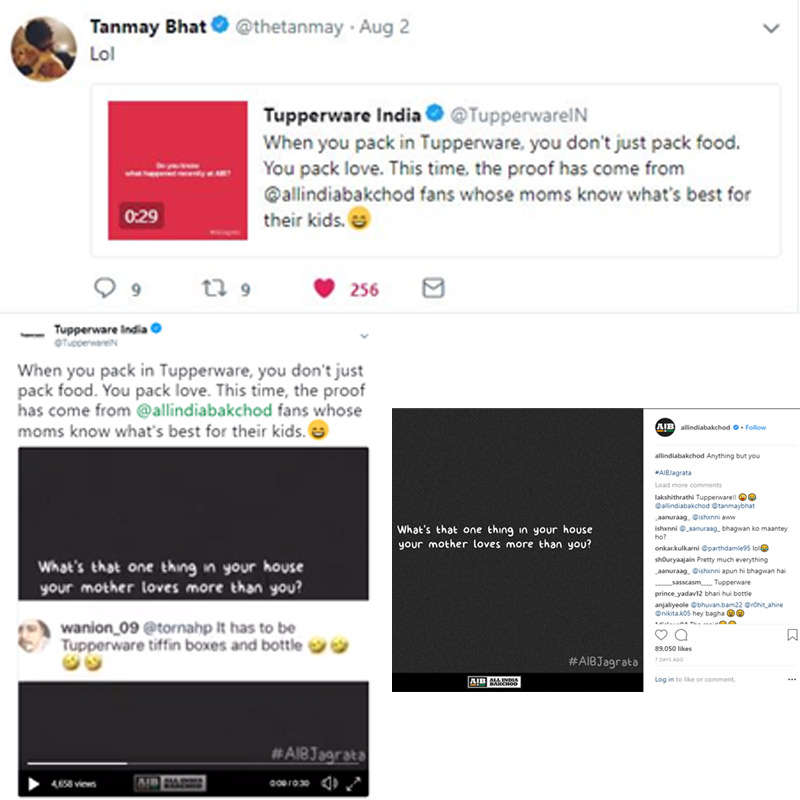
    Recently content creator All India Bakchod (AIB) had a post on Instagram which created a buzz. AIB asks its followers a random question under #AIBJagraata. This time, the question was “What’s that one thing in your house that your mother loves more than you?”

    The replies naturally included Tupperware given the strong market positioning of the kitchen accessory brand. But, Tupperware India (with its end-to-end marketing managed by Pulp Strategy) left no stone unturned to tap into this now-prevailing opportunity. The agency’s social media listening team proactively participated in the ongoing discussion and further amplified the overall engagement by taking it off to its own Facebook, Twitter, and Instagram handles.

    Pulp Strategy founder and managing director Ambika Sharma said, “At Pulp Strategy, we do not merely create opportunities, but also ensure that we tap into every single one that surfaces anytime, anywhere. This all-embracive approach is what has helped us in staying ahead of the curve always. I’m proud that the team at Pulp Strategy has yet again upheld that culture.”

    Within 24 hours, Tupperware India reached out to more than 25,000 people on Facebook and 1,686 people on Instagram, and all of that, without spending a single penny. The whole activity also caught the attention of Tanmay Bhat, the co-founder of AIB, who retweeted the Tupperware India post.

    This year, the marketing agency had also conceptualised and executed the #PressForConfidence campaign for Tupperware around International Women’s Day. The innovative campaign effectively used Facebook’s newly-released ‘press and hold’ feature to create an interactive content series and received massive participation on the social media platform.

  • DoT seeks views on blocking mobile apps like FB, WhatsApp

    DoT seeks views on blocking mobile apps like FB, WhatsApp

    NEW DELHI: India’s telecom department has sought views of the stakeholders on technical measures that can be adopted for blocking mobile apps like Instagram, Facebook, WhatsApp and Telegram. The proposal has been questioned and criticised by a large section of the industry and civil society, including chamber of commerce Assocham.

    The Department of Telecom (DoT) on 18 July, 2018 had written to all telecom operators, the Internet Service Providers Association of India (ISPAI), industry body Cellular Operators Association of India (COAI) and others and asked for their inputs to block applications under Section 69A of the Information technology Act. Stated aim: to uphold national security and public order.

    “DoT in the letter had said that the Ministry of Electronics and IT and law enforcement agencies have raised issue around blocking of certain mobile apps like Instagram, Facebook, WhatsApp, Telecom, etc. to meet requirement under Section 69A of IT Act,” PTI quoted an unnamed government source aware of the development.

    However, a source at DoT, on condition of anonymity, told the wire news service there was no such move to block any app and the telecom department had only started a consultation process based on a reference from the Ministry of Electronics and Information technology (Meity).

    Though PTI filed a news report on the development yesterday in the second half, the story was actually broken by online news portal medianama.com, which said it had reviewed the letter.

    The Section 69A of IT Act talks about power to issue directions for blocking for public access to any information through any computer resource. The law authorises the federal government or any officer authorised by it to issue direction to block the information on Internet in the interest of sovereignty and integrity of India, defence of India, security of the state, friendly relations with foreign states or public order or for preventing incitement to the commission of any cognisable offence relating to them.

    “Meity (Ministry of Electronics and IT) has informed DoT that blocking such apps during emergency situations are difficult as they work through multiple IP addresses and on different protocols, and, hence, there is a need for a reasonable good solution to protect national security. Being the licensing authority, DoT has initiated the discussion based on a letter received from the Group Coordinator, Cyber Law Division (Meity) during the second week of July,” a DoT official told PTI.

    In response to DoT consultation, industry body Assocham said that a proposed measure to evolve mechanisms to block applications as a whole at the telecom operator level is excessive, unnecessary, and would greatly harm India’s reputation as growing hub of innovation in technology as the country needed a “clear and predictable legal framework grounded on fairness, proportionality and the rule of law”.

    Assocham said that with the development in technology, there have emerged tools such as virtual private network, which enables users to access content that may have been blocked at telecom service provider (TSP) or internet service provider (ISP) level.

    “In this scenario, blocking of applications at the TSP/ISP level may not be an efficacious solution as users can get around the same with increasing ease. Therefore, the focus on developing mechanism to block content may be unwarranted,” Assocham said in a letter to the top-most government official at DoT, which was also sent to other senior civil servants.

    Assocham has buttressed its arguments against blocking of mobile apps by stating that online apps contribute substantially to India’s digital economy. Overall the Internet eco-system is expected to contribute up to $ 537.4 billion to overall India’s GDP of which a minimum of $ 270.9 billion could be attributed to apps, Assocham has pointed out quoting market research

    Recently, there have been widespread incidents of mob lynching in the country based on rumours spread through social media apps. The popular messaging app WhatsApp has been in the eye of storm over abuse of its platform for circulation of fake news that resulted in incitement of mob fury.

    An IT ministry official, who did not wish to be named, said WhatsApp has not committed itself on “traceability” and attribution of messages, which had been one of the key demands of the government. Hence, the ministry’s concerns have not been addressed and the potential for misuse still remains, the source was quoted by PTI.
    Last month, the government had expressed dissatisfaction over measures previously listed by WhatsApp for checking fake news that have, in several cases, triggered mob violence. WhatsApp told the government it was building a local team, including India head, as part of steps to check fake news circulation.

    Over the last one year, the Indian government has been exploring various avenues to regulate online media content, some of them botched at the initial stage, while some like the setting up of a social media hub to monitor Indians’ digital footprints was scrapped by Ministry of Information and Broadcasting after Supreme Court questioned the proposal stating whether it could lead to a surveillance state. However, a government body still exists that has the mandate to look into online media norms.

  • WhatsApp adds multi-calling feature

    WhatsApp adds multi-calling feature

    MUMBAI: WhatsApp has finally launched multi-calling feature for both voice and video calls. It is being rolled out to Android and iOS users globally. Facebook confirmed the group video calling feature at its annual F8 conference. 

    Once a call gets connected, a new ‘add participant’ icon at the top right corner of the call screen can be clicked to add more participants from the contact list. The icon gets disabled after a third participant is added. Calls can have up to four participants including the person who started the call.

    Earlier WhatsApp had to face criticism for issues related to fake news and disinformation that has been rampant on the platform in the last couple of months. It added a new feature in July which puts a limit to the number of messages forwarded by a user.

    Any message that is forwarded without editing will display the word ‘forwarded’ and it also restricted sending such messages to more than five contacts at a time.

    The Facebook-owned service has come under harsh criticism from even the government of India regarding several of its features.